Explore the world of crystalline states, symmetry in nature, arts, and industry, with a focus on basic symmetry concepts and crystallography in two and three dimensions. Discover the significance of symbols, conventions, transformations of indices, and various two-dimensional lattice systems in crystallography.
Please find below an Image/Link to download the presentation.
The content on the website is provided AS IS for your information and personal use only. It may not be sold, licensed, or shared on other websites without obtaining consent from the author. If you encounter any issues during the download, it is possible that the publisher has removed the file from their server.
You are allowed to download the files provided on this website for personal or commercial use, subject to the condition that they are used lawfully. All files are the property of their respective owners.
The content on the website is provided AS IS for your information and personal use only. It may not be sold, licensed, or shared on other websites without obtaining consent from the author.
E N D
Presentation Transcript
Crystalline state Symmetry in nature Symmetry in arts and industry Description of symmetry basic concepts Crystallography of two dimensions Crystallography of three dimensions
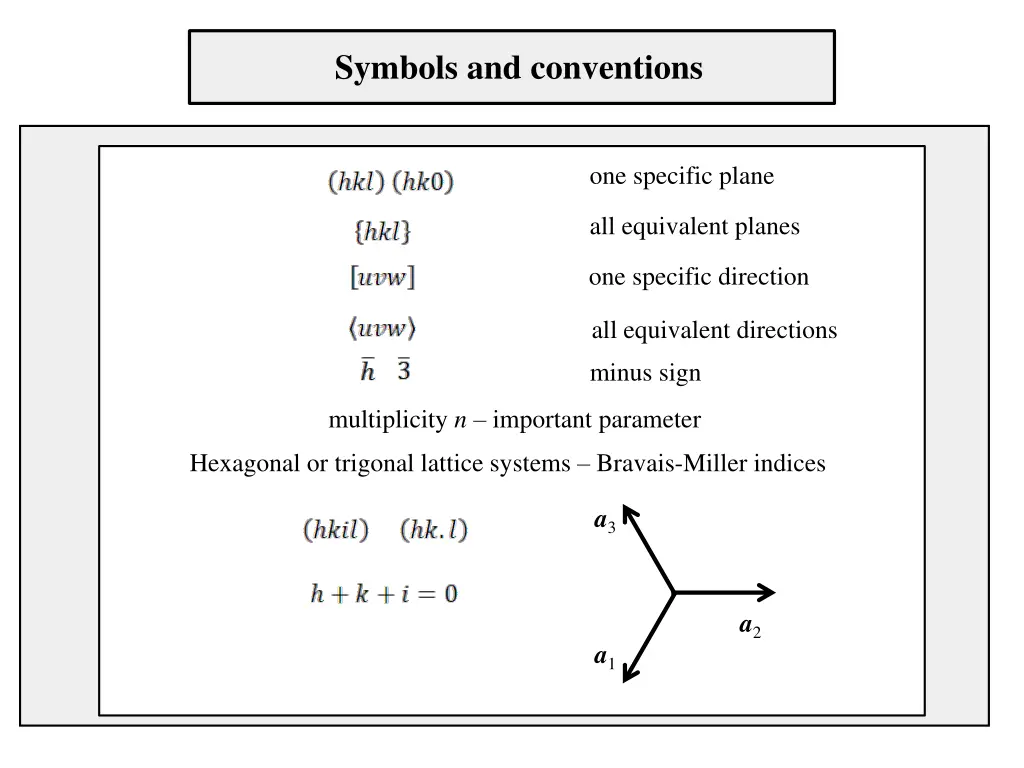
Symbols and conventions one specific plane all equivalent planes one specific direction all equivalent directions minus sign multiplicity n important parameter Hexagonal or trigonal lattice systems Bravais-Miller indices a3 a2 a1
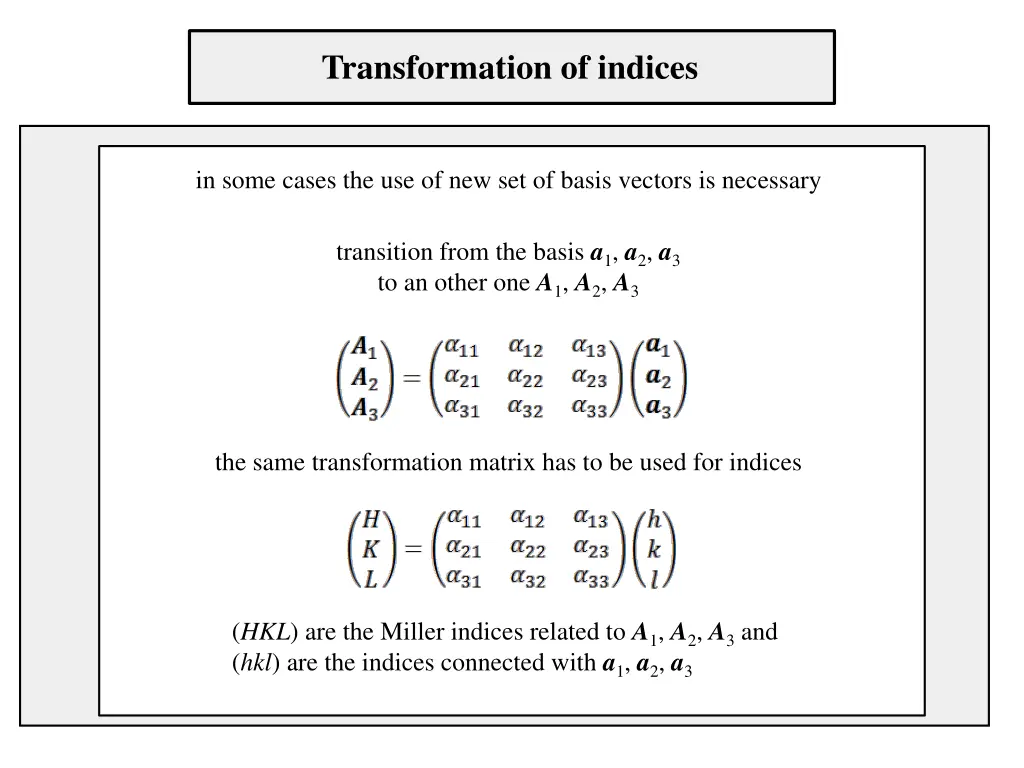
Transformation of indices in some cases the use of new set of basis vectors is necessary transition from the basis a1, a2, a3 to an other one A1, A2, A3 the same transformation matrix has to be used for indices (HKL) are the Miller indices related to A1, A2, A3and (hkl) are the indices connected with a1, a2, a3
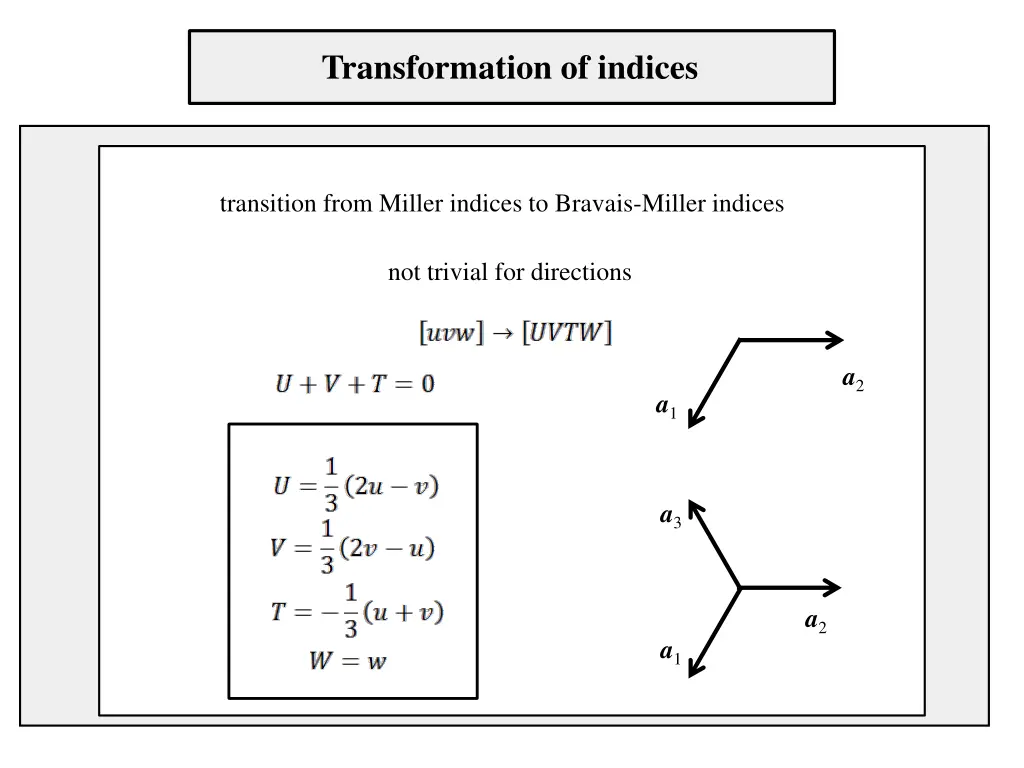
Transformation of indices transition from Miller indices to Bravais-Miller indices not trivial for directions a2 a1 a3 a2 a1
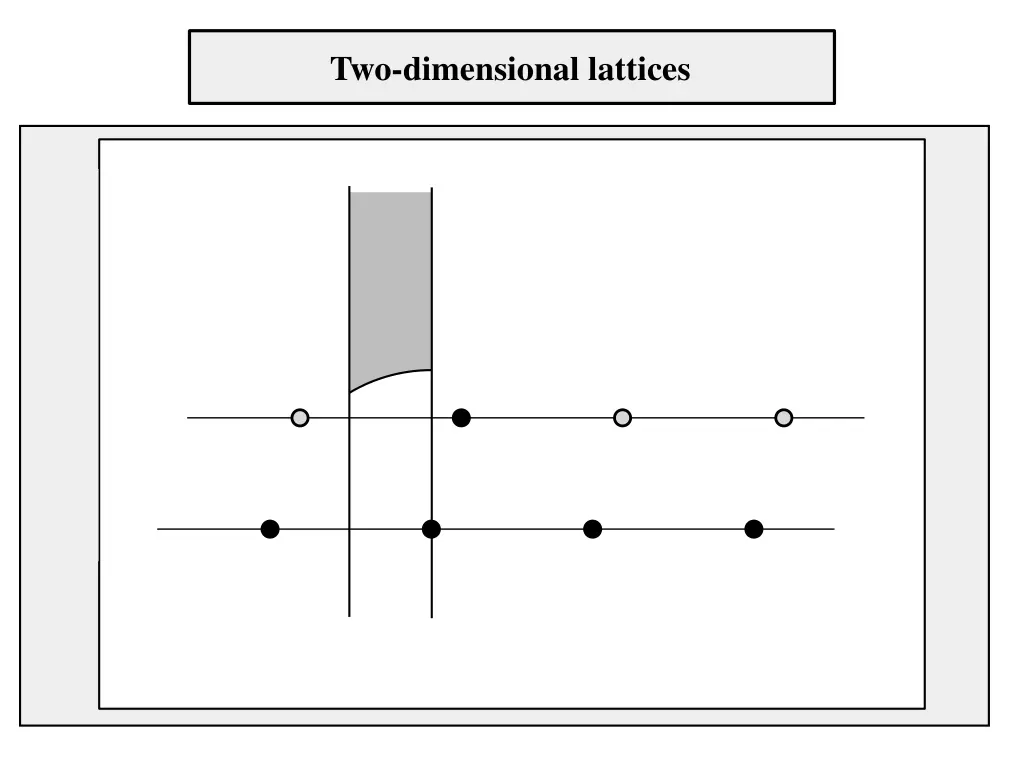
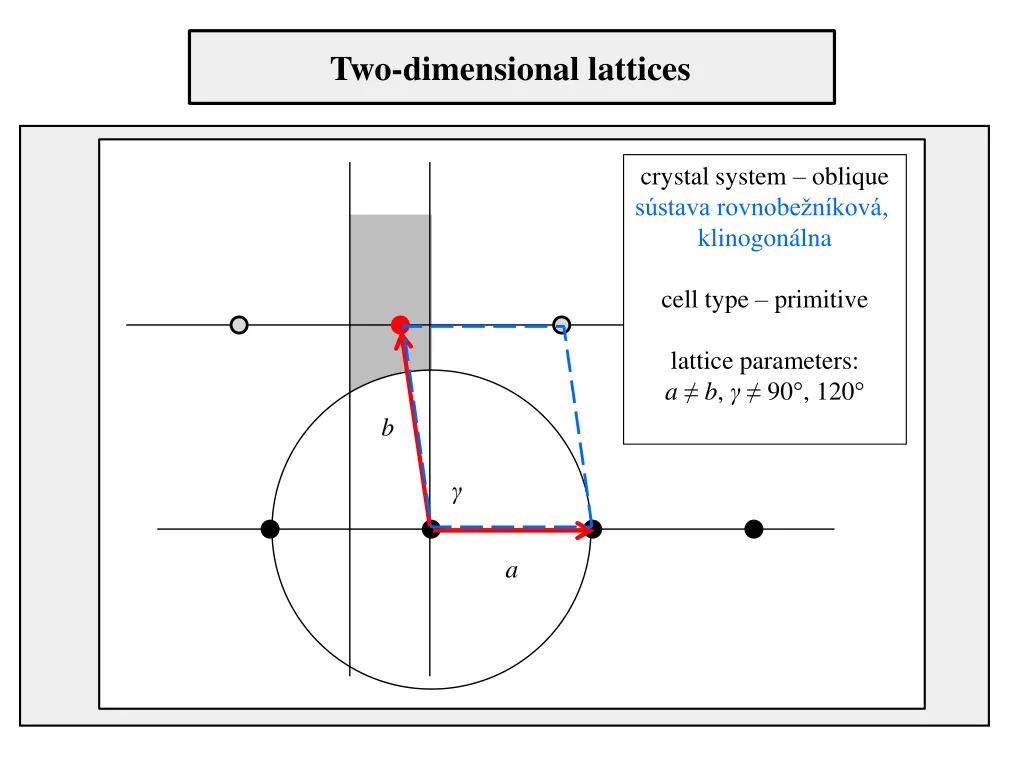
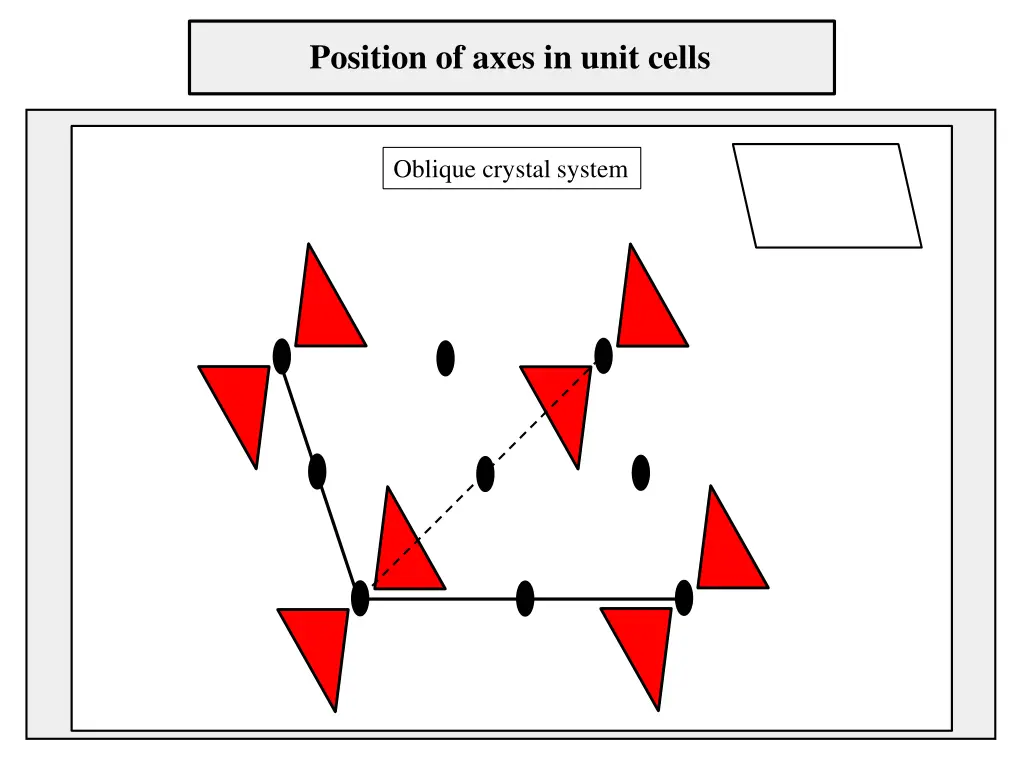
Two-dimensional lattices crystal system oblique s stava rovnobe n kov , klinogon lna cell type primitive lattice parameters: a b, 90 , 120 b a
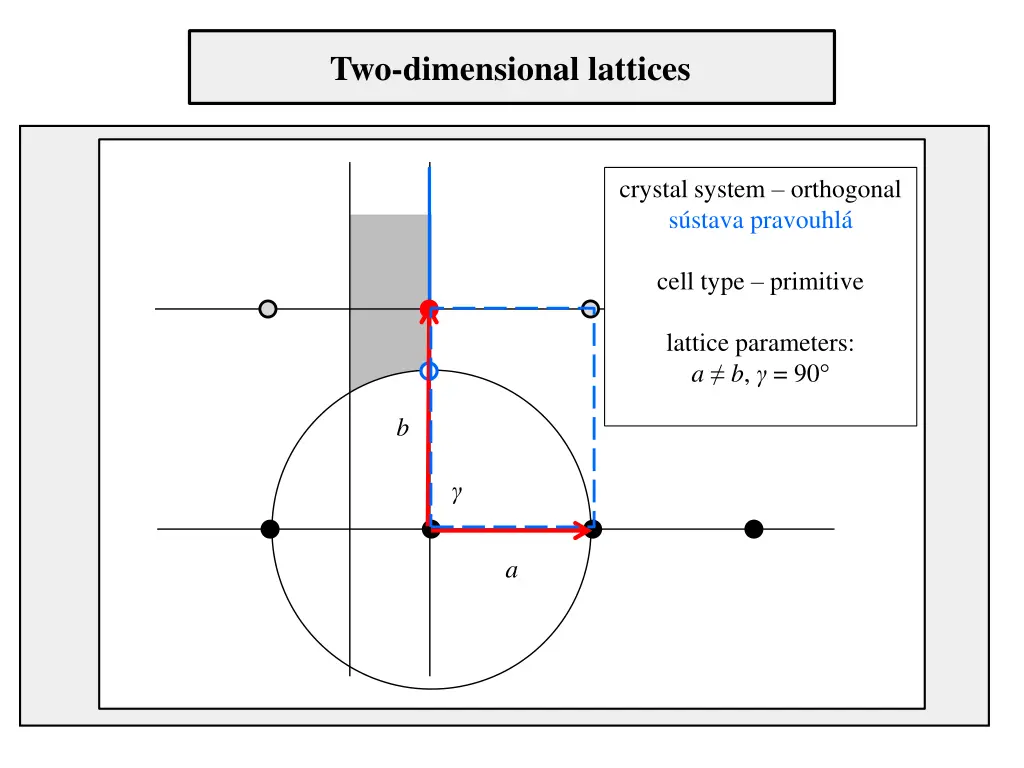
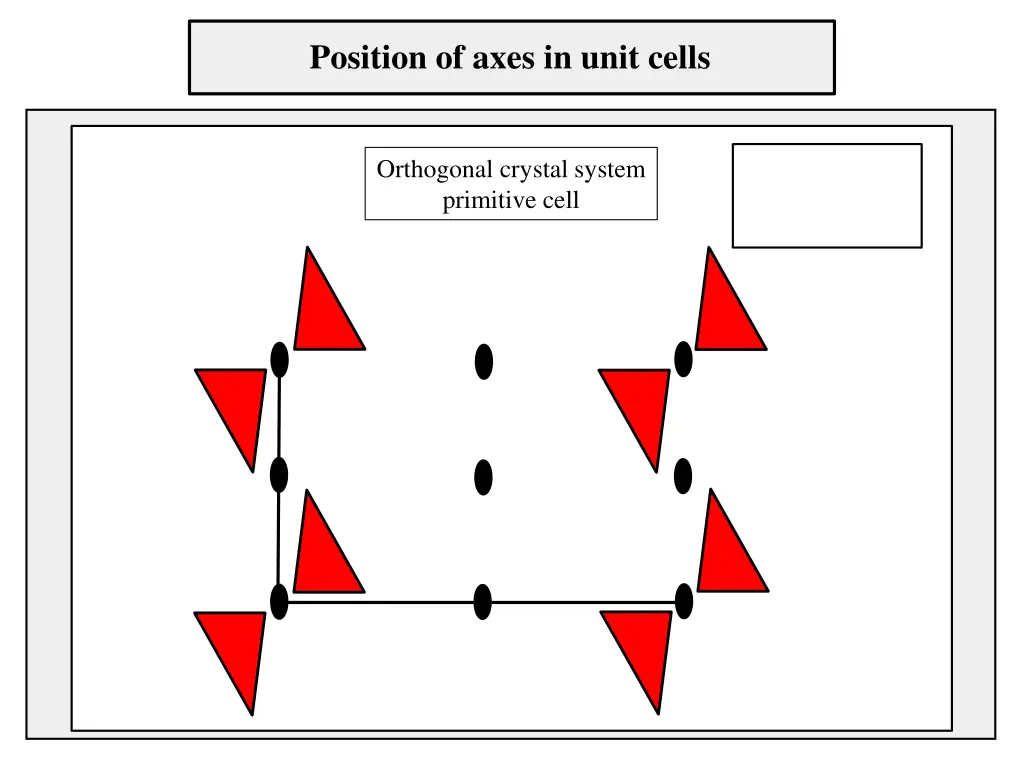
Two-dimensional lattices crystal system orthogonal s stava pravouhl cell type primitive lattice parameters: a b, = 90 b a
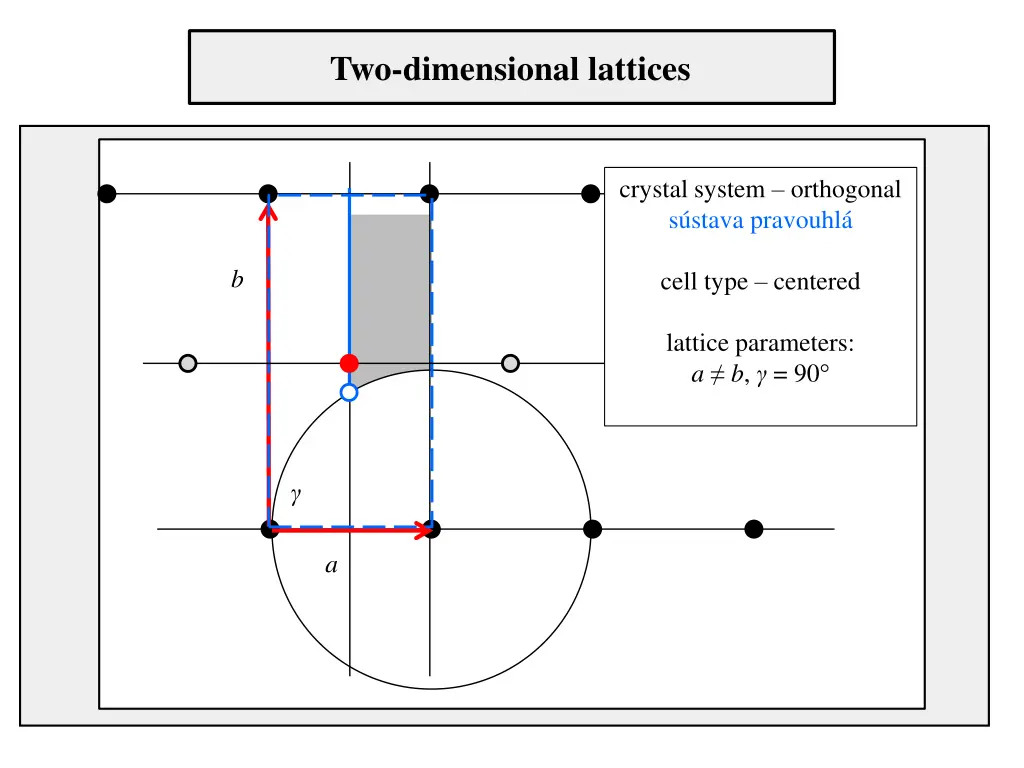
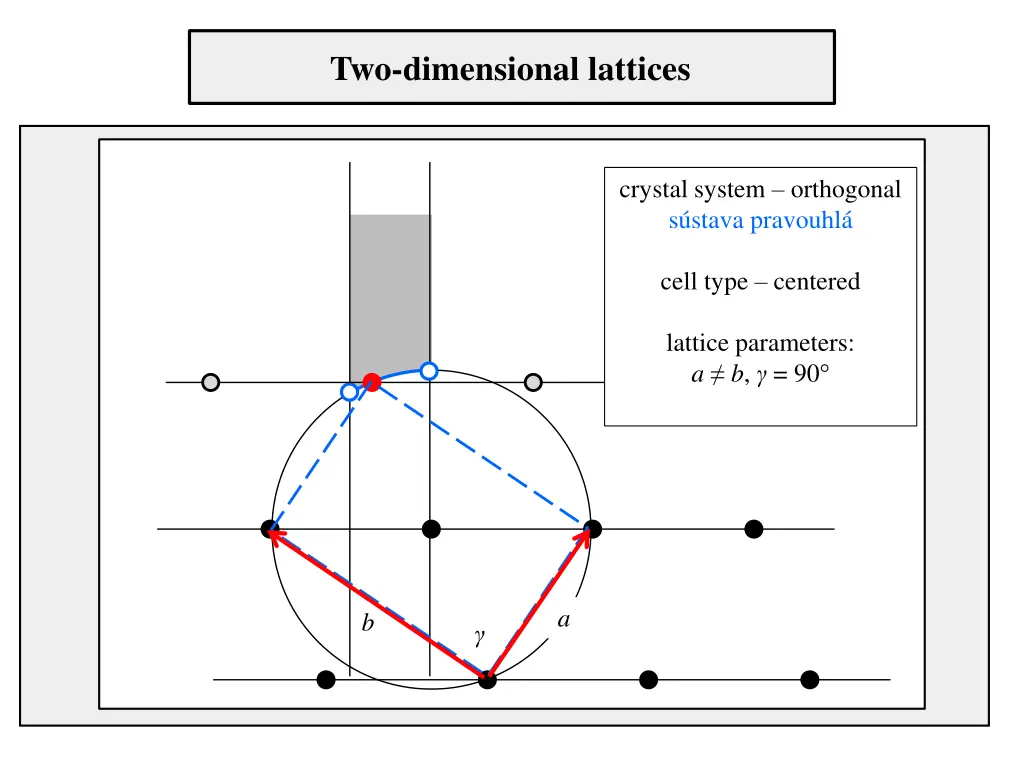
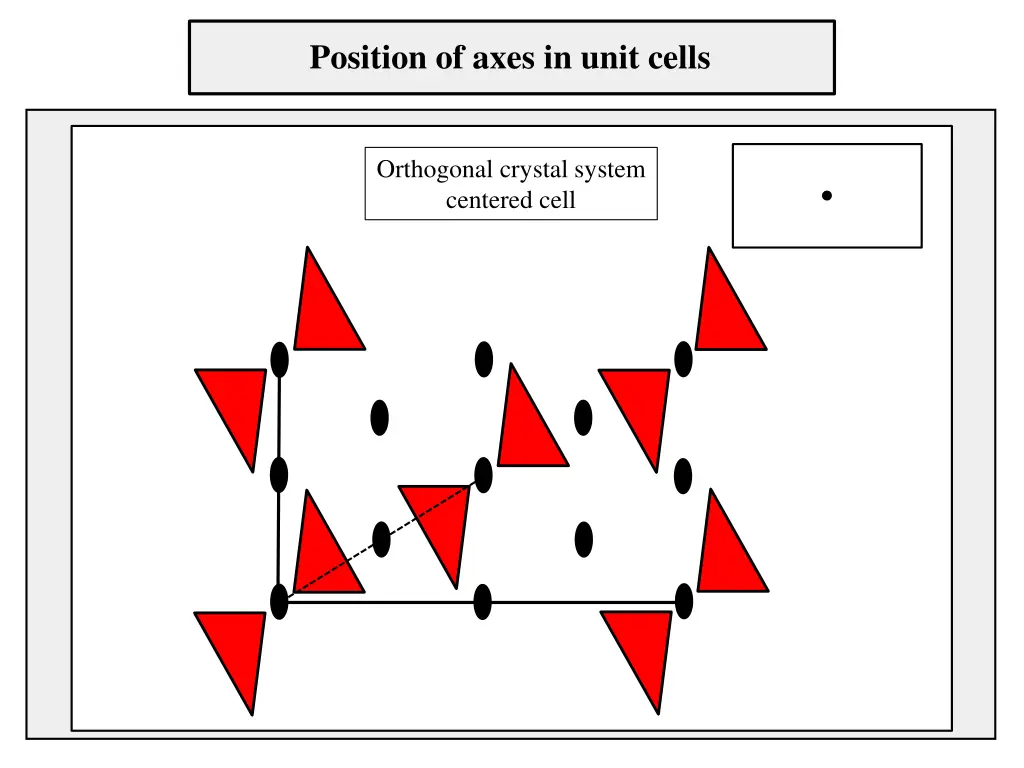
Two-dimensional lattices crystal system orthogonal s stava pravouhl cell type centered b lattice parameters: a b, = 90 a
Two-dimensional lattices crystal system orthogonal s stava pravouhl cell type centered lattice parameters: a b, = 90 a b
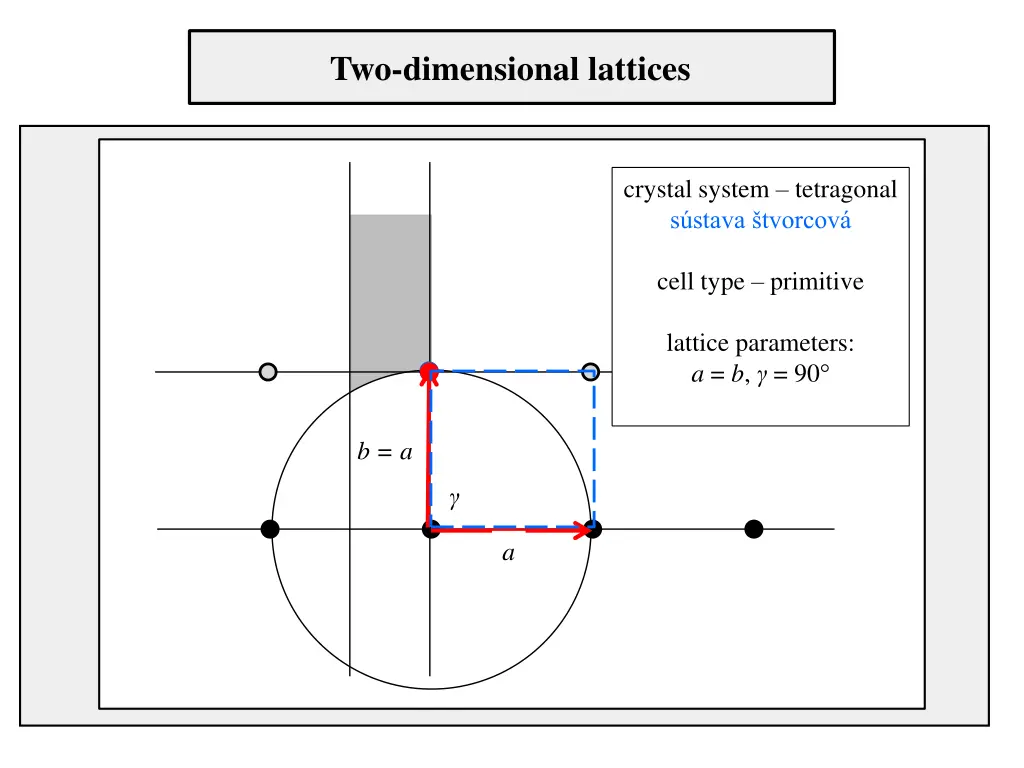
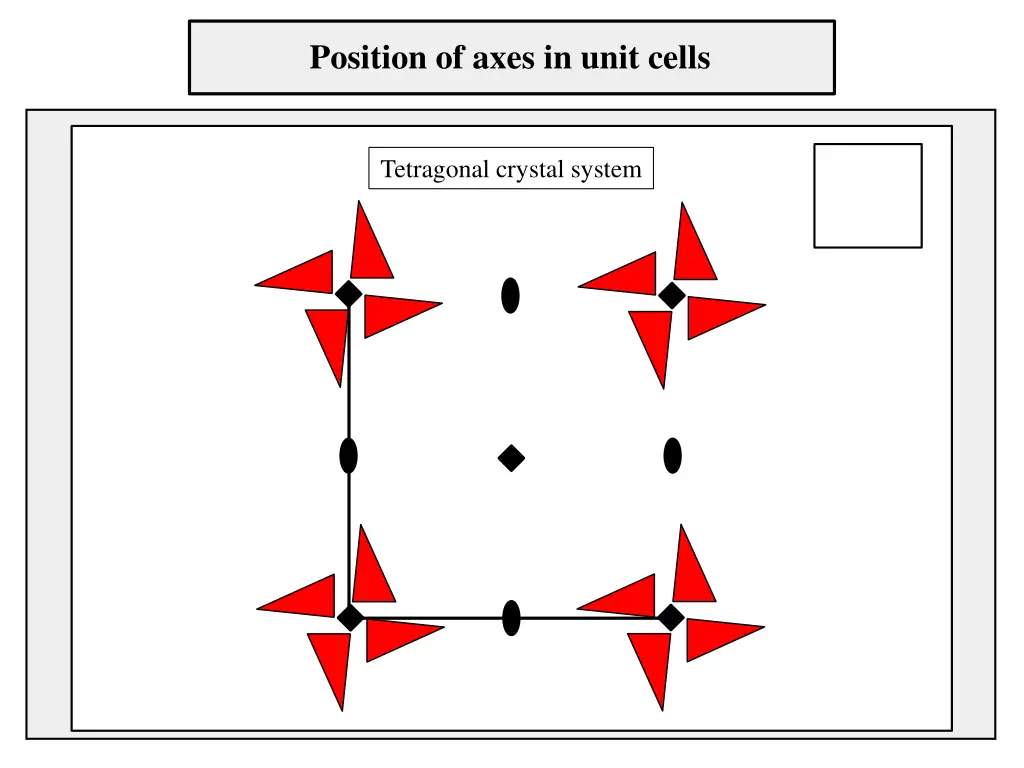
Two-dimensional lattices crystal system tetragonal s stava tvorcov cell type primitive lattice parameters: a = b, = 90 b = a a
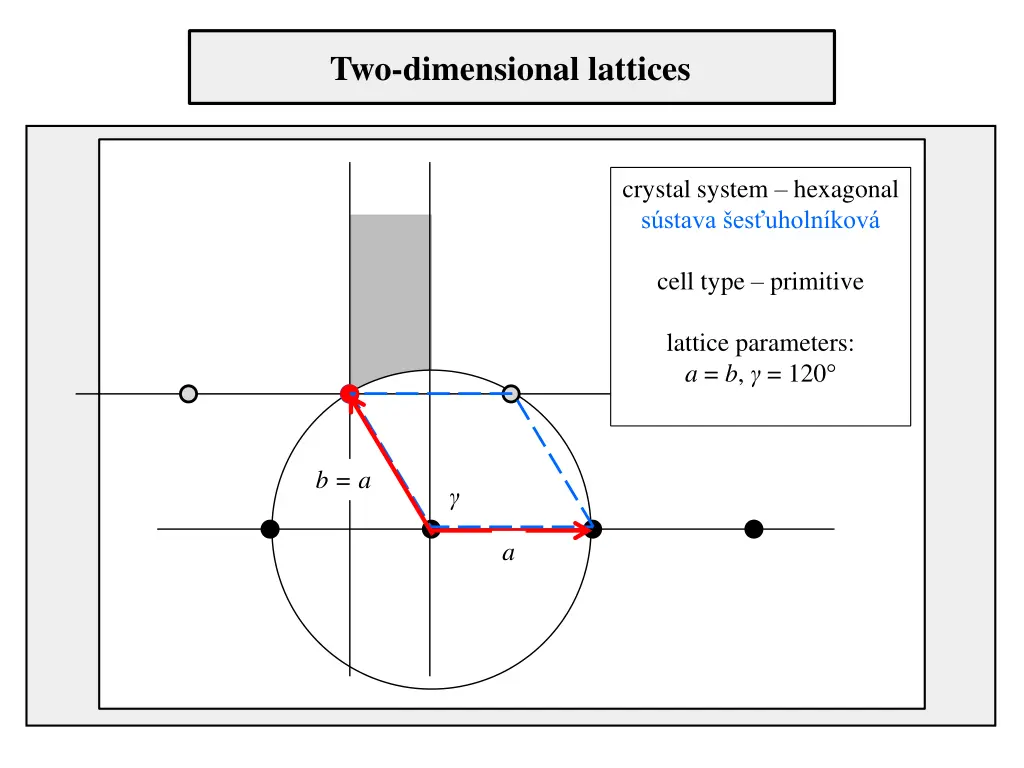
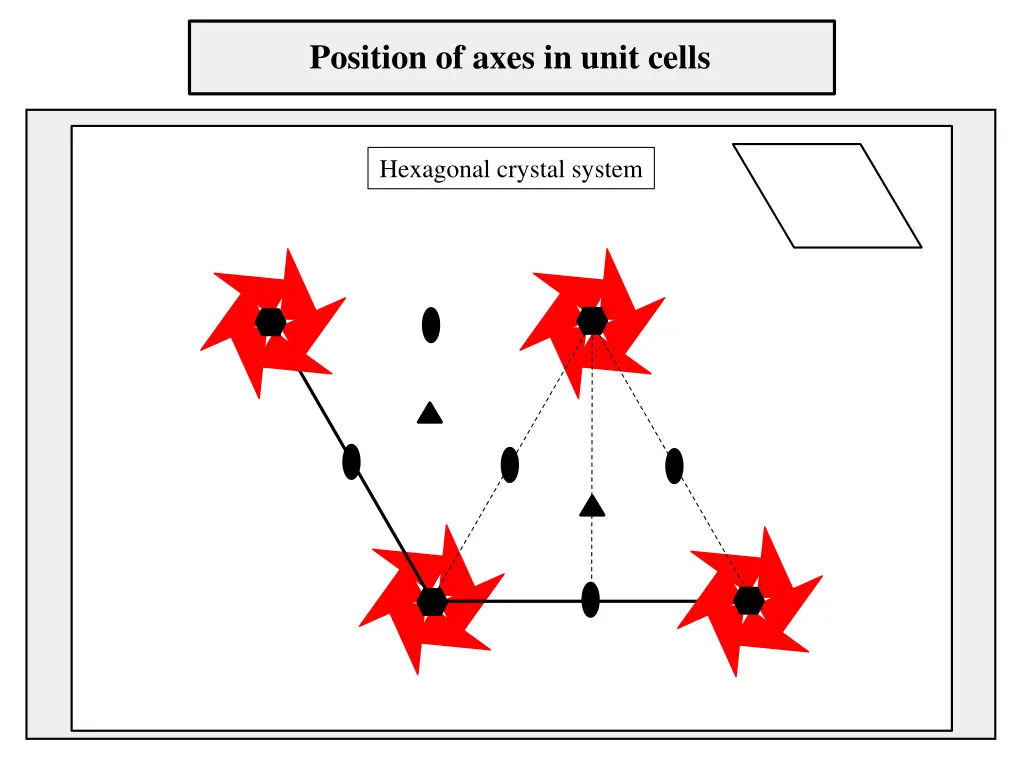
Two-dimensional lattices crystal system hexagonal s stava es uholn kov cell type primitive lattice parameters: a = b, = 120 b = a a
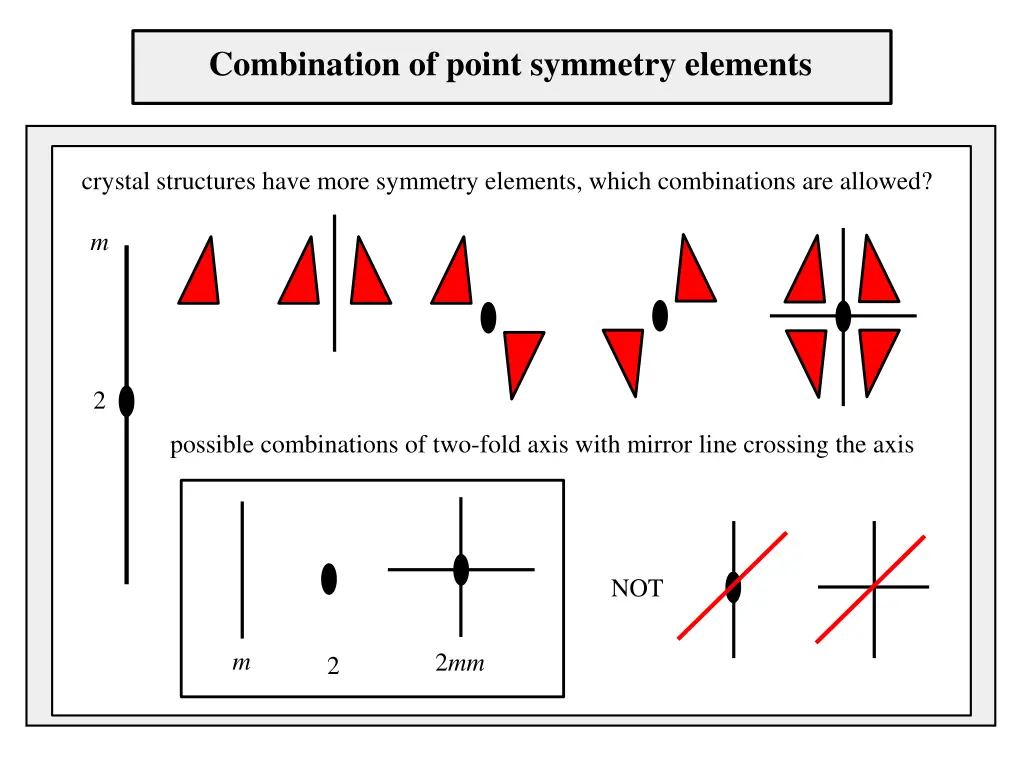
Combination of point symmetry elements crystal structures have more symmetry elements, which combinations are allowed? m 2 possible combinations of two-fold axis with mirror line crossing the axis NOT m 2mm 2
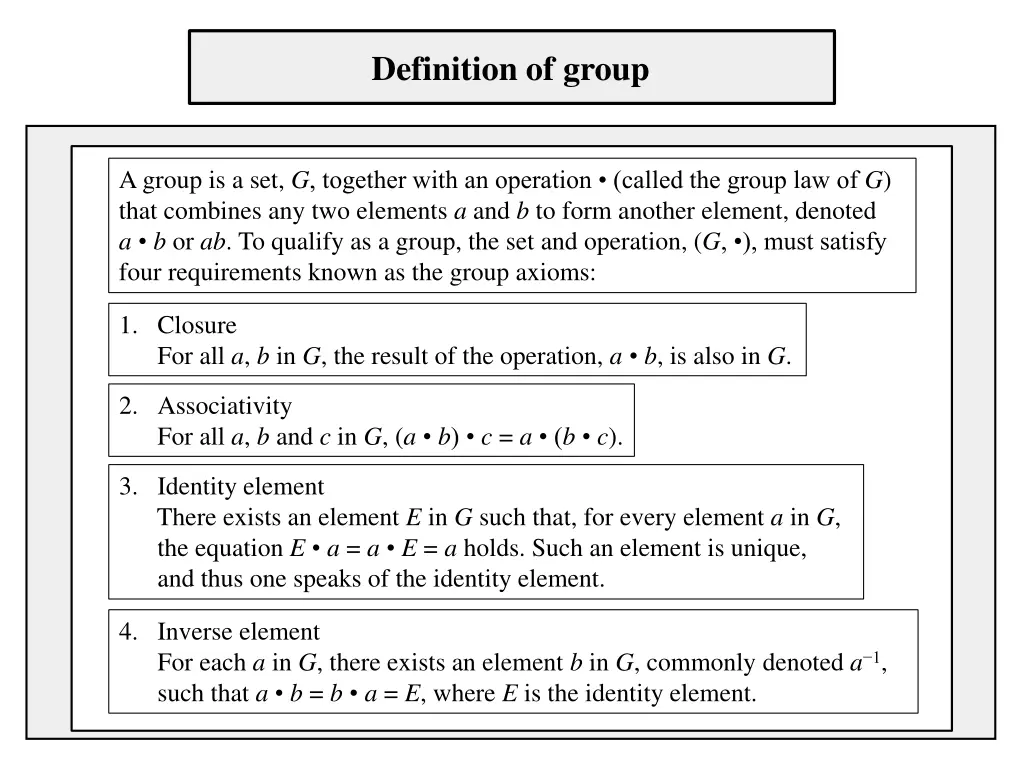
Definition of group A group is a set, G, together with an operation (called the group law of G) that combines any two elements a and b to form another element, denoted a b or ab. To qualify as a group, the set and operation, (G, ), must satisfy four requirements known as the group axioms: 1. Closure For all a, b in G, the result of the operation, a b, is also in G. 2. Associativity For all a, b and c in G, (a b) c = a (b c). 3. Identity element There exists an element E in G such that, for every element a in G, the equation E a = a E = a holds. Such an element is unique, and thus one speaks of the identity element. 4. Inverse element For each a in G, there exists an element b in G, commonly denoted a 1, such that a b = b a = E, where E is the identity element.
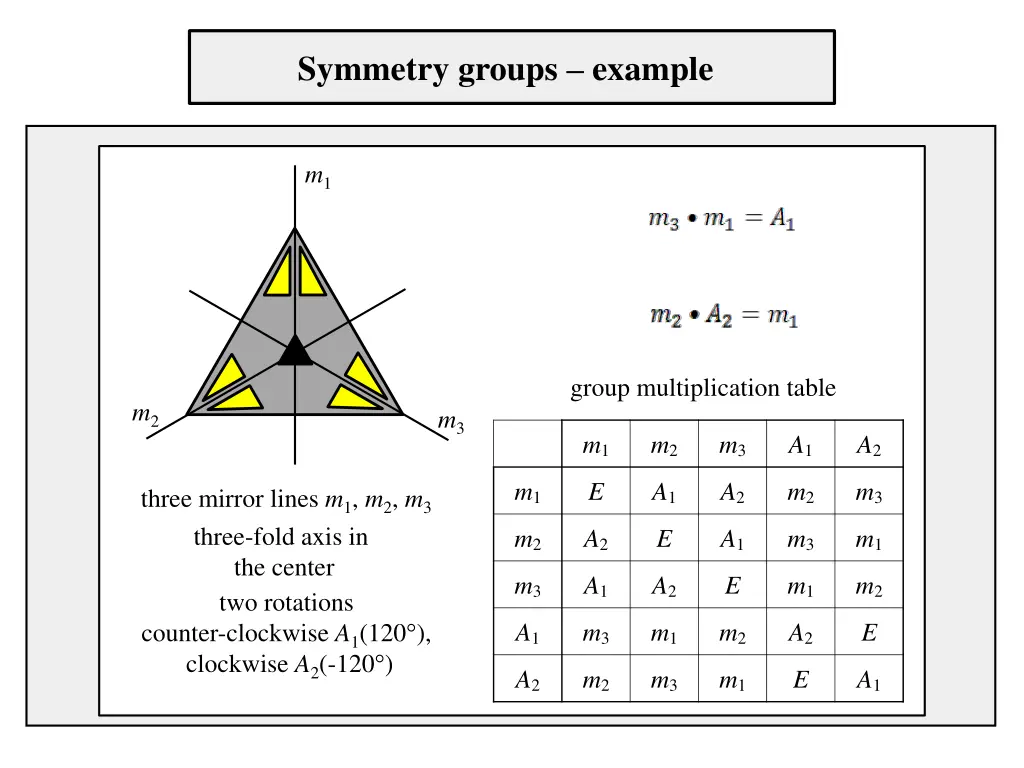
Symmetry groups example m1 group multiplication table m2 m3 m1 m2 m3 A1 A2 m1 E A1 A2 m2 m3 three mirror lines m1, m2, m3 three-fold axis in the center m2 A2 E A1 m3 m1 m3 A1 A2 E m1 m2 two rotations A1 m3 m1 m2 A2 E counter-clockwise A1(120 ), clockwise A2(-120 ) A2 m2 m3 m1 E A1
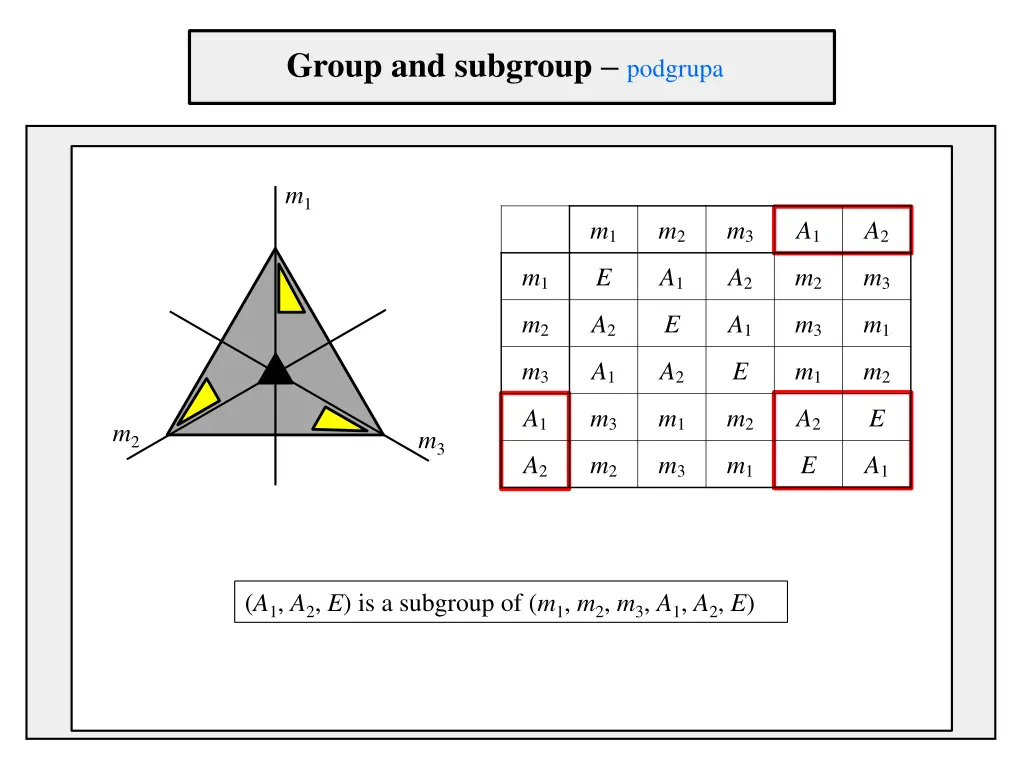
Group and subgroup podgrupa m1 m1 m2 m3 A1 A2 m1 E A1 A2 m2 m3 m2 A2 E A1 m3 m1 m3 A1 A2 E m1 m2 A1 m3 m1 m2 A2 E m2 m3 A2 m2 m3 m1 E A1 (A1, A2, E) is a subgroup of (m1, m2, m3, A1, A2, E)
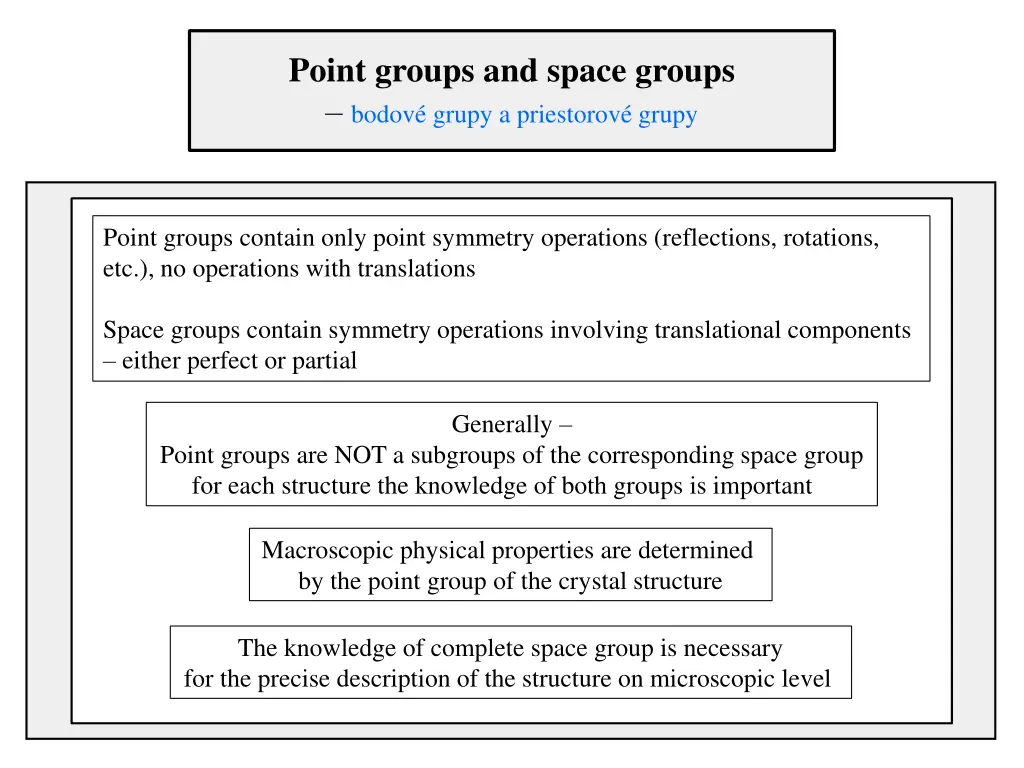
Point groups and space groups bodov grupy a priestorov grupy Point groups contain only point symmetry operations (reflections, rotations, etc.), no operations with translations Space groups contain symmetry operations involving translational components either perfect or partial Generally Point groups are NOT a subgroups of the corresponding space group for each structure the knowledge of both groups is important Macroscopic physical properties are determined by the point group of the crystal structure The knowledge of complete space group is necessary for the precise description of the structure on microscopic level
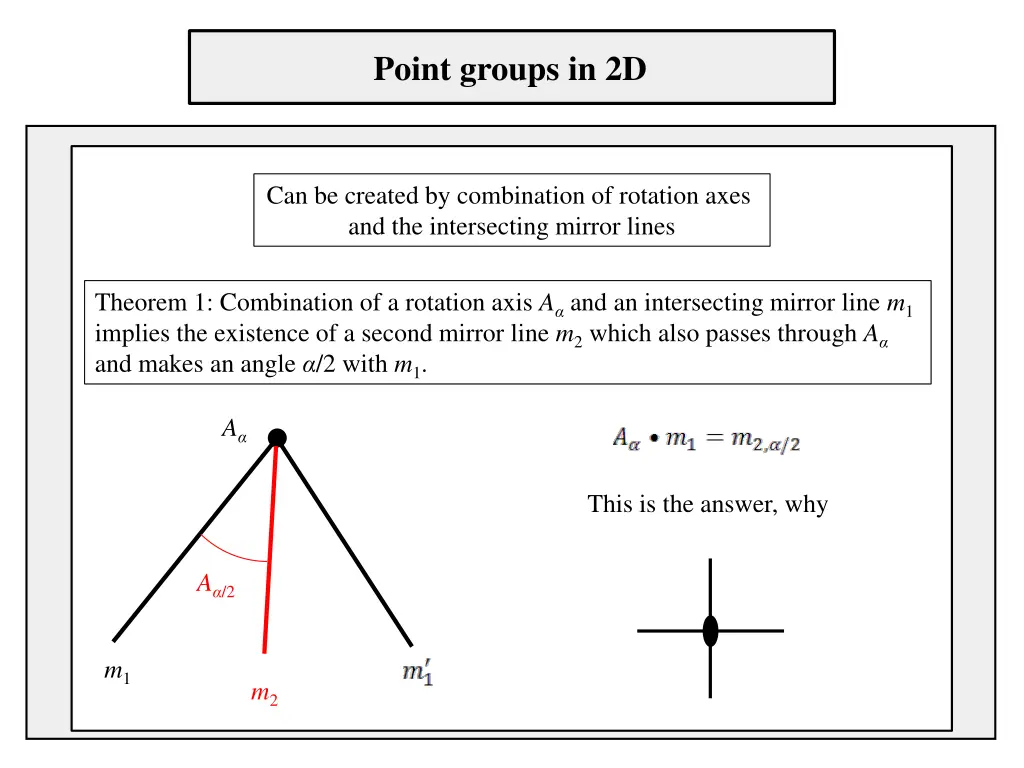
Point groups in 2D Can be created by combination of rotation axes and the intersecting mirror lines Theorem 1: Combination of a rotation axis A and an intersecting mirror line m1 implies the existence of a second mirror line m2which also passes through A and makes an angle /2 with m1. A This is the answer, why A /2 m1 m2
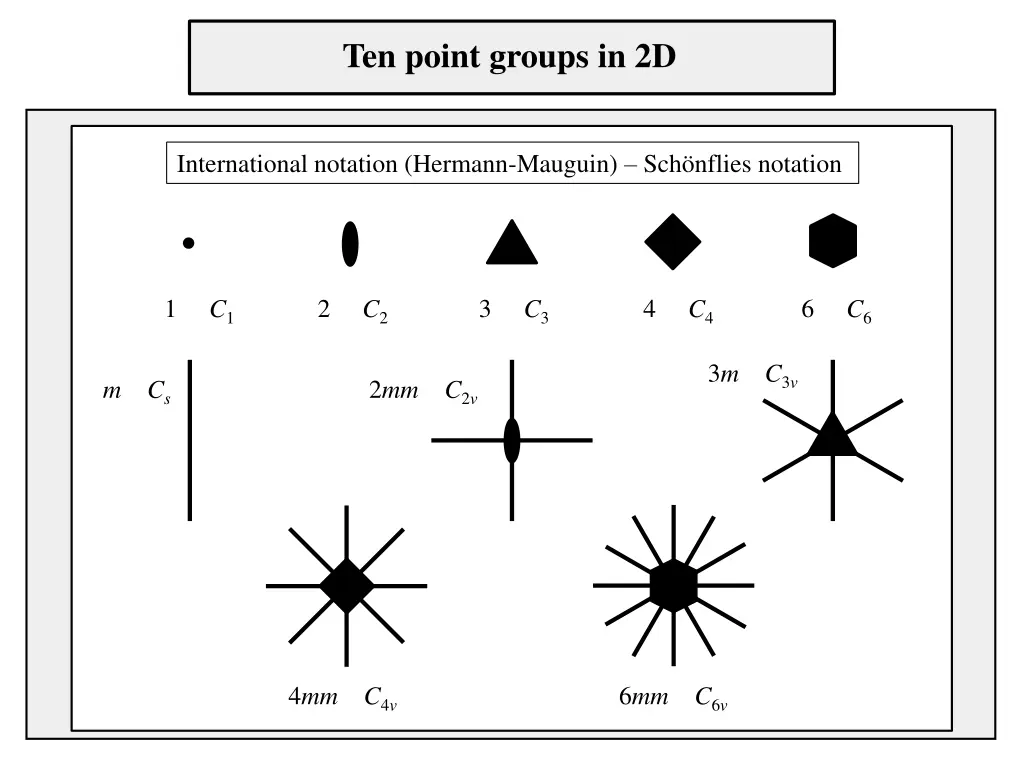
Ten point groups in 2D International notation (Hermann-Mauguin) Sch nflies notation 1 C1 2 C2 3 C3 4 C4 6 C6 3m C3v 2mm C2v m Cs 4mm C4v 6mm C6v
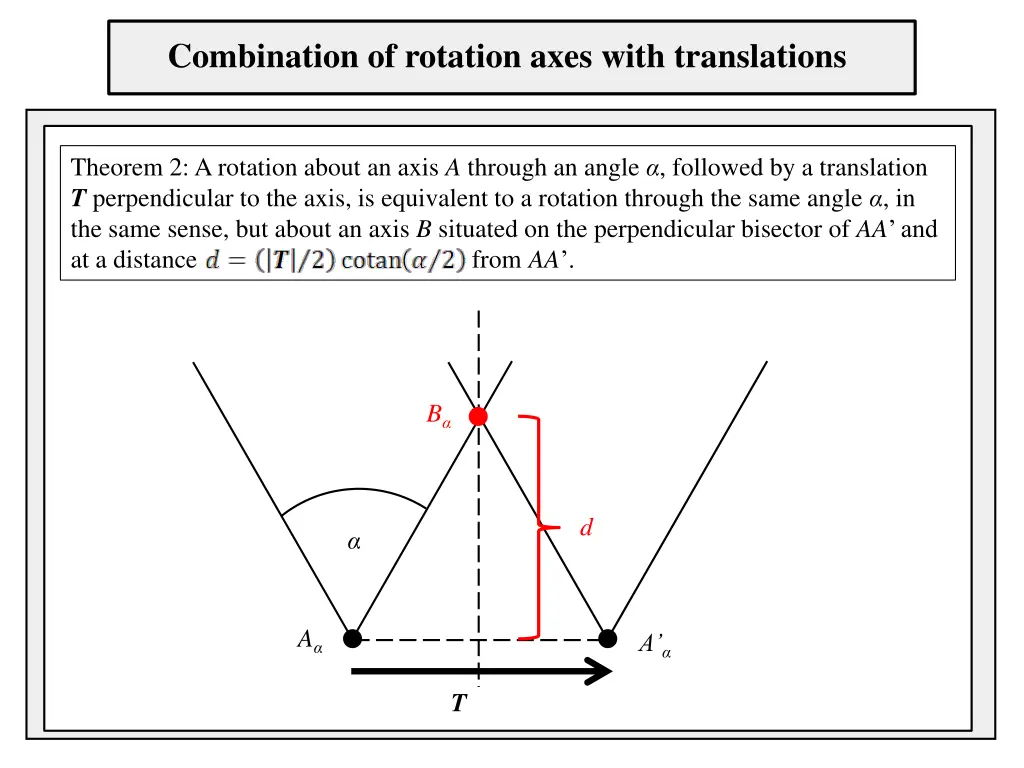
Combination of rotation axes with translations Theorem 2: A rotation about an axis A through an angle , followed by a translation T perpendicular to the axis, is equivalent to a rotation through the same angle , in the same sense, but about an axis B situated on the perpendicular bisector of AA and at a distance from AA . B d A A T