Understanding Daniel Chapter 5: Historical Context and Revelations
Explore the historical context of Daniel Chapter 5, focusing on King Belshazzar's banquet, the reign of Nabonidus, and the interactions with Nebuchadnezzar. Discover the significance of the feast and the lessons it holds. Dive into the implications of the Most High God's sovereignty over kingdoms and its relevance today.

Download Presentation

Please find below an Image/Link to download the presentation.
The content on the website is provided AS IS for your information and personal use only. It may not be sold, licensed, or shared on other websites without obtaining consent from the author. If you encounter any issues during the download, it is possible that the publisher has removed the file from their server.
You are allowed to download the files provided on this website for personal or commercial use, subject to the condition that they are used lawfully. All files are the property of their respective owners.
The content on the website is provided AS IS for your information and personal use only. It may not be sold, licensed, or shared on other websites without obtaining consent from the author.
E N D
Presentation Transcript
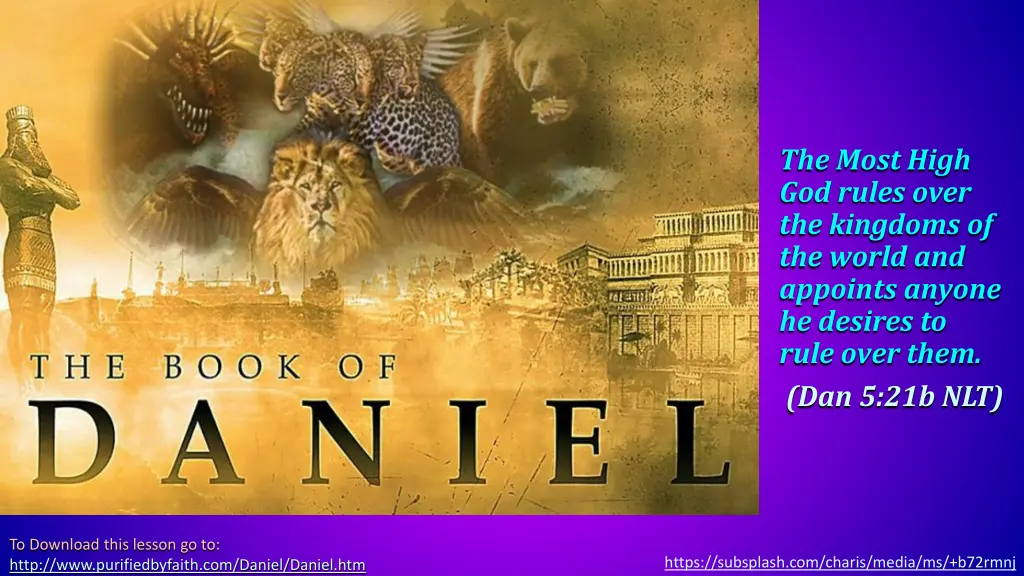
The Most High God rules over the kingdoms of the world and appoints anyone he desires to rule over them. (Dan 5:21b NLT) To Download this lesson go to: http://www.purifiedbyfaith.com/Daniel/Daniel.htm https://subsplash.com/charis/media/ms/+b72rmnj
The Feast (5:1-4) 5:1 King Belshazzar gave a great banquet for a thousand of his nobles and drank wine with them. 2 While Belshazzar was drinking his wine, he gave orders to bring in the gold and silver goblets that Nebuchadnezzar his father had taken from the temple in Jerusalem, so that the king and his nobles, his wives and his concubines might drink from them. 3 So they brought in the gold goblets that had been taken from the temple of God in Jerusalem, and the king and his nobles, his wives and his concubines drank from them. 4 As they drank the wine, they praised the gods of gold and silver, of bronze, iron, wood and stone. (NIV)
Historical Context of Daniel Chapter 5 There is a bit of a historical gap between the end of chapter 4 and the beginning of chapter 5. 1 Nebuchadnezzar died in 562 BC, and three kings succeeded him before Nabonidus took the throne in 556 BC. 1 Nabonidus was Babylon s final king, serving until 539 BC, when Persia conquered Babylon. 1 Until the last half of the nineteenth century the name Belshazzar was never mentioned in any known historical documents except for the Book of Daniel and works dependent upon it, such as Baruch and Josephus s writings. 2 From the extra-biblical historical sources that they had at that time, Nabonidus was known to have been the last king of Babylon, and some commentators went so far as to declare that Belshazzar was a fictional character invented by Daniel! 2 Since that time, an abundance of evidence has come to light that demonstrates not only that Belshazzar did live but that he was both the sonof and coregent with Nabonidus. 2 1 House, Paul R.; Daniel (Tyndale Old Testament Commentaries); (p. 104) 2 Miller, Stephen R., Daniel, vol. 18, The New American Commentary (pp. 147 150)
Historical Context of Daniel Chapter 5 Belshazzar s father, Nabonidus, lived about five hundred miles south of Babylon for most of his seventeen-year reign, apparently for religious reasons. During these long absences, it was Belshazzar, the crown prince, who ruled the empire. Although Daniel was awareof Nabonidus (as evidenced by the phrase the third highest ruler in the kingdom in 5:7, 16, 29), he doesn t mention him by name because he played no part in the events described, and, for all practical purposes, Belshazzar was the only king the people served. Nebuchadnezzaris called Belshazzar s father six times (vv. 2, 11 [three times], 13, 18), and Belshazzar is designated as the son of Nebuchadnezzar once (v. 22). In light of the relationship of Belshazzar to Nabonidus, how may these statements be accounted for? Numerous suggestions have been offered to explain the specific father-son relationship between Nebuchadnezzar and Belshazzar noted in this chapter. Miller, Stephen R., Daniel, vol. 18, The New American Commentary (pp. 147 150)
Historical Context of Daniel Chapter 5 The terms father and son have a wide range of meanings in Semitic languages. The term father may refer to one s immediate father, grandfather, ancestor, or in the case of kings, a predecessor. Likewise, son may mean one s immediate offspring, grandson, descendant, or successor. For example, Jesus was called the son of David (e.g., Matt 1:1; 9:27; 12:23; 20:30 31; 21:9; etc.), although David was not Christ s immediate parent but an ancestor. Commentaries have suggested a number of possible scenarios to explain the terminology used in the book of Daniel given what we think we know about Nebuchadnezzar, Nabonidus, and Belshazzar. We do not currently have enough data to know for sure which, if any, of the suggested scenarios are a description of what actually took place. Miller, Stephen R., Daniel, vol. 18, The New American Commentary (pp. 147 150)
Historical Context of Daniel Chapter 5 For example, one commentary (Leupold) suggests it is entirely possible that Belshazzar was Nebuchadnezzar s actual son, and, when Nebuchadnezzar died, Nabonidus (might have) married Belshazzar s widowed mother (to gain royal standing) and adopted Belshazzar as his son in order to gain an heir for himself. 1 Other commentaries think it s more likely that Nabonidus married a daughter of Nebuchadnezzar and that Belshazzar was their son, thereby making Belshazzar Nebuchadnezzar s grandson. 2 If this were the case, the obvious reason that Belshazzar s relationship with Nebuchadnezzar is stressed (and that of Nabonidus is omitted) is that only Nebuchadnezzar and Belshazzar are germane to the story. 2 Belshazzar should have learned the lesson of humility and submission to Israel s God from the episode in the life of Nebuchadnezzar (not Nabonidus). 2 1 Leupold, H. C.; Exposition of Daniel (1949); (pp. 211 212) 2 Miller, Stephen R., Daniel, vol. 18, The New American Commentary (pp. 147 150)
5:1 King Belshazzar made a great feast for a thousand of his lords and drank wine in front of the thousand. (ESV) Belshazzar hosted a great feast for a thousand of his lords. Large feasts of this kind were not uncommon in ancient times. Two Greek historians, Herodotus and Xenophon, testified that a banquet was in progress on the night Babylon fell. The date would have been October 12, 539 B.C., about thirty years after the events recorded in Daniel chapter 4. King Belshazzar drank wine in front of the thousand Customarily the king was hidden from the sight of his guests, but here he deliberately sat in full view of his subjects and took the lead in this drinking bout. drank is an Aramaic participle which in this context probably carries the idea of continuous drinking. The king s actions encouraged those attending the party to participate in the consumption of wine, and it may safely be assumed that within a short period of time the king and his guests were well on their way to becoming drunk. Miller, Stephen R., Daniel, vol. 18, The New American Commentary (pp. 150 152)
5:1 King Belshazzar made a great feast for a thousand of his lords and drank wine in front of the thousand. (ESV) What was the purpose of this banquet? Outside the city walls the Persian armies were camped, preparing to invade the city . According to the extra-biblical historical records, the Babylonians had suffered a crushing defeat just days before at the hands of the Persians, and Nabonidus had fled. Only the great city of Babylon remained unconquered, and the situation appeared bleak. Miller, Stephen R., Daniel, vol. 18, The New American Commentary (pp. 150 152)
5:1 King Belshazzar made a great feast for a thousand of his lords and drank wine in front of the thousand. (ESV) Under such circumstances, why would Belshazzar host a party like this? The celebration might have been held to build morale and encourage his people. After all, the walls of the city seemed invincible, and the Euphrates River ran through the city; so there was an ample water supply. Herodotus, a Greek historian, reports that the city had been stocked with enough food to last for years. Miller, Stephen R., Daniel, vol. 18, The New American Commentary (pp. 150 152)
5:2 Belshazzar, when he tasted the wine, commanded that the vessels of gold and of silver that Nebuchadnezzar his father had taken out of the temple in Jerusalem be brought, that the king and his lords, his wives, and his concubines might drink from them. (ESV) Belshazzar now commits an incredible act of sacrilege against the God of Israel. Nebuchadnezzar had taken these gold and silver vessels from the temple in Jerusalem fifty years earlier, and they had remained trophies of war in a pagan temple treasury until this night (cf. 1:2). Now Belshazzar brought them into his drunken orgy so that he, his nobles, his wives, and his concubines might fill them with wine and drink toasts to the pagan gods of Babylon. This, of course, was a blasphemous act against Yahweh, the God of Israel. While it was a custom to offer drink offerings to the gods after feasts, an attack like this upon other deities was not routine. Miller, Stephen R., Daniel, vol. 18, The New American Commentary (p. 153)
5:3 Then they brought in the golden vessels that had been taken out of the temple, the house of God in Jerusalem, and the king and his lords, his wives, and his concubines drank from them. 4 They drank wine and praised the gods of gold and silver, bronze, iron, wood, and stone. (ESV) The the golden vessels that had been taken out of the temple , the house of God were brought into the feast, and the blasphemy began. Toasts were offered to the pagan gods of Babylon represented by idols made of gold, silver, bronze, iron, wood, and stone. Why did Belshazzar choose to challenge and blaspheme the God of Israel rather than one of the countless other foreign deities? It s possible that the king just happened to remember the beautiful vessels taken from Jerusalem and decided to put them to good use. But this seems unlikely. There would have been many other feasts in which these vessels could have been used but evidently were not. And surely other nations had been conquered by the Babylonians, whose religious vessels were beautiful and could have been brought into the feast. Miller, Stephen R., Daniel, vol. 18, The New American Commentary (pp. 153 154)
5:3 Then they brought in the golden vessels that had been taken out of the temple, the house of God in Jerusalem, and the king and his lords, his wives, and his concubines drank from them. 4 They drank wine and praised the gods of gold and silver, bronze, iron, wood, and stone. (ESV) In vv. 22 24 Daniel indicates that this was a deliberate act of defiance against Yahweh s authority and power. Belshazzar knew that Yahweh had humbled Nebuchadnezzar, yet he deliberatelydefied the God of Israel. By his blasphemous actions the king was saying, Yahweh, you may have humbled Nebuchadnezzar, but you will neverconquer me! Furthermore, in the third year of Belshazzar s reign, Daniel had prophesiedBabylon s fall to the Persians (cf. 8:1 4, 15 20) and the prophet Isaiah had prophesied by name Cyrus, the Persian king, 150 years before he conquered Babylon (Isa 44:28; 45:1). Belshazzar could have heard of these prophecies and perhaps wanted to challenge Yahweh because hewas the God who had predicted Babylon s defeat by Persia and Belshazzar didn t like that. Miller, Stephen R., Daniel, vol. 18, The New American Commentary (pp. 153 154)
The Handwriting on the Wall (5:5-9) 5:5 Suddenly the fingers of a human hand appeared and wrote on the plaster of the wall, near the lampstand in the royal palace. The king watched the hand as it wrote. 6 His face turned pale and he was so frightened that his knees knocked together and his legs gave way. 7 The king called out for the enchanters, astrologers and diviners to be brought and said to these wise men of Babylon, Whoever reads this writing and tells me what it means will be clothed in purple and have a gold chain placed around his neck, and he will be made the third highest ruler in the kingdom. 8 Then all the king's wise men came in, but they could not read the writing or tell the king what it meant. 9 So King Belshazzar became even more terrified and his face grew more pale. His nobles were baffled. (NIV)
5:5 Immediately the fingers of a human hand appeared and wrote on the plaster of the wall of the king's palace, opposite the lampstand. And the king saw the hand as it wrote. 6 Then the king's color changed, and his thoughts alarmed him; his limbs gave way, and his knees knocked together. (ESV) the fingers of a human hand appeared Not the whole hand just the fingers. Not a man writing; not even an arm, but fingers that seemed to move by themselves! the fingers appeared and [then] wrote They came out of nowhere. Apparently, they could be seen even before they began writing. It was alarming and almost creepy! These fingers were clearlynot something put there by some person. It would have been obvious to all who were there that this was the work of a Divine being of some kind in response to the party that was taking place. But whether as a rebuke for their revelry and drunkenness, or for their sacrilege in drinking out of the consecrated vessels, or whether it was a warning of some approaching fearful calamity, was not immediately obvious. It is easy to see how this would immediately bring a halt to their revelry, and be a cause for sober concern. Barnes, Albert; The Ultimate Commentary On Daniel: A Collective Wisdom On The Bible (pp. 405-407)
5:5 Immediately the fingers of a human hand appeared and wrote on the plaster of the wall of the king's palace, opposite the lampstand. And the king saw the hand as it wrote. 6 Then the king's color changed, and his thoughts alarmed him; his limbs gave way, and his knees knocked together. (ESV) The crime of sacrilege was regarded among the pagans of that time as one of the most awful sins which could be committed. The lampstand , which might have been taken from the temple at Jerusalem along with the sacred vessels, was now introduced into this scene of revelry. Two ideas may have gone through their mind as they observed that the writing was opposite the lampstand it made the writing clearly visible, and might just be a sign that the writing was a rebuke for their act of sacrilege. Then the king's color changed The Chaldean word rendered color here means brightness, splendor the King s bright looks, cheerfulness, and hilarity suddenly changed as his face turned pale (as it says in the NIV). Belshazzar had enough power, and had drunk enough alcohol to act confidently in defiance of God; and yet when God, as it were, lifted up his finger against him, his thoughts alarmed him so much that his knees knocked together in fear. Barnes, Albert; The Ultimate Commentary On Daniel: A Collective Wisdom On The Bible (pp. 407-409)
5:7 The king called loudly to bring in the enchanters, the Chaldeans, and the astrologers. The king declared to the wise men of Babylon, Whoever reads this writing, and shows me its interpretation, shall be clothed with purple and have a chain of gold around his neck and shall be the third ruler in the kingdom. (ESV) The king called loudly in his terror, Belshazzar began screaming for his wise men the enchanters, the Chaldeans, and the astrologers. When the wise men arrived, the king explained the situation and promised them a threefold reward. Whoever interpreted the writing would be clothed with purple and would receive a chain of gold around his neck , both symbols of high rank. Purple was the color of royalty in antiquity and during the Persian period a gold chain was sometimes presented to persons of rank by the king. The person who interpreted the writing would alsobe made the third ruler in the kingdom ( the third highest ruler in the kingdom, NIV). In other words, the interpreter would to be promoted to the third position of authority in the kingdom. Miller, Stephen R., Daniel, vol. 18, The New American Commentary (pp. 157 158)
5:7 The king called loudly to bring in the enchanters, the Chaldeans, and the astrologers. The king declared to the wise men of Babylon, Whoever reads this writing, and shows me its interpretation, shall be clothed with purple and have a chain of gold around his neck and shall be the third ruler in the kingdom. (ESV) Such a reward was quite reasonable under the circumstances. The king had received a divine message from a deity, surely the God whom he had just blasphemed. The Persian armies were outside the walls, and Babylonian forces already had suffered defeat at their hands. He was in desperate straits and would have been willing to give all within his power to anyone who could help him. Third position in the kingdom was the highest honor he could confer. This raises the question of the identity of the third ruler other than Belshazzar and the dream interpreter. Some commentaries argue that if three rulers were involved, the third would be the queen-mother, but there is no evidence that the queen-mother ever possessed such authority during the Neo-Babylonian period. In light of the known historical circumstances the most reasonable view is to identify the third person as Belshazzar s father, Nabonidus. Miller, Stephen R., Daniel, vol. 18, The New American Commentary (pp. 157 158)
5:8 Then all the king's wise men came in, but they could not read the writing or make known to the king the interpretation. 9 Then King Belshazzar was greatly alarmed, and his color changed, and his lords were perplexed. (ESV) Belshazzar s wise men arrived but were unable to read the writing or make known to the king the interpretation. As a result, the king was greatly alarmed, and his color changed (or as the NIV translates it: his face grew more pale. ) His nobles were perplexed as well. They were at a loss to know what to do. One might wonder why these counselors, or for that matter the king and his nobles, could not read the writing. The message was written in Aramaic, as vv. 25 28 make clear, and that language was well-known in Babylon. According to Jewish tradition, the letters were not comprehensible because they were written vertically instead of horizontally. But more than likely the words themselves were understood, but they simply didn t understand what the message that the words were intended to convey. Miller, Stephen R., Daniel, vol. 18, The New American Commentary (pp. 158 159)
Daniel Summoned (5:10-16) 5:10 The queen, hearing the voices of the king and his nobles, came into the banquet hall. O king, live forever! she said. Don't be alarmed! Don't look so pale! 11 There is a man in your kingdom who has the spirit of the holy gods in him. In the time of your father he was found to have insight and intelligence and wisdom like that of the gods. King Nebuchadnezzar your father--your father the king, I say--appointed him chief of the magicians, enchanters, astrologers and diviners. 12 This man Daniel, whom the king called Belteshazzar, was found to have a keen mind and knowledge and understanding, and also the ability to interpret dreams, explain riddles and solve difficult problems. Call for Daniel, and he will tell you what the writing means.
Daniel Summoned (5:10-16) 5:13 So Daniel was brought before the king, and the king said to him, Are you Daniel, one of the exiles my father the king brought from Judah? 14 I have heard that the spirit of the gods is in you and that you have insight, intelligence and outstanding wisdom. 15 The wise men and enchanters were brought before me to read this writing and tell me what it means, but they could not explain it. 16 Now I have heard that you are able to give interpretations and to solve difficult problems. If you can read this writing and tell me what it means, you will be clothed in purple and have a gold chain placed around your neck, and you will be made the third highest ruler in the kingdom. (NIV)
5:10 The queen, because of the words of the king and his lords, came into the banqueting hall, and the queen declared, O king, live forever! Let not your thoughts alarm you or your color change. (ESV) Word of the handwriting reached the queen somewhere in the palace complex, and she hurried to the banquet hall. This queen was not Belshazzar s wife, for the text explicitly states that the wives of the king (along with their concubines) were already present. Yet she must have been a highly prestigious individual to enter the banquet hall uninvited, and when she arrived, she seemed to take charge. For these reasons most commentators since the time of Josephus (first century A.D.) have identified her as the queen-mother, either the wife of Nebuchadnezzar or the wife of Nabonidus. Miller, Stephen R., Daniel, vol. 18, The New American Commentary (pp. 159 160)
5:10 The queen, because of the words of the king and his lords, came into the banqueting hall, and the queen declared, O king, live forever! Let not your thoughts alarm you or your color change. (ESV) If the queen here is the wife of Nebuchadnezzar, she probably was the grandmother of Belshazzar, unless Leupold is correct in suggesting that Nabonidus married a widow of Nebuchadnezzar with a child (Belshazzar) by the former king whom Nabonidus adopted as his own. In that case Nebuchadnezzar s widow (and Nabonidus s wife) would have been Belshazzar s mother. But if she was the wife of Nabonidus, and not a widow (but perhaps the daughter) of Nebuchadnezzar, she may have been the famous Nitocris of Babylon. At any rate, this woman displays firsthand information about the affairs of Nebuchadnezzar that would not have been known by a younger wife of Belshazzar, and she seems to have first hand knowledge of Daniel s ministry in Nebuchadnezzar s court. Miller, Stephen R., Daniel, vol. 18, The New American Commentary (pp. 159 160)
5:11 There is a man in your kingdom in whom is the spirit of the holy gods. In the days of your father, light and understanding and wisdom like the wisdom of the gods were found in him, and King Nebuchadnezzar, your father--your father the king--made him chief of the magicians, enchanters, Chaldeans, and astrologers (ESV) The queen reminds Belshazzar of who Daniel is and of his eminent qualifications. She tells him that Daniel has the spirit of the holy gods within him, meaning that Daniel had the wisdom of the gods, for their spirit was in him. His light, understanding, and wisdom were like that of the gods themselves. Daniel was so wise that Nebuchadnezzar had placed him over all the sages of Babylon. Miller, Stephen R., Daniel, vol. 18, The New American Commentary (pp. 159 160)
5:12because an excellent spirit, knowledge, and understanding to interpret dreams, explain riddles, and solve problems were found in this Daniel, whom the king named Belteshazzar. Now let Daniel be called, and he will show the interpretation." (ESV) Daniel had an excellent spirit probably a further allusion to the amazing gift of understanding placed within him by God already referred to in the previous verse ( in whom is the spirit of the holy gods ). The fact that the queen twice referred to the prophet by his personal Hebrew name, Daniel , may indicate that she is personally acquainted with Daniel. Belshazzar does not seem to be personally acquainted with Daniel. One reason is that it had been twenty-three years since Nebuchadnezzar s death, and Daniel did not have the exalted position in the new regime that he had enjoyed earlier. Daniel probably had semi-retired from public life after Nebuchadnezzar s death (he was almost sixty years of age), and now he was about eighty. The king also could simply have forgotten Daniel, or perhaps the liquor clouded his memory. Miller, Stephen R., Daniel, vol. 18, The New American Commentary (pp. 160 161)
5:13Then Daniel was brought in before the king. The king answered and said to Daniel, You are that Daniel, one of the exiles of Judah, whom the king my father brought from Judah. (ESV) The queen s advice was immediately followed, and Daniel was brought before the king. 1 The king s first statement almost seems to be a statement of surprise: So, you are that Daniel, the man about whom he had heard but whom, in his profligate and frivolous life, he had apparently never bothered to consult. 2 The aged Daniel, no doubt, presented a venerable appearance and had a countenance that elicited the king s admiration. 2 In addressing Daniel, Belshazzar seems to avoid using his Babylonian name ( Belteshazzar ), which was so similar to his own name. 1 1 Young, Edward J.; The Prophecy of Daniel: A Commentary); (p. 123) 2 Leupold, H. C.; Exposition of Daniel (1949); (p. 228)
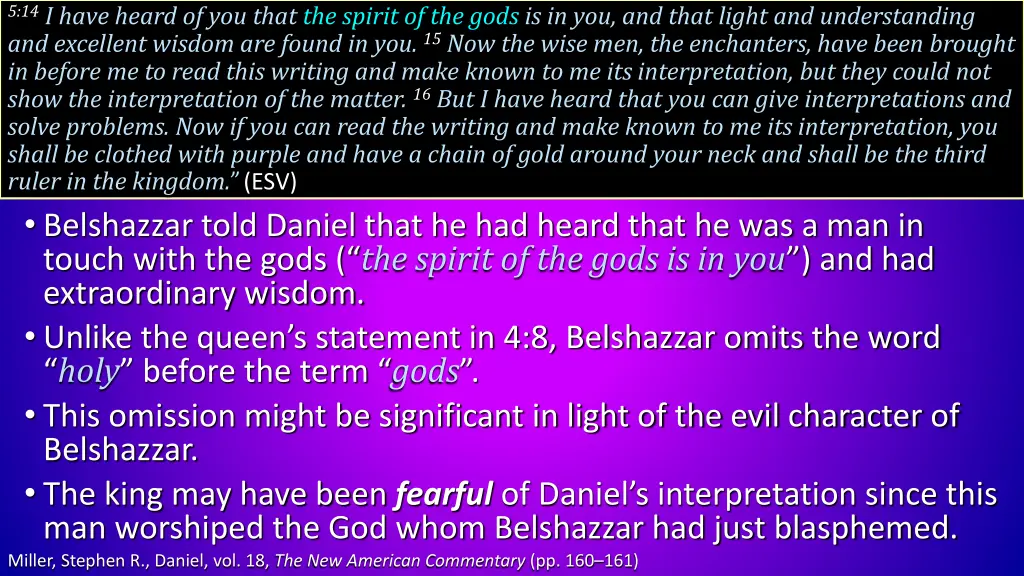
5:14 I have heard of you that the spirit of the gods is in you, and that light and understanding and excellent wisdom are found in you. 15 Now the wise men, the enchanters, have been brought in before me to read this writing and make known to me its interpretation, but they could not show the interpretation of the matter. 16 But I have heard that you can give interpretations and solve problems. Now if you can read the writing and make known to me its interpretation, you shall be clothed with purple and have a chain of gold around your neck and shall be the third ruler in the kingdom. (ESV) Belshazzar told Daniel that he had heard that he was a man in touch with the gods ( the spirit of the gods is in you ) and had extraordinary wisdom. Unlike the queen s statement in 4:8, Belshazzar omits the word holy before the term gods . This omission might be significant in light of the evil character of Belshazzar. The king may have been fearfulof Daniel s interpretation since this man worshiped the God whom Belshazzar had just blasphemed. Miller, Stephen R., Daniel, vol. 18, The New American Commentary (pp. 160 161)
Class Discussion Time We noted in introduction to today s lesson that until the last half of the nineteenth century (i.e. the late 1800s) the name Belshazzar was never mentioned in any known historical documents except for the Book of Daniel. This caused some (liberal) commentators and historians to declare that Belshazzar was a fictional character invented by Daniel! Since that time, an abundance of evidence has come to light that demonstrates not only that Belshazzar did live but that he was both the son of and coregent with Nabonidus. As those who believe the Bible is reliable, we are not surprised when something like this happens the Bible is the Word of God, after all. Even in the present day, there are a number of things that are affirmed by the Bible that extra-biblical records never confirm. Even though we know we can and should trust the Bible in such cases (Rom 3:4 Let God be true, and every man a liar. NIV), does it boost your confidence a bit to see how doubters in the past have been proven wrong?
Class Discussion Time James Montgomery Boice in his commentary on Daniel points out there are three takeaways from this passage: First, sin is not static. Second, sin makes us impervious to danger. Third, God is not static. Sin is Not Static - That is, the one who sins never remains on a plateau. The path of sin always leads downhill. In the case of Belshazzar, he would not learn from the example and experience of his predecessor Nebuchadnezzar. Nebuchadnezzar sinned by boasting, He took to himself the glory due God and was punished by God by the loss of his reason. Belshazzar went further. He blasphemed God by desecrating the vessels of God taken from the temple at Jerusalem and by praising idols in the true God s place. He was punished by the loss of his kingdom and his life. Do you think Boice is right about this? Why or why not? Boice, James Montgomery; Daniel: An Expositional Commentary ; (pp 60 62)
Class Discussion Time Sin Makes Us Impervious to Danger Karl Marx said that religion is the opiate of the people. He meant that religion puts us to sleep so that our oppressors have less trouble maintaining their supremacy. But Marx got it exactly backward. It is not religion that drugs us; it is sin. True religion wakes us up by turning us from sin to the righteousness of God that is in Jesus Christ. Belshazzar s final fling is an example of this stupidity. Darius was outside the walls. At the moment of this greatest of all dangers, Belshazzar was drugging himself at his party. Yet it is not only Belshazzar who has done this. Our culture is doing it as well. By refusing to think, especially about eternal realities, and by filling our days with entertainment, particularly sin-oriented entertainment, we lose sight of danger and plunge into the abyss. Do you agree with Boice? Why or why not? Boice, James Montgomery; Daniel: An Expositional Commentary ; (pp 60 62)
Class Discussion Time God Is Not Static There are times in history when sin abounds and God does not seem to intervene at least not spectacularly. But we must not think that God is unaffected by sin or that he will ignore it forever simply because his judgments are postponed. In times like these the wrath of God accumulates, like waters rising behind a dam. The time eventually comes when that great accumulation of wrath is poured out against sinners. This happens to nations at the moments of their greatest arrogance. It happens to individuals. It happens when the judgments of God are least expected. The only thing more certain for us than death and taxes is the final judgment. Do you think Boice makes a good point here? If so, why? Boice, James Montgomery; Daniel: An Expositional Commentary ; (pp 60 62)
Class Discussion Time Albert Barnes in his commentary on Daniel 5:5 mentions that the crime of sacrilege was regarded among the pagans of that time as one of the most awful sins which could be committed. As we look around in our society today, we see people committing sacrilege all the time. As bad as the people described in Daniel 5 are, they had enough of a conscience to feel fear over their practice of sacrilege when confronted by what they must thought to be a divine being. Is it possible that many people in the society that we live in today are even more degenerate than this group of degenerate drunken, carousing, party goers?