Understanding Eigenvector Centrality in Complex Networks
Explore the concept of eigenvector centrality in complex networks, its interpretation, and why it is considered an extension of degree centrality. Learn how eigenvector centrality is computed, its importance in identifying key players in social networks, and its relation to node importance and local influence. Dive into examples and explanations to grasp the essence of this essential network analysis metric.

Download Presentation

Please find below an Image/Link to download the presentation.
The content on the website is provided AS IS for your information and personal use only. It may not be sold, licensed, or shared on other websites without obtaining consent from the author. If you encounter any issues during the download, it is possible that the publisher has removed the file from their server.
You are allowed to download the files provided on this website for personal or commercial use, subject to the condition that they are used lawfully. All files are the property of their respective owners.
The content on the website is provided AS IS for your information and personal use only. It may not be sold, licensed, or shared on other websites without obtaining consent from the author.
E N D
Presentation Transcript
Prof. Ralucca Gera, rgera@nps.edu Applied Mathematics Department, Excellence Through Knowledge Naval Postgraduate School MA4404 Complex Networks Eigenvector Centrality
Compute eigenvector centrality. Interpret the meaning of the values of eigenvector centrality. Explain why the eigenvector centrality is an extension of degree centrality. Learning Outcomes
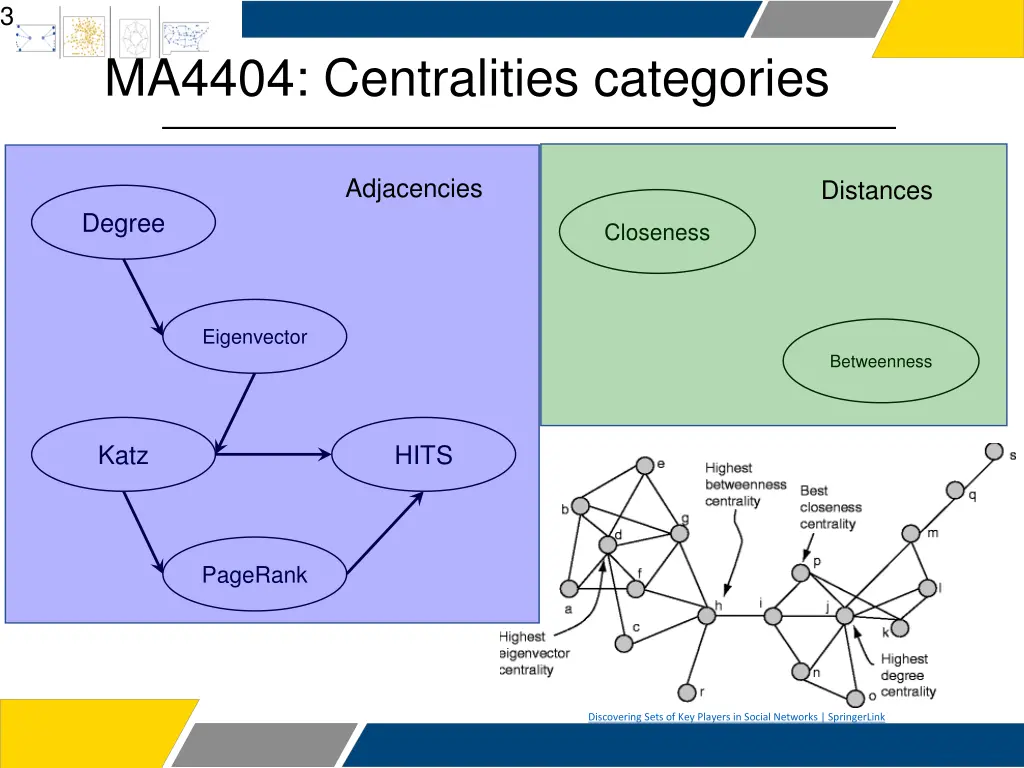
3 MA4404: Centralities categories Adjacencies Distances Degree Closeness Eigenvector Betweenness Katz HITS PageRank Discovering Sets of Key Players in Social Networks | SpringerLink
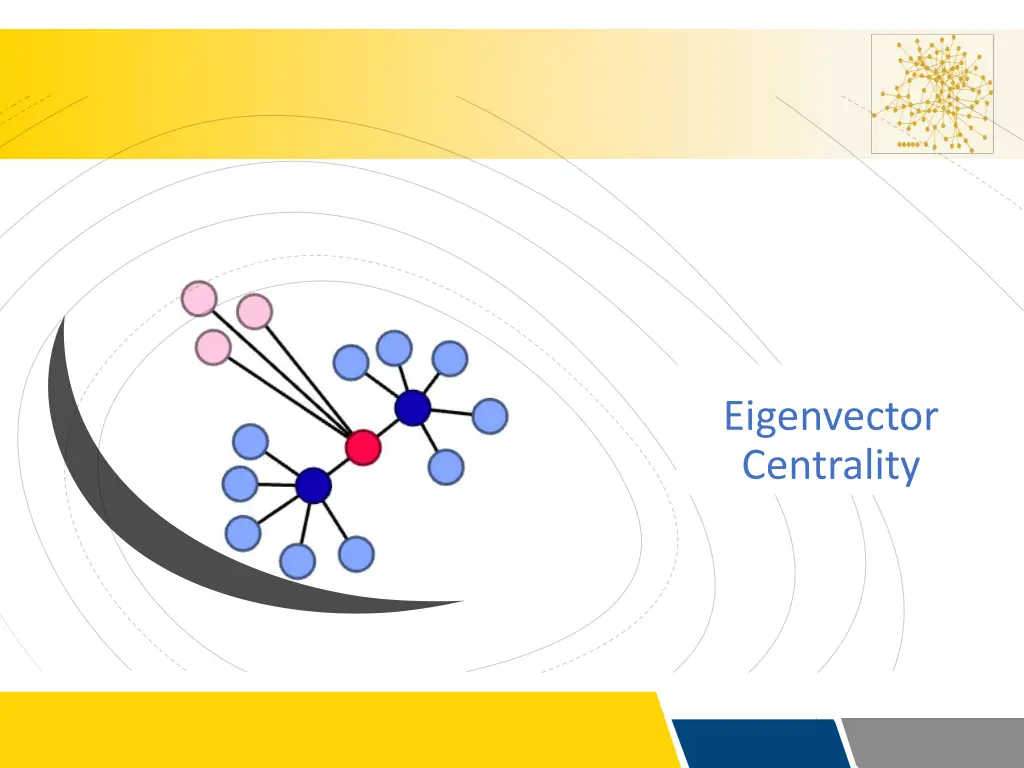
Eigenvector Centrality
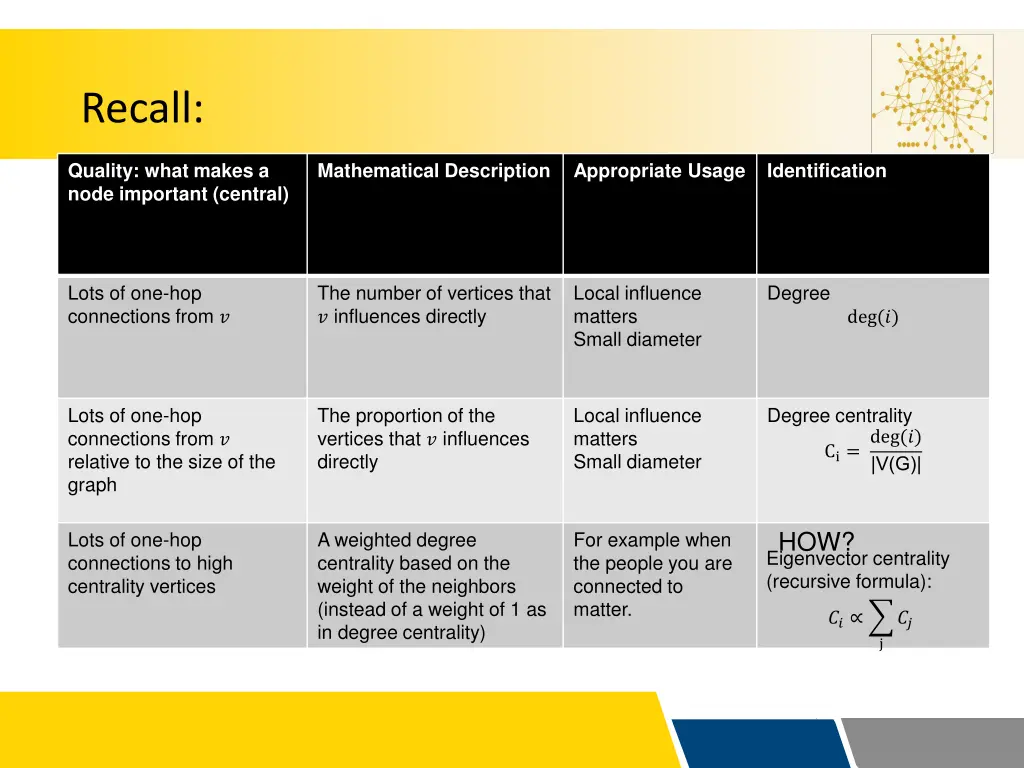
Recall: Quality: what makes a node important (central) Mathematical Description Appropriate Usage Identification Lots of one-hop connections from ? The number of vertices that ? influences directly Local influence matters Small diameter Degree deg(?) Lots of one-hop connections from ? relative to the size of the graph The proportion of the vertices that ? influences directly Local influence matters Small diameter Degree centrality deg(?) |V(G)| Ci= HOW? Eigenvector centrality (recursive formula): Lots of one-hop connections to high centrality vertices A weighted degree centrality based on the weight of the neighbors (instead of a weight of 1 as in degree centrality) For example when the people you are connected to matter. ?? ?? j
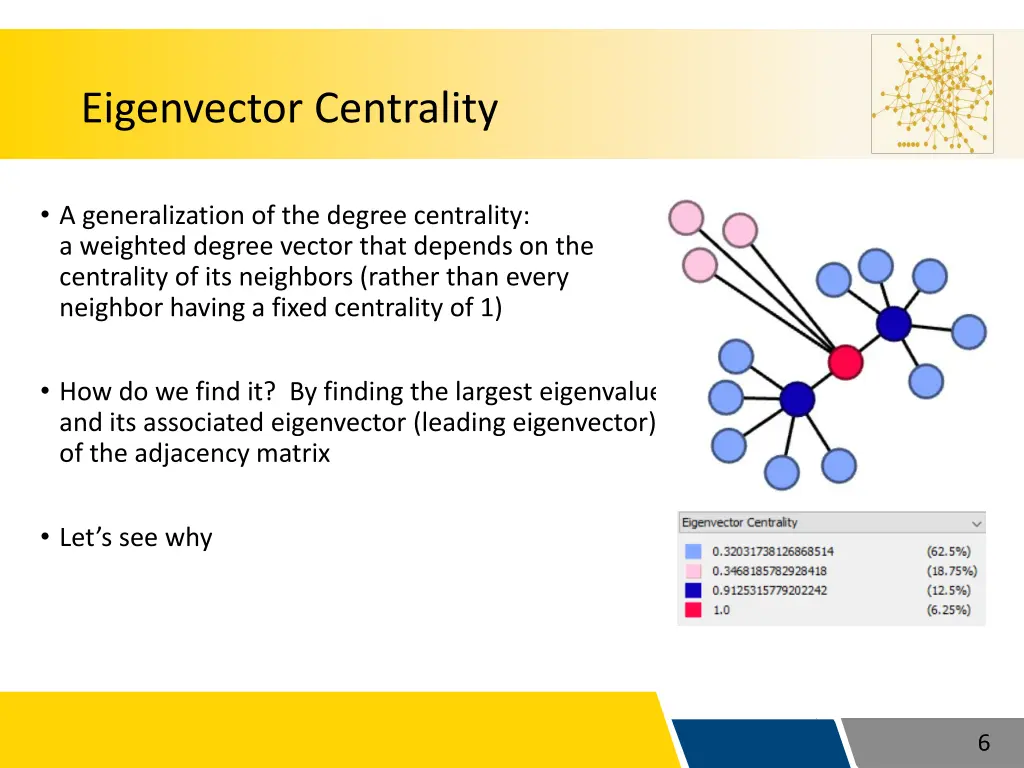
Eigenvector Centrality A generalization of the degree centrality: a weighted degree vector that depends on the centrality of its neighbors (rather than every neighbor having a fixed centrality of 1) How do we find it? By finding the largest eigenvalue and its associated eigenvector (leading eigenvector) of the adjacency matrix Let s see why 6
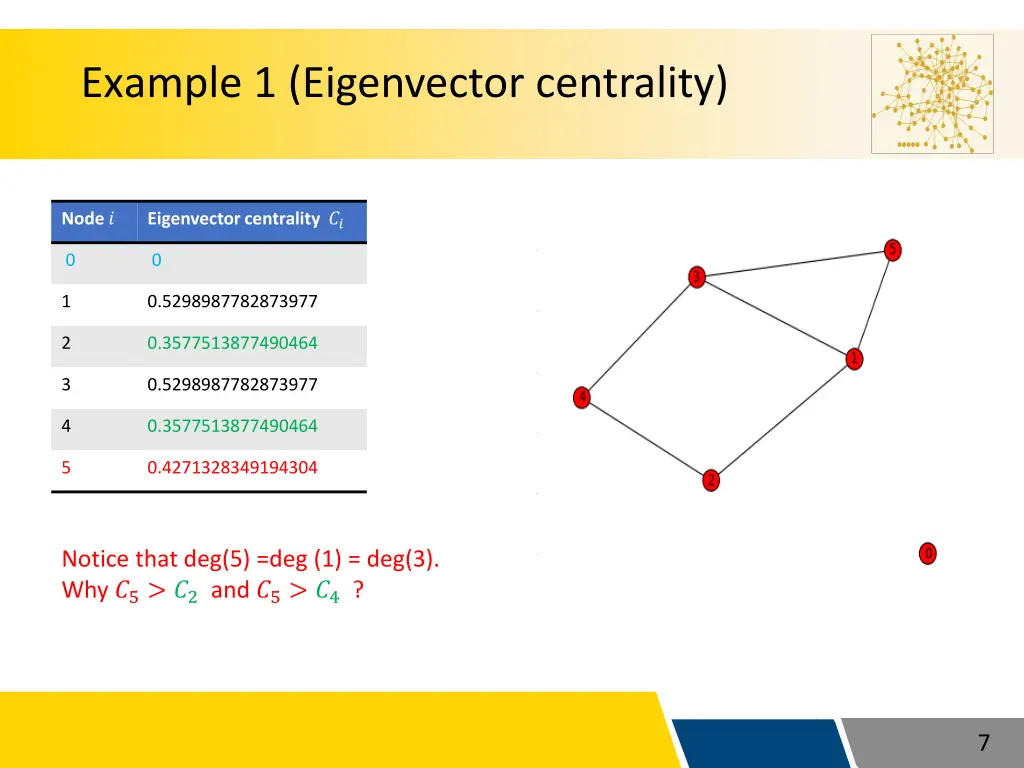
Example 1 (Eigenvector centrality) Node ? Eigenvector centrality ?? 0 0 1 0.5298987782873977 2 0.3577513877490464 3 0.5298987782873977 4 0.3577513877490464 5 0.4271328349194304 Notice that deg(5) =deg (1) = deg(3). Why ?5> ?2and ?5> ?4? 7
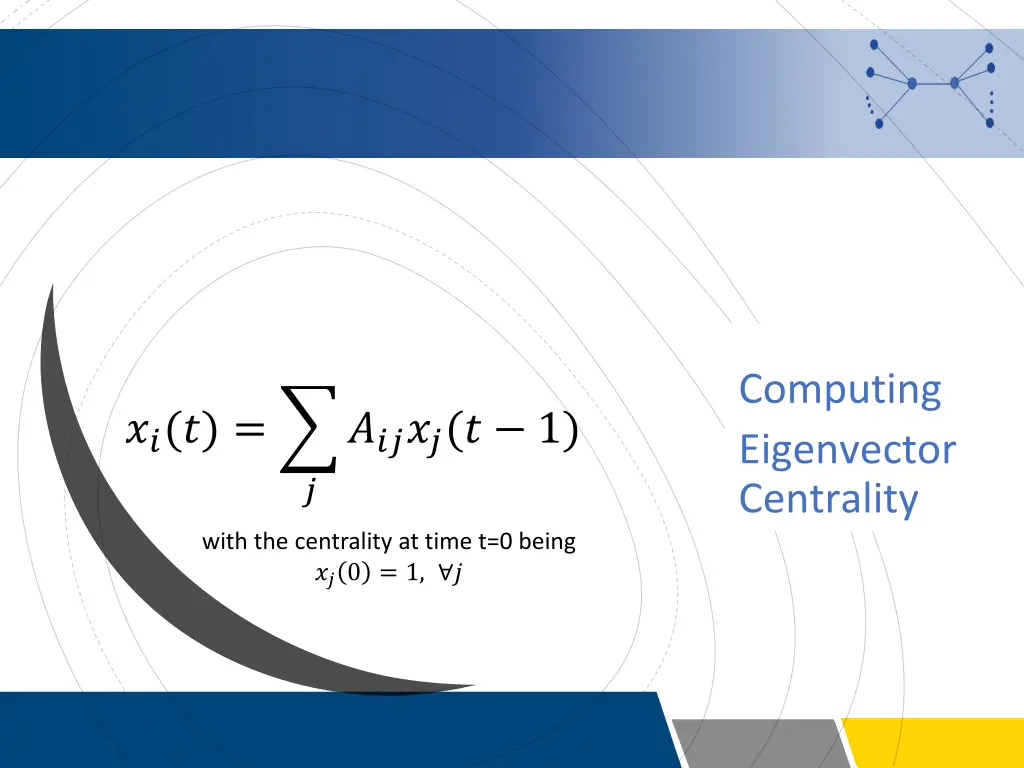
Computing Eigenvector Centrality ??(?) = ?????(? 1) ? with the centrality at time t=0 being ??0 = 1, ?
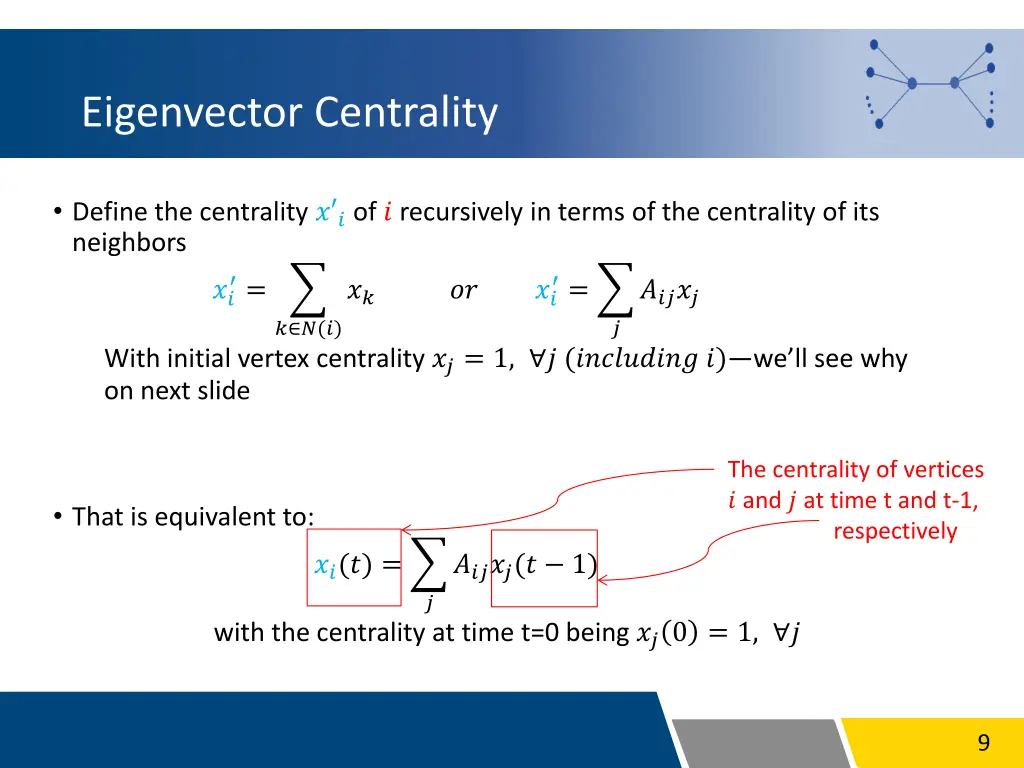
Eigenvector Centrality Define the centrality ? ? of ? recursively in terms of the centrality of its neighbors = = ?? ?? ?? ?? ????? ? ?(?) ? With initial vertex centrality ??= 1, ? (????????? ?) we ll see why on next slide The centrality of vertices ? and ? at time t and t-1, respectively That is equivalent to: ??(?) = ?????(? 1) ? with the centrality at time t=0 being ??0 = 1, ? 9
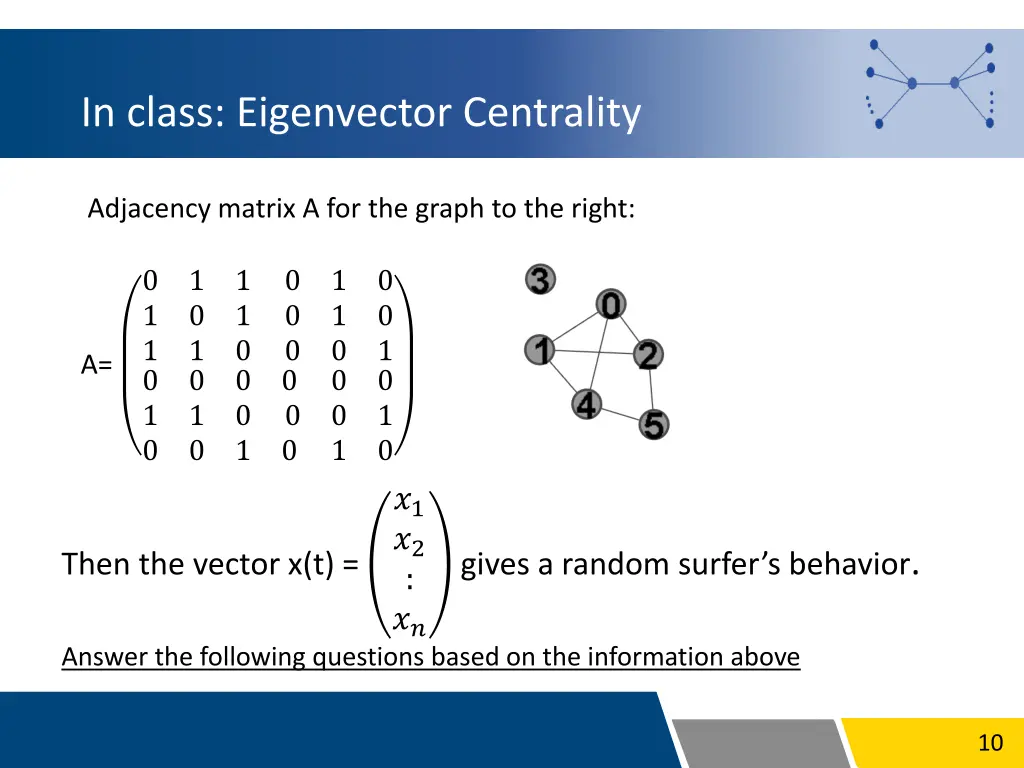
In class: Eigenvector Centrality Adjacency matrix A for the graph to the right: 0 1 1 0 1 0 1 0 1 0 1 0 1 1 0 0 0 1 0 0 0 0 0 0 1 1 0 0 0 1 0 0 1 0 1 0 A= ?1 ?2 : ?? gives a random surfer s behavior. Then the vector x(t) = Answer the following questions based on the information above 10
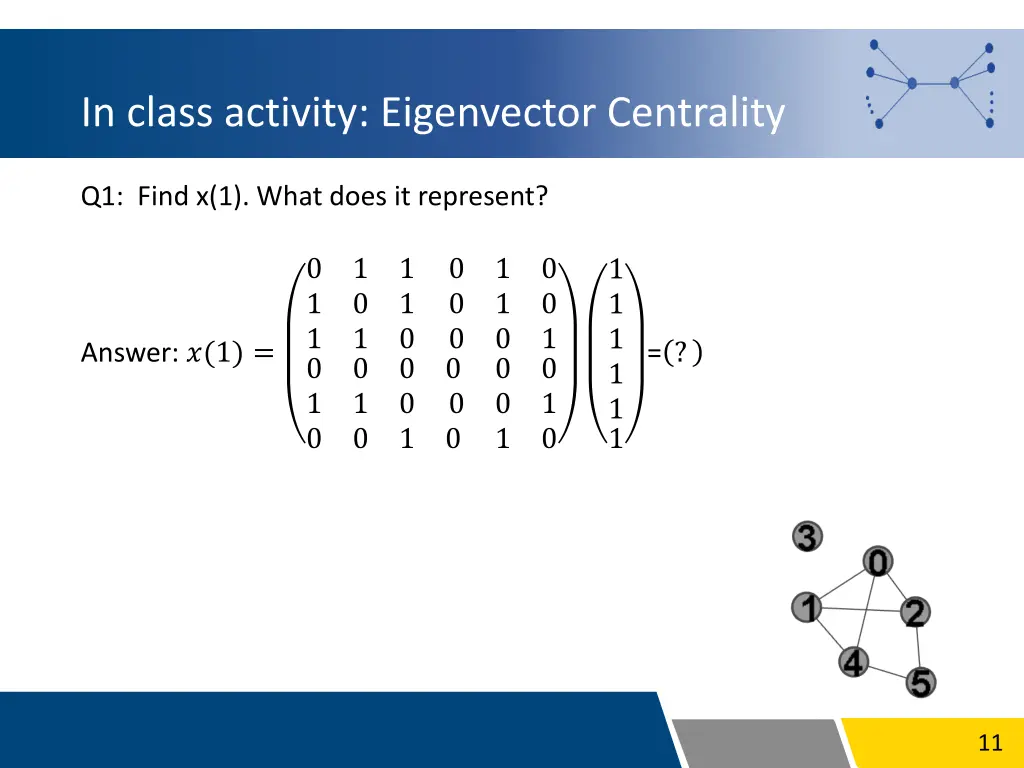
In class activity: Eigenvector Centrality Q1: Find x(1). What does it represent? 0 1 1 0 1 0 1 0 1 0 1 0 1 1 0 0 0 1 0 0 0 0 0 0 1 1 0 0 0 1 0 0 1 0 1 0 1 1 1 1 1 1 Answer: ?(1) = = ? 11
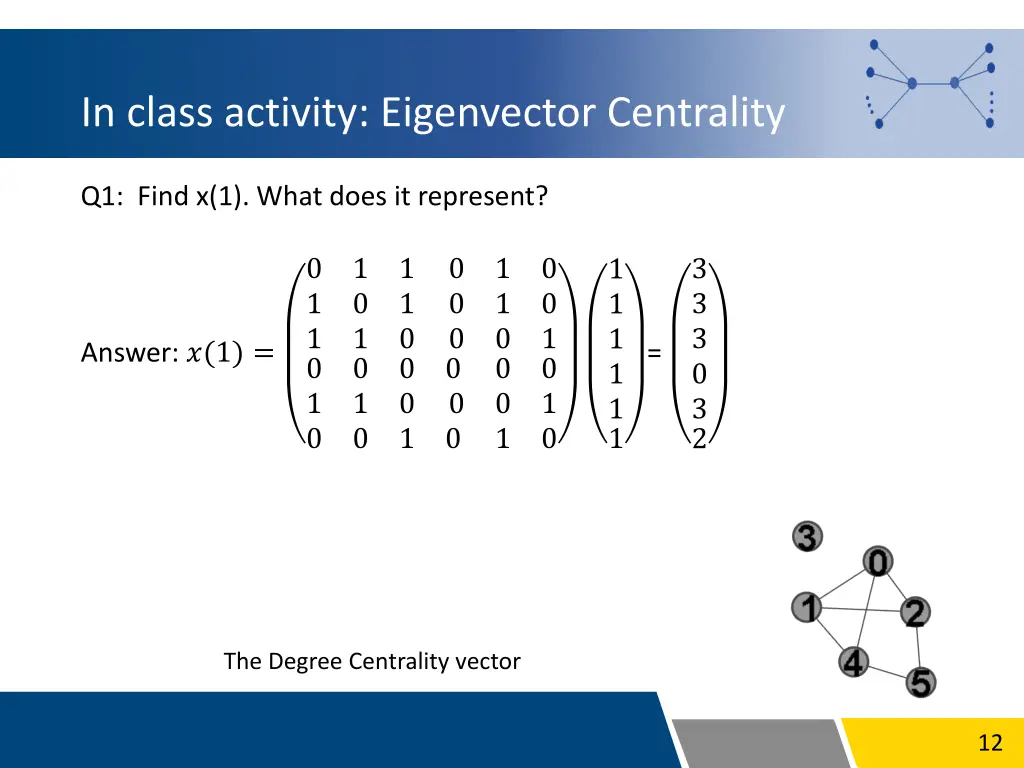
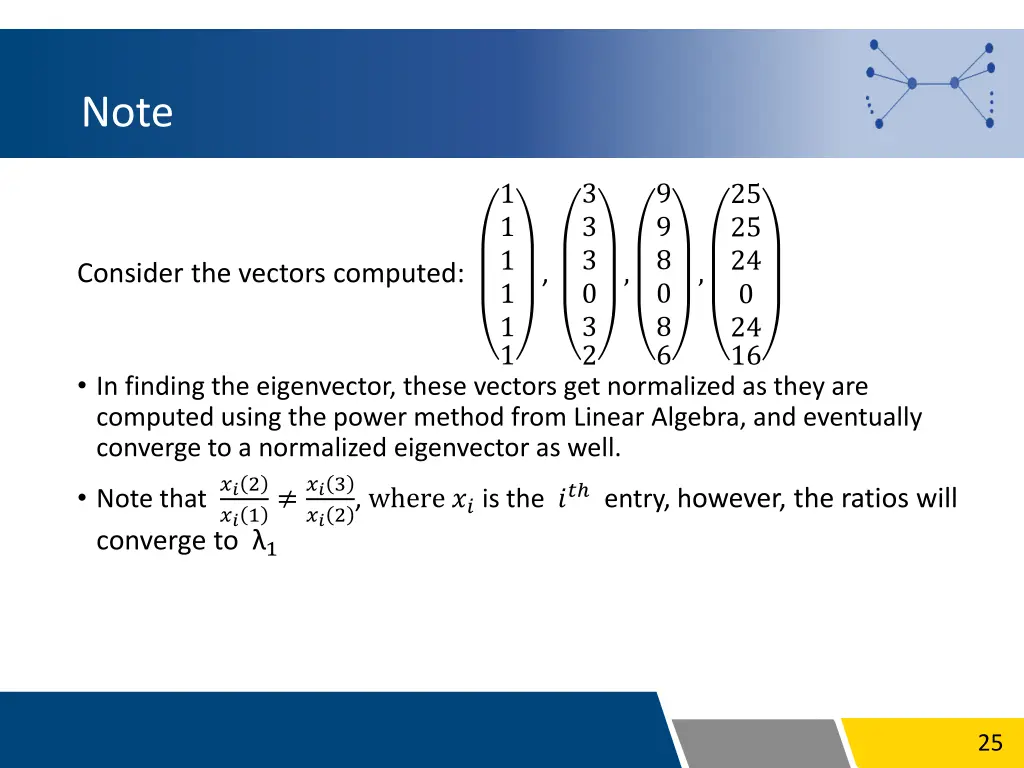
In class activity: Eigenvector Centrality Q1: Find x(1). What does it represent? 0 1 1 0 1 0 1 0 1 0 1 0 1 1 0 0 0 1 0 0 0 0 0 0 1 1 0 0 0 1 0 0 1 0 1 0 3 3 3 0 3 2 1 1 1 1 1 1 Answer: ?(1) = = The Degree Centrality vector 12
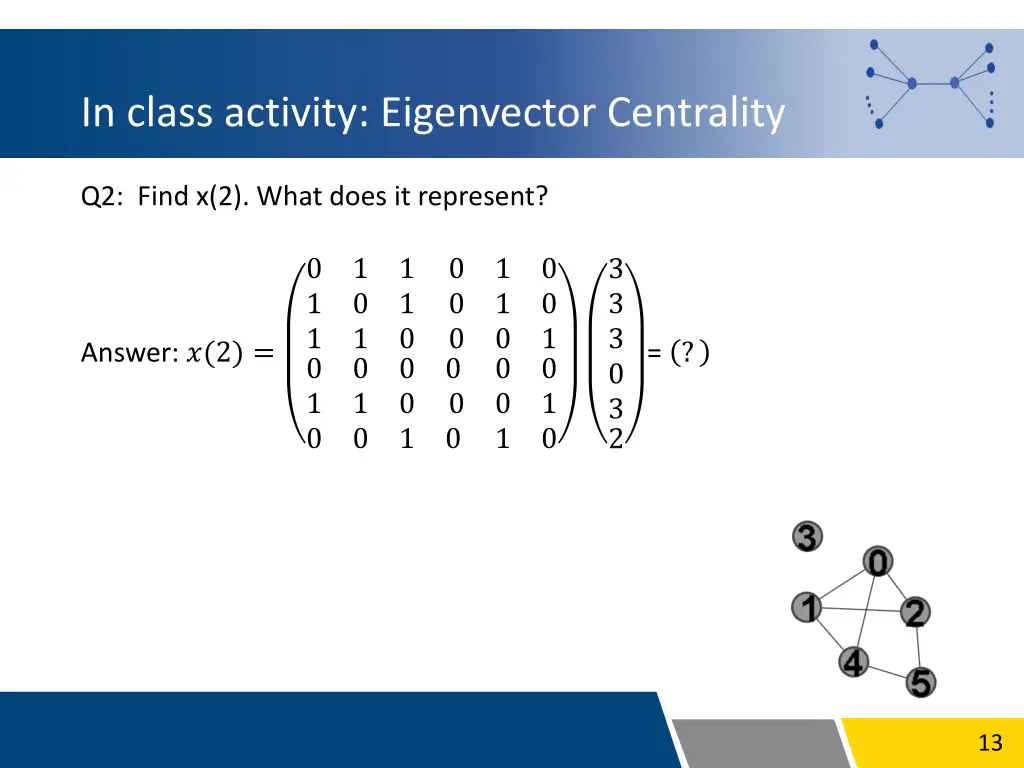
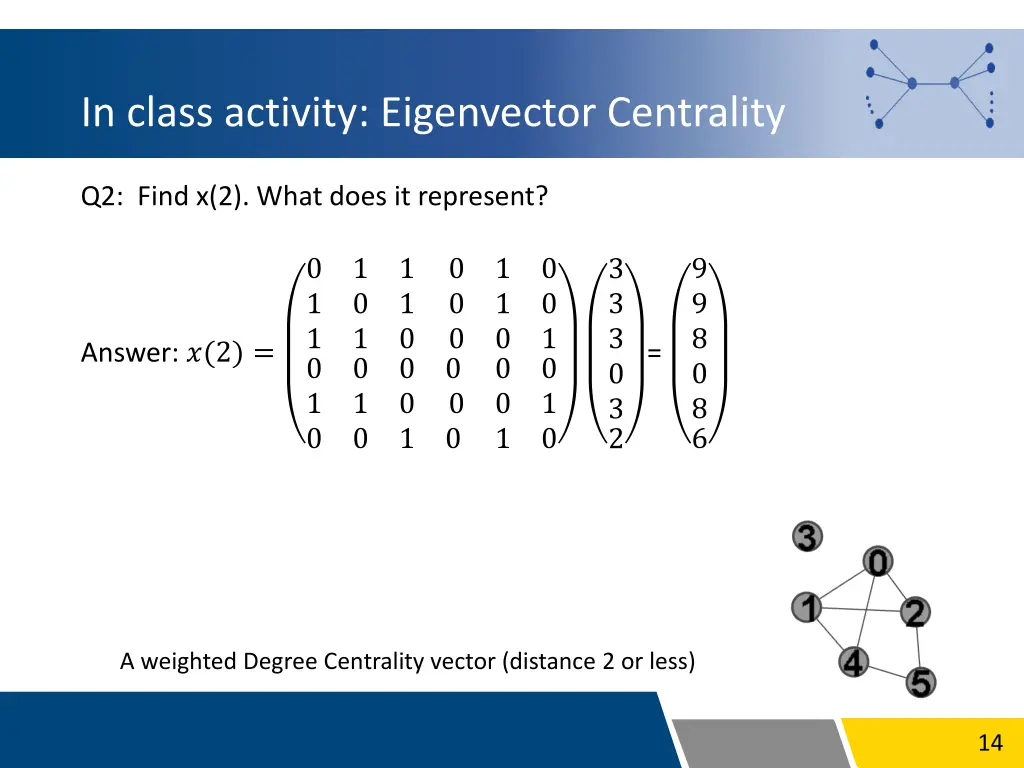
In class activity: Eigenvector Centrality Q2: Find x(2). What does it represent? 0 1 1 0 1 0 1 0 1 0 1 0 1 1 0 0 0 1 0 0 0 0 0 0 1 1 0 0 0 1 0 0 1 0 1 0 3 3 3 0 3 2 Answer: ?(2) = = ? 13
In class activity: Eigenvector Centrality Q2: Find x(2). What does it represent? 0 1 1 0 1 0 1 0 1 0 1 0 1 1 0 0 0 1 0 0 0 0 0 0 1 1 0 0 0 1 0 0 1 0 1 0 9 9 8 0 8 6 3 3 3 0 3 2 Answer: ?(2) = = A weighted Degree Centrality vector (distance 2 or less) 14
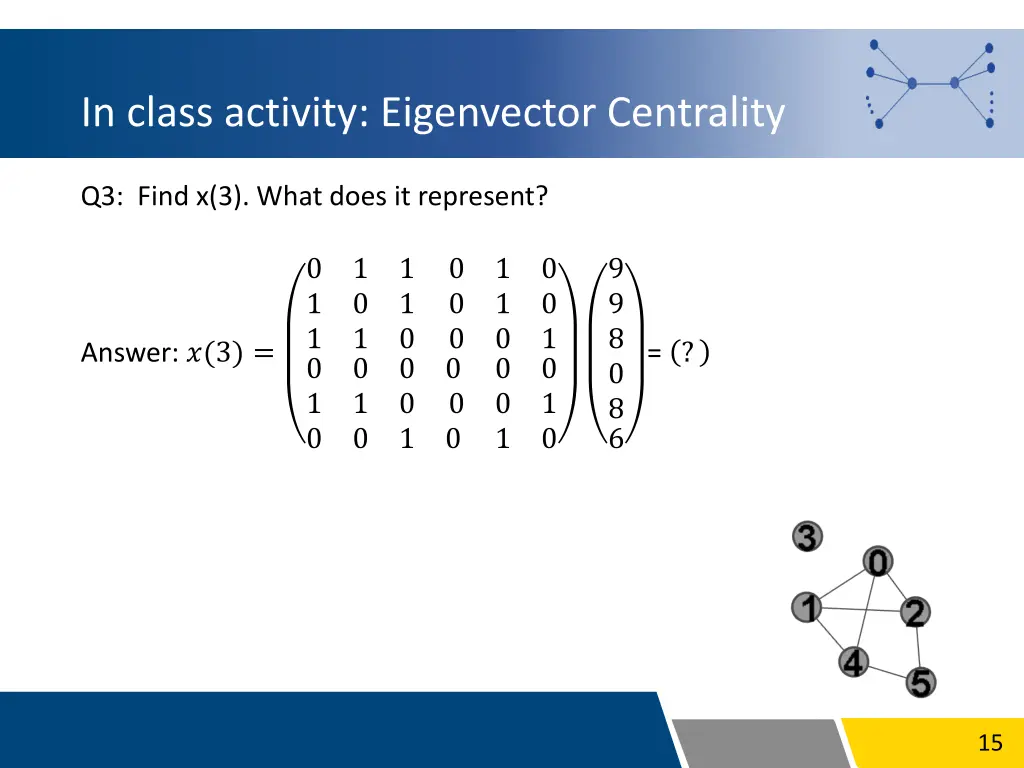
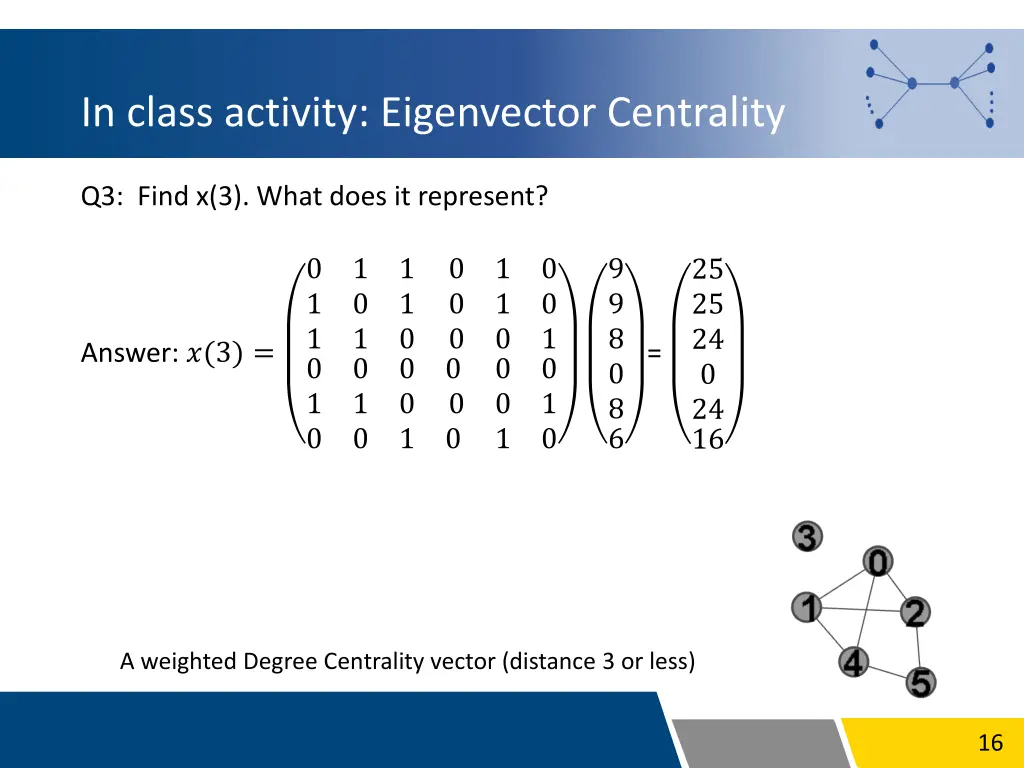
In class activity: Eigenvector Centrality Q3: Find x(3). What does it represent? 0 1 1 0 1 0 1 0 1 0 1 0 1 1 0 0 0 1 0 0 0 0 0 0 1 1 0 0 0 1 0 0 1 0 1 0 9 9 8 0 8 6 Answer: ?(3) = = ? 15
In class activity: Eigenvector Centrality Q3: Find x(3). What does it represent? 0 1 1 0 1 0 1 0 1 0 1 0 1 1 0 0 0 1 0 0 0 0 0 0 1 1 0 0 0 1 0 0 1 0 1 0 9 9 8 0 8 6 25 25 24 0 24 16 Answer: ?(3) = = A weighted Degree Centrality vector (distance 3 or less) 16
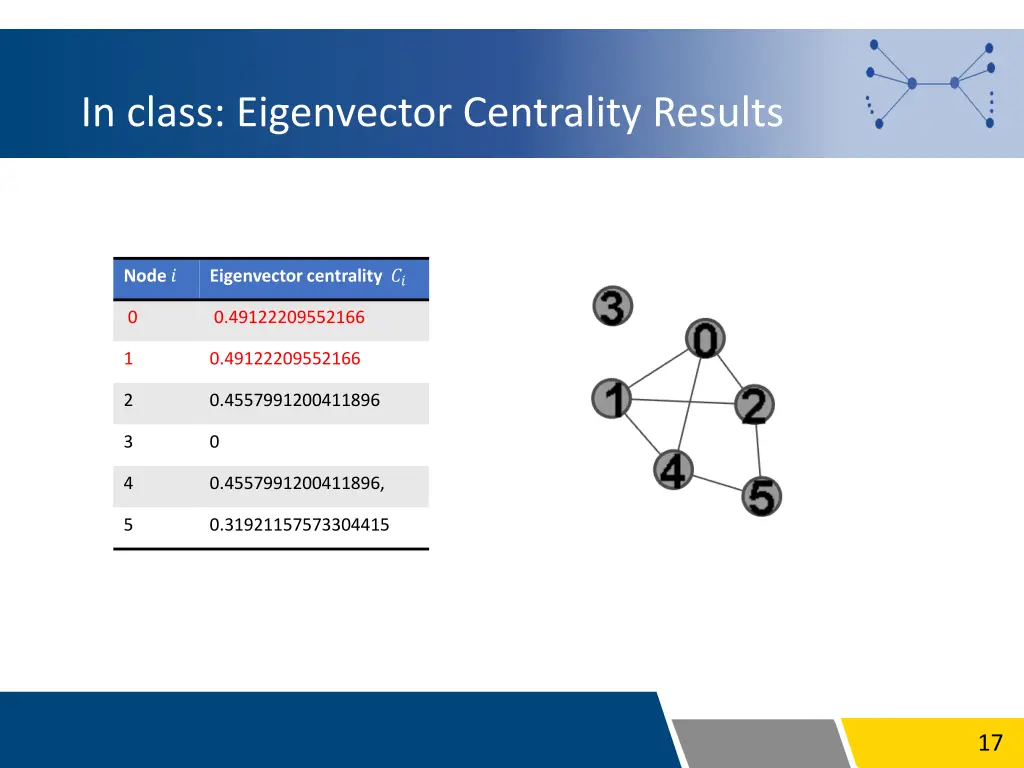
In class: Eigenvector Centrality Results Node ? Eigenvector centrality ?? 0 0.49122209552166 1 0.49122209552166 2 0.4557991200411896 3 0 4 0.4557991200411896, 5 0.31921157573304415 17
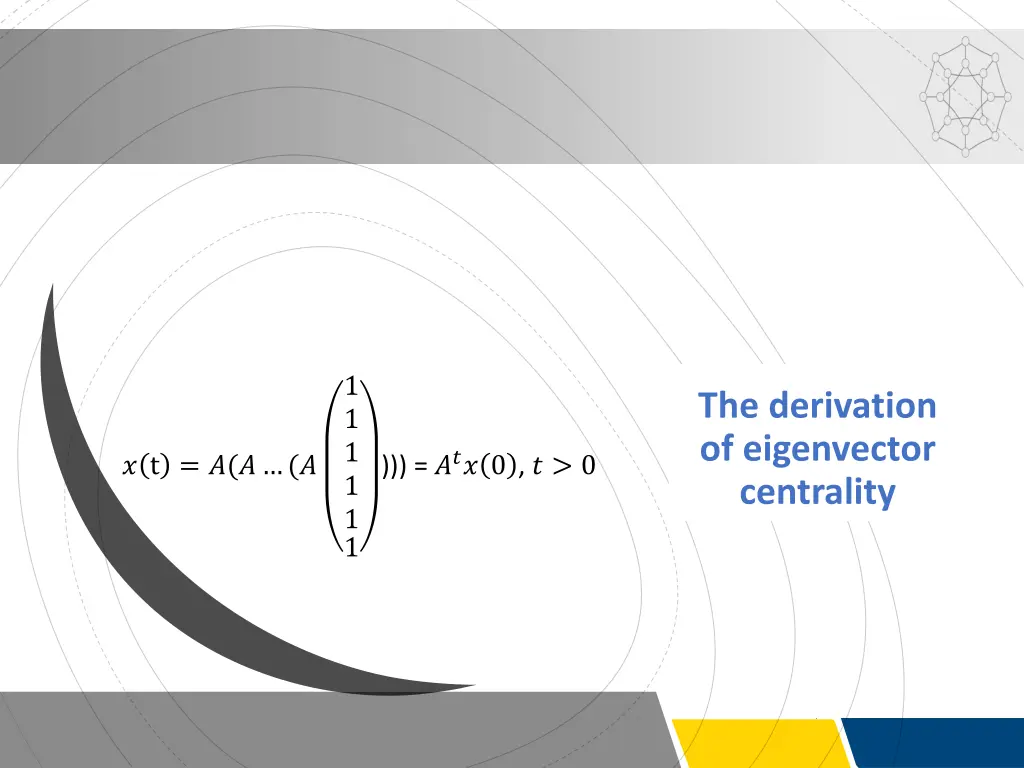
1 1 1 1 1 1 The derivation of eigenvector centrality ))) = ??? 0 , ? > 0 ? t = ?(? (?
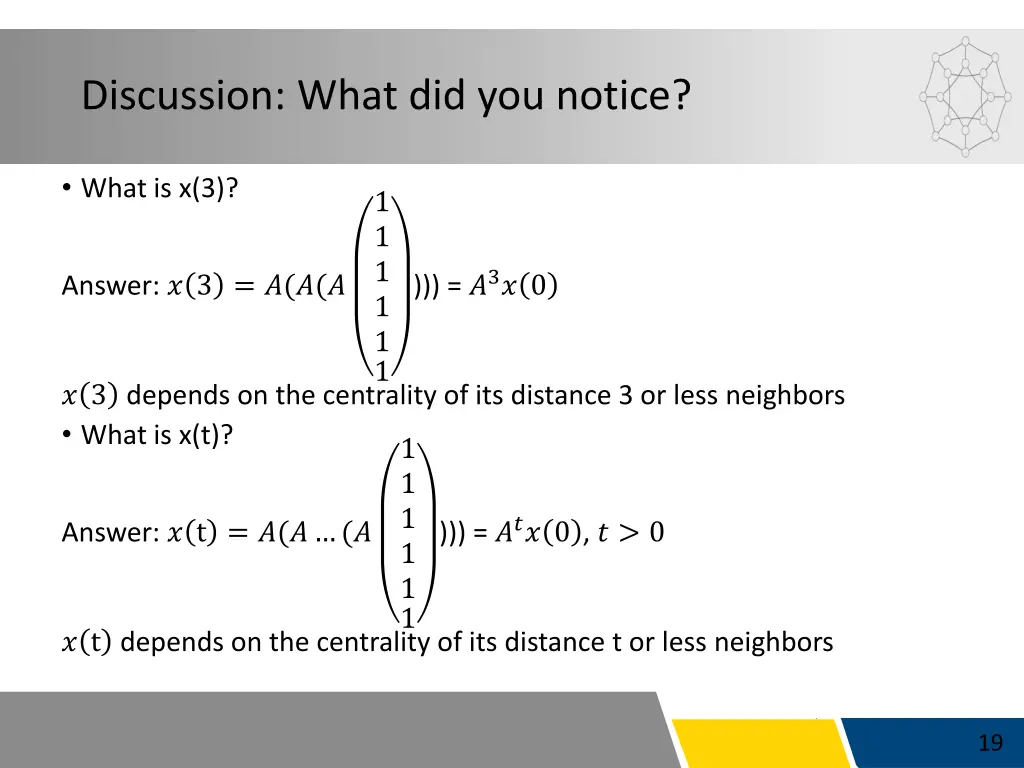
Discussion: What did you notice? What is x(3)? 1 1 1 1 1 1 ))) = ?3? 0 Answer: ? 3 = ?(?(? ? 3 depends on the centrality of its distance 3 or less neighbors What is x(t)? 1 1 1 1 1 1 ? t depends on the centrality of its distance t or less neighbors ))) = ??? 0 , ? > 0 Answer: ? t = ?(? (? 19
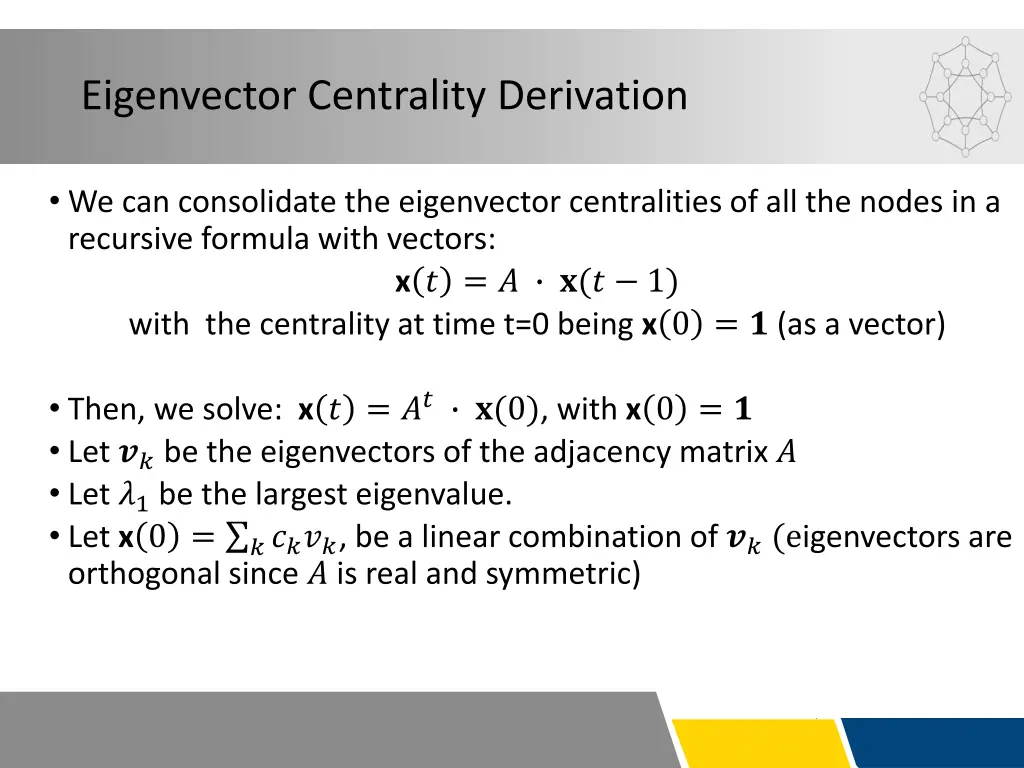
Eigenvector Centrality Derivation We can consolidate the eigenvector centralities of all the nodes in a recursive formula with vectors: x ? = ? ?(? 1) with the centrality at time t=0 being x 0 = ? (as a vector) Then, we solve: x ? = ?? ?(0), with x 0 = ? Let ?? be the eigenvectors of the adjacency matrix ? Let ?1 be the largest eigenvalue. Let x 0 = ?????, be a linear combination of ?? (eigenvectors are orthogonal since ? is real and symmetric)
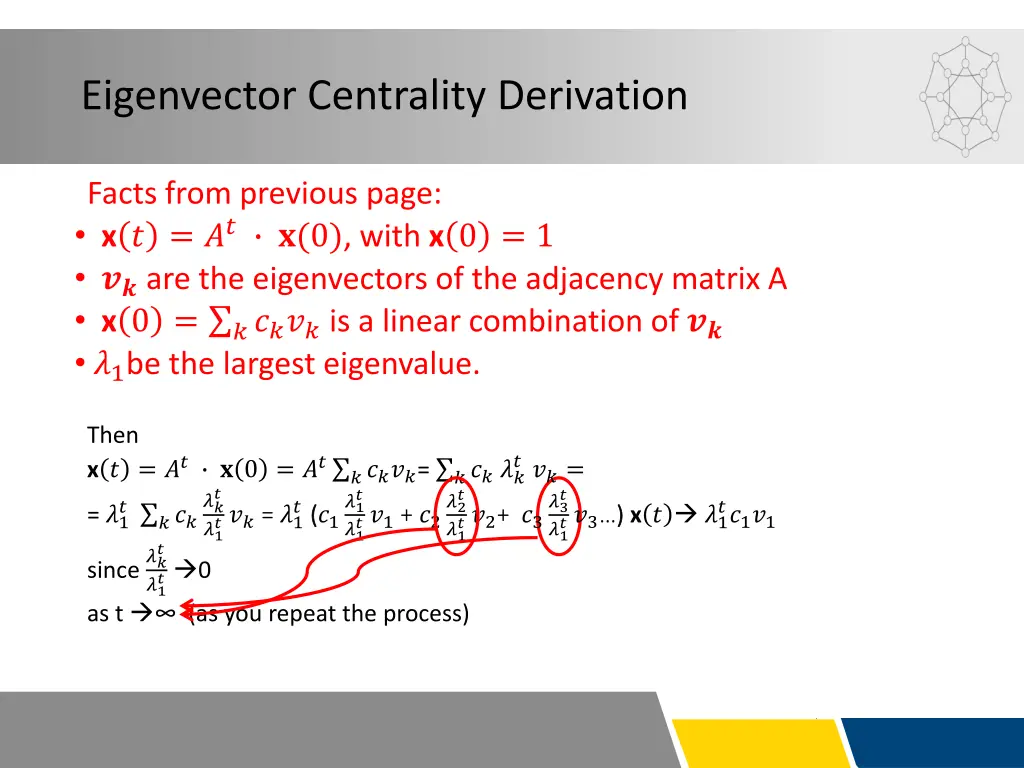
Eigenvector Centrality Derivation Facts from previous page: x ? = ?? ?(0), with x 0 = 1 ?? are the eigenvectors of the adjacency matrix A x 0 = ????? is a linear combination of ?? ?1be the largest eigenvalue. Then x ? = ?? ? 0 = ?? ?????= ??? ?? ?? ?1 since ?? ?1 as t (as you repeat the process) ? ??= ?3 ?1 ? ??? = ?1 ? ??1 + ?2 ? ??2+ ?3 ? ??3 ) ) x ? ?1 ?1 ?1 ?2 ?1 ? ??? ?( (?1 ??1?1 = ?1 ? ? 0
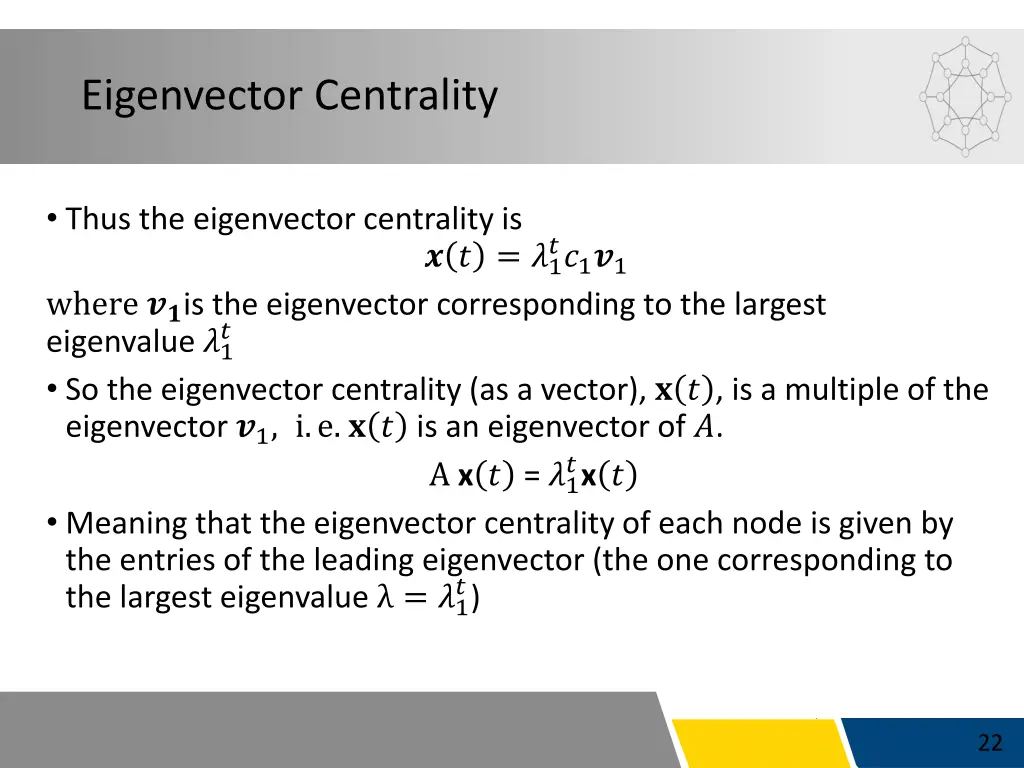
Eigenvector Centrality Thus the eigenvector centrality is ??1?1 ? ? = ?1 where ??is the eigenvector corresponding to the largest eigenvalue ?1 So the eigenvector centrality (as a vector), ? ? , is a multiple of the eigenvector ?1, i.e.? ? is an eigenvector of ?. A x ? = ?1 Meaning that the eigenvector centrality of each node is given by the entries of the leading eigenvector (the one corresponding to the largest eigenvalue = ?1 ? ?x ? ?) 22
Is it well defined? That is: Is the eigenvector guaranteed to exist? Is the eigenvector unique? Is the eigenvalue unique? Can we have negative entries in the eigenvector? We say that a matrix/vector is positive if all of its entries are positive Perron-Frobenius theorem: A real square matrix with positive entries has a unique largest real eigenvalue and that the corresponding eigenvector has strictly positive components Perron-Frobenius theorem applies to positive matrices (but it gives similar information for nonnegative ones) 23
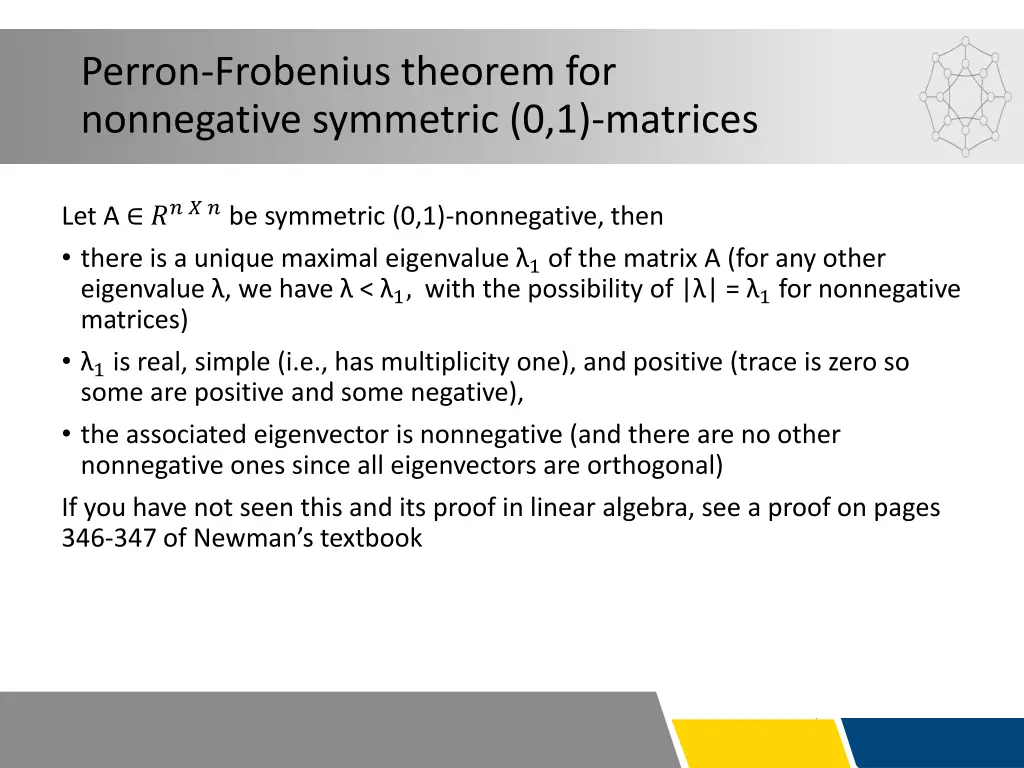
Perron-Frobenius theorem for nonnegative symmetric (0,1)-matrices Let A ?? ? ? be symmetric (0,1)-nonnegative, then there is a unique maximal eigenvalue 1of the matrix A (for any other eigenvalue , we have < 1, with the possibility of | | = 1 for nonnegative matrices) 1 is real, simple (i.e., has multiplicity one), and positive (trace is zero so some are positive and some negative), the associated eigenvector is nonnegative (and there are no other nonnegative ones since all eigenvectors are orthogonal) If you have not seen this and its proof in linear algebra, see a proof on pages 346-347 of Newman s textbook
Note 3 3 3 0 3 2 9 9 8 0 8 6 1 1 1 1 1 1 25 25 24 0 24 16 Consider the vectors computed: , , , In finding the eigenvector, these vectors get normalized as they are computed using the power method from Linear Algebra, and eventually converge to a normalized eigenvector as well. Note that ??2 converge to 1 ??1 ??3 ??2, where ?? is the ?? entry, however, the ratios will 25
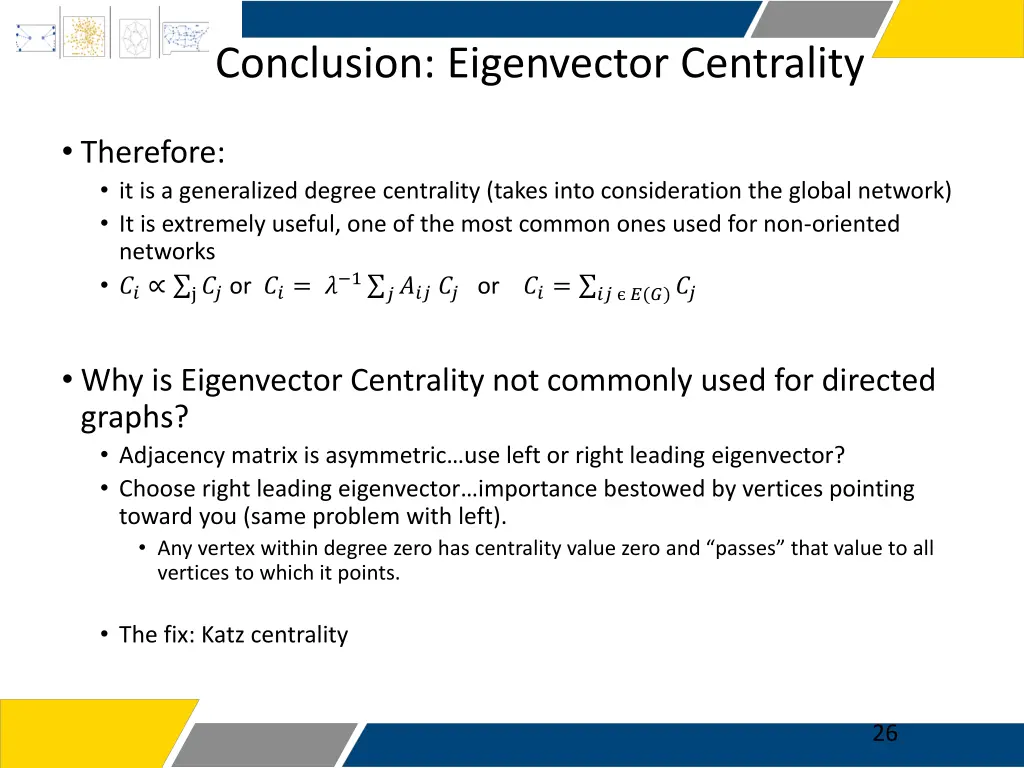
Conclusion: Eigenvector Centrality Therefore: it is a generalized degree centrality (takes into consideration the global network) It is extremely useful, one of the most common ones used for non-oriented networks ?? j?? or ??= ? 1 ???? ?? or ??= ?? ?(?)?? Why is Eigenvector Centrality not commonly used for directed graphs? Adjacency matrix is asymmetric use left or right leading eigenvector? Choose right leading eigenvector importance bestowed by vertices pointing toward you (same problem with left). Any vertex within degree zero has centrality value zero and passes that value to all vertices to which it points. The fix: Katz centrality 26