Understanding Electron Thermal Transport in ST Plasmas
Explore the validation and development of reduced transport models for electron thermal transport in spherical torus plasmas. The research aims to enhance the accuracy of fluid-based models by comparing them with gyrokinetic simulations and experimental data, ultimately determining the physics regimes needing further model development.

Uploaded on | 0 Views
Download Presentation

Please find below an Image/Link to download the presentation.
The content on the website is provided AS IS for your information and personal use only. It may not be sold, licensed, or shared on other websites without obtaining consent from the author. If you encounter any issues during the download, it is possible that the publisher has removed the file from their server.
You are allowed to download the files provided on this website for personal or commercial use, subject to the condition that they are used lawfully. All files are the property of their respective owners.
The content on the website is provided AS IS for your information and personal use only. It may not be sold, licensed, or shared on other websites without obtaining consent from the author.
E N D
Presentation Transcript
Kickoff meeting for NSTX-U Milestone R(18-3) T&T TSG group meeting November 6, 2017 R(18-3) milestone kickoff meeting 1
R18-3: Validate and further develop reduced transport models for electron thermal transport in ST plasmas http://nstx-u.pppl.gov/program/milestones/fy2018-research The design of next generation spherical tori (STs) will be influenced by the scaling of energy confinement. While ion thermal transport is often near neoclassical levels in H-modes in ST plasmas, gyro-kinetic simulations have indicated a number of potential drift wave turbulence mechanisms that can influence electron thermal transport. Reduced transport models that capture the key physics and scaling of the computationally expensive first-principles gyro-kinetic simulations are required to more thoroughly validate the modeling against experimental data, which can then be used to infer the key physics that determines the overall energy confinement. A variety of reduced transport models based on drift wave turbulence have been developed and tested extensively for conventional tokamaks. These models encompass much of the physics expected to be important in STs, although they have been tested much less rigorously for ST parameters (low aspect ratio, high beta, strong flow). In order to improve the fidelity of reduced transport models (like TGLF, RLW and MMM), experimental NSTX, MAST and NSTX-U data will be used to examine predictions based on these models to assess their suitability for ST plasma. The physics accuracy of these fluid-based models will be also be qualified by comparing directly to first-principles gyro-kinetic simulations over a range of conditions. The dependence of electrostatic ITG and TEM instabilities on aspect ratio will be evaluated by comparing L-mode cases to established conventional aspect ratio conditions. Validation with high beta H-mode data will push the limits of the available reduced models to recover electromagnetic instabilities like MTM and KBM. A key outcome of this milestone will be to determine the ST physics regimes in which further model development is required. The first-principles gyro-kinetic simulations based on ST parameters will form the basis for enhancements of the TGLF reduced model. R(18-3) milestone kickoff meeting 2
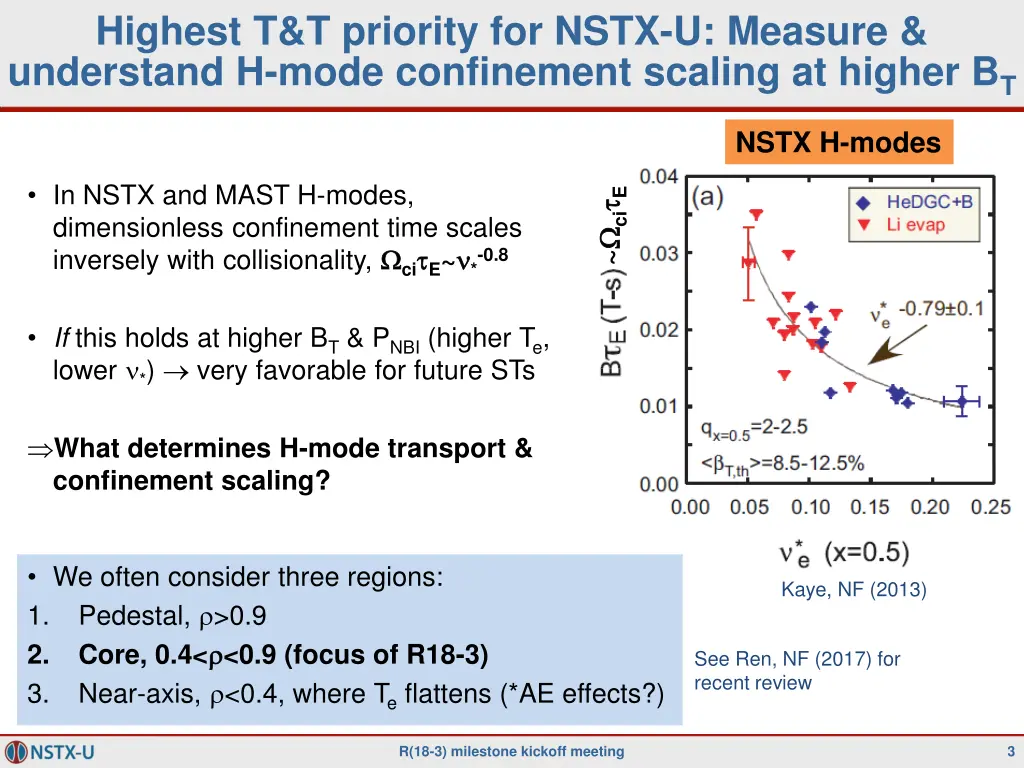
Highest T&T priority for NSTX-U: Measure & understand H-mode confinement scaling at higher BT NSTX H-modes In NSTX and MAST H-modes, dimensionless confinement time scales inversely with collisionality, ci E~ *-0.8 ~ ci E If this holds at higher BT & PNBI (higher Te, lower *) very favorable for future STs What determines H-mode transport & confinement scaling? We often consider three regions: 1. Pedestal, >0.9 2. Core, 0.4< <0.9 (focus of R18-3) 3. Near-axis, <0.4, where Te flattens (*AE effects?) Kaye, NF (2013) See Ren, NF (2017) for recent review R(18-3) milestone kickoff meeting 3
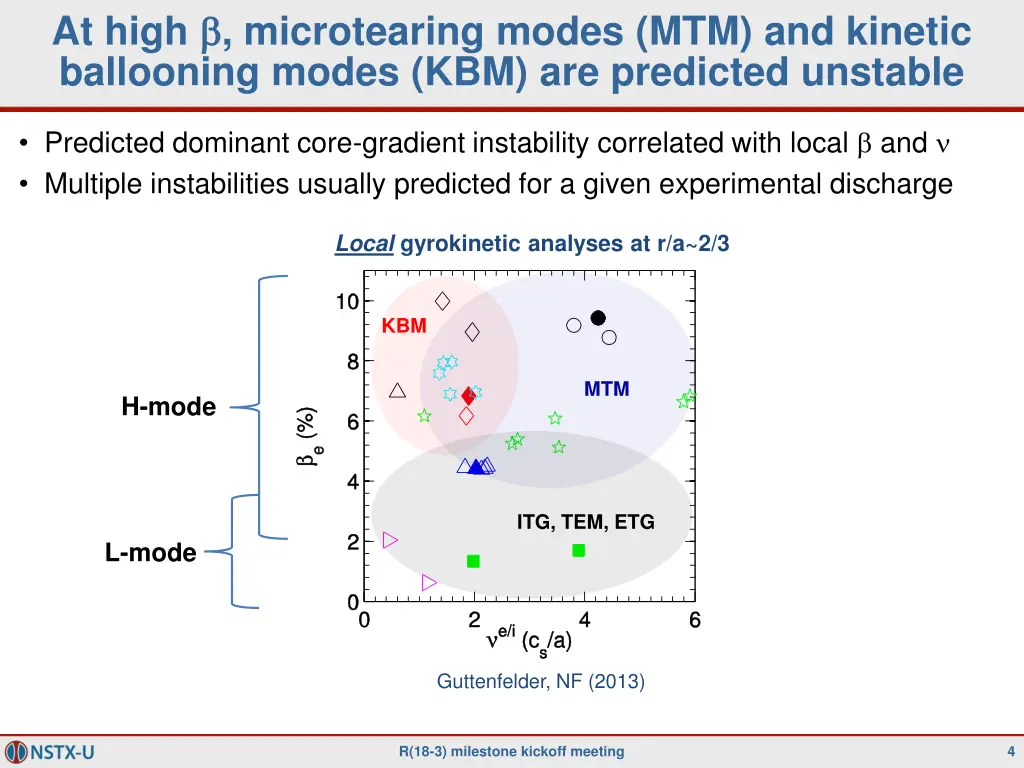
At high , microtearing modes (MTM) and kinetic ballooning modes (KBM) are predicted unstable Predicted dominant core-gradient instability correlated with local and Multiple instabilities usually predicted for a given experimental discharge Local gyrokinetic analyses at r/a~2/3 KBM MTM H-mode ITG, TEM, ETG L-mode Guttenfelder, NF (2013) R(18-3) milestone kickoff meeting 4
Milestone goals: (1) Identify ST conditions for which current core transport models work & fail, (2) Try to improve models Focus on: Core transport in L-mode and H-mode (excluding pedestal), specifically: Electron thermal transport (+ ion thermal transport in L-modes) Drift wave (DW) based transport, i.e. not energetic particle mechanisms like GAE/CAE-KAW electron orbit stochastization/energy channeling But need to consider this when judging whether DW models work or fail Two complementary components of the milestone work: 1. Model validation comparing profile predictions to experimental data 2. Model qualification comparing reduced models to gyrokinetic simulations of linear stability, thresholds and nonlinear transport A significant amount of transport modeling and gyrokinetic analysis has been done for MAST, NSTX, NSTX-U (see 4 reference slides) R(18-3) milestone kickoff meeting 5
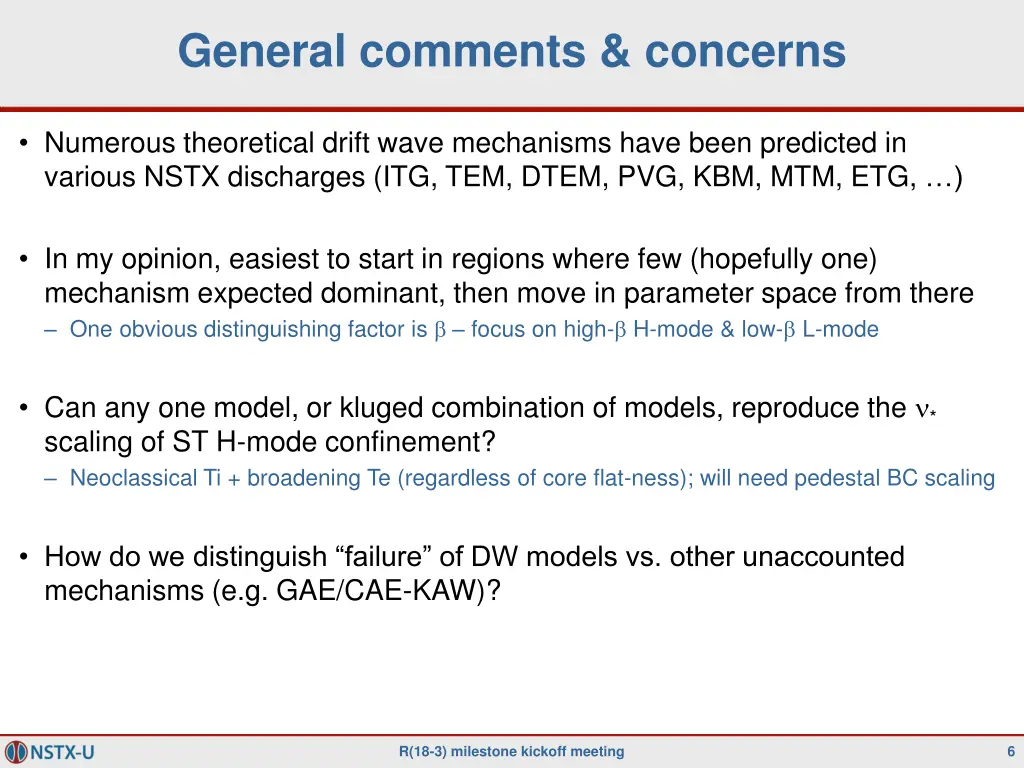
General comments & concerns Numerous theoretical drift wave mechanisms have been predicted in various NSTX discharges (ITG, TEM, DTEM, PVG, KBM, MTM, ETG, ) In my opinion, easiest to start in regions where few (hopefully one) mechanism expected dominant, then move in parameter space from there One obvious distinguishing factor is focus on high- H-mode & low- L-mode Can any one model, or kluged combination of models, reproduce the * scaling of ST H-mode confinement? Neoclassical Ti + broadening Te (regardless of core flat-ness); will need pedestal BC scaling How do we distinguish failure of DW models vs. other unaccounted mechanisms (e.g. GAE/CAE-KAW)? R(18-3) milestone kickoff meeting 6
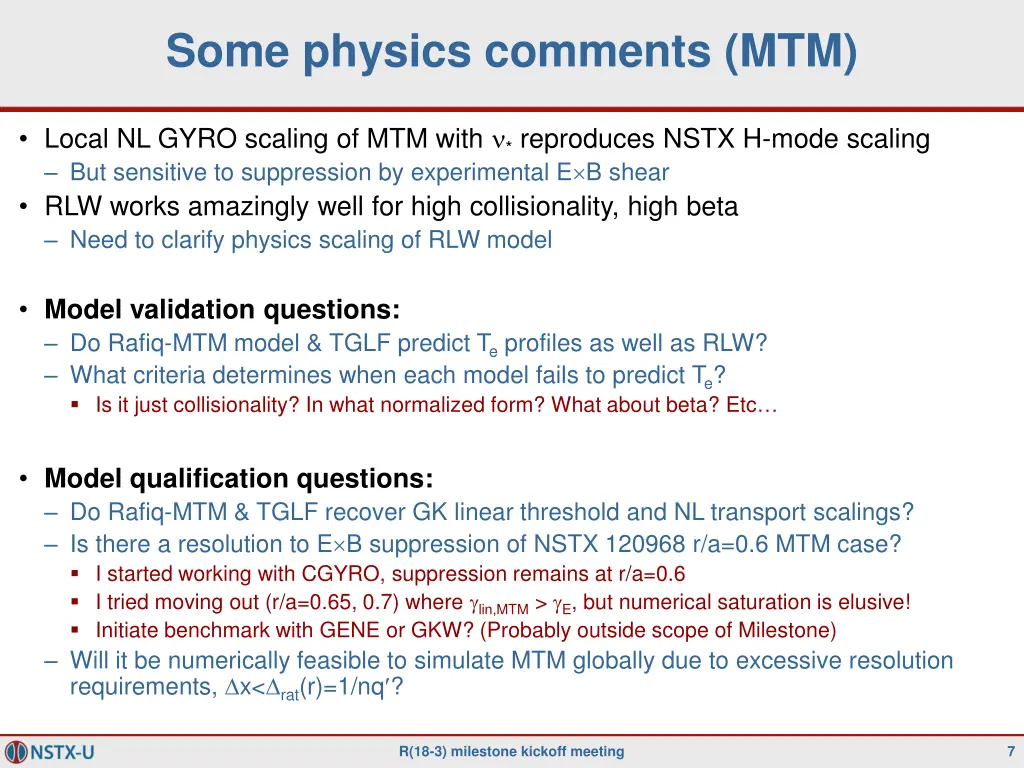
Some physics comments (MTM) Local NL GYRO scaling of MTM with * reproduces NSTX H-mode scaling But sensitive to suppression by experimental E B shear RLW works amazingly well for high collisionality, high beta Need to clarify physics scaling of RLW model Model validation questions: Do Rafiq-MTM model & TGLF predict Te profiles as well as RLW? What criteria determines when each model fails to predict Te? Is it just collisionality? In what normalized form? What about beta? Etc Model qualification questions: Do Rafiq-MTM & TGLF recover GK linear threshold and NL transport scalings? Is there a resolution to E B suppression of NSTX 120968 r/a=0.6 MTM case? I started working with CGYRO, suppression remains at r/a=0.6 I tried moving out (r/a=0.65, 0.7) where lin,MTM > E, but numerical saturation is elusive! Initiate benchmark with GENE or GKW? (Probably outside scope of Milestone) Will it be numerically feasible to simulate MTM globally due to excessive resolution requirements, x< rat(r)=1/nq ? R(18-3) milestone kickoff meeting 7
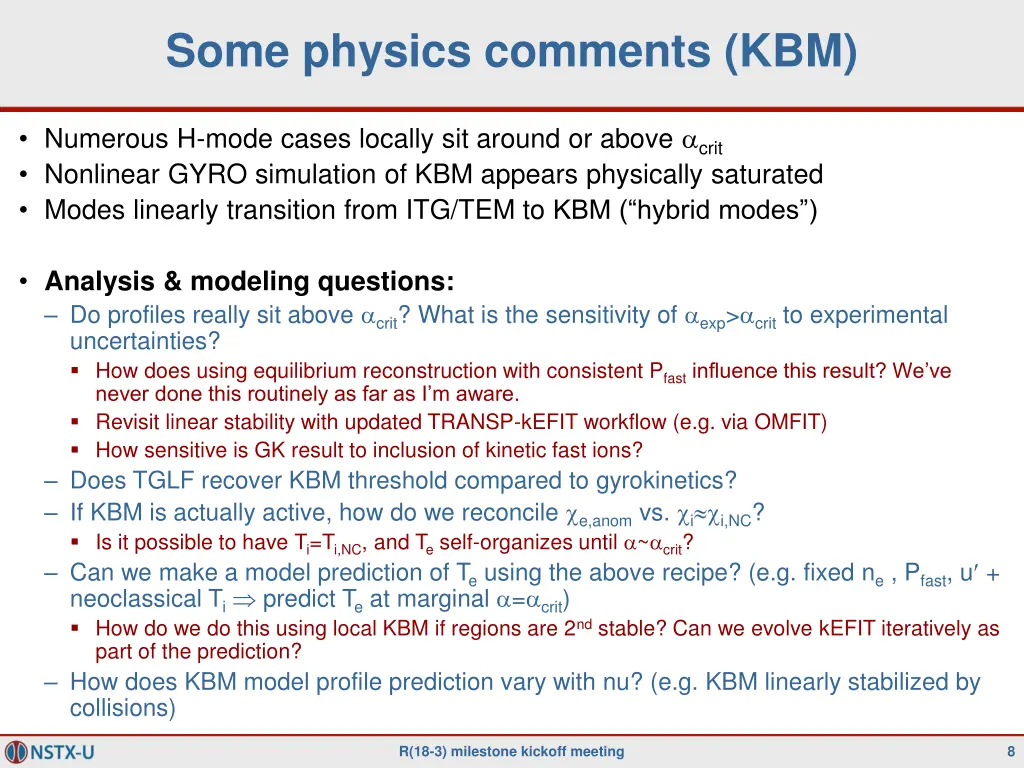
Some physics comments (KBM) Numerous H-mode cases locally sit around or above crit Nonlinear GYRO simulation of KBM appears physically saturated Modes linearly transition from ITG/TEM to KBM ( hybrid modes ) Analysis & modeling questions: Do profiles really sit above crit? What is the sensitivity of exp> crit to experimental uncertainties? How does using equilibrium reconstruction with consistent Pfastinfluence this result? We ve never done this routinely as far as I m aware. Revisit linear stability with updated TRANSP-kEFIT workflow (e.g. via OMFIT) How sensitive is GK result to inclusion of kinetic fast ions? Does TGLF recover KBM threshold compared to gyrokinetics? If KBM is actually active, how do we reconcile e,anom vs. i i,NC? Is it possible to have Ti=Ti,NC, and Te self-organizes until ~ crit? Can we make a model prediction of Te using the above recipe? (e.g. fixed ne , Pfast, u + neoclassical Ti predict Te at marginal = crit) How do we do this using local KBM if regions are 2nd stable? Can we evolve kEFIT iteratively as part of the prediction? How does KBM model profile prediction vary with nu? (e.g. KBM linearly stabilized by collisions) R(18-3) milestone kickoff meeting 8
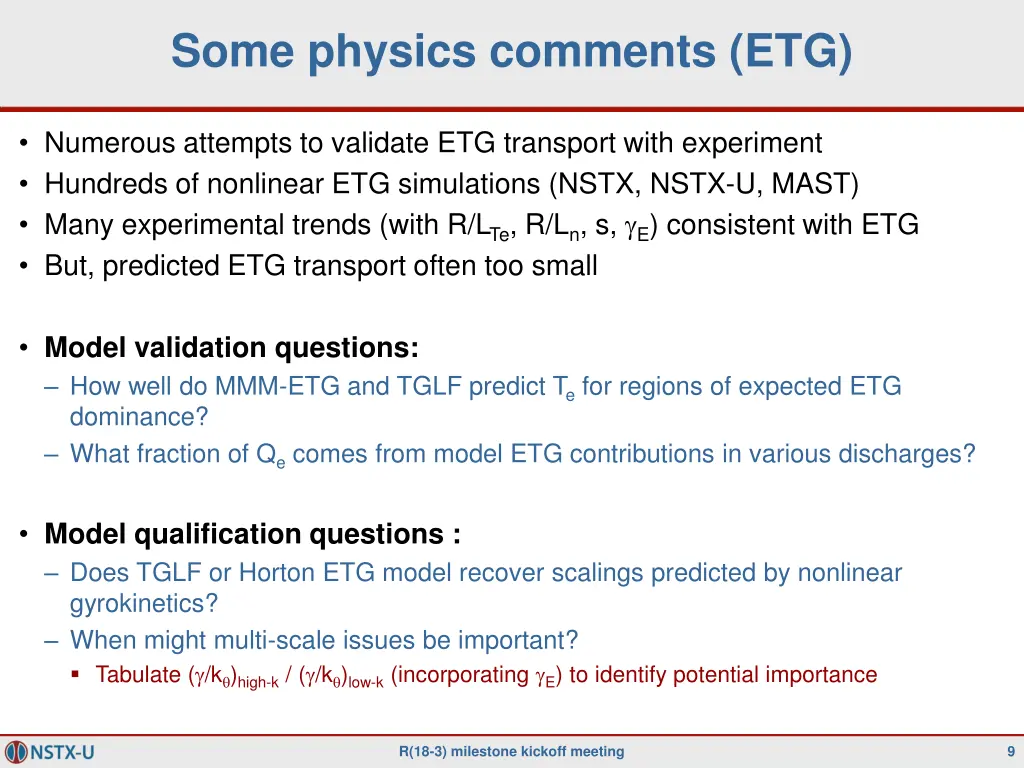
Some physics comments (ETG) Numerous attempts to validate ETG transport with experiment Hundreds of nonlinear ETG simulations (NSTX, NSTX-U, MAST) Many experimental trends (with R/LTe, R/Ln, s, E) consistent with ETG But, predicted ETG transport often too small Model validation questions: How well do MMM-ETG and TGLF predict Te for regions of expected ETG dominance? What fraction of Qe comes from model ETG contributions in various discharges? Model qualification questions : Does TGLF or Horton ETG model recover scalings predicted by nonlinear gyrokinetics? When might multi-scale issues be important? Tabulate ( /k )high-k / ( /k )low-k (incorporating E) to identify potential importance R(18-3) milestone kickoff meeting 9
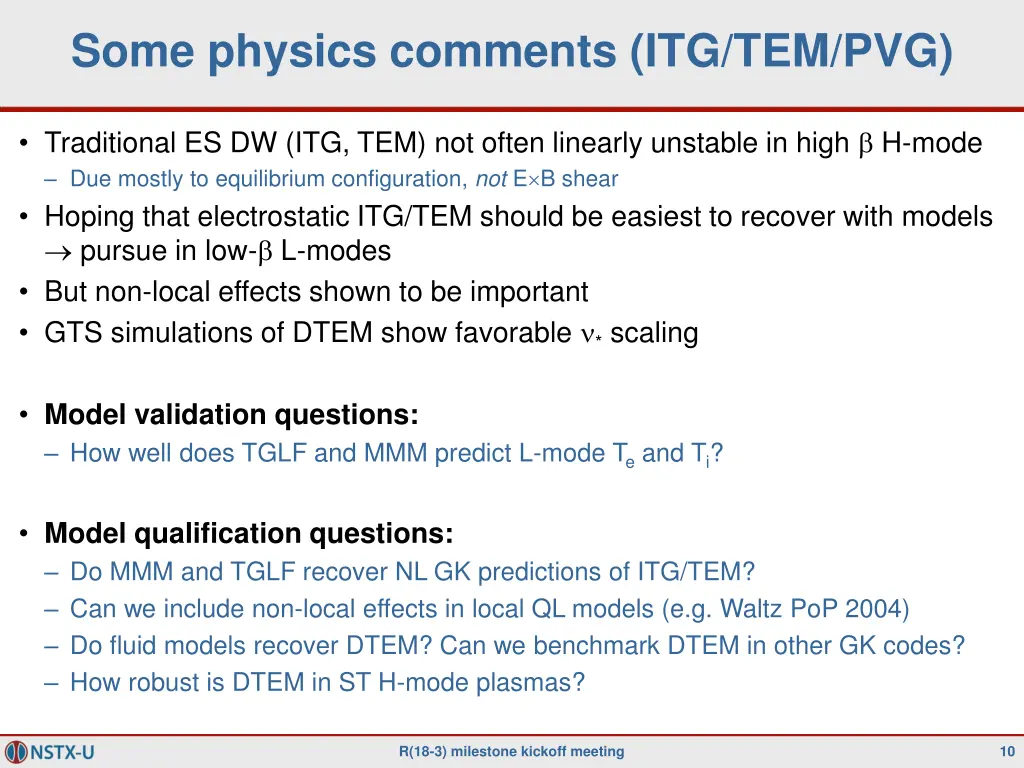
Some physics comments (ITG/TEM/PVG) Traditional ES DW (ITG, TEM) not often linearly unstable in high H-mode Due mostly to equilibrium configuration, not E B shear Hoping that electrostatic ITG/TEM should be easiest to recover with models pursue in low- L-modes But non-local effects shown to be important GTS simulations of DTEM show favorable * scaling Model validation questions: How well does TGLF and MMM predict L-mode Te and Ti? Model qualification questions: Do MMM and TGLF recover NL GK predictions of ITG/TEM? Can we include non-local effects in local QL models (e.g. Waltz PoP 2004) Do fluid models recover DTEM? Can we benchmark DTEM in other GK codes? How robust is DTEM in ST H-mode plasmas? R(18-3) milestone kickoff meeting 10
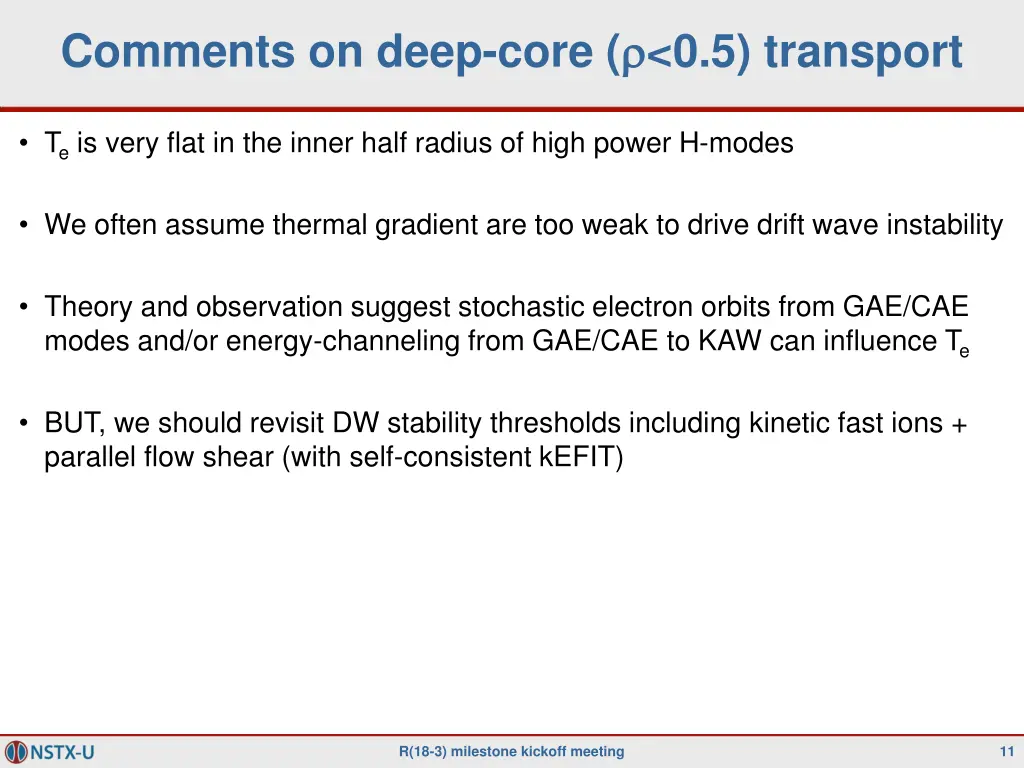
Comments on deep-core ( <0.5) transport Te is very flat in the inner half radius of high power H-modes We often assume thermal gradient are too weak to drive drift wave instability Theory and observation suggest stochastic electron orbits from GAE/CAE modes and/or energy-channeling from GAE/CAE to KAW can influence Te BUT, we should revisit DW stability thresholds including kinetic fast ions + parallel flow shear (with self-consistent kEFIT) R(18-3) milestone kickoff meeting 11
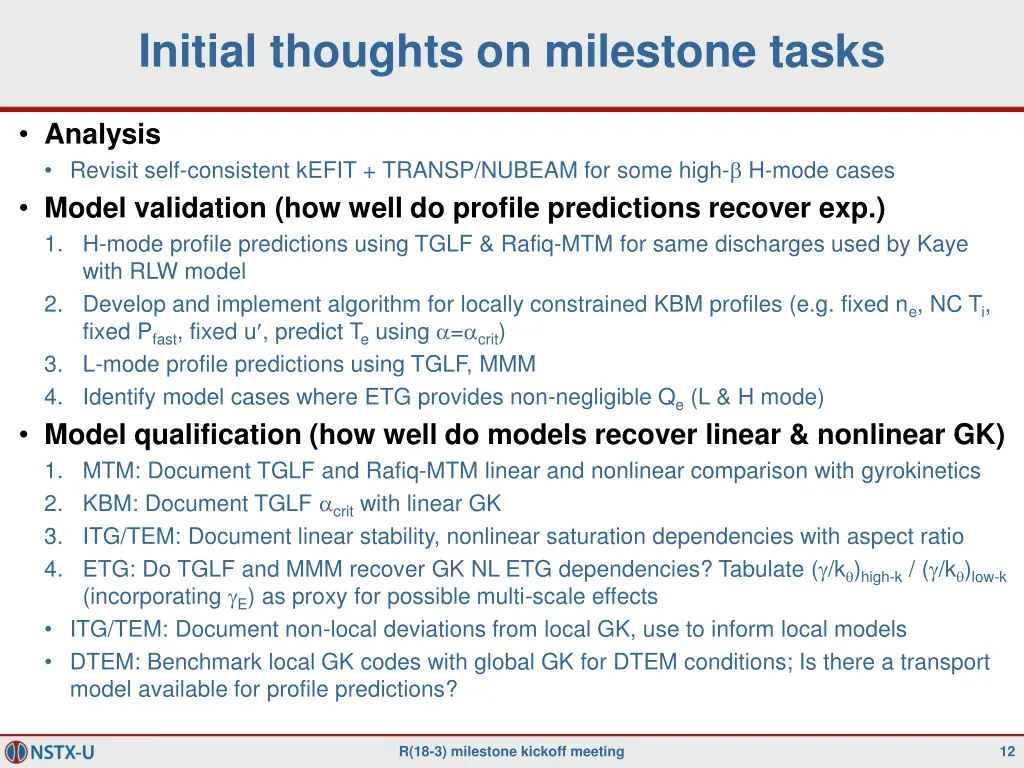
Initial thoughts on milestone tasks Analysis Revisit self-consistent kEFIT + TRANSP/NUBEAM for some high- H-mode cases Model validation (how well do profile predictions recover exp.) 1. H-mode profile predictions using TGLF & Rafiq-MTM for same discharges used by Kaye with RLW model 2. Develop and implement algorithm for locally constrained KBM profiles (e.g. fixed ne, NC Ti, fixed Pfast, fixed u , predict Te using = crit) 3. L-mode profile predictions using TGLF, MMM 4. Identify model cases where ETG provides non-negligible Qe (L & H mode) Model qualification (how well do models recover linear & nonlinear GK) 1. MTM: Document TGLF and Rafiq-MTM linear and nonlinear comparison with gyrokinetics 2. KBM: Document TGLF crit with linear GK 3. ITG/TEM: Document linear stability, nonlinear saturation dependencies with aspect ratio 4. ETG: Do TGLF and MMM recover GK NL ETG dependencies? Tabulate ( /k )high-k / ( /k )low-k (incorporating E) as proxy for possible multi-scale effects ITG/TEM: Document non-local deviations from local GK, use to inform local models DTEM: Benchmark local GK codes with global GK for DTEM conditions; Is there a transport model available for profile predictions? R(18-3) milestone kickoff meeting 12
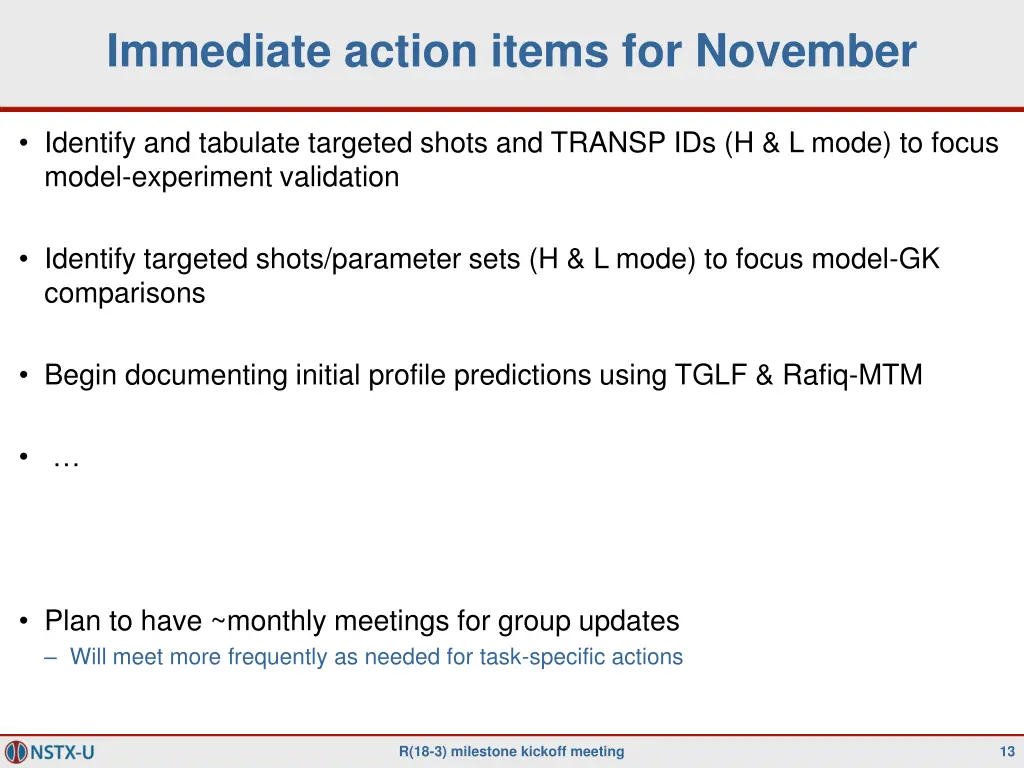
Immediate action items for November Identify and tabulate targeted shots and TRANSP IDs (H & L mode) to focus model-experiment validation Identify targeted shots/parameter sets (H & L mode) to focus model-GK comparisons Begin documenting initial profile predictions using TGLF & Rafiq-MTM Plan to have ~monthly meetings for group updates Will meet more frequently as needed for task-specific actions R(18-3) milestone kickoff meeting 13
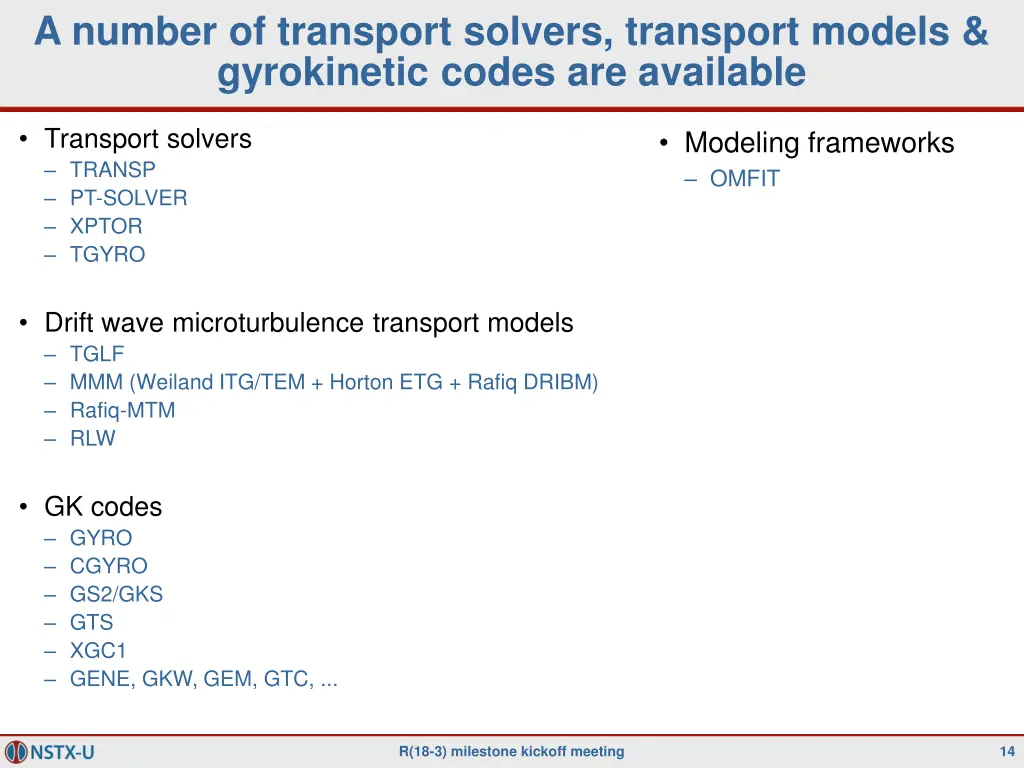
A number of transport solvers, transport models & gyrokinetic codes are available Transport solvers TRANSP PT-SOLVER XPTOR TGYRO Modeling frameworks OMFIT Drift wave microturbulence transport models TGLF MMM (Weiland ITG/TEM + Horton ETG + Rafiq DRIBM) Rafiq-MTM RLW GK codes GYRO CGYRO GS2/GKS GTS XGC1 GENE, GKW, GEM, GTC, ... R(18-3) milestone kickoff meeting 14
References R(18-3) milestone kickoff meeting 15
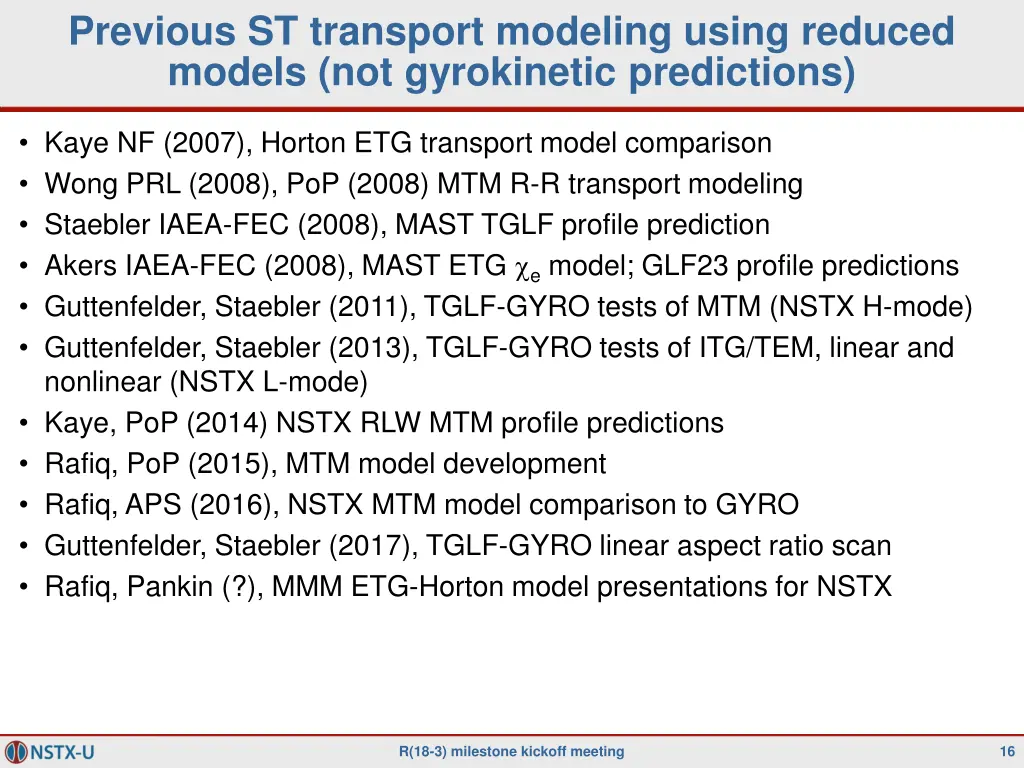
Previous ST transport modeling using reduced models (not gyrokinetic predictions) Kaye NF (2007), Horton ETG transport model comparison Wong PRL (2008), PoP (2008) MTM R-R transport modeling Staebler IAEA-FEC (2008), MAST TGLF profile prediction Akers IAEA-FEC (2008), MAST ETG e model; GLF23 profile predictions Guttenfelder, Staebler (2011), TGLF-GYRO tests of MTM (NSTX H-mode) Guttenfelder, Staebler (2013), TGLF-GYRO tests of ITG/TEM, linear and nonlinear (NSTX L-mode) Kaye, PoP (2014) NSTX RLW MTM profile predictions Rafiq, PoP (2015), MTM model development Rafiq, APS (2016), NSTX MTM model comparison to GYRO Guttenfelder, Staebler (2017), TGLF-GYRO linear aspect ratio scan Rafiq, Pankin (?), MMM ETG-Horton model presentations for NSTX R(18-3) milestone kickoff meeting 16
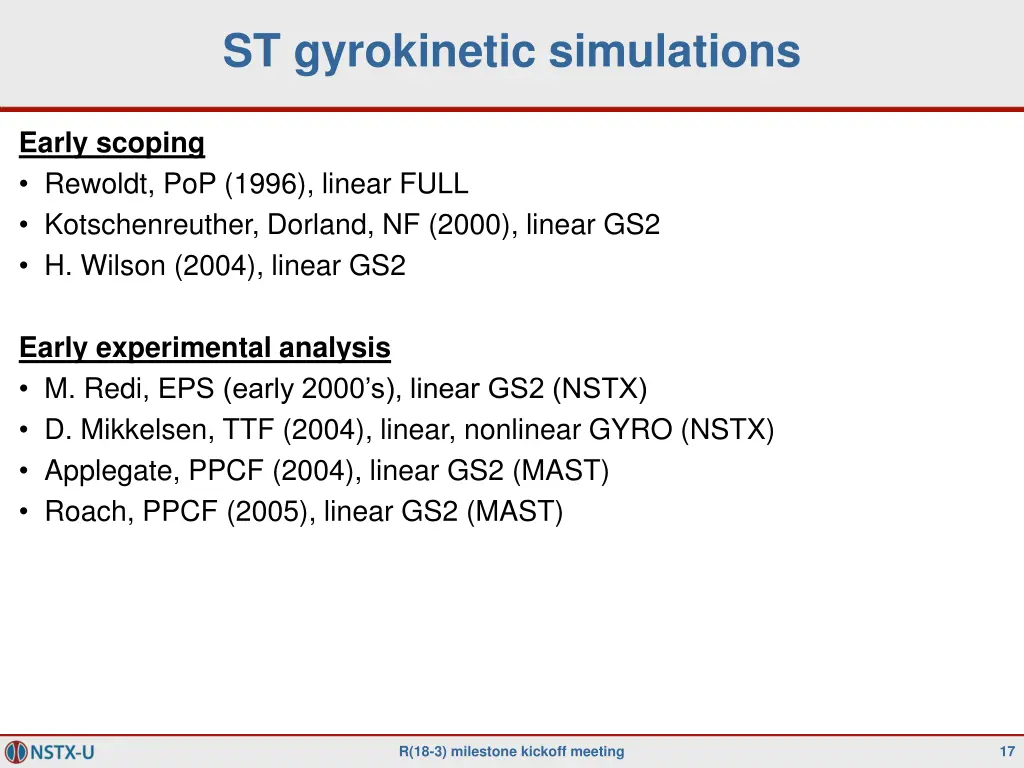
ST gyrokinetic simulations Early scoping Rewoldt, PoP (1996), linear FULL Kotschenreuther, Dorland, NF (2000), linear GS2 H. Wilson (2004), linear GS2 Early experimental analysis M. Redi, EPS (early 2000 s), linear GS2 (NSTX) D. Mikkelsen, TTF (2004), linear, nonlinear GYRO (NSTX) Applegate, PPCF (2004), linear GS2 (MAST) Roach, PPCF (2005), linear GS2 (MAST) R(18-3) milestone kickoff meeting 17
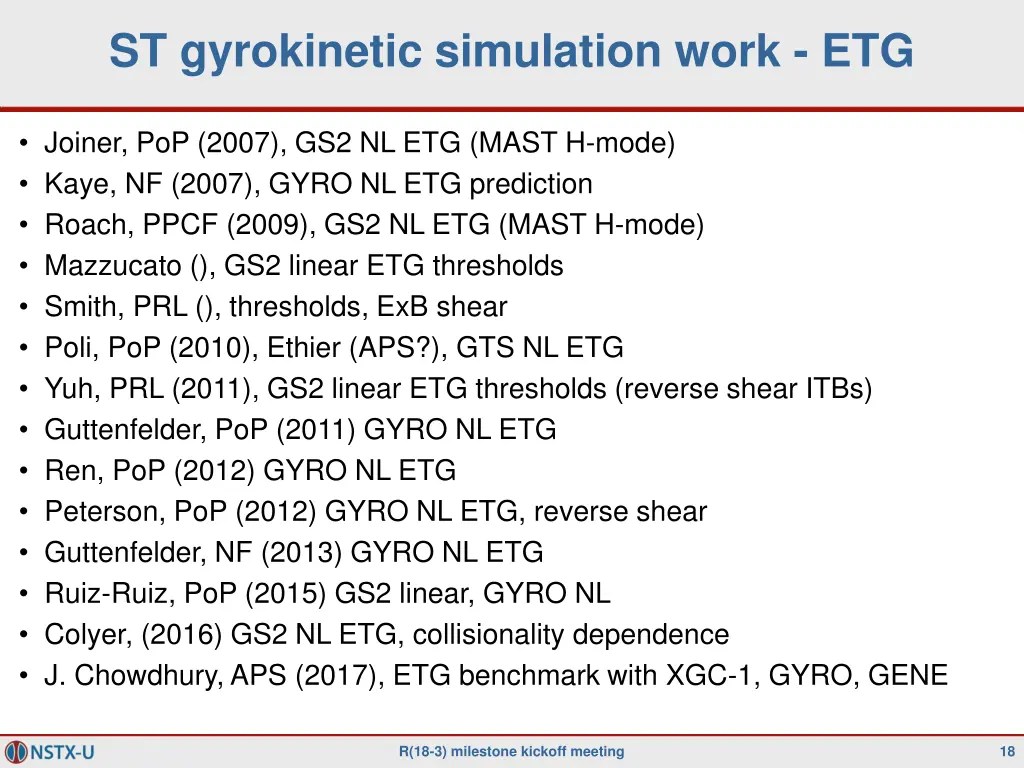
ST gyrokinetic simulation work - ETG Joiner, PoP (2007), GS2 NL ETG (MAST H-mode) Kaye, NF (2007), GYRO NL ETG prediction Roach, PPCF (2009), GS2 NL ETG (MAST H-mode) Mazzucato (), GS2 linear ETG thresholds Smith, PRL (), thresholds, ExB shear Poli, PoP (2010), Ethier (APS?), GTS NL ETG Yuh, PRL (2011), GS2 linear ETG thresholds (reverse shear ITBs) Guttenfelder, PoP (2011) GYRO NL ETG Ren, PoP (2012) GYRO NL ETG Peterson, PoP (2012) GYRO NL ETG, reverse shear Guttenfelder, NF (2013) GYRO NL ETG Ruiz-Ruiz, PoP (2015) GS2 linear, GYRO NL Colyer, (2016) GS2 NL ETG, collisionality dependence J. Chowdhury, APS (2017), ETG benchmark with XGC-1, GYRO, GENE R(18-3) milestone kickoff meeting 18
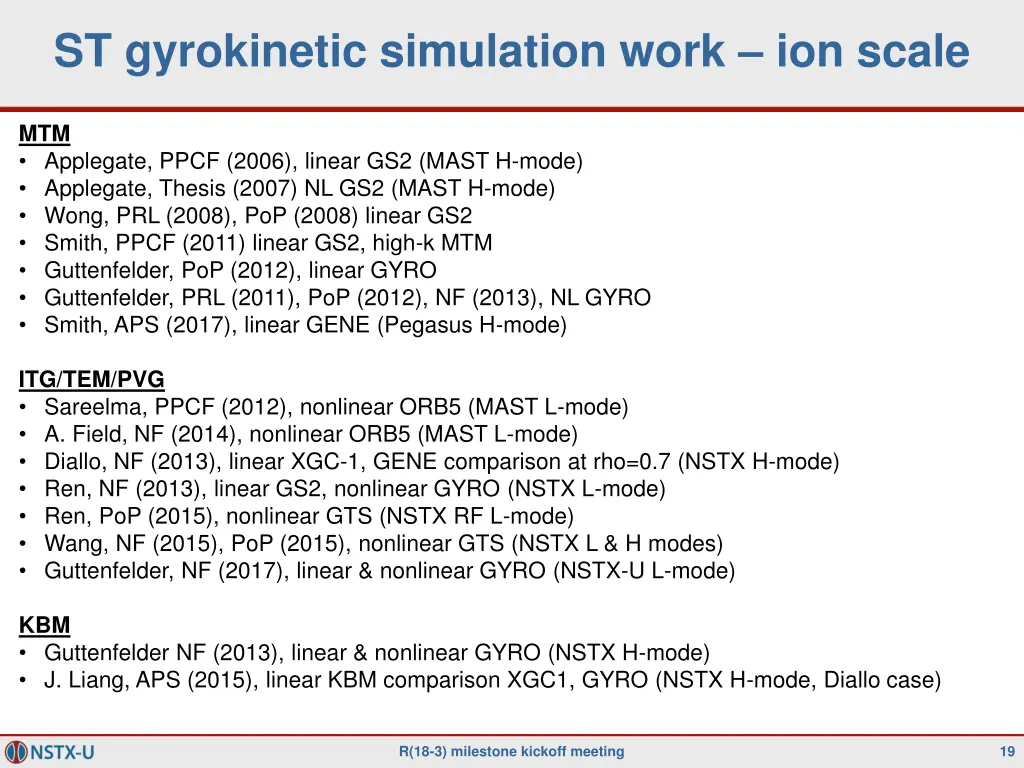
ST gyrokinetic simulation work ion scale MTM Applegate, PPCF (2006), linear GS2 (MAST H-mode) Applegate, Thesis (2007) NL GS2 (MAST H-mode) Wong, PRL (2008), PoP (2008) linear GS2 Smith, PPCF (2011) linear GS2, high-k MTM Guttenfelder, PoP (2012), linear GYRO Guttenfelder, PRL (2011), PoP (2012), NF (2013), NL GYRO Smith, APS (2017), linear GENE (Pegasus H-mode) ITG/TEM/PVG Sareelma, PPCF (2012), nonlinear ORB5 (MAST L-mode) A. Field, NF (2014), nonlinear ORB5 (MAST L-mode) Diallo, NF (2013), linear XGC-1, GENE comparison at rho=0.7 (NSTX H-mode) Ren, NF (2013), linear GS2, nonlinear GYRO (NSTX L-mode) Ren, PoP (2015), nonlinear GTS (NSTX RF L-mode) Wang, NF (2015), PoP (2015), nonlinear GTS (NSTX L & H modes) Guttenfelder, NF (2017), linear & nonlinear GYRO (NSTX-U L-mode) KBM Guttenfelder NF (2013), linear & nonlinear GYRO (NSTX H-mode) J. Liang, APS (2015), linear KBM comparison XGC1, GYRO (NSTX H-mode, Diallo case) R(18-3) milestone kickoff meeting 19
Extra slides R(18-3) milestone kickoff meeting 20
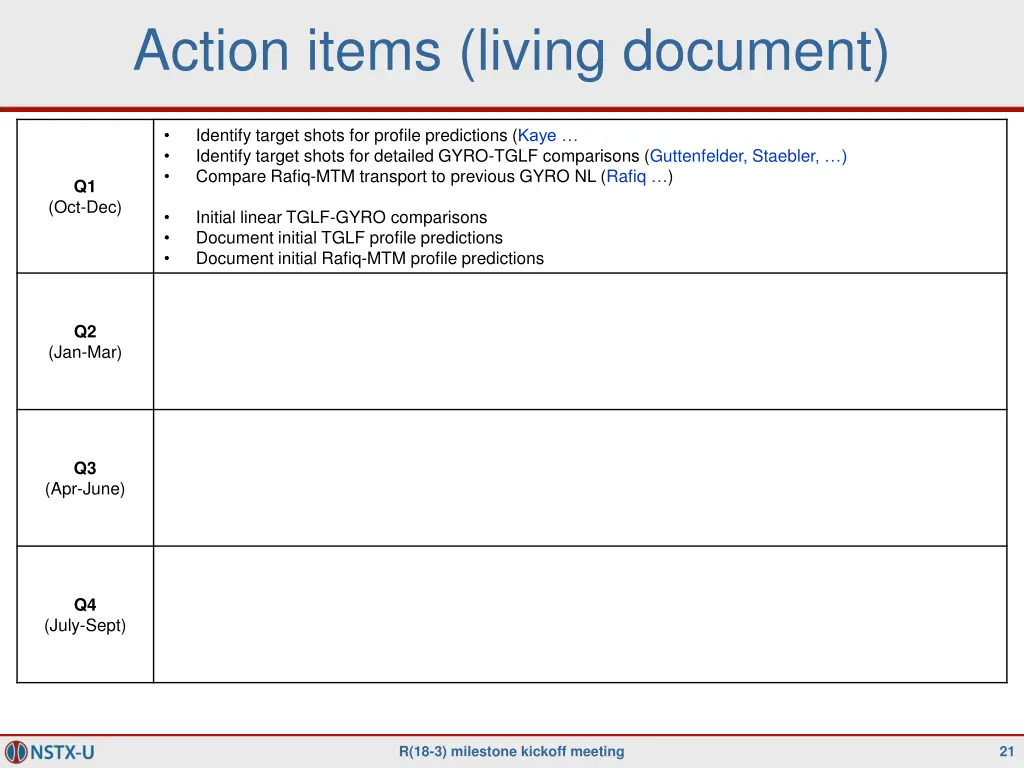
Action items (living document) Identify target shots for profile predictions (Kaye Identify target shots for detailed GYRO-TGLF comparisons (Guttenfelder, Staebler, ) Compare Rafiq-MTM transport to previous GYRO NL (Rafiq ) Q1 (Oct-Dec) Initial linear TGLF-GYRO comparisons Document initial TGLF profile predictions Document initial Rafiq-MTM profile predictions Q2 (Jan-Mar) Q3 (Apr-June) Q4 (July-Sept) R(18-3) milestone kickoff meeting 21