Understanding Entity Relationship Model in Database Management Systems
Learn about Entity Relationship Model (ER-Model) which involves entities, attributes, relationships, keys, and more in database design. Explore the components, types, and representation of entities in ER diagrams. Dive into the concepts of weak entities and attributes in database management systems.

Download Presentation

Please find below an Image/Link to download the presentation.
The content on the website is provided AS IS for your information and personal use only. It may not be sold, licensed, or shared on other websites without obtaining consent from the author. If you encounter any issues during the download, it is possible that the publisher has removed the file from their server.
You are allowed to download the files provided on this website for personal or commercial use, subject to the condition that they are used lawfully. All files are the property of their respective owners.
The content on the website is provided AS IS for your information and personal use only. It may not be sold, licensed, or shared on other websites without obtaining consent from the author.
E N D
Presentation Transcript
UG SECOND YEAR SEMESTER -IV UNIT-III TOPIC : Data Base Management System (Entity Relationship Model) NAME: Mr.RATIKANTA SA (Faculty of Commerce)
Entity Relationship Model (ER-Model) An Entity relationship model (ER model) describes the structure of a database with the help of a diagram ,which is known as Entity Relationship Diagram (ER Diagram).It consists of a collection of basic objects ,called entities(which is distinguishable from other objects)
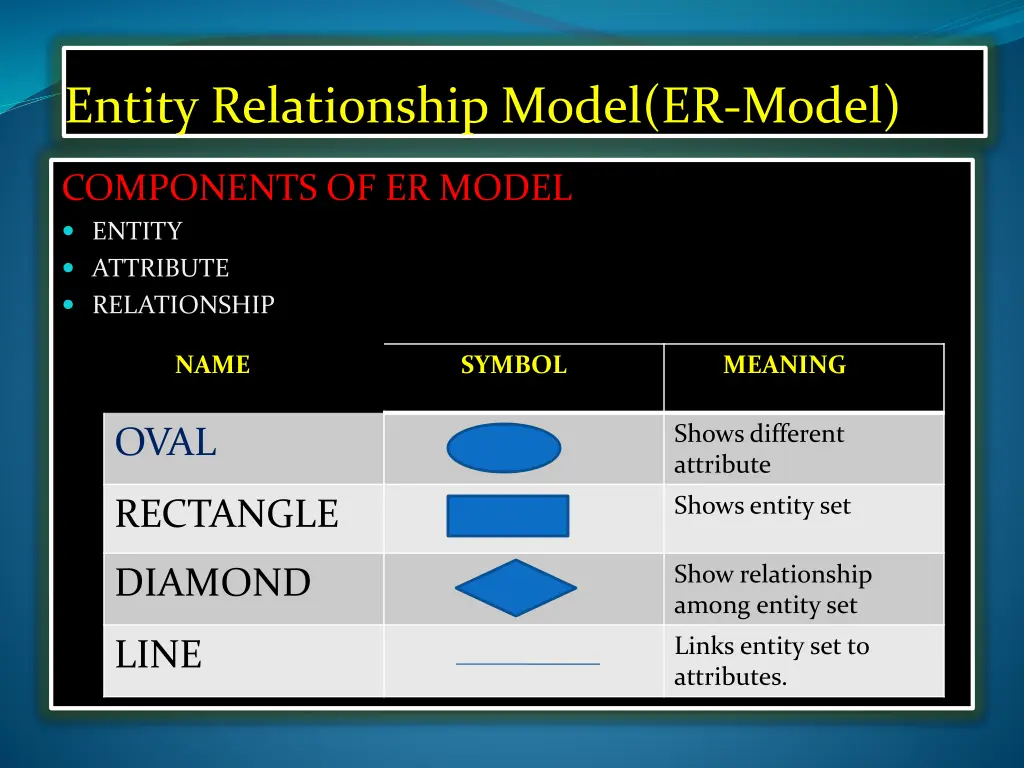
Entity Relationship Model(ER-Model) COMPONENTS OF ER MODEL ENTITY ATTRIBUTE RELATIONSHIP NAME SYMBOL MEANING Shows different attribute OVAL Shows entity set RECTANGLE Show relationship among entity set DIAMOND Links entity set to attributes. LINE
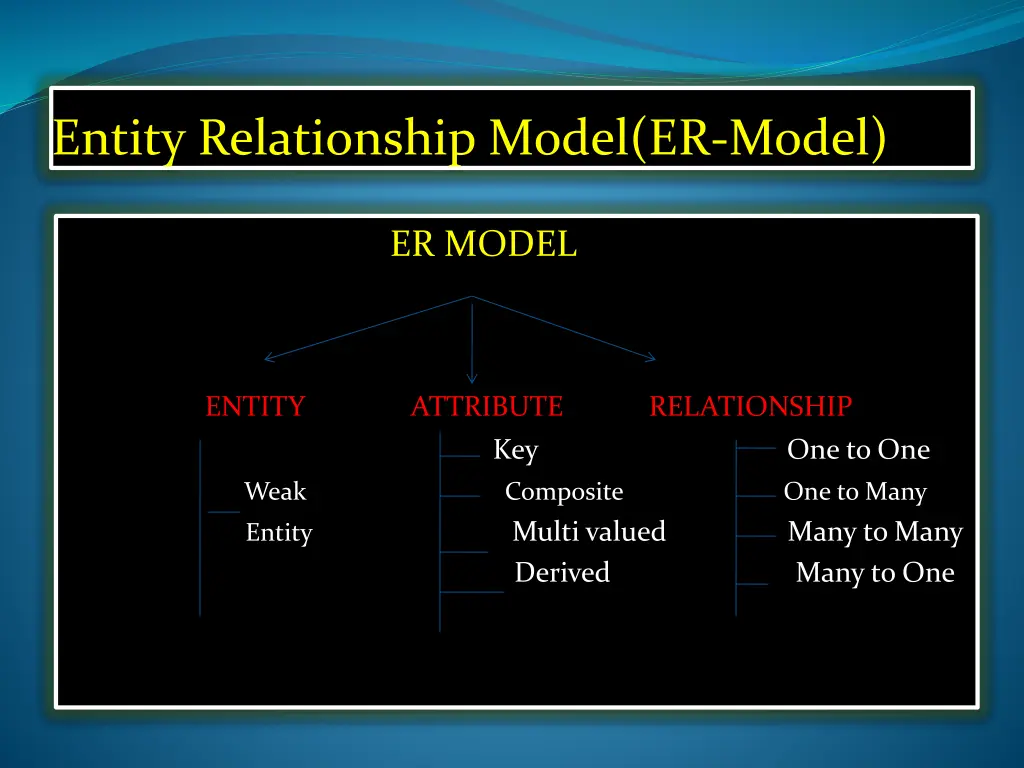
Entity Relationship Model(ER-Model) ER MODEL ENTITY ATTRIBUTE RELATIONSHIP Key One to One Weak Composite One to Many Entity Multi valued Many to Many Derived Many to One
Entity Relationship Model (ER-Model ENTITY An entity is an object or component of data. An entity is represented as rectangle in an ER Diagram.
Entity Relationship Model ( ER-Model) WEAK ENTITY An entity that cannot be uniquely identified by its own attributes and relies on the relationship with other entity is called weak entity. The weak entity is represented by a double rectangle.
Entity Relationship Model (ER-Model) ATTRIBUTE An attribute describes the property of an entity .An attribute is represented as Oval in an ER diagram . There are four types of attributes.
Entity Relationship Model ( ER-Model) KEY ATTRIBUTE A key attribute can uniquely identify an entity from an entity set .key attribute is represented by oval same as other attributes however the text of key attribute is underlined.
Entity Relationship Model (ER-Model) COMPOSITE ATTRIBUTE An attribute that is a combination of other attribute is known as composite attribute .
Entity Relationship Model (ER-Model) MULTIVALUED ATTRIBUTE An attribute that can hold multiple values is known as multi valued attribute . It is represented with double ovals in an ER diagram.
Entity Relationship Model (ER-Model) DERIVED ATTRIBUTE A derived attribute is one whose value is dynamic and derived from another attribute .It is represented by dashed oval in an ER diagram.
Entity Relationship Model(ER-Model) RELATIONSHIP Cardinality :Defines the numerical attributes of the relationship between two entities or entity sets. A relationship is represented by diamond shape in ER diagram , it shows the relationship among entities.
Entity Relationship Model (ER-Model) ONE TO ONE RELATIONSHIP When a single instance of an entity is associated with a single instance of another entity then its called one to one relationship.
Entity Relationship Model (ER-Model) ONE TO MANY RELATIONSHIP When a single instance of an entity is associated with more than one instance of another entity then it is called one to many relationship.
Entity Relationship Model(ER-Model) MANY TO ONE RELATIONSHIP When more than one instances of an entity is associated with a single instance of another entity then it is called many to one relationship.
Entity Relationship Model (ER-Model) MANY TO MANY RELATIONSHIP When more than one instance of an entity is associated with more than one instances of another entity then it is called many to many relationship.
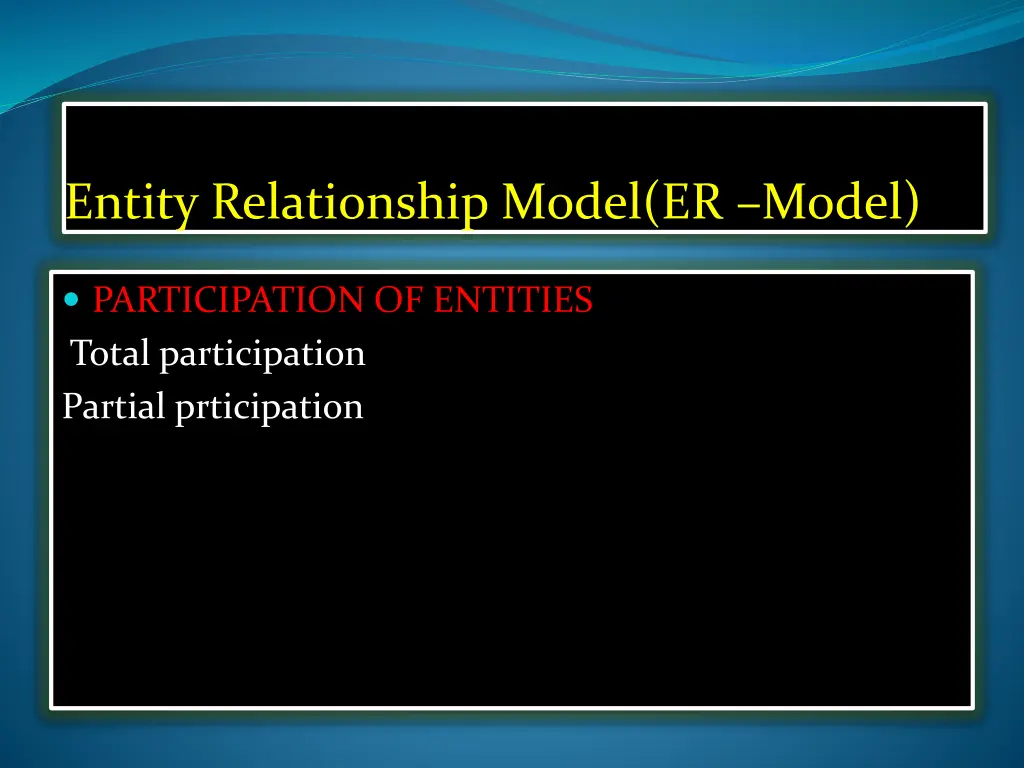
Entity Relationship Model (ER-Model) PARTICIPATION CONSTRAINTS IN RELATIONSHIP Total participation Partial participation
Entity Relationship Model (ER-Model) Steps to create an ERD Entity identification 2. Relationship identification 3. Cardinality identification 4. Identify attribute 5. Create ERD 1.
Entity Relationship Model (ER-Model) ENTITY IDENTIFICATION STUDENT COURSE PROFESSOR
Entity Relationship Model(ER-Model) RELATIONSHIP IDENTIFICATION A student is assigned a couse Professor delivers a course
Entity Relationship Model (ER-Model) CARDINALITY IDENTIFICATION A student can be assigned multiple courses. A professor can deliver only one course
Entity Relationship Model(ER Model) PARTICIPATION OF ENTITIES Total participation Partial prticipation
Entity Relationship Model (ER-Model) IDENTIFY ATTRIBUTES You need to study the files , forms, reports , data currently maintained by the organization to identify Attributes.