Enzymes are essential biocatalysts synthesized by living cells to increase the rate of chemical reactions without undergoing changes themselves. Learn about the structure, function, and classification of enzymes along with their vital role in biochemistry. Explore the active sites, enzyme-substrate complex theory, and the applications of enzymes in various fields.
Please find below an Image/Link to download the presentation.
The content on the website is provided AS IS for your information and personal use only. It may not be sold, licensed, or shared on other websites without obtaining consent from the author. If you encounter any issues during the download, it is possible that the publisher has removed the file from their server.
You are allowed to download the files provided on this website for personal or commercial use, subject to the condition that they are used lawfully. All files are the property of their respective owners.
The content on the website is provided AS IS for your information and personal use only. It may not be sold, licensed, or shared on other websites without obtaining consent from the author.
E N D
Presentation Transcript
ENZYMES Sana Naaz Fatima Assistant Professor Dept. Of Pharmaceutics St.Peter s Institute Of Pharmaceutical Sciences
DEFINITATION:- Enzymes are biocatalysts the catalysts of life. A catalyst is defined as a substance that increases the velocity or rate of a chemical reaction without itself undergoing any change in the overall process. Enzymes may be defined as biocatalysts synthesized by living cells. They are protein in nature colloidal and thermolabile in character, and specific in their action. Some special RNA species also act as enzymes and are called Ribozymes e.g. hammerhead ribozyme.
The functional unit of the enzyme is known as holoenzyme which is often made up of apoenzyme (the protein part) and a coenzyme (non-protein organic part). Holoenzyme (active enzyme) Apoenzyme + Coenzyme (protein part) (non-protein part)
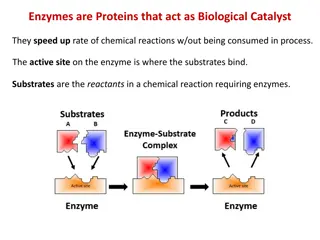
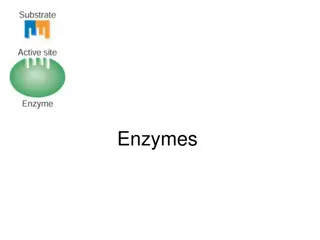
ACTIVE SITE The active site (or active centre) of an enzyme represents as the small region at which the substrate(s) binds and participates in the catalysis. SUBSTRATE The reactant in biochemical reaction is termed as substrate. When a substrate binds to an enzyme it forms an enzyme substrate complex.
MODE OF ACTION OF ENZYMES:- Enzyme substrate-complex theory (most accepted) has been proposed. Michaellis and Menton (1913) proposed Enzyme substrate complex theory to explain mode of enzyme action. Enzymes have certain active sites for the attachment of substrate molecule where an enzyme can form an intimate relationship with substrate. Enzyme forms a weakly bound compound with substrate which on hydrolysis decomposes into the reaction products.
NOMENCLATURE AND CLASSIFICATION:- Since 1964, the IUB system of enzyme classification has been in force. Enzymes are divided into six major classes (in that order). 1. Oxidoreductases : Enzymes involved in oxidation-reduction reactions. 2. Transferases : Enzymes that catalyze the transfer of functional groups. 3. Hydrolases : Enzymes that bring about hydrolysis of various compounds. 4. Lyases : Enzymes specialized in the addition or removal of water, ammonia, CO2. 5. Isomerases : Enzymes involved in all the isomerization reactions. 6. Ligases : Enzymes catalyzing the synthetic reactions (Greek : ligate to bind) where two molecules are joined together and ATP is used.
APPLICATIONS OF ENZYMES Certain enzymes are useful as therapeutic agents, analytical reagents, in genetic manipulations and for industrial applications Enzymes as therapeutic agents 1. Streptokinase prepared from streptococcus is useful for clearing the blood clots. The enzyme asparaginase is used in the treatment of leukemias. 2.
Enzymes as analytical reagents Some enzymes are useful in the clinical laboratory for the measurement of substrates, drugs, and even the activities of other enzymes A good example is the estimation of plasma glucose by glucose oxidase and peroxidase method. Enzymes as diagnostic agents Estimation of enzyme activities in biological fluids (particularly plasma/serum) is of great clinical importance. e.g. lipoprotein lipase, plasmin, thrombin, choline esterase, ceruloplasmin, amylase, pepsin, trypsin, lipase, . lactate dehydrogenase, transaminases, acid and alkaline phosphatases, creatine phosphokinase etc.