Understanding Financial Aid: Application, Eligibility, and Sources
Discover the intricacies of student financial aid, from categories like merit and need-based aid to the application process through FAFSA. Learn about eligibility determination, award notifications, and the advantages of using FAFSA online. Essential tips for gathering documents and obtaining FSA IDs are also included.

Uploaded on | 0 Views
Download Presentation

Please find below an Image/Link to download the presentation.
The content on the website is provided AS IS for your information and personal use only. It may not be sold, licensed, or shared on other websites without obtaining consent from the author. If you encounter any issues during the download, it is possible that the publisher has removed the file from their server.
You are allowed to download the files provided on this website for personal or commercial use, subject to the condition that they are used lawfully. All files are the property of their respective owners.
The content on the website is provided AS IS for your information and personal use only. It may not be sold, licensed, or shared on other websites without obtaining consent from the author.
E N D
Presentation Transcript
Financial Aid Presentation Grand Island High School Sean Hudson Assistant Director of Student Financial Aid Canisius College
Topics for Discussion Categories of Financial Aid How to Apply How Is Eligibility Determined Sources of Financial Aid Award Notification
Section I Categories of Financial Aid
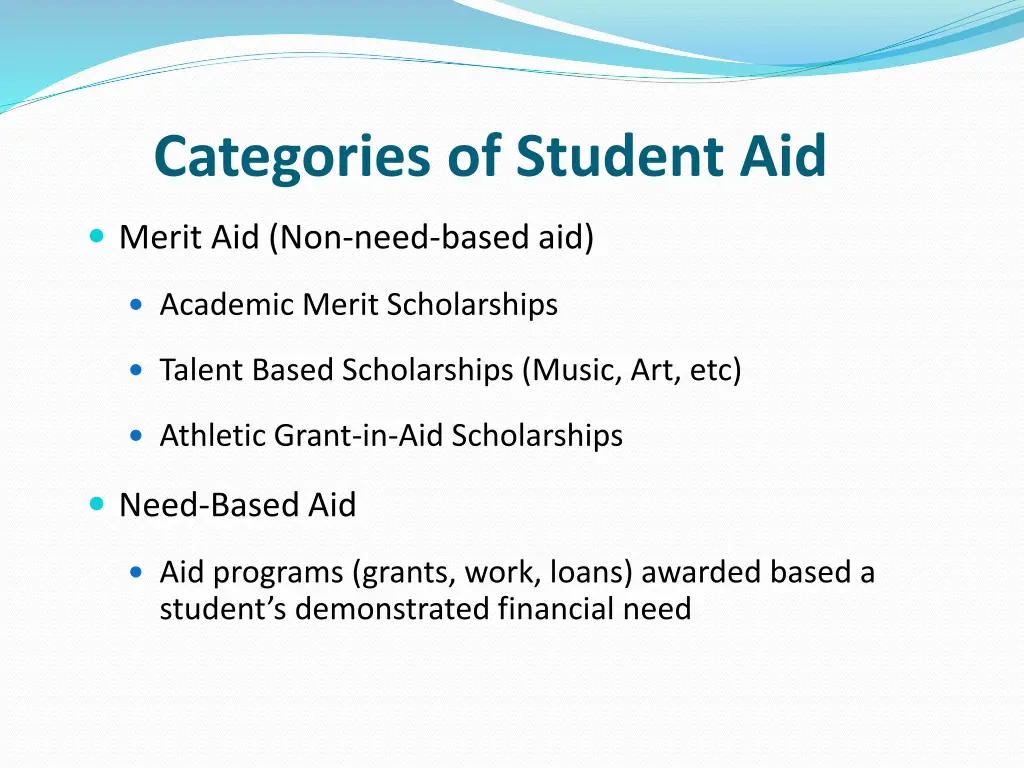
Categories of Student Aid Merit Aid (Non-need-based aid) Academic Merit Scholarships Talent Based Scholarships (Music, Art, etc) Athletic Grant-in-Aid Scholarships Need-Based Aid Aid programs (grants, work, loans) awarded based a student s demonstrated financial need
Section II How to Apply For Need Based Aid
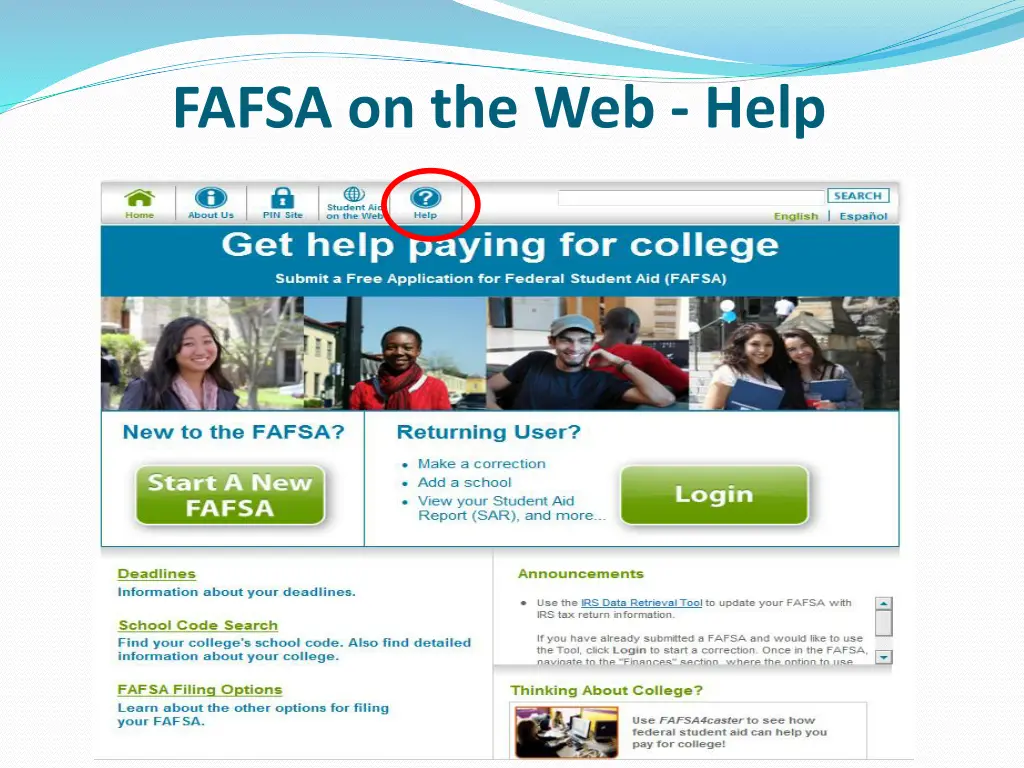
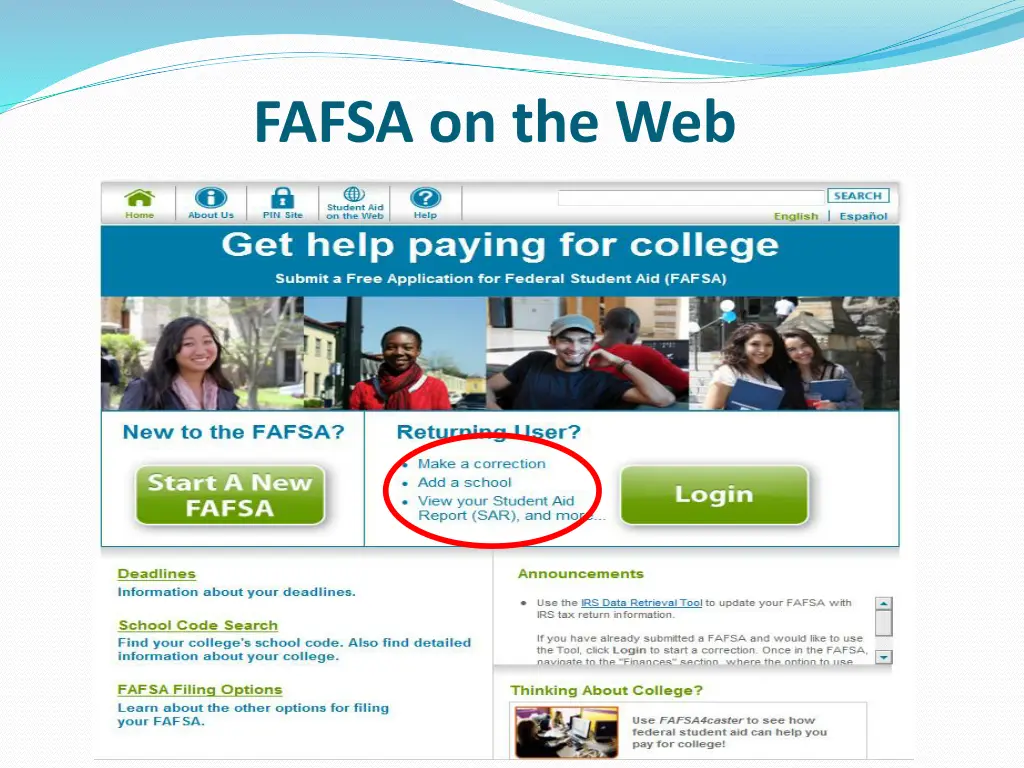
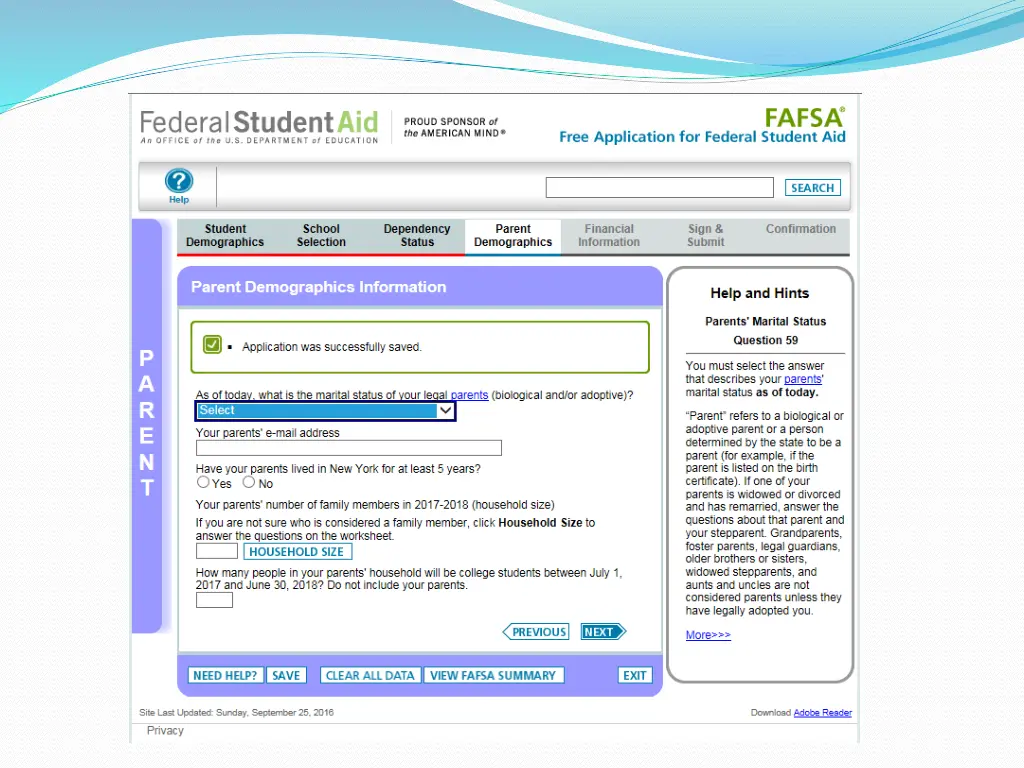
FREE Application for Federal Student Aid (FAFSA) Determines an Expected Family Contribution (EFC). Student Aid Report (SAR) Electronic version of FAFSA FAFSA on the web at www.fafsa.gov Limited distribution of Paper FAFSA
FAFSA (Cont.) Allows students to be considered for Federal Student Aid (FSA) Programs Used by colleges, states and some scholarship programs to determine need-based eligibility Required to Apply for N.Y.S. Financial Aid (TAP Program) Complete after October 1st
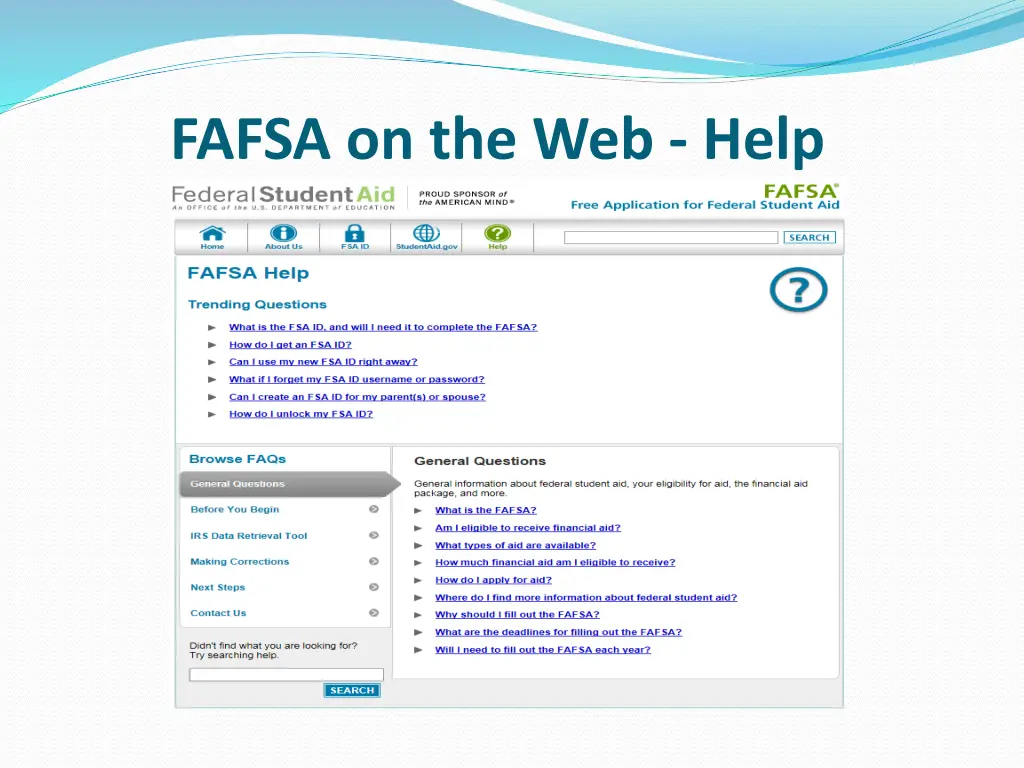
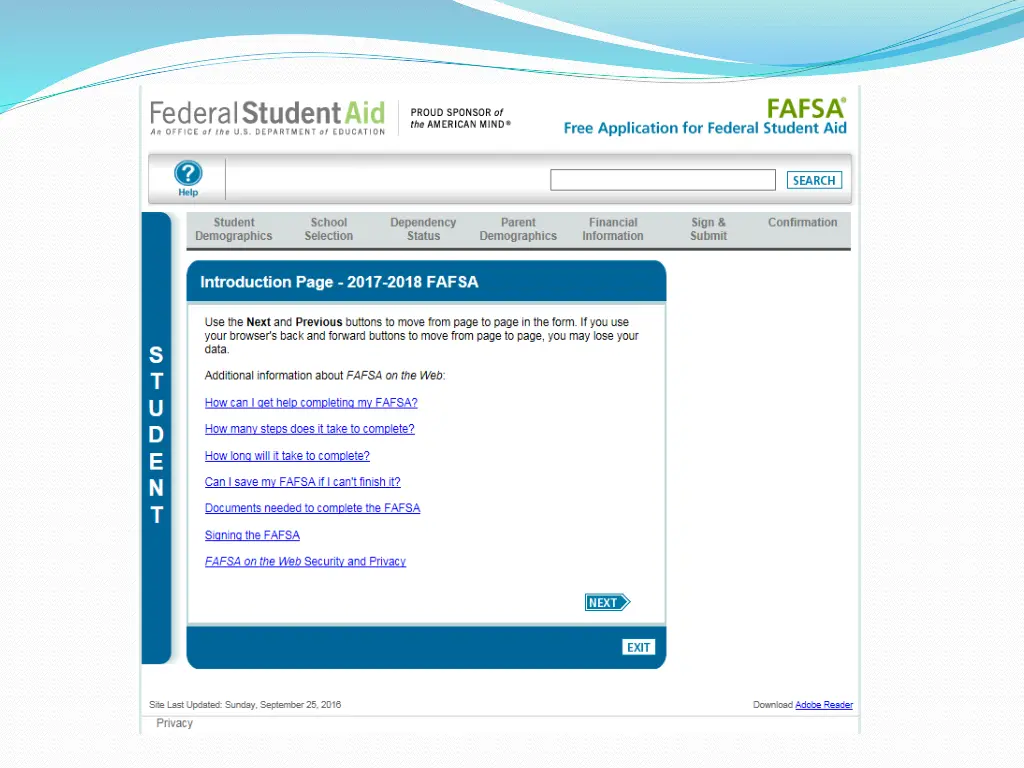
Advantages of FAFSA on the Web More timely submission of original and corrected information Built-in edits to prevent errors Skip logic allows applicant to skip unnecessary questions More detailed instructions & help for common questions Ability to check applicant status on-line Simplified application process in the future Ability to list up to ten colleges/universities
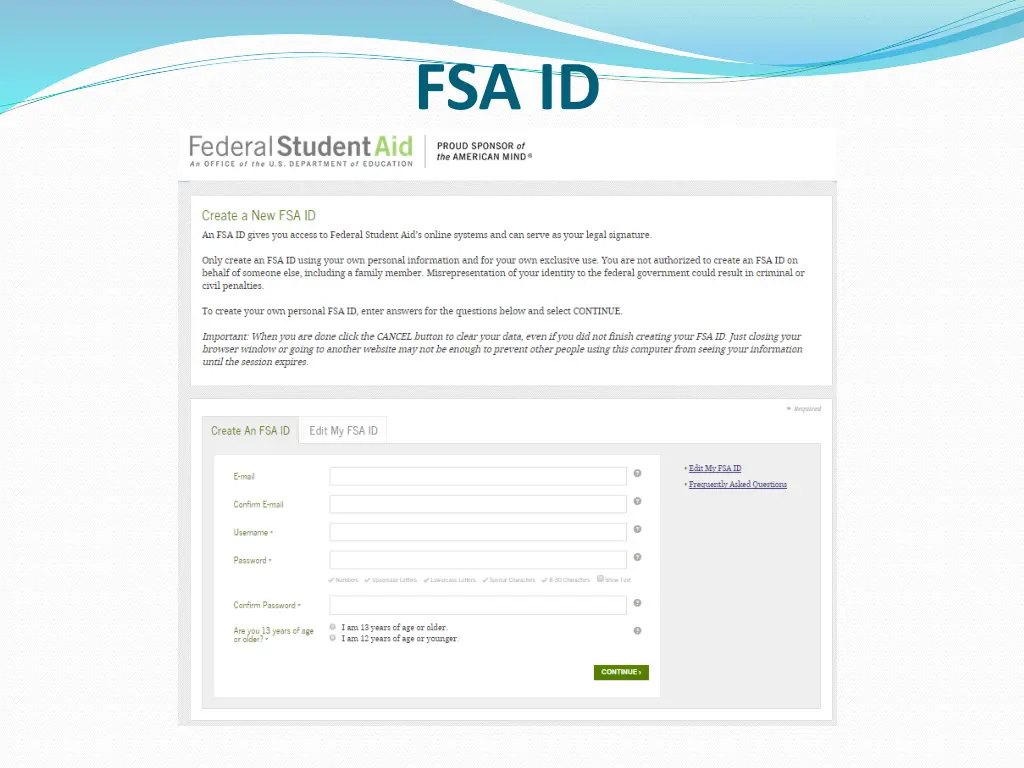
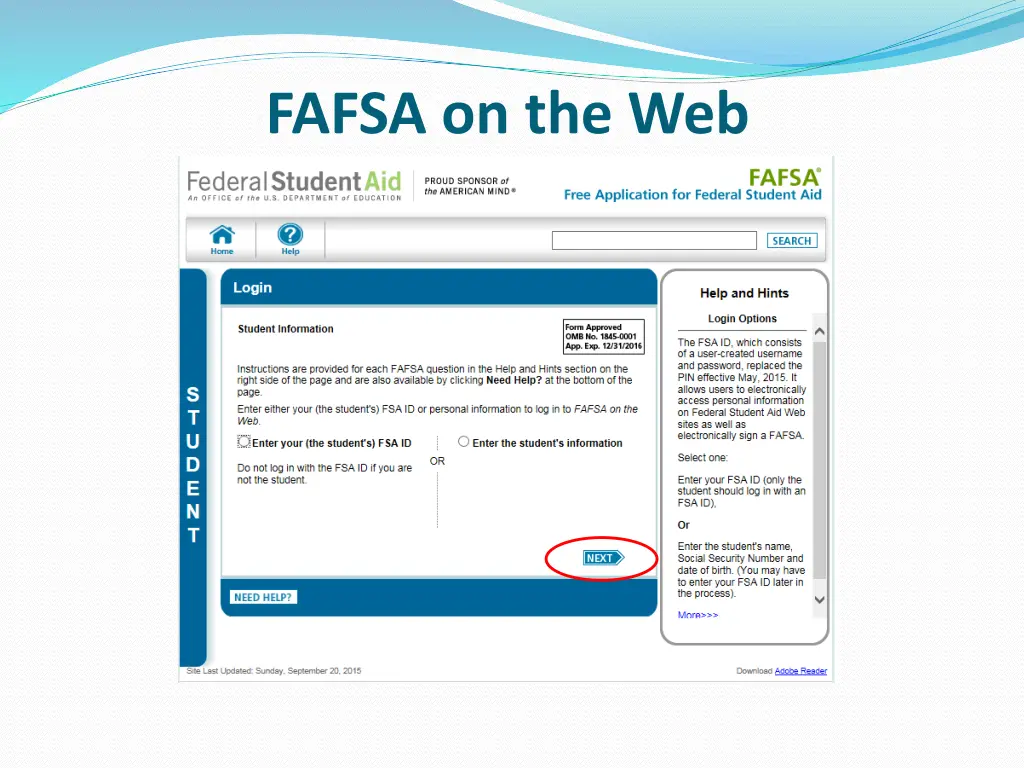
Before Starting the FAFSA Student and a parent each apply for their own FSA ID (replaces PIN) Used to access features and sign FAFSA electronically Can be done at points within the FAFSA application or directly at https://fsaid.ed.gov/npas/indexhtm May be used by students and parents throughout aid process, including subsequent school year Gather important documents needed to file the FAFSA
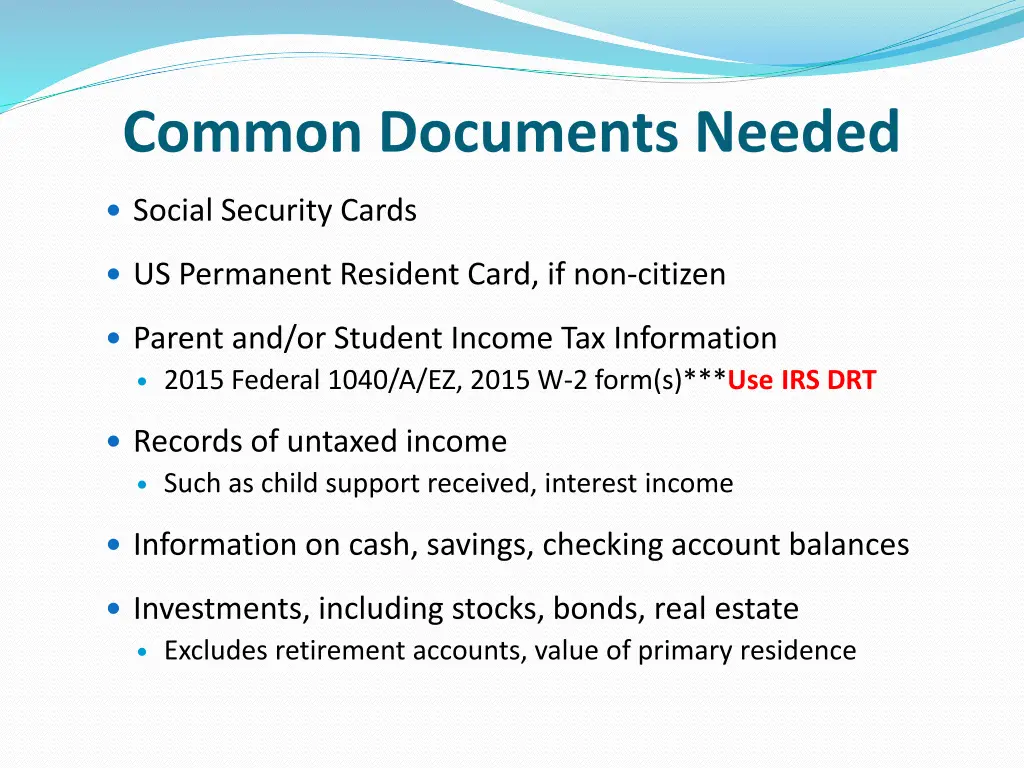
Common Documents Needed Social Security Cards US Permanent Resident Card, if non-citizen Parent and/or Student Income Tax Information 2015 Federal 1040/A/EZ, 2015 W-2 form(s)***Use IRS DRT Records of untaxed income Such as child support received, interest income Information on cash, savings, checking account balances Investments, including stocks, bonds, real estate Excludes retirement accounts, value of primary residence
IRS Data Retrieval Tool While completing FOTW, applicant may submit real-time request to IRS for tax data IRS will authenticate taxpayer s identity If match found, IRS sends real-time results to applicant in new browser window Applicant chooses whether or not to transfer data to FOTW
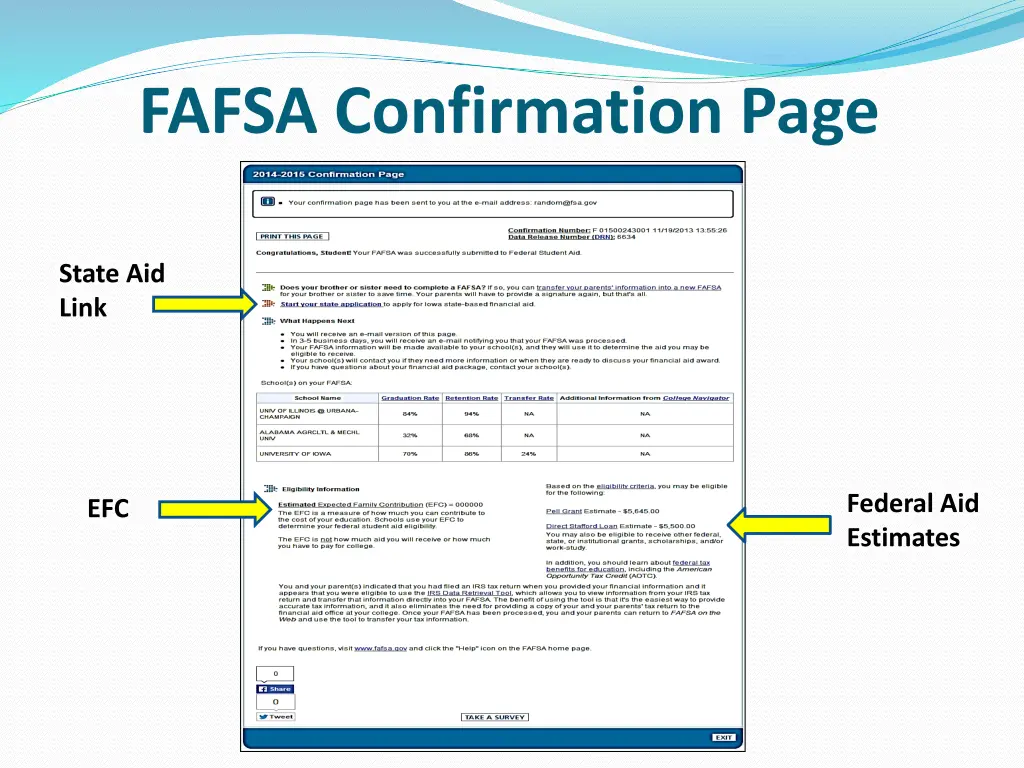
FAFSA Confirmation Page State Aid Link Federal Aid Estimates EFC
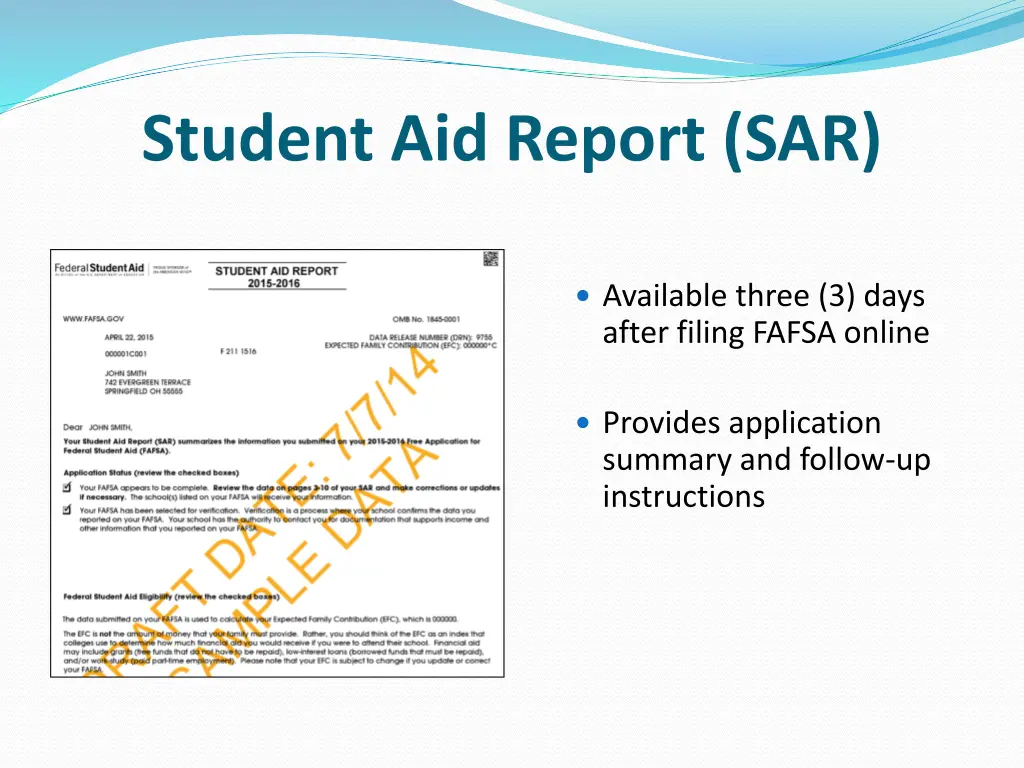
Student Aid Report (SAR) Available three (3) days after filing FAFSA online Provides application summary and follow-up instructions
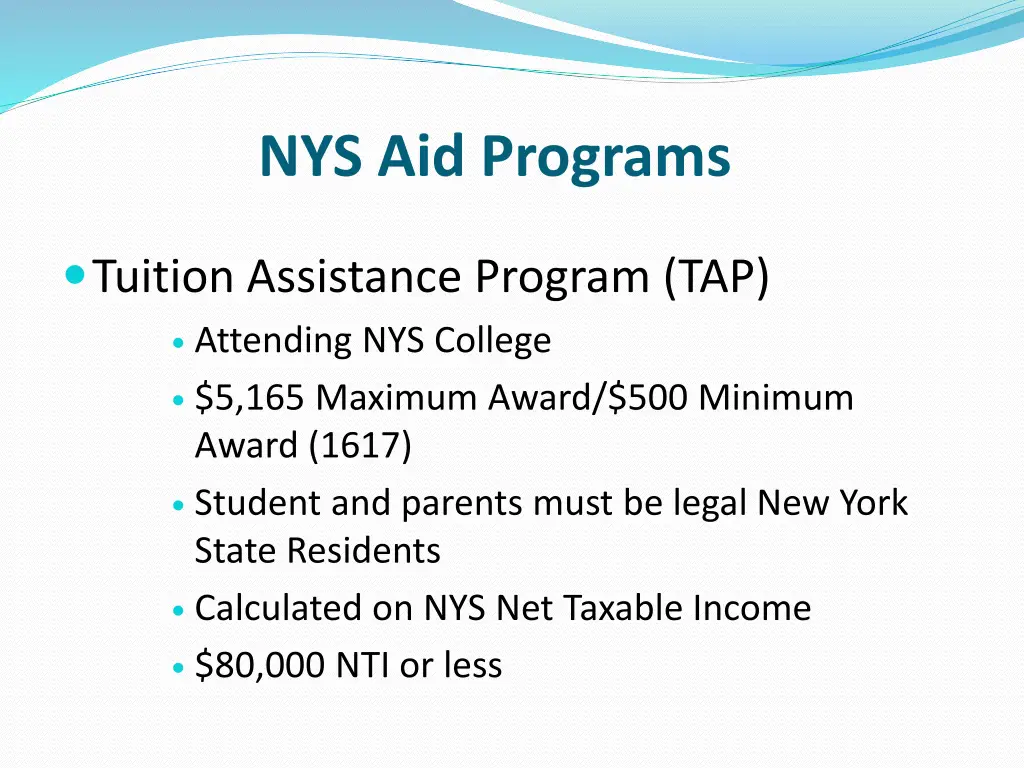
NYS Aid Programs Tuition Assistance Program (TAP) Attending NYS College $5,165 Maximum Award/$500 Minimum Award (1617) Student and parents must be legal New York State Residents Calculated on NYS Net Taxable Income $80,000 NTI or less
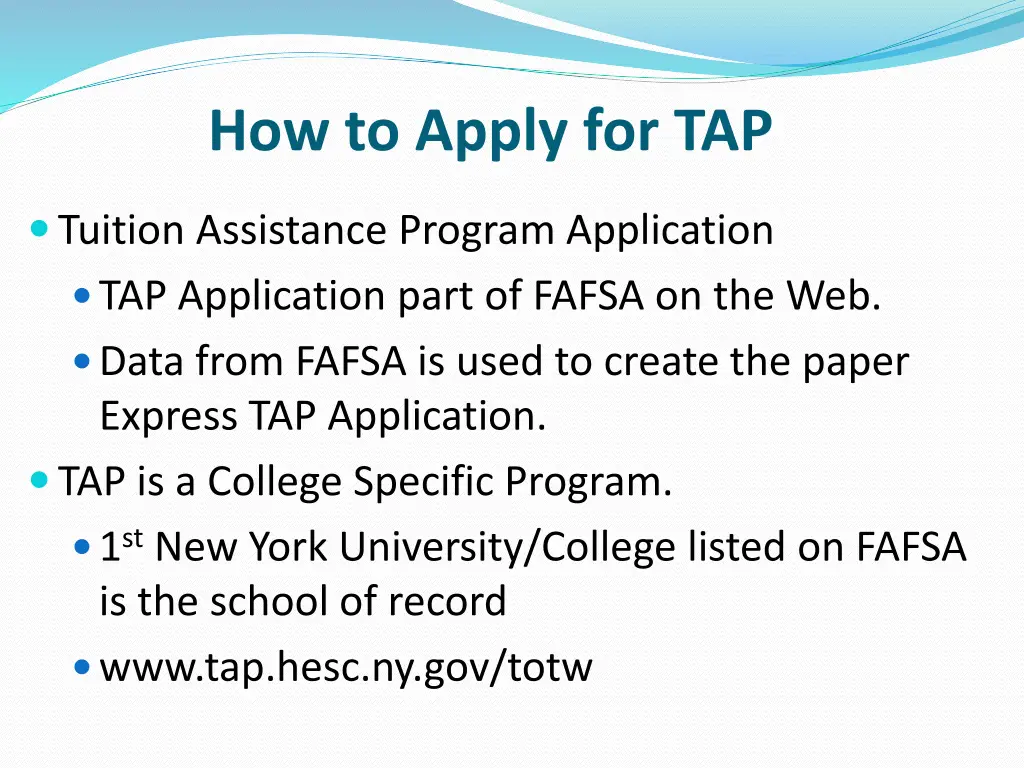
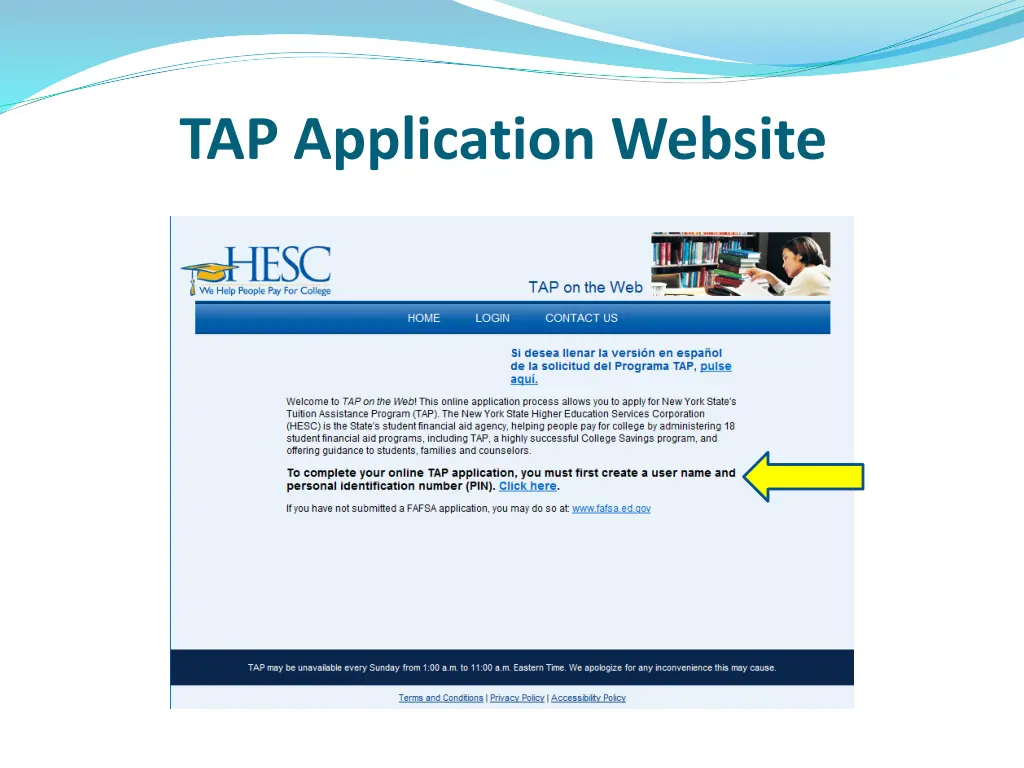
How to Apply for TAP Tuition Assistance Program Application TAP Application part of FAFSA on the Web. Data from FAFSA is used to create the paper Express TAP Application. TAP is a College Specific Program. 1st New York University/College listed on FAFSA is the school of record www.tap.hesc.ny.gov/totw
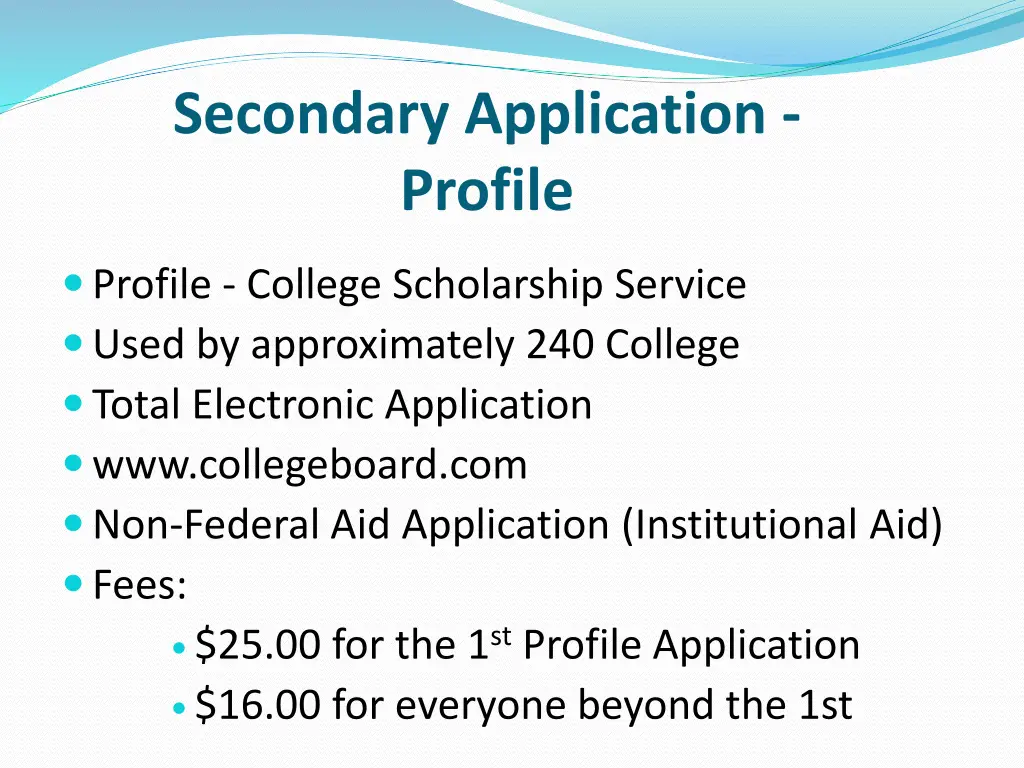
Secondary Application - Profile Profile - College Scholarship Service Used by approximately 240 College Total Electronic Application www.collegeboard.com Non-Federal Aid Application (Institutional Aid) Fees: $25.00 for the 1st Profile Application $16.00 for everyone beyond the 1st
Secondary Application College Forms Some Colleges May Have an Institution Need Based Aid Application Or a Specific Scholarship Application Colleges will Distribute Their Own Forms
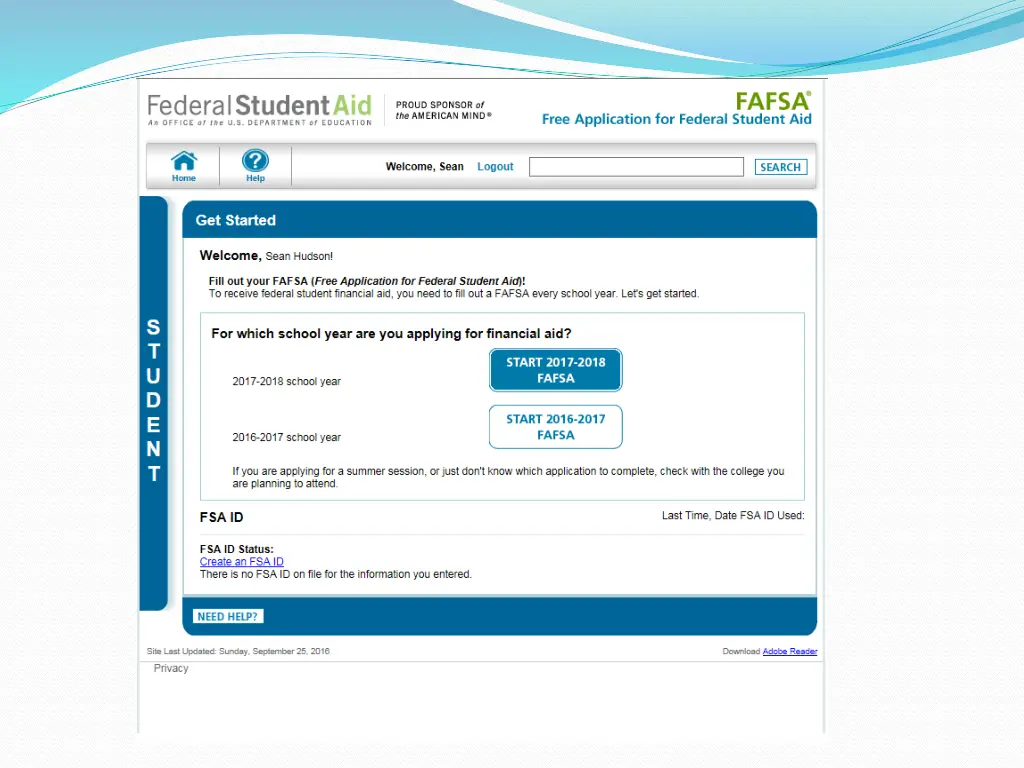
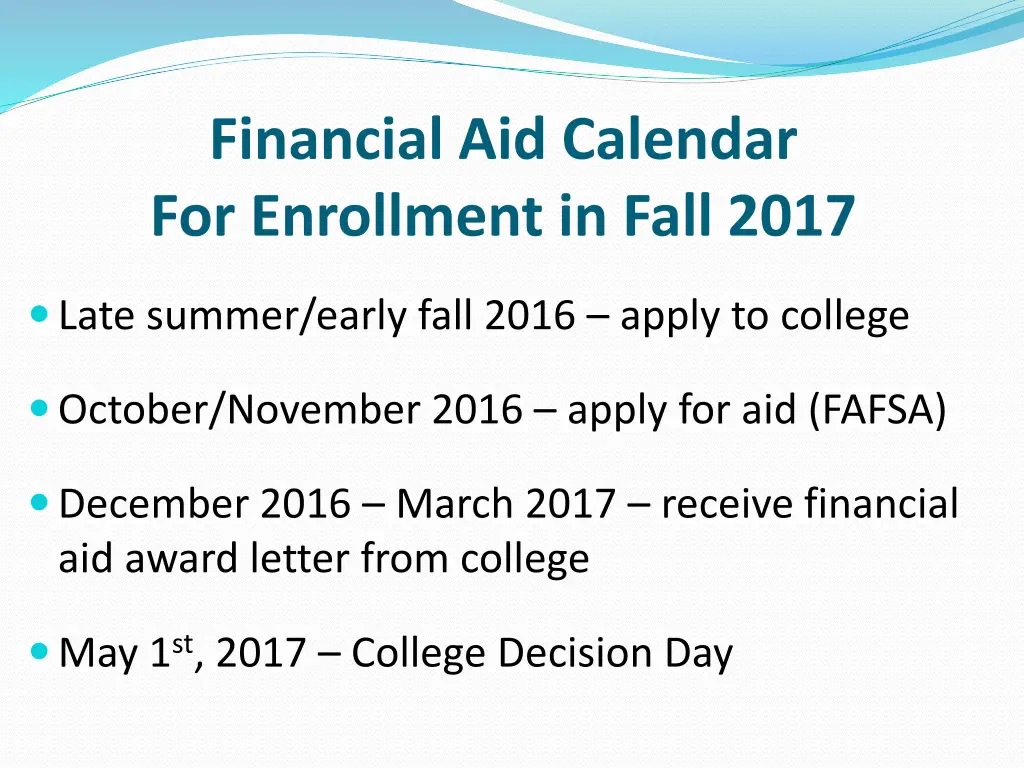
Financial Aid Calendar For Enrollment in Fall 2017 Late summer/early fall 2016 apply to college October/November 2016 apply for aid (FAFSA) December 2016 March 2017 receive financial aid award letter from college May 1st, 2017 College Decision Day
Section III How is Eligibility Determined
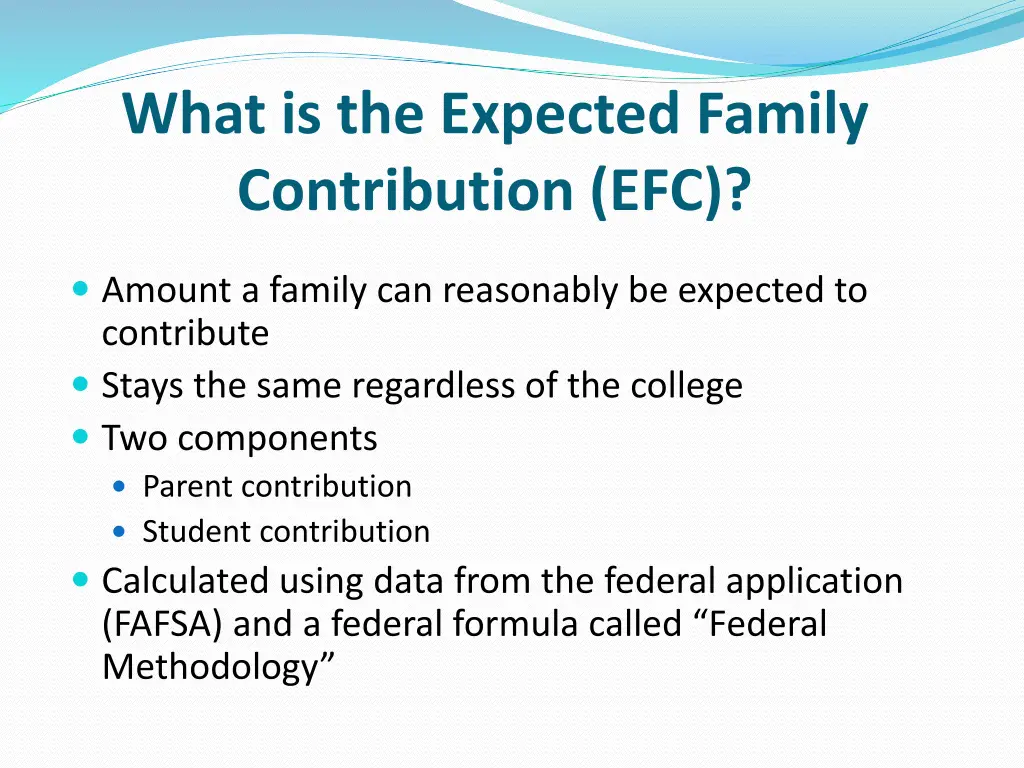
What is the Expected Family Contribution (EFC)? Amount a family can reasonably be expected to contribute Stays the same regardless of the college Two components Parent contribution Student contribution Calculated using data from the federal application (FAFSA) and a federal formula called Federal Methodology
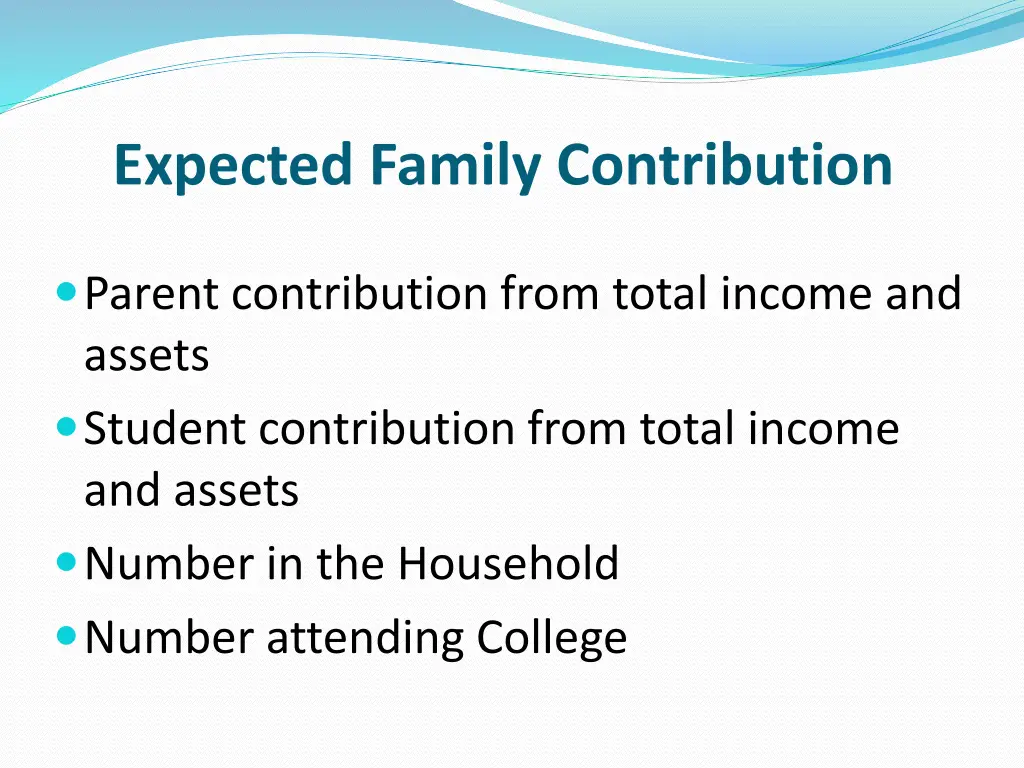
Expected Family Contribution Parent contribution from total income and assets Student contribution from total income and assets Number in the Household Number attending College
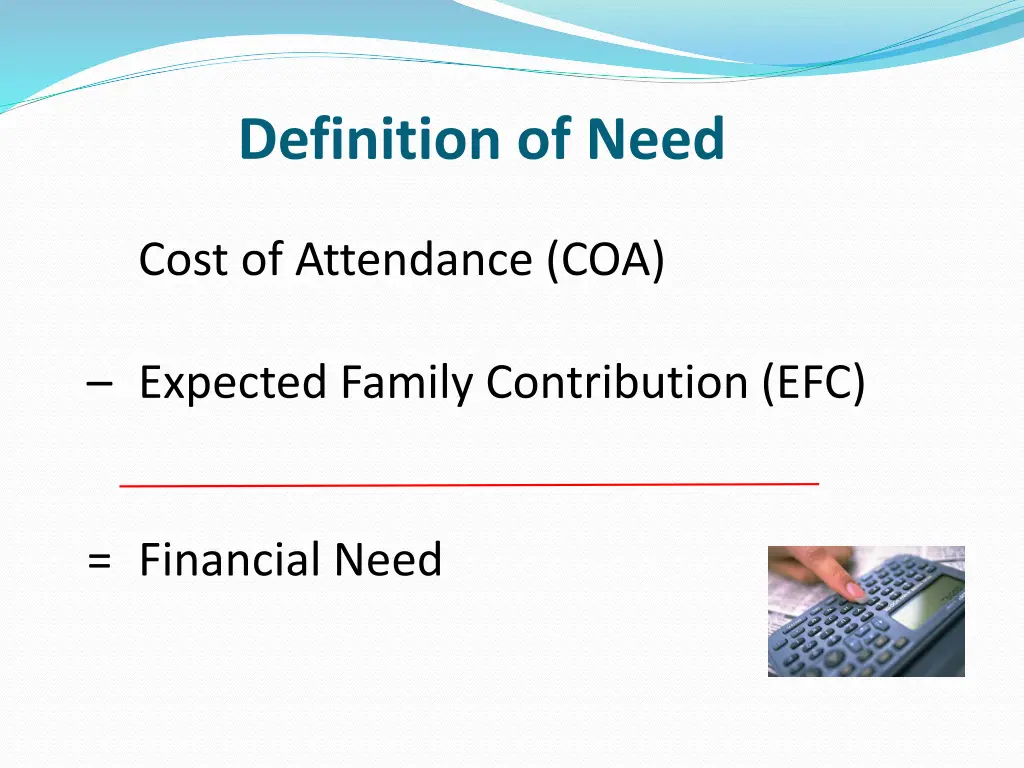
Definition of Need Cost of Attendance (COA) Expected Family Contribution (EFC) = Financial Need
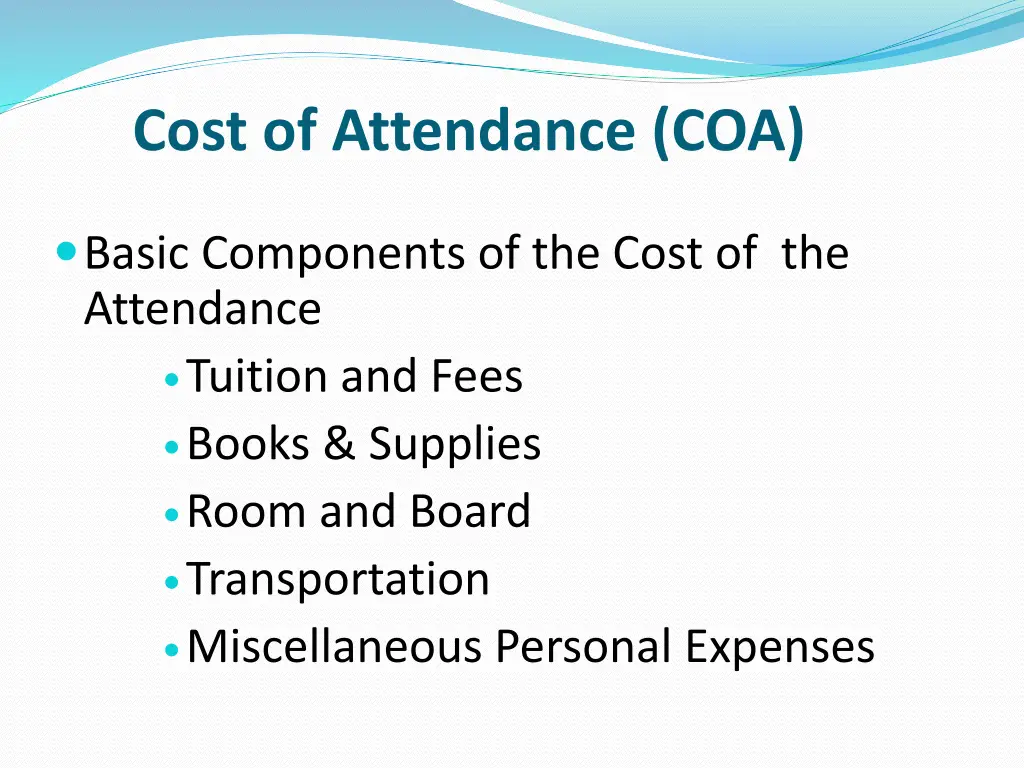
Cost of Attendance (COA) Basic Components of the Cost of the Attendance Tuition and Fees Books & Supplies Room and Board Transportation Miscellaneous Personal Expenses
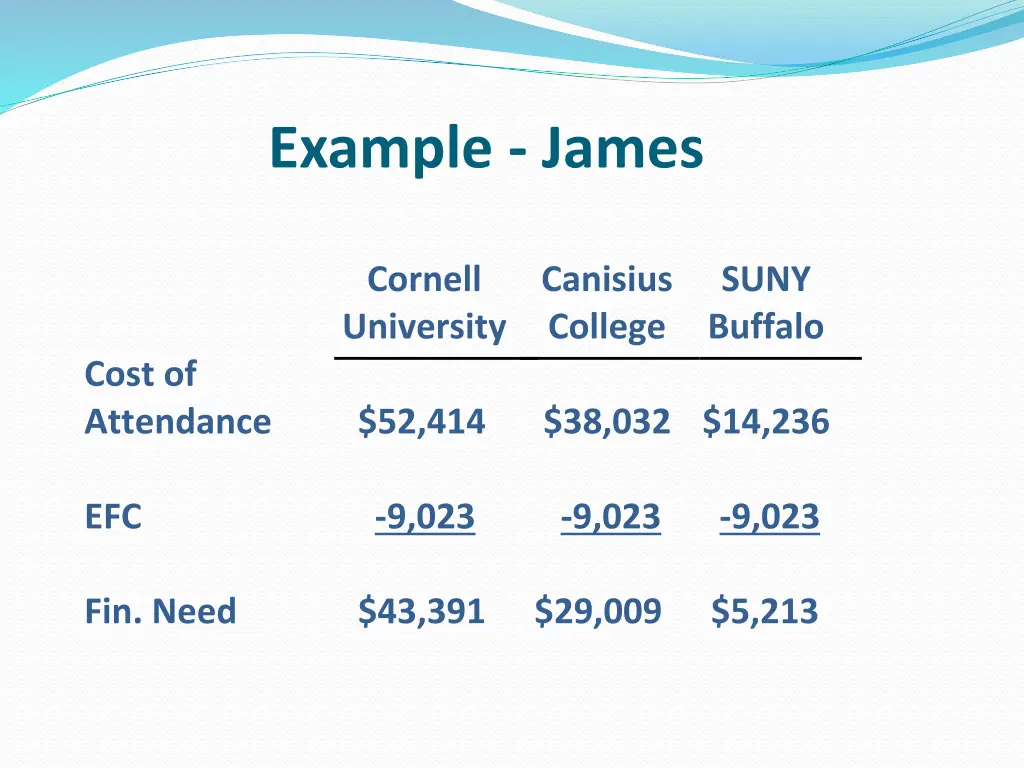
Example - James Cost of Attendance EFC Fin. Need Cornell University $52,414 Canisius College $38,032 -9,023 $29,009 SUNY Buffalo $14,236 -9,023 -9,023 $5,213 $43,391
Section IV Sources of Financial Aid
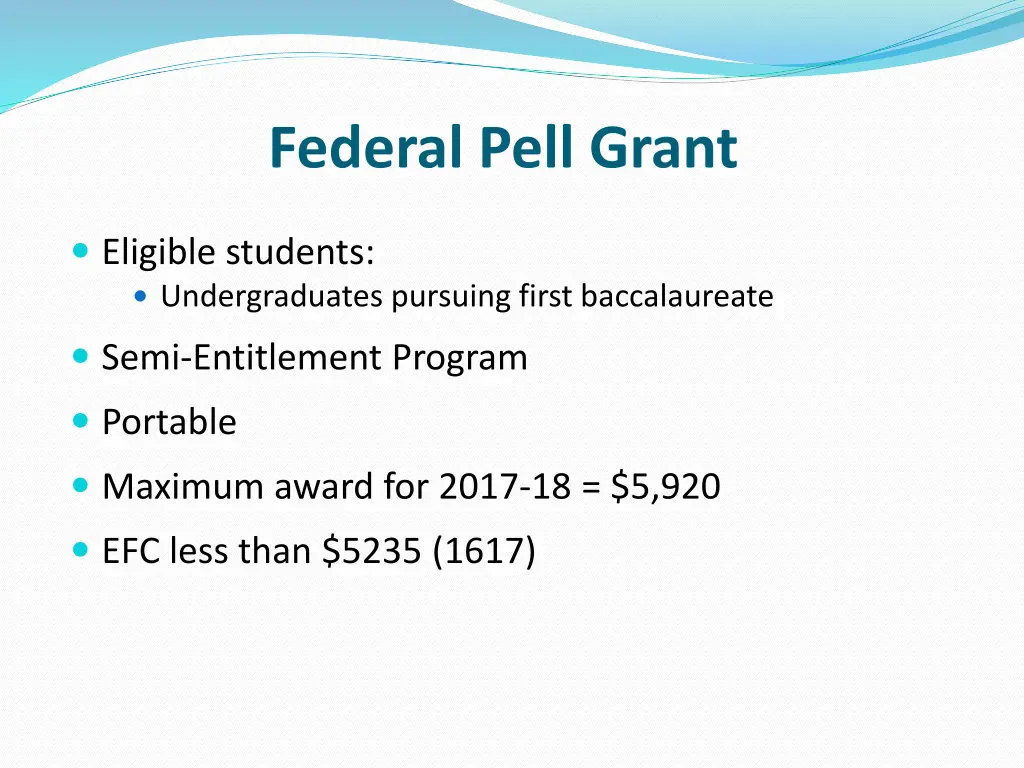
Federal Pell Grant Eligible students: Undergraduates pursuing first baccalaureate Semi-Entitlement Program Portable Maximum award for 2017-18 = $5,920 EFC less than $5235 (1617)
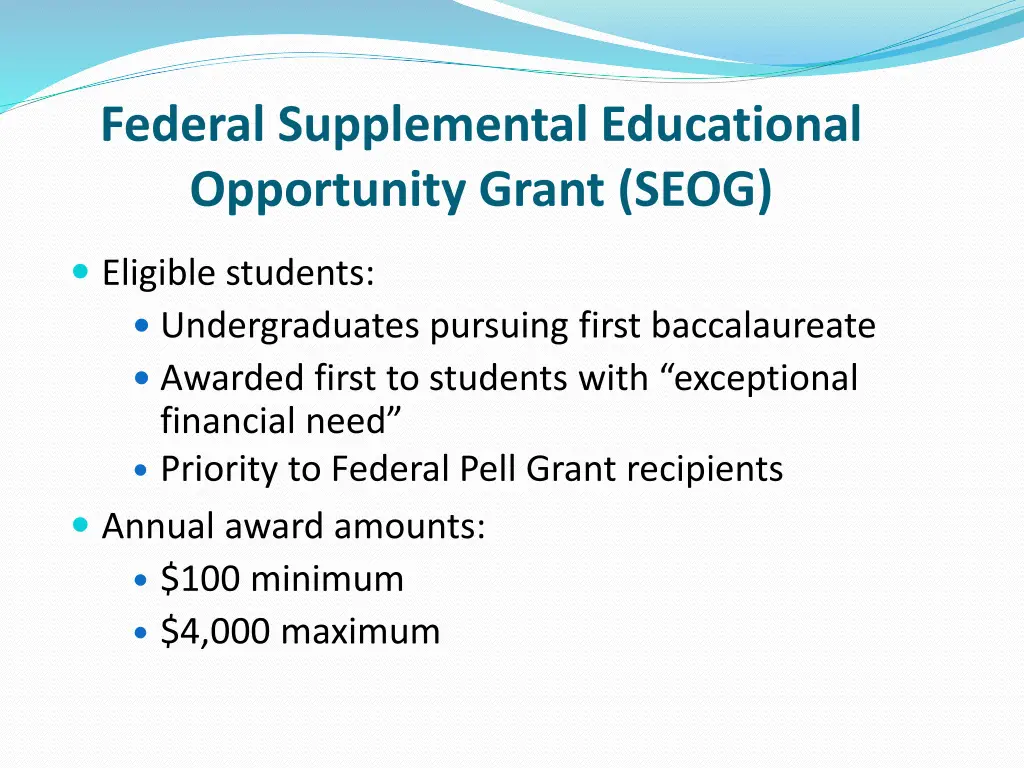
Federal Supplemental Educational Opportunity Grant (SEOG) Eligible students: Undergraduates pursuing first baccalaureate Awarded first to students with exceptional financial need Priority to Federal Pell Grant recipients Annual award amounts: $100 minimum $4,000 maximum
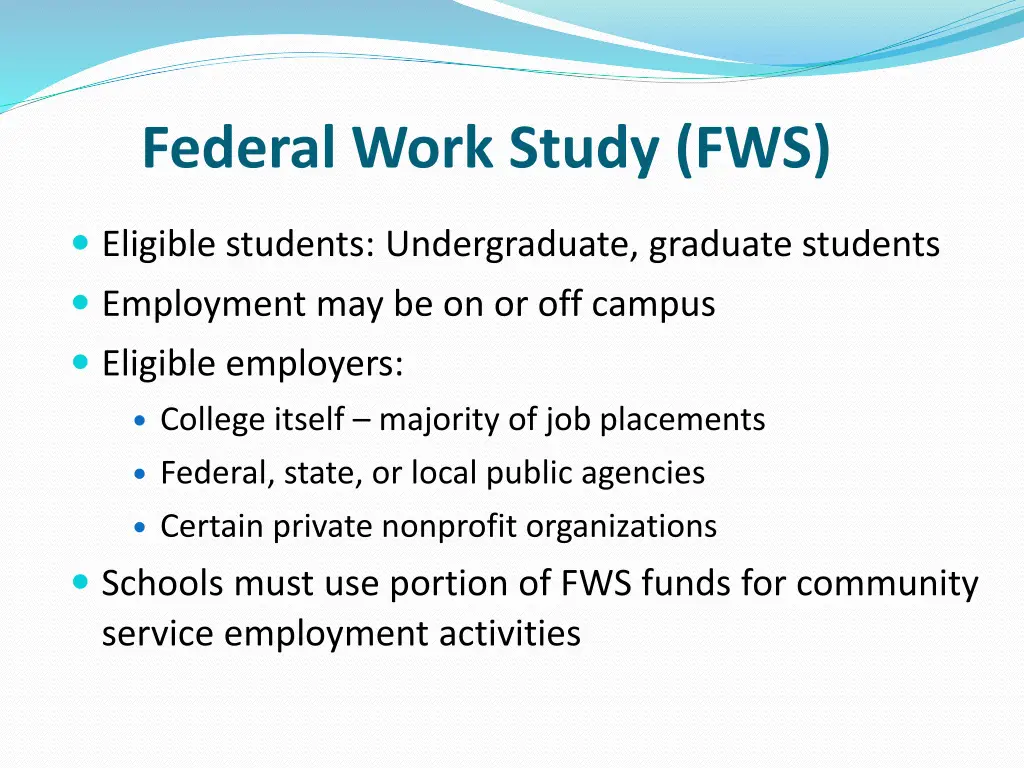
Federal Work Study (FWS) Eligible students: Undergraduate, graduate students Employment may be on or off campus Eligible employers: College itself majority of job placements Federal, state, or local public agencies Certain private nonprofit organizations Schools must use portion of FWS funds for community service employment activities
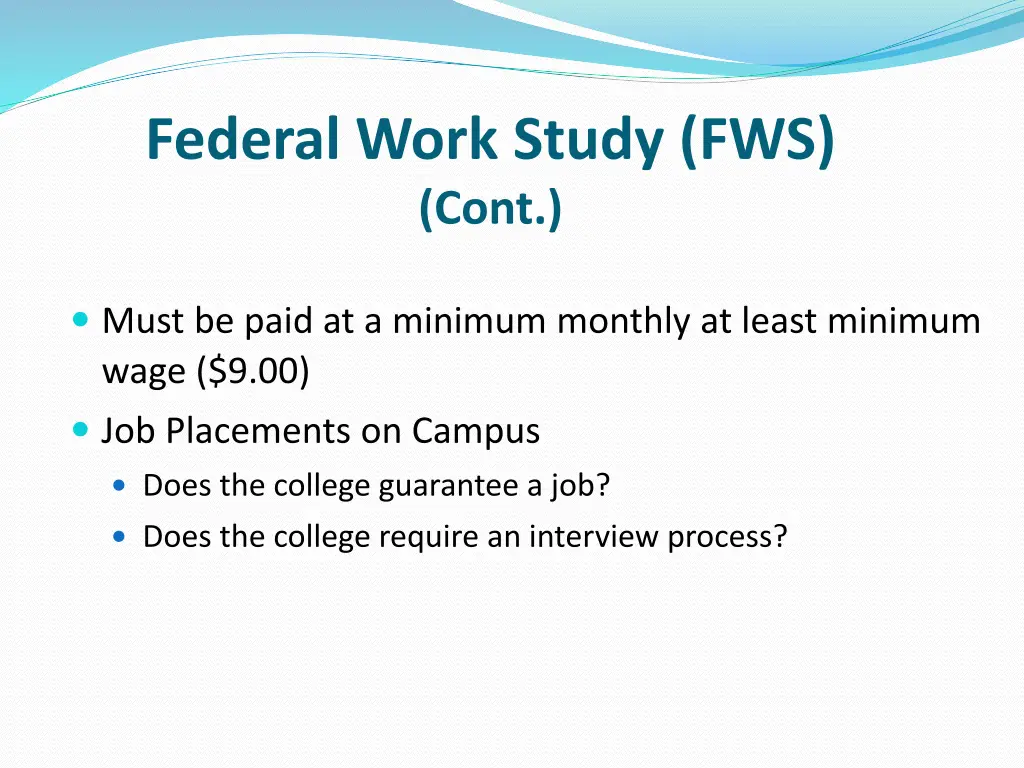
Federal Work Study (FWS) (Cont.) Must be paid at a minimum monthly at least minimum wage ($9.00) Job Placements on Campus Does the college guarantee a job? Does the college require an interview process?
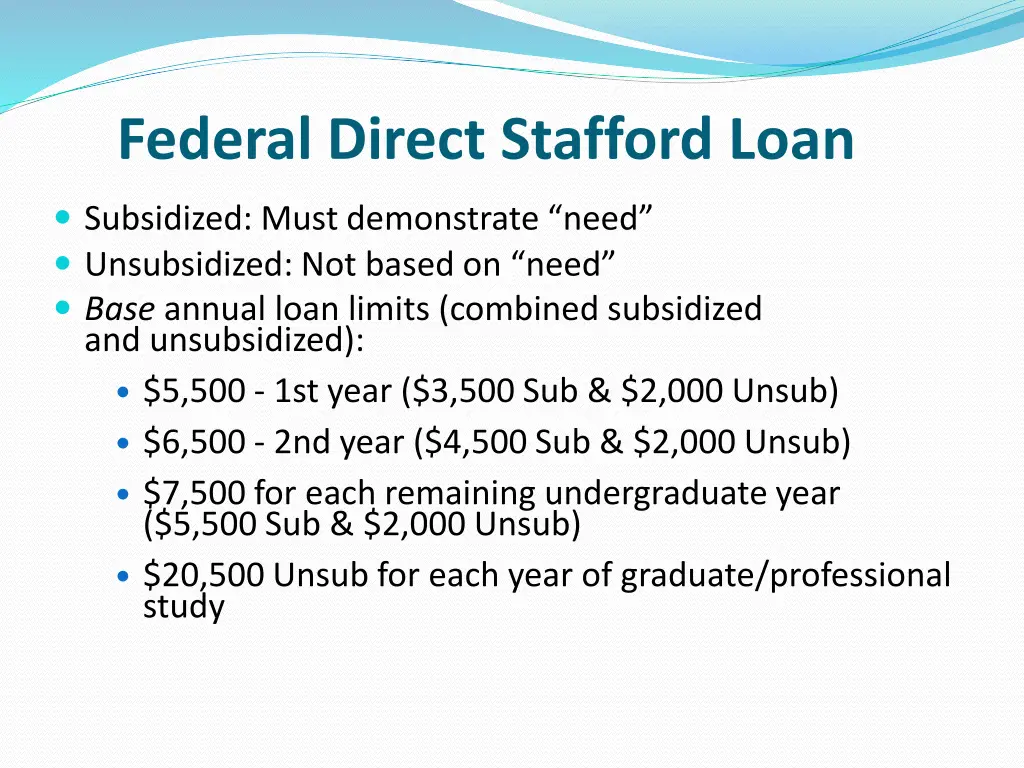
Federal Direct Stafford Loan Subsidized: Must demonstrate need Unsubsidized: Not based on need Base annual loan limits (combined subsidized and unsubsidized): $5,500 - 1st year ($3,500 Sub & $2,000 Unsub) $6,500 - 2nd year ($4,500 Sub & $2,000 Unsub) $7,500 for each remaining undergraduate year ($5,500 Sub & $2,000 Unsub) $20,500 Unsub for each year of graduate/professional study
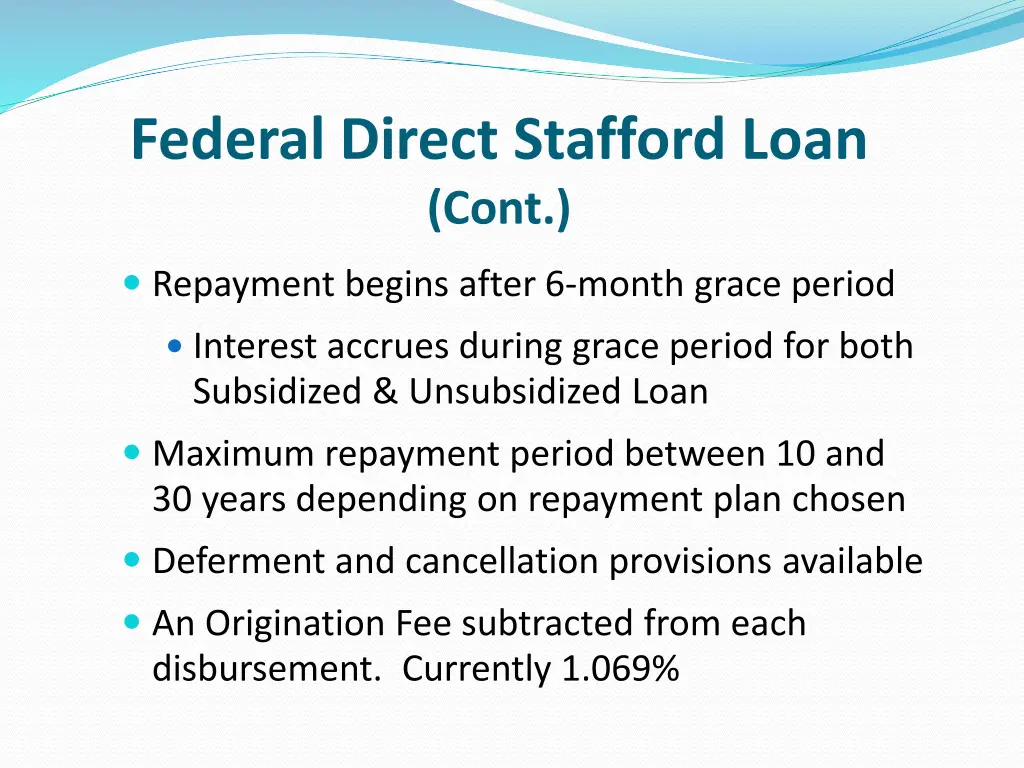
Federal Direct Stafford Loan (Cont.) Repayment begins after 6-month grace period Interest accrues during grace period for both Subsidized & Unsubsidized Loan Maximum repayment period between 10 and 30 years depending on repayment plan chosen Deferment and cancellation provisions available An Origination Fee subtracted from each disbursement. Currently 1.069%
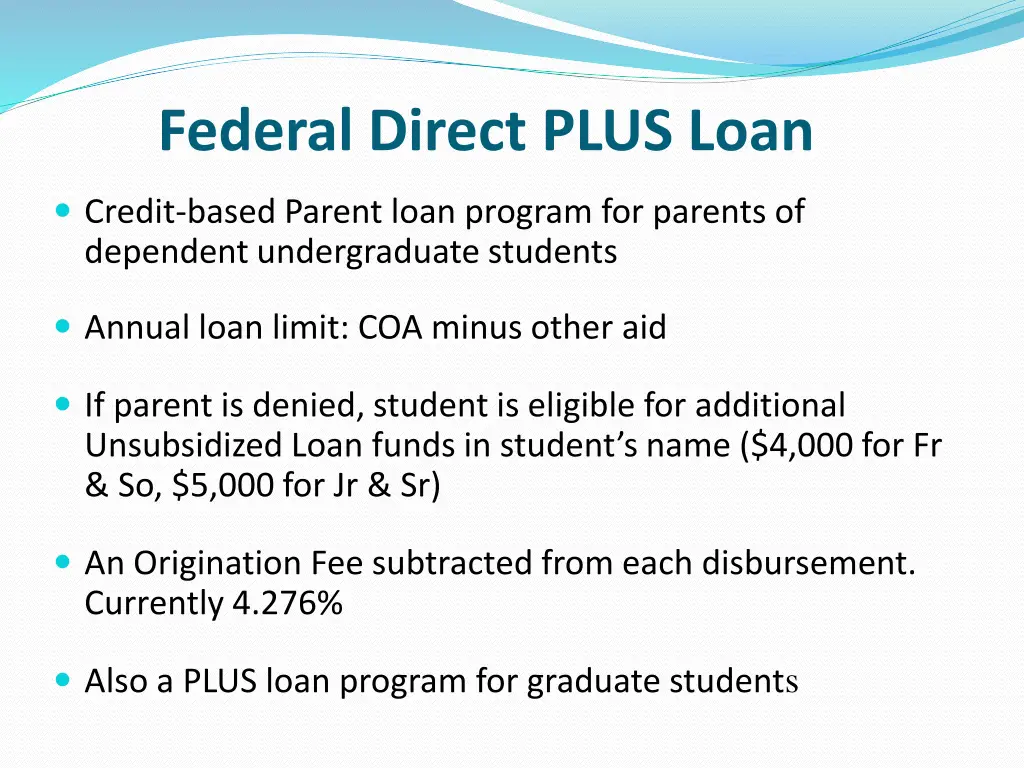
Federal Direct PLUS Loan Credit-based Parent loan program for parents of dependent undergraduate students Annual loan limit: COA minus other aid If parent is denied, student is eligible for additional Unsubsidized Loan funds in student s name ($4,000 for Fr & So, $5,000 for Jr & Sr) An Origination Fee subtracted from each disbursement. Currently 4.276% Also a PLUS loan program for graduate students
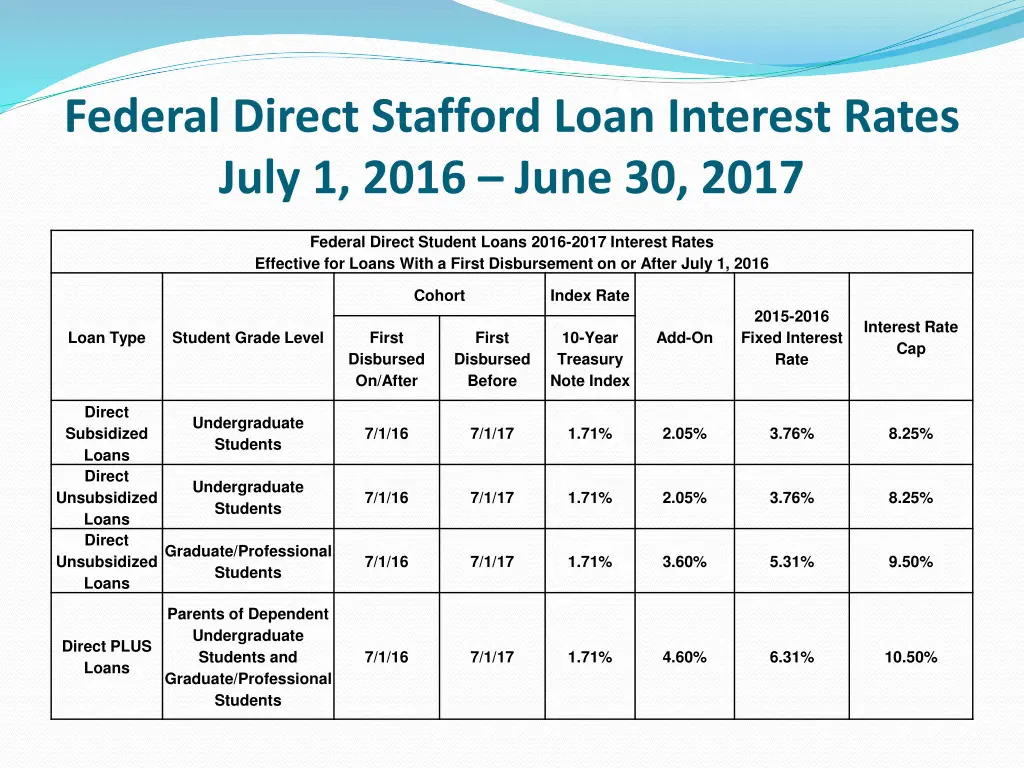
Federal Direct Stafford Loan Interest Rates July 1, 2016 June 30, 2017 Federal Direct Student Loans 2016-2017 Interest Rates Effective for Loans With a First Disbursement on or After July 1, 2016 Cohort Index Rate 2015-2016 Fixed Interest Rate Interest Rate Cap First First 10-Year Treasury Note Index Loan Type Student Grade Level Add-On Disbursed On/After Disbursed Before Direct Subsidized Loans Direct Unsubsidized Loans Direct Unsubsidized Loans Undergraduate Students 7/1/16 7/1/17 1.71% 2.05% 3.76% 8.25% Undergraduate Students 7/1/16 7/1/17 1.71% 2.05% 3.76% 8.25% Graduate/Professional Students 7/1/16 7/1/17 1.71% 3.60% 5.31% 9.50% Parents of Dependent Undergraduate Students and Graduate/Professional Students Direct PLUS Loans 7/1/16 7/1/17 1.71% 4.60% 6.31% 10.50%
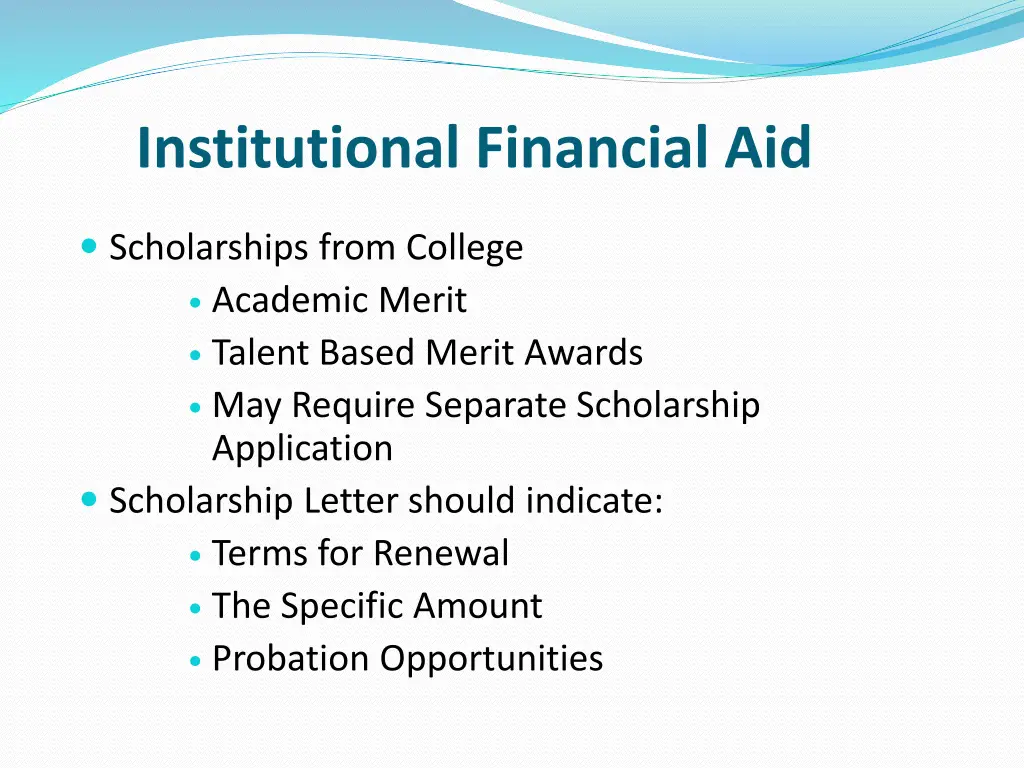
Institutional Financial Aid Scholarships from College Academic Merit Talent Based Merit Awards May Require Separate Scholarship Application Scholarship Letter should indicate: Terms for Renewal The Specific Amount Probation Opportunities
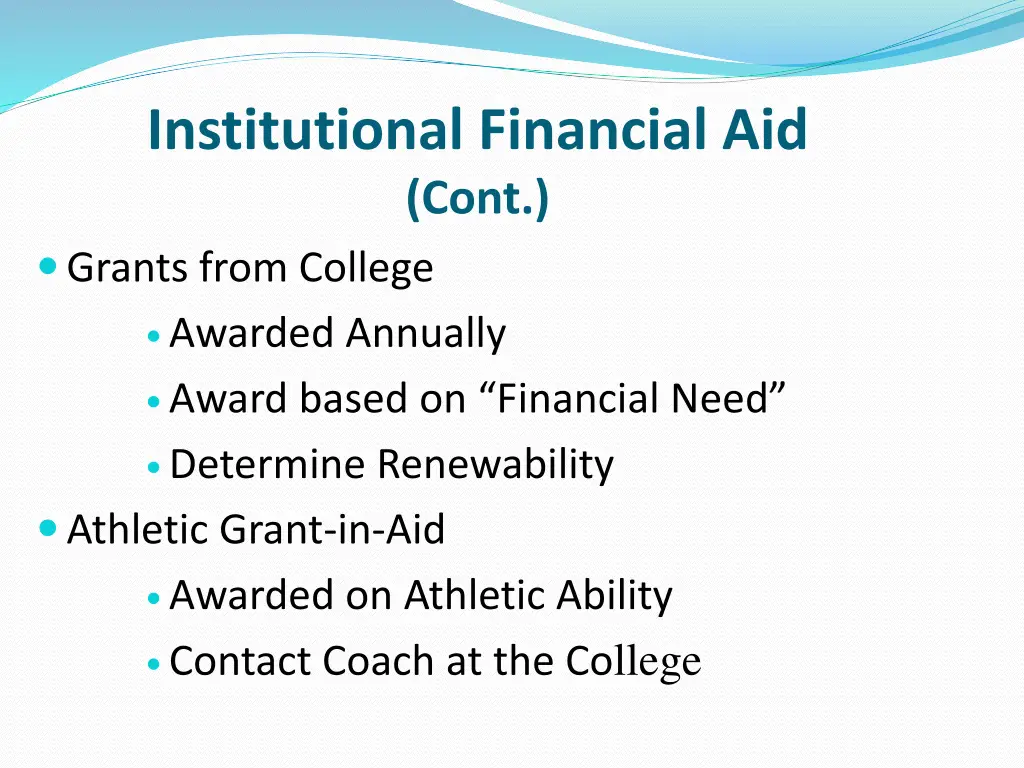
Institutional Financial Aid (Cont.) Grants from College Awarded Annually Award based on Financial Need Determine Renewability Athletic Grant-in-Aid Awarded on Athletic Ability Contact Coach at the College
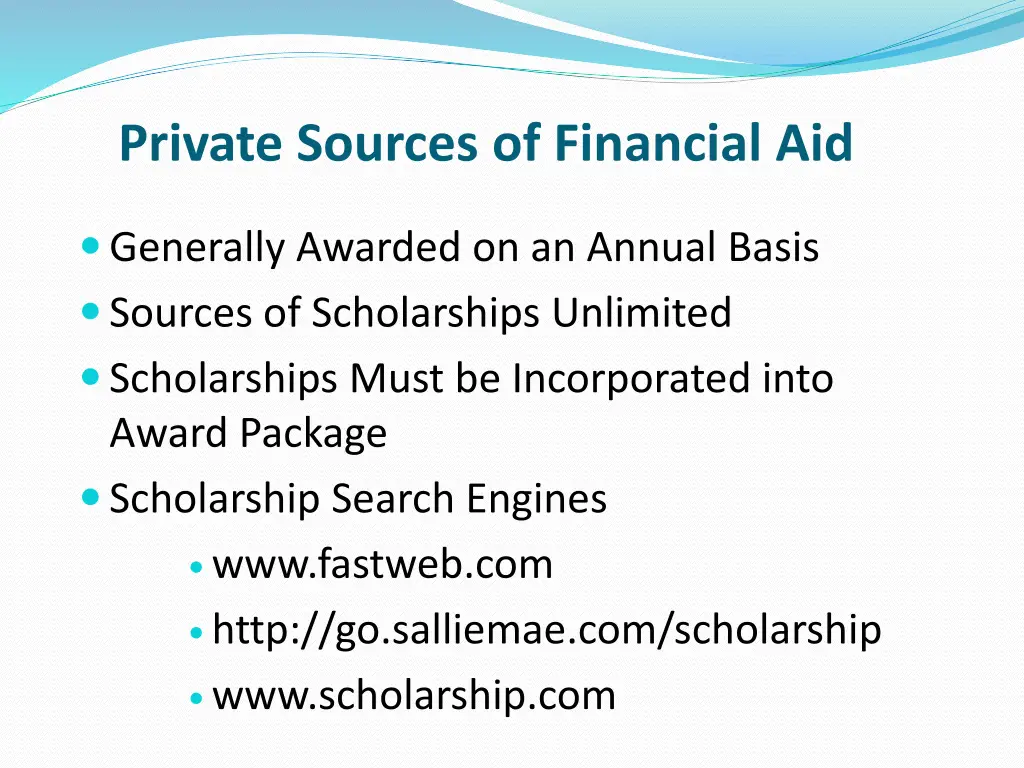
Private Sources of Financial Aid Generally Awarded on an Annual Basis Sources of Scholarships Unlimited Scholarships Must be Incorporated into Award Package Scholarship Search Engines www.fastweb.com http://go.salliemae.com/scholarship www.scholarship.com
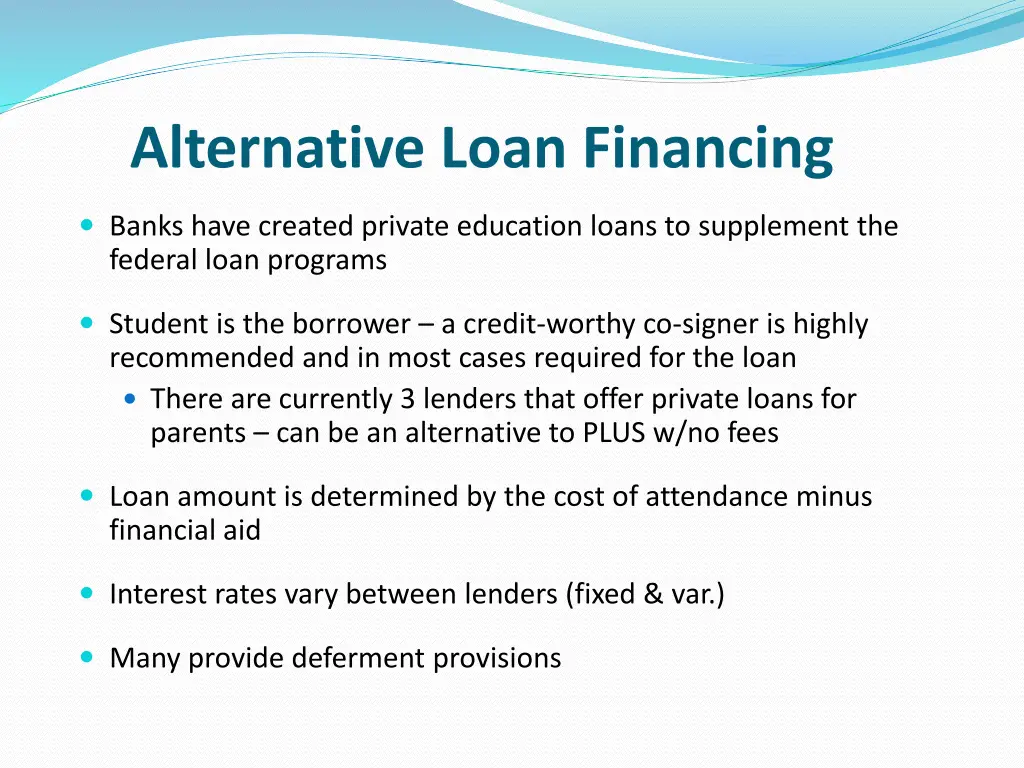
Alternative Loan Financing Banks have created private education loans to supplement the federal loan programs Student is the borrower a credit-worthy co-signer is highly recommended and in most cases required for the loan There are currently 3 lenders that offer private loans for parents can be an alternative to PLUS w/no fees Loan amount is determined by the cost of attendance minus financial aid Interest rates vary between lenders (fixed & var.) Many provide deferment provisions
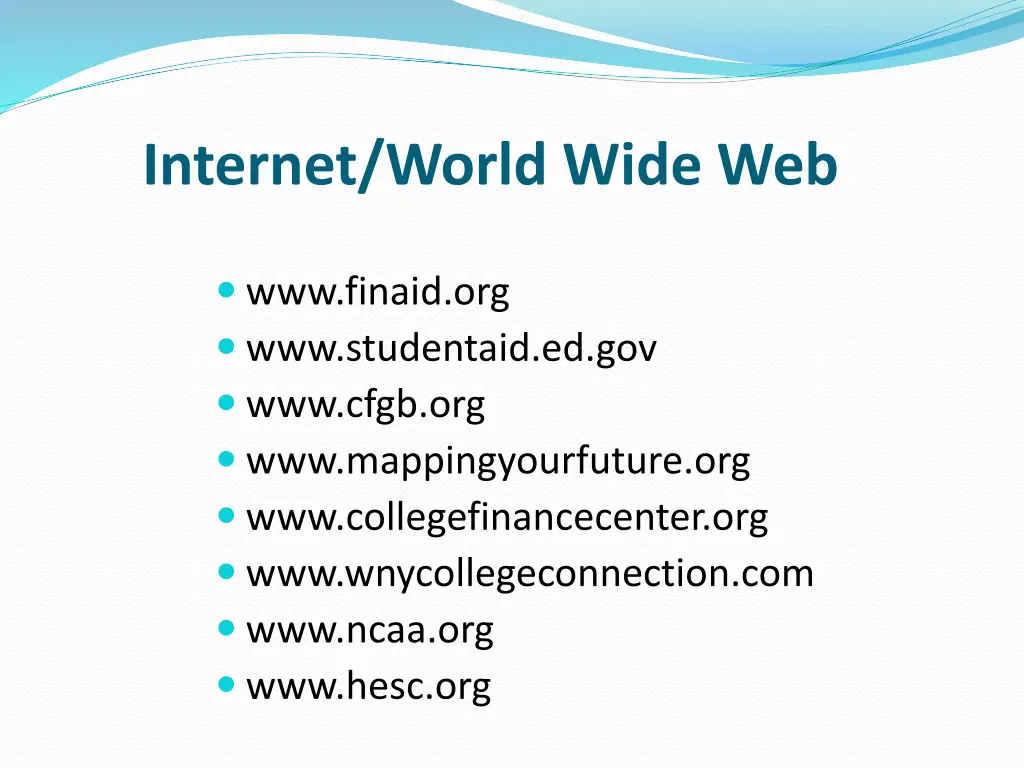
Internet/World Wide Web www.finaid.org www.studentaid.ed.gov www.cfgb.org www.mappingyourfuture.org www.collegefinancecenter.org www.wnycollegeconnection.com www.ncaa.org www.hesc.org
Section V Award Notification
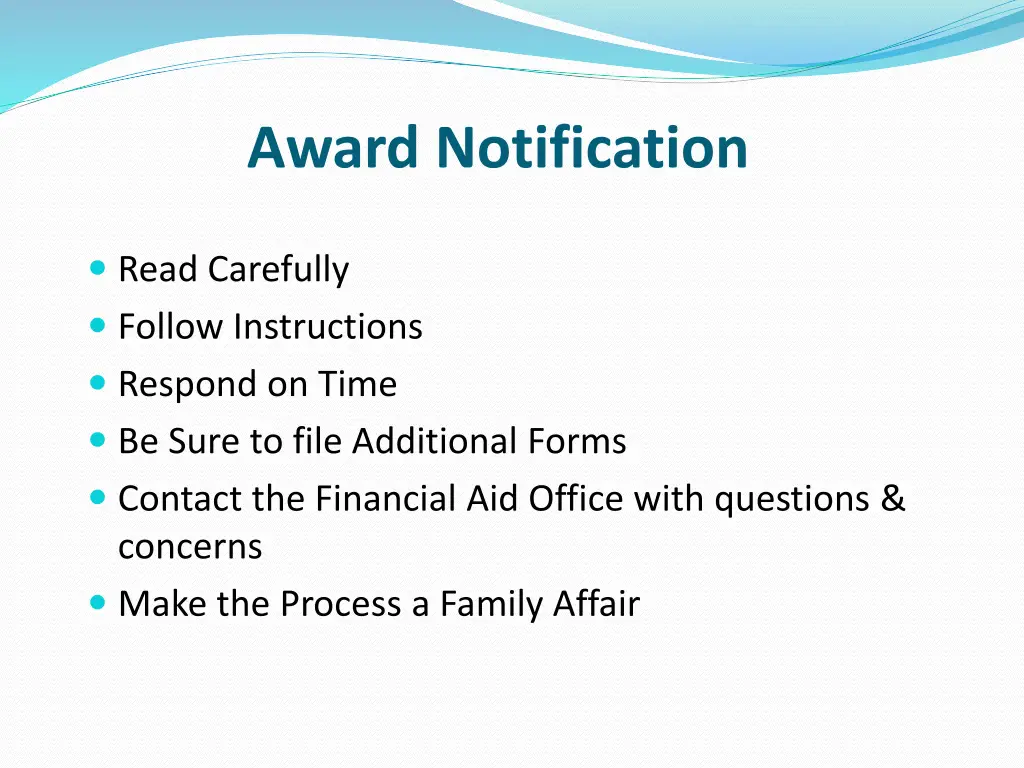
Award Notification Read Carefully Follow Instructions Respond on Time Be Sure to file Additional Forms Contact the Financial Aid Office with questions & concerns Make the Process a Family Affair
Special Circumstances/Conditions Contact the college financial aid office when: You are not sure how to answer a question on the FAFSA The information provided on the FAFSA is no longer correct. i.e. Loss of employment, Loss of untaxable/taxable income (child support, social security, etc.), Separation or Divorce, Death of parent or spouse. Anything else that you are unsure of!