Understanding Frames of Reference in Physics
Explore the concept of frames of reference in physics, including relative velocity and different examples to understand how to calculate velocities in different frames of reference. Learn how to determine velocity relative to various reference points, such as objects and celestial bodies, to deepen your understanding of motion.

Download Presentation

Please find below an Image/Link to download the presentation.
The content on the website is provided AS IS for your information and personal use only. It may not be sold, licensed, or shared on other websites without obtaining consent from the author. If you encounter any issues during the download, it is possible that the publisher has removed the file from their server.
You are allowed to download the files provided on this website for personal or commercial use, subject to the condition that they are used lawfully. All files are the property of their respective owners.
The content on the website is provided AS IS for your information and personal use only. It may not be sold, licensed, or shared on other websites without obtaining consent from the author.
E N D
Presentation Transcript
With Relative Velocity FRAMES OF REFERENCE
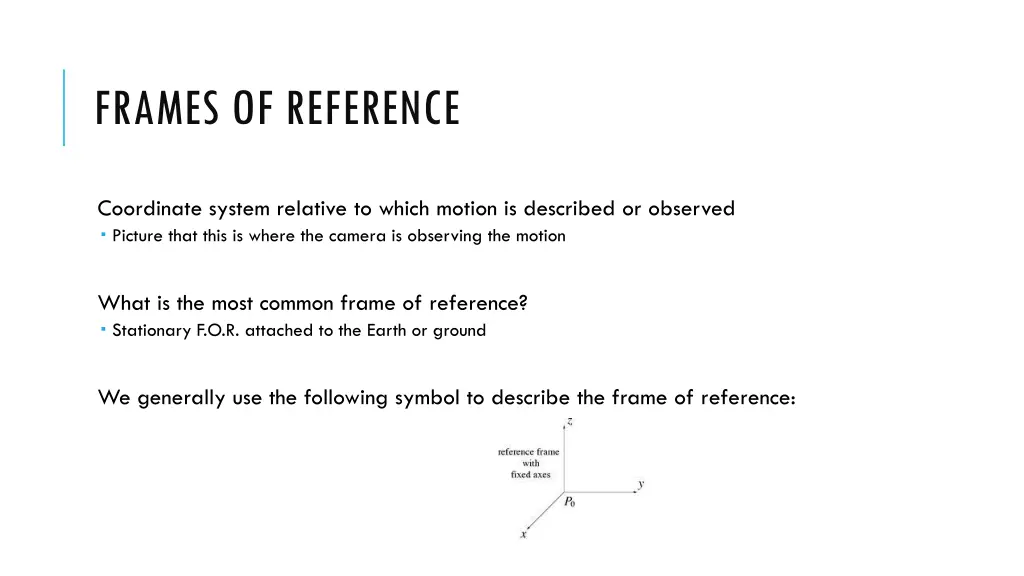
FRAMES OF REFERENCE Coordinate system relative to which motion is described or observed Picture that this is where the camera is observing the motion What is the most common frame of reference? Stationary F.O.R. attached to the Earth or ground We generally use the following symbol to describe the frame of reference:
RELATIVE VELOCITY Velocity of an object relative to a specific frame of reference
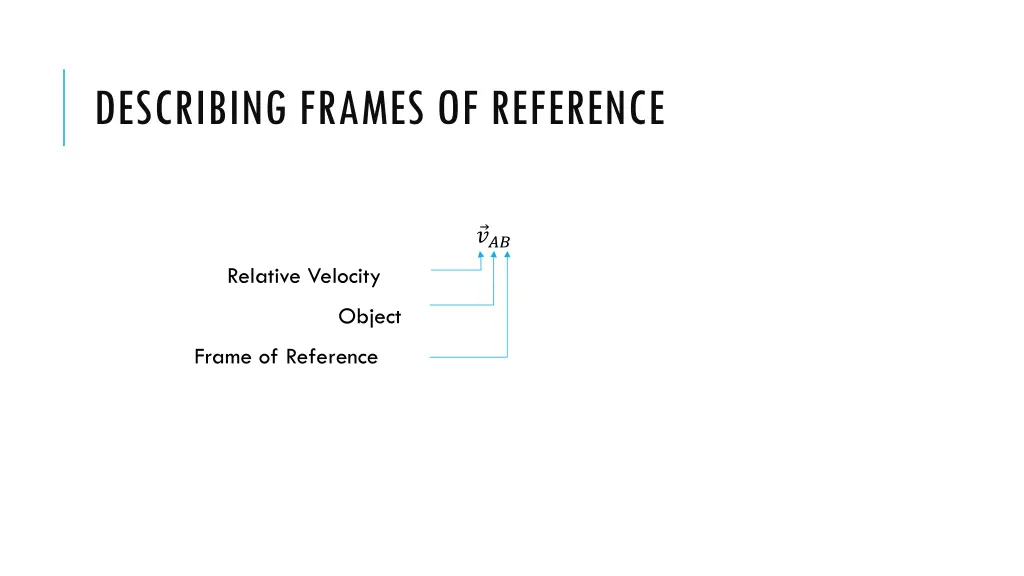
DESCRIBING FRAMES OF REFERENCE ??? Relative Velocity Object Frame of Reference
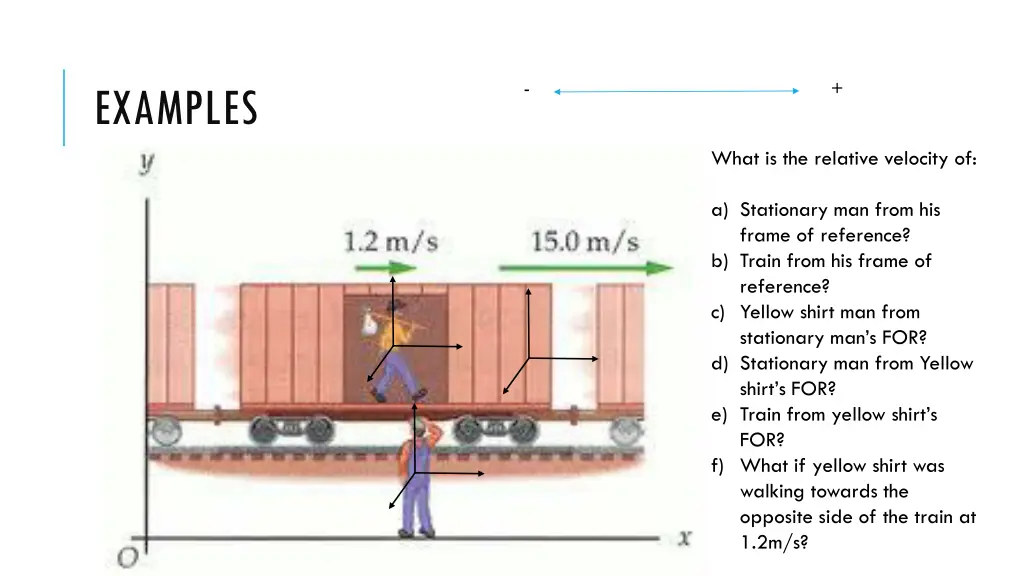
- + EXAMPLES What is the relative velocity of: a) Stationary man from his frame of reference? b) Train from his frame of reference? c) Yellow shirt man from stationary man s FOR? d) Stationary man from Yellow shirt s FOR? e) Train from yellow shirt s FOR? f) What if yellow shirt was walking towards the opposite side of the train at 1.2m/s?
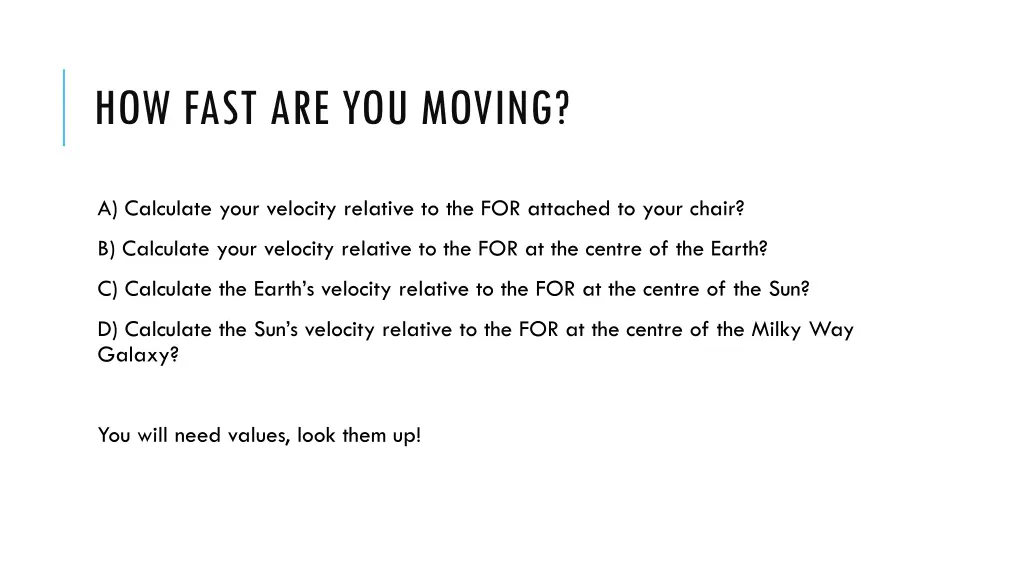
HOW FAST ARE YOU MOVING? A) Calculate your velocity relative to the FOR attached to your chair? B) Calculate your velocity relative to the FOR at the centre of the Earth? C) Calculate the Earth s velocity relative to the FOR at the centre of the Sun? D) Calculate the Sun s velocity relative to the FOR at the centre of the Milky Way Galaxy? You will need values, look them up!
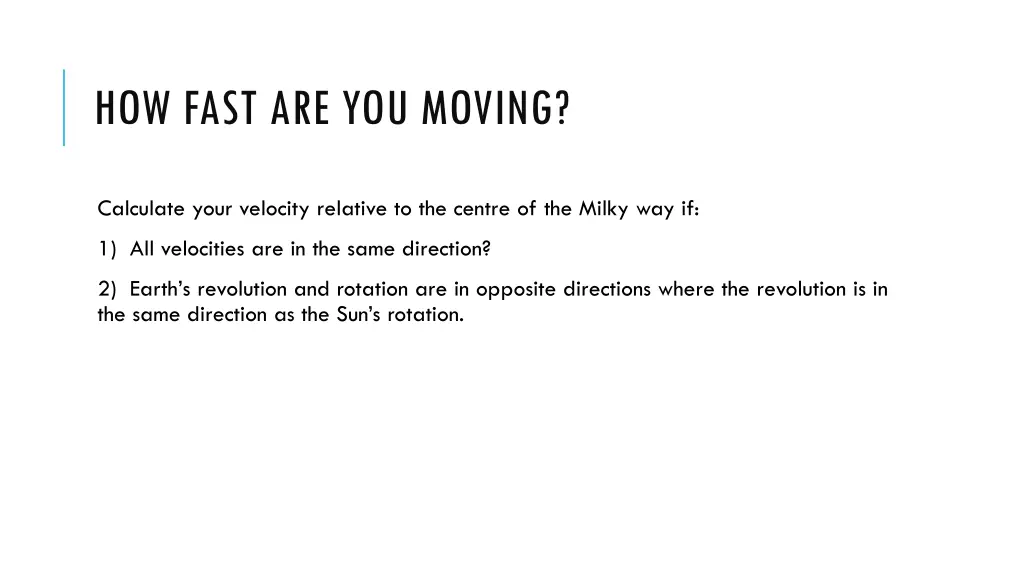
HOW FAST ARE YOU MOVING? Calculate your velocity relative to the centre of the Milky way if: 1) All velocities are in the same direction? 2) Earth s revolution and rotation are in opposite directions where the revolution is in the same direction as the Sun s rotation.
WHAT IS THE FRAME OF REFERENCE? http://www.anyclip.com/movies/the-matrix/arming/ https://www.youtube.com/watch?v=Y70vcs3oV14
FRAMES OF REFERENCE The video!
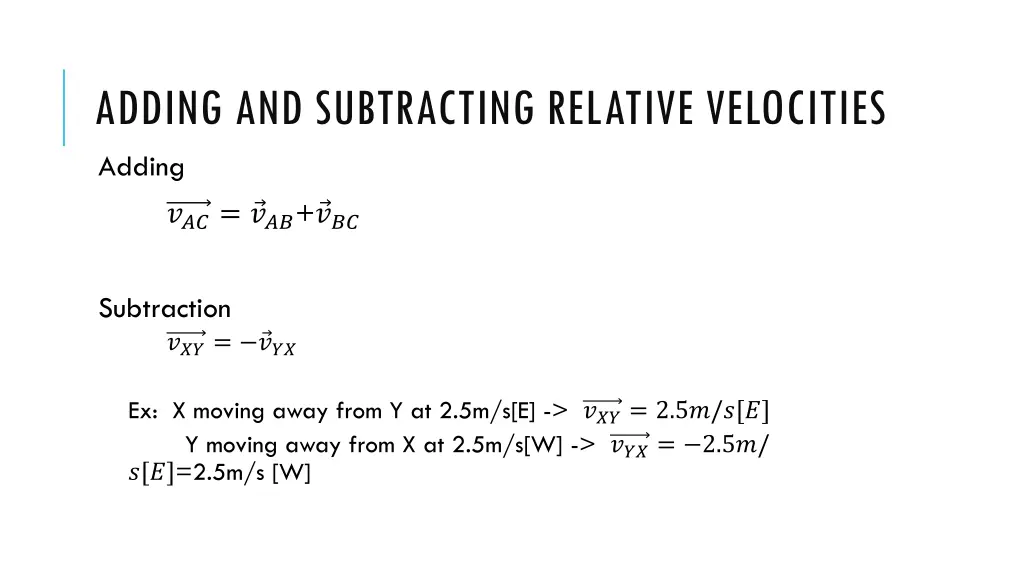
ADDING AND SUBTRACTING RELATIVE VELOCITIES Adding ???= ???+ ??? Subtraction ???= ??? Ex: X moving away from Y at 2.5m/s[E] -> ???= 2.5?/?[?] Y moving away from X at 2.5m/s[W] -> ???= 2.5?/ ?[?]=2.5m/s [W]
EXAMPLE 1: When seen from the shore, the current of a river is moving 12m/s [S]. A person in a boat is paddling as fast as they can 4m/s [W]. What is the resultant velocity of the boat?
EXAMPLE 2: A plane has a velocity relative to the air around it of 35m/s [N40oE]. The pilot sees a tower and does some calculations to determine the tower is moving at 46m/s [E55oS]. What will the wind speed at the tower be?
Example # 4: From Town A to Town B are on a straight river. Town B is a 150 km down stream of Town A. A boat travelling with its maximum speed can travel from A to B in 5.0 h. The return trip at maximum speed takes 7.5 h.
a) What is the speed of the current? b) What is the maximum speed of the boat? c) How long would it take to drift from Town A to Town B?
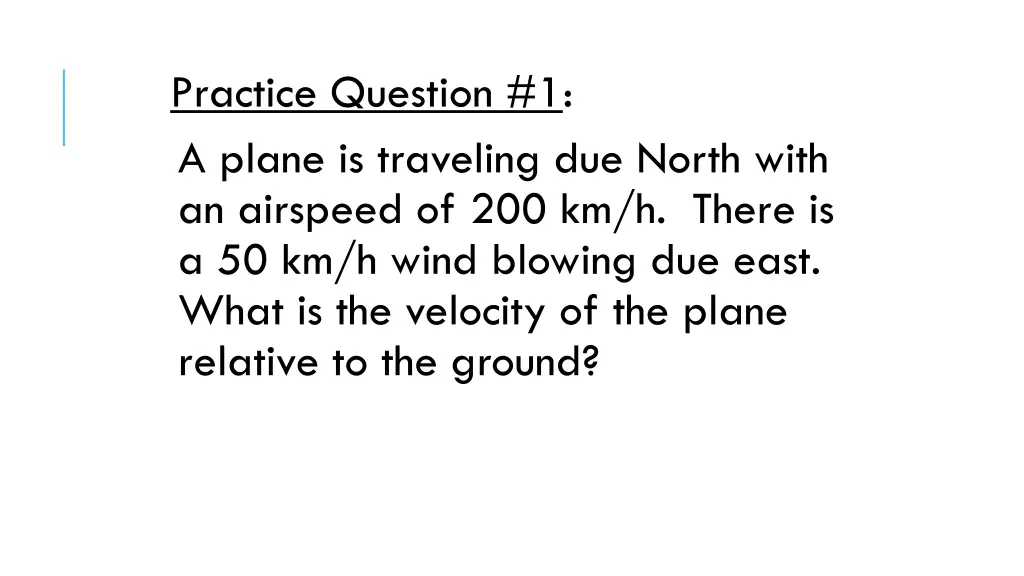
Practice Question #1: A plane is traveling due North with an airspeed of 200 km/h. There is a 50 km/h wind blowing due east. What is the velocity of the plane relative to the ground?
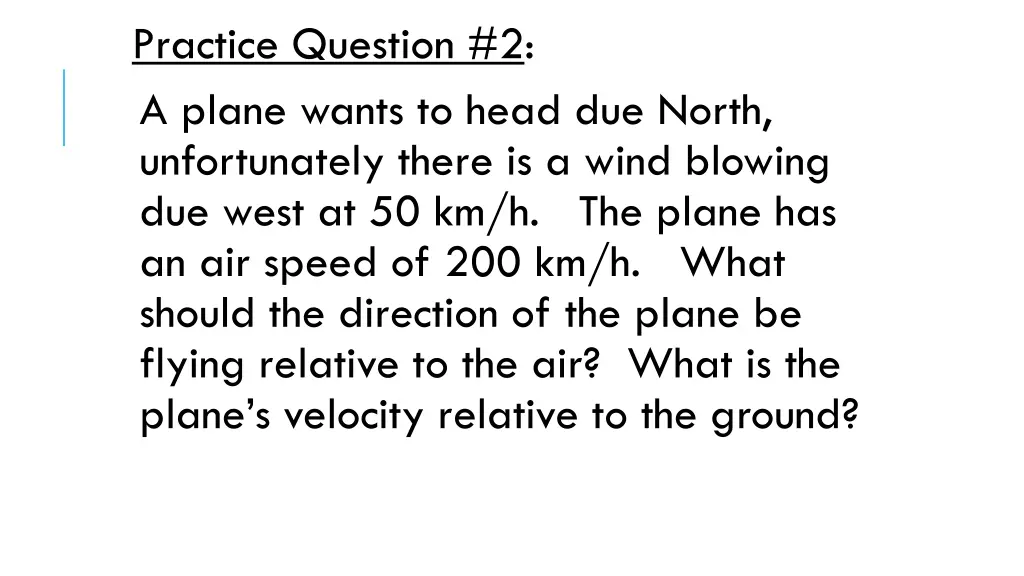
Practice Question #2: A plane wants to head due North, unfortunately there is a wind blowing due west at 50 km/h. The plane has an air speed of 200 km/h. What should the direction of the plane be flying relative to the air? What is the plane s velocity relative to the ground?