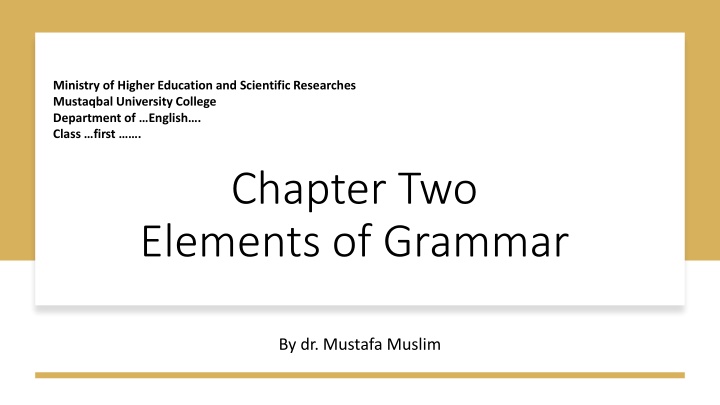
Explore the essential elements of grammar through a detailed study of adverbials and sentence structures. Learn about the three main types of adverbials - time, place, and process, as well as different sentence structures involving subjects, verbs, complements, and adverbs. Enhance your knowledge of English grammar with practical examples and explanations.
Please find below an Image/Link to download the presentation.
The content on the website is provided AS IS for your information and personal use only. It may not be sold, licensed, or shared on other websites without obtaining consent from the author. If you encounter any issues during the download, it is possible that the publisher has removed the file from their server.
You are allowed to download the files provided on this website for personal or commercial use, subject to the condition that they are used lawfully. All files are the property of their respective owners.
The content on the website is provided AS IS for your information and personal use only. It may not be sold, licensed, or shared on other websites without obtaining consent from the author.
Categories of adverbial There are three main types for adverbials: 1- Adverbs of time refer to the time of the action. Ex: The girl is now a student. Ex: John travelled to London yesterday. 2- Adverbs of place refer the place of the action. Ex: The boy is upstairs. Ex: The girl is studying in the college.
3- Adverbs of process refer to verbs that can be in progress , the aspect of on-going activity. Ex: The girl searched the room carefully. The adverb of process carefully describes the verb of the sentence ( the way of searching ). Note: the adverbs of process can t be used with stative verbs: * The girl is a student carefully.
Types of sentence structures 1- Subject + V ( stative , intensive ) + A place + ( A time ) Ex: She is in London now. S V A place A time Note : The adverb of place is ( in London ) an obligatory part in this structure while the adverb of time ( now ) is an optional part that can be deleted.
2- Subject + V ( stative , intensive ) + Cs + ( A place )+ ( A time ) Ex: She is a student in London now. S V Cs A place A time Note : The adverb of place ( in London ) and the adverb of time ( now ) are optional parts that can be deleted.
3- Subject + V ( extensive , transitive ) + Od + ( A place )+ ( A time ) Ex: John heard the explosion from his room yesterday . S V Od A place A time Note : both adverb of place ( from his room) and the adverb of time ( yesterday ) are optional parts that can be deleted.
4- Subject + V ( intensive , dynamic ) + Cs + A place + A time Ex: Universities became famous in Europe During the Middle Ages . S V Cs A place A time Note : The adjective famous is used as subject complement for it is describing the subject.
5-Subject + V ( extensive , monotransitive ) + Od + A process + A place + A time Ex: They ate the meat slowly in the restaurant that night. S V Od A process A place A time Note : all the adverbs ( process , place , time ) are optional.
6- Subject + V ( dynamic ,extensive , ditransitive ) + Oi + Od + (A process )+(A place) + (A time ) Ex: He offered her some chocolates politely outside the hall last night. S V Oi Od A process A place A time Note : all the adverbs ( process , place , time ) are optional. The indirect object her is also an optional part in the sentence.
7- Subject + V ( dynamic ,intensive , complex transitive ) + Od + Co + (A process )+(A place) + (A time ) Ex: They elected him chairman without argument in London yesterday. S V Od Co A process A place A time Note : all the adverbs ( process , place , time ) are optional. The verb is complex transitive for the object complement chairman after the direct object him .
8-Subject + V ( dynamic ,intransitive )+ (A process )+(A place) + (A time ) Ex: The train had arrived quietly at the station before we noticed it. S V A process A place A time Note : all the adverbs ( process , place , time ) are optional.