Understanding Gravitational Potential Energy Conversions
Explore the concept of gravitational potential energy and its conversion to kinetic energy through engaging examples and practical applications. Learn about the equation for gravitational potential energy, its relationship with height and mass, and how energy transformations occur during objects' motion. Discover how to calculate kinetic energy and object speed based on gravitational potential energy. Dive into worked examples, worksheets, and answer keys to enhance your understanding further.

Download Presentation

Please find below an Image/Link to download the presentation.
The content on the website is provided AS IS for your information and personal use only. It may not be sold, licensed, or shared on other websites without obtaining consent from the author. If you encounter any issues during the download, it is possible that the publisher has removed the file from their server.
You are allowed to download the files provided on this website for personal or commercial use, subject to the condition that they are used lawfully. All files are the property of their respective owners.
The content on the website is provided AS IS for your information and personal use only. It may not be sold, licensed, or shared on other websites without obtaining consent from the author.
E N D
Presentation Transcript
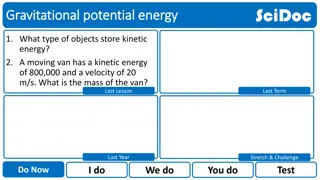
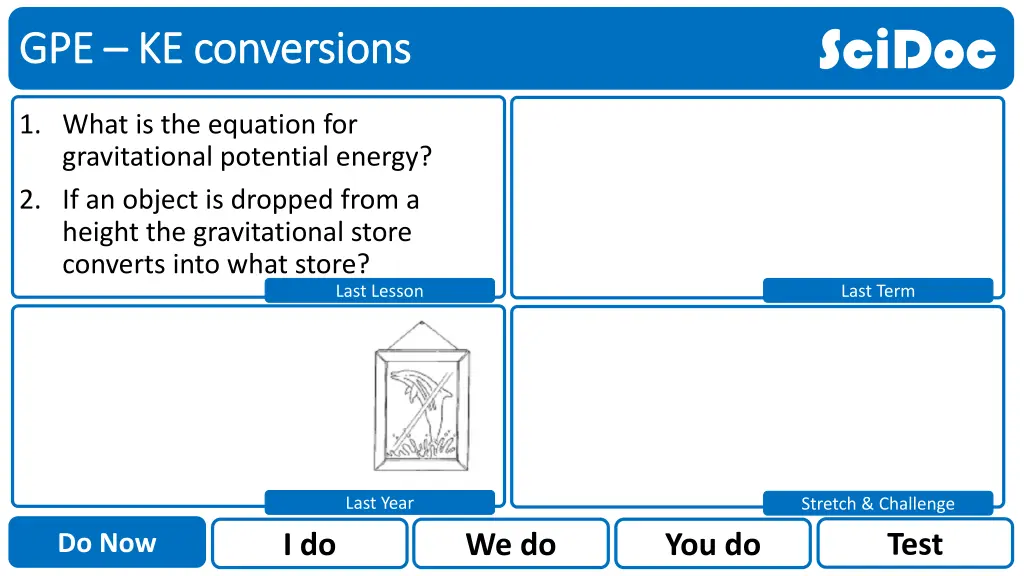
SciDoc GPE GPE KE conversions KE conversions 1. What is the equation for gravitational potential energy? 2. If an object is dropped from a height the gravitational store converts into what store? Last Lesson Last Term Last Year Stretch & Challenge I do We do Test I do We do You do Do Now
SciDoc Keywords Learning Objectives Keywords Gravitational Potential Energy Height Metres Joules Mass State energy transfers that occur for a falling objects Recall the principle of conservation of energy. Calculate final velocities from drop heights. I do We do Test I do We do You do Do Now
SciDoc Energy conversions Energy conversions Stretch: Kris is at the top of a 5 m high slide. Assuming that all of her GPE is converted to KE, what will be her maximum speed when she reaches the bottom? Kris has a mass of 55 kg. An object at height initially has gravitational potential energy. If it falls, this energy is converted into kinetic energy. As the book reaches the ground its final KE will be equal to its initial GPE. I do We do Test I do We do You do LO:
SciDoc Worked example 1 Worked example 1 Worked example 1: Kris is at the top of a 5 m high slide. Assuming that all of her GPE is converted to KE, what will be her maximum speed when she reaches the bottom? Kris has a mass of 55 kg. Step 1: Calculate Kris s GPE at the top of the slide: ??= ? ? = 55 10 5 = 2750 ? Step 2: As Kris slides down, her GPE is converted to KE. At the bottom of the slide, all her GPE will have been converted to KE, i.e. her KE equals 2750 J. 2 ?? ? Next, rearrange the KE equation to find her speed: ? = 2 2750 55 Step 3: Substitute our known values for m and KE: ? = = 10 ?/? I do We do Test I do We do You do LO:
SciDoc Worksheet Worksheet Complete the worksheet! I do We do Test I do We do You do LO:
SciDoc Basic/medium answers Basic/medium answers 1. a) B b) C d) Ep = m g h = 60 9.8 8 = 4704 J e) 4704 J 2. a) Starts with maximum KE. This reduces as the iPad falls and turns into KE. The iPad has max KE and min GPE just before it hits the floor. b) Ep = m g h = 0.47 9.8 2 = 9.2 J c) 9.2 J 3. a) Ek = 0.5 m v2 = 0.5 0.005 252 = 15.6 J b) 15.6 J c) Ep = m g h 15.6 = 0.05 9.8 h h = 31.8 m 4. a) Ep = m g h = 0.0025 9.8 828 = 20.3 J b) 20.3 J c) Ek = 0.5 m v2 20.3 = 0.5 0.0025 v2 v = 16240 = 127.4 m/s c) D I do We do Test I do We do You do LO:
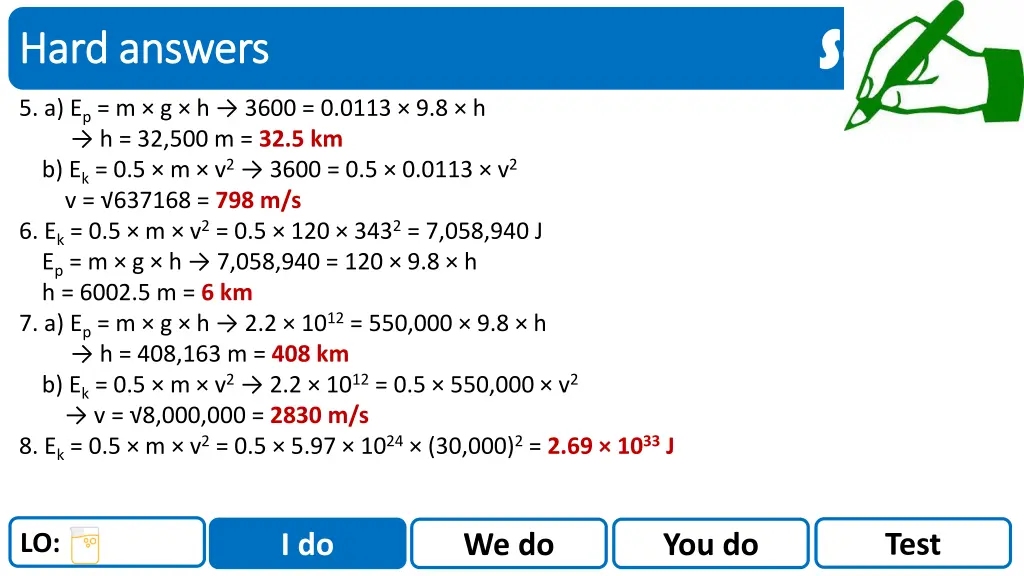
SciDoc Hard answers Hard answers 5. a) Ep = m g h 3600 = 0.0113 9.8 h h = 32,500 m = 32.5 km b) Ek = 0.5 m v2 3600 = 0.5 0.0113 v2 v = 637168 = 798 m/s 6. Ek = 0.5 m v2 = 0.5 120 3432 = 7,058,940 J Ep = m g h 7,058,940 = 120 9.8 h h = 6002.5 m = 6 km 7. a) Ep = m g h 2.2 1012 = 550,000 9.8 h h = 408,163 m = 408 km b) Ek = 0.5 m v2 2.2 1012 = 0.5 550,000 v2 v = 8,000,000 = 2830 m/s 8. Ek = 0.5 m v2 = 0.5 5.97 1024 (30,000)2 = 2.69 1033 J I do We do Test I do We do You do LO:
SciDoc Struggle time Struggle time Exam questions so exam conditions! You have 8 minutes. I do We do Test I do We do You do LO:
SciDoc Struggle time review Struggle time review I do We do Test I do We do You do LO:
SciDoc Struggle time review Struggle time review I do We do Test I do We do You do LO: