Understanding Guarding and Triangulation in Computational Geometry
Dive into the concepts of guarding and triangulation in computational geometry, exploring topics such as the art gallery problem, polygon triangulation, and the placement of cameras to guard a polygon efficiently. Learn about theorems regarding triangulation and the minimum number of cameras needed for guarding, with insightful diagrams and explanations to enhance your understanding.

Download Presentation

Please find below an Image/Link to download the presentation.
The content on the website is provided AS IS for your information and personal use only. It may not be sold, licensed, or shared on other websites without obtaining consent from the author. If you encounter any issues during the download, it is possible that the publisher has removed the file from their server.
You are allowed to download the files provided on this website for personal or commercial use, subject to the condition that they are used lawfully. All files are the property of their respective owners.
The content on the website is provided AS IS for your information and personal use only. It may not be sold, licensed, or shared on other websites without obtaining consent from the author.
E N D
Presentation Transcript
Lecture Notes for Introduction to Computational Geometry (Com S 418/518) Yan-Bin Jia, Iowa State University Guarding and Triangulation Outline I. Properties of polygon triangulation II. Solution to the art gallery probelm Textbook: Computational Geometry: Algorithms and Applications (3rd ed.) by M. de Berg et al., Springer-Verlag, 2008.
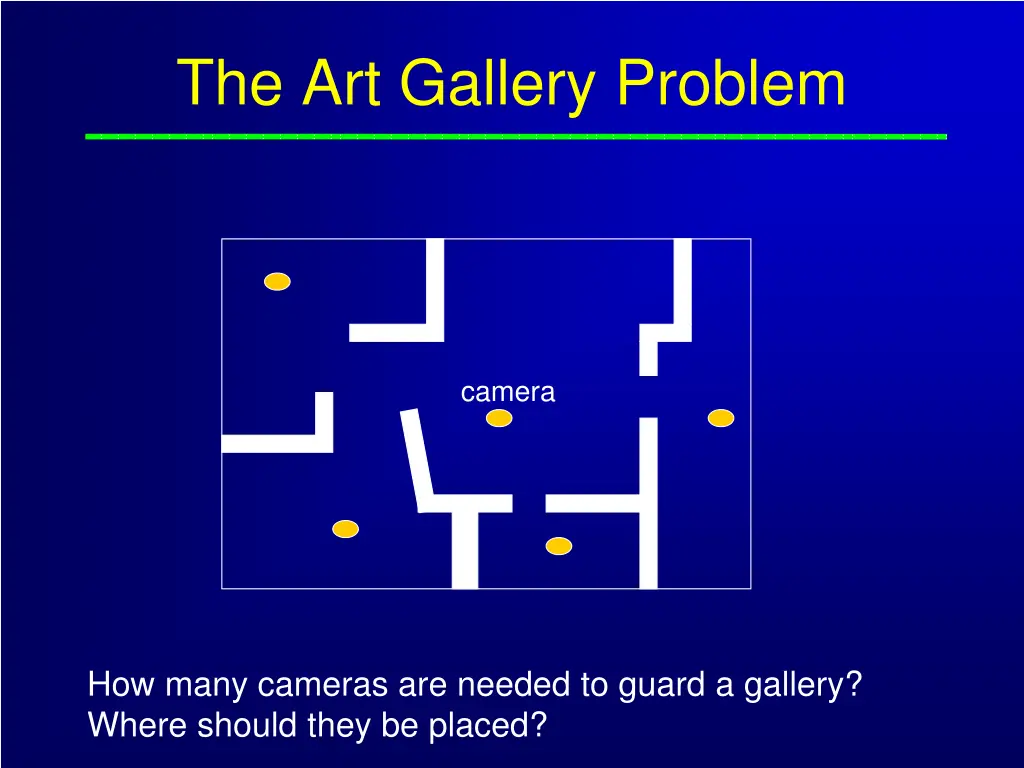
The Art Gallery Problem camera How many cameras are needed to guard a gallery? Where should they be placed?
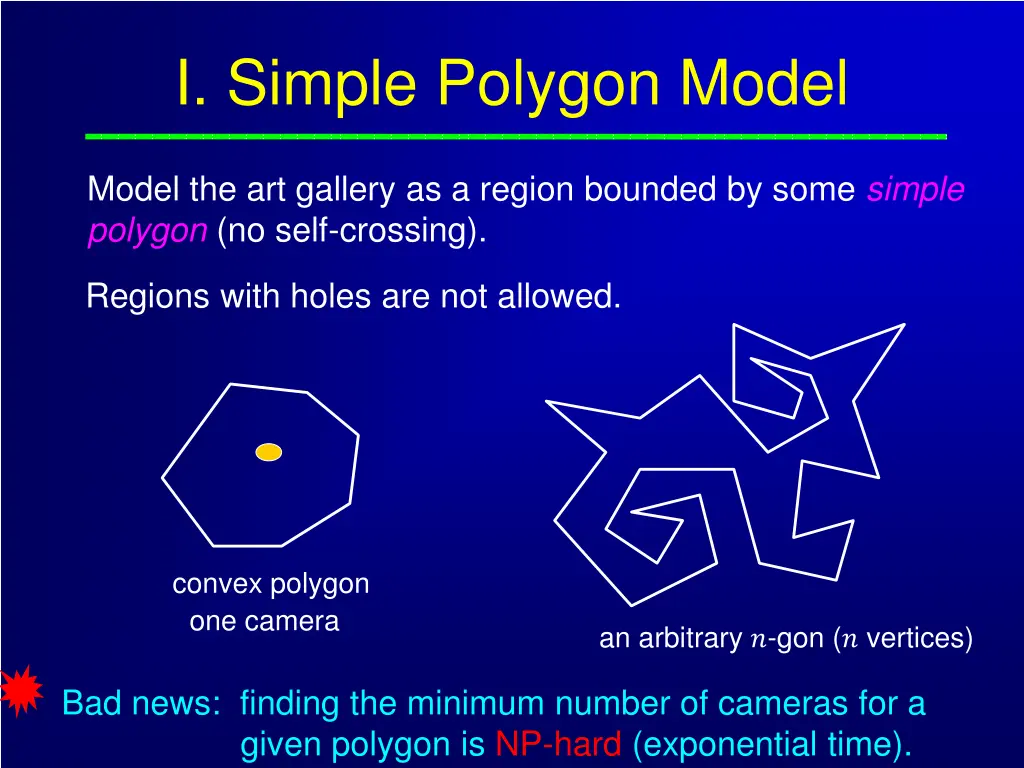
I. Simple Polygon Model Model the art gallery as a region bounded by some simple polygon (no self-crossing). Regions with holes are not allowed. convex polygon one camera an arbitrary ?-gon (? vertices) Bad news: finding the minimum number of cameras for a given polygon is NP-hard (exponential time).
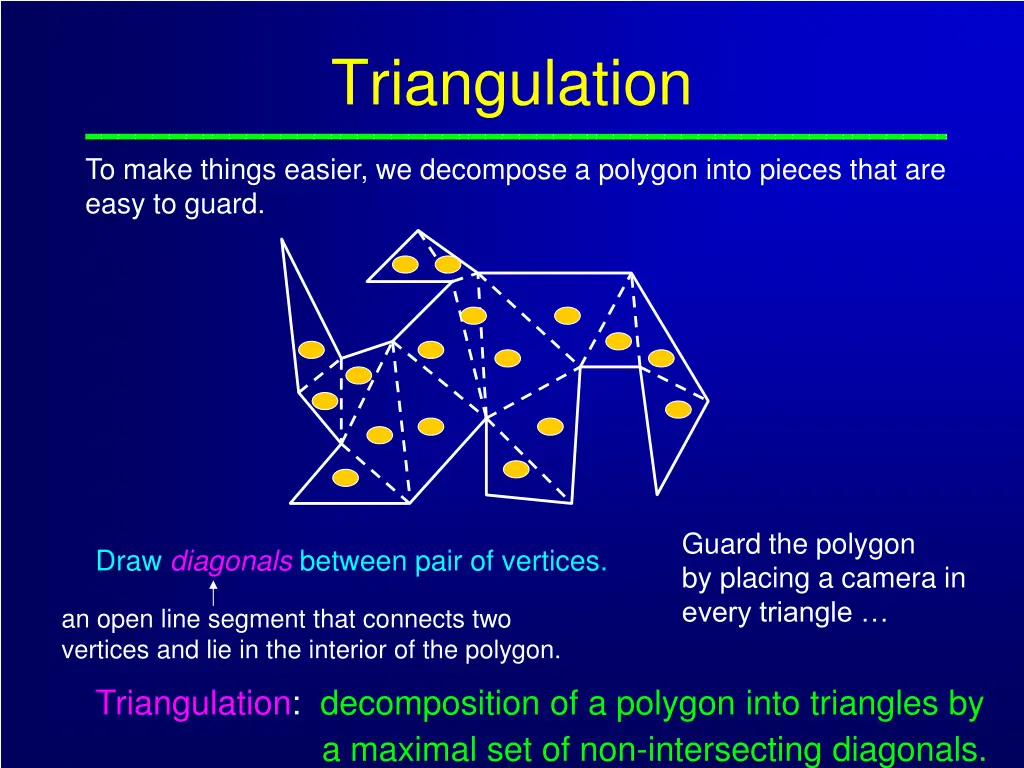
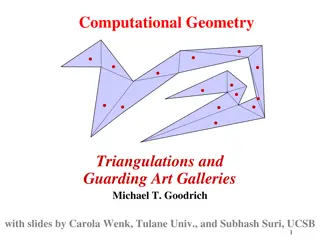
Triangulation To make things easier, we decompose a polygon into pieces that are easy to guard. Guard the polygon by placing a camera in every triangle Draw diagonals between pair of vertices. an open line segment that connects two vertices and lie in the interior of the polygon. Triangulation: decomposition of a polygon into triangles by a maximal set of non-intersecting diagonals.
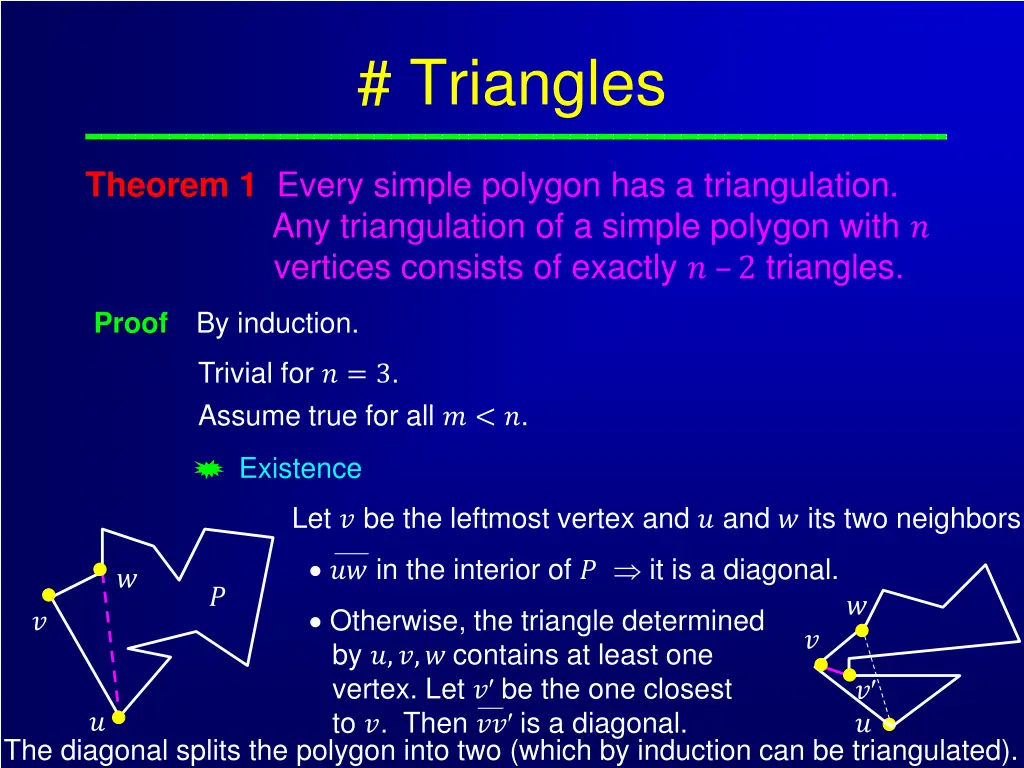
# Triangles Theorem 1 Every simple polygon has a triangulation. Any triangulation of a simple polygon with ? vertices consists of exactly ? 2 triangles. By induction. Proof Trivial for? = 3. Assume true for all ? < ?. Existence Let ? be the leftmost vertex and ? and ? its two neighbors. ?? in the interior of ? it is a diagonal. ? ? ? Otherwise, the triangle determined by ?,?,? contains at least one vertex. Let ? be the one closest to ?. Then ?? is a diagonal. ? ? ? ? ? The diagonal splits the polygon into two (which by induction can be triangulated).
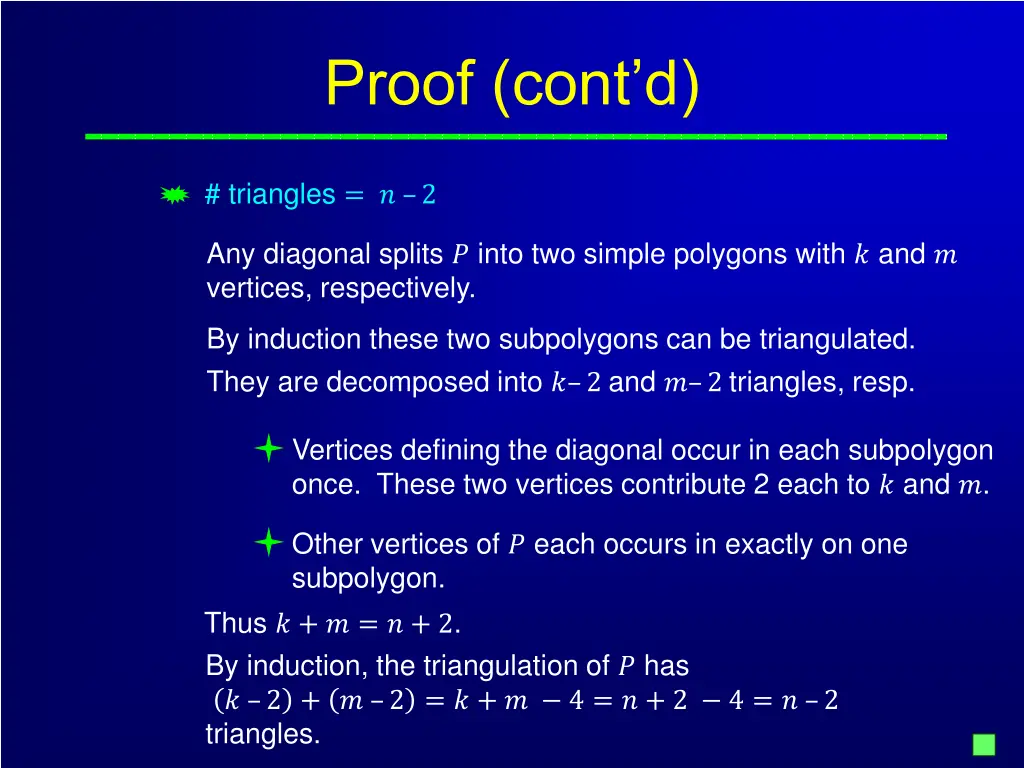
Proof (contd) # triangles = ? 2 Any diagonal splits ? into two simple polygons with ? and ? vertices, respectively. By induction these two subpolygons can be triangulated. They are decomposed into ? 2 and ? 2 triangles, resp. Vertices defining the diagonal occur in each subpolygon once. These two vertices contribute 2 each to ? and ?. Other vertices of ? each occurs in exactly on one subpolygon. Thus ? + ? = ? + 2. By induction, the triangulation of ? has ? 2 + ? 2 = ? + ? 4 = ? + 2 4 = ? 2 triangles.
II. # Cameras for AG Theorem 1 ? 2 cameras can guard the simple polygon. A camera on a diagonal guards two triangles. # cameras can be reduced to roughly ?/2. A vertex is adjacent to many triangles. So placing cameras at vertices can do even better
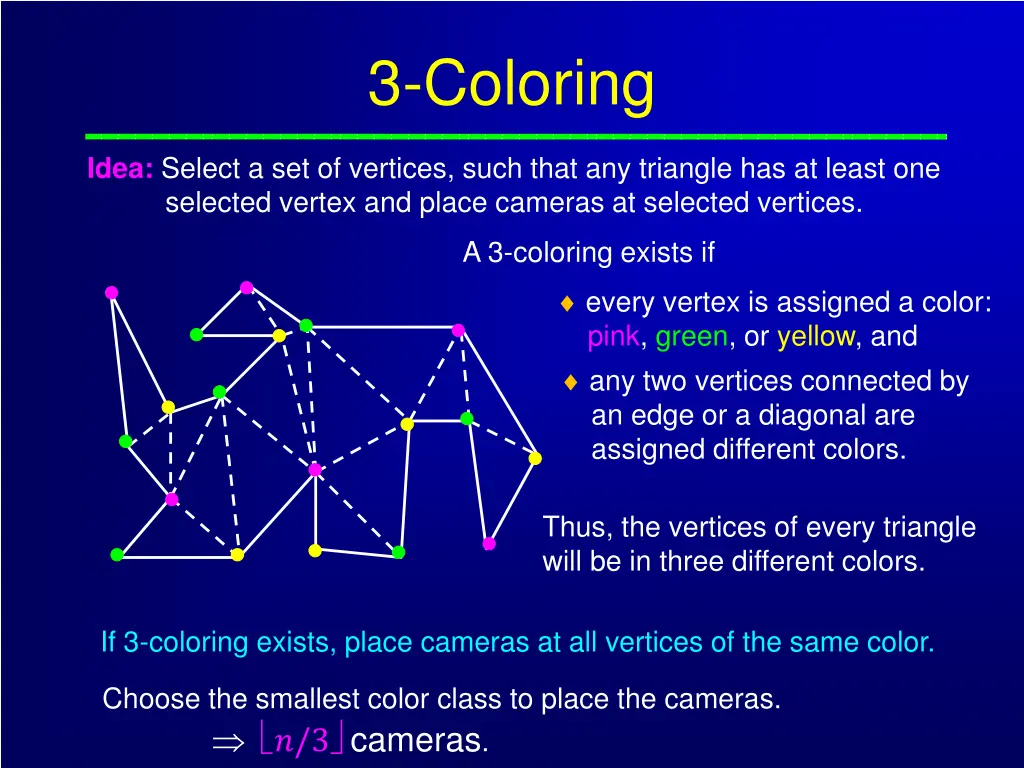
3-Coloring Idea: Select a set of vertices, such that any triangle has at least one selected vertex and place cameras at selected vertices. A 3-coloring exists if every vertex is assigned a color: pink, green, or yellow, and any two vertices connected by an edge or a diagonal are assigned different colors. Thus, the vertices of every triangle will be in three different colors. If 3-coloring exists, place cameras at all vertices of the same color. Choose the smallest color class to place the cameras. ?/3 cameras.
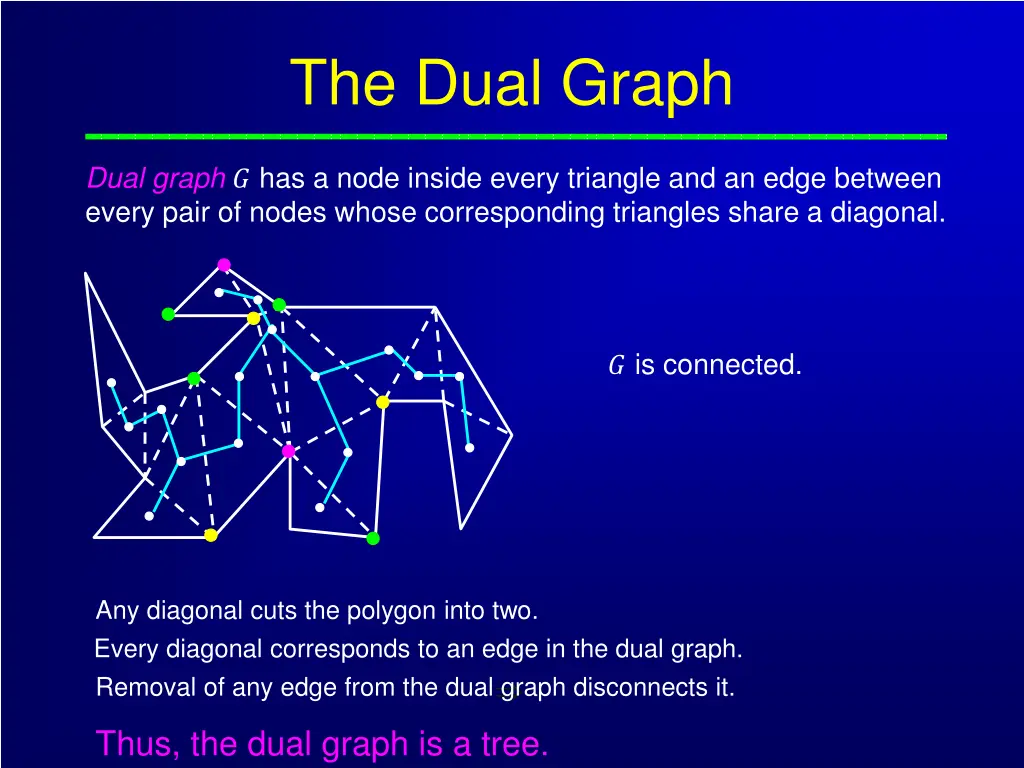
The Dual Graph Dual graph? has a node inside every triangle and an edge between every pair of nodes whose corresponding triangles share a diagonal. ? is connected. Any diagonal cuts the polygon into two. Every diagonal corresponds to an edge in the dual graph. Removal of any edge from the dual graph disconnects it. Thus, the dual graph is a tree.
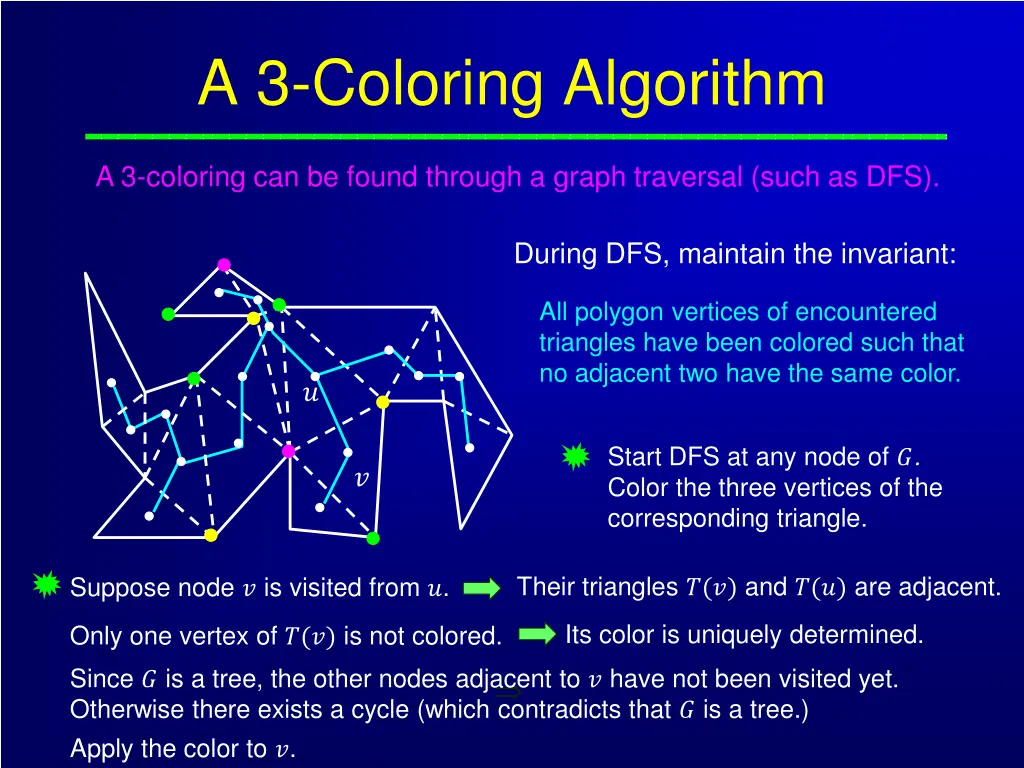
A 3-Coloring Algorithm A 3-coloring can be found through a graph traversal (such as DFS). During DFS, maintain the invariant: All polygon vertices of encountered triangles have been colored such that no adjacent two have the same color. ? Start DFS at any node of ?. Color the three vertices of the corresponding triangle. ? Suppose node ? is visited from ?. Their triangles ?(?) and ?(?) are adjacent. Its color is uniquely determined. Only one vertex of?(?) is not colored. Since ? is a tree, the other nodes adjacent to ? have not been visited yet. Otherwise there exists a cycle (which contradicts that ? is a tree.) Apply the color to ?.
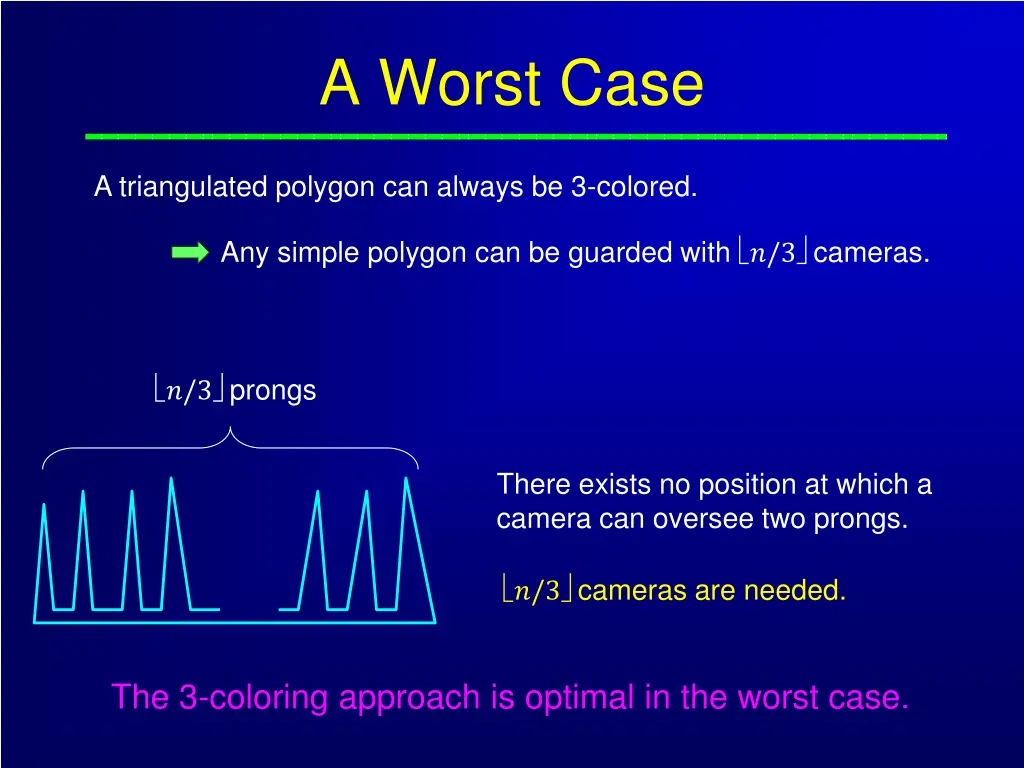
A Worst Case A triangulated polygon can always be 3-colored. Any simple polygon can be guarded with ?/3 cameras. ?/3 prongs There exists no position at which a camera can oversee two prongs. ?/3 cameras are needed. The 3-coloring approach is optimal in the worst case.
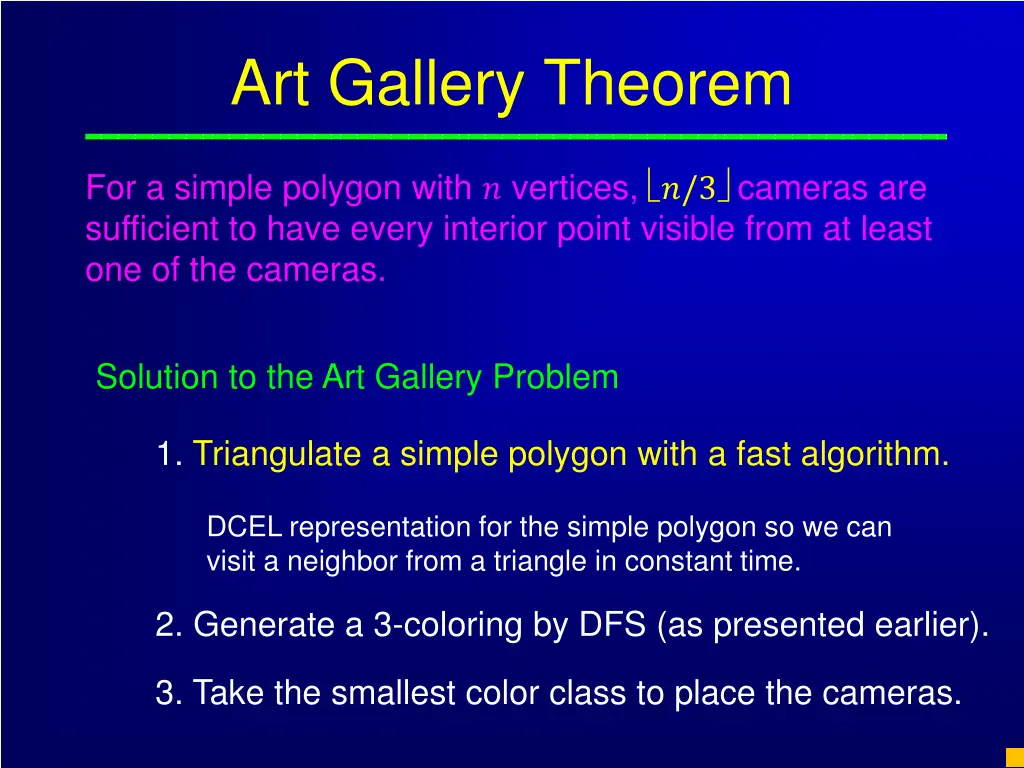
Art Gallery Theorem For a simple polygon with ? vertices, ?/3 cameras are sufficient to have every interior point visible from at least one of the cameras. Solution to the Art Gallery Problem 1. Triangulate a simple polygon with a fast algorithm. DCEL representation for the simple polygon so we can visit a neighbor from a triangle in constant time. 2. Generate a 3-coloring by DFS (as presented earlier). 3. Take the smallest color class to place the cameras.