Understanding Health Insurance for International Students
Learn about the importance of health insurance for international students in the U.S., how premiums work, common terms like co-insurance and deductibles, and key concepts such as pre-existing conditions and exclusions. Make informed decisions to protect your health and academic journey while studying abroad.

Download Presentation

Please find below an Image/Link to download the presentation.
The content on the website is provided AS IS for your information and personal use only. It may not be sold, licensed, or shared on other websites without obtaining consent from the author. If you encounter any issues during the download, it is possible that the publisher has removed the file from their server.
You are allowed to download the files provided on this website for personal or commercial use, subject to the condition that they are used lawfully. All files are the property of their respective owners.
The content on the website is provided AS IS for your information and personal use only. It may not be sold, licensed, or shared on other websites without obtaining consent from the author.
E N D
Presentation Transcript
A Guide for New International Students Fall 2019
The U.S. has no national health care system. Each person is responsible for the cost of their own health care. Medical care in the U.S. is very expensive. The costs of a serious accident or illness can end a student s academic career. Emory University requires all students to carry health insurance. For J-1 students, health insurance is also required by law.
Individuals pay a premium to enroll in a health insurance plan. That payment is combined with the premiums of others in the plan to form a pool of money. The money is then used to pay the medical bills of those in the plan who need medical care. Your policy will state what the insurance company will pay for, and how much of the bill you will have to pay.
Co-Insurance: The percentage of covered expenses you share with the carrier. (i.e., for an 80/20 plan, your co-insurance is 20%.) If applicable, co-insurance applies after you pay the deductible Co-Payment: The amount you must pay toward the cost of a particular benefit. For example, a plan might require a $25 co-pay for each doctor's office visit. Deductible: The dollar amount you must pay for covered expenses during a calendar year before the plan begins paying co-insurance benefits.
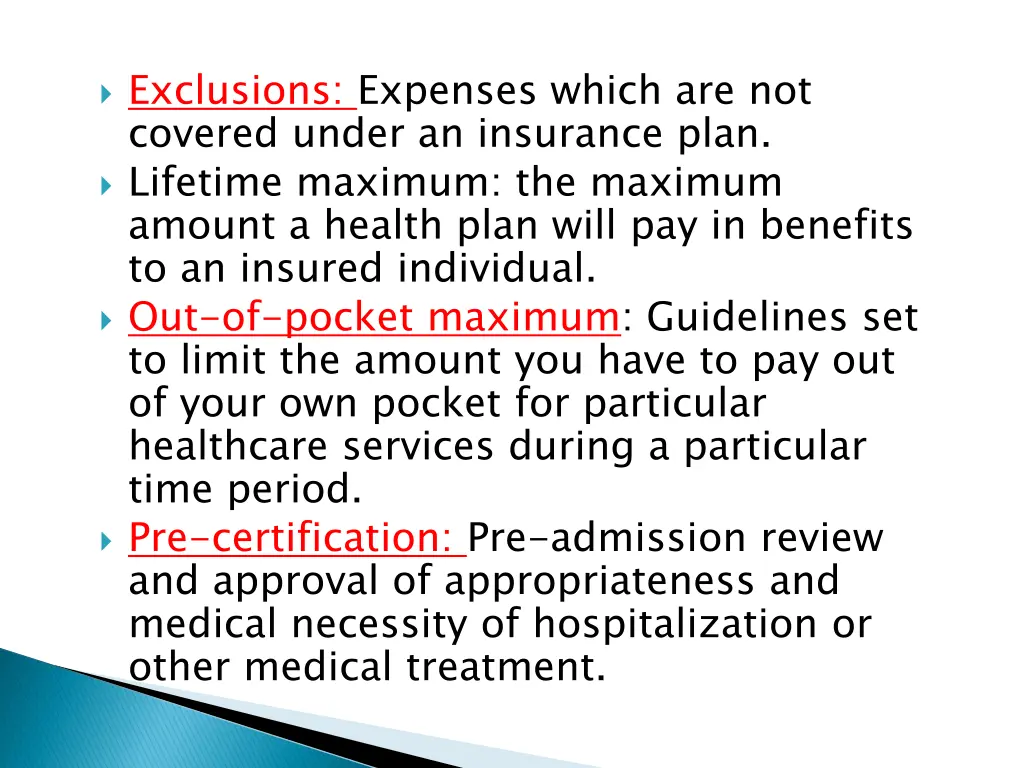
Exclusions: Expenses which are not covered under an insurance plan. Lifetime maximum: the maximum amount a health plan will pay in benefits to an insured individual. Out-of-pocket maximum: Guidelines set to limit the amount you have to pay out of your own pocket for particular healthcare services during a particular time period. Pre-certification: Pre-admission review and approval of appropriateness and medical necessity of hospitalization or other medical treatment.
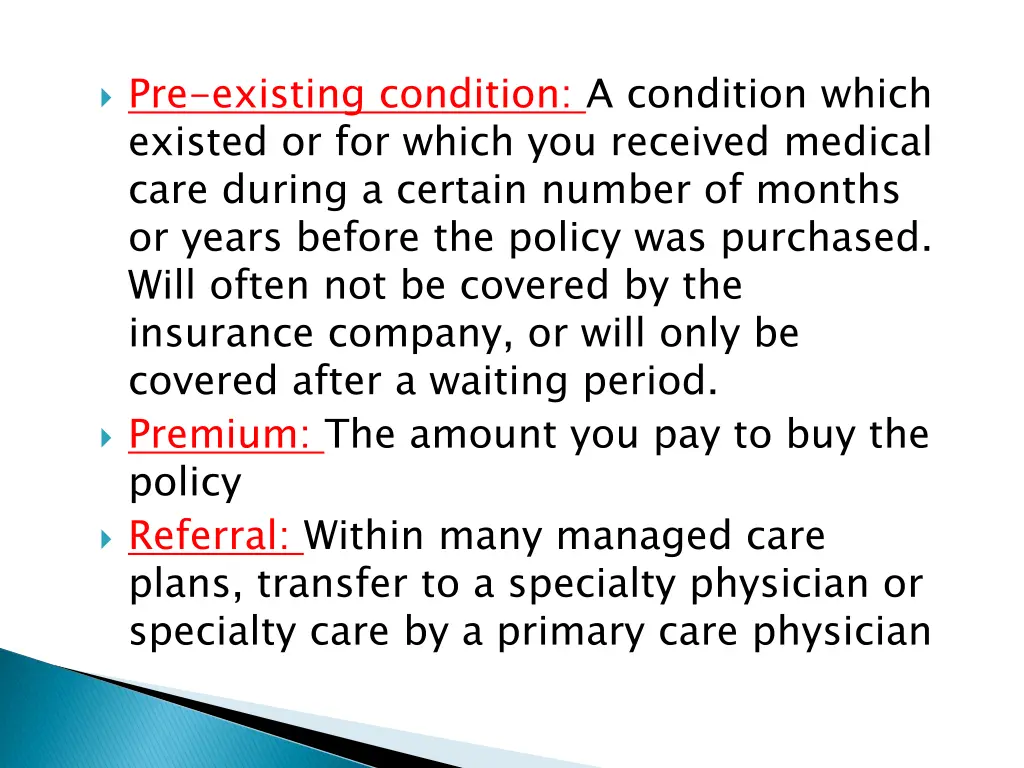
Pre-existing condition: A condition which existed or for which you received medical care during a certain number of months or years before the policy was purchased. Will often not be covered by the insurance company, or will only be covered after a waiting period. Premium: The amount you pay to buy the policy Referral: Within many managed care plans, transfer to a specialty physician or specialty care by a primary care physician
Well use the Emory Student Health Insurance Plan as an example. You have gone to a friend s house in another state over Spring Break. One night, you accidentally cut your hand. The cut looks very deep, and it won t stop bleeding.
Your friend takes you to the emergency room. Since you re not near Emory, the hospital is not in the Core network. Instead it is an in network At the emergency room, you pay your $75 co in- - network hospital. $75 co- -payment payment.
You get stitches in your hand and are sent home. When you receive your hospital bill, the amount is $1,500 Because you have insurance, most of it will be paid by the insurance company. How much? Let s find out $1,500.
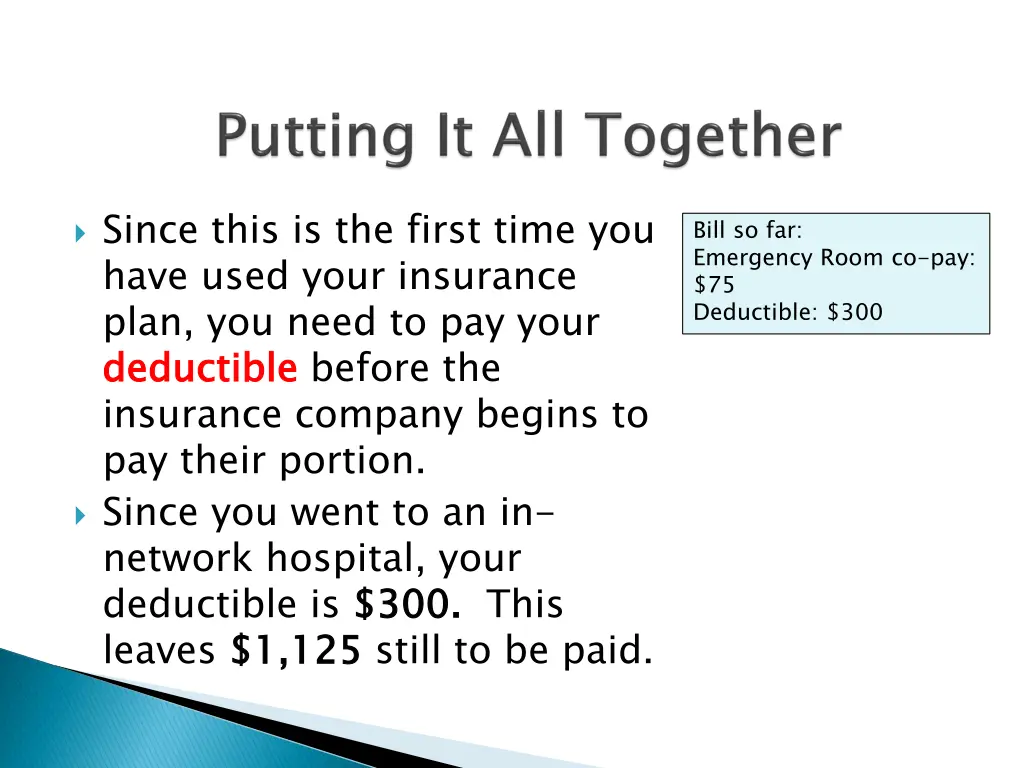
Since this is the first time you have used your insurance plan, you need to pay your deductible insurance company begins to pay their portion. Since you went to an in- network hospital, your deductible is $300. leaves $1,125 Bill so far: Emergency Room co-pay: $75 Deductible: $300 deductible before the $300. This $1,125 still to be paid.
At an in-network hospital, Aetna will pay 80% after you have paid the deductible. You are responsible for the other 20% This is your co-insurance. For your emergency room visit, Aetna will pay $900 You will be responsible for the additional $225 Your bill so far: Emergency Room co-pay: $75 Deductible: $300 Co-insurance: $225 Aetna s bill so far: Co-insurance: $900 80% of the bill 20%. $900. $225.
Your doctor also gave you a prescription for antibiotics that you need to fill at a pharmacy. The cost of the antibiotics is $60. For a generic prescription, you pay a $15 The insurance company pays for the rest of the medication, up to at an unlimited amount per year. For this prescription, they will pay the remaining $45 Your bill so far: Emergency Room co-pay: $75 Deductible: $300 Co-insurance: $225 Prescription: $15 $15 co co- -payment payment. Aetna s bill so far: Co-insurance: $900 Prescription: $45 $45.
A week later, you go to the doctor to have your stitches removed. At the doctor, you pay your $25 co Your bill for the doctor s visit is $200. Since your co-insurance is 20%, you pay $40 Aetna pays the remaining $160 Your bill so far: Emergency Room co-pay: $75 Deductible: $300 Co-insurance: $225 Prescription: $15 Doctor s visit co-pay: $25 Doctor s visit co-insurance: $40 $25 co- -payment payment. Aetna s bill so far: Co-insurance: $900 Prescription: $45 Doctor s visit co-insurance: $160 $40. $160.
Aetnas costs: Co-insurance: $900 Prescription: $45 Doctor s visit co-insurance: $160 Aetna s costs: Your costs: Emergency Room co-pay: $75 Deductible: $300 Co-insurance: $225 Prescription: $15 Doctor s visit co-pay: $25 Doctor s visit co-insurance: $40 Your costs: Total: $ Total: $1,105 1,105 Total: Total: $680 $680 Without health insurance, you would have had to pay the full $1,760.
All Emory students must have health insurance that is valid in Atlanta All students who wish to use their own insurance plan must complete the mandatory insurance waiver process on-line via OPUS each year while enrolled at Emory You must certify that your insurance plan meets certain criteria in order to be given a waiver. DEADLINE AUG 28th EUSHS Insurance Office: 404-727-7560 or email us at: mandatoryinsurancelistserv.cc.emory.edu.. ..
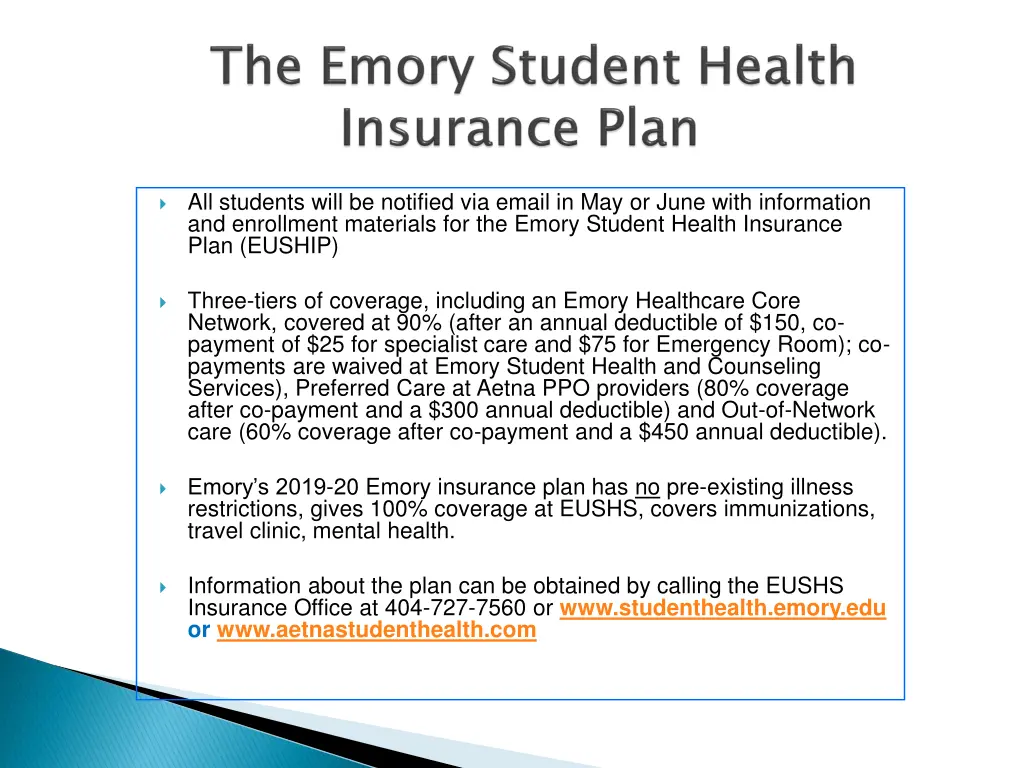
All students will be notified via email in May or June with information and enrollment materials for the Emory Student Health Insurance Plan (EUSHIP) Three-tiers of coverage, including an Emory Healthcare Core Network, covered at 90% (after an annual deductible of $150, co- payment of $25 for specialist care and $75 for Emergency Room); co- payments are waived at Emory Student Health and Counseling Services), Preferred Care at Aetna PPO providers (80% coverage after co-payment and a $300 annual deductible) and Out-of-Network care (60% coverage after co-payment and a $450 annual deductible). Emory s 2019-20 Emory insurance plan has no pre-existing illness restrictions, gives 100% coverage at EUSHS, covers immunizations, travel clinic, mental health. Information about the plan can be obtained by calling the EUSHS Insurance Office at 404-727-7560 or www.studenthealth.emory.edu or www.aetnastudenthealth.com
You must have a referral from an EUSHS provider prior to receiving care from a specialist. For ongoing care, the referral must be renewed at the beginning of the new policy year (generally, a phone call to your EUSHS provider will do)
Annual premium - $3,570 Continuation Plan premium - $1,500 3-tier Pharmacy copay structure - $15 / $30 / $45 90-day medication supply option (with no override) Standard Pharmacy Plan effective September 1, 2019 Dependent coverage is still available for both Domestic and International students enrolled in the plan. Dependent and Continuation Plan enrollment managed through the Emory Storefront https://tinyurl.com/EmoryStudentHealthPremiums Once again, automatic annual Dental PPO coverage upon enrollment in the medical plan.
Dependent coverage for spouses , domestic partners and children is available for an additional cost: spouse ($3,570); Child/ren ($3,570). Enroll online at the Emory Storefront https://tinyurl.com/EmoryStudentHealthPremi ums Routine Dental coverage is available through the medical plan. Routine Vision is not covered. The EyeMed discount program is available.
International Students International Students: : 8/1/19 7/31/20
You can print your by accessing Aetna's website at www.aetnastudenthealth.com/emory and click on the Print Your ID Card tab. You will need your Emory student ID# and date of birth. You can also request a permanent ID card by calling Aetna Student Health at 1-877-261-8403 or download the Aetna Mobile App on your Smartphone by visiting www.aetna.com/mobile.
Student Health at the 1525 Clifton Road Building Counseling Center at 1462 Clifton Rd. Suite 235 Via cyberspace at: studenthealth.emory. edu