Learn about the Household Dietary Diversity Score (HDDS) developed by FANTA as a proxy measure of food access. HDDS focuses on the correlation between dietary diversity and health outcomes, including caloric adequacy and household income. Discover the strengths, limitations, and linkages of HDDS in Integrated Food Security Phase Classification (IPC) analyses.
Please find below an Image/Link to download the presentation.
The content on the website is provided AS IS for your information and personal use only. It may not be sold, licensed, or shared on other websites without obtaining consent from the author. If you encounter any issues during the download, it is possible that the publisher has removed the file from their server.
You are allowed to download the files provided on this website for personal or commercial use, subject to the condition that they are used lawfully. All files are the property of their respective owners.
The content on the website is provided AS IS for your information and personal use only. It may not be sold, licensed, or shared on other websites without obtaining consent from the author.
E N D
Presentation Transcript
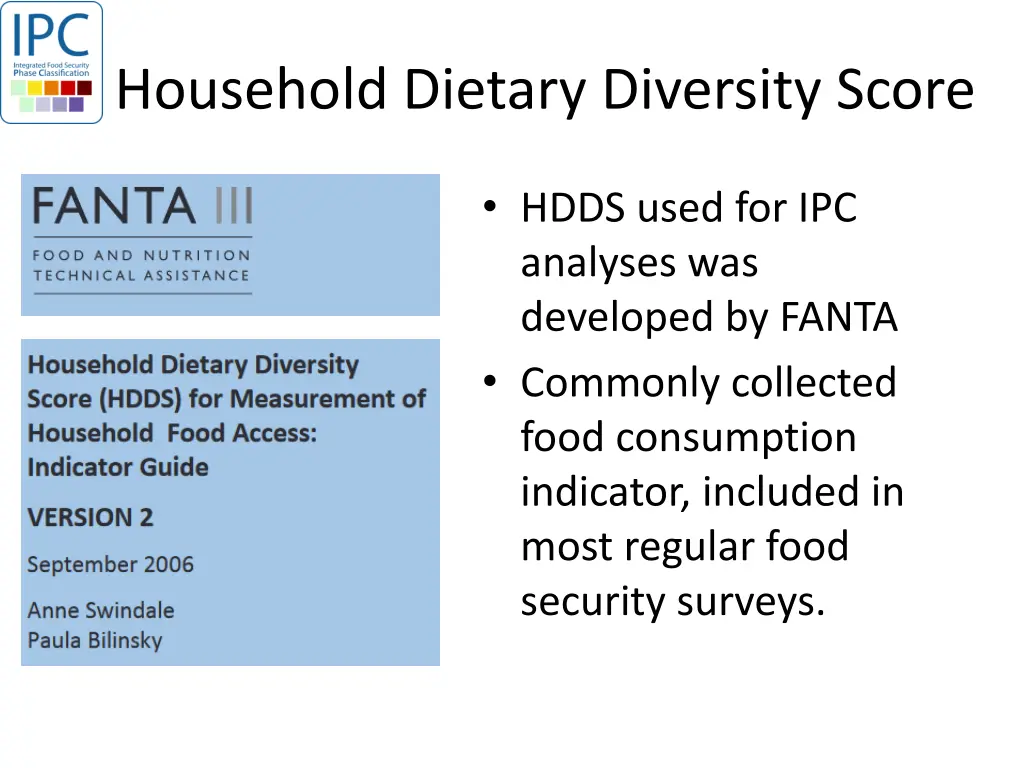
Household Dietary Diversity Score HDDS used for IPC analyses was developed by FANTA Commonly collected food consumption indicator, included in most regular food security surveys.
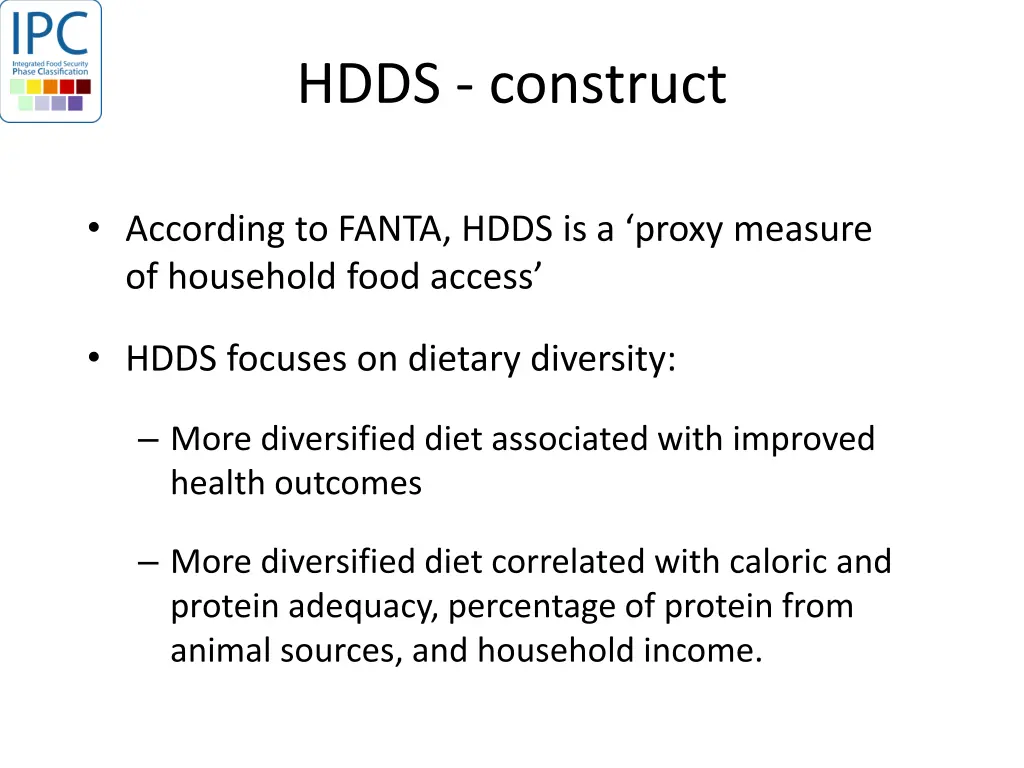
HDDS - construct According to FANTA, HDDS is a proxy measure of household food access HDDS focuses on dietary diversity: More diversified diet associated with improved health outcomes More diversified diet correlated with caloric and protein adequacy, percentage of protein from animal sources, and household income. 3
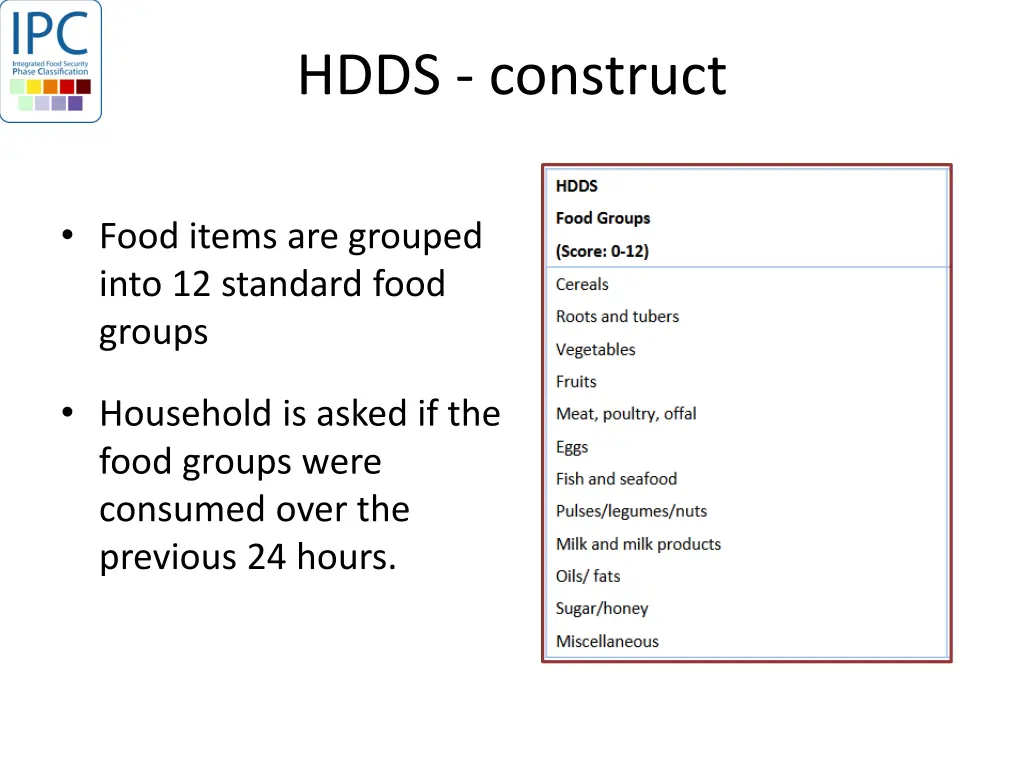
HDDS - construct Food items are grouped into 12 standard food groups Household is asked if the food groups were consumed over the previous 24 hours. 4
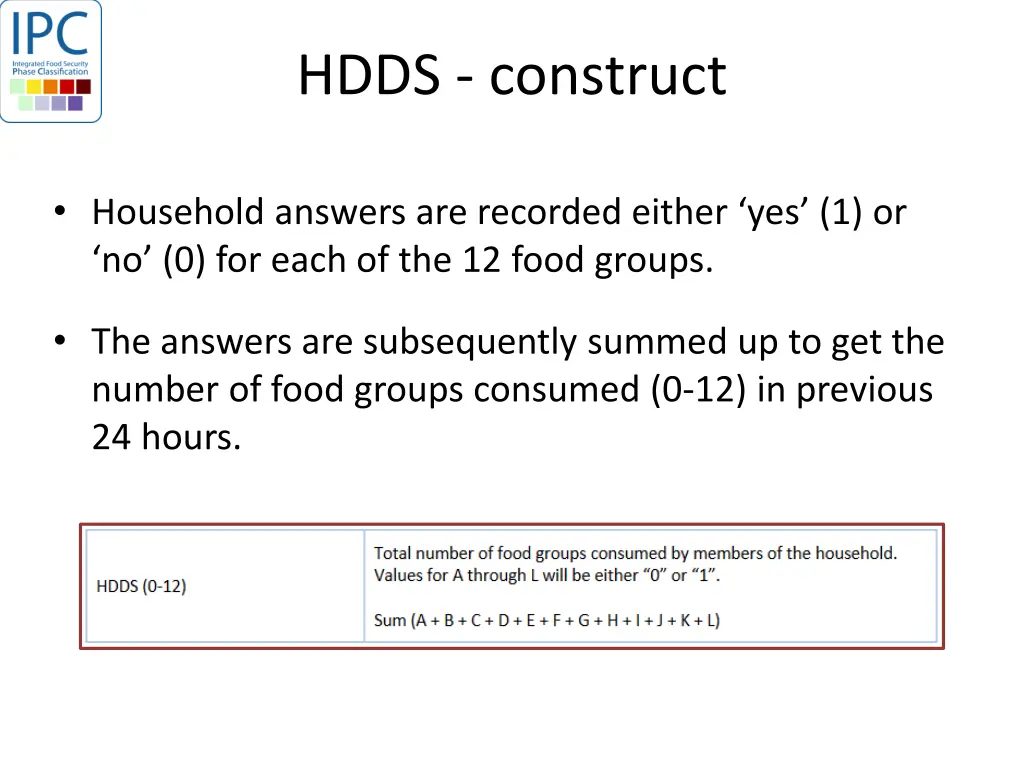
HDDS - construct Household answers are recorded either yes (1) or no (0) for each of the 12 food groups. The answers are subsequently summed up to get the number of food groups consumed (0-12) in previous 24 hours. 5
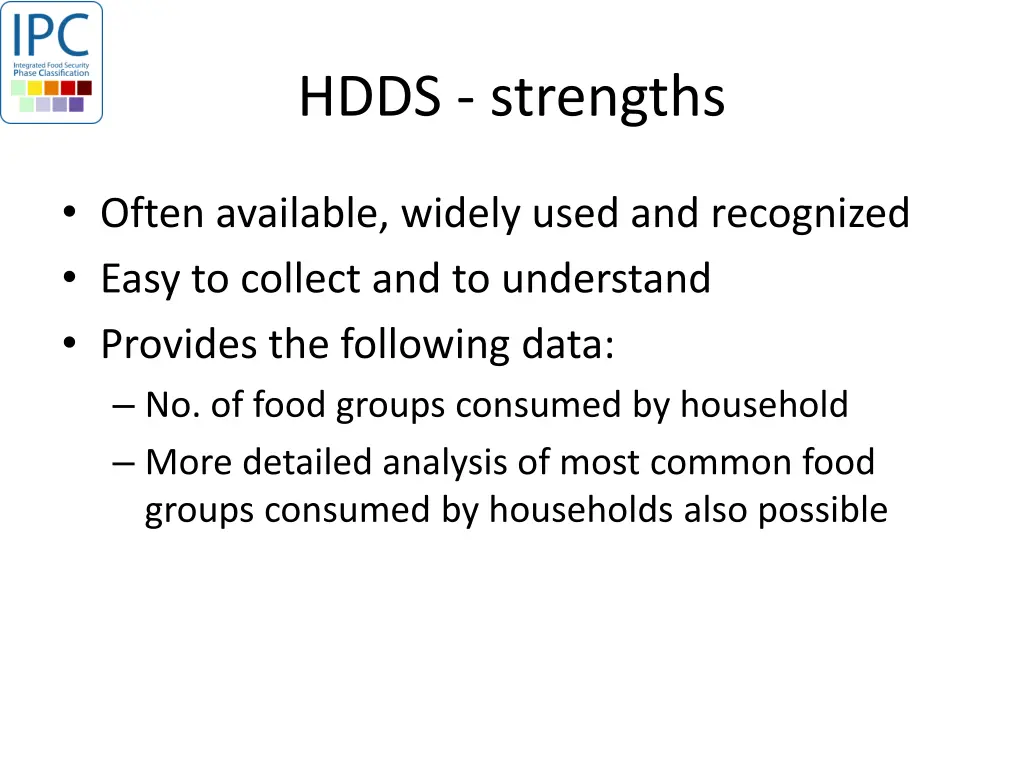
HDDS - strengths Often available, widely used and recognized Easy to collect and to understand Provides the following data: No. of food groups consumed by household More detailed analysis of most common food groups consumed by households also possible
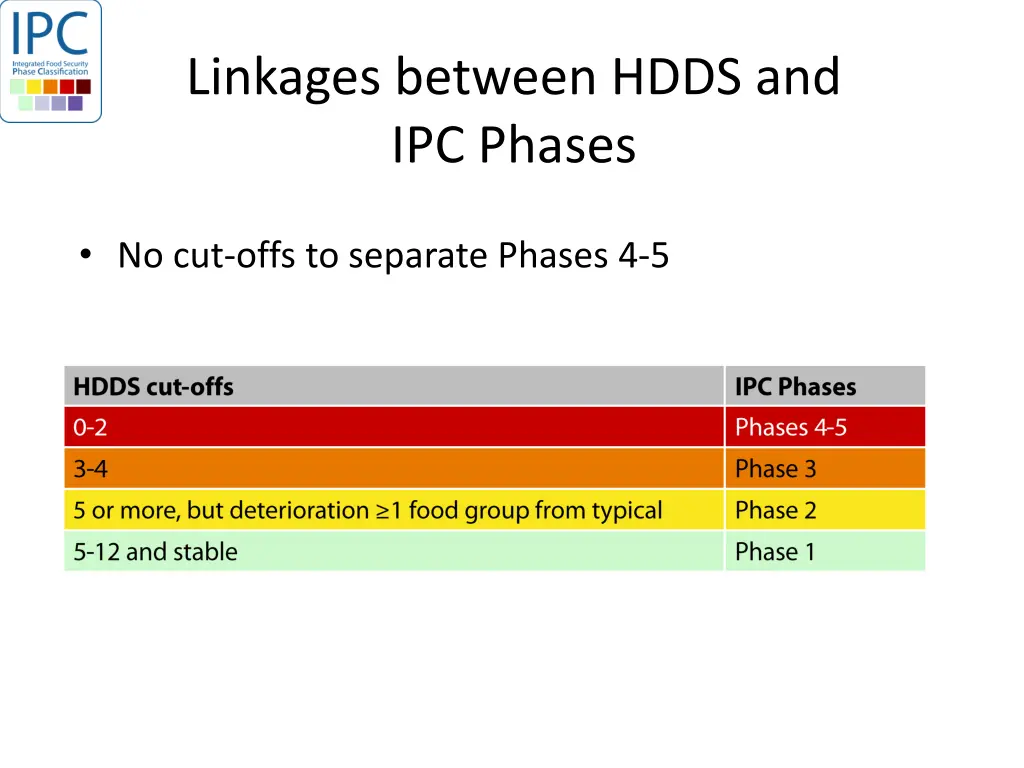
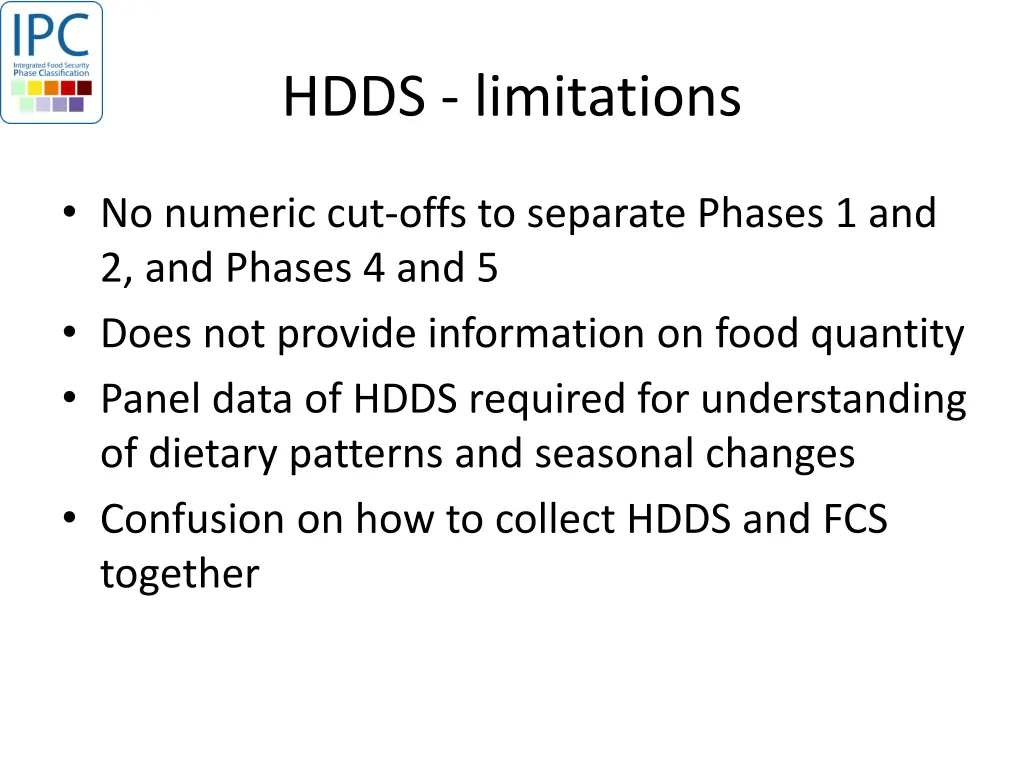
HDDS - limitations No numeric cut-offs to separate Phases 1 and 2, and Phases 4 and 5 Does not provide information on food quantity Panel data of HDDS required for understanding of dietary patterns and seasonal changes Confusion on how to collect HDDS and FCS together
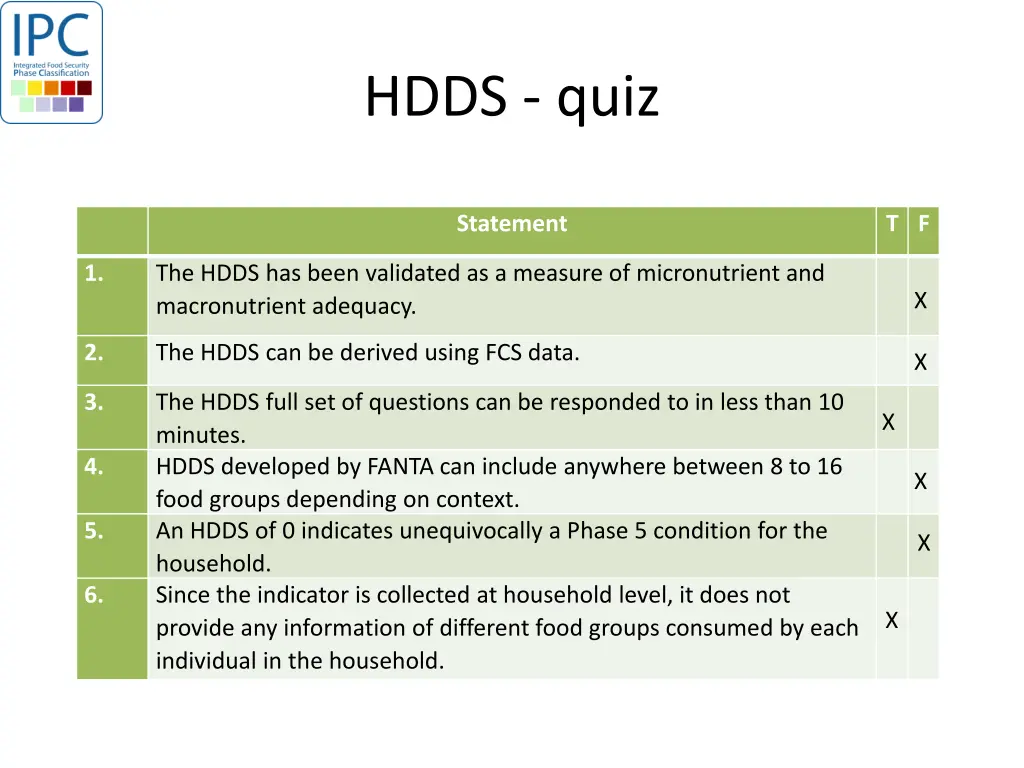
HDDS - quiz Statement T F 1. The HDDS has been validated as a measure of micronutrient and macronutrient adequacy. X 2. The HDDS can be derived using FCS data. X 3. The HDDS full set of questions can be responded to in less than 10 minutes. HDDS developed by FANTA can include anywhere between 8 to 16 food groups depending on context. An HDDS of 0 indicates unequivocally a Phase 5 condition for the household. Since the indicator is collected at household level, it does not provide any information of different food groups consumed by each individual in the household. X 4. X 5. X 6. X