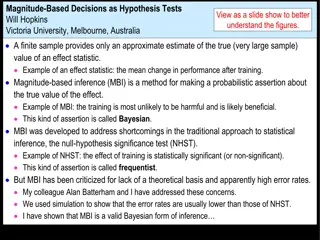
Explore the concept of hypothesis testing with real-world examples such as verifying household income data, assessing average tyre life, and analyzing share prices. Learn the steps involved in hypothesis testing using Z and T statistics for single populations to make informed decisions based on statistical significance.
Please find below an Image/Link to download the presentation.
The content on the website is provided AS IS for your information and personal use only. It may not be sold, licensed, or shared on other websites without obtaining consent from the author. If you encounter any issues during the download, it is possible that the publisher has removed the file from their server.
You are allowed to download the files provided on this website for personal or commercial use, subject to the condition that they are used lawfully. All files are the property of their respective owners.
The content on the website is provided AS IS for your information and personal use only. It may not be sold, licensed, or shared on other websites without obtaining consent from the author.
EXAMPLE A marketing research firm conducted a survey 10 years ago and found that the average household income of a particular geographic region is Rs. 10,000. Mr. Gupta, who has recently joined the firm as a vice president has expressed doubts about the accuracy of the data. For verifying the data, the firm has decided to take a random sample of 200 households that yield a sample mean(for household income) of Rs. 11,000. Assume that the population standard deviation of the household income is Rs. 1200. Verify Mr. Gupta s doubts using the seven steps of hypothesis testing. Take 5 % level of significance. Table value: 1.96
A cable TV network company wants to provide modern facilities to its consumers. The company has five year old data which reveals that the average household income is Rs. 120,000, Company officials believe that due to the fast development in the region, the average household income might have increased. The company takes a random sample of 40 households to verify this assumption. From the sample, the average income of the household is calculated as 125,000. From historical data, population standard deviation is obtained as 1200. Use level of significance as 5 % to verify the finding. Z table value is 1.645.
EXAMPLE Royal tyres has launched a new brand of tyres for tractors and claims that under normal circumstances the average life of the tyres is 40,000 km. A retailer wants to test this claim and has taken a random sample of 8 tyres. He tests the life of the tyres under normal circumstance. Table value: 2.365. The results obtained are presented below:
Prices of shares of a company on different days in a month were found to be as follows 572, 545, 575, 570, 580, 565, 568, 571, 572, 592. Test at 5% level of significance if the price of shares on an average is Rs. 575.
EXERCISE 1.2 Given the following information relating to two places, A & B, test whether there is any significant difference between their mean wages : A B Mean wages 47 49 SD 28 40 No of workers 1000 1500 Z tabulated value: 1.96
INDEPENDENT SAMPLE T- TEST A group of seven chickens reared on a high protein diet weigh 12, 15, 11, 16, 14, 14, and 16 ounces; a second group of five chickens, similarly treated except that they receive a low protein diet, weigh 8, 10, 14, 10 and 13 ounces. Test at 5 per cent level whether there is significant evidence that additional protein has increased the weight of the chickens.
Taking the null hypothesis that additional protein has not increased the weight of the chickens we can write: H0 : 1 = 2 Ha: 1 > 2 (as we want to conclude that additional protein has increased the weight of chickens) Since in the given question variances of the populations are not known and the size of samples is small, we shall use t-test for difference in means, assuming the populations to be normal. d.f. = (n1 + n2 2)
Degrees of freedom = (n1 + n2 2) = 10 As Ha is one-sided, we shall apply a one-tailed test (in the right tail because Ha is of more than type) for determining the rejection region at 5 per cent level at 10 degrees of freedom. Ho is rejected and we can conclude that additional protein has increased the weight of chickens, at 5 per cent level of significance.
PAIRED T TEST Applicable when samples are related or dependent. In t test, two samples were assumed to be independent as the value of one observation is not dependent on the other. When the elements in one sample are related to the observations in other sample then they are said to be dependent samples. While using paired t test, observation collected from the two samples are in the form of matched pairs eg before and after treatment observation. While carrying out the paired t test the mean and standard deviation of the difference is calculated.
The best selling product of a consumer durables manufacturer has reached the saturation stage in its product life cycle. The company is not willing to withdraw the product from the market and has decided to motivate its sales executives to take the personal selling route. The company organized a three day workshop to motivate its sales executive. Three month later, the company selected nine sales executives randomly and collected data on the number of average productive sales calls in a day before and after the training. Test at 5 % level of significance.t value: 2.306. The data collected are provided in the following table: Sales Executives Productive sales call(Before training) Productive Sales call(After Training) 6 7 5 7 2 6 5 8 6 1 2 3 4 5 6 7 8 9 3 4 2 5 3 4 6 5 4
Mean(D)= -16/9= -1.78 Standard Deviation= 1.6401 T value=-3.25 Null hypothesis is rejected.
A shopkeeper has shifted from using a manual typewriter to a computer to do his job. The number of mistakes he makes in both the methods are as follows. Is the computer helpful in reducing mistakes? Test at 5% level of significance. T value=2.57 Pages 1 Mistakes before using computer 58 Mistakes after using computer 53 2 29 28 3 30 31 4 55 48 5 56 50 6 45 42
QUICK QUIZ Q1: The form of the alternative hypothesis can be: A) one-tailed B) two-tailed C) neither one nor two-tailed D) one or two-tailed
Q2) By taking a level of significance of 5% it is the same as saying: a) We are 5% confident the results have not occurred by chance b) We are 95% confident that the results have not occurred by chance c) We are 95% confident that the results have occurred by chance d) None of the above
Q4: A two-tailed test is one where: A) results in only one direction can lead to rejection of the null hypothesis B) negative sample means lead to rejection of the null hypothesis C) results in either of two directions can lead to rejection of the null hypothesis D) no results lead to the rejection of the null hypothesis