Understanding IEEE 802.11-18/1447r0 and 802.1Q-2003/2011 in Networking
Explore the relationship between IEEE 802.11-18/1447r0 and 802.1Q-2003/2011 in networking discussions. Delve into how 802.11 references different versions of 802.1Q and the debate on simplifying cross-references. Learn about VLAN tags, frame classifiers, and more in this informative document.

Download Presentation

Please find below an Image/Link to download the presentation.
The content on the website is provided AS IS for your information and personal use only. It may not be sold, licensed, or shared on other websites without obtaining consent from the author. If you encounter any issues during the download, it is possible that the publisher has removed the file from their server.
You are allowed to download the files provided on this website for personal or commercial use, subject to the condition that they are used lawfully. All files are the property of their respective owners.
The content on the website is provided AS IS for your information and personal use only. It may not be sold, licensed, or shared on other websites without obtaining consent from the author.
E N D
Presentation Transcript
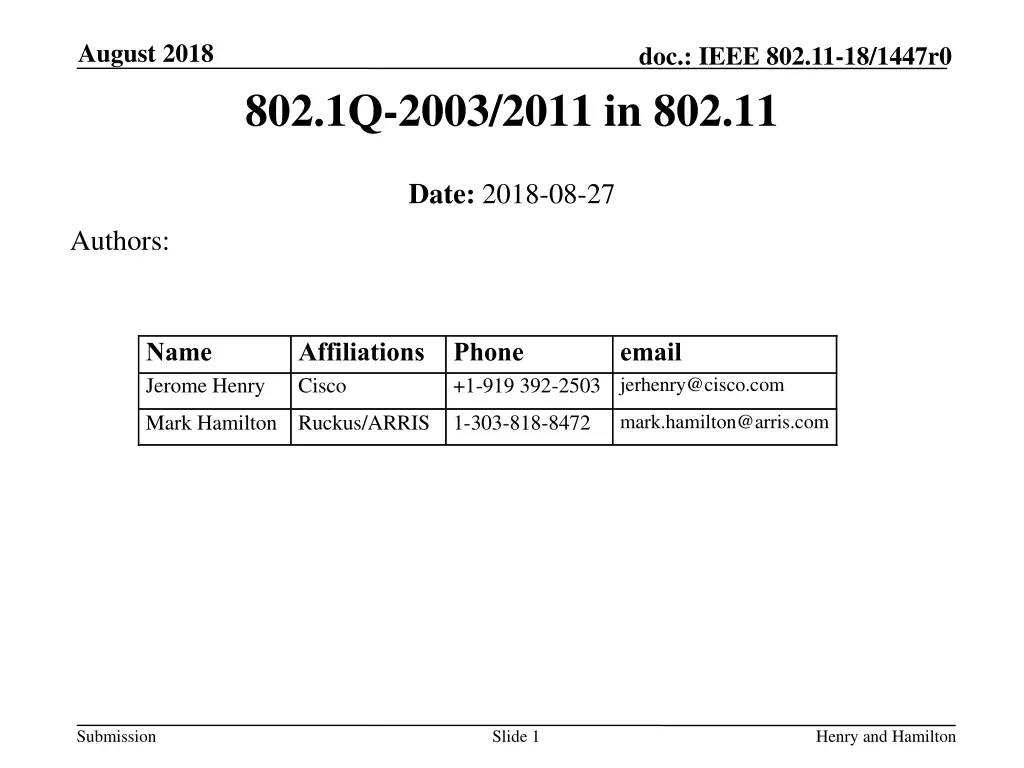
August 2018 doc.: IEEE 802.11-18/1447r0 802.1Q-2003/2011 in 802.11 Date: 2018-08-27 Authors: Name Jerome Henry Affiliations Phone Cisco email +1-919 392-2503 jerhenry@cisco.com mark.hamilton@arris.com Mark Hamilton Ruckus/ARRIS 1-303-818-8472 Submission Slide 1 Henry and Hamilton
August 2018 doc.: IEEE 802.11-18/1447r0 Abstract During discussion on resolution of LB232 CID 1014, observations were made that 802.11 sometimes references 802.1Q, and sometimes references a particular version of 802.1Q (2003 and 2011). Participants debated the merit of reducing cross reference complexity by only referring to the general 802.1Q (and avoiding dependence on superseded Standards) This submission examines this possibility Submission Slide 2 Henry and Hamilton
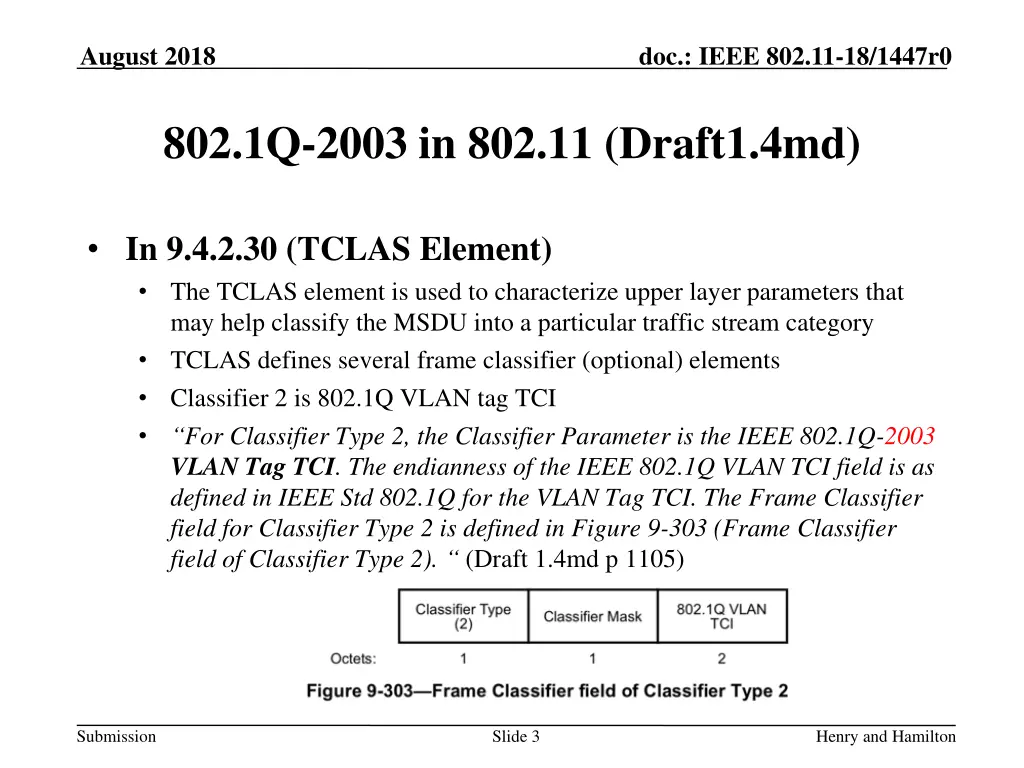
August 2018 doc.: IEEE 802.11-18/1447r0 802.1Q-2003 in 802.11 (Draft1.4md) In 9.4.2.30 (TCLAS Element) The TCLAS element is used to characterize upper layer parameters that may help classify the MSDU into a particular traffic stream category TCLAS defines several frame classifier (optional) elements Classifier 2 is 802.1Q VLAN tag TCI For Classifier Type 2, the Classifier Parameter is the IEEE 802.1Q-2003 VLAN Tag TCI. The endianness of the IEEE 802.1Q VLAN TCI field is as defined in IEEE Std 802.1Q for the VLAN Tag TCI. The Frame Classifier field for Classifier Type 2 is defined in Figure 9-303 (Frame Classifier field of Classifier Type 2). (Draft 1.4md p 1105) Submission Slide 3 Henry and Hamilton
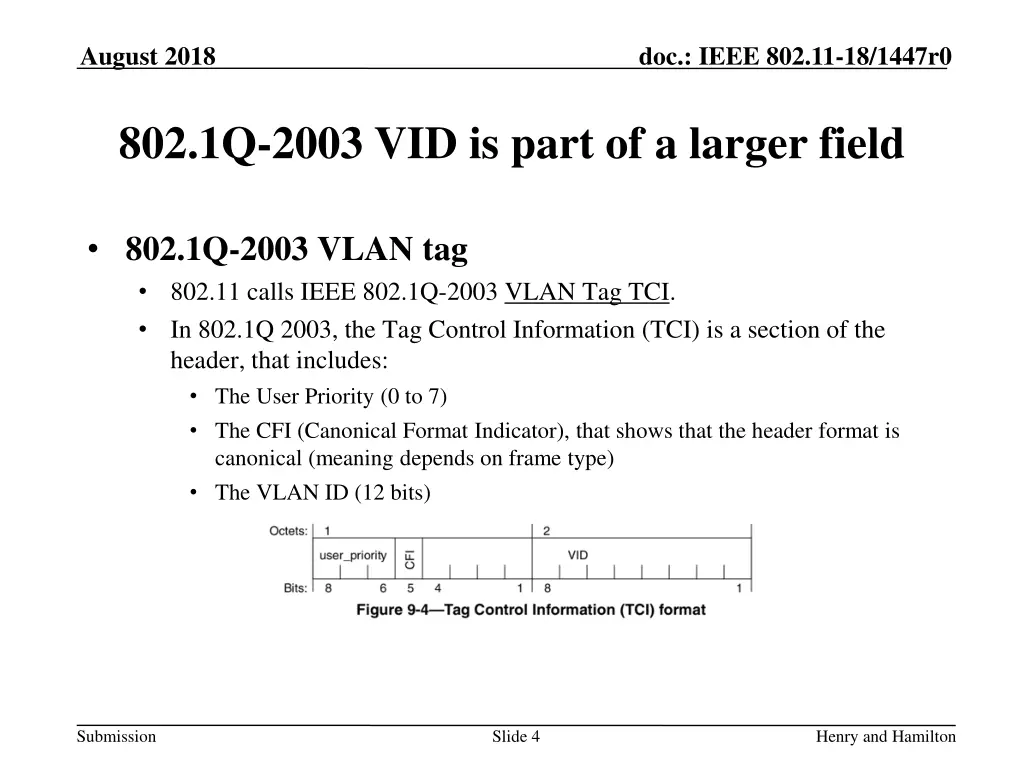
August 2018 doc.: IEEE 802.11-18/1447r0 802.1Q-2003 VID is part of a larger field 802.1Q-2003 VLAN tag 802.11 calls IEEE 802.1Q-2003 VLAN Tag TCI. In 802.1Q 2003, the Tag Control Information (TCI) is a section of the header, that includes: The User Priority (0 to 7) The CFI (Canonical Format Indicator), that shows that the header format is canonical (meaning depends on frame type) The VLAN ID (12 bits) Submission Slide 4 Henry and Hamilton
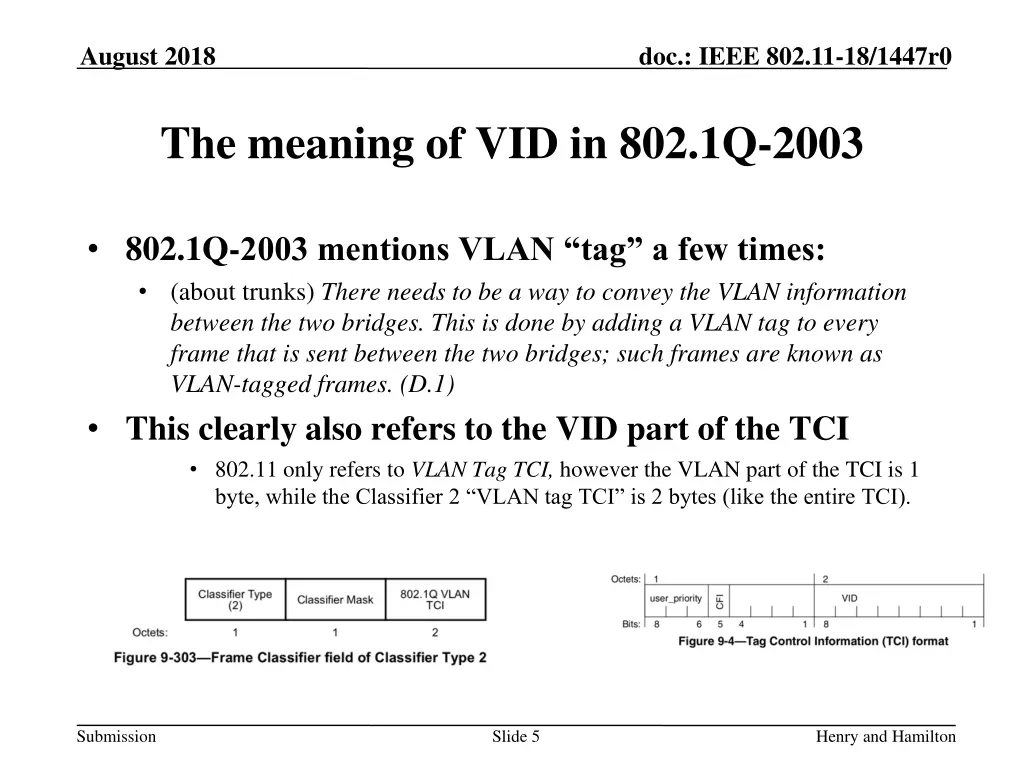
August 2018 doc.: IEEE 802.11-18/1447r0 The meaning of VID in 802.1Q-2003 802.1Q-2003 mentions VLAN tag a few times: (about trunks) There needs to be a way to convey the VLAN information between the two bridges. This is done by adding a VLAN tag to every frame that is sent between the two bridges; such frames are known as VLAN-tagged frames. (D.1) This clearly also refers to the VID part of the TCI 802.11 only refers to VLAN Tag TCI, however the VLAN part of the TCI is 1 byte, while the Classifier 2 VLAN tag TCI is 2 bytes (like the entire TCI). Submission Slide 5 Henry and Hamilton
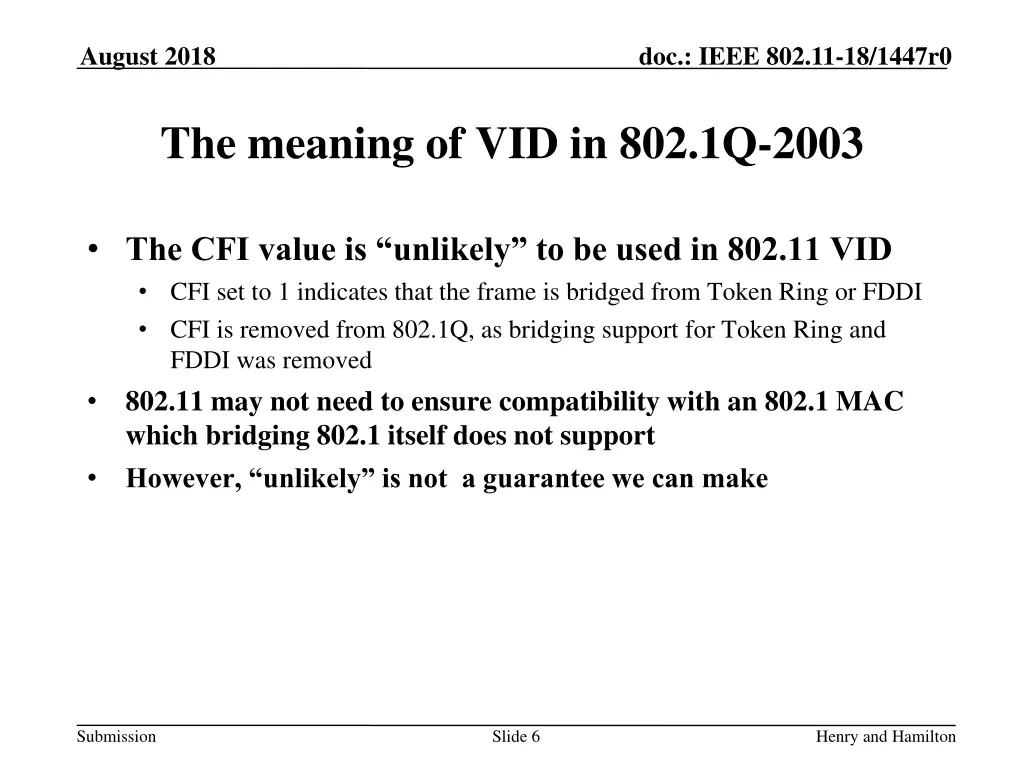
August 2018 doc.: IEEE 802.11-18/1447r0 The meaning of VID in 802.1Q-2003 The CFI value is unlikely to be used in 802.11 VID CFI set to 1 indicates that the frame is bridged from Token Ring or FDDI CFI is removed from 802.1Q, as bridging support for Token Ring and FDDI was removed 802.11 may not need to ensure compatibility with an 802.1 MAC which bridging 802.1 itself does not support However, unlikely is not a guarantee we can make Submission Slide 6 Henry and Hamilton
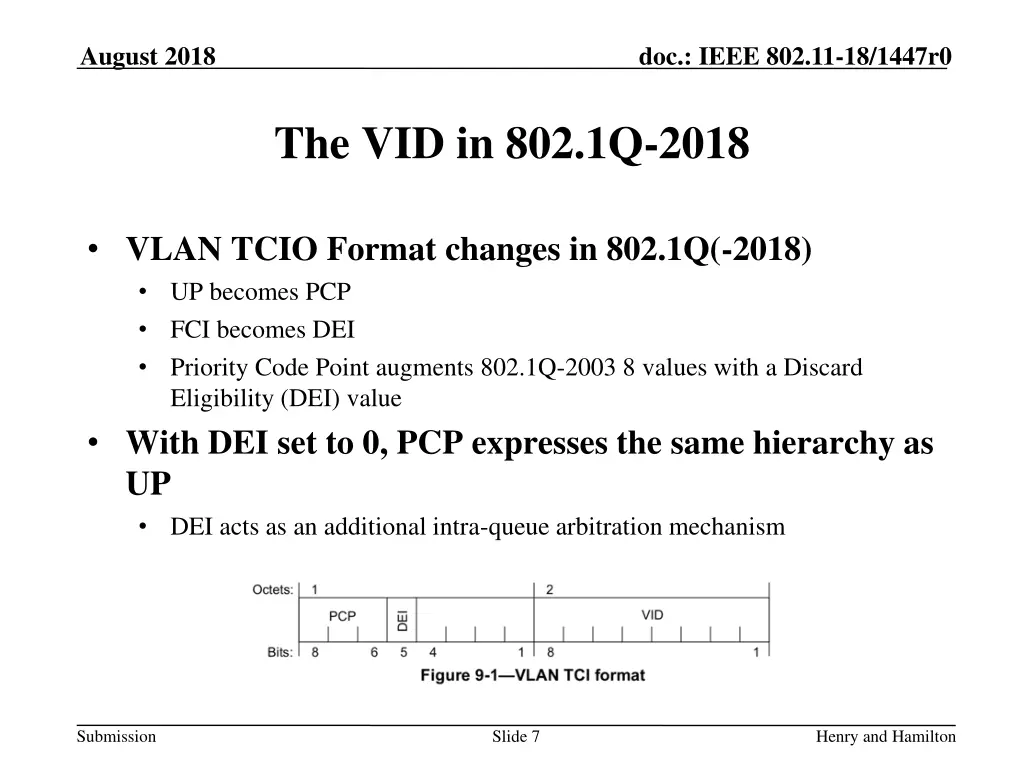
August 2018 doc.: IEEE 802.11-18/1447r0 The VID in 802.1Q-2018 VLAN TCIO Format changes in 802.1Q(-2018) UP becomes PCP FCI becomes DEI Priority Code Point augments 802.1Q-2003 8 values with a Discard Eligibility (DEI) value With DEI set to 0, PCP expresses the same hierarchy as UP DEI acts as an additional intra-queue arbitration mechanism Submission Slide 7 Henry and Hamilton
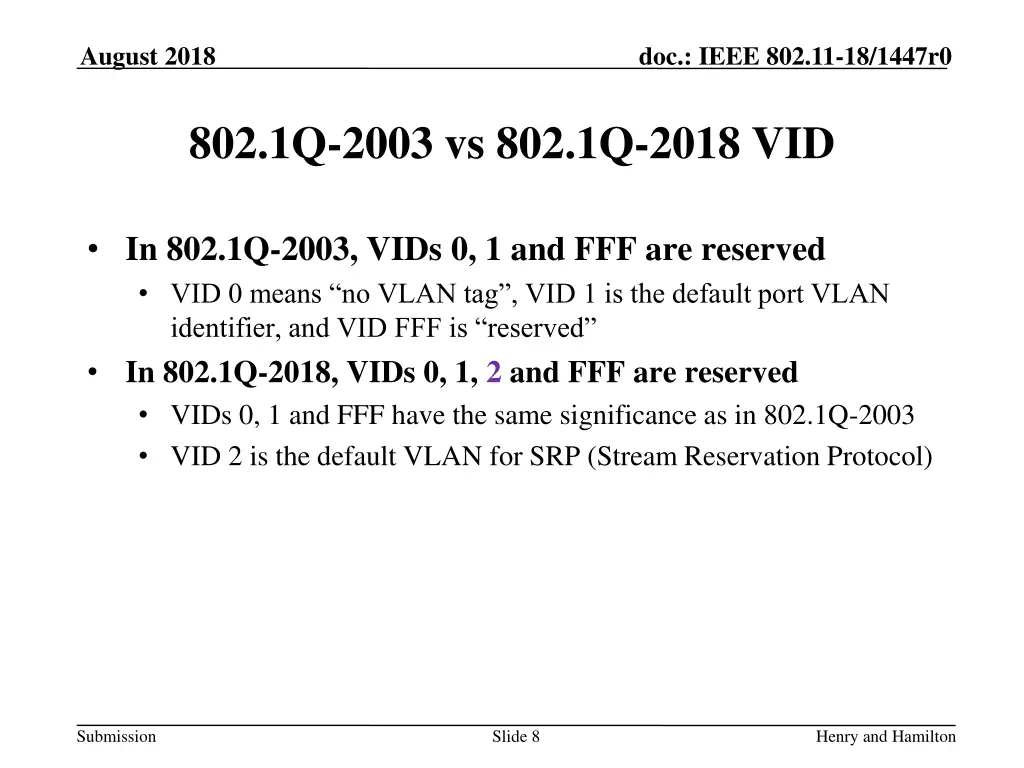
August 2018 doc.: IEEE 802.11-18/1447r0 802.1Q-2003 vs 802.1Q-2018 VID In 802.1Q-2003, VIDs 0, 1 and FFF are reserved VID 0 means no VLAN tag , VID 1 is the default port VLAN identifier, and VID FFF is reserved In 802.1Q-2018, VIDs 0, 1, 2 and FFF are reserved VIDs 0, 1 and FFF have the same significance as in 802.1Q-2003 VID 2 is the default VLAN for SRP (Stream Reservation Protocol) Submission Slide 8 Henry and Hamilton
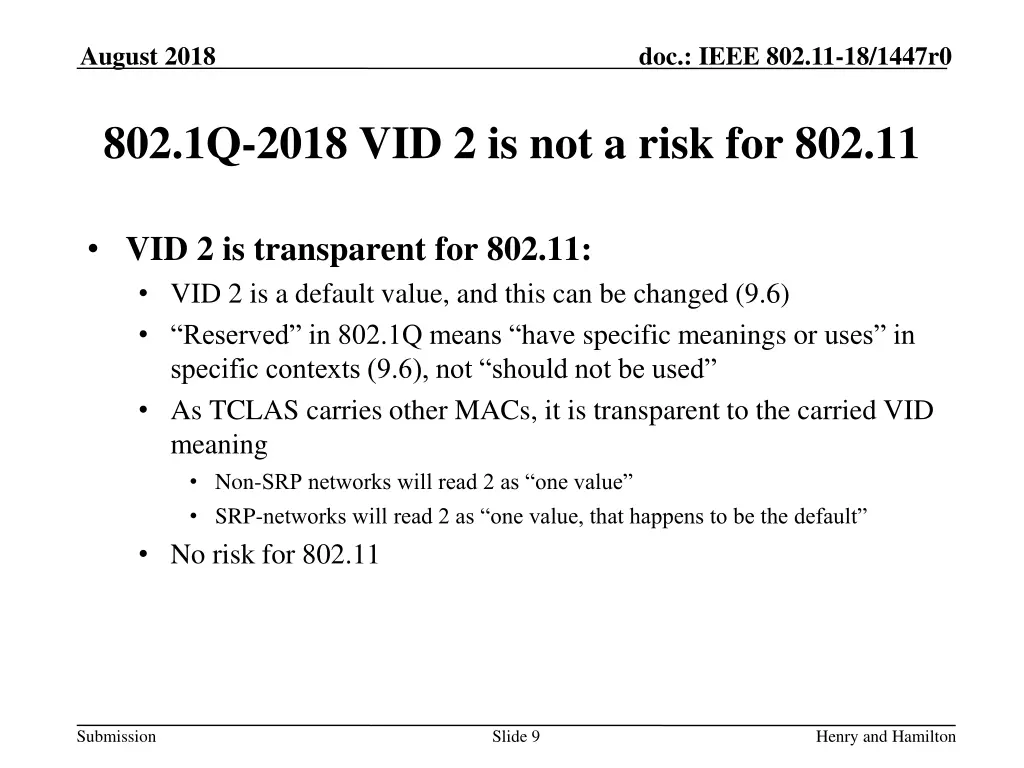
August 2018 doc.: IEEE 802.11-18/1447r0 802.1Q-2018 VID 2 is not a risk for 802.11 VID 2 is transparent for 802.11: VID 2 is a default value, and this can be changed (9.6) Reserved in 802.1Q means have specific meanings or uses in specific contexts (9.6), not should not be used As TCLAS carries other MACs, it is transparent to the carried VID meaning Non-SRP networks will read 2 as one value SRP-networks will read 2 as one value, that happens to be the default No risk for 802.11 Submission Slide 9 Henry and Hamilton
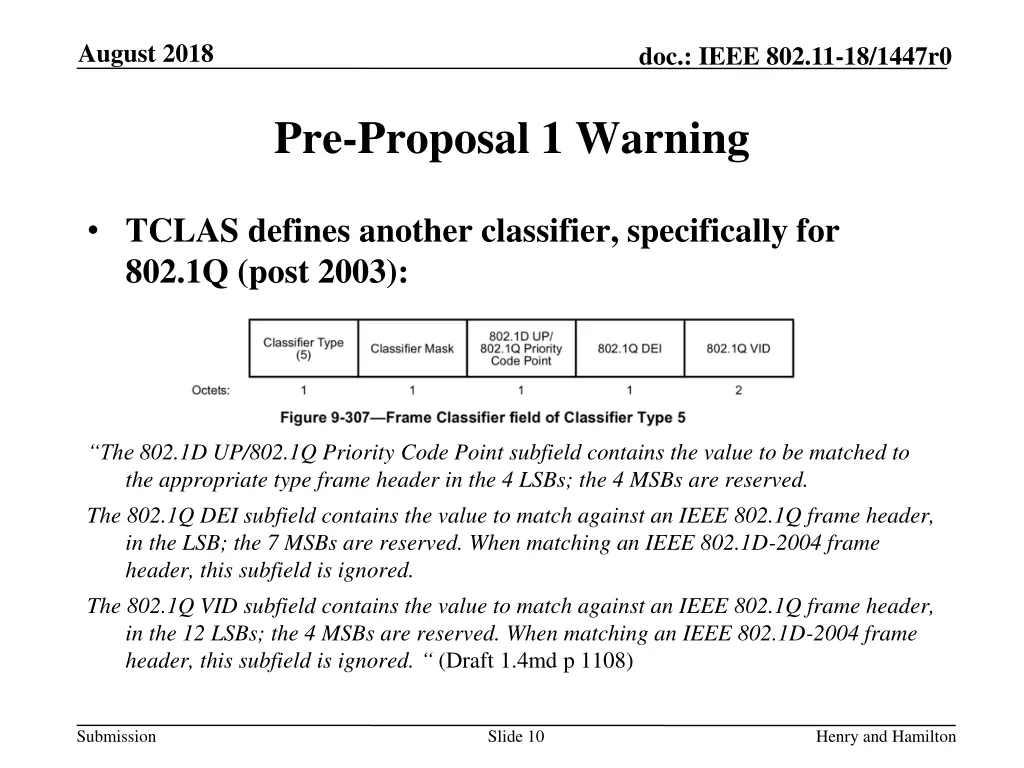
August 2018 doc.: IEEE 802.11-18/1447r0 Pre-Proposal 1 Warning TCLAS defines another classifier, specifically for 802.1Q (post 2003): The 802.1D UP/802.1Q Priority Code Point subfield contains the value to be matched to the appropriate type frame header in the 4 LSBs; the 4 MSBs are reserved. The 802.1Q DEI subfield contains the value to match against an IEEE 802.1Q frame header, in the LSB; the 7 MSBs are reserved. When matching an IEEE 802.1D-2004 frame header, this subfield is ignored. The 802.1Q VID subfield contains the value to match against an IEEE 802.1Q frame header, in the 12 LSBs; the 4 MSBs are reserved. When matching an IEEE 802.1D-2004 frame header, this subfield is ignored. (Draft 1.4md p 1108) Submission Slide 10 Henry and Hamilton
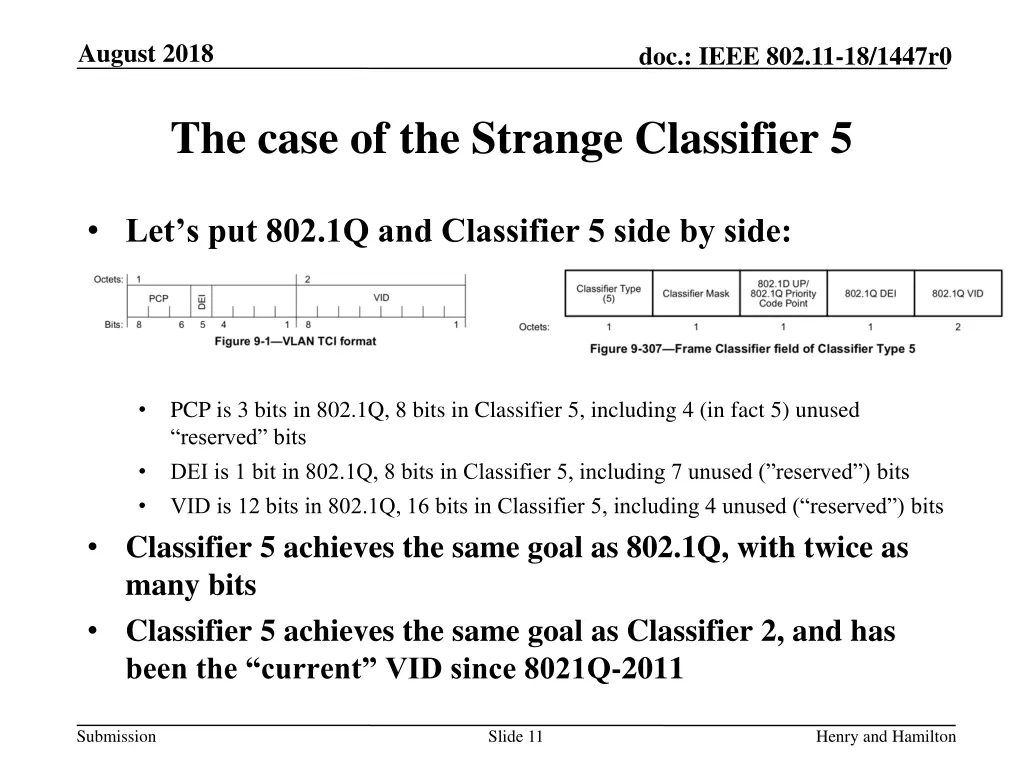
August 2018 doc.: IEEE 802.11-18/1447r0 The case of the Strange Classifier 5 Let s put 802.1Q and Classifier 5 side by side: PCP is 3 bits in 802.1Q, 8 bits in Classifier 5, including 4 (in fact 5) unused reserved bits DEI is 1 bit in 802.1Q, 8 bits in Classifier 5, including 7 unused ( reserved ) bits VID is 12 bits in 802.1Q, 16 bits in Classifier 5, including 4 unused ( reserved ) bits Classifier 5 achieves the same goal as 802.1Q, with twice as many bits Classifier 5 achieves the same goal as Classifier 2, and has been the current VID since 8021Q-2011 Submission Slide 11 Henry and Hamilton
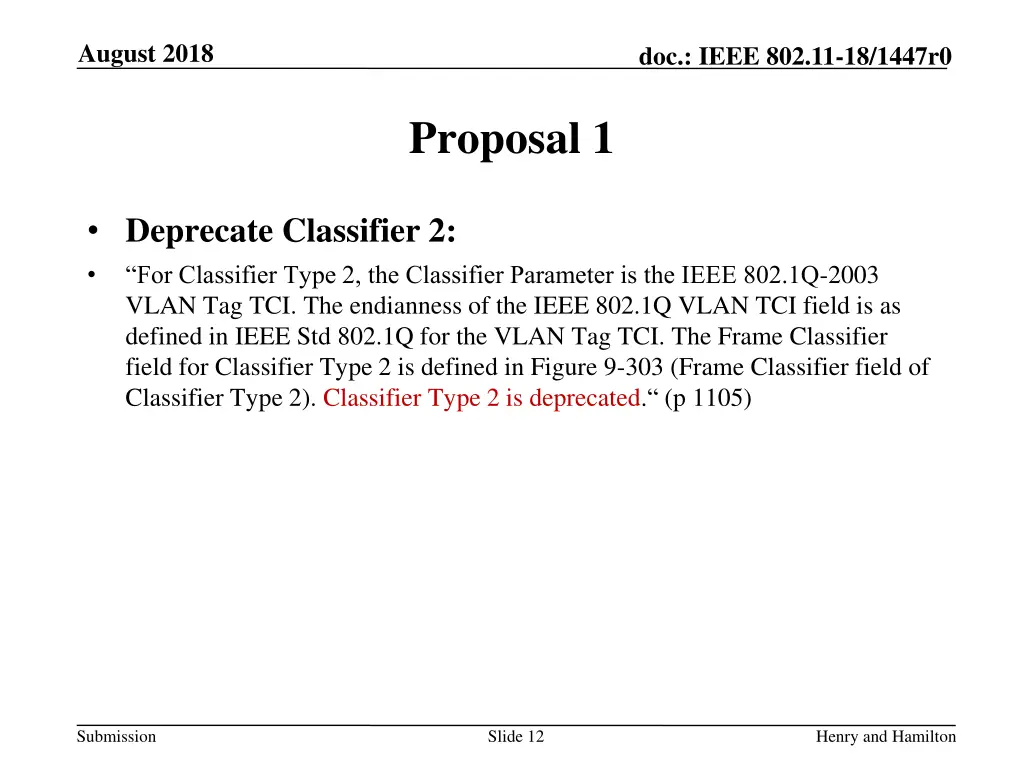
August 2018 doc.: IEEE 802.11-18/1447r0 Proposal 1 Deprecate Classifier 2: For Classifier Type 2, the Classifier Parameter is the IEEE 802.1Q-2003 VLAN Tag TCI. The endianness of the IEEE 802.1Q VLAN TCI field is as defined in IEEE Std 802.1Q for the VLAN Tag TCI. The Frame Classifier field for Classifier Type 2 is defined in Figure 9-303 (Frame Classifier field of Classifier Type 2). Classifier Type 2 is deprecated. (p 1105) Submission Slide 12 Henry and Hamilton
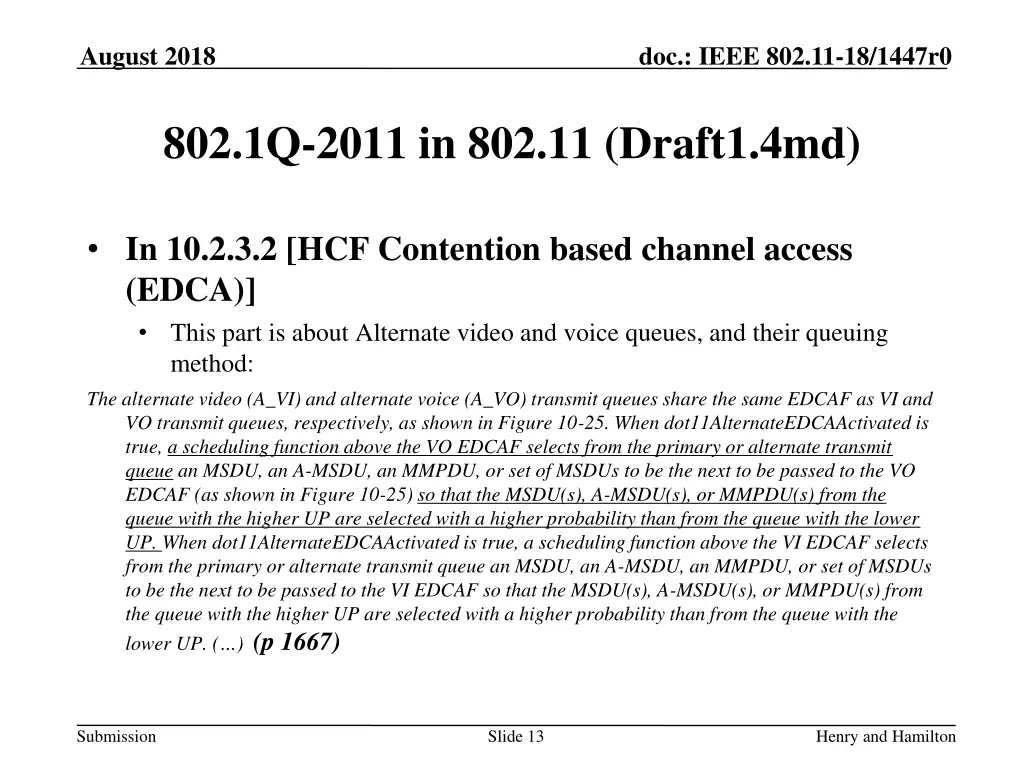
August 2018 doc.: IEEE 802.11-18/1447r0 802.1Q-2011 in 802.11 (Draft1.4md) In 10.2.3.2 [HCF Contention based channel access (EDCA)] This part is about Alternate video and voice queues, and their queuing method: The alternate video (A_VI) and alternate voice (A_VO) transmit queues share the same EDCAF as VI and VO transmit queues, respectively, as shown in Figure 10-25. When dot11AlternateEDCAActivated is true, a scheduling function above the VO EDCAF selects from the primary or alternate transmit queue an MSDU, an A-MSDU, an MMPDU, or set of MSDUs to be the next to be passed to the VO EDCAF (as shown in Figure 10-25) so that the MSDU(s), A-MSDU(s), or MMPDU(s) from the queue with the higher UP are selected with a higher probability than from the queue with the lower UP. When dot11AlternateEDCAActivated is true, a scheduling function above the VI EDCAF selects from the primary or alternate transmit queue an MSDU, an A-MSDU, an MMPDU, or set of MSDUs to be the next to be passed to the VI EDCAF so that the MSDU(s), A-MSDU(s), or MMPDU(s) from the queue with the higher UP are selected with a higher probability than from the queue with the lower UP. ( ) (p 1667) Submission Slide 13 Henry and Hamilton
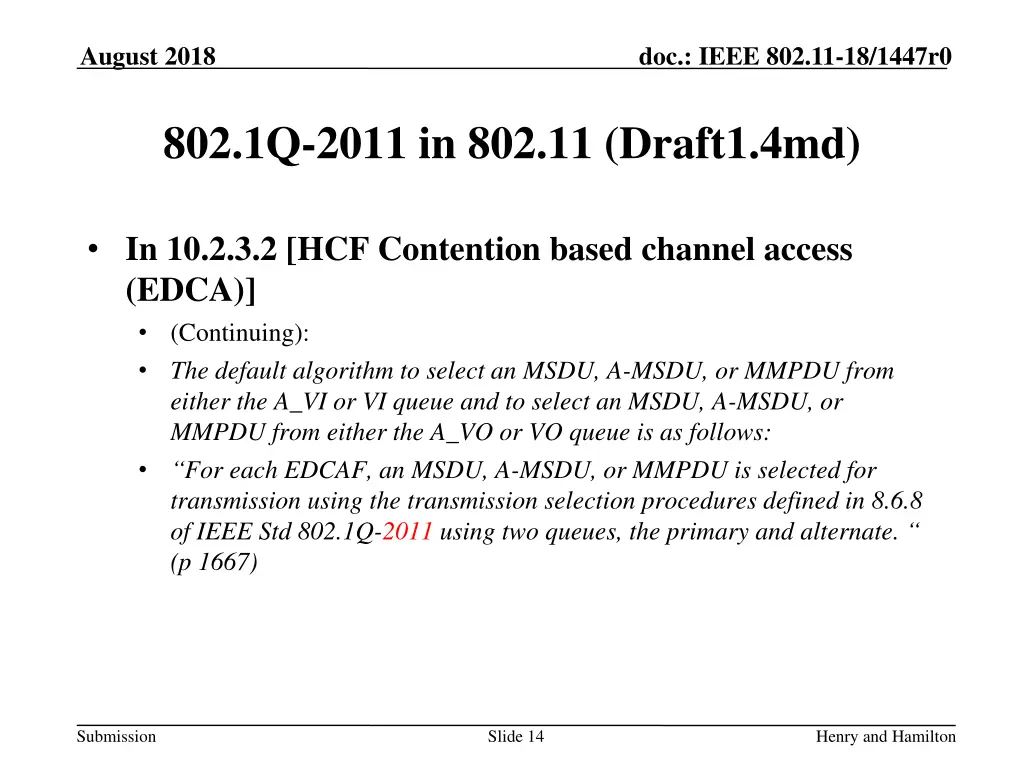
August 2018 doc.: IEEE 802.11-18/1447r0 802.1Q-2011 in 802.11 (Draft1.4md) In 10.2.3.2 [HCF Contention based channel access (EDCA)] (Continuing): The default algorithm to select an MSDU, A-MSDU, or MMPDU from either the A_VI or VI queue and to select an MSDU, A-MSDU, or MMPDU from either the A_VO or VO queue is as follows: For each EDCAF, an MSDU, A-MSDU, or MMPDU is selected for transmission using the transmission selection procedures defined in 8.6.8 of IEEE Std 802.1Q-2011 using two queues, the primary and alternate. (p 1667) Submission Slide 14 Henry and Hamilton
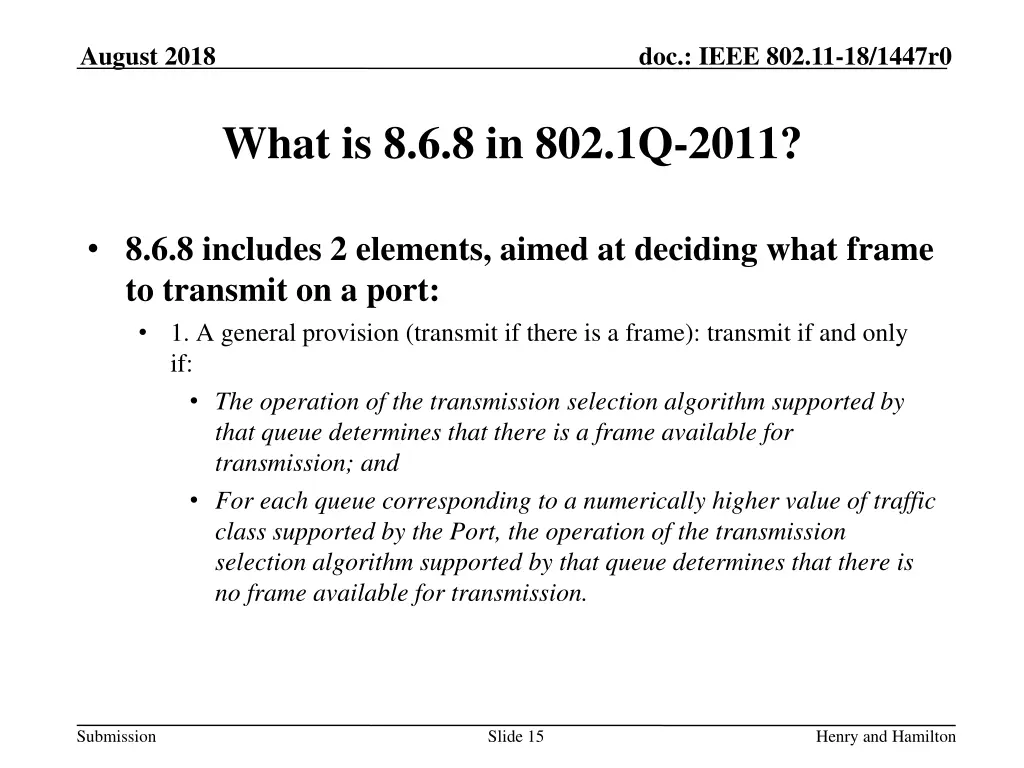
August 2018 doc.: IEEE 802.11-18/1447r0 What is 8.6.8 in 802.1Q-2011? 8.6.8 includes 2 elements, aimed at deciding what frame to transmit on a port: 1. A general provision (transmit if there is a frame): transmit if and only if: The operation of the transmission selection algorithm supported by that queue determines that there is a frame available for transmission; and For each queue corresponding to a numerically higher value of traffic class supported by the Port, the operation of the transmission selection algorithm supported by that queue determines that there is no frame available for transmission. Submission Slide 15 Henry and Hamilton
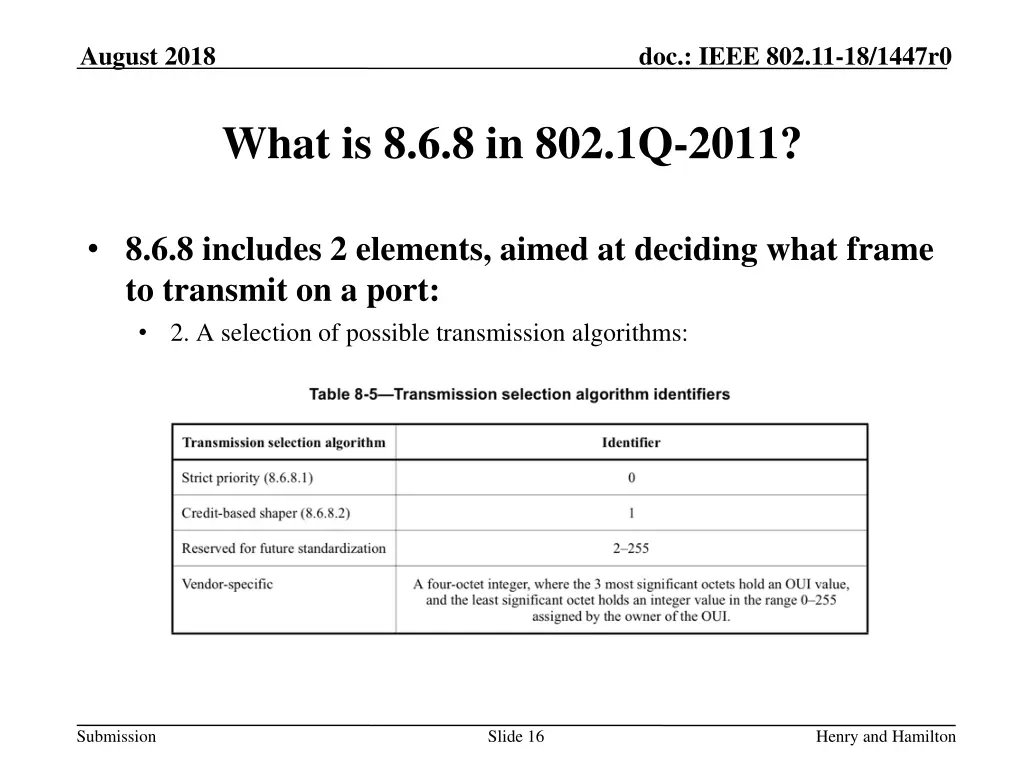
August 2018 doc.: IEEE 802.11-18/1447r0 What is 8.6.8 in 802.1Q-2011? 8.6.8 includes 2 elements, aimed at deciding what frame to transmit on a port: 2. A selection of possible transmission algorithms: Submission Slide 16 Henry and Hamilton
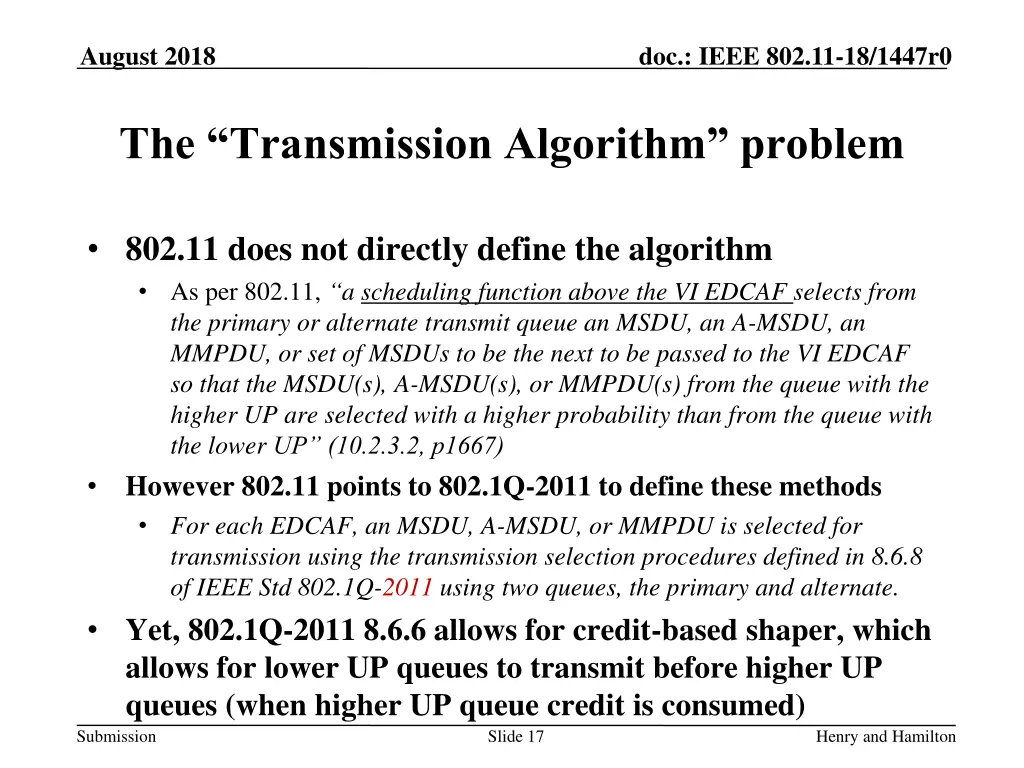
August 2018 doc.: IEEE 802.11-18/1447r0 The Transmission Algorithm problem 802.11 does not directly define the algorithm As per 802.11, a scheduling function above the VI EDCAF selects from the primary or alternate transmit queue an MSDU, an A-MSDU, an MMPDU, or set of MSDUs to be the next to be passed to the VI EDCAF so that the MSDU(s), A-MSDU(s), or MMPDU(s) from the queue with the higher UP are selected with a higher probability than from the queue with the lower UP (10.2.3.2, p1667) However 802.11 points to 802.1Q-2011 to define these methods For each EDCAF, an MSDU, A-MSDU, or MMPDU is selected for transmission using the transmission selection procedures defined in 8.6.8 of IEEE Std 802.1Q-2011 using two queues, the primary and alternate. Yet, 802.1Q-2011 8.6.6 allows for credit-based shaper, which allows for lower UP queues to transmit before higher UP queues (when higher UP queue credit is consumed) Submission Slide 17 Henry and Hamilton
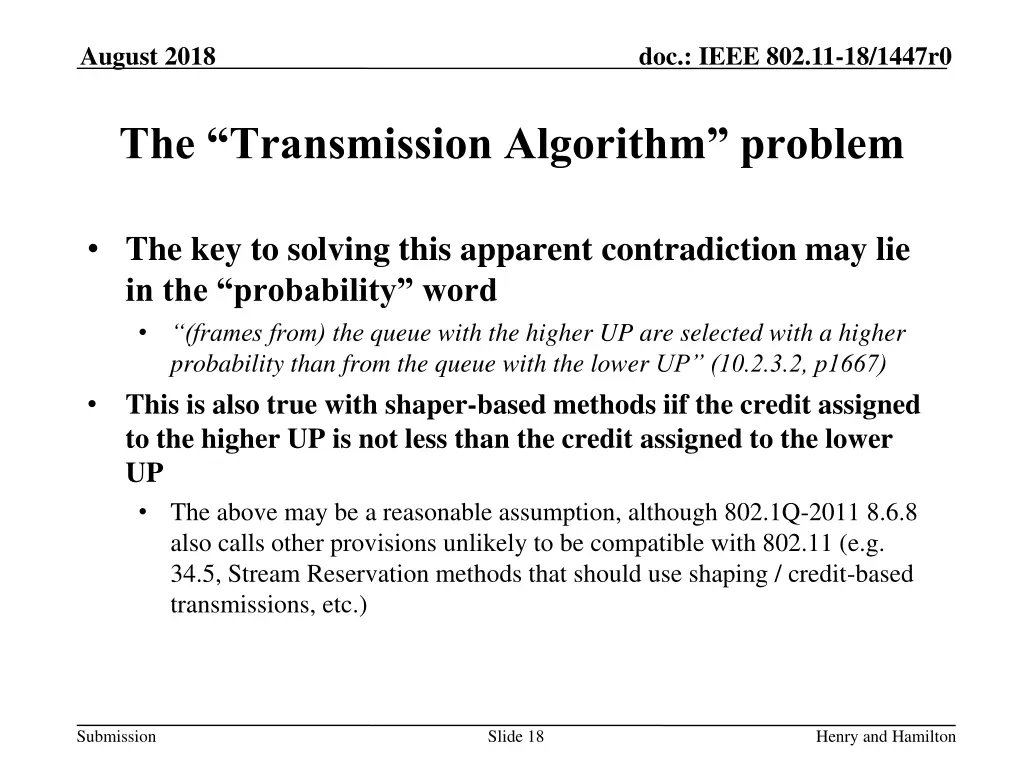
August 2018 doc.: IEEE 802.11-18/1447r0 The Transmission Algorithm problem The key to solving this apparent contradiction may lie in the probability word (frames from) the queue with the higher UP are selected with a higher probability than from the queue with the lower UP (10.2.3.2, p1667) This is also true with shaper-based methods iif the credit assigned to the higher UP is not less than the credit assigned to the lower UP The above may be a reasonable assumption, although 802.1Q-2011 8.6.8 also calls other provisions unlikely to be compatible with 802.11 (e.g. 34.5, Stream Reservation methods that should use shaping / credit-based transmissions, etc.) Submission Slide 18 Henry and Hamilton
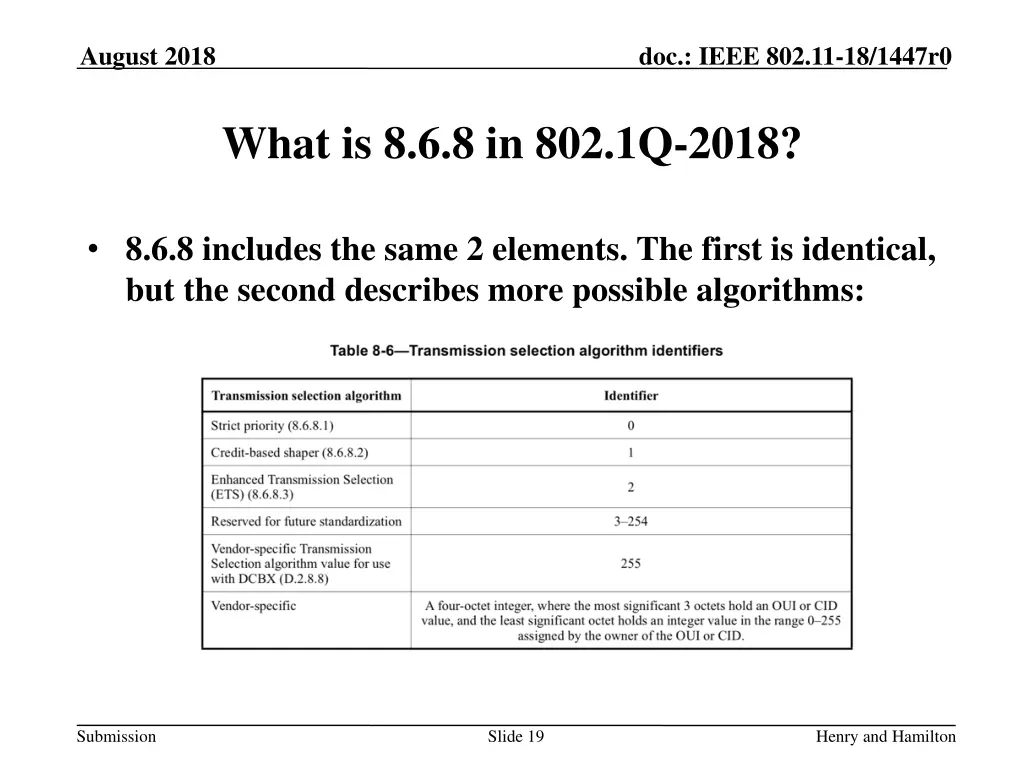
August 2018 doc.: IEEE 802.11-18/1447r0 What is 8.6.8 in 802.1Q-2018? 8.6.8 includes the same 2 elements. The first is identical, but the second describes more possible algorithms: Submission Slide 19 Henry and Hamilton
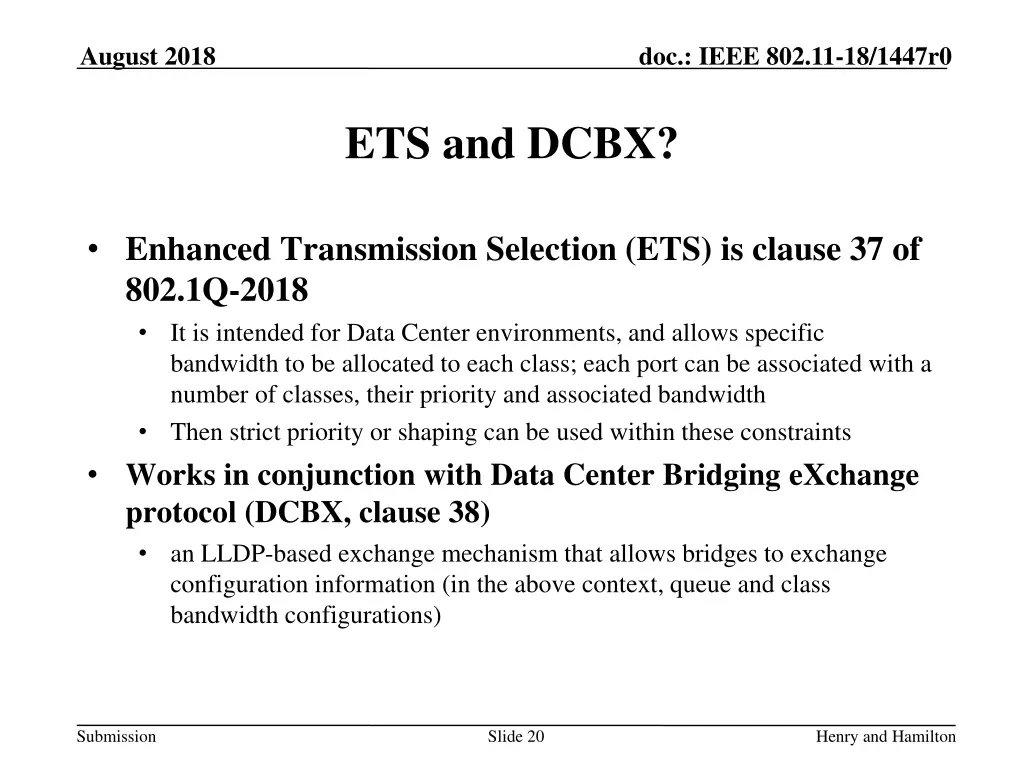
August 2018 doc.: IEEE 802.11-18/1447r0 ETS and DCBX? Enhanced Transmission Selection (ETS) is clause 37 of 802.1Q-2018 It is intended for Data Center environments, and allows specific bandwidth to be allocated to each class; each port can be associated with a number of classes, their priority and associated bandwidth Then strict priority or shaping can be used within these constraints Works in conjunction with Data Center Bridging eXchange protocol (DCBX, clause 38) an LLDP-based exchange mechanism that allows bridges to exchange configuration information (in the above context, queue and class bandwidth configurations) Submission Slide 20 Henry and Hamilton
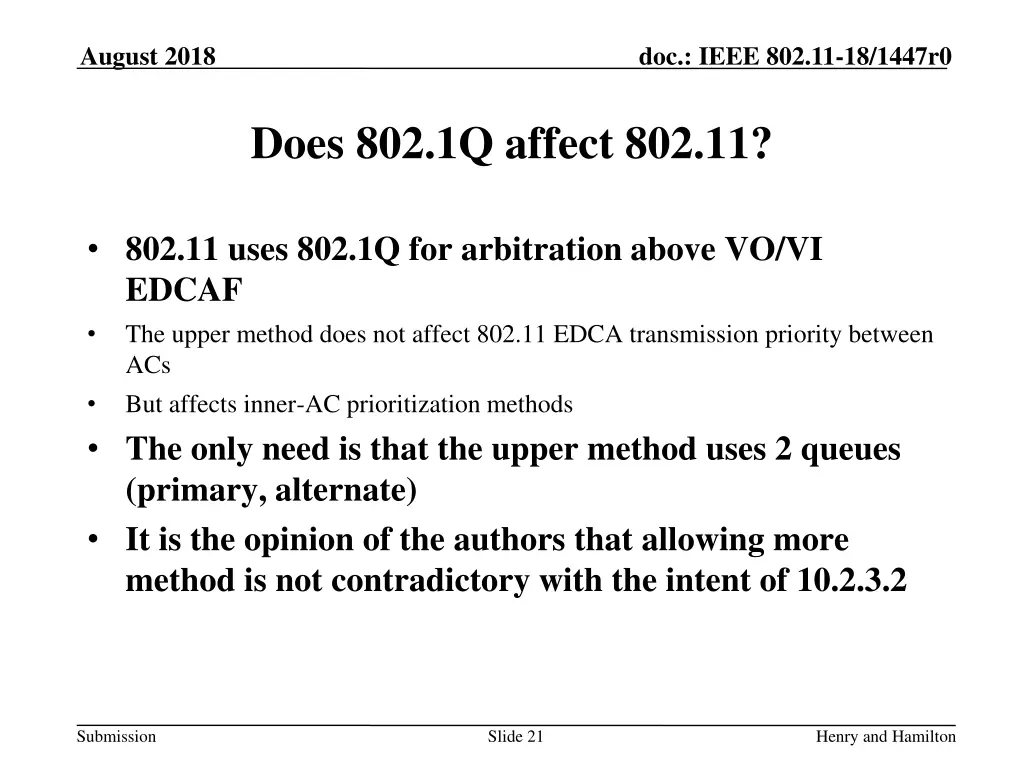
August 2018 doc.: IEEE 802.11-18/1447r0 Does 802.1Q affect 802.11? 802.11 uses 802.1Q for arbitration above VO/VI EDCAF The upper method does not affect 802.11 EDCA transmission priority between ACs But affects inner-AC prioritization methods The only need is that the upper method uses 2 queues (primary, alternate) It is the opinion of the authors that allowing more method is not contradictory with the intent of 10.2.3.2 Submission Slide 21 Henry and Hamilton
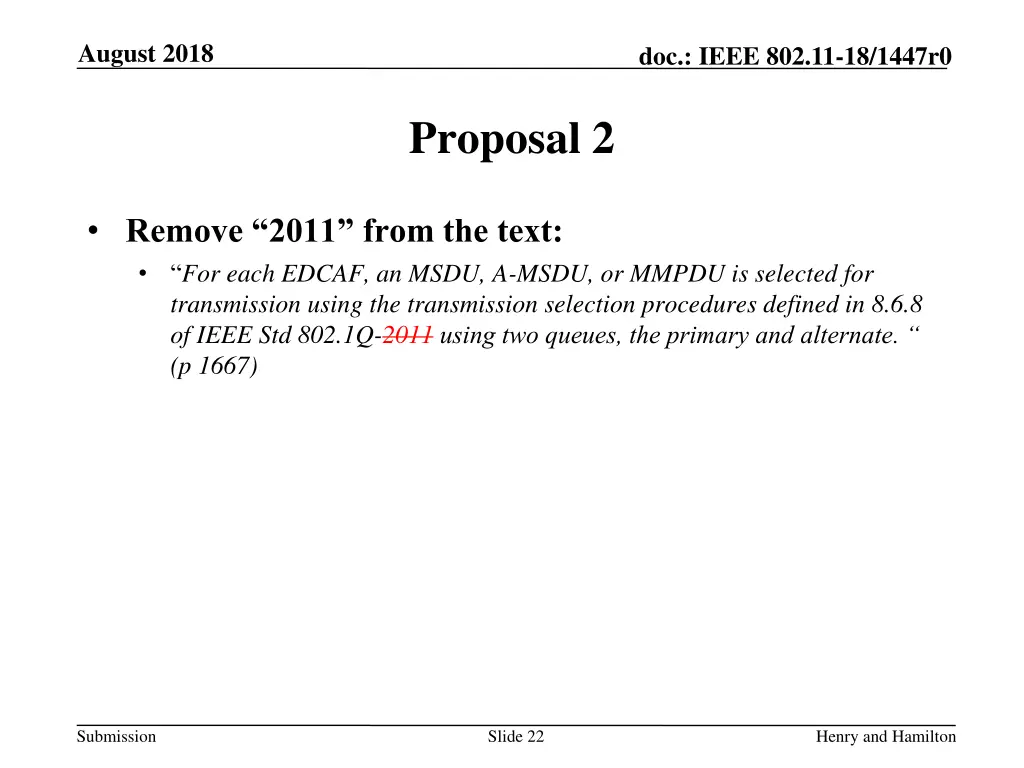
August 2018 doc.: IEEE 802.11-18/1447r0 Proposal 2 Remove 2011 from the text: For each EDCAF, an MSDU, A-MSDU, or MMPDU is selected for transmission using the transmission selection procedures defined in 8.6.8 of IEEE Std 802.1Q-2011 using two queues, the primary and alternate. (p 1667) Submission Slide 22 Henry and Hamilton
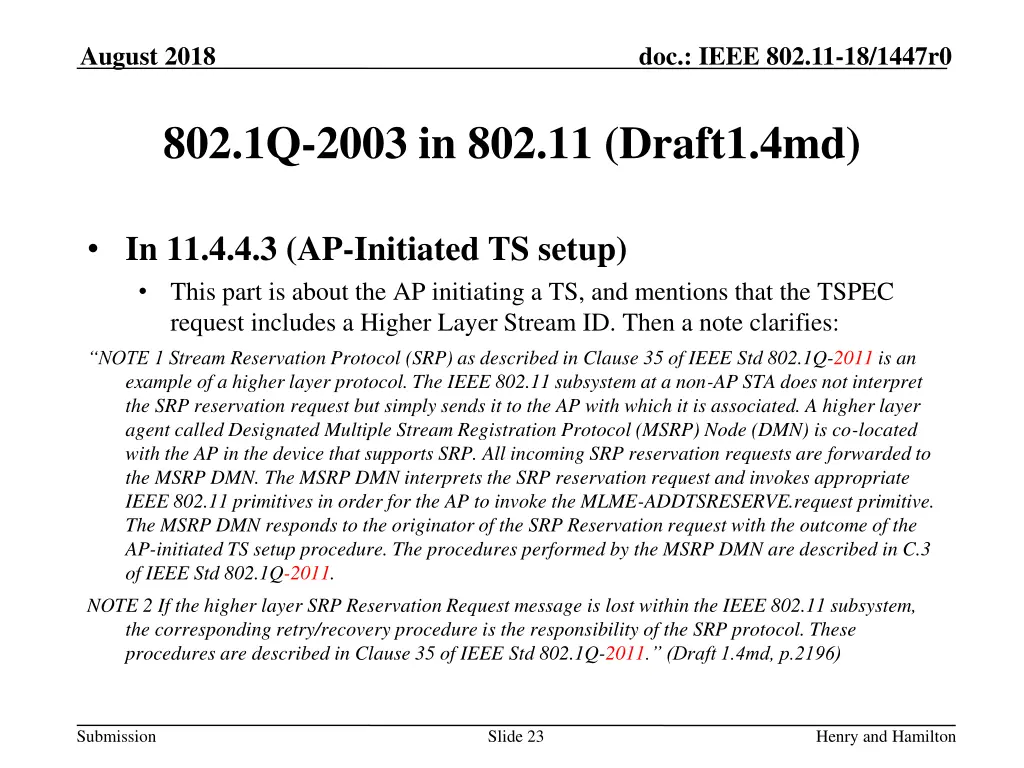
August 2018 doc.: IEEE 802.11-18/1447r0 802.1Q-2003 in 802.11 (Draft1.4md) In 11.4.4.3 (AP-Initiated TS setup) This part is about the AP initiating a TS, and mentions that the TSPEC request includes a Higher Layer Stream ID. Then a note clarifies: NOTE 1 Stream Reservation Protocol (SRP) as described in Clause 35 of IEEE Std 802.1Q-2011 is an example of a higher layer protocol. The IEEE 802.11 subsystem at a non-AP STA does not interpret the SRP reservation request but simply sends it to the AP with which it is associated. A higher layer agent called Designated Multiple Stream Registration Protocol (MSRP) Node (DMN) is co-located with the AP in the device that supports SRP. All incoming SRP reservation requests are forwarded to the MSRP DMN. The MSRP DMN interprets the SRP reservation request and invokes appropriate IEEE 802.11 primitives in order for the AP to invoke the MLME-ADDTSRESERVE.request primitive. The MSRP DMN responds to the originator of the SRP Reservation request with the outcome of the AP-initiated TS setup procedure. The procedures performed by the MSRP DMN are described in C.3 of IEEE Std 802.1Q-2011. NOTE 2 If the higher layer SRP Reservation Request message is lost within the IEEE 802.11 subsystem, the corresponding retry/recovery procedure is the responsibility of the SRP protocol. These procedures are described in Clause 35 of IEEE Std 802.1Q-2011. (Draft 1.4md, p.2196) Submission Slide 23 Henry and Hamilton
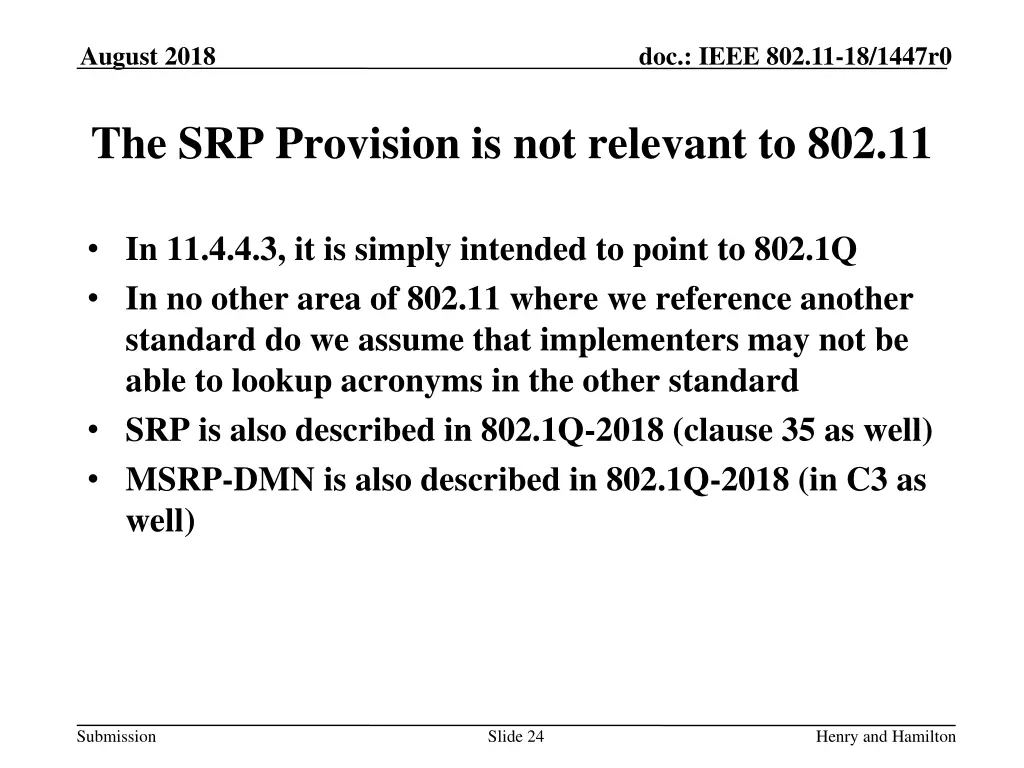
August 2018 doc.: IEEE 802.11-18/1447r0 The SRP Provision is not relevant to 802.11 In 11.4.4.3, it is simply intended to point to 802.1Q In no other area of 802.11 where we reference another standard do we assume that implementers may not be able to lookup acronyms in the other standard SRP is also described in 802.1Q-2018 (clause 35 as well) MSRP-DMN is also described in 802.1Q-2018 (in C3 as well) Submission Slide 24 Henry and Hamilton
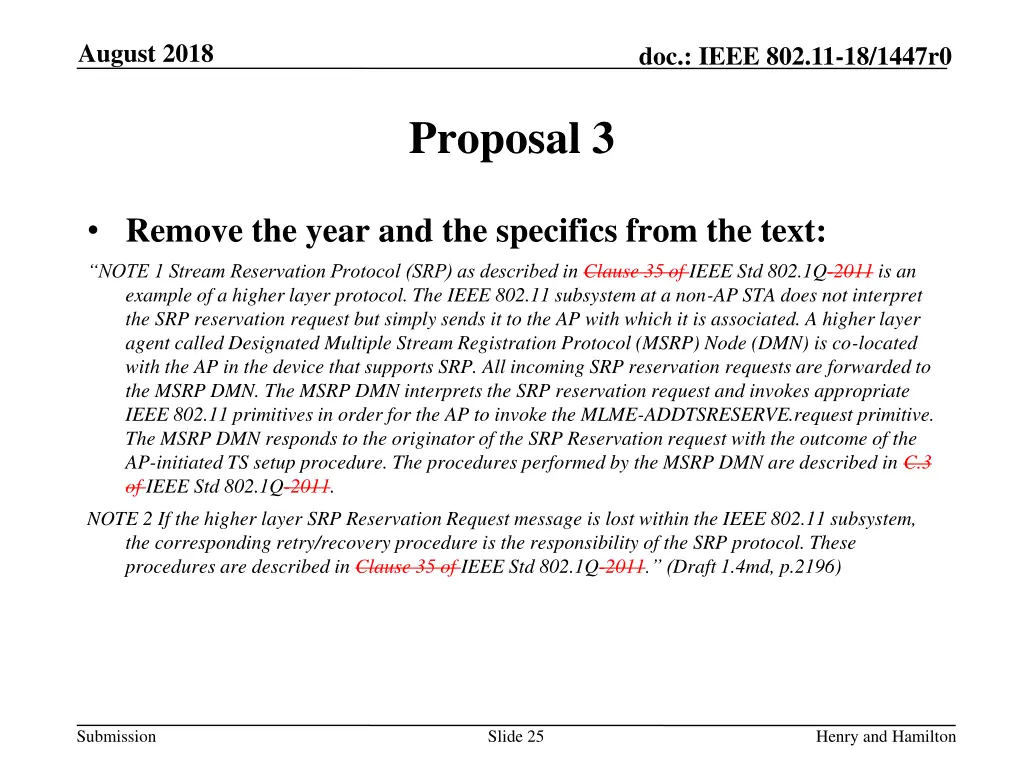
August 2018 doc.: IEEE 802.11-18/1447r0 Proposal 3 Remove the year and the specifics from the text: NOTE 1 Stream Reservation Protocol (SRP) as described in Clause 35 of IEEE Std 802.1Q-2011 is an example of a higher layer protocol. The IEEE 802.11 subsystem at a non-AP STA does not interpret the SRP reservation request but simply sends it to the AP with which it is associated. A higher layer agent called Designated Multiple Stream Registration Protocol (MSRP) Node (DMN) is co-located with the AP in the device that supports SRP. All incoming SRP reservation requests are forwarded to the MSRP DMN. The MSRP DMN interprets the SRP reservation request and invokes appropriate IEEE 802.11 primitives in order for the AP to invoke the MLME-ADDTSRESERVE.request primitive. The MSRP DMN responds to the originator of the SRP Reservation request with the outcome of the AP-initiated TS setup procedure. The procedures performed by the MSRP DMN are described in C.3 of IEEE Std 802.1Q-2011. NOTE 2 If the higher layer SRP Reservation Request message is lost within the IEEE 802.11 subsystem, the corresponding retry/recovery procedure is the responsibility of the SRP protocol. These procedures are described in Clause 35 of IEEE Std 802.1Q-2011. (Draft 1.4md, p.2196) Submission Slide 25 Henry and Hamilton