Understanding Impaired Hearing and Service Connection Criteria
Learn about impaired hearing and the criteria for service connection based on auditory thresholds at specific frequencies and speech recognition scores. Examples are provided to help understand the evaluation process for veterans' hearing loss claims.

Download Presentation

Please find below an Image/Link to download the presentation.
The content on the website is provided AS IS for your information and personal use only. It may not be sold, licensed, or shared on other websites without obtaining consent from the author. If you encounter any issues during the download, it is possible that the publisher has removed the file from their server.
You are allowed to download the files provided on this website for personal or commercial use, subject to the condition that they are used lawfully. All files are the property of their respective owners.
The content on the website is provided AS IS for your information and personal use only. It may not be sold, licensed, or shared on other websites without obtaining consent from the author.
E N D
Presentation Transcript
Eduard G. Bueno DAV National Service Officer Service Connection of Hearing Loss
According to the provisions of 38 C.F.R. 3.385, impaired hearing will be considered to be a disability when the auditory threshold in any of the frequencies of 500, 1000, 2000, 3000 or 4000 Hertz is 40 decibels or greater; or when the auditory thresholds for at least three frequencies are 26 decibels or greater; or when speech recognition scores using the Maryland CNC Test are less than 94 percent. What is Impaired Hearing? Pure tone threshold in the 500, 1000, 2000, 3000, and 4000 Hz range are often used to determine entitlement connection. Test results from pure tone audiograms are reported on military service examinations. to service
Note: Impaired hearing in the 250, 6000 and 8000 hz ranges is not considered in determining service connection. Hearing Loss Sensorineural hearing loss is considered an organic disease of the nervous system and is subject to presumptive service connection under 38 C.F.R. 3.309a.
Hearing Loss Examples In the following examples, review the hearing test results and determine if the veteran should be service-connected based recorded on the military separation examination. on the information
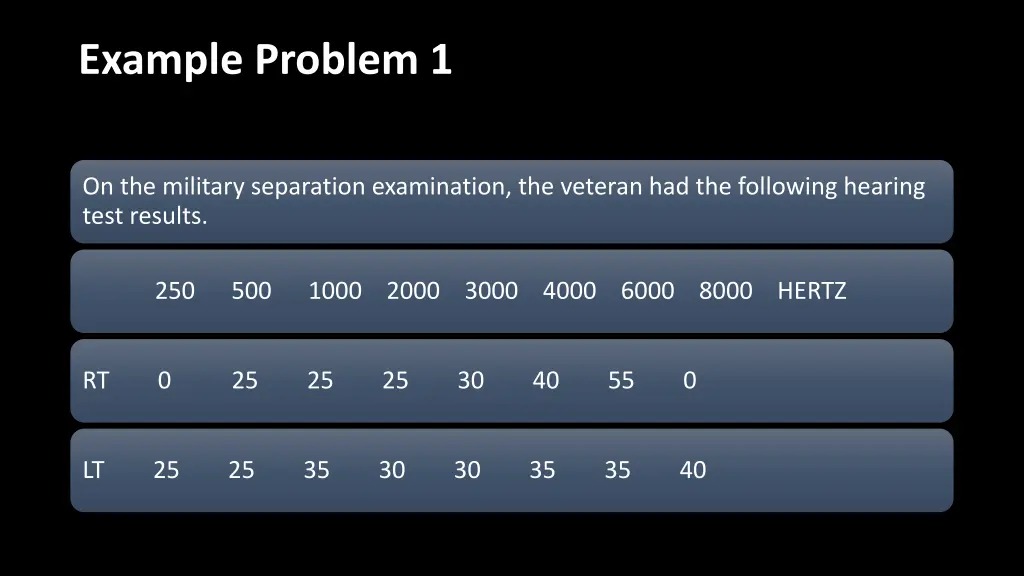
Example Problem 1 On the military separation examination, the veteran had the following hearing test results. 250 500 1000 2000 3000 4000 6000 8000 HERTZ RT 0 25 25 25 30 40 55 0 LT 25 25 35 30 30 35 35 40
Does the veteran have impaired hearing in either ear?
Answer Answer Right Ear: The veteran has an auditory threshold of 40 decibels at 4000 Hertz. He therefore has impaired hearing consistent with 38 C.F.R. 3.385. 3.385 Left Ear: The veteran has an auditory threshold of 35 decibels at 1000 Hertz, 30 at 2000, 30 at 3000, and 35 at 4000. The auditory thresholds of at least three frequencies are 26 decibels or greater. He therefore has impaired hearing consistent with 38 C.F.R. 3.385. 3.385
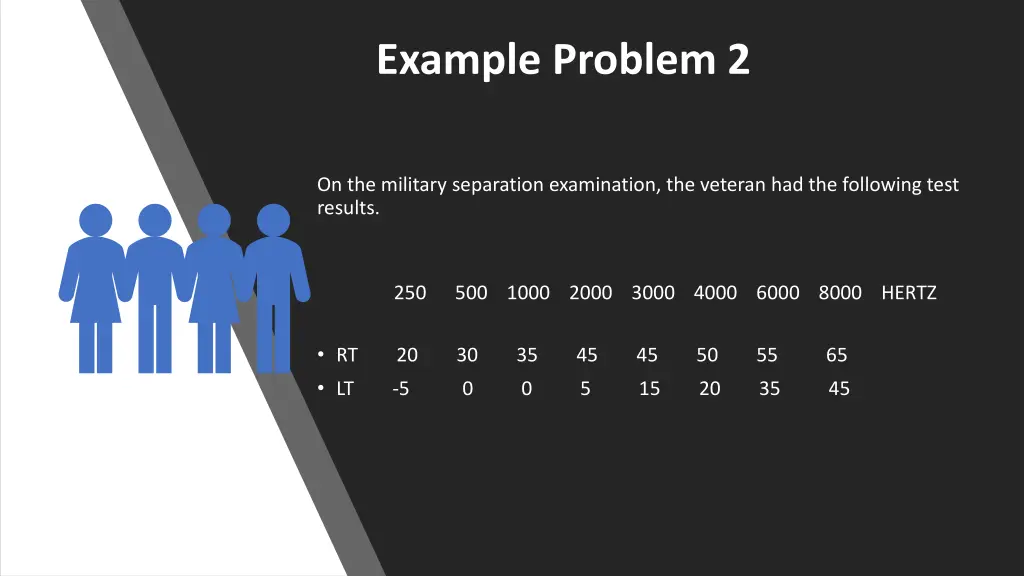
Example Problem 2 On the military separation examination, the veteran had the following test results. 250 500 1000 2000 3000 4000 6000 8000 HERTZ RT LT 20 30 35 45 45 50 55 65 -5 0 0 5 15 20 35 45
Does the veteran have impaired hearing of either the right or left ear?
Right Ear: The veteran has an auditory threshold of 30 decibels at 500 Hertz, 35 at 1000, 45 at 2000, 45 at 3000, and 50 at 4000. The auditory thresholds of five frequencies are 26 decibels or greater. He also thresholds of 40 or more in three ranges. He therefore has impaired hearing consistent 3.385. This is an example of a sensorineural hearing impairment. Answer has auditory with 38 C.F.R. Left Ear: impaired hearing consistent with 38 C.F.R. 3.385. The veteran does not have
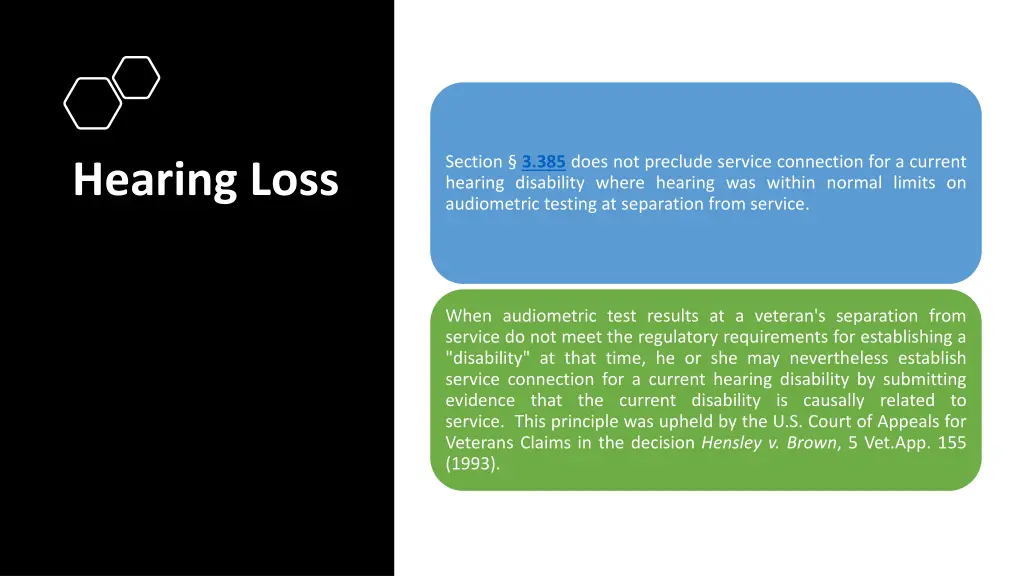
3.385 Section 3.385 does not preclude service connection for a current hearing disability where hearing was within normal limits on audiometric testing at separation from service. Hearing Loss When audiometric test results at a veteran's separation from service do not meet the regulatory requirements for establishing a "disability" at that time, he or she may nevertheless establish service connection for a current hearing disability by submitting evidence that the current disability is causally related to service. This principle was upheld by the U.S. Court of Appeals for Veterans Claims in the decision Hensley v. Brown, 5 Vet.App. 155 (1993).
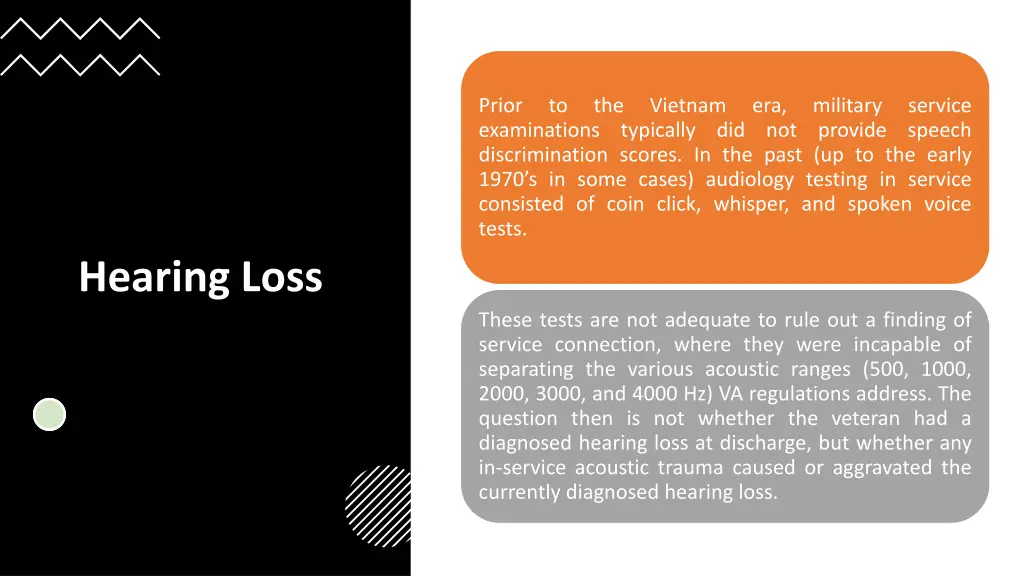
Prior examinations discrimination scores. In the past (up to the early 1970 s in some cases) audiology testing in service consisted of coin click, whisper, and spoken voice tests. to the Vietnam typically era, not military provide service speech did Hearing Loss These tests are not adequate to rule out a finding of service connection, where they were incapable of separating the various acoustic ranges (500, 1000, 2000, 3000, and 4000 Hz) VA regulations address. The question then is not whether the veteran had a diagnosed hearing loss at discharge, but whether any in-service acoustic trauma caused or aggravated the currently diagnosed hearing loss.
Types of Hearing Loss In determining the appropriate percentage to assign service-connected hearing loss, the VA considers the range of hearing only in the pure tone thresholds in the 1000-2000- 3000-4000 hz range. In our discussion of the different types of hearing loss, you will note that different types of loss will have a different effect on each range of hearing. Most people can hear sounds between 20 hertz (hz), or vibrations, per second and 20,000 hz per second.
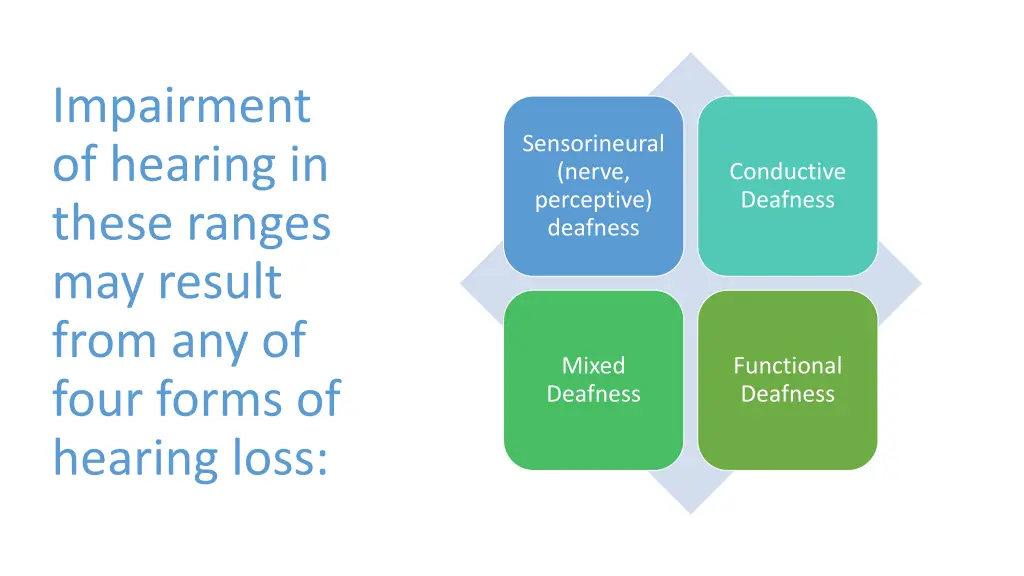
Impairment of hearing in these ranges may result from any of four forms of hearing loss: Sensorineural (nerve, perceptive) deafness Conductive Deafness Mixed Deafness Functional Deafness
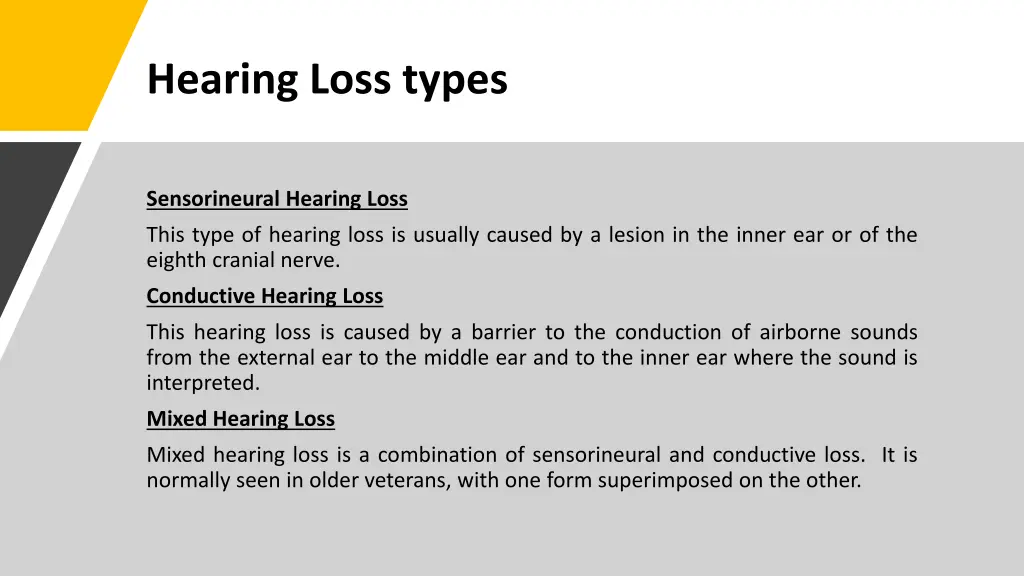
Hearing Loss types Sensorineural Hearing Loss This type of hearing loss is usually caused by a lesion in the inner ear or of the eighth cranial nerve. Conductive Hearing Loss This hearing loss is caused by a barrier to the conduction of airborne sounds from the external ear to the middle ear and to the inner ear where the sound is interpreted. Mixed Hearing Loss Mixed hearing loss is a combination of sensorineural and conductive loss. It is normally seen in older veterans, with one form superimposed on the other.
Functional Hearing Loss Functional hearing loss is a loss without evident organic basis, and is therefore assumed to have a psychiatric origin. Determine entitlement to service connection for a psychiatric disability manifested in part by a hearing impairment by the usual regulations pertaining to the grant of service connection. Hearing Loss types continued. It is anticipated the psychiatric disorder will be identifiable by manifestations other than those relating to hearing complaints alone. If service connection is warranted, and manifestations of organic and functional disability are predominantly hearing impairment, base the rating either on the organic hearing loss or the psychiatric disorder, but not in combination.
Evaluation of Hearing Impairment - 4.85 An examination for hearing impairment for VA purposes must be conducted by a state-licensed audiologist and must include a controlled speech discrimination test (Maryland CNC) and a puretone audiometry test. Examinations will be conducted without the use of hearing aids.
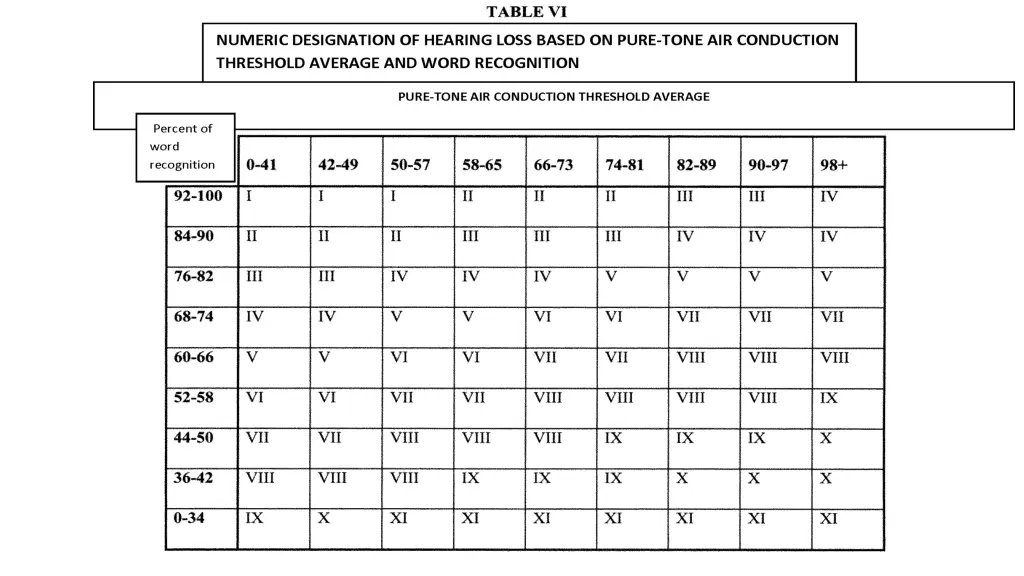
Table VI, "Numeric Designation of Hearing Impairment Based on Average and Speech Discrimination," is used to determine a Roman numeral designation (I through XI) for hearing impairment based on a combination of the discrimination (horizontal puretone threshold columns). The Roman numeral designation is located at the point where the percentage of speech discrimination and puretone threshold average intersect. Puretone Threshold Hearing Loss percent of speech and (vertical rows) average the
Hearing Loss "Puretone threshold average," as used in Tables VI and VIa, is a sum of the puretone thresholds at 1000, 2000, 3000, and 4000 Hertz, divided by four. This average is used in all cases (including those in 4.86) to determine the Roman numeral designation for hearing impairment from Table VI or VIa
Special Monthly Compensation for Hearing Loss When evaluating any claim for impaired hearing, refer to 3.350 of this chapter to determine whether the veteran may be entitled to special monthly compensation due either to deafness, or to deafness in combination with other specified disabilities. When evaluating any claim for impaired hearing, refer to 3.350 to determine whether the veteran may be entitled to special monthly compensation due either to deafness, or to deafness in combination with other specified disabilities. 38 U.S.C. 1114(k) authorizes payment of SMC if there is absence of air and bone conduction in both ears. The implementing regulation, 38 C.F.R. 3.350(a)(5), states that deafness of both ears, having absence of air and bone conduction, will be held to exist when bilateral hearing loss is equal to or greater than the minimum bilateral hearing loss required for a maximum rating (100%) under the schedule.
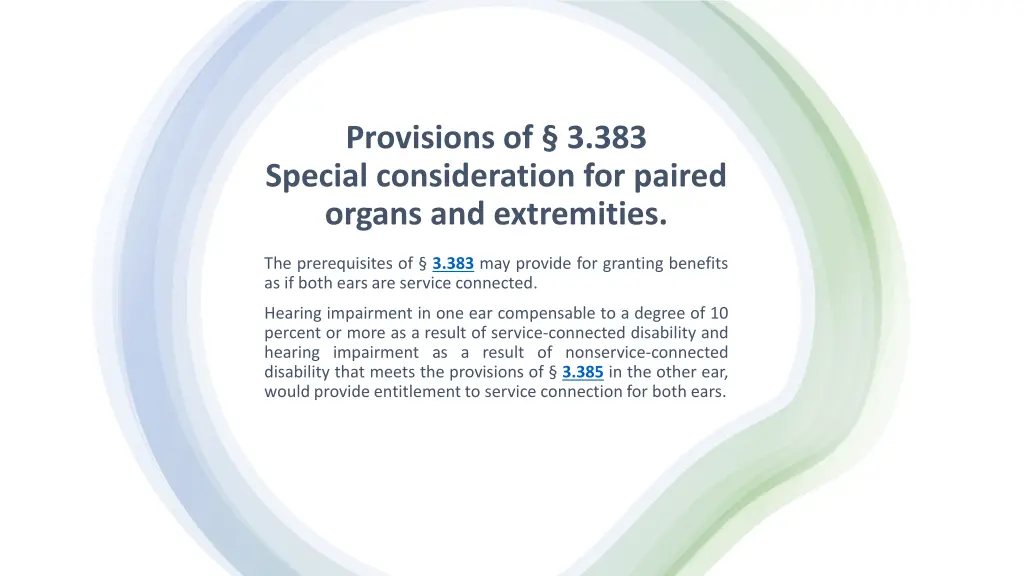
Provisions of 3.383 Special consideration for paired organs and extremities. The prerequisites of 3.383 may provide for granting benefits as if both ears are service connected. Hearing impairment in one ear compensable to a degree of 10 percent or more as a result of service-connected disability and hearing impairment as a result of nonservice-connected disability that meets the provisions of 3.385 in the other ear, would provide entitlement to service connection for both ears.