Understanding Information Retrieval and Organization
Explore the concept of Information Retrieval and Organization, including the challenges of information overload and the differences between Internet-based and classic retrieval systems. Learn about the fundamentals of Web search engines and the characteristics of Web users, and gain insights into intelligent information retrieval techniques and strategies.

Download Presentation

Please find below an Image/Link to download the presentation.
The content on the website is provided AS IS for your information and personal use only. It may not be sold, licensed, or shared on other websites without obtaining consent from the author. If you encounter any issues during the download, it is possible that the publisher has removed the file from their server.
You are allowed to download the files provided on this website for personal or commercial use, subject to the condition that they are used lawfully. All files are the property of their respective owners.
The content on the website is provided AS IS for your information and personal use only. It may not be sold, licensed, or shared on other websites without obtaining consent from the author.
E N D
Presentation Transcript
Overview of Information Retrieval and Organization CSC 575 Intelligent Information Retrieval
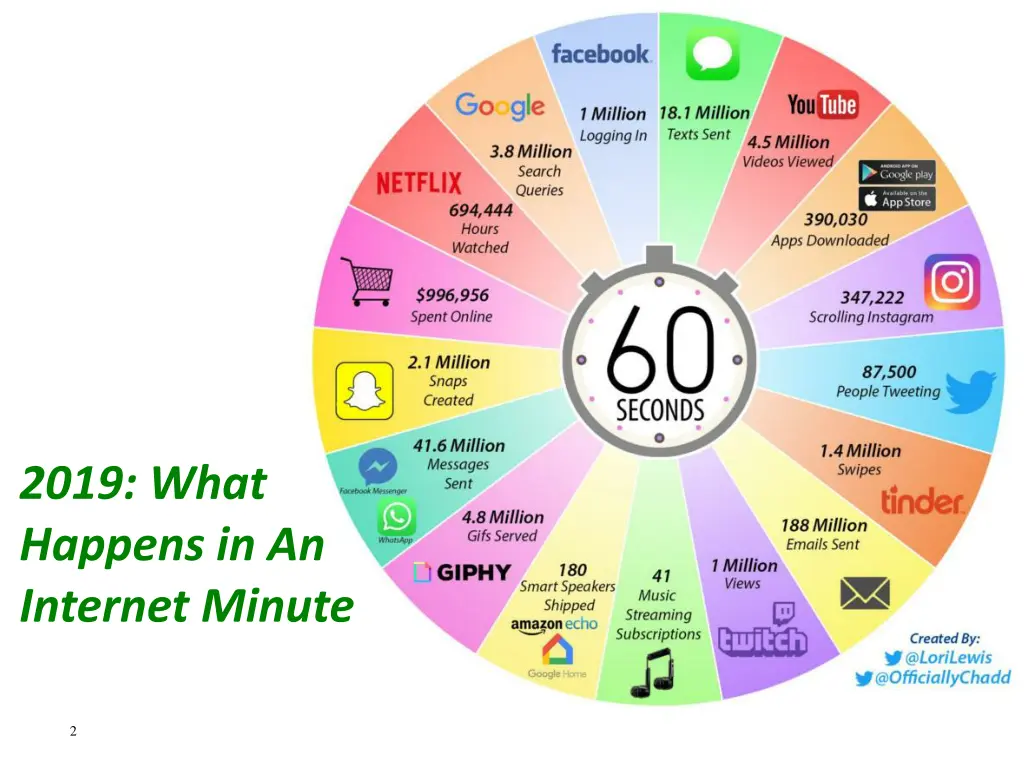
2019: What Happens in An Internet Minute 2
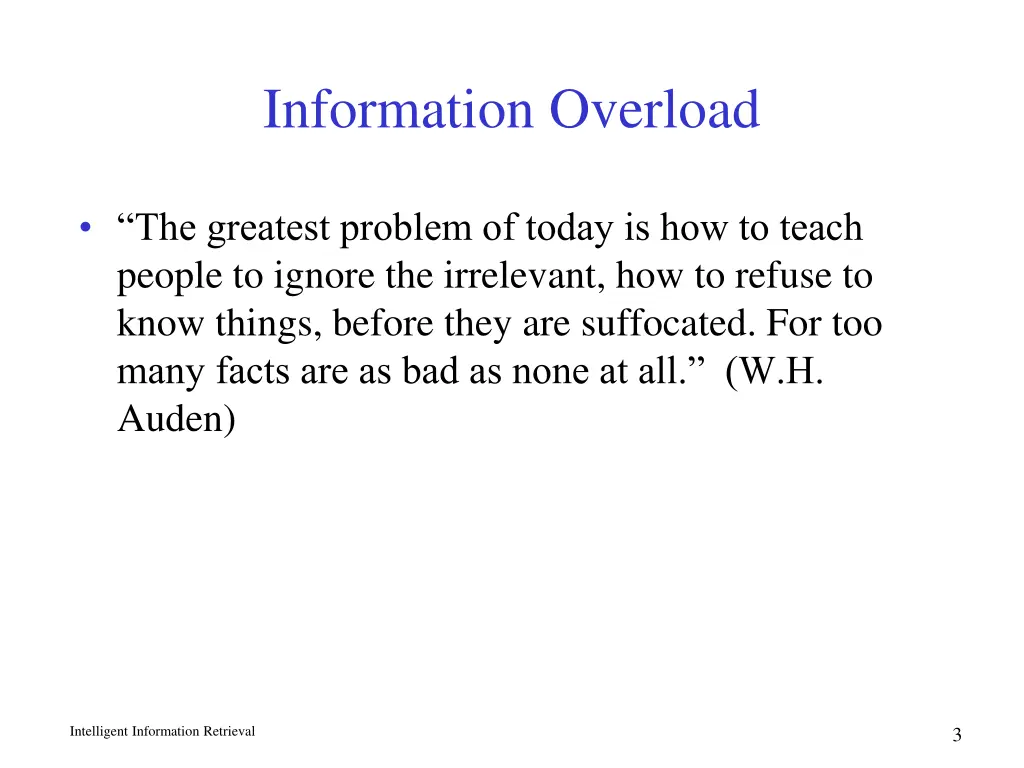
Information Overload The greatest problem of today is how to teach people to ignore the irrelevant, how to refuse to know things, before they are suffocated. For too many facts are as bad as none at all. (W.H. Auden) Intelligent Information Retrieval 3
Information Retrieval Information Retrieval (IR) is finding material (usually documents) of an unstructured nature (usually text) that satisfies an information need from within large collections (usually stored on computers). Most prominent example: Web Search Engines 4
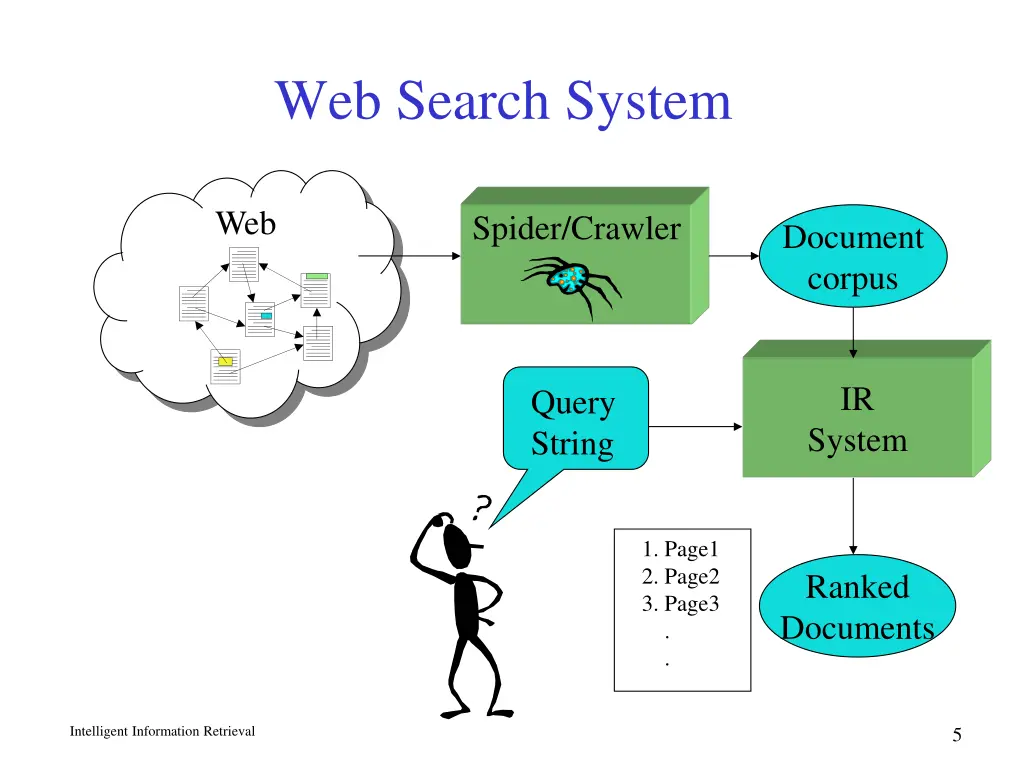
Web Search System Web Spider/Crawler Document corpus IR Query String System 1. Page1 2. Page2 3. Page3 . . Ranked Documents Intelligent Information Retrieval 5
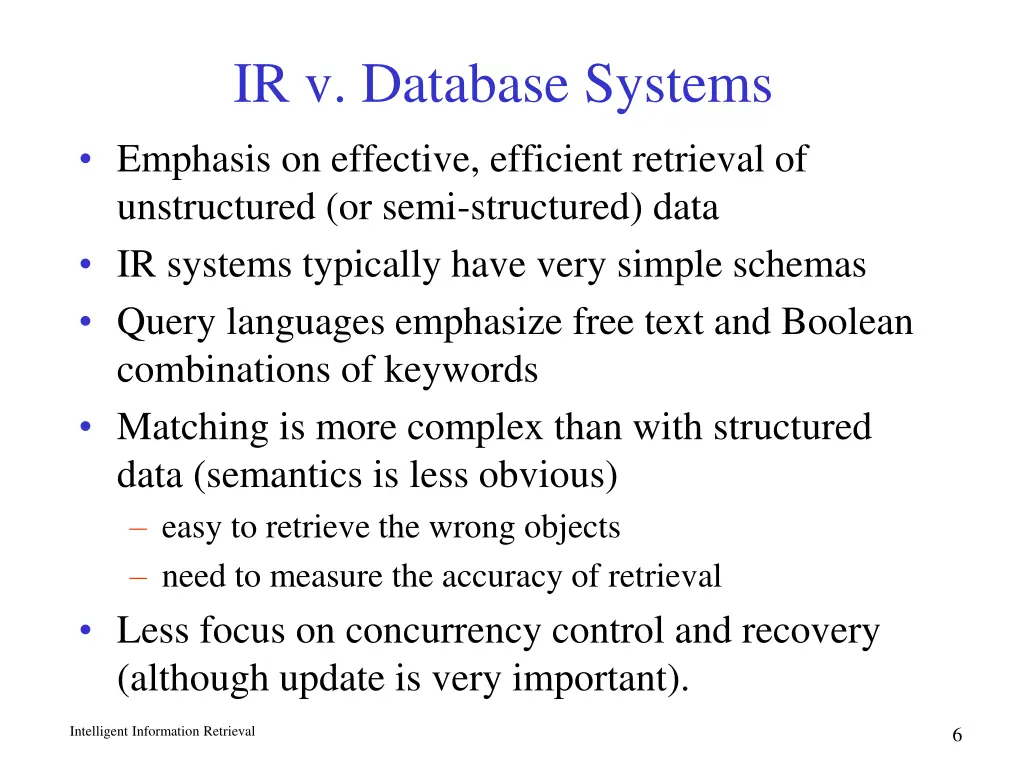
IR v. Database Systems Emphasis on effective, efficient retrieval of unstructured (or semi-structured) data IR systems typically have very simple schemas Query languages emphasize free text and Boolean combinations of keywords Matching is more complex than with structured data (semantics is less obvious) easy to retrieve the wrong objects need to measure the accuracy of retrieval Less focus on concurrency control and recovery (although update is very important). Intelligent Information Retrieval 6
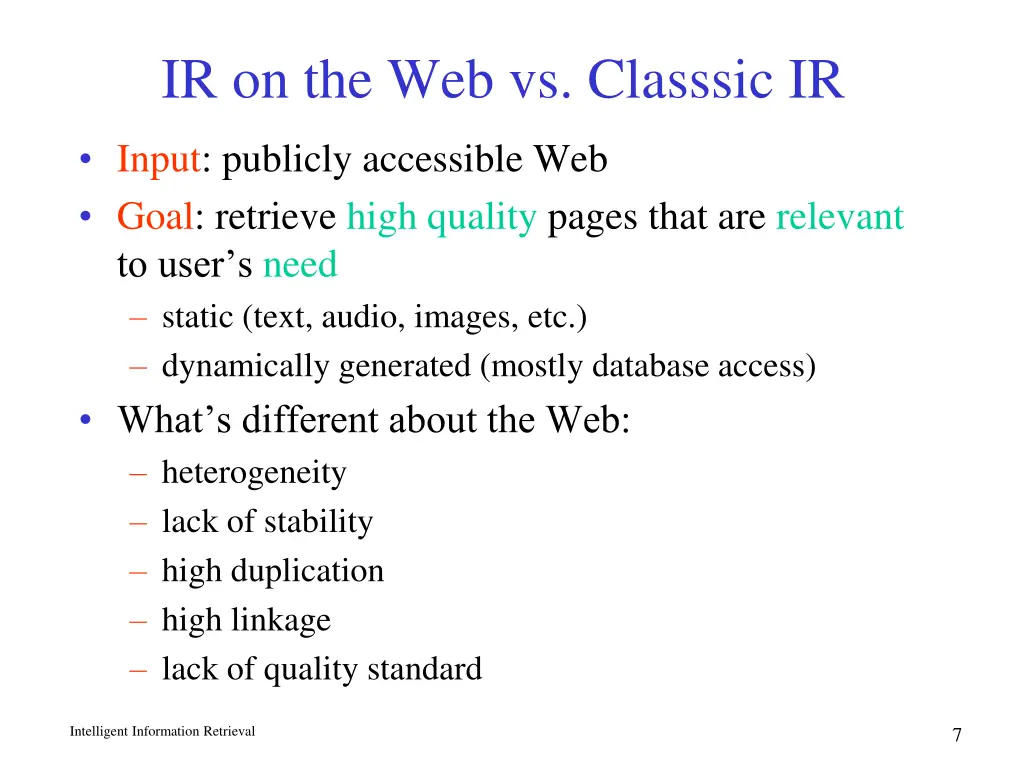
IR on the Web vs. Classsic IR Input: publicly accessible Web Goal: retrieve high quality pages that are relevant to user s need static (text, audio, images, etc.) dynamically generated (mostly database access) What s different about the Web: heterogeneity lack of stability high duplication high linkage lack of quality standard Intelligent Information Retrieval 7
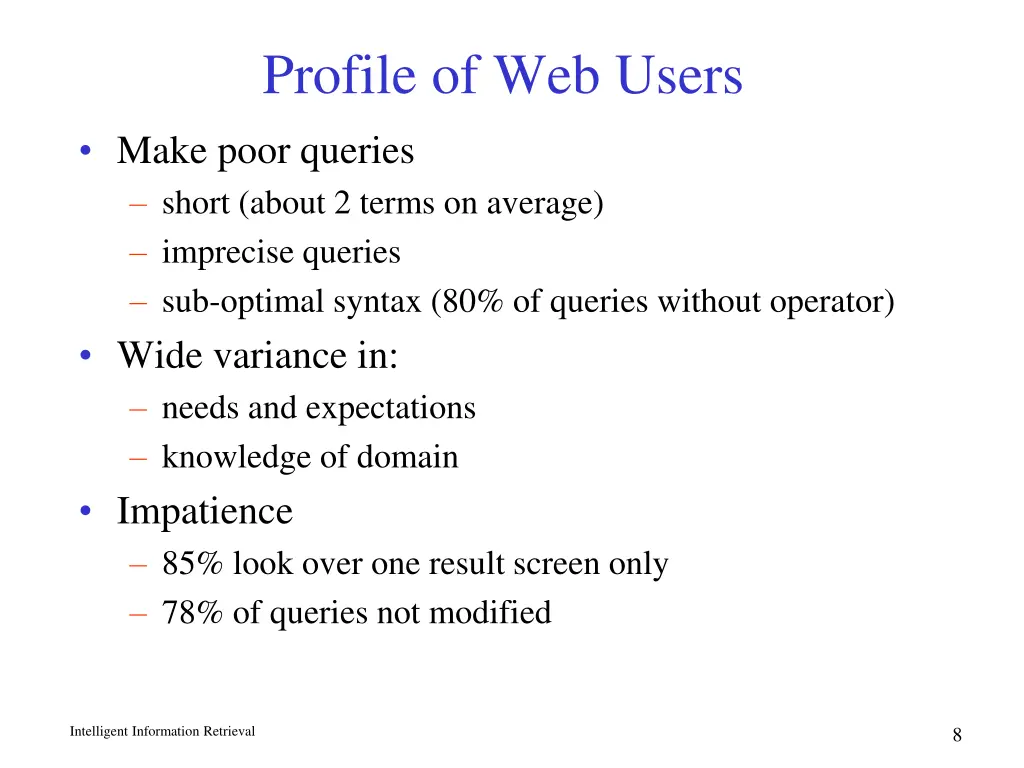
Profile of Web Users Make poor queries short (about 2 terms on average) imprecise queries sub-optimal syntax (80% of queries without operator) Wide variance in: needs and expectations knowledge of domain Impatience 85% look over one result screen only 78% of queries not modified Intelligent Information Retrieval 8
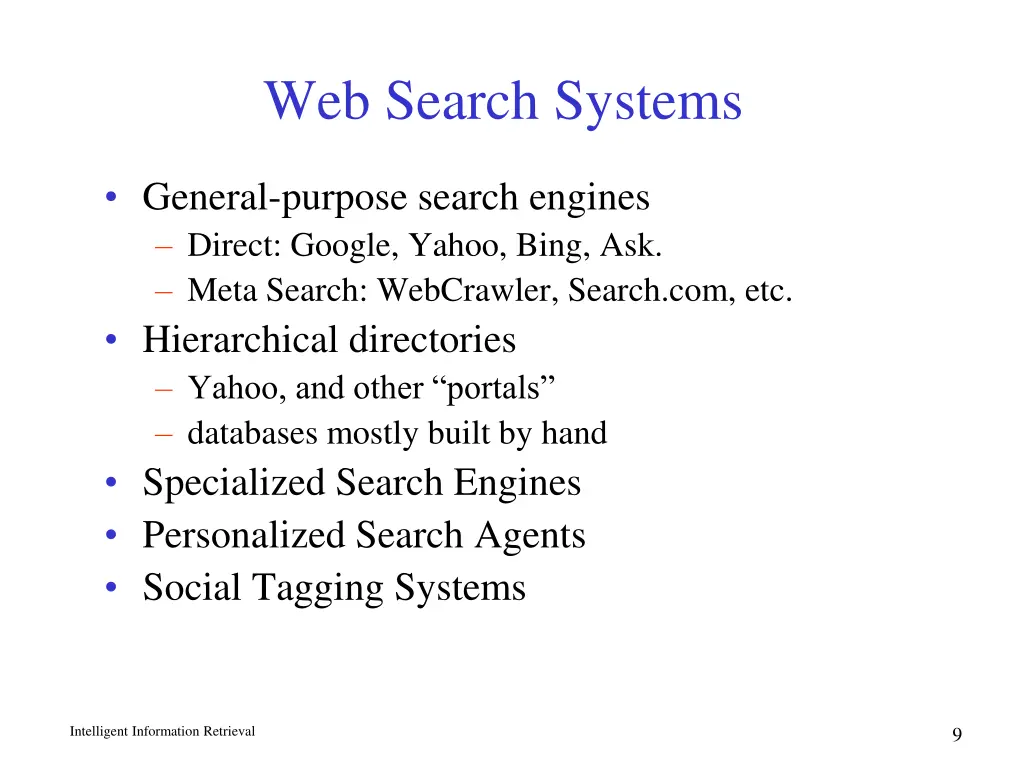
Web Search Systems General-purpose search engines Direct: Google, Yahoo, Bing, Ask. Meta Search: WebCrawler, Search.com, etc. Hierarchical directories Yahoo, and other portals databases mostly built by hand Specialized Search Engines Personalized Search Agents Social Tagging Systems Intelligent Information Retrieval 9
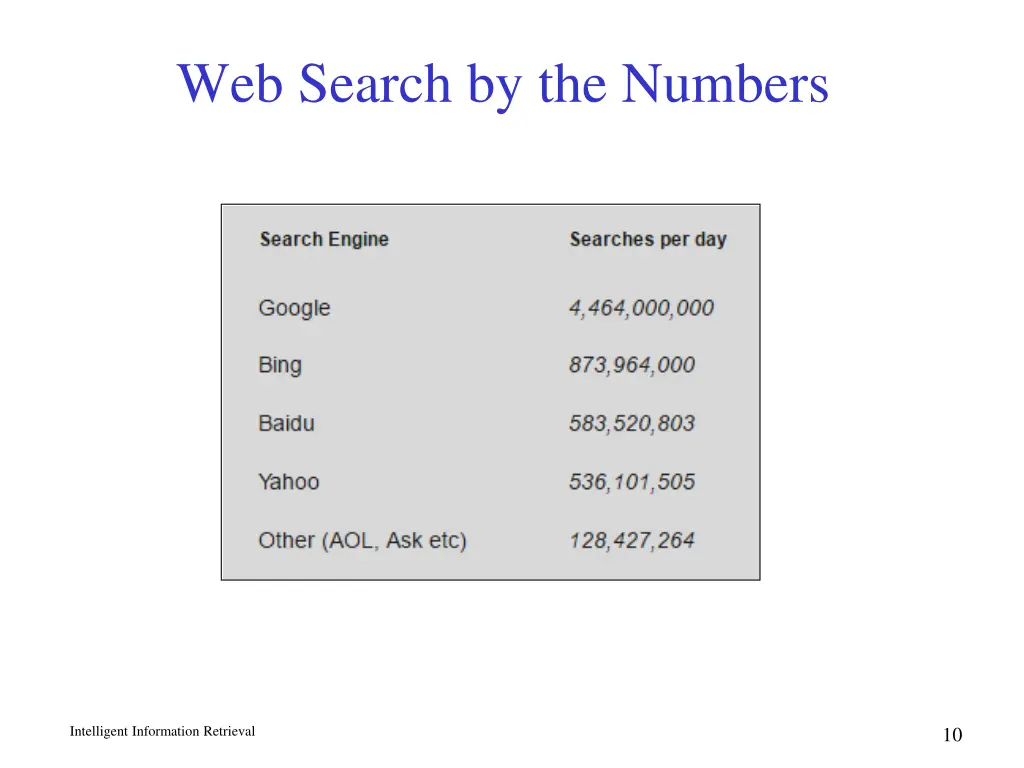
Web Search by the Numbers Intelligent Information Retrieval 10
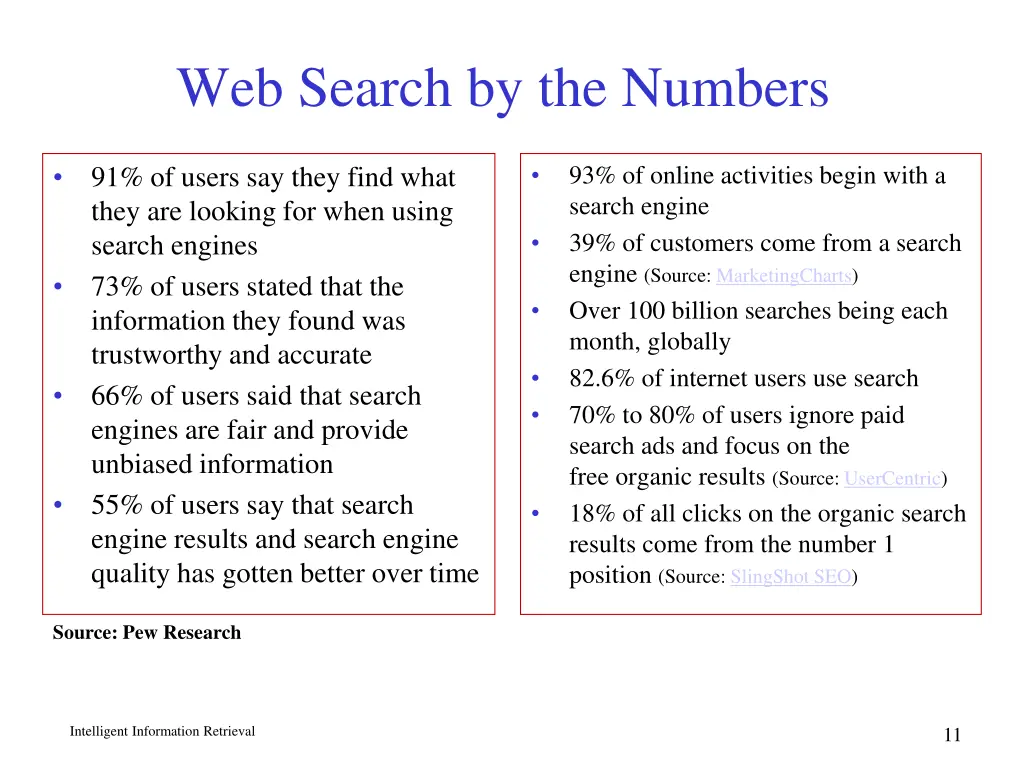
Web Search by the Numbers 93% of online activities begin with a search engine 39% of customers come from a search engine (Source: MarketingCharts) Over 100 billion searches being each month, globally 82.6% of internet users use search 70% to 80% of users ignore paid search ads and focus on the free organic results (Source: UserCentric) 18% of all clicks on the organic search results come from the number 1 position (Source: SlingShot SEO) 91% of users say they find what they are looking for when using search engines 73% of users stated that the information they found was trustworthy and accurate 66% of users said that search engines are fair and provide unbiased information 55% of users say that search engine results and search engine quality has gotten better over time Source: Pew Research Intelligent Information Retrieval 11
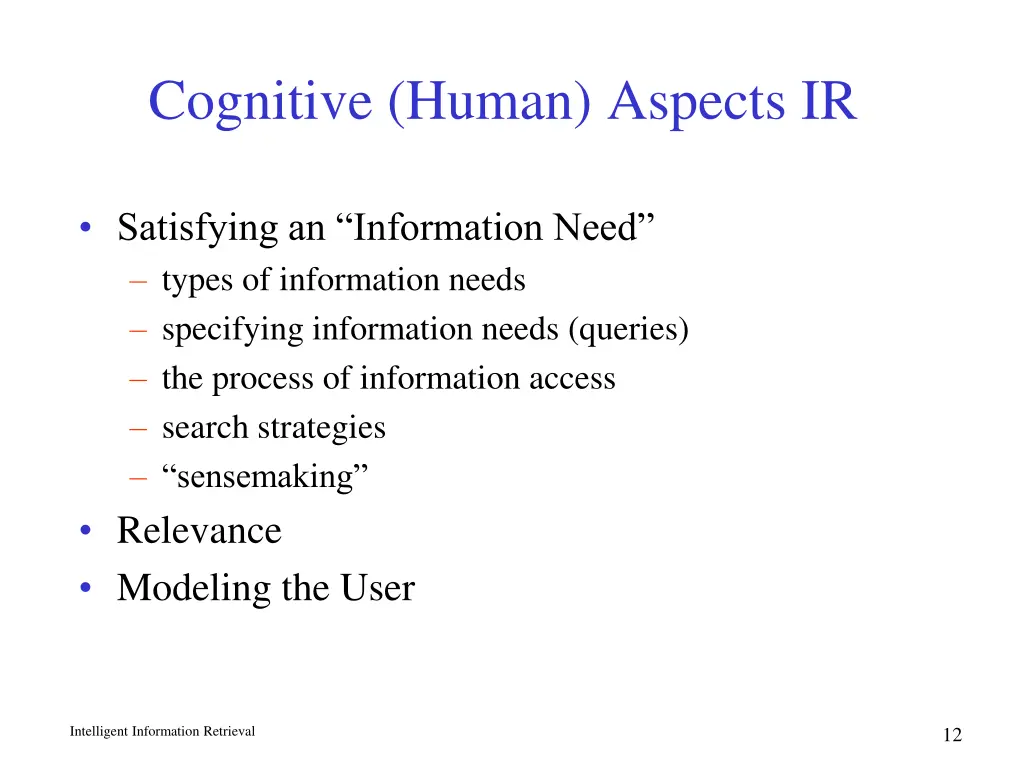
Cognitive (Human) Aspects IR Satisfying an Information Need types of information needs specifying information needs (queries) the process of information access search strategies sensemaking Relevance Modeling the User Intelligent Information Retrieval 12
Cognitive (Human) Aspects IR Three phases: Asking of a question Construction of an answer Assessment of the answer Part of an iterative process Intelligent Information Retrieval 13
Question Asking Person asking = user In a frame of mind, a cognitive state Aware of a gap in their knowledge May not be able to fully define this gap Paradox of IR: If user knew the question to ask, there would often be no work to do. The need to describe that which you do not know in order to find it Roland Hjerppe Query External expression of this ill-defined state Intelligent Information Retrieval 14
Question Answering Say question answerer is human. Can they translate the user s ill-defined question into a better one? Do they know the answer themselves? Are they able to verbalize this answer? Will the user understand this verbalization? Can they provide the needed background? What if answerer is a computer system? Intelligent Information Retrieval 15
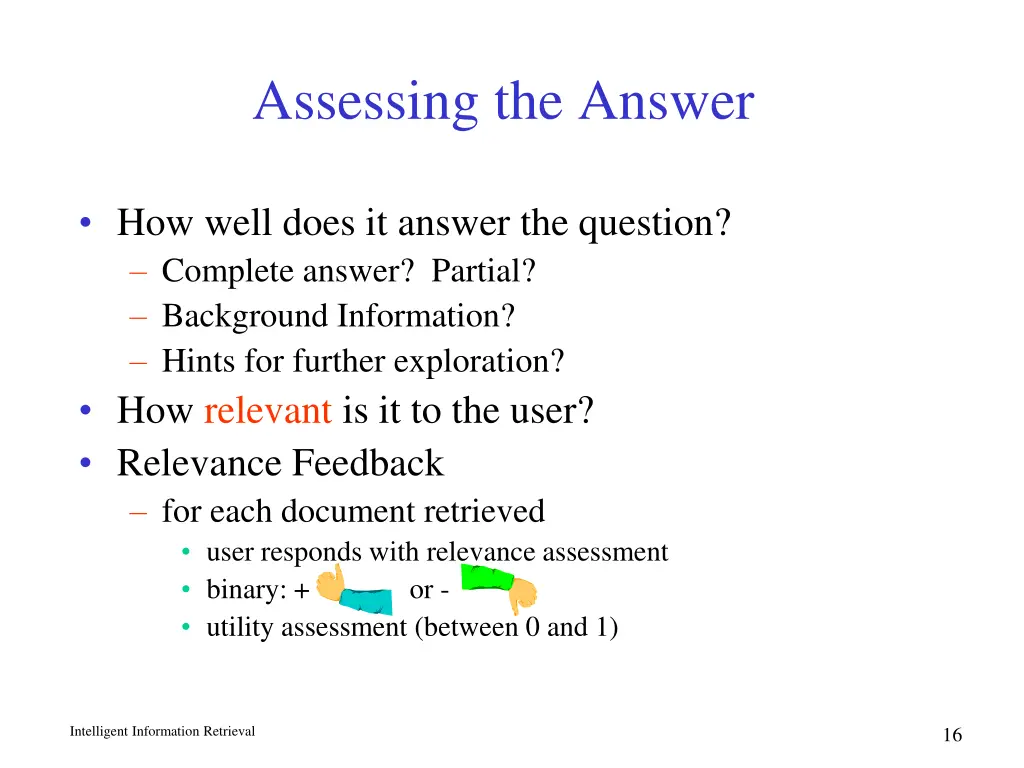
Assessing the Answer How well does it answer the question? Complete answer? Partial? Background Information? Hints for further exploration? How relevant is it to the user? Relevance Feedback for each document retrieved user responds with relevance assessment binary: + or - utility assessment (between 0 and 1) Intelligent Information Retrieval 16
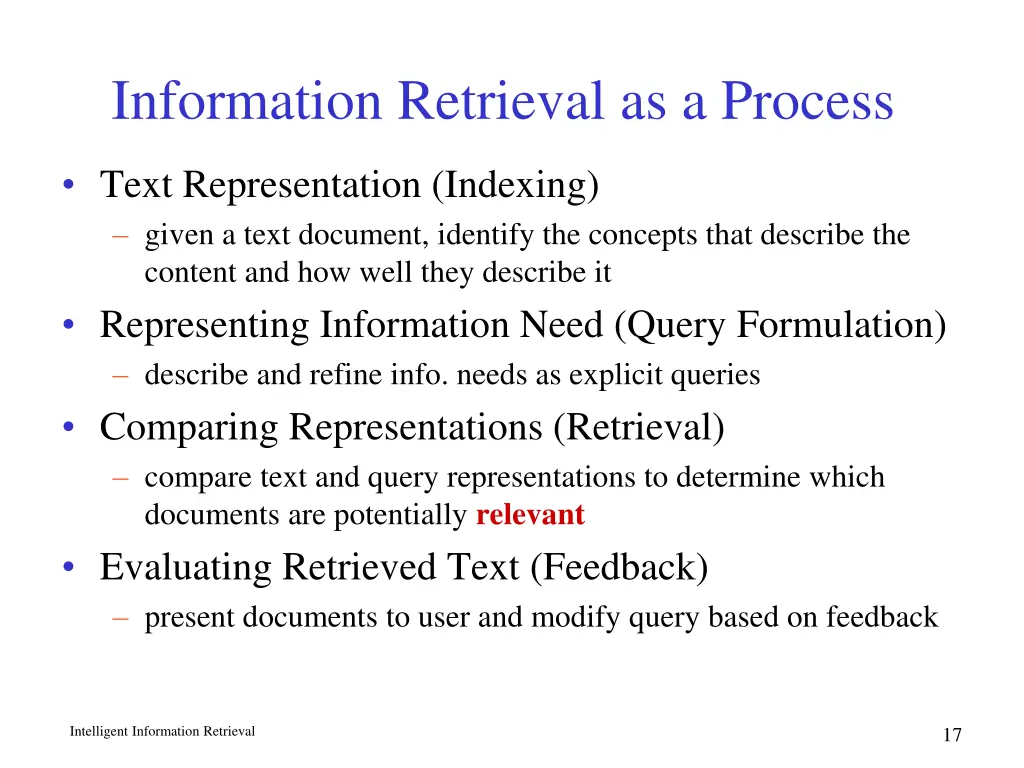
Information Retrieval as a Process Text Representation (Indexing) given a text document, identify the concepts that describe the content and how well they describe it Representing Information Need (Query Formulation) describe and refine info. needs as explicit queries Comparing Representations (Retrieval) compare text and query representations to determine which documents are potentially relevant Evaluating Retrieved Text (Feedback) present documents to user and modify query based on feedback Intelligent Information Retrieval 17
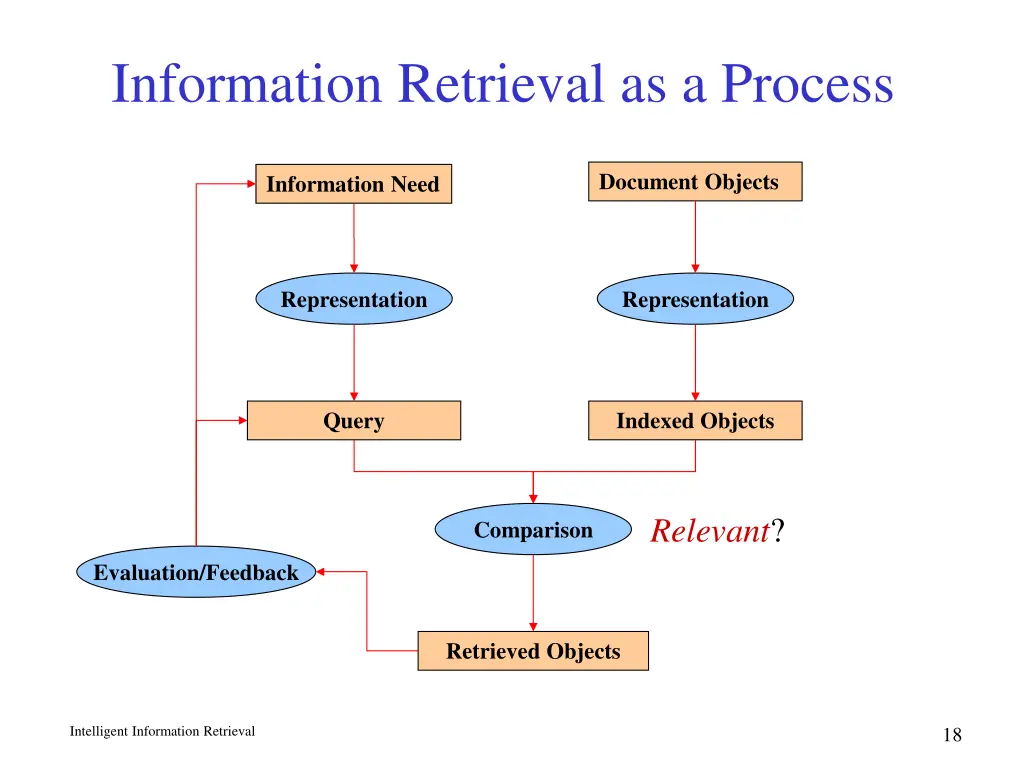
Information Retrieval as a Process Document Objects Information Need Representation Representation Query Indexed Objects Relevant? Comparison Evaluation/Feedback Retrieved Objects Intelligent Information Retrieval 18
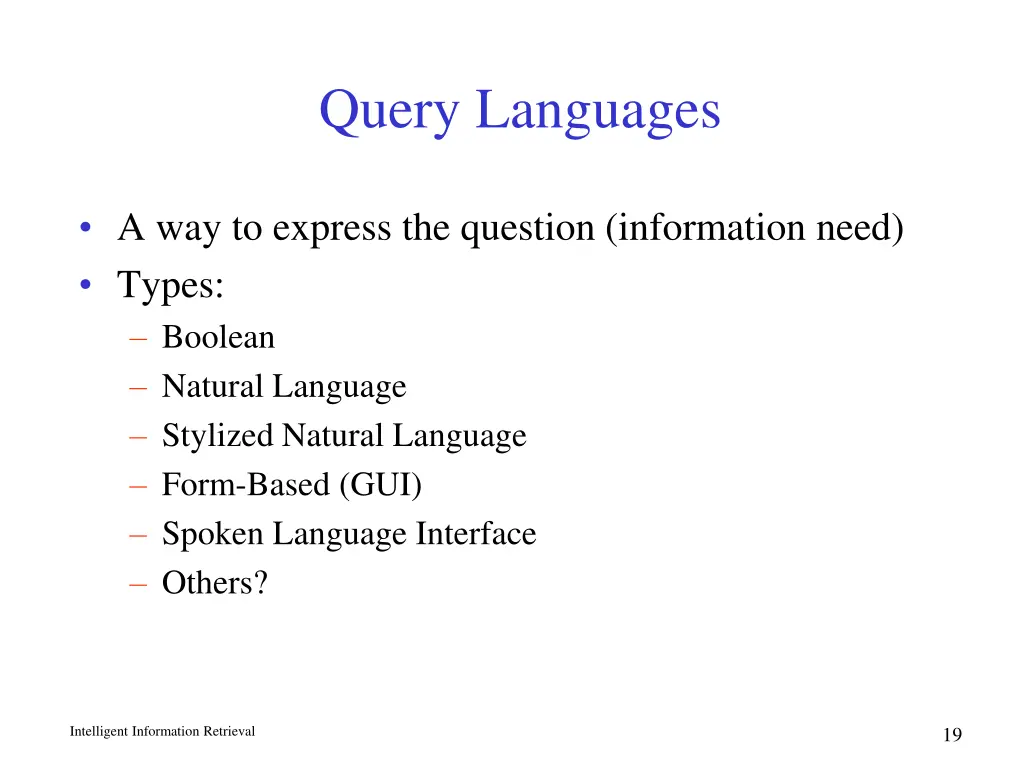
Query Languages A way to express the question (information need) Types: Boolean Natural Language Stylized Natural Language Form-Based (GUI) Spoken Language Interface Others? Intelligent Information Retrieval 19
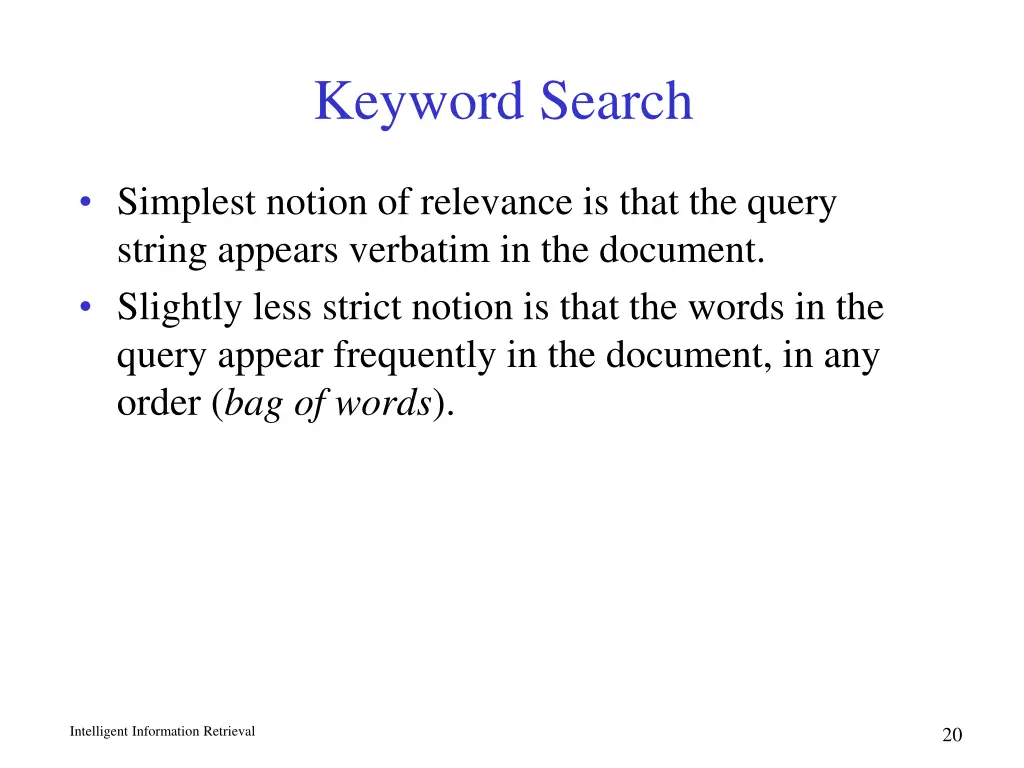
Keyword Search Simplest notion of relevance is that the query string appears verbatim in the document. Slightly less strict notion is that the words in the query appear frequently in the document, in any order (bag of words). Intelligent Information Retrieval 20
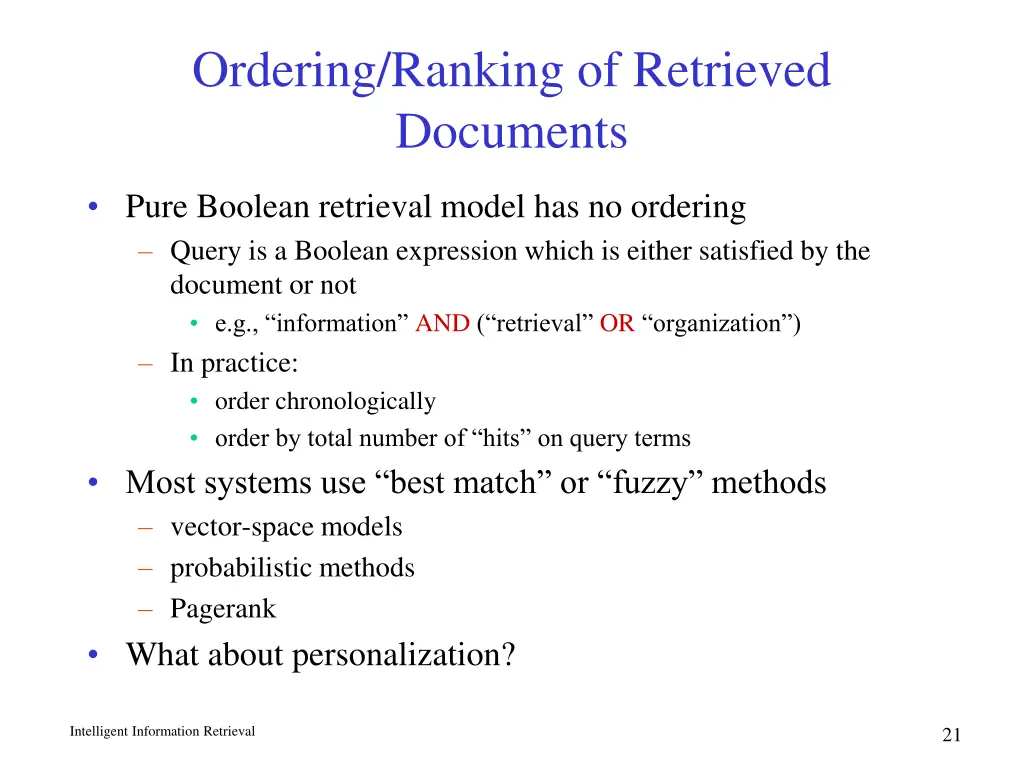
Ordering/Ranking of Retrieved Documents Pure Boolean retrieval model has no ordering Query is a Boolean expression which is either satisfied by the document or not e.g., information AND ( retrieval OR organization ) In practice: order chronologically order by total number of hits on query terms Most systems use best match or fuzzy methods vector-space models probabilistic methods Pagerank What about personalization? Intelligent Information Retrieval 21
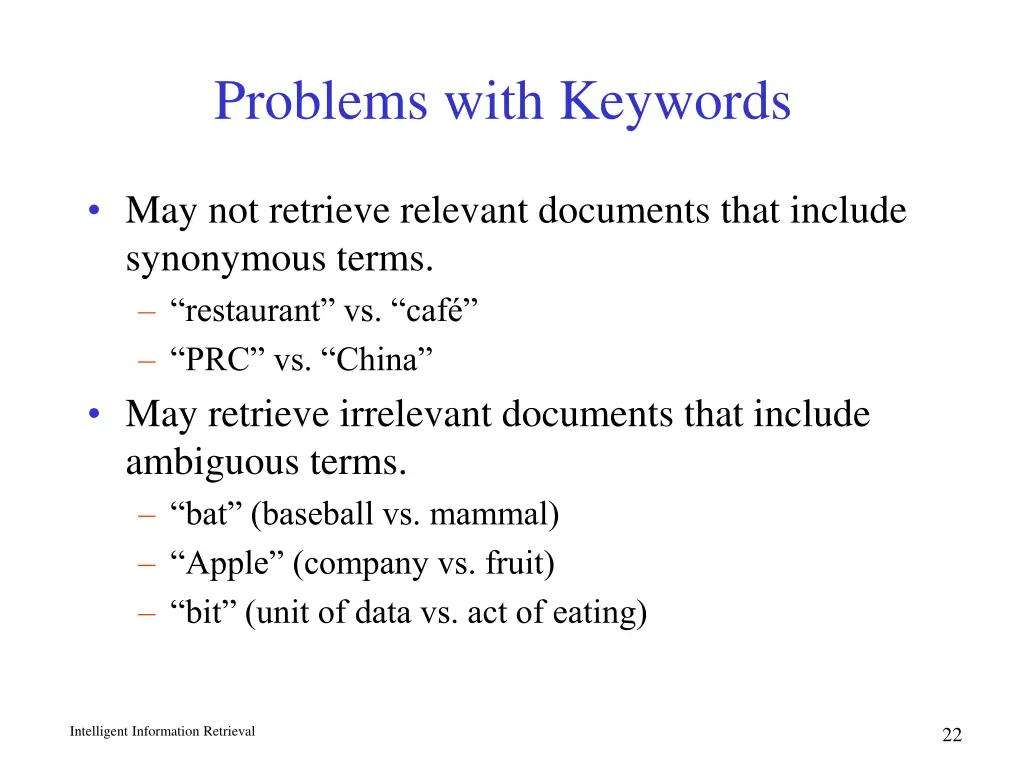
Problems with Keywords May not retrieve relevant documents that include synonymous terms. restaurant vs. caf PRC vs. China May retrieve irrelevant documents that include ambiguous terms. bat (baseball vs. mammal) Apple (company vs. fruit) bit (unit of data vs. act of eating) Intelligent Information Retrieval 22
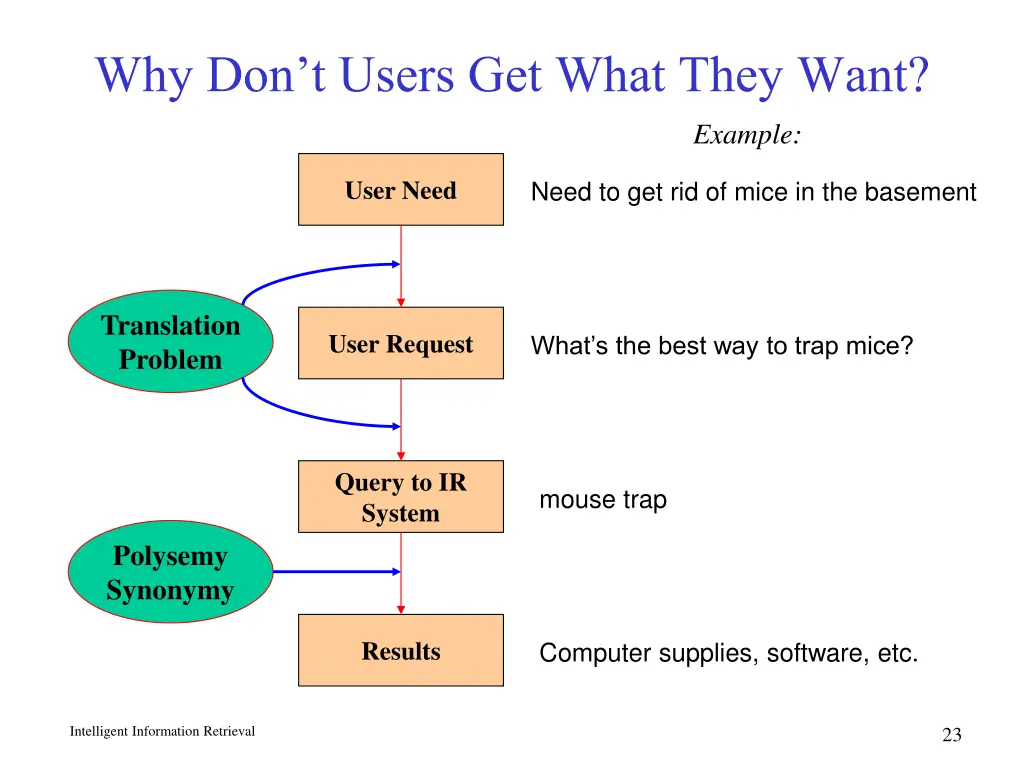
Why Dont Users Get What They Want? Example: User Need Need to get rid of mice in the basement Translation Problem User Request What s the best way to trap mice? Query to IR System mouse trap Polysemy Synonymy Results Computer supplies, software, etc. Intelligent Information Retrieval 23
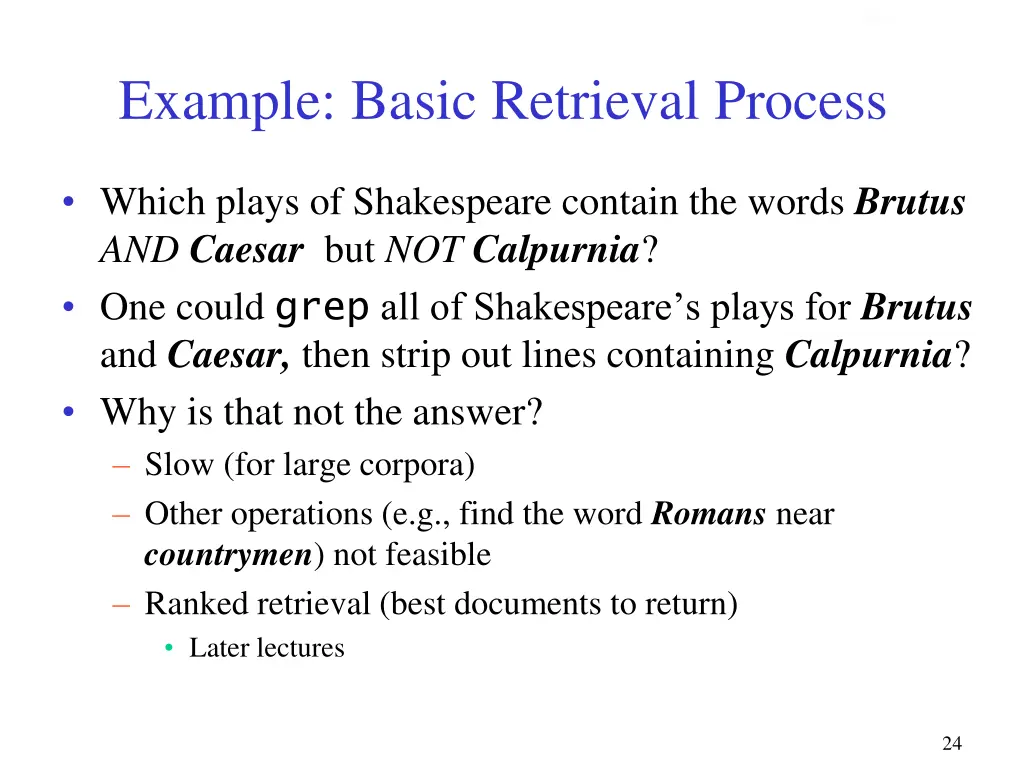
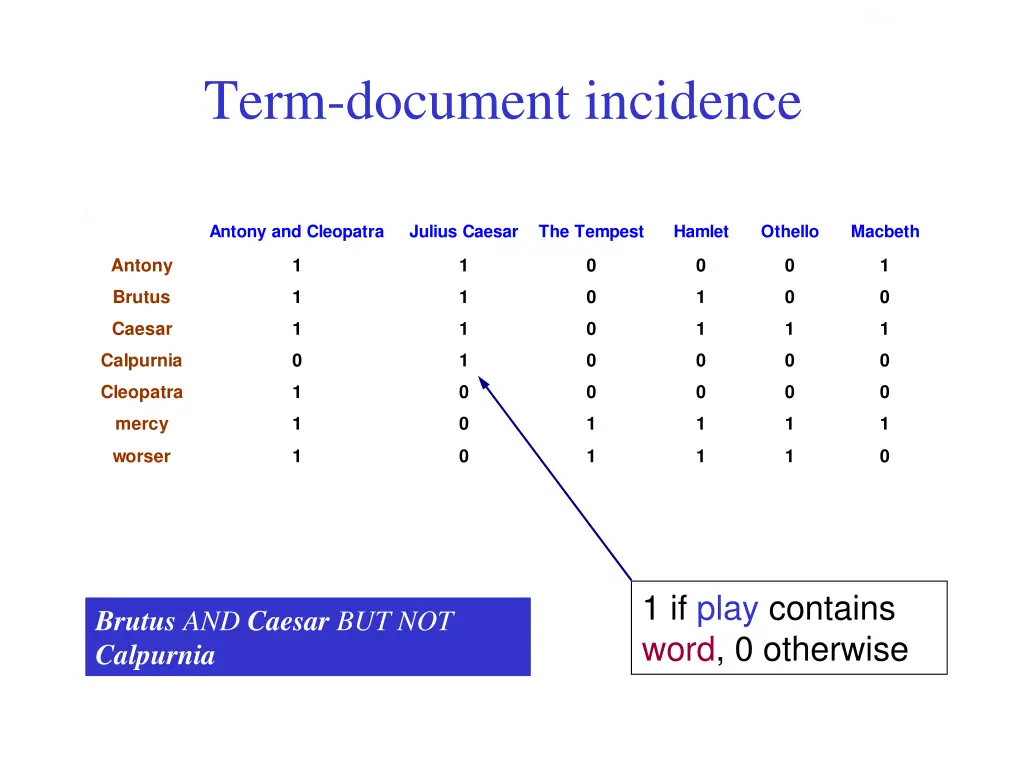
Sec. 1.1 Example: Basic Retrieval Process Which plays of Shakespeare contain the words Brutus ANDCaesar but NOTCalpurnia? One could grepall of Shakespeare s plays for Brutus and Caesar, then strip out lines containing Calpurnia? Why is that not the answer? Slow (for large corpora) Other operations (e.g., find the word Romans near countrymen) not feasible Ranked retrieval (best documents to return) Later lectures 24
Sec. 1.1 Term-document incidence Antony and Cleopatra Julius Caesar The Tempest Hamlet Othello Macbeth Antony 1 1 0 0 0 1 Brutus 1 1 0 1 0 0 Caesar 1 1 0 1 1 1 Calpurnia 0 1 0 0 0 0 Cleopatra 1 0 0 0 0 0 mercy 1 0 1 1 1 1 worser 1 0 1 1 1 0 1 if play contains word, 0 otherwise BrutusANDCaesarBUTNOT Calpurnia
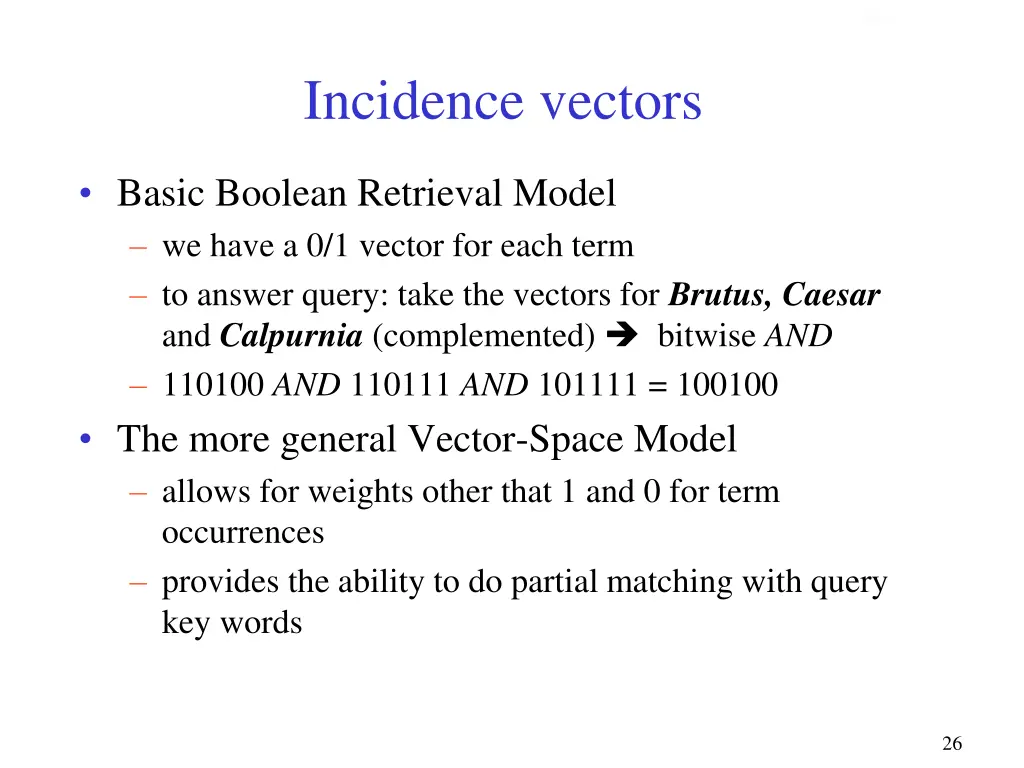
Sec. 1.1 Incidence vectors Basic Boolean Retrieval Model we have a 0/1 vector for each term to answer query: take the vectors for Brutus, Caesar and Calpurnia (complemented) bitwise AND 110100 AND 110111 AND 101111 = 100100 The more general Vector-Space Model allows for weights other that 1 and 0 for term occurrences provides the ability to do partial matching with query key words 26
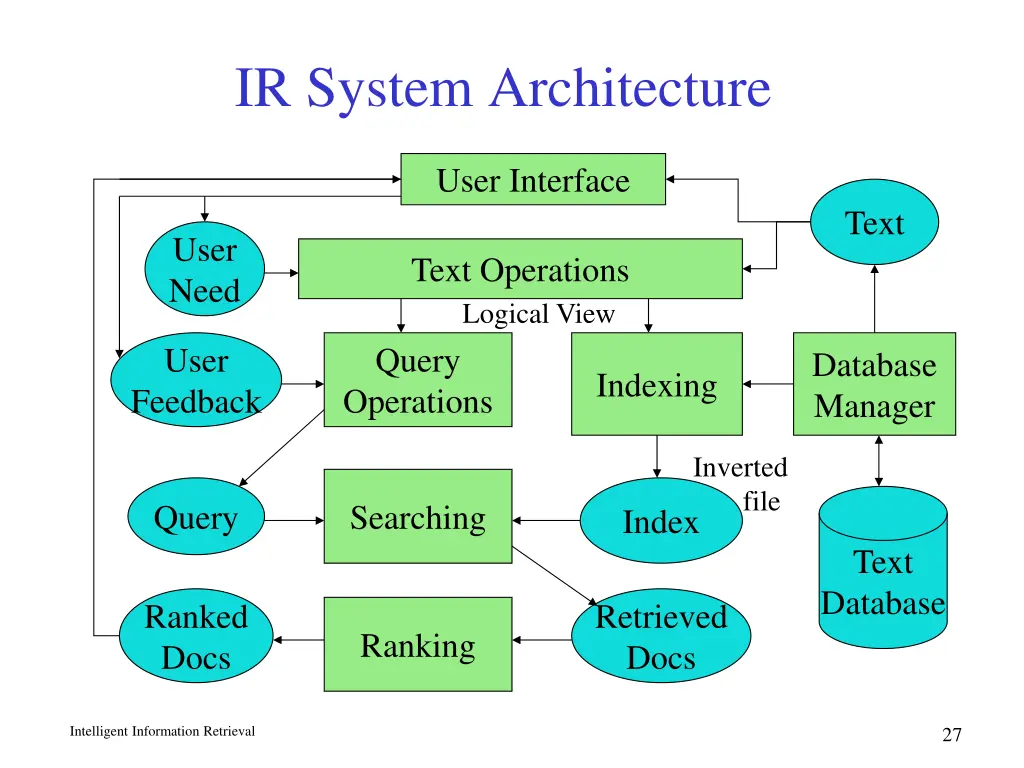
IR System Architecture User Interface Text User Need Text Operations Logical View User Query Operations Database Manager Indexing Feedback Inverted file Query Searching Index Text Database Ranked Docs Retrieved Docs Ranking Intelligent Information Retrieval 27
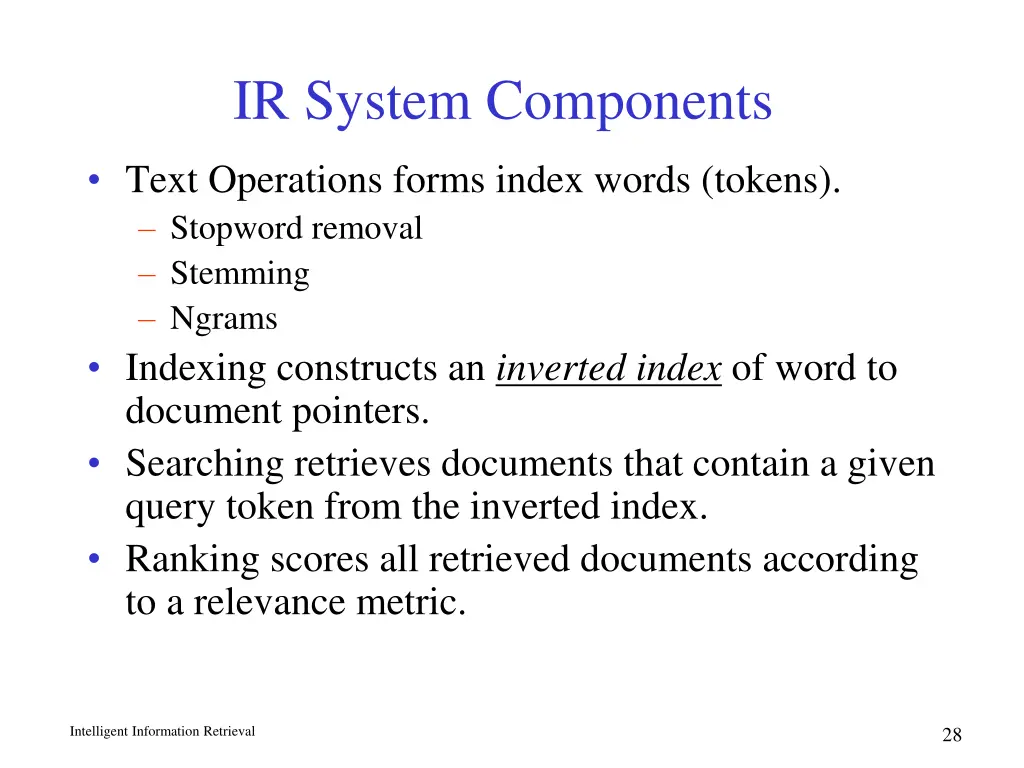
IR System Components Text Operations forms index words (tokens). Stopword removal Stemming Ngrams Indexing constructs an inverted index of word to document pointers. Searching retrieves documents that contain a given query token from the inverted index. Ranking scores all retrieved documents according to a relevance metric. Intelligent Information Retrieval 28
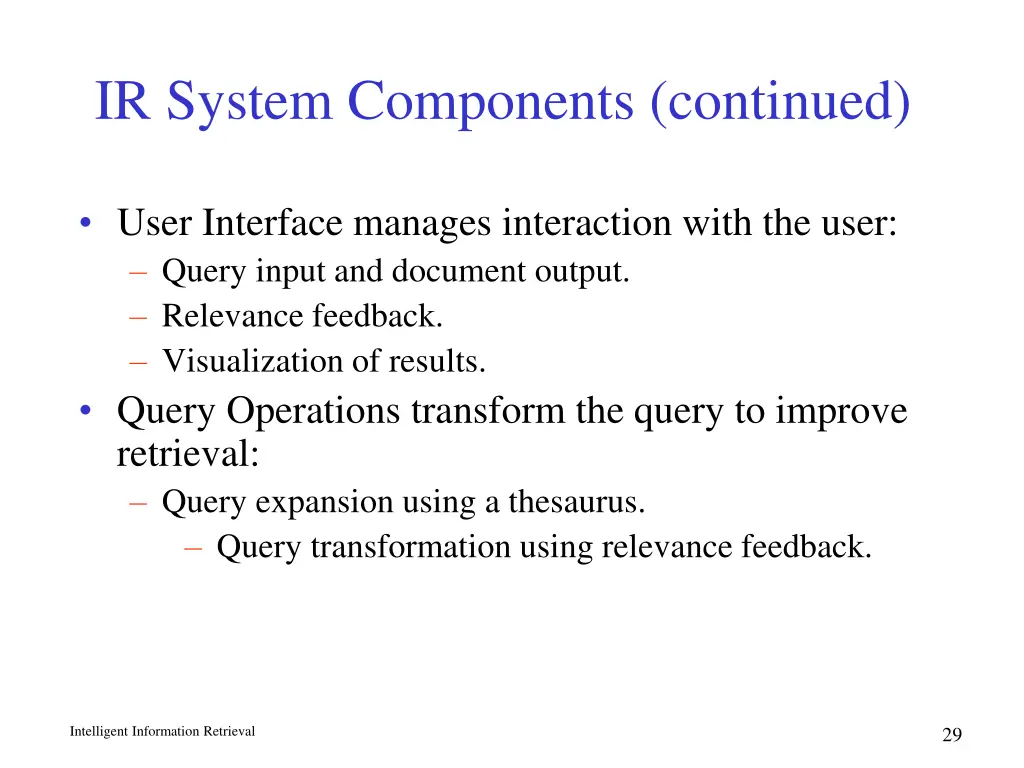
IR System Components (continued) User Interface manages interaction with the user: Query input and document output. Relevance feedback. Visualization of results. Query Operations transform the query to improve retrieval: Query expansion using a thesaurus. Query transformation using relevance feedback. Intelligent Information Retrieval 29
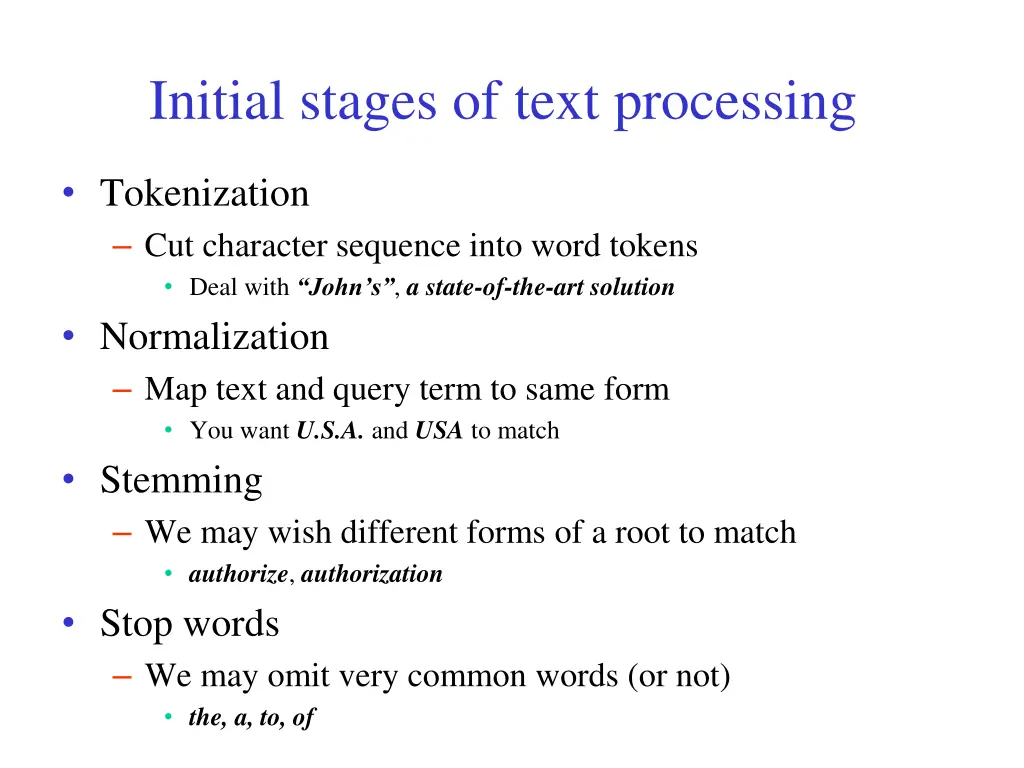
Initial stages of text processing Tokenization Cut character sequence into word tokens Deal with John s , a state-of-the-art solution Normalization Map text and query term to same form You want U.S.A. and USA to match Stemming We may wish different forms of a root to match authorize, authorization Stop words We may omit very common words (or not) the, a, to, of
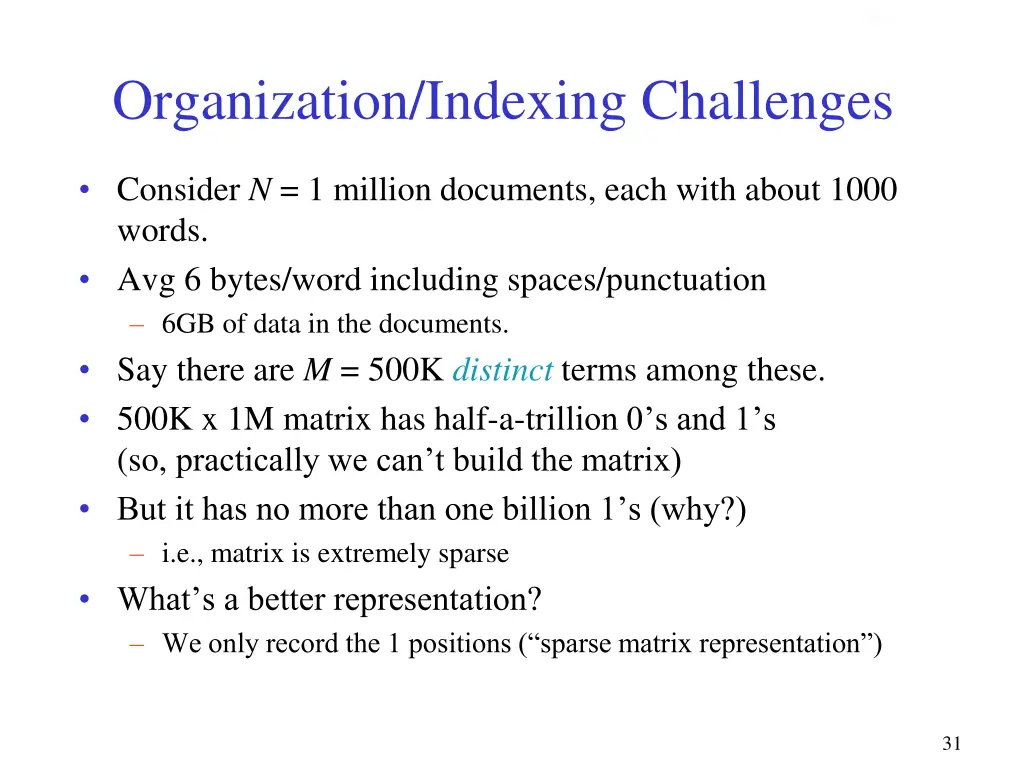
Sec. 1.1 Organization/Indexing Challenges Consider N = 1 million documents, each with about 1000 words. Avg 6 bytes/word including spaces/punctuation 6GB of data in the documents. Say there are M = 500K distinct terms among these. 500K x 1M matrix has half-a-trillion 0 s and 1 s (so, practically we can t build the matrix) But it has no more than one billion 1 s (why?) i.e., matrix is extremely sparse What s a better representation? We only record the 1 positions ( sparse matrix representation ) 31
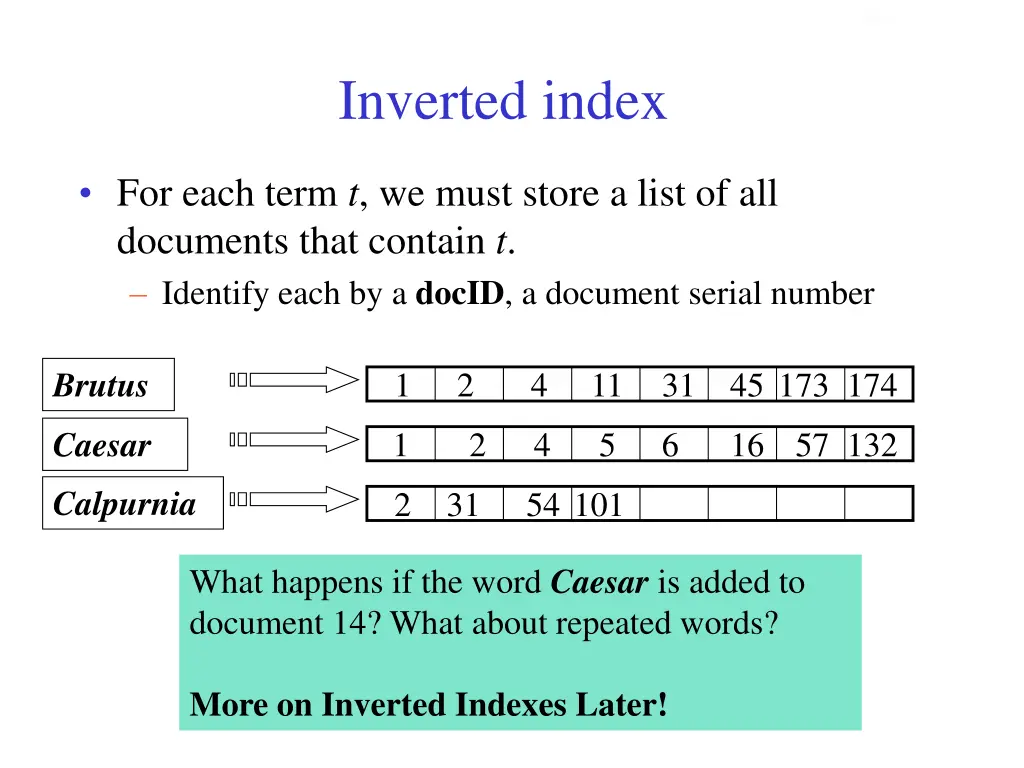
Sec. 1.2 Inverted index For each term t, we must store a list of all documents that contain t. Identify each by a docID, a document serial number Brutus 1 2 4 11 31 45 173 174 Caesar 1 2 4 5 6 16 57 132 Calpurnia 2 31 54 101 What happens if the word Caesar is added to document 14? What about repeated words? More on Inverted Indexes Later!
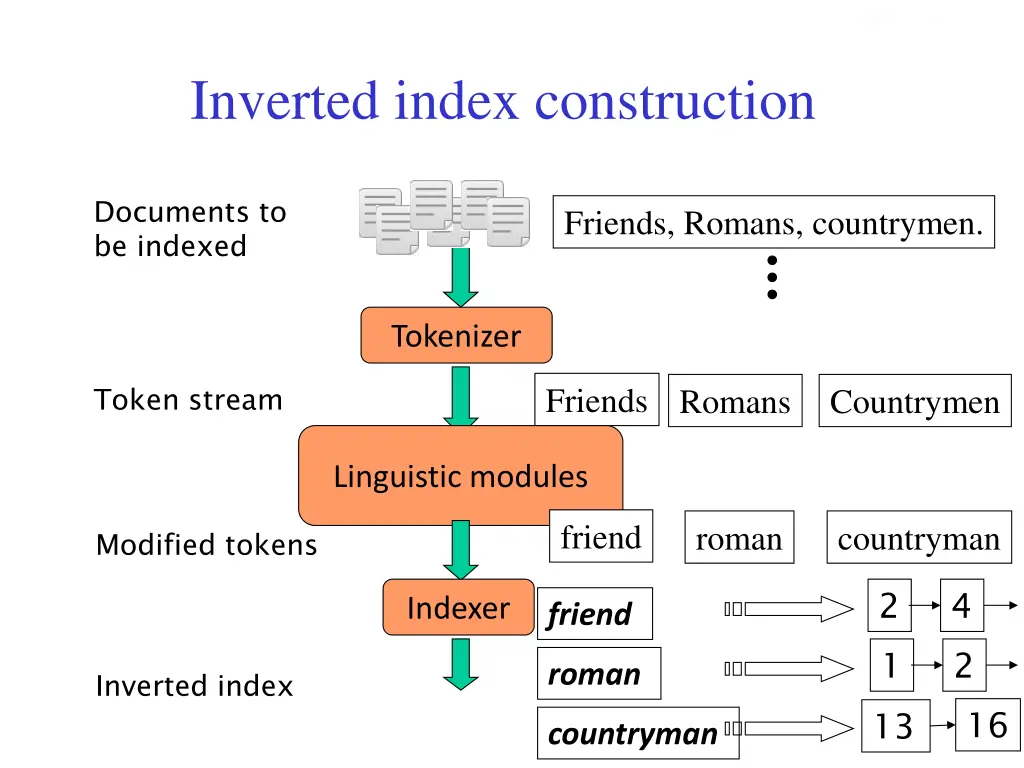
Sec. 1.2 Inverted index construction Documents to be indexed Friends, Romans, countrymen. Tokenizer Friends Romans Countrymen Token stream Linguistic modules friend roman countryman Modified tokens 2 4 Indexer friend 1 2 roman Inverted index 16 13 countryman
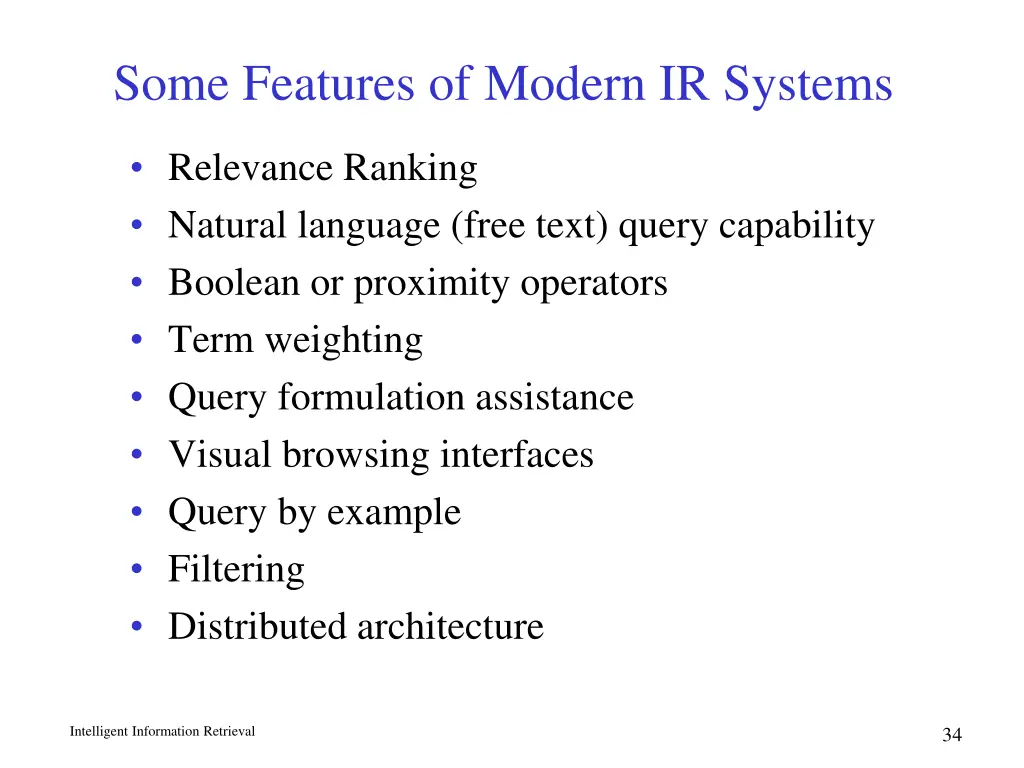
Some Features of Modern IR Systems Relevance Ranking Natural language (free text) query capability Boolean or proximity operators Term weighting Query formulation assistance Visual browsing interfaces Query by example Filtering Distributed architecture Intelligent Information Retrieval 34
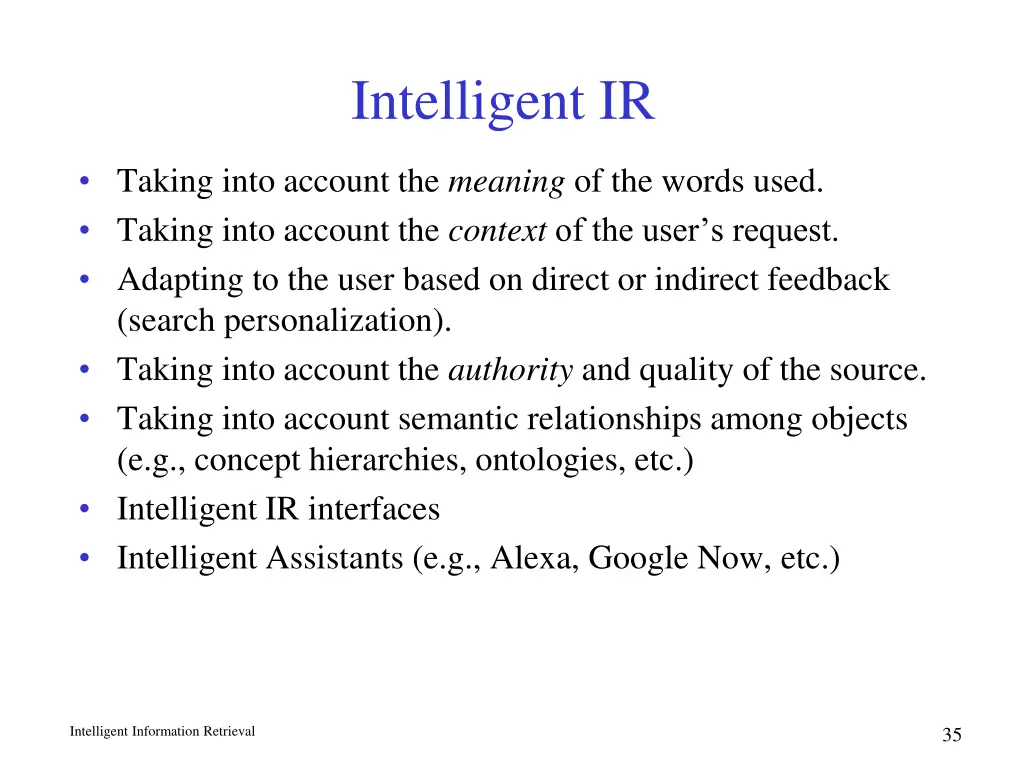
Intelligent IR Taking into account the meaning of the words used. Taking into account the context of the user s request. Adapting to the user based on direct or indirect feedback (search personalization). Taking into account the authority and quality of the source. Taking into account semantic relationships among objects (e.g., concept hierarchies, ontologies, etc.) Intelligent IR interfaces Intelligent Assistants (e.g., Alexa, Google Now, etc.) Intelligent Information Retrieval 35
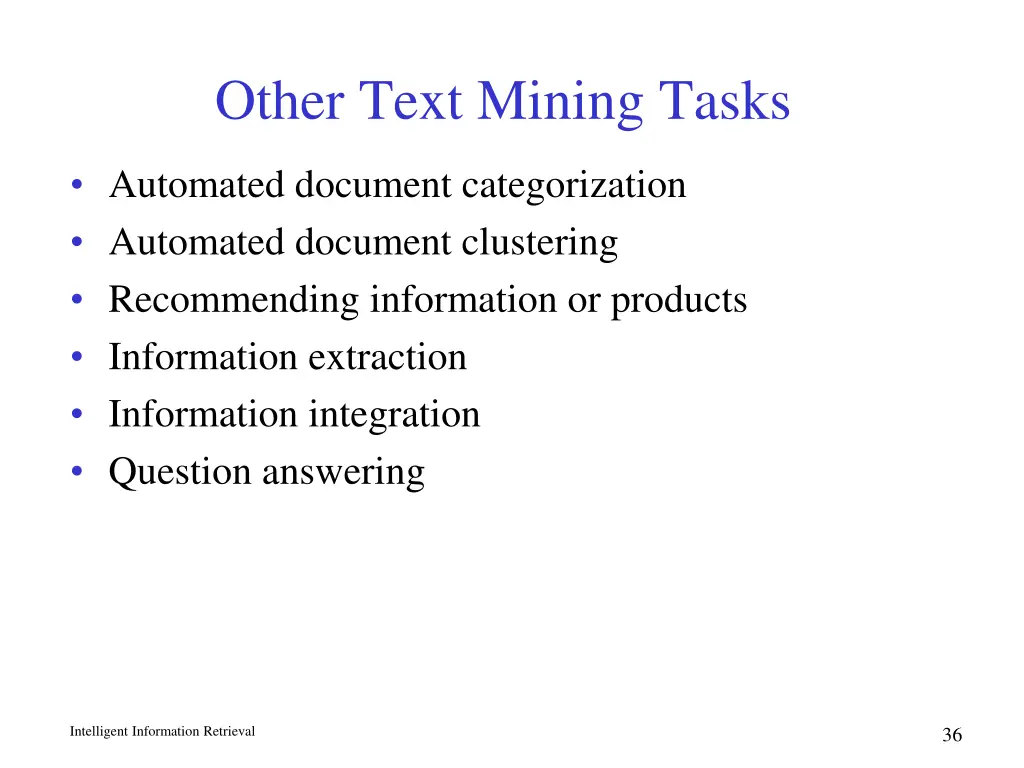
Other Text Mining Tasks Automated document categorization Automated document clustering Recommending information or products Information extraction Information integration Question answering Intelligent Information Retrieval 36
Overview of Information Retrieval and Organization CSC 575 Intelligent Information Retrieval
![❤[READ]❤ Deep Space Craft: An Overview of Interplanetary Flight (Springer Praxis](/thumb/21511/read-deep-space-craft-an-overview-of-interplanetary-flight-springer-praxis.jpg)