Understanding Leg Swelling Causes and Management
Explore the causes, evaluation, and management of leg swelling in a GP scenario involving Mrs. Jones, highlighting conditions like DVT and related complications. Learn about Virchow's triad, diagnostic investigations, DVT treatment, and preventive measures to reduce incidences in hospitals.

Download Presentation

Please find below an Image/Link to download the presentation.
The content on the website is provided AS IS for your information and personal use only. It may not be sold, licensed, or shared on other websites without obtaining consent from the author. If you encounter any issues during the download, it is possible that the publisher has removed the file from their server.
You are allowed to download the files provided on this website for personal or commercial use, subject to the condition that they are used lawfully. All files are the property of their respective owners.
The content on the website is provided AS IS for your information and personal use only. It may not be sold, licensed, or shared on other websites without obtaining consent from the author.
E N D
Presentation Transcript
Lady with swollen leg Sarah Perrott, Created 12/08/21 Tag Year: Year 1 Tag specialty: General Practice, Cardiovascular
Introduction 2030 - you are a GP trainee. Mrs Jones, a 65 year old lady, presents with a unilateral leg swelling of 2 days duration.
Question 1 Name some causes of leg swellings. Think about whether each would be bilateral (i.e. both legs) or unilateral (i.e. one leg).
Question 2 What other pieces of information might you want to know to help?
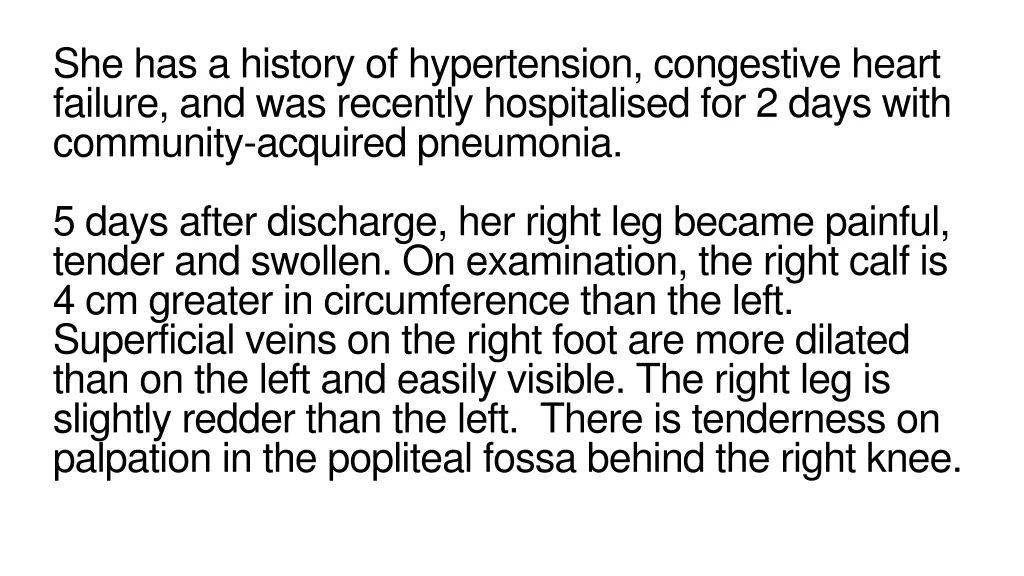
She has a history of hypertension, congestive heart failure, and was recently hospitalised for 2 days with community-acquired pneumonia. 5 days after discharge, her right leg became painful, tender and swollen. On examination, the right calf is 4 cm greater in circumference than the left. Superficial veins on the right foot are more dilated than on the left and easily visible. The right leg is slightly redder than the left. There is tenderness on palpation in the popliteal fossa behind the right knee.
Question 3 What is Virchow s triad and how may it relate to Mrs Jones?
You suspect Mrs Jones may have a DVT. You admit her to your local hospital s ambulatory clinic. Question 4 What investigations will they perform?
Compression ultrasound confirms DVT. Question 5 What is the mainstay of treatment for DVTs?
Mrs Jones becomes acutely breathless and complains of chest pain. Question 6 What complication is likely to have occurred?
Question 7 What actions are taken to limit the incidence of DVTs in hospital?
Useful resources Deep vein thrombosis NICE guidelines https://cks.nice.org.uk/topics/deep-vein-thrombosis/ Pulmonary embolism NICE guidelines https://cks.nice.org.uk/topics/pulmonary-embolism/management/suspected-pulmonary-embolism/