Understanding Linear Regression and Statistical Analysis in Gun Control Debate
Explore the nuances of linear regression in statistical analysis, while delving into the contentious issue of gun control in the US. Consider the impact of outliers and influential points in regression models, and ponder the interpretation of coefficients of determination.

Download Presentation

Please find below an Image/Link to download the presentation.
The content on the website is provided AS IS for your information and personal use only. It may not be sold, licensed, or shared on other websites without obtaining consent from the author. If you encounter any issues during the download, it is possible that the publisher has removed the file from their server.
You are allowed to download the files provided on this website for personal or commercial use, subject to the condition that they are used lawfully. All files are the property of their respective owners.
The content on the website is provided AS IS for your information and personal use only. It may not be sold, licensed, or shared on other websites without obtaining consent from the author.
E N D
Presentation Transcript
Linear Regression AP Statistics Chapter 8 & 9 Day 3
Read the two articles. Free Write: What is your personal opinion about the current state of gun control in the US? What changes, if any, would you make? Why? Are assault weapons to blame for the recent mass killings? How would you conduct a study to determine the relationship?
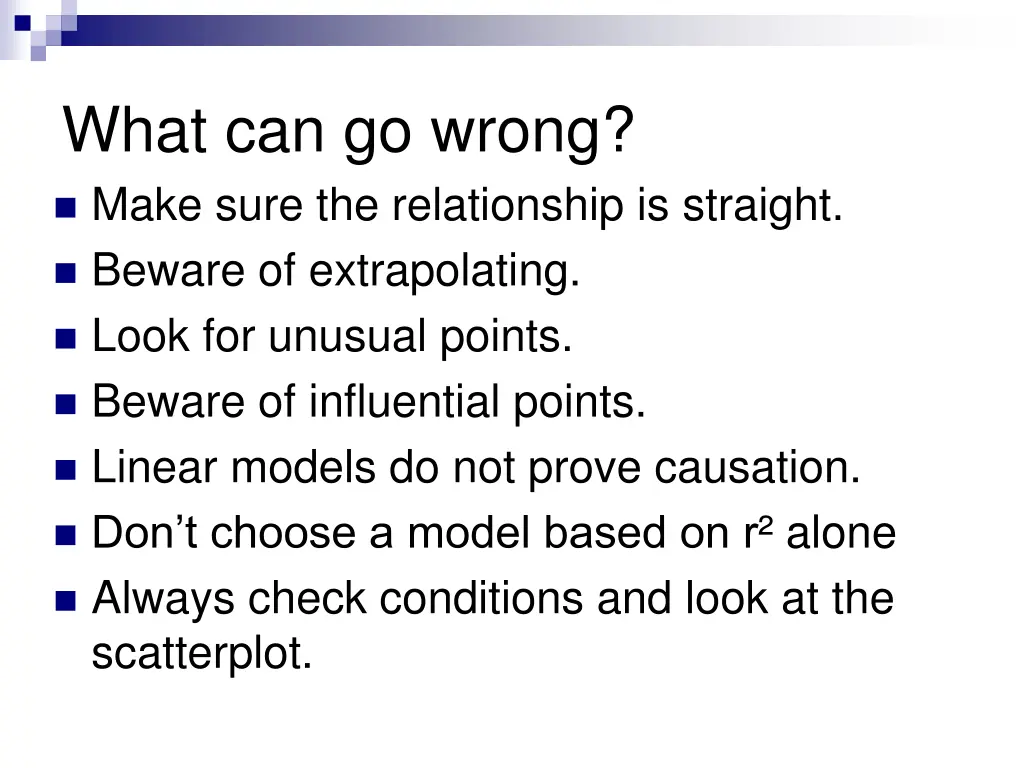
What can go wrong? Make sure the relationship is straight. Beware of extrapolating. Look for unusual points. Beware of influential points. Linear models do not prove causation. Don t choose a model based on r alone Always check conditions and look at the scatterplot.
Vocabulary Extrapolation Outlier Influential point Lurking variables Page 199 (52)
Which of the following statements about outliers is true? I. Removing an outlier from a data set can have a major effect on the regression line. II. If you calculated the residual between the outlier and a regression line based on the rest of the data, it would probably be large. III. You will typically find an outlier horizontally distant from the rest of the data along the x- axis. 1.
2. Which of the following statements about influential points is true? I. Removing an influential point from a data set can have a major effect on the regression line. II. If you calculate the residual between the influential point and a regression line based on the rest of the data, it will probably be large. III. You will typically find an influential point horizontally distant from the rest of the data along the x-axis.
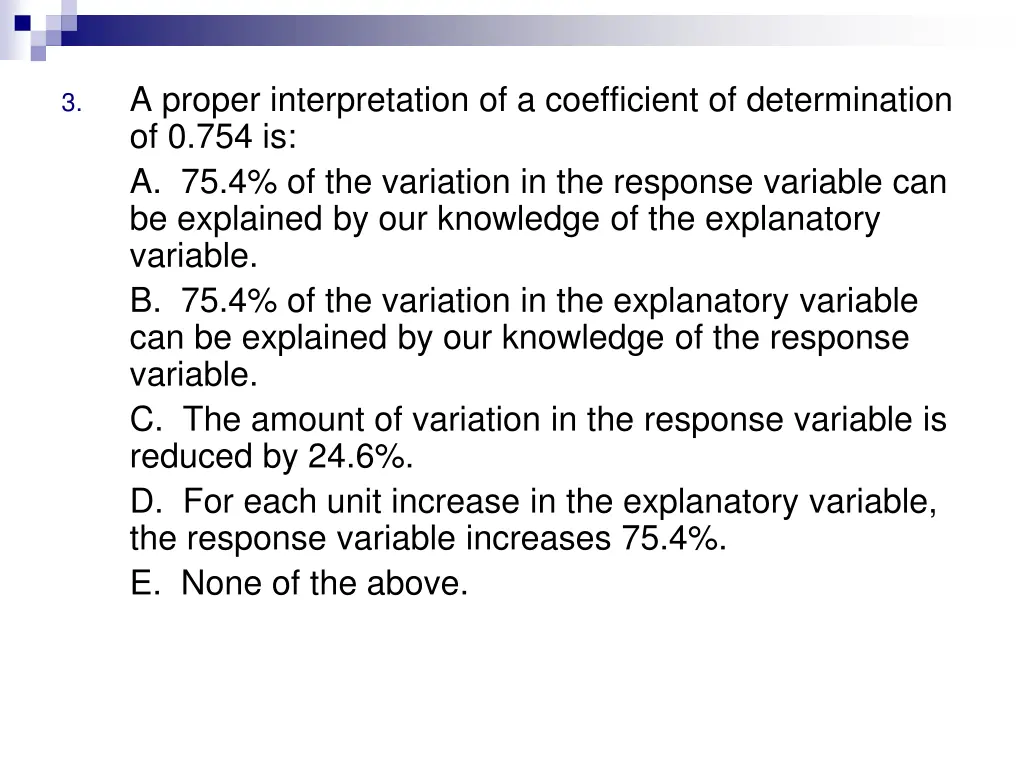
A proper interpretation of a coefficient of determination of 0.754 is: A. 75.4% of the variation in the response variable can be explained by our knowledge of the explanatory variable. B. 75.4% of the variation in the explanatory variable can be explained by our knowledge of the response variable. C. The amount of variation in the response variable is reduced by 24.6%. D. For each unit increase in the explanatory variable, the response variable increases 75.4%. E. None of the above. 3.
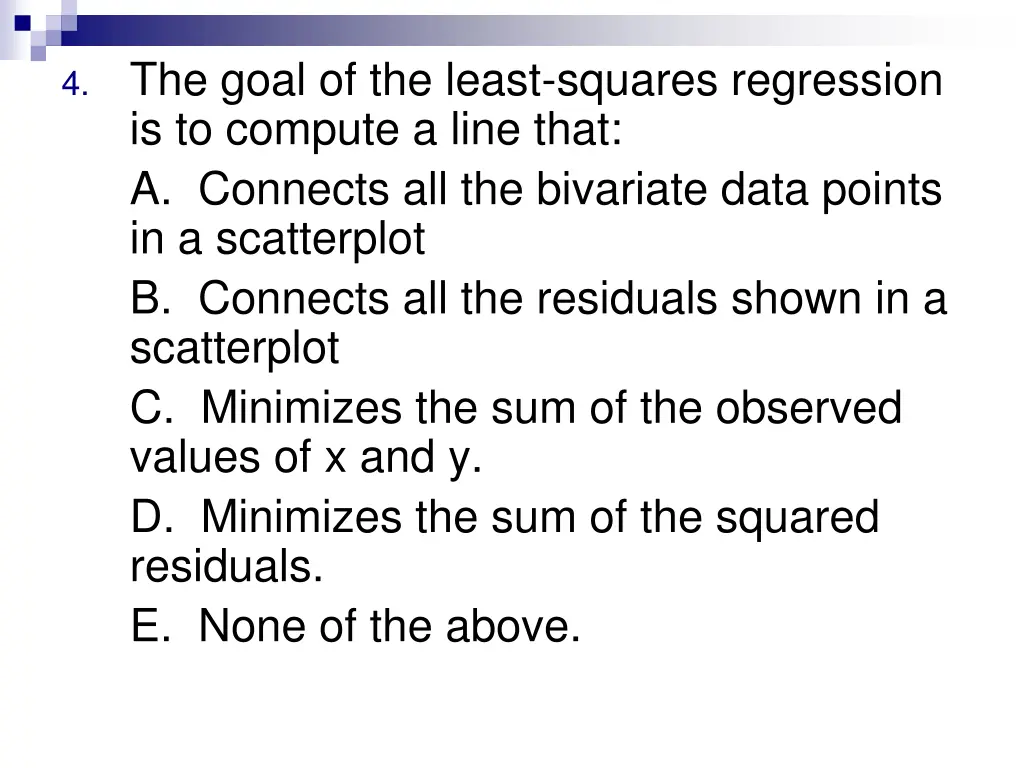
4. The goal of the least-squares regression is to compute a line that: A. Connects all the bivariate data points in a scatterplot B. Connects all the residuals shown in a scatterplot C. Minimizes the sum of the observed values of x and y. D. Minimizes the sum of the squared residuals. E. None of the above.
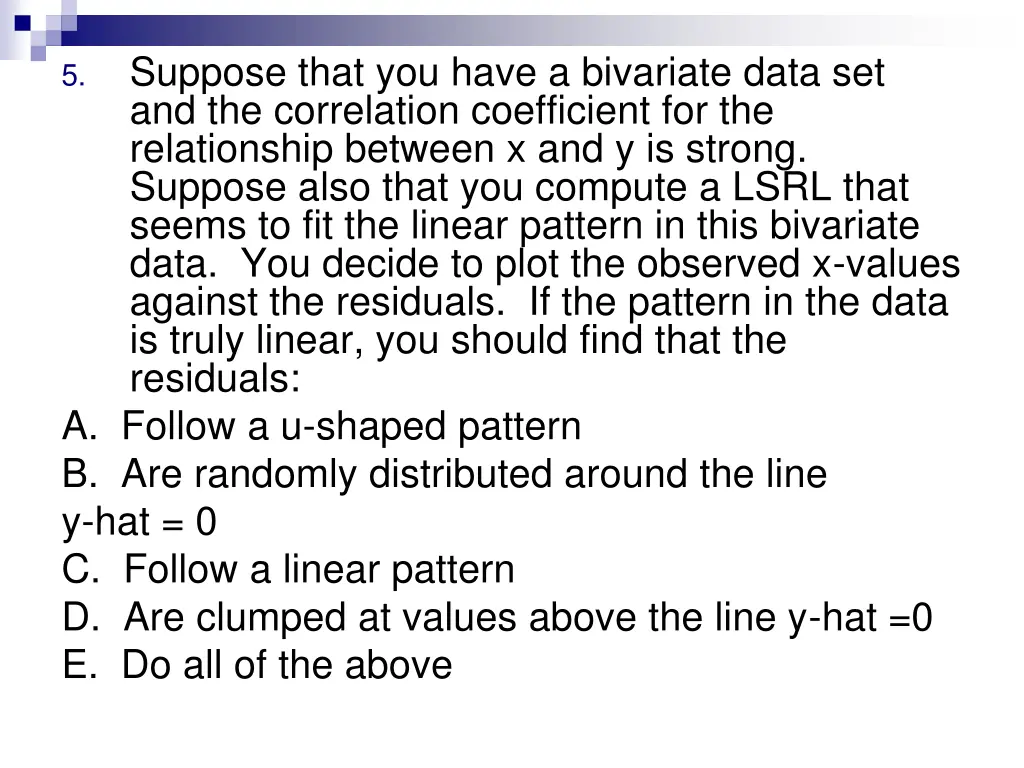
Suppose that you have a bivariate data set and the correlation coefficient for the relationship between x and y is strong. Suppose also that you compute a LSRL that seems to fit the linear pattern in this bivariate data. You decide to plot the observed x-values against the residuals. If the pattern in the data is truly linear, you should find that the residuals: A. Follow a u-shaped pattern B. Are randomly distributed around the line y-hat = 0 C. Follow a linear pattern D. Are clumped at values above the line y-hat =0 E. Do all of the above 5.
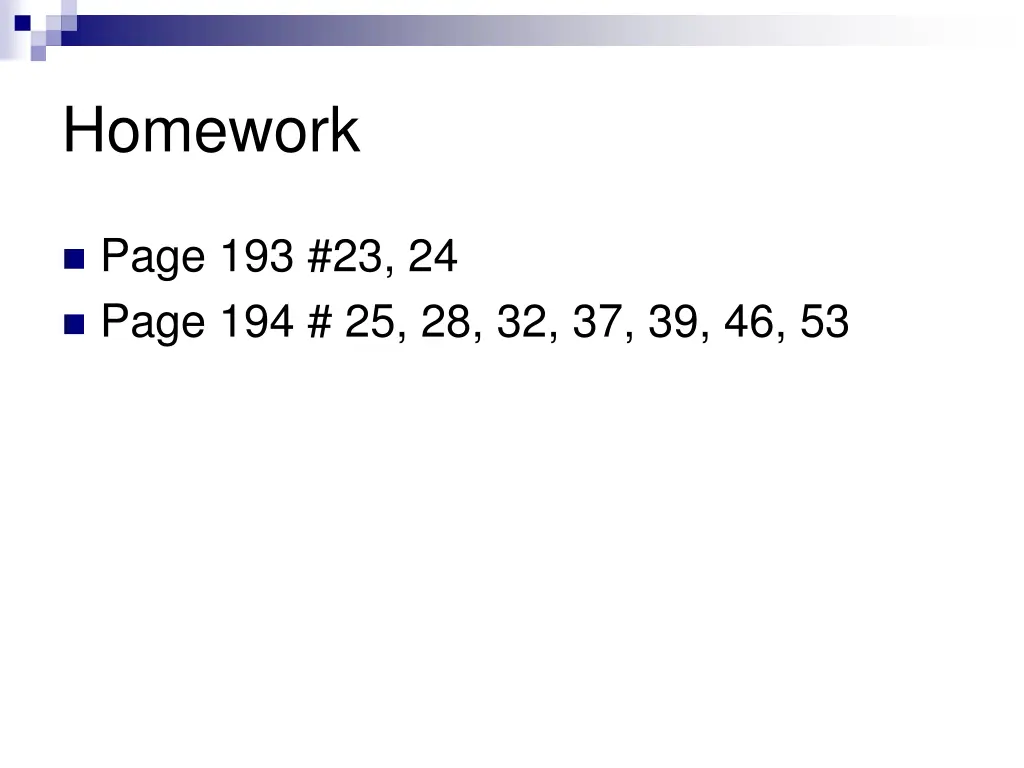
Homework Page 193 #23, 24 Page 194 # 25, 28, 32, 37, 39, 46, 53