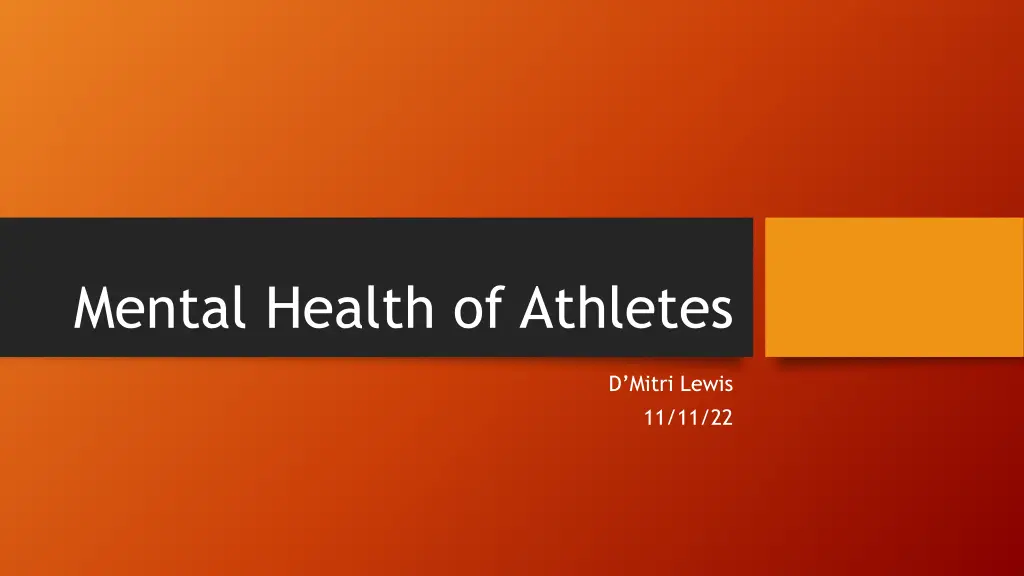
Athletes face immense pressure and significant highs and lows, which can impact their mental health. Recognizing signs of mental health issues, such as performance decline, depression, and the reluctance to seek help, is crucial for their well-being. Learn more about the importance of mental toughness and support in the world of sports.
Please find below an Image/Link to download the presentation.
The content on the website is provided AS IS for your information and personal use only. It may not be sold, licensed, or shared on other websites without obtaining consent from the author. If you encounter any issues during the download, it is possible that the publisher has removed the file from their server.
You are allowed to download the files provided on this website for personal or commercial use, subject to the condition that they are used lawfully. All files are the property of their respective owners.
The content on the website is provided AS IS for your information and personal use only. It may not be sold, licensed, or shared on other websites without obtaining consent from the author.
Mental Toughness It takes a lot more than just raw talent to be an athlete. Whether you are just starting off or are going pro, managing the pressure of competing is something all athletes in all sports face.
For athletes, the swings from their highs and lows seem bigger than in other scenarios the satisfaction and joy when you win versus the heartbreak and disappointment if you lose. As a result, mental exhaustion and other mental health issues can become more prevalent, especially at higher levels of competition. Mental Toughness
Mental Toughness When they need it, many athletes won't actively seek care for their mental health. Instead, someone can notice that "something seems strange" and encourage them to talk about it, such as a coach or parent.
Mental Toughness The following are indications that an athlete might need to have their mental health evaluated: sleeping problems, irritability, changes in eating, low energy etc.
Athletes with mental illnesses see a gradual decline in performance over time or changes in both competition and training. Some athletes, particularly in team sports, exhibit increased aggression Performance Decline
Performance Decline They may seem to miss more training sessions than other people. If they're trying to hide the issue, they might see doctors more frequently, either at work or elsewhere. Injuries or illnesses might also result from fatigue.
Athletes who are injured or going through rehabilitation are more likely to experience depression. This could potentially result in an even longer recovery period. Depression makes athletes less motivated to workout Depression
Depression It's unlikely that the depressed athlete will be enthusiastic. Additionally, they might be less focused on the workout and/or socially withdraw. They might communicate less about what they're doing, and others might even give up the sport altogether.
Depression The athlete has periods of increased isolation and withdrawal. Even when they are around their friends, family, or fellow athletes, they may still feel alone and quiet. Athletes that are depressed occasionally get angrier or more violent.
Depression Depression can also be indicated by an increased appearance of fatigue and diminished concentration. Sometimes the athlete increases their intake on their own, which results in weight loss or gain. Even when they are around their friends, family, or fellow athletes, they may still feel alone and quiet. Athletes that are depressed occasionally get angrier or more violent.
Depression In rare instances, the athlete may cry more, act and seem flat, or take on a completely different persona. In some instances, the person may even harm themselves while dressing to hide it, or they may even broach the subject of death or dying.
Depression can also be indicated by an increased appearance of fatigue and diminished concentration. Sometimes the athlete increases their intake on their own, which results in weight loss or gain. Depression
Depression Depression can make it difficult to remember details or focus during meetings, activities, performances, and daily activities. The athlete can also find it challenging to communicate or concentrate on what must be done.
Drug Use The usage of drugs may also be an indication of depression in the athlete. Although anti-doping organizations typically catch this, it's possible that the athlete wasn't tested while the substance was in their system.
Mental State As the stakes climb and competitions take on a greater sense of significance, these distractions may become more pronounced and the pressure to succeed may increase. An athlete's performance or score may occasionally just suffer as a result of a shift in their emotional state.
Mental State Taking a baseball pitcher who suddenly loses his ability to throw or a golfer who has the "yips" when putting as examples. When a gymnast is flipping through the air or a downhill skier is swooshing down a slope, for example, a preoccupied mind could be hazardous.
Mental State The need to focus on the mental health of athletes of all ages is very important. For many years, the best advice for dealing with mental health problems could be summed up in just four words, Just push through it .
Mental State Some athletes said it is still challenging to speak openly about their challenges, despite an increase in prominent figures and celebrities doing so. They don t want their image to be tarnished or to be looked at as weak
Mental State "I still think the stigma's pretty strong," said Solomon Thomas of the Las Vegas Raiders, who said he began to seek help after the death of his sister. "That's the one reason I didn't come out and start speaking right away about my depression, about my journey, and about my sister's journey, as well. I was afraid of, like, what fans would think, if teammates would think I'm soft."
Mental State DJ Chark, a wide receiver for the Detroit Lions, said that he first started to struggle with anxiety as a student at Louisiana State University, where he would "always be nervous," whether it was football-related or not. However, when he entered the NFL, he worried about how his struggles would be perceived.
Mental State It's critical for athletes to be able to be "honest" with their teammates, according to Minnesota Vikings player Adam Thielen, whose runs a nonprofit organization, the Theilen Foundation, raises awareness of youth mental health.
CTE Being an athlete especially in contact sports, injury is a lot more common. Football for example, getting hit repeatedly and sometimes even in the head can really shake you up. Brain disorders are a big thing in the NFL. There is a common diagnosis in the football community called, Chronic Traumatic Encephalopathy (CTE). Football players, boxers, or anyone who gets repeated blows to the head can get this condition, which kills brain cells. CTE can only be found if the person being tested is no longer living.
CTE Players diagnosed with CTE : Aaron Hernandez Demaryius Thomas Bubba Smith Junior Seau And many more .
CTE Wide receiver Antonio Brown, an All-Pro in the NFL, has exhibited unpredictable conduct for years, which has led many to worry about his mental health. The Tampa Bay Buccaneers game on Sunday saw Brown engage in more bizarre public conduct. He removed his shoulder pads and jersey after a disagreement with the Bucs coaches on the sidelines, flung his shirt and gloves into the crowd, did jumping jacks for the fans in the stands, and then left the field.
CTE He's no longer a part of the Buccaneers and hasn t suited up for an NFL game ever since. Many individuals are concerned and speculating that Antonio Brown may be showing CTE symptoms.
Athletes Who Opened up John wall Demar DeRozan Simone Biles Michael Phelps Ronda Rousey And more ..
Student Athletes Student-athletes frequently experience a great deal of strain since they must successfully juggle their academic obligations with their sporting activities. Student athletes may face more stress since they are given less time than other students to perform the more demanding tasks that have been put on them. Student athletes may have a higher risk of developing mental health issues for a variety of reasons, including, intense commitment to sports coupled with pressure to meet academic deadlines.
Student Athletes Along with the estimate that between 10 and 20% of student- athletes experience depression, it was also mentioned that student-athletes are more likely than their non-athlete counterparts to face mental health issues like drug addiction (especially alcohol) and social anxiety.
Conclusion Even while it could sound frightening, there are simple actions you can take to improve your mental health. Speak to a member of your family, your team, your coach, or the support staff; anyone you feel most at ease telling what's going on.