Understanding Operant Conditioning in Criminal Behavior
Explore how operant conditioning theory, developed by Skinner, can be used to explain criminal behavior. Learn how reinforcement and punishment play a role in shaping criminal actions, and understand the concepts of positive and negative reinforcement in relation to criminal behavior.

Download Presentation

Please find below an Image/Link to download the presentation.
The content on the website is provided AS IS for your information and personal use only. It may not be sold, licensed, or shared on other websites without obtaining consent from the author. If you encounter any issues during the download, it is possible that the publisher has removed the file from their server.
You are allowed to download the files provided on this website for personal or commercial use, subject to the condition that they are used lawfully. All files are the property of their respective owners.
The content on the website is provided AS IS for your information and personal use only. It may not be sold, licensed, or shared on other websites without obtaining consent from the author.
E N D
Presentation Transcript
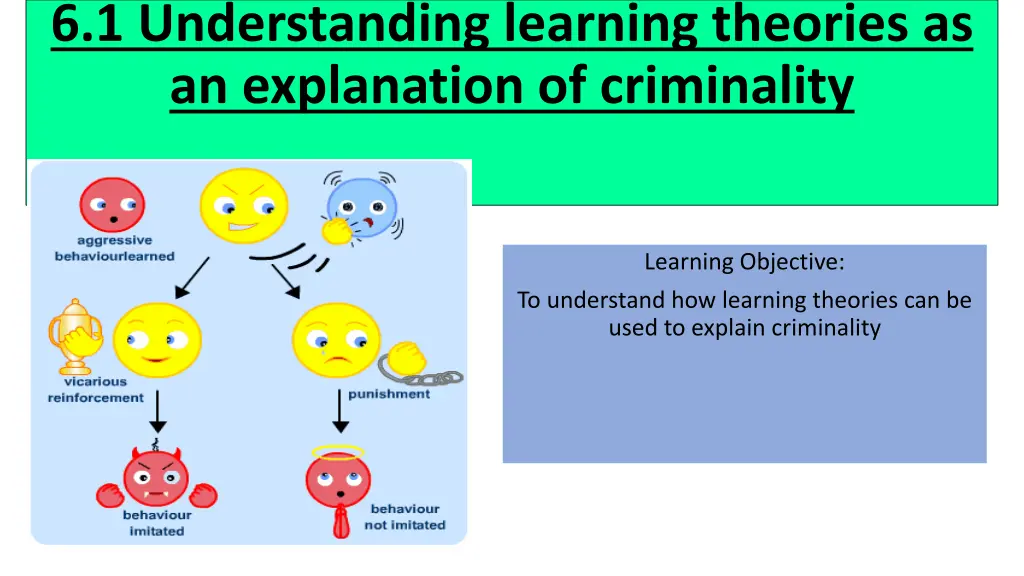
6.1 Understanding learning theories as an explanation of criminality Learning Objective: To understand how learning theories can be used to explain criminality
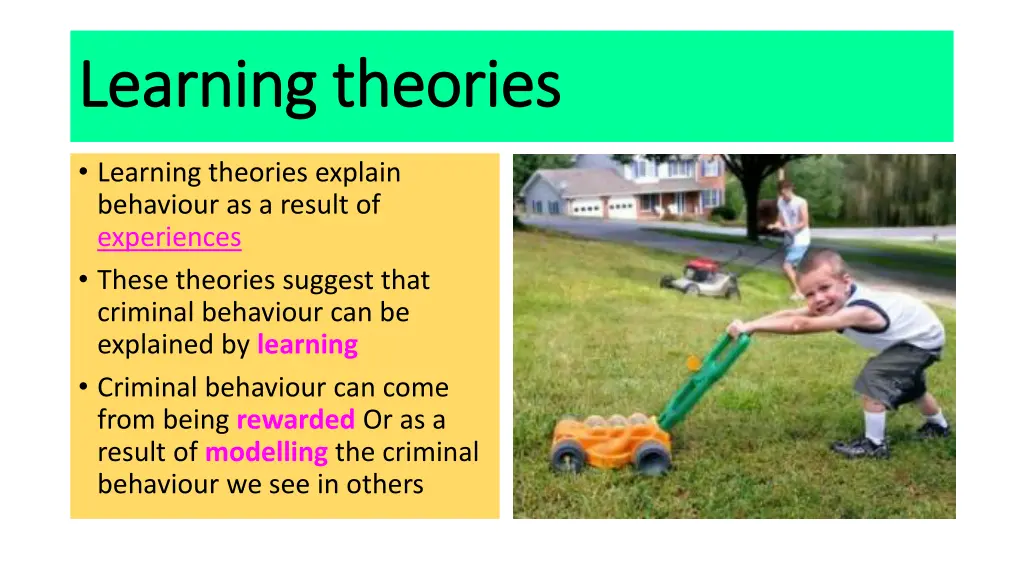
Learning theories Learning theories Learning theories explain behaviour as a result of experiences These theories suggest that criminal behaviour can be explained by learning Criminal behaviour can come from being rewarded Or as a result of modelling the criminal behaviour we see in others
Operant Conditioning as an explanation of criminality + Reinforcement We get a reward for behaviour We are then likely to repeat it Criminals who receive praise, respect or financial benefit from their crimes are likely to commit those crimes again - Reinforcement When our behaviour allows us to avoid an unpleasant experience we are likely to repeat it If stealing avoids starving, being able to buy drugs to avoid withdrawal or even if killing someone avoids abuse this is negative reinforcement Skinner (1948) developed a theory of learning called operant conditioning. He believed that behaviours are likely to be repeated if they are reinforced and extinguished or not repeated if they are punished. Carry out research, and use pages 168-169 of the book
Operant Conditioning as an explanation of criminality Skinner (1948) developed a theory of learning called operant conditioning. He believed that behaviours are likely to be repeated if they are reinforced and extinguished or not repeated if they are punished. + Punishment We receive a negative consequence for (something we find unpleasant) for a behaviour such as being told off, getting a DT or in the case of criminal behaviour, a prison sentence or a fine. - Punishment When something pleasant is taken from us as a consequence for undesired behaviour, such as removing a child from a fun activity because of bad behaviour, stopping a teenager going to prom because of poor school behaviour or in the case of criminal behaviour. A gang member being removed from the group for not carrying out a gang behaviour Carry out research, and use pages 168-169 of the book
Operant conditioning explains that there are two types of positive reinforcers that can be used as consequences of behaviours in order to strengthen behaviour Primary reinforcers these satisfy a basic biological need such as food or water. A parent may reward a child with food treats For behaving well. Although it is unlikely That most criminals commit crimes for primary reinforcers, people who are in extreme poverty or starving may resort to committing a crime in order to meet a basic need. Secondary reinforcers these are common reinforcers, such as school grades and tokens. These reinforcers often have no survival Value, but we have learned to associate them with primary reinforcers. A good example is a credit card as the card itself as no intrinsic value but can be used to buy goods, which are rewarding or satisfy a basic need such as food and warmth.
Exam Q: A school tutor group is collecting money for charity. The collection box is kept at the back of the room. One day, Richard notices that the tutor room is empty and he goes in and takes a pound coin from the collection box. Each day, Richard returns and takes another pound coin. Explain what type of reinforcer is shown in this example (2 marks) It is likely to be a secondary reinforcer The money has no survival value and Richard takes a small amount each day Richard may use the stolen money to buy food or other small items but the money itself is a secondary reinforcer
Two siblings enjoy watching their favourite television programmes. They begin to fight over the remote control, so their parents send them to their rooms. Explain what kind of reinforcement is shown in this example (2 marks) This is actually negative punishment Because the siblings have been punished by having the activity they want to do (watching their favourite TV programmes), taken away from them.
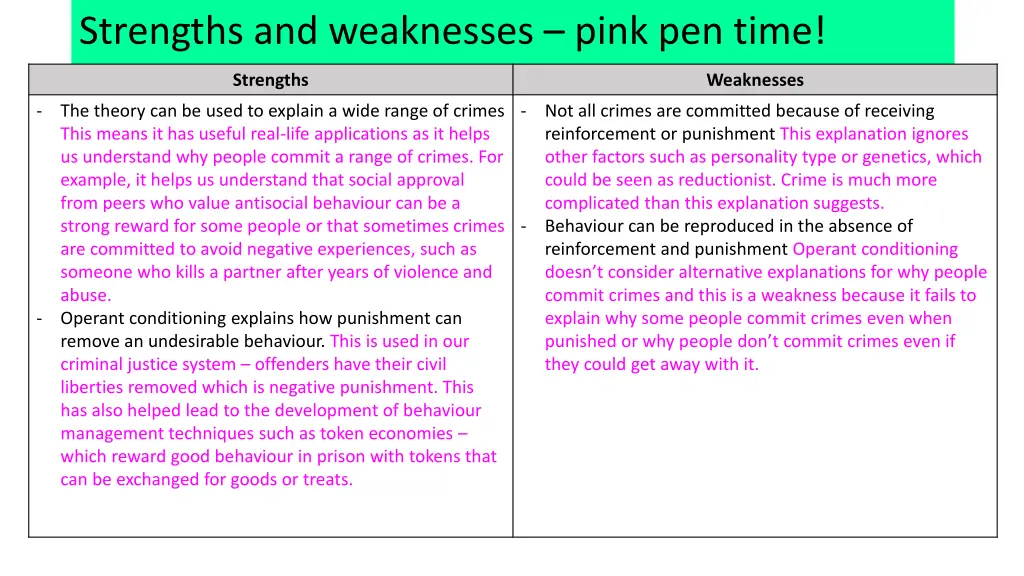
Strengths and weaknesses pink pen time! Strengths Weaknesses - The theory can be used to explain a wide range of crimes This means it has useful real-life applications as it helps us understand why people commit a range of crimes. For example, it helps us understand that social approval from peers who value antisocial behaviour can be a strong reward for some people or that sometimes crimes are committed to avoid negative experiences, such as someone who kills a partner after years of violence and abuse. Operant conditioning explains how punishment can remove an undesirable behaviour. This is used in our criminal justice system offenders have their civil liberties removed which is negative punishment. This has also helped lead to the development of behaviour management techniques such as token economies which reward good behaviour in prison with tokens that can be exchanged for goods or treats. - Not all crimes are committed because of receiving reinforcement or punishment This explanation ignores other factors such as personality type or genetics, which could be seen as reductionist. Crime is much more complicated than this explanation suggests. Behaviour can be reproduced in the absence of reinforcement and punishment Operant conditioning doesn t consider alternative explanations for why people commit crimes and this is a weakness because it fails to explain why some people commit crimes even when punished or why people don t commit crimes even if they could get away with it. - -
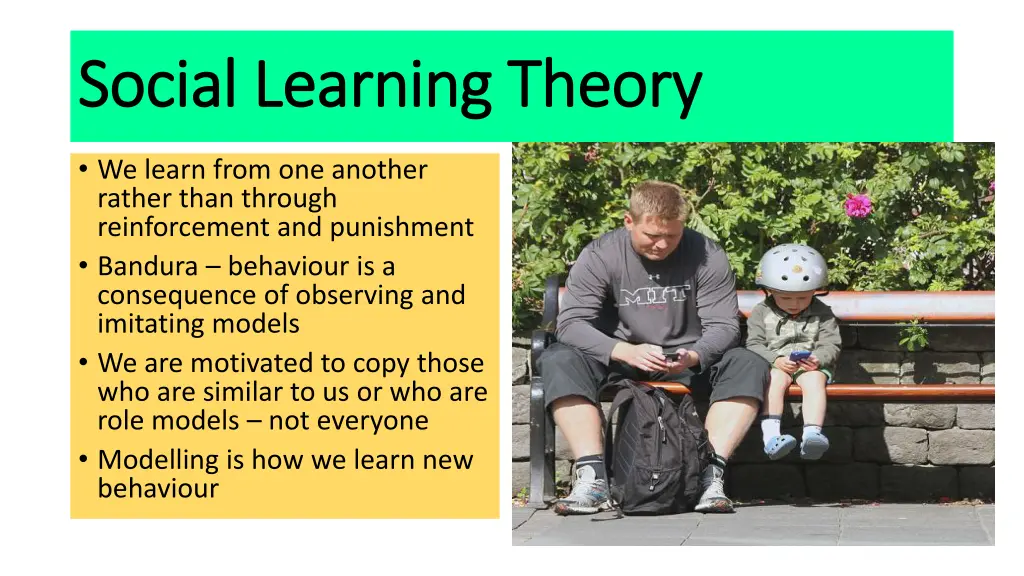
Social Learning Theory Social Learning Theory We learn from one another rather than through reinforcement and punishment Bandura behaviour is a consequence of observing and imitating models We are motivated to copy those who are similar to us or who are role models not everyone Modelling is how we learn new behaviour
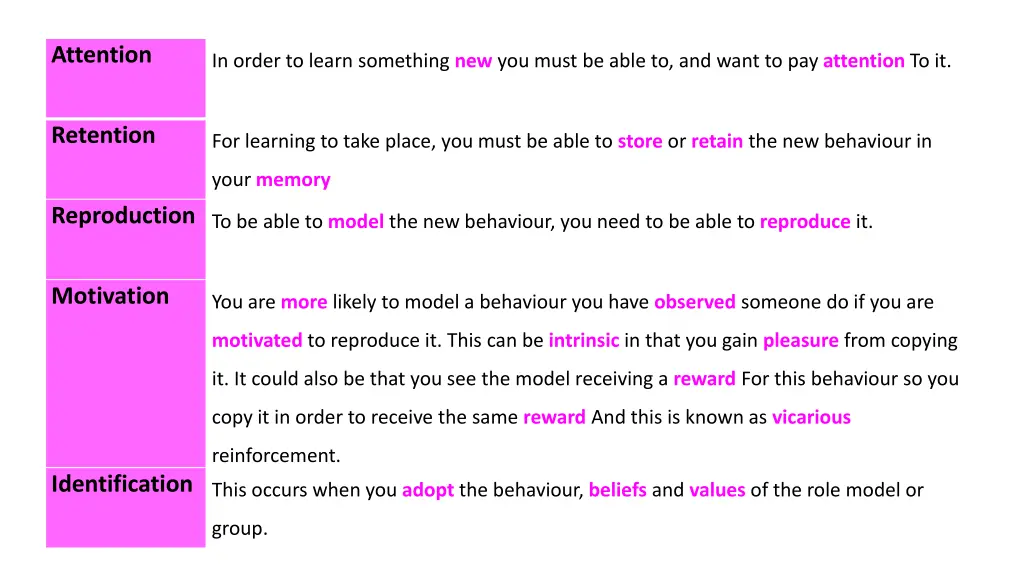
Attention In order to learn something new you must be able to, and want to pay attention To it. Retention For learning to take place, you must be able to store or retain the new behaviour in your memory Reproduction To be able to model the new behaviour, you need to be able to reproduce it. Motivation You are more likely to model a behaviour you have observed someone do if you are motivated to reproduce it. This can be intrinsic in that you gain pleasure from copying it. It could also be that you see the model receiving a reward For this behaviour so you copy it in order to receive the same reward And this is known as vicarious reinforcement. Identification This occurs when you adopt the behaviour, beliefs and values of the role model or group.
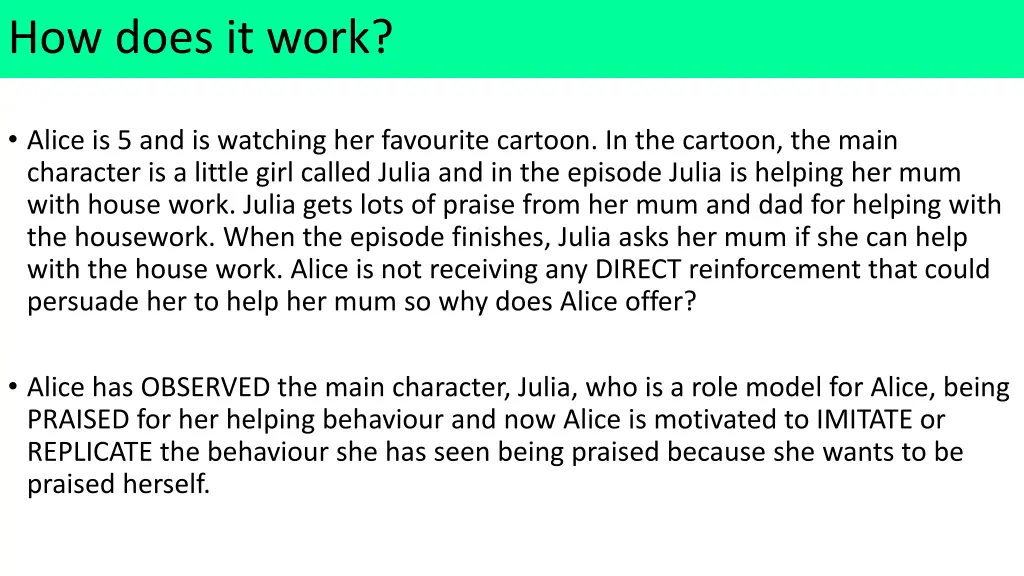
How does it work? Alice is 5 and is watching her favourite cartoon. In the cartoon, the main character is a little girl called Julia and in the episode Julia is helping her mum with house work. Julia gets lots of praise from her mum and dad for helping with the housework. When the episode finishes, Julia asks her mum if she can help with the house work. Alice is not receiving any DIRECT reinforcement that could persuade her to help her mum so why does Alice offer? Alice has OBSERVED the main character, Julia, who is a role model for Alice, being PRAISED for her helping behaviour and now Alice is motivated to IMITATE or REPLICATE the behaviour she has seen being praised because she wants to be praised herself.
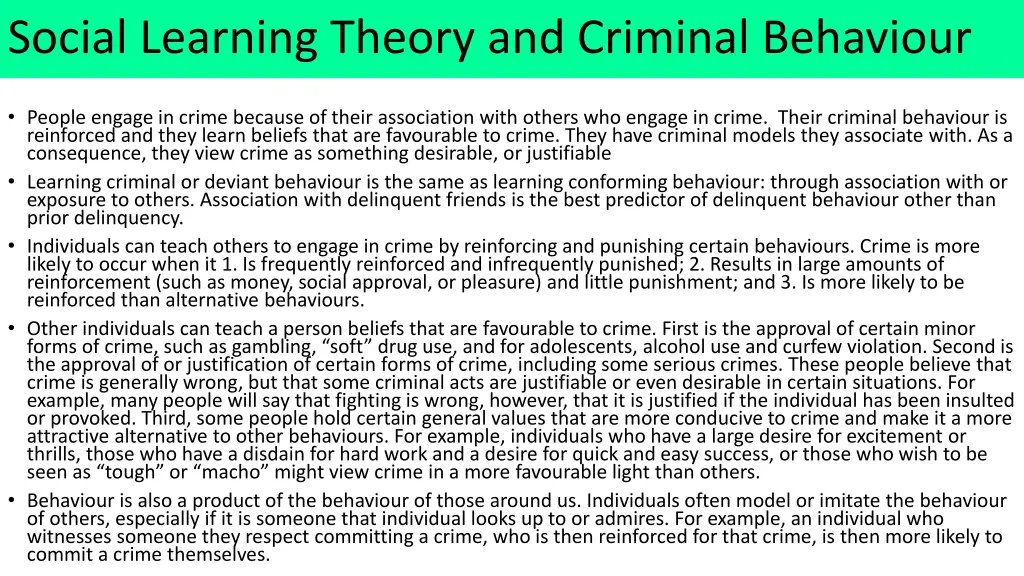
Social Learning Theory and Criminal Behaviour People engage in crime because of their association with others who engage in crime. Their criminal behaviour is reinforced and they learn beliefs that are favourable to crime. They have criminal models they associate with. As a consequence, they view crime as something desirable, or justifiable Learning criminal or deviant behaviour is the same as learning conforming behaviour: through association with or exposure to others. Association with delinquent friends is the best predictor of delinquent behaviour other than prior delinquency. Individuals can teach others to engage in crime by reinforcing and punishing certain behaviours. Crime is more likely to occur when it 1. Is frequently reinforced and infrequently punished; 2. Results in large amounts of reinforcement (such as money, social approval, or pleasure) and little punishment; and 3. Is more likely to be reinforced than alternative behaviours. Other individuals can teach a person beliefs that are favourable to crime. First is the approval of certain minor forms of crime, such as gambling, soft drug use, and for adolescents, alcohol use and curfew violation. Second is the approval of or justification of certain forms of crime, including some serious crimes. These people believe that crime is generally wrong, but that some criminal acts are justifiable or even desirable in certain situations. For example, many people will say that fighting is wrong, however, that it is justified if the individual has been insulted or provoked. Third, some people hold certain general values that are more conducive to crime and make it a more attractive alternative to other behaviours. For example, individuals who have a large desire for excitement or thrills, those who have a disdain for hard work and a desire for quick and easy success, or those who wish to be seen as tough or macho might view crime in a more favourable light than others. Behaviour is also a product of the behaviour of those around us. Individuals often model or imitate the behaviour of others, especially if it is someone that individual looks up to or admires. For example, an individual who witnesses someone they respect committing a crime, who is then reinforced for that crime, is then more likely to commit a crime themselves.
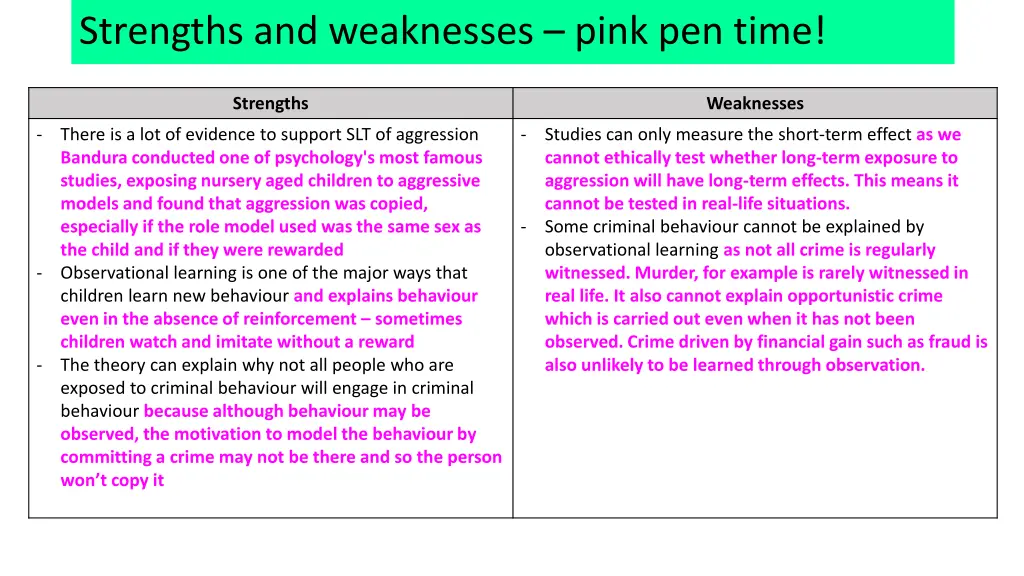
Strengths and weaknesses pink pen time! Strengths Weaknesses - There is a lot of evidence to support SLT of aggression Bandura conducted one of psychology's most famous studies, exposing nursery aged children to aggressive models and found that aggression was copied, especially if the role model used was the same sex as the child and if they were rewarded Observational learning is one of the major ways that children learn new behaviour and explains behaviour even in the absence of reinforcement sometimes children watch and imitate without a reward The theory can explain why not all people who are exposed to criminal behaviour will engage in criminal behaviour because although behaviour may be observed, the motivation to model the behaviour by committing a crime may not be there and so the person won t copy it - Studies can only measure the short-term effect as we cannot ethically test whether long-term exposure to aggression will have long-term effects. This means it cannot be tested in real-life situations. Some criminal behaviour cannot be explained by observational learning as not all crime is regularly witnessed. Murder, for example is rarely witnessed in real life. It also cannot explain opportunistic crime which is carried out even when it has not been observed. Crime driven by financial gain such as fraud is also unlikely to be learned through observation. - - -
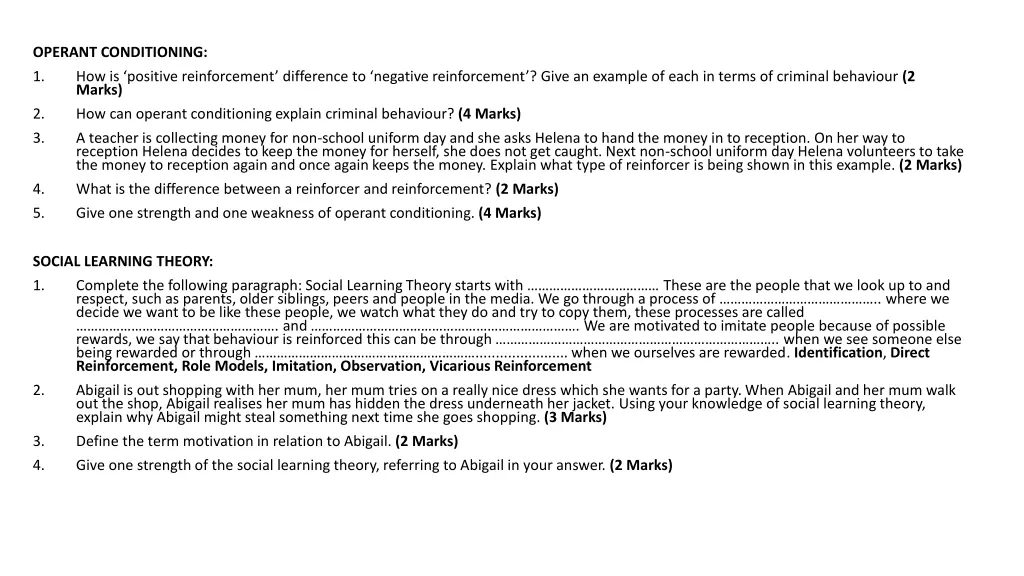
OPERANT CONDITIONING: 1. How is positive reinforcement difference to negative reinforcement ? Give an example of each in terms of criminal behaviour (2 Marks) 2. How can operant conditioning explain criminal behaviour? (4 Marks) 3. A teacher is collecting money for non-school uniform day and she asks Helena to hand the money in to reception. On her way to reception Helena decides to keep the money for herself, she does not get caught. Next non-school uniform day Helena volunteers to take the money to reception again and once again keeps the money. Explain what type of reinforcer is being shown in this example. (2 Marks) 4. What is the difference between a reinforcer and reinforcement? (2 Marks) 5. Give one strength and one weakness of operant conditioning. (4 Marks) SOCIAL LEARNING THEORY: 1. Complete the following paragraph: Social Learning Theory starts with These are the people that we look up to and respect, such as parents, older siblings, peers and people in the media. We go through a process of .. where we decide we want to be like these people, we watch what they do and try to copy them, these processes are called . and . We are motivated to imitate people because of possible rewards, we say that behaviour is reinforced this can be through .. when we see someone else being rewarded or through ....................... when we ourselves are rewarded. Identification, Direct Reinforcement, Role Models, Imitation, Observation, Vicarious Reinforcement 2. Abigail is out shopping with her mum, her mum tries on a really nice dress which she wants for a party. When Abigail and her mum walk out the shop, Abigail realises her mum has hidden the dress underneath her jacket. Using your knowledge of social learning theory, explain why Abigail might steal something next time she goes shopping. (3 Marks) 3. Define the term motivation in relation to Abigail. (2 Marks) 4. Give one strength of the social learning theory, referring to Abigail in your answer. (2 Marks)
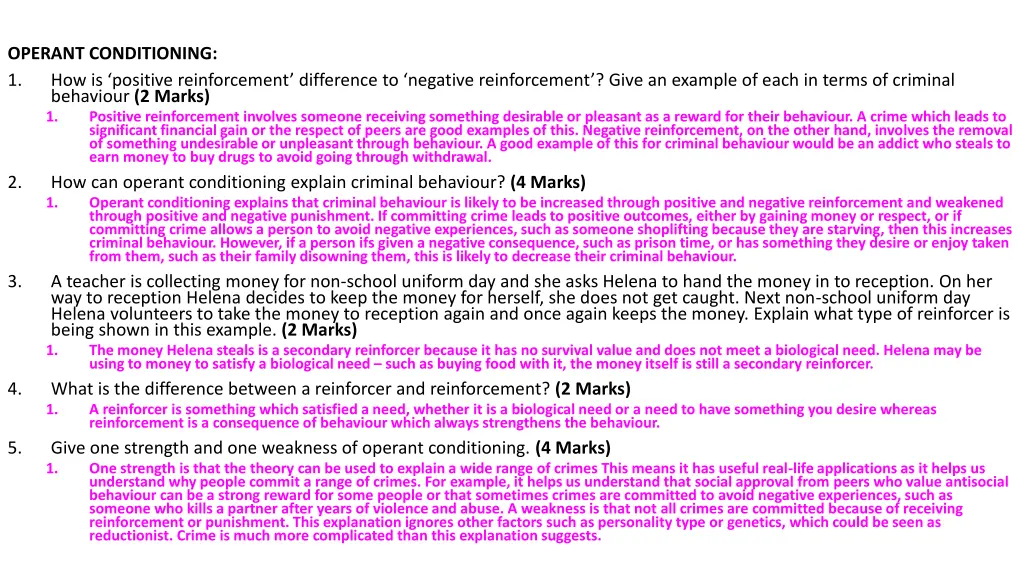
OPERANT CONDITIONING: 1. How is positive reinforcement difference to negative reinforcement ? Give an example of each in terms of criminal behaviour (2 Marks) 1. Positive reinforcement involves someone receiving something desirable or pleasant as a reward for their behaviour. A crime which leads to significant financial gain or the respect of peers are good examples of this. Negative reinforcement, on the other hand, involves the removal of something undesirable or unpleasant through behaviour. A good example of this for criminal behaviour would be an addict who steals to earn money to buy drugs to avoid going through withdrawal. 2. How can operant conditioning explain criminal behaviour? (4 Marks) 1. Operant conditioning explains that criminal behaviour is likely to be increased through positive and negative reinforcement and weakened through positive and negative punishment. If committing crime leads to positive outcomes, either by gaining money or respect, or if committing crime allows a person to avoid negative experiences, such as someone shoplifting because they are starving, then this increases criminal behaviour. However, if a person ifs given a negative consequence, such as prison time, or has something they desire or enjoy taken from them, such as their family disowning them, this is likely to decrease their criminal behaviour. 3. A teacher is collecting money for non-school uniform day and she asks Helena to hand the money in to reception. On her way to reception Helena decides to keep the money for herself, she does not get caught. Next non-school uniform day Helena volunteers to take the money to reception again and once again keeps the money. Explain what type of reinforcer is being shown in this example. (2 Marks) 1. The money Helena steals is a secondary reinforcer because it has no survival value and does not meet a biological need. Helena may be using to money to satisfy a biological need such as buying food with it, the money itself is still a secondary reinforcer. 4. What is the difference between a reinforcer and reinforcement? (2 Marks) 1. A reinforcer is something which satisfied a need, whether it is a biological need or a need to have something you desire whereas reinforcement is a consequence of behaviour which always strengthens the behaviour. 5. Give one strength and one weakness of operant conditioning. (4 Marks) 1. One strength is that the theory can be used to explain a wide range of crimes This means it has useful real-life applications as it helps us understand why people commit a range of crimes. For example, it helps us understand that social approval from peers who value antisocial behaviour can be a strong reward for some people or that sometimes crimes are committed to avoid negative experiences, such as someone who kills a partner after years of violence and abuse. A weakness is that not all crimes are committed because of receiving reinforcement or punishment. This explanation ignores other factors such as personality type or genetics, which could be seen as reductionist. Crime is much more complicated than this explanation suggests.
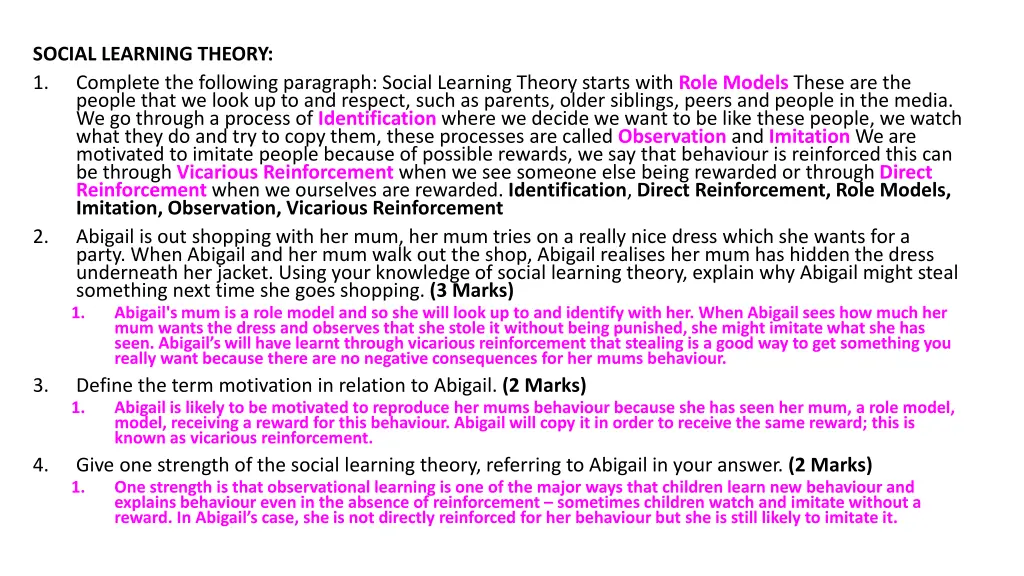
SOCIAL LEARNING THEORY: 1. Complete the following paragraph: Social Learning Theory starts with Role Models These are the people that we look up to and respect, such as parents, older siblings, peers and people in the media. We go through a process of Identification where we decide we want to be like these people, we watch what they do and try to copy them, these processes are called Observation and Imitation We are motivated to imitate people because of possible rewards, we say that behaviour is reinforced this can be through Vicarious Reinforcement when we see someone else being rewarded or through Direct Reinforcement when we ourselves are rewarded. Identification, Direct Reinforcement, Role Models, Imitation, Observation, Vicarious Reinforcement 2. Abigail is out shopping with her mum, her mum tries on a really nice dress which she wants for a party. When Abigail and her mum walk out the shop, Abigail realises her mum has hidden the dress underneath her jacket. Using your knowledge of social learning theory, explain why Abigail might steal something next time she goes shopping. (3 Marks) 1. Abigail's mum is a role model and so she will look up to and identify with her. When Abigail sees how much her mum wants the dress and observes that she stole it without being punished, she might imitate what she has seen. Abigail s will have learnt through vicarious reinforcement that stealing is a good way to get something you really want because there are no negative consequences for her mums behaviour. 3. Define the term motivation in relation to Abigail. (2 Marks) 1. Abigail is likely to be motivated to reproduce her mums behaviour because she has seen her mum, a role model, model, receiving a reward for this behaviour. Abigail will copy it in order to receive the same reward; this is known as vicarious reinforcement. 4. Give one strength of the social learning theory, referring to Abigail in your answer. (2 Marks) 1. One strength is that observational learning is one of the major ways that children learn new behaviour and explains behaviour even in the absence of reinforcement sometimes children watch and imitate without a reward. In Abigail s case, she is not directly reinforced for her behaviour but she is still likely to imitate it.