Understanding Perspectives on Education System
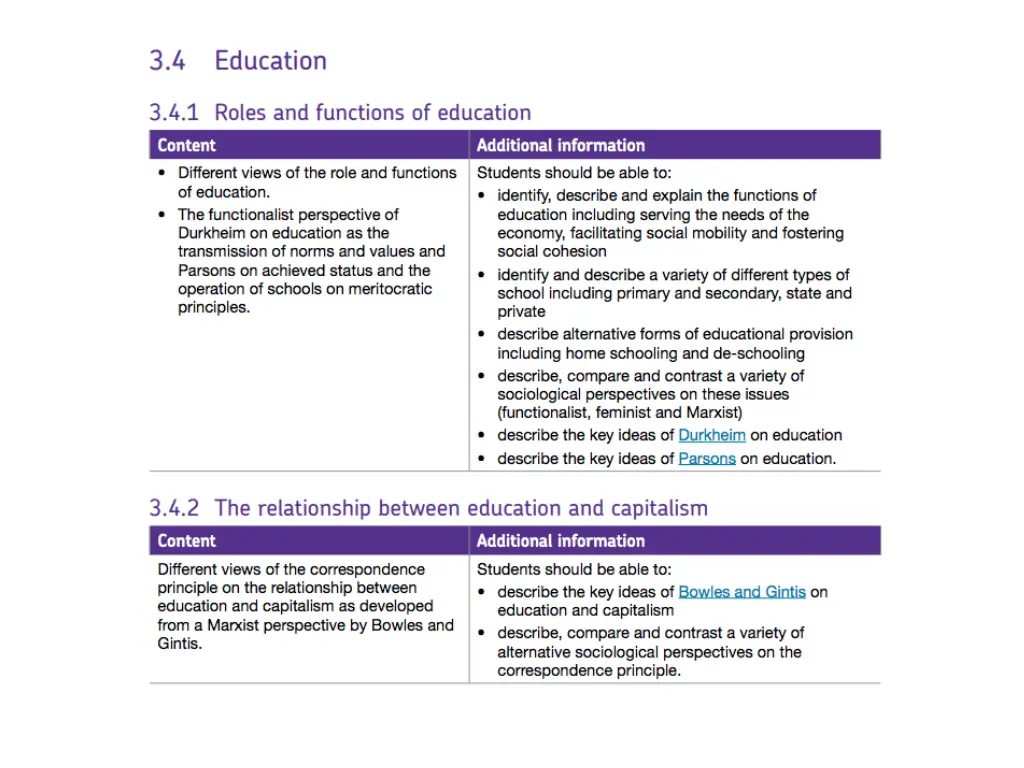
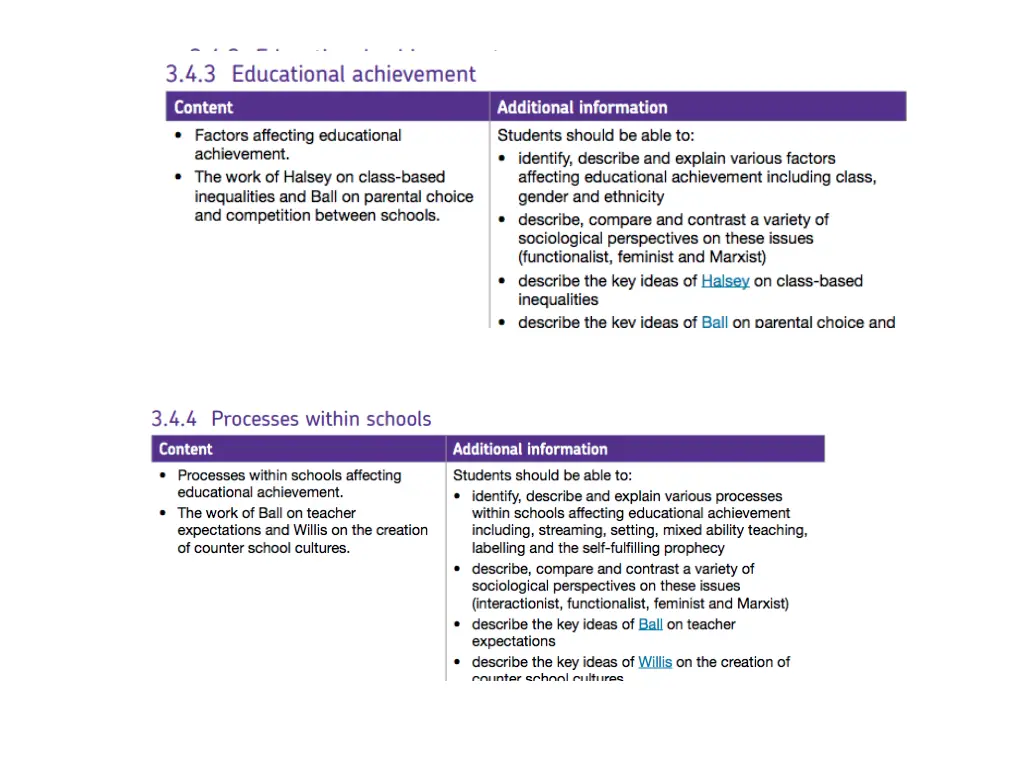
Explore the Functionalist and Marxist perspectives on education, the organization of the education system, the impact of social class on education, and the role of formal and informal education. Analyze the inequalities, hidden curriculum, meritocracy, cultural capital, and the effects of parental values on student achievement. Gain insights into different schooling systems and their influence on social stratification within society.

Download Presentation

Please find below an Image/Link to download the presentation.
The content on the website is provided AS IS for your information and personal use only. It may not be sold, licensed, or shared on other websites without obtaining consent from the author. If you encounter any issues during the download, it is possible that the publisher has removed the file from their server.
You are allowed to download the files provided on this website for personal or commercial use, subject to the condition that they are used lawfully. All files are the property of their respective owners.
The content on the website is provided AS IS for your information and personal use only. It may not be sold, licensed, or shared on other websites without obtaining consent from the author.
E N D
Presentation Transcript
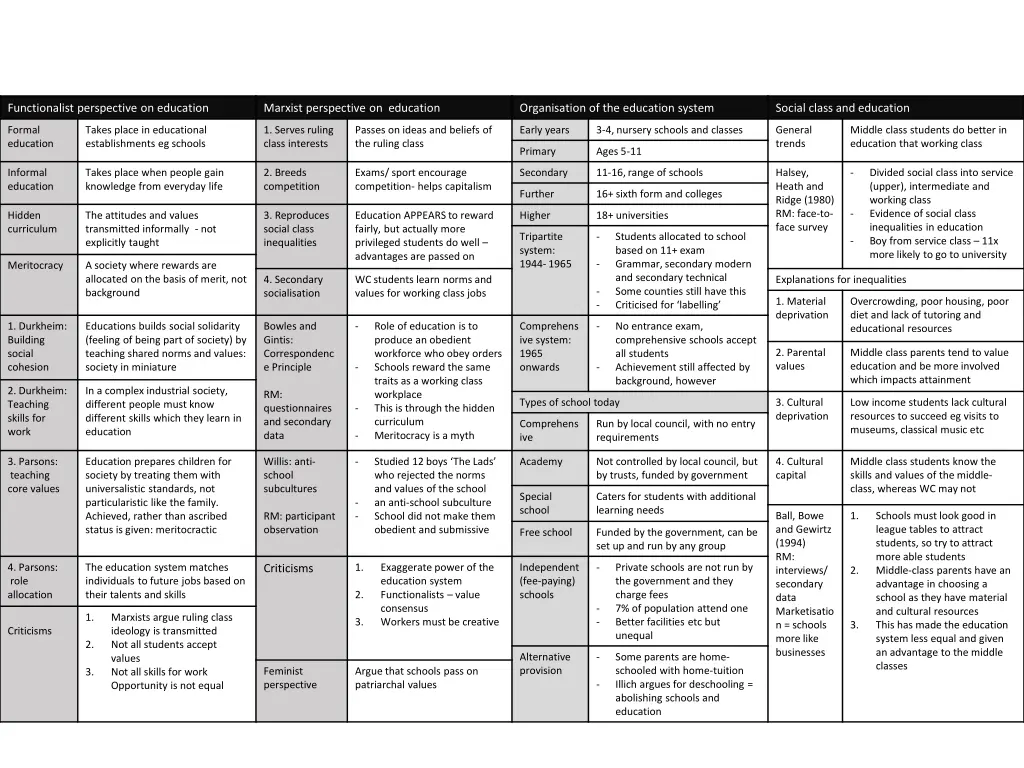
Functionalist perspective on education Marxist perspective on education Organisation of the education system Social class and education Formal education Takes place in educational establishments eg schools 1. Serves ruling class interests Passes on ideas and beliefs of the ruling class Early years 3-4, nursery schools and classes General trends Middle class students do better in education that working class Primary Ages 5-11 Informal education Takes place when people gain knowledge from everyday life 2. Breeds competition Exams/ sport encourage competition- helps capitalism Secondary 11-16, range of schools Halsey, Heath and Ridge (1980) RM: face-to- face survey - Divided social class into service (upper), intermediate and working class Evidence of social class inequalities in education Boy from service class 11x more likely to go to university Further 16+ sixth form and colleges - Hidden curriculum The attitudes and values transmitted informally - not explicitly taught 3. Reproduces social class inequalities Education APPEARS to reward fairly, but actually more privileged students do well advantages are passed on Higher 18+ universities Tripartite system: 1944-1965 - Students allocated to school based on 11+ exam Grammar, secondary modern and secondary technical Some counties still have this Criticised for labelling - - Meritocracy A society where rewards are allocated on the basis of merit, not background 4. Secondary socialisation WC students learn norms and values for working class jobs Explanations for inequalities - - 1. Material deprivation Overcrowding, poor housing, poor diet and lack of tutoring and educational resources 1. Durkheim: Building social cohesion Educations builds social solidarity (feeling of being part of society) by teaching shared norms and values: society in miniature Bowles and Gintis: Correspondenc e Principle - Role of education is to produce an obedient workforce who obey orders Schools reward the same traits as a working class workplace This is through the hidden curriculum Meritocracy is a myth Comprehens ive system: 1965 onwards - No entrance exam, comprehensive schools accept all students Achievement still affected by background, however 2. Parental values Middle class parents tend to value education and be more involved which impacts attainment - - 2. Durkheim: Teaching skills for work In a complex industrial society, different people must know different skills which they learn in education RM: questionnaires and secondary data Types of school today 3. Cultural deprivation Low income students lack cultural resources to succeed eg visits to museums, classical music etc - Comprehens ive Run by local council, with no entry requirements - 3. Parsons: teaching core values Education prepares children for society by treating them with universalistic standards, not particularistic like the family. Achieved, rather than ascribed status is given: meritocractic Willis: anti- school subcultures - Studied 12 boys The Lads who rejected the norms and values of the school an anti-school subculture School did not make them obedient and submissive Academy Not controlled by local council, but by trusts, funded by government 4. Cultural capital Middle class students know the skills and values of the middle- class, whereas WC may not Special school Caters for students with additional learning needs - - Ball, Bowe and Gewirtz (1994) RM: interviews/ secondary data Marketisatio n = schools more like businesses 1. Schools must look good in league tables to attract students, so try to attract more able students Middle-class parents have an advantage in choosing a school as they have material and cultural resources This has made the education system less equal and given an advantage to the middle classes RM: participant observation Free school Funded by the government, can be set up and run by any group 4. Parsons: role allocation The education system matches individuals to future jobs based on their talents and skills 1. Exaggerate power of the education system Functionalists value consensus Workers must be creative Independent (fee-paying) schools - Private schools are not run by the government and they charge fees 7% of population attend one Better facilities etc but unequal Criticisms 2. 2. - - 1. Marxists argue ruling class ideology is transmitted Not all students accept values Not all skills for work Opportunity is not equal 3. 3. Criticisms 2. Alternative provision - Some parents are home- schooled with home-tuition Illich argues for deschooling = abolishing schools and education Feminist perspective Argue that schools pass on patriarchal values 3. -
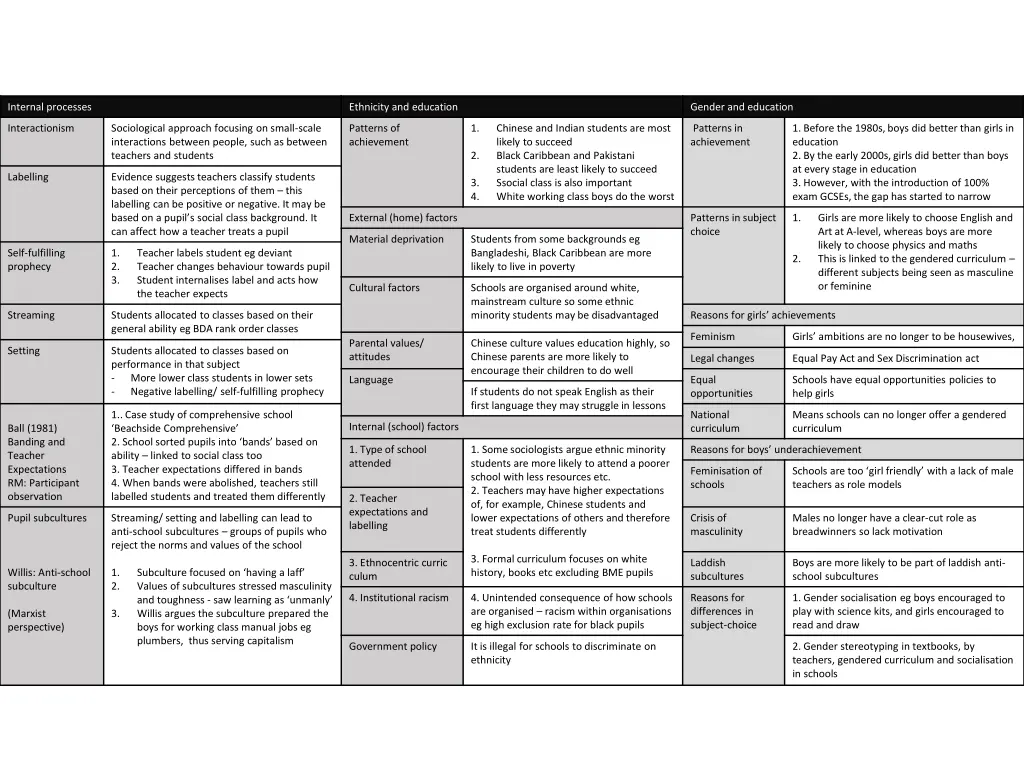
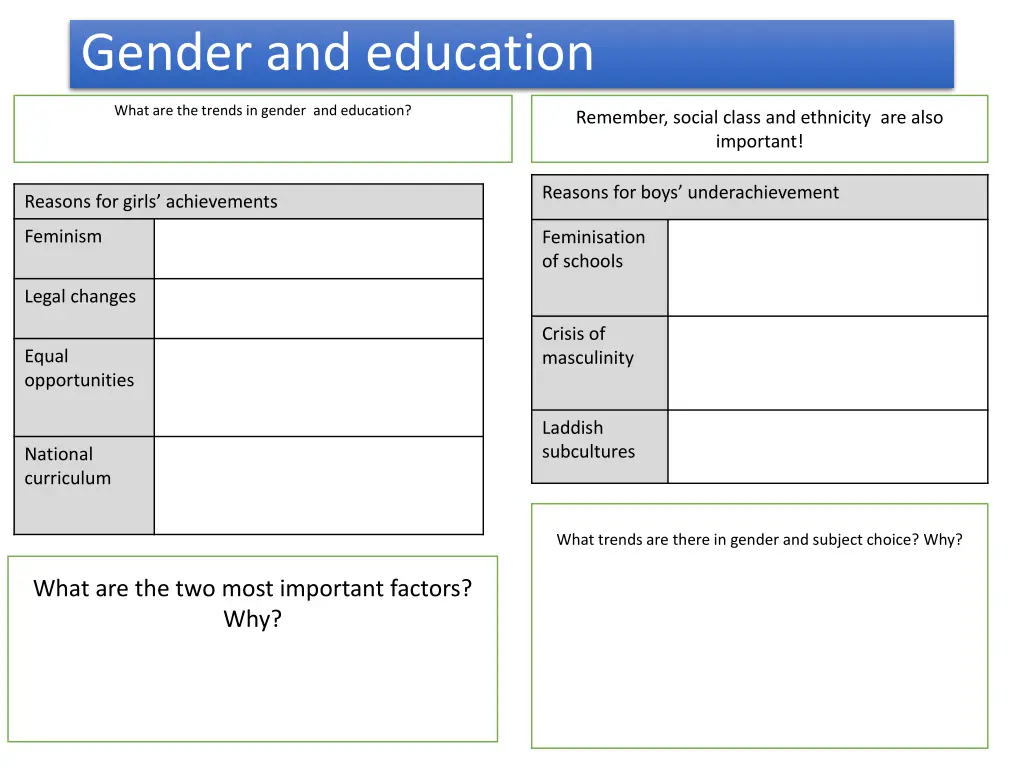
Internal processes Ethnicity and education Gender and education Interactionism Sociological approach focusing on small-scale interactions between people, such as between teachers and students Patterns of achievement 1. Chinese and Indian students are most likely to succeed Black Caribbean and Pakistani students are least likely to succeed Ssocial class is also important White working class boys do the worst Patterns in achievement 1. Before the 1980s, boys did better than girls in education 2. By the early 2000s, girls did better than boys at every stage in education 3. However, with the introduction of 100% exam GCSEs, the gap has started to narrow 2. Labelling Evidence suggests teachers classify students based on their perceptions of them this labelling can be positive or negative. It may be based on a pupil s social class background. It can affect how a teacher treats a pupil 3. 4. External (home) factors Patterns in subject choice 1. Girls are more likely to choose English and Art at A-level, whereas boys are more likely to choose physics and maths This is linked to the gendered curriculum different subjects being seen as masculine or feminine Material deprivation Students from some backgrounds eg Bangladeshi, Black Caribbean are more likely to live in poverty Self-fulfilling prophecy 1. 2. 3. Teacher labels student eg deviant Teacher changes behaviour towards pupil Student internalises label and acts how the teacher expects 2. Cultural factors Schools are organised around white, mainstream culture so some ethnic minority students may be disadvantaged Streaming Students allocated to classes based on their general ability eg BDA rank order classes Reasons for girls achievements Feminism Girls ambitions are no longer to be housewives, Parental values/ attitudes Chinese culture values education highly, so Chinese parents are more likely to encourage their children to do well Setting Students allocated to classes based on performance in that subject - More lower class students in lower sets - Negative labelling/ self-fulfilling prophecy Legal changes Equal Pay Act and Sex Discrimination act Language Equal opportunities Schools have equal opportunities policies to help girls If students do not speak English as their first language they may struggle in lessons 1.. Case study of comprehensive school Beachside Comprehensive 2. School sorted pupils into bands based on ability linked to social class too 3. Teacher expectations differed in bands 4. When bands were abolished, teachers still labelled students and treated them differently National curriculum Means schools can no longer offer a gendered curriculum Internal (school) factors Ball (1981) Banding and Teacher Expectations RM: Participant observation 1. Type of school attended 1. Some sociologists argue ethnic minority students are more likely to attend a poorer school with less resources etc. 2. Teachers may have higher expectations of, for example, Chinese students and lower expectations of others and therefore treat students differently Reasons for boys underachievement Feminisation of schools Schools are too girl friendly with a lack of male teachers as role models 2. Teacher expectations and labelling Pupil subcultures Streaming/ setting and labelling can lead to anti-school subcultures groups of pupils who reject the norms and values of the school Crisis of masculinity Males no longer have a clear-cut role as breadwinners so lack motivation 3. Formal curriculum focuses on white history, books etc excluding BME pupils 3. Ethnocentric curric culum Laddish subcultures Boys are more likely to be part of laddish anti- school subcultures Willis: Anti-school subculture 1. 2. Subculture focused on having a laff Values of subcultures stressed masculinity and toughness - saw learning as unmanly Willis argues the subculture prepared the boys for working class manual jobs eg plumbers, thus serving capitalism 4. Institutional racism 4. Unintended consequence of how schools are organised racism within organisations eg high exclusion rate for black pupils Reasons for differences in subject-choice 1. Gender socialisation eg boys encouraged to play with science kits, and girls encouraged to read and draw (Marxist perspective) 3. Government policy It is illegal for schools to discriminate on ethnicity 2. Gender stereotyping in textbooks, by teachers, gendered curriculum and socialisation in schools
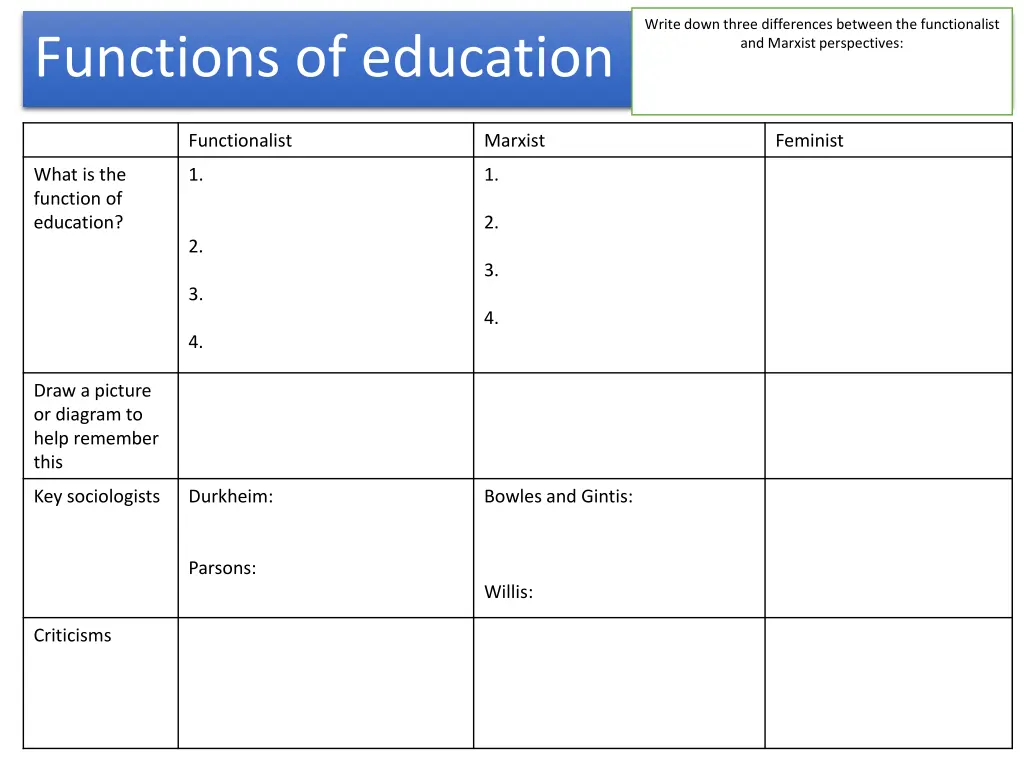
Write down three differences between the functionalist and Marxist perspectives: Functions of education Functionalist Marxist Feminist What is the function of education? 1. 1. 2. 2. 3. 3. 4. 4. Draw a picture or diagram to help remember this Key sociologists Durkheim: Bowles and Gintis: Parsons: Willis: Criticisms
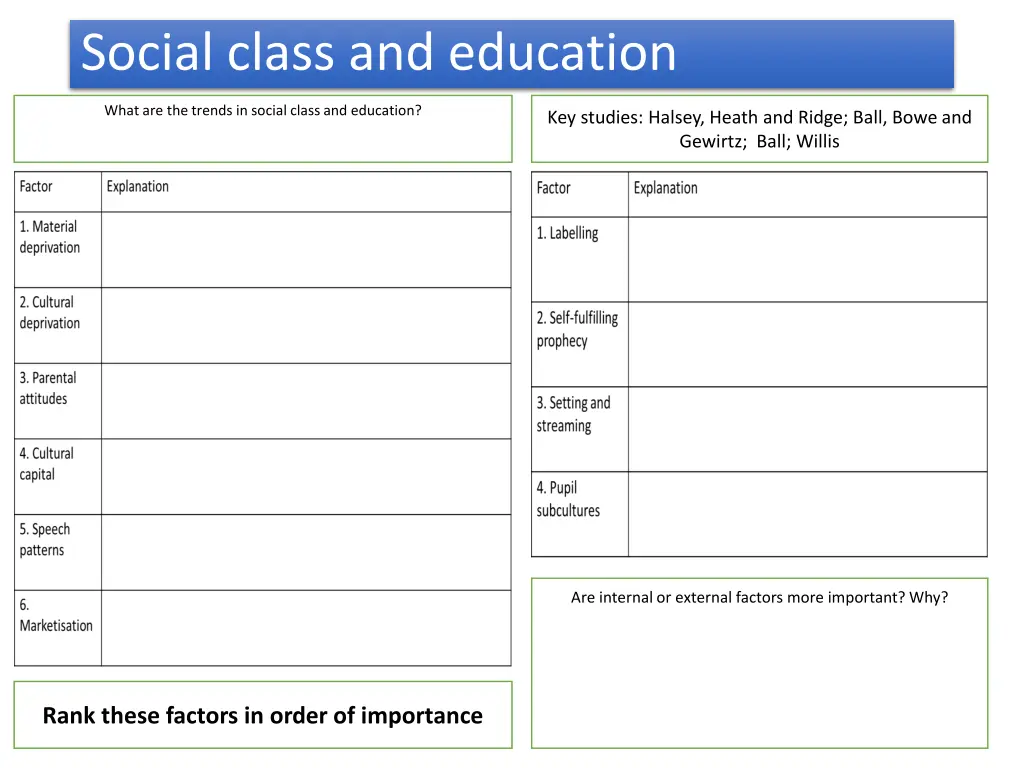
Social class and education What are the trends in social class and education? Key studies: Halsey, Heath and Ridge; Ball, Bowe and Gewirtz; Ball; Willis Are internal or external factors more important? Why? Rank these factors in order of importance
Key studies Perspective Research method Key ideas Connects with Parsons Durkheim Bowles and Gintis Willis Ball Ball, Bowe and Gewirtz Halsey, Heath and Ridge
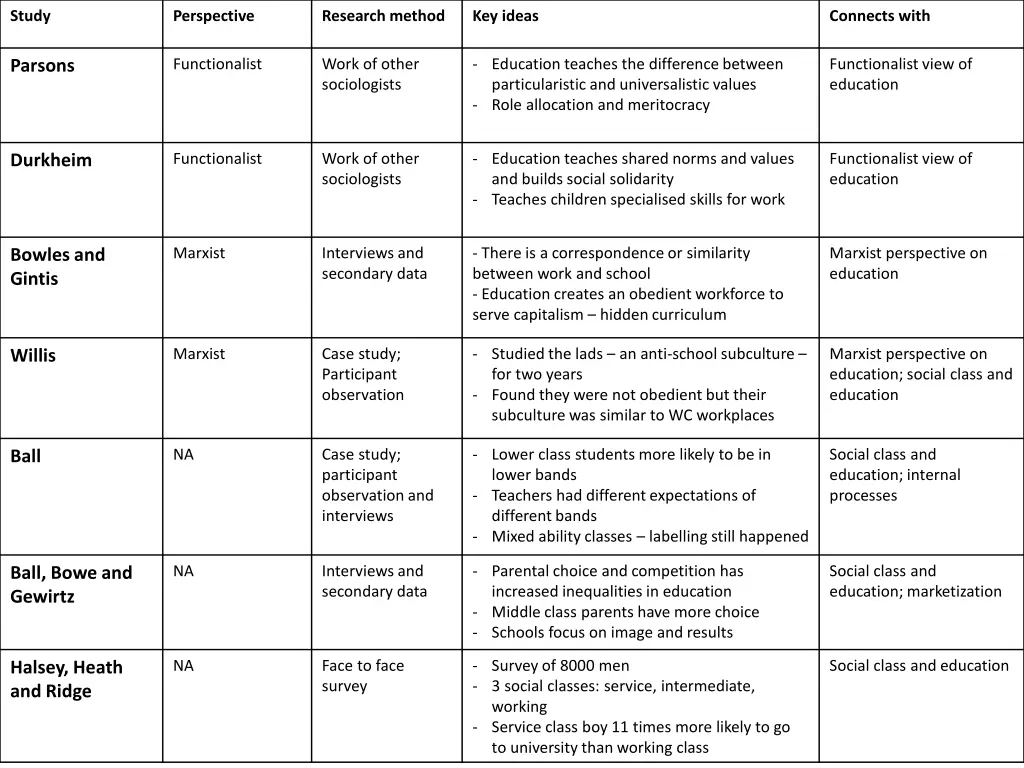
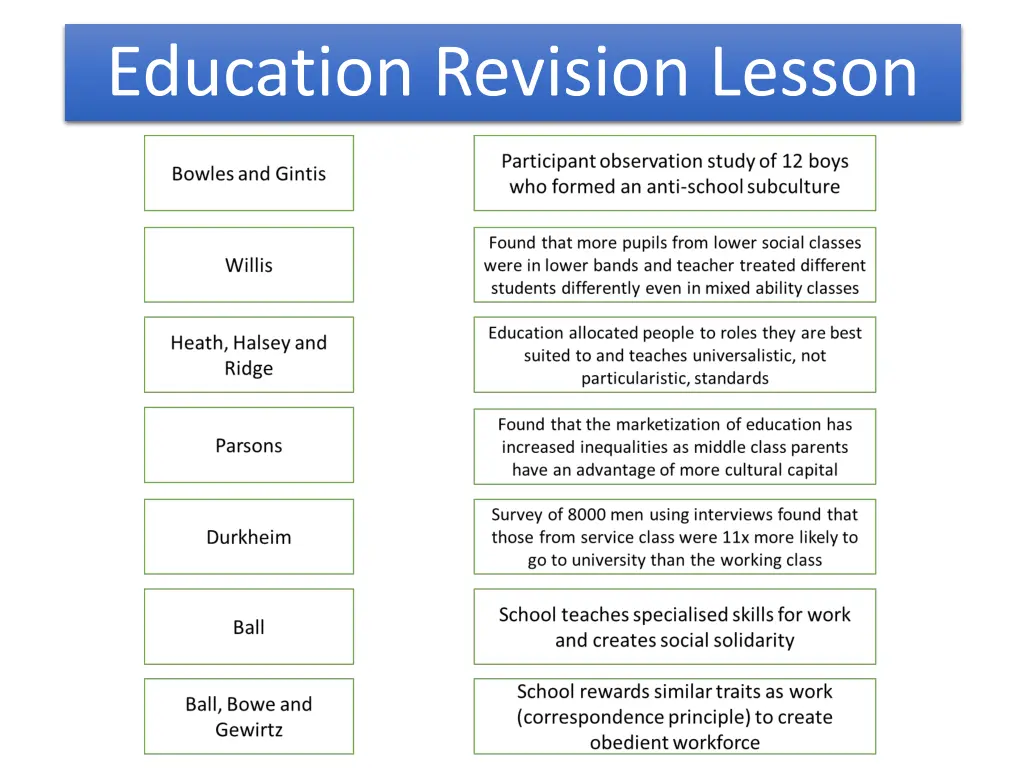
Study Perspective Research method Key ideas Connects with Functionalist Work of other sociologists - Education teaches the difference between particularistic and universalistic values - Role allocation and meritocracy Functionalist view of education Parsons Functionalist Work of other sociologists - Education teaches shared norms and values and builds social solidarity - Teaches children specialised skills for work Functionalist view of education Durkheim Marxist Interviews and secondary data - There is a correspondence or similarity between work and school - Education creates an obedient workforce to serve capitalism hidden curriculum Marxist perspective on education Bowles and Gintis Marxist Case study; Participant observation - Studied the lads an anti-school subculture for two years - Found they were not obedient but their subculture was similar to WC workplaces Marxist perspective on education; social class and education Willis NA Case study; participant observation and interviews - Lower class students more likely to be in lower bands - Teachers had different expectations of different bands - Mixed ability classes labelling still happened Social class and education; internal processes Ball NA Interviews and secondary data - Parental choice and competition has increased inequalities in education - Middle class parents have more choice - Schools focus on image and results Social class and education; marketization Ball, Bowe and Gewirtz NA Face to face survey - Survey of 8000 men - 3 social classes: service, intermediate, working - Service class boy 11 times more likely to go to university than working class Social class and education Halsey, Heath and Ridge
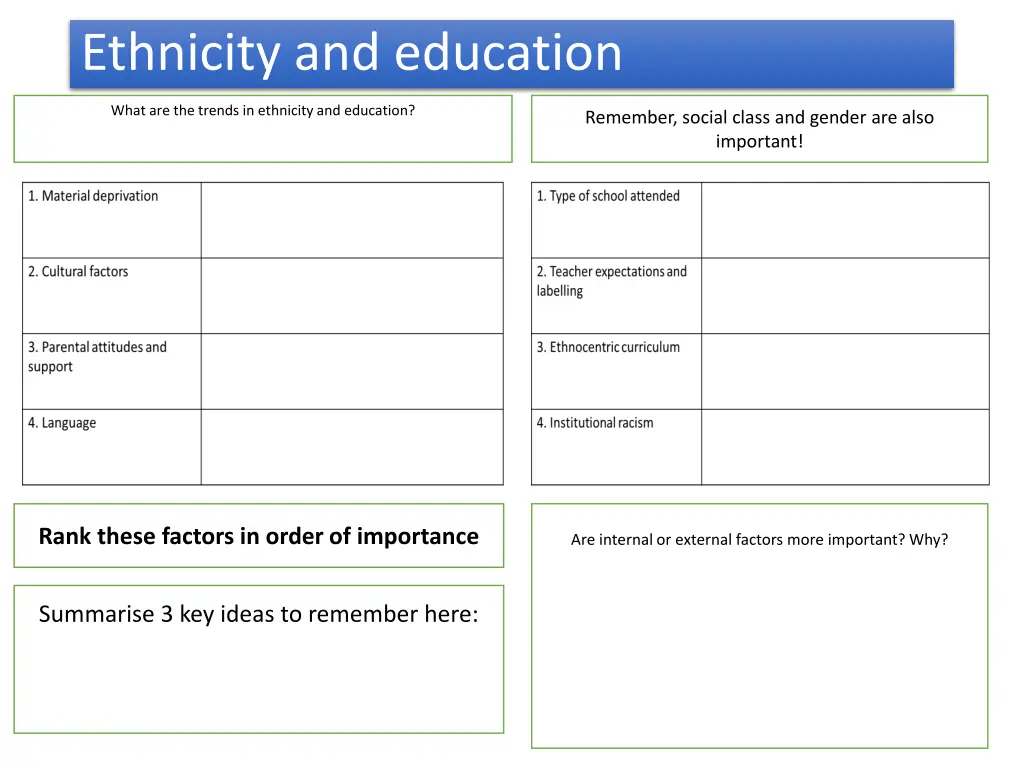
Ethnicity and education What are the trends in ethnicity and education? Remember, social class and gender are also important! Rank these factors in order of importance Are internal or external factors more important? Why? Summarise 3 key ideas to remember here:
Gender and education What are the trends in gender and education? Remember, social class and ethnicity are also important! Reasons for boys underachievement Reasons for girls achievements Feminism Feminisation of schools Legal changes Crisis of masculinity Equal opportunities Laddish subcultures National curriculum What trends are there in gender and subject choice? Why? What are the two most important factors? Why?
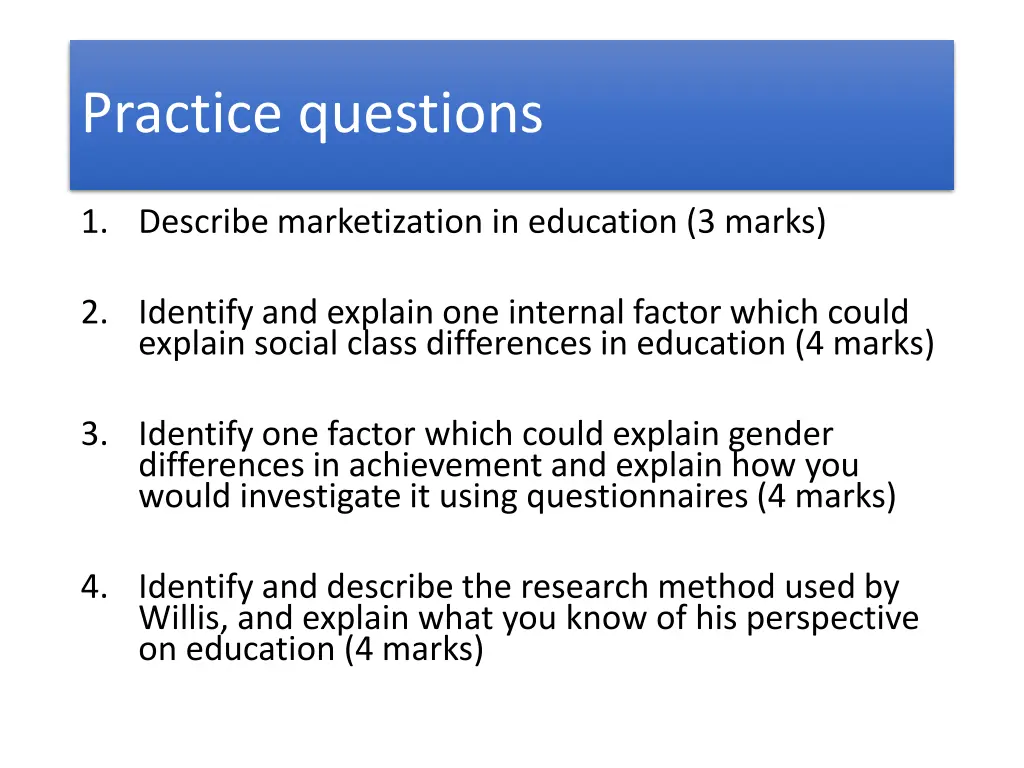
Practice questions 1. Describe marketization in education (3 marks) 2. Identify and explain one internal factor which could explain social class differences in education (4 marks) 3. Identify one factor which could explain gender differences in achievement and explain how you would investigate it using questionnaires (4 marks) 4. Identify and describe the research method used by Willis, and explain what you know of his perspective on education (4 marks)
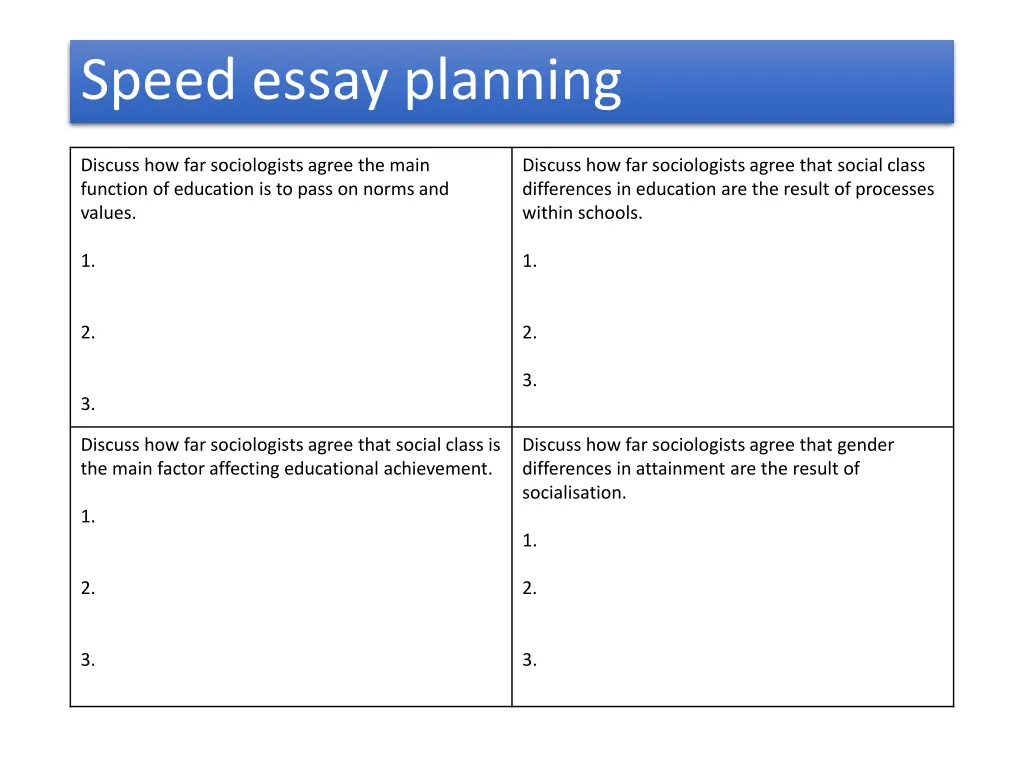
Speed essay planning Discuss how far sociologists agree the main function of education is to pass on norms and values. Discuss how far sociologists agree that social class differences in education are the result of processes within schools. 1. 1. 2. 2. 3. 3. Discuss how far sociologists agree that social class is the main factor affecting educational achievement. Discuss how far sociologists agree that gender differences in attainment are the result of socialisation. 1. 1. 2. 2. 3. 3.
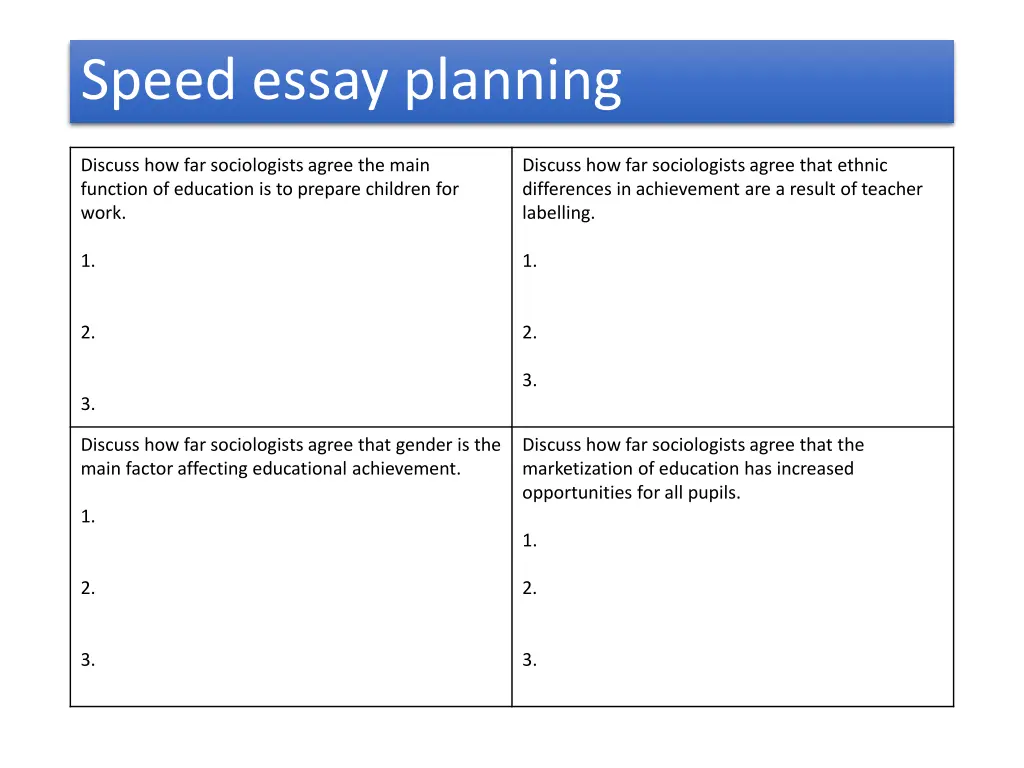
Speed essay planning Discuss how far sociologists agree the main function of education is to prepare children for work. Discuss how far sociologists agree that ethnic differences in achievement are a result of teacher labelling. 1. 1. 2. 2. 3. 3. Discuss how far sociologists agree that gender is the main factor affecting educational achievement. Discuss how far sociologists agree that the marketization of education has increased opportunities for all pupils. 1. 1. 2. 2. 3. 3.