Understanding Pion Transition Form Factor Models
Explore the dynamics of pion transition form factor in the frameworks of the PNJL model, quark model with separable interaction, and various approaches in non-perturbative and perturbative QCD. Discover the complexities of quark-photon vertex, Bethe-Salpeter amplitude, dressed quark propagator, form factors, and more within these advanced models.

Download Presentation

Please find below an Image/Link to download the presentation.
The content on the website is provided AS IS for your information and personal use only. It may not be sold, licensed, or shared on other websites without obtaining consent from the author. If you encounter any issues during the download, it is possible that the publisher has removed the file from their server.
You are allowed to download the files provided on this website for personal or commercial use, subject to the condition that they are used lawfully. All files are the property of their respective owners.
The content on the website is provided AS IS for your information and personal use only. It may not be sold, licensed, or shared on other websites without obtaining consent from the author.
E N D
Presentation Transcript
Pion transition form-factor in the frameworks of the PNJL model and the quark model with separable interaction A.Friesen, Yu. Kalinovsky, D. Goderidze, A. Khmelev INFINUM2025, Dubna, May 12-16
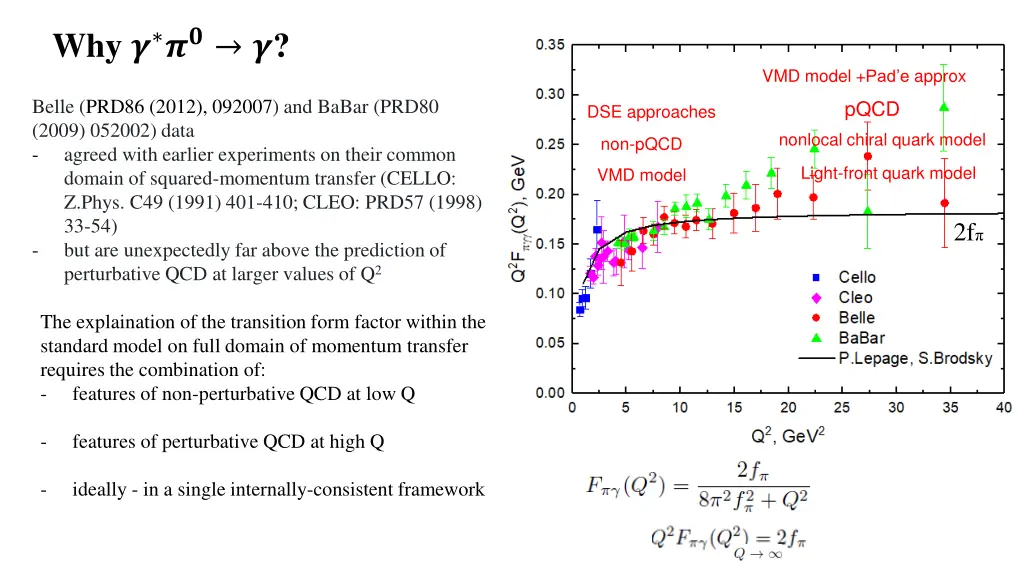
Why ??? ?? VMD model +Pad e approx Belle (PRD86 (2012), 092007) and BaBar (PRD80 (2009) 052002) data - agreed with earlier experiments on their common domain of squared-momentum transfer (CELLO: Z.Phys. C49 (1991) 401-410; CLEO: PRD57 (1998) 33-54) - but are unexpectedly far above the prediction of perturbative QCD at larger values of Q2 pQCD DSE approaches nonlocal chiral quark model non-pQCD Light-front quark model VMD model 2f The explaination of the transition form factor within the standard model on full domain of momentum transfer requires the combination of: - features of non-perturbative QCD at low Q - features of perturbative QCD at high Q - ideally - in a single internally-consistent framework
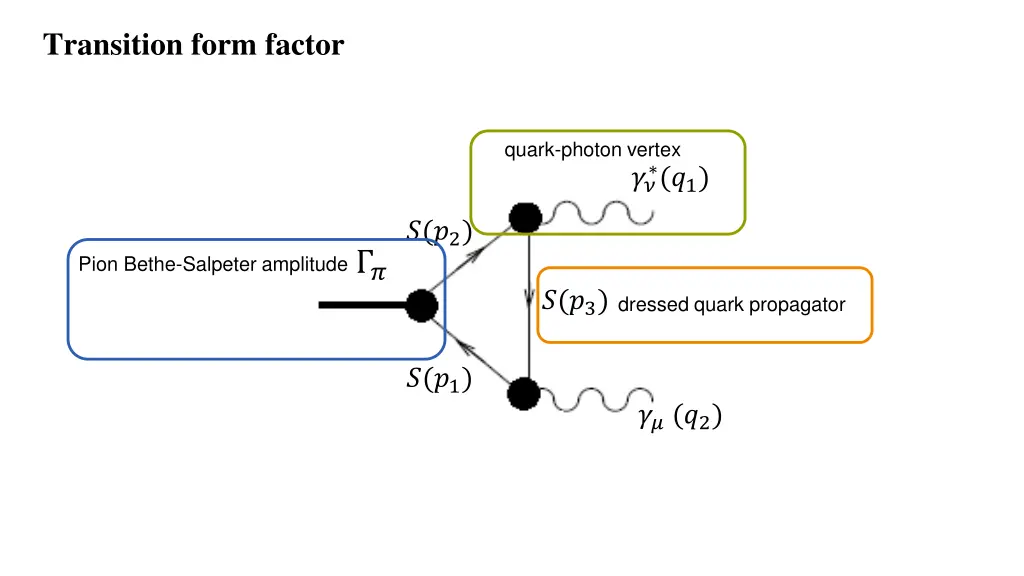
Transition form factor quark-photon vertex ?? (?1) ?(?2) ? Pion Bethe-Salpeter amplitude ?(?3) dressed quark propagator ?(?1) ??(?2)
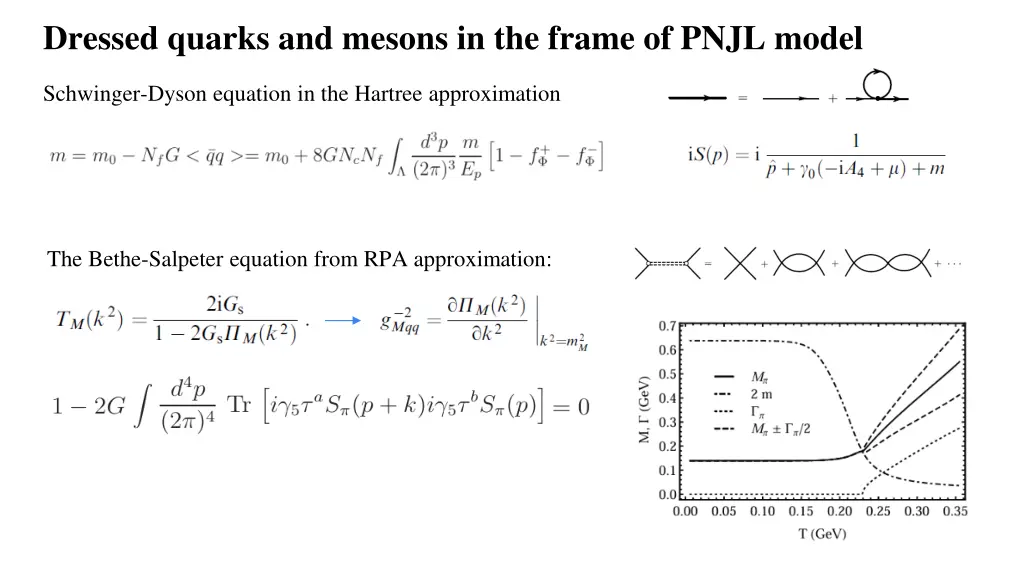
Dressed quarks and mesons in the frame of PNJL model Schwinger-Dyson equation in the Hartree approximation The Bethe-Salpeter equation from RPA approximation:
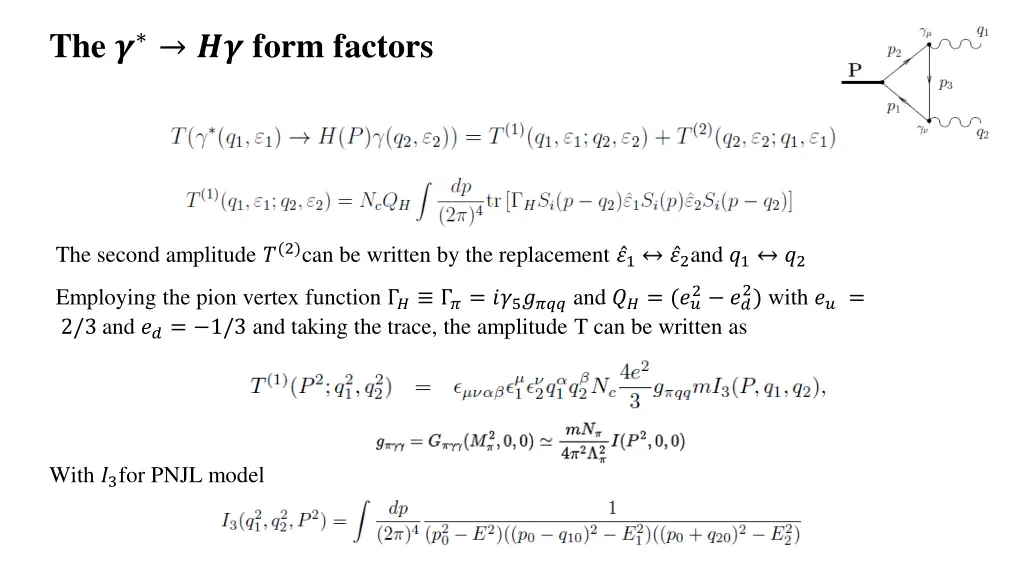
The ? ?? form factors The second amplitude ?(2)can be written by the replacement ?1 ?2and ?1 ?2 2) with ??= 2 ?? Employing the pion vertex function ? ?= ??5????and ??= (?? 2/3 and ??= 1/3 and taking the trace, the amplitude T can be written as With ?3for PNJL model
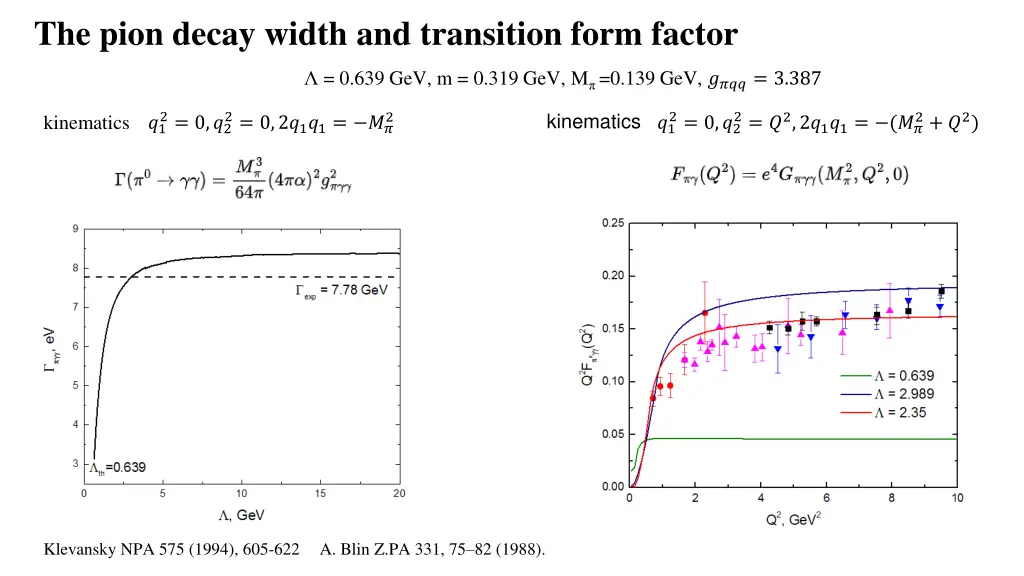
The pion decay width and transition form factor = 0.639 GeV, m = 0.319 GeV, M =0.139 GeV, ????= 3.387 kinematics 2= 0,?2 2= 0,2?1?1= ?? 2= 0,?2 2= ?2,2?1?1= (?? 2 2+ ?2) kinematics ?1 ?1 Klevansky NPA 575 (1994), 605-622 A. Blin Z.PA 331, 75 82 (1988).
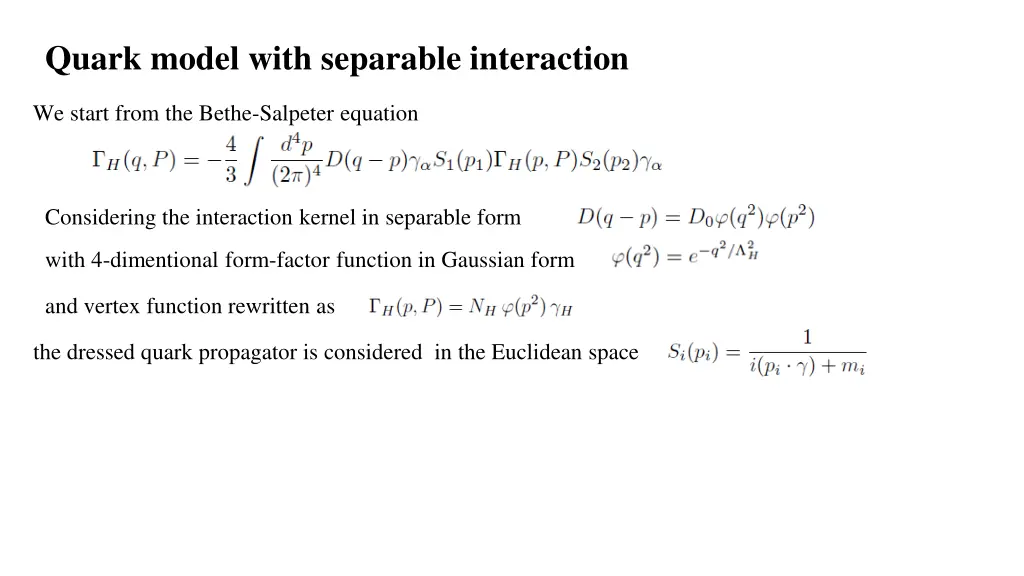
Quark model with separable interaction We start from the Bethe-Salpeter equation Considering the interaction kernel in separable form with 4-dimentional form-factor function in Gaussian form and vertex function rewritten as the dressed quark propagator is considered in the Euclidean space
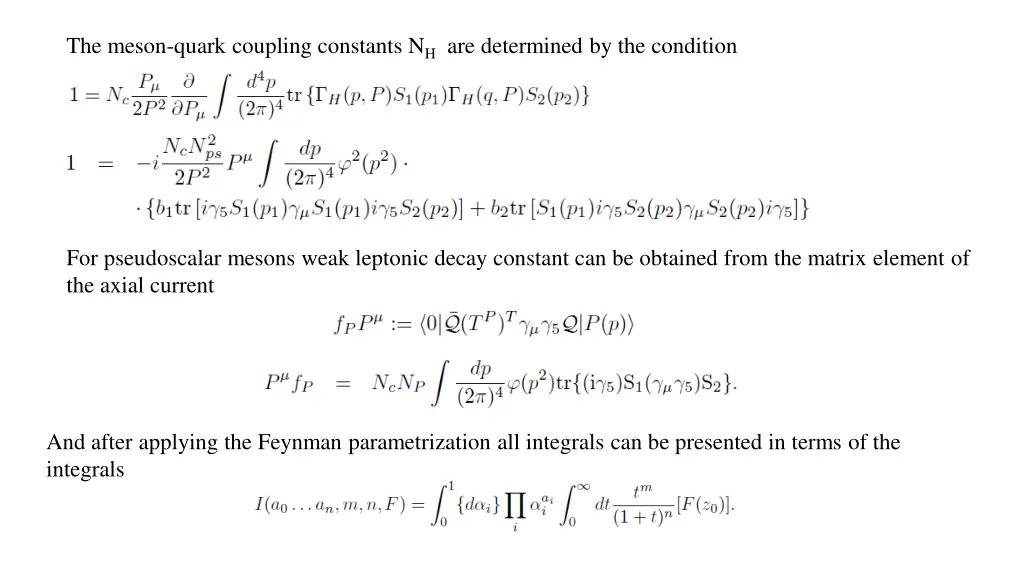
The meson-quark coupling constants NHare determined by the condition For pseudoscalar mesons weak leptonic decay constant can be obtained from the matrix element of the axial current And after applying the Feynman parametrization all integrals can be presented in terms of the integrals
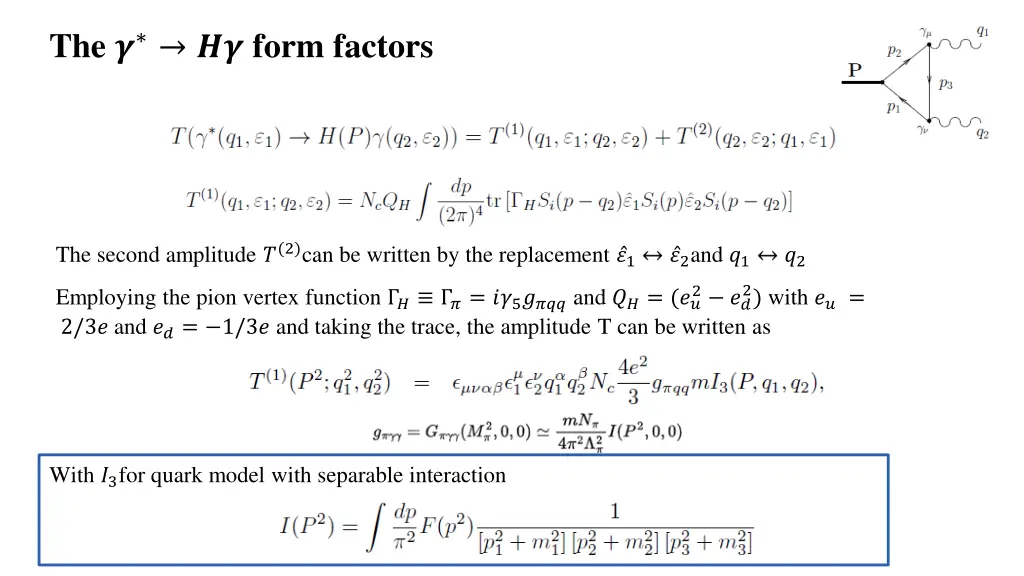
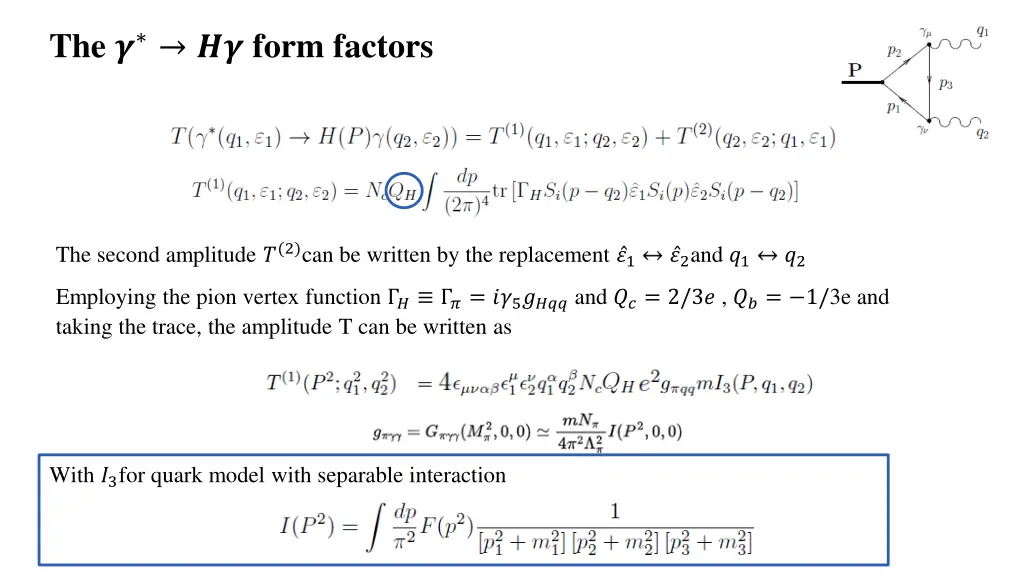
The ? ?? form factors The second amplitude ?(2)can be written by the replacement ?1 ?2and ?1 ?2 2) with ??= 2 ?? Employing the pion vertex function ? ?= ??5????and ??= (?? 2/3? and ??= 1/3? and taking the trace, the amplitude T can be written as With ?3for quark model with separable interaction
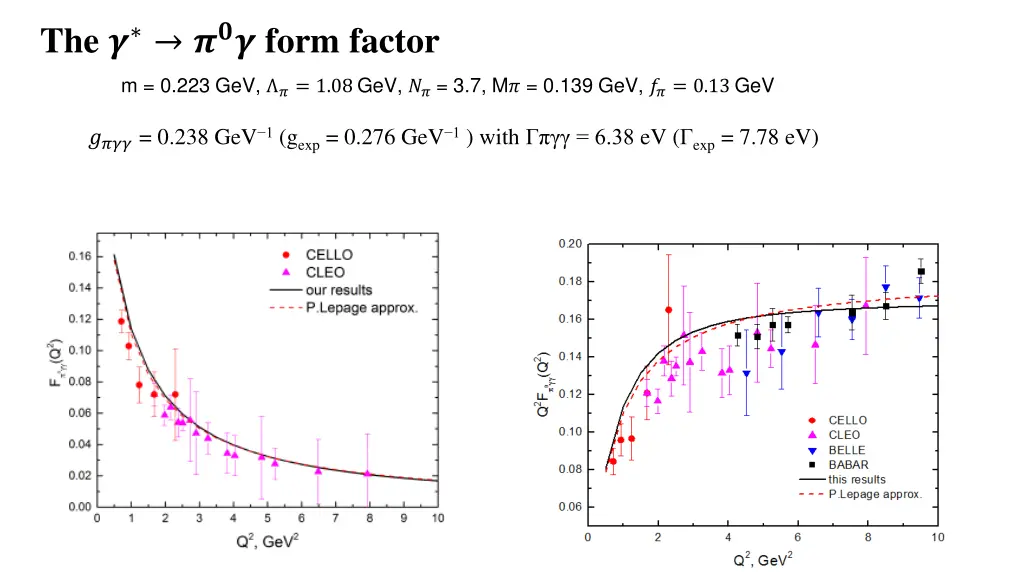
The ? ??? form factor m = 0.223 GeV, ?= 1.08 GeV, ??= 3.7, M? = 0.139 GeV, ??= 0.13 GeV ????= 0.238 GeV 1(gexp= 0.276 GeV 1) with = 6.38 eV ( exp= 7.78 eV)
The ? ?? form factors The second amplitude ?(2)can be written by the replacement ?1 ?2and ?1 ?2 Employing the pion vertex function ? ?= ??5????and ??= 2/3? , ??= 1/3e and taking the trace, the amplitude T can be written as With ?3for quark model with separable interaction
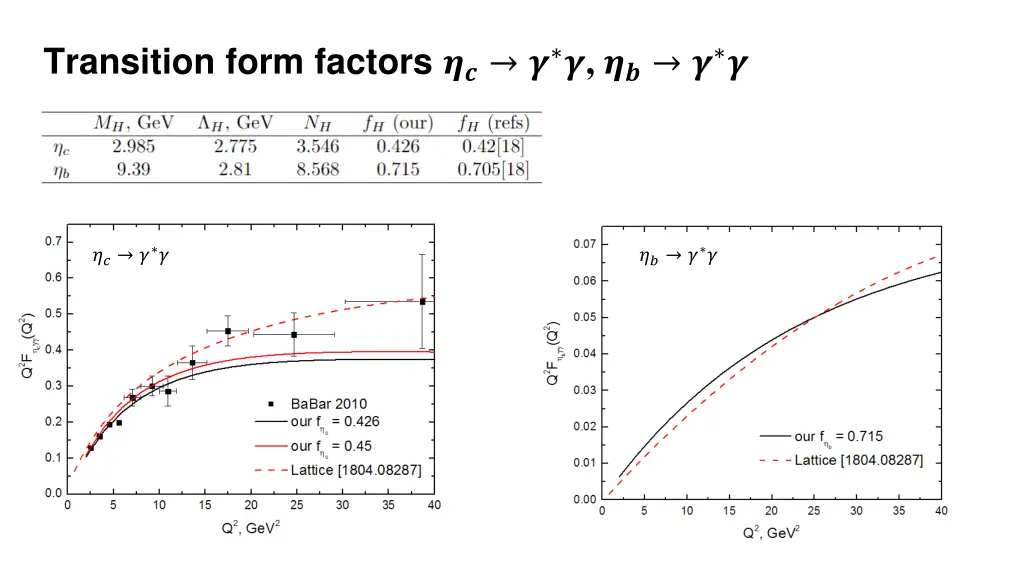
Transition form factors ?? ??, ?? ?? ?? ? ? ?? ? ?
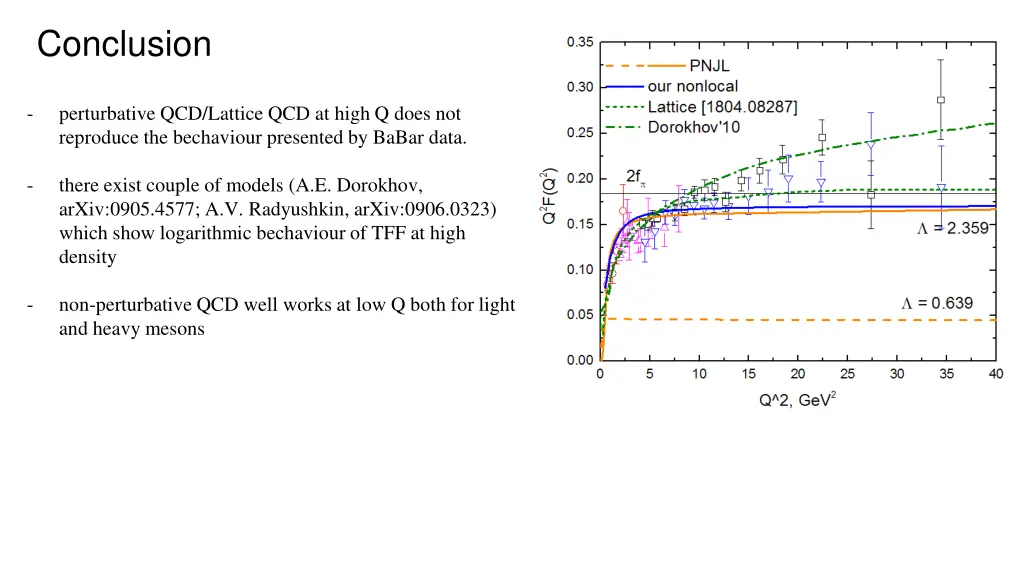
Conclusion - perturbative QCD/Lattice QCD at high Q does not reproduce the bechaviour presented by BaBar data. - there exist couple of models (A.E. Dorokhov, arXiv:0905.4577; A.V. Radyushkin, arXiv:0906.0323) which show logarithmic bechaviour of TFF at high density - non-perturbative QCD well works at low Q both for light and heavy mesons