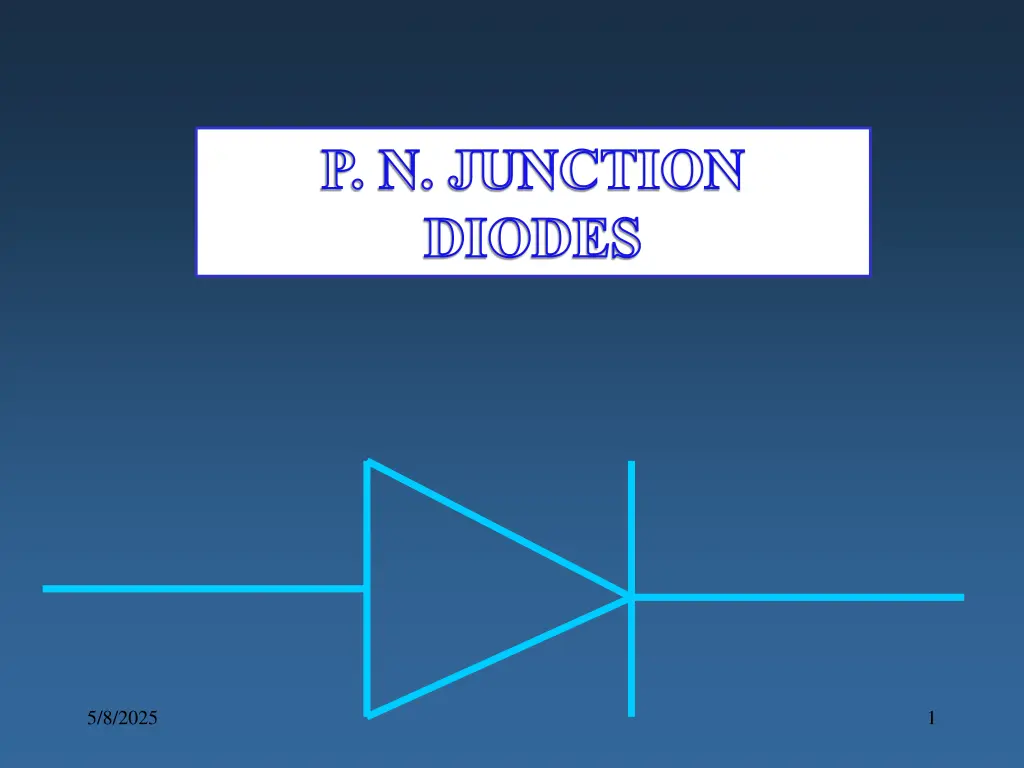
Learn about PN junction diodes, including N-type and P-type materials, the formation of a PN junction, biasing types, and their behaviors under different bias conditions. Explore the crucial concepts of doping, depletion region, and carrier movement in semiconductor devices.
Please find below an Image/Link to download the presentation.
The content on the website is provided AS IS for your information and personal use only. It may not be sold, licensed, or shared on other websites without obtaining consent from the author. If you encounter any issues during the download, it is possible that the publisher has removed the file from their server.
You are allowed to download the files provided on this website for personal or commercial use, subject to the condition that they are used lawfully. All files are the property of their respective owners.
The content on the website is provided AS IS for your information and personal use only. It may not be sold, licensed, or shared on other websites without obtaining consent from the author.
N-Type Material When extra valence electrons are introduced into a material such as silicon an n-type material is produced. The extra valence electrons are introduced impurities or dopant into the silicon. The dopant used to create an n-type material are Group V elements. The most commonly used dopant from Group V are arsenic, antimony and phosphorus. N-Type Material: by putting +4 +4 +4 +4 +5 +4 The 2D diagram to the left shows the extra electron that will be present when a Group V dopant is introduced to a material such as silicon. This extra electron is very mobile. +4 +4 +4 5/8/2025 2
P-Type Material P-type material is produced when the dopant that is introduced is from Group III. Group III elements have only 3 valence electrons and therefore there is an electron missing. This creates a hole (h+), or a positive charge that can move around in the material. Commonly used Group III dopant are aluminum, boron, and gallium. P-Type Material: +4 +4 +4 +4 +3 +4 The 2D diagram to the left shows the hole that will be present when a Group III dopant is introduced to a material such as silicon. This hole is quite mobile in the same way the extra electron is mobile in a n-type material. +4 +4 +4 5/8/2025 3
The PN Junction Steady State Metallurgical Junction Na Nd When no external source is connected to the pn junction, diffusion and drift balance each other out for both the holes and electrons + + + + + - - - - - + + + + + - - - - - P n + + + + + - - - - - + + + + + - - - - - Space Charge Region ionized acceptors ionized donors E-Field _ _ + + = = = = e- drift h+ drift h+ diffusion e- diffusion Space Charge Region: Also called the depletion region. This region includes the net positively and negatively charged regions. The space charge region does not have any free carriers. The width of the space charge region is denoted by W in pn junction formula s. Metallurgical Junction: The interface where the p- and n-type materials meet. Na & Nd: Represent the amount of negative and positive doping in number of carriers per centimeter cubed. Usually in the range of 1015 to 1020. 5/8/2025 4
The Biased PN Junction Metal Contact _ Ohmic Contact + (Rs~0) Applied Electric Field P n I _ + Vapplied The pn junction is considered biased when an external voltage is applied. There are two types of biasing: Forward bias and Reverse bias. These are described on then next slide. 5/8/2025 5
The Biased PN Junction Forward Bias: In forward bias the depletion region shrinks slightly in width. With this shrinking the energy required for charge carriers to cross the depletion region decreases exponentially. Therefore, as the applied voltage increases, current starts to flow across the junction. The barrier potential of the diode is the voltage at which appreciable current starts to flow through the diode. The barrier potential varies for different materials. Vapplied > 0 Under reverse bias the depletion region widens. This causes the electric field produced by the ions to cancel out the applied reverse bias voltage. A small leakage current, Is (saturation current) flows under reverse bias conditions. This saturation current is made up of electron-hole pairs being produced in the depletion region. Saturation current is sometimes referred to as scale current because of it s relationship to junction temperature. Reverse Bias: Vapplied < 0 5/8/2025 6
Properties of Diodes Figure 1.10 The Diode Transconductance Curve2 ID VD = Bias Voltage (mA) ID = Current through Diode. ID is Negative for Reverse Bias and Positive for Forward Bias IS VBR IS = Saturation Current VD ~V VBR = Breakdown Voltage V = Barrier Potential Voltage (nA) 5/8/2025 7
Properties of Diodes The Shockley Equation The transconductance curve on the previous slide is characterized by the following equation: ID = IS(eVD/ VT 1) As described in the last slide, ID is the current through the diode, IS is the saturation current and VD is the applied biasing voltage. VT is the thermal equivalent voltage and is approximately 26 mV at room temperature. The equation to find VT at various temperatures is: VT = kT k = 1.38 x 10⁻²³ J/K T = temperature in Kelvin q = 1.6 x 10⁻¹⁹ C q is the emission coefficient for the diode. It is determined by the way the diode is constructed. It somewhat varies with diode current. For a silicon diode is around 2 for low currents and goes down to about 1 at higher currents 5/8/2025 10
PN junction diode definitions: 1. Forward biasing:When an external D.C. voltage is applied across the junction in such a direction that it cancels the potential barrier, thus permitting current flow, it is called forward biasing. 2. Reverse biasing: When an external D.C. voltage is applied across the junction in such a direction that it widens the potential barrier, it is called reverse biasing. 3. Breakdown voltage: It is the reverse voltage at which pn junction breaks down with sudden rise in reverse current. 4. Knee voltage or cut-in voltage: It is the forward voltage at which the current through the junction starts to increase rapidly. 5/8/2025 11
Maximum forward current: It is the highest instantaneous forward current that a pn junction can conduct without damage to the junction. 5. Peak inverse voltage (PIV): It is the maximum reverse voltage that can be applied to the pn junction without damage to the junction. 6. Maximum power rating: It is the maximum power that can be dissipated at the junction without damaging it. The power dissipated at the junction is equal to the product of junction current and the voltage across the junction. 7. Reverse current or leakage current or saturation current: It is the current that flows through a reverse biased diode. This current is due to minority carriers. Under normal operating voltages, the reverse current is quite small. Its value is extremely small (<1 A) for Silicon diodes but it is appreciable (approx. 100 A) for Germanium diodes. 8. 5/8/2025 12
1. The diffusion current can be defined as the flow of charge carriers within a semiconductor travels from a higher concentration region to a lower concentration region. A higher concentration region is nothing but where the number of electrons present in the semiconductor. Similarly, a lower concentration region is where the less number of electrons present in the semiconductor. The process of diffusion mainly occurs when a semiconductor is doped non-uniformly. 2. Drift current can be defined as the charge carrier s moves in a semiconductor because of the electric field. There are two kinds of charge carriers in a semiconductor like holes and electrons. Once the voltage is applied to a semiconductor, then electrons move toward the +Ve terminal of a battery whereas the holes travel toward the Ve terminal of a battery. 5/8/2025 13
Drift Current Diffusion Current The movement of charge carriers is because of the applied electric field is known as drift current. It requires electrical energy for the process The diffusion current can be occurred because of the diffusion in charge carriers. Some amount of external energy is enough for the process of diffusion current. of drift current. This current obeys Ohm s Law. This current obeys Fick s Law. The direction of charge carriers in the semiconductor is reverse to each other. For charge carriers, the densities of diffusion are reverse in symbol to each other. The direction of the drift current, as well as the electric field, will be the same. The direction of this current can be decided by the concentration of the carrier slope. It is independent of permittivity It depends on the permittivity The direction of this current mainly depends on the charge within the concentrations of carrier The direction of this current mainly depends on the polarity of the applied electric field. 5/8/2025 14
Types of Diodes and Their Uses Are used to allow current to flow in one direction while blocking current flow in the opposite direction. The pn junction diode is the typical diode that has been used in the previous circuits. PN Junction Diodes: A K P n Schematic Symbol for a PN Junction Diode Representative Structure for a PN Junction Diode Are specifically designed to operate under reverse breakdown conditions. These diodes have a very accurate and specific reverse breakdown voltage. Zener Diodes: A K Schematic Symbol for a Zener Diode 5/8/2025 15
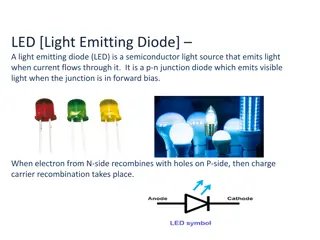
Types of Diodes and Their Uses Light-emitting diodes are designed with a very large band gap so movement of carriers across their depletion region emits photons of light energy. Lower band gap LEDs (Light-Emitting Diodes) emit infrared radiation, while LEDs with higher band gap energy emit visible light. Many stop lights are now starting to use LEDs because they are extremely bright and last longer than regular bulbs for a relatively low cost. Light-Emitting Diodes: The arrows in the LED representation indicate emitted light. A K Schematic Symbol for a Light-Emitting Diode 5/8/2025 16
Types of Diodes and Their Uses While LEDs emit light, Photodiodes are sensitive to received light. They are constructed so their pn junction can be exposed to the outside through a clear window or lens. Photodiodes: A K In Photoconductive mode the saturation current increases in proportion to the intensity of the received light. This type of diode is used in CD players. A K In Photovoltaic mode, when the pn junction is exposed to a certain wavelength of light, the diode generates voltage and can be used as an energy source. This type of diode is used in the production of solar power. Schematic Symbols for Photodiodes 5/8/2025 17