Understanding Probabilistic Proof Systems in Computer Science
Delve into the world of probabilistic proof systems as defined by Oded Goldreich from the Weizmann Institute of Science. Explore the concepts of traditional NP-proof systems, interactive proofs, zero-knowledge proof systems, and their essential components such as interaction, randomness, and error probabilities.

Download Presentation

Please find below an Image/Link to download the presentation.
The content on the website is provided AS IS for your information and personal use only. It may not be sold, licensed, or shared on other websites without obtaining consent from the author. If you encounter any issues during the download, it is possible that the publisher has removed the file from their server.
You are allowed to download the files provided on this website for personal or commercial use, subject to the condition that they are used lawfully. All files are the property of their respective owners.
The content on the website is provided AS IS for your information and personal use only. It may not be sold, licensed, or shared on other websites without obtaining consent from the author.
E N D
Presentation Transcript
Probabilistic Proof Systems Oded Goldreich Weizmann Institute of Science
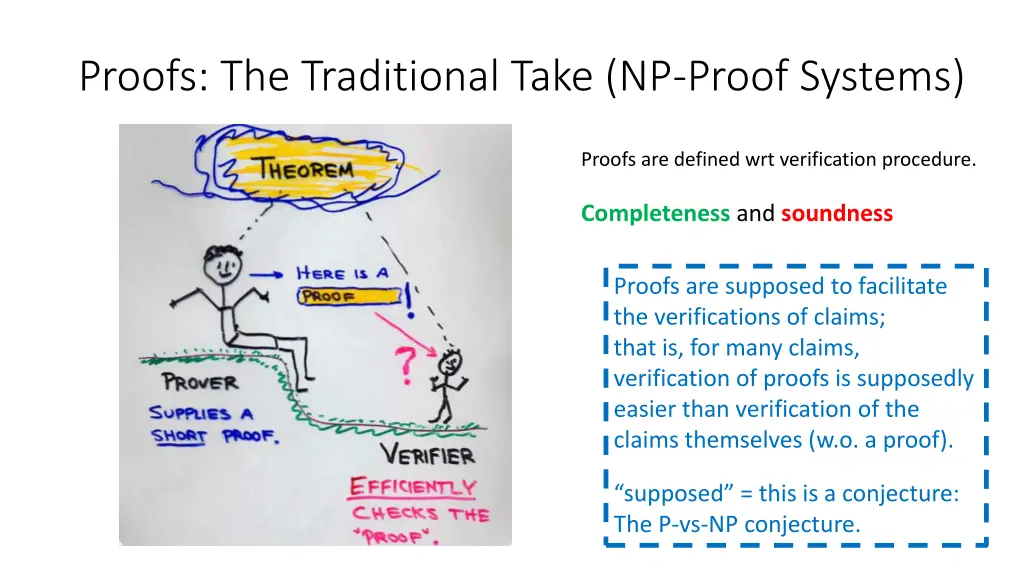
Proofs: The Traditional Take (NP-Proof Systems) Proofs are defined wrt verification procedure. Completeness and soundness Proofs are supposed to facilitate the verifications of claims; that is, for many claims, verification of proofs is supposedly easier than verification of the claims themselves (w.o. a proof). supposed = this is a conjecture: The P-vs-NP conjecture.
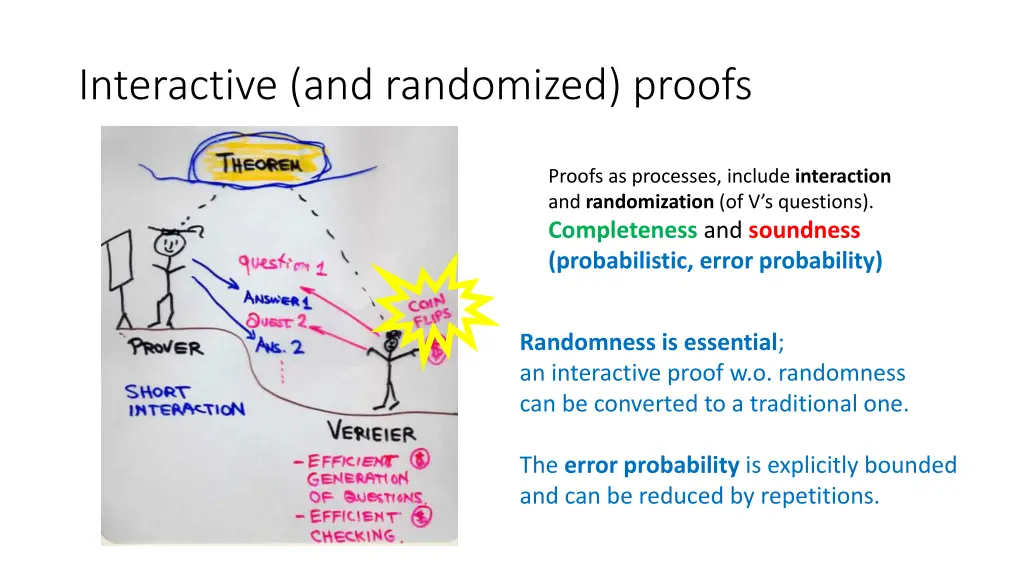
Interactive (and randomized) proofs Proofs as processes, include interaction and randomization(of V s questions). Completeness and soundness (probabilistic, error probability) Randomness is essential; an interactive proof w.o. randomness can be converted to a traditional one. The error probability is explicitly bounded and can be reduced by repetitions.
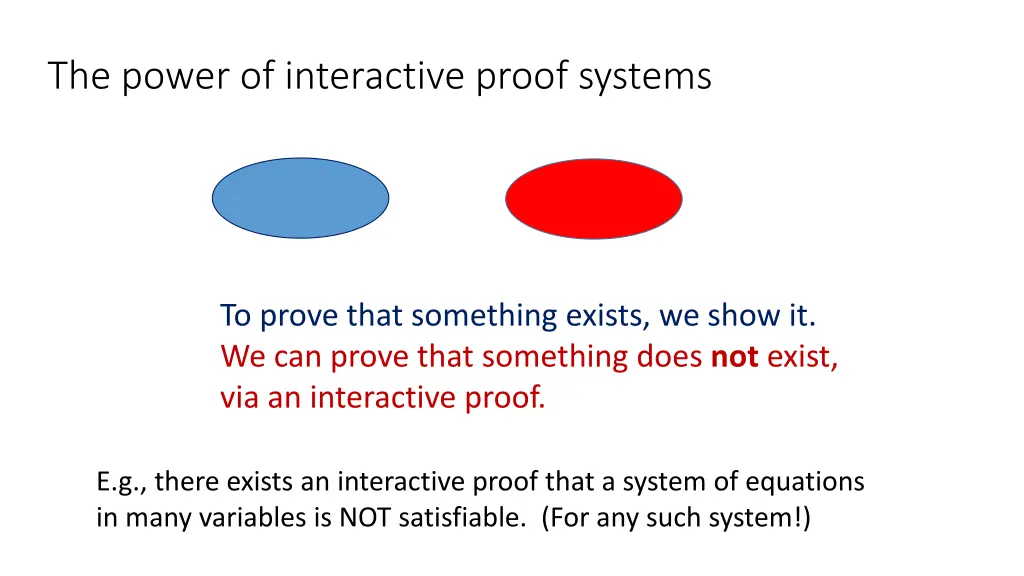
The power of interactive proof systems To prove that something exists, we show it. We can prove that something does not exist, via an interactive proof. E.g., there exists an interactive proof that a system of equations in many variables is NOT satisfiable. (For any such system!)
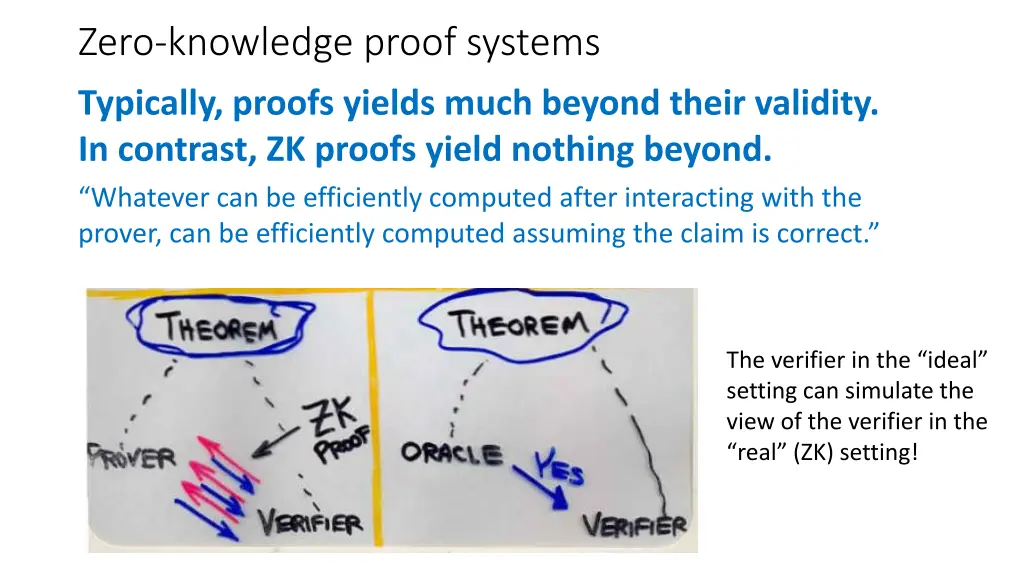
Zero-knowledge proof systems Typically, proofs yields much beyond their validity. In contrast, ZK proofs yield nothing beyond. Whatever can be efficiently computed after interacting with the prover, can be efficiently computed assuming the claim is correct. The verifier in the ideal setting can simulate the view of the verifier in the real (ZK) setting!
The power of zero-knowledge proof systems We can prove that something exists by showing it. Using ZKIP, we can prove that something exist, without showing it; furthermore, without showing any part of it. There exists a zero-knowledge proof that a system of equations in many variables is satisfiable. (For any such system!)
Essential and inessential ingredients Interaction is essential (both in IP and ZK). Randomness is essential (both in IP and ZK (for both parties)). E.g., if the verifier is deterministic, then IP-systems collapses to NP-systems. No point to interact with a predictable person who is computationally weaker. Error probability is essential, but can be reduced almost arbitrarily. Sophisticated question help but are inessential for IP (i.e., wlog, the verifier may ask totally random questions).
Zero-knowledge proof systems Typically, proofs yields much beyond their validity. In contrast, ZK proofs yield nothing beyond. Whatever can be efficiently computed after interacting with the prover, can be efficiently computed assuming the claim is correct. Formally, for an interactive proof (P,V) and any (valid) claim x, we consider two distributions: 1. The output generated by V (or even by any feasible knowledge-seeking adversary ) on input x after interacting with the prover strategy P. 2. The output of some efficient procedure ( simulator ) on input x. We require that these distributions are identical / statistically-close / computationally-indistinguishable.