Understanding Rabin Lock in Public-Key Cryptography
Explore the concept of Rabin Lock, a public-key system based on the square root problem in a finite ring. Learn about the Rabin Crypto-System, quadratic residues, and quadratic non-residues in GF(p), and how to identify them. Delve into the complexities of squaring and square roots in Zm while uncovering the unique properties and challenges of the Rabin Lock method.

Download Presentation

Please find below an Image/Link to download the presentation.
The content on the website is provided AS IS for your information and personal use only. It may not be sold, licensed, or shared on other websites without obtaining consent from the author. If you encounter any issues during the download, it is possible that the publisher has removed the file from their server.
You are allowed to download the files provided on this website for personal or commercial use, subject to the condition that they are used lawfully. All files are the property of their respective owners.
The content on the website is provided AS IS for your information and personal use only. It may not be sold, licensed, or shared on other websites without obtaining consent from the author.
E N D
Presentation Transcript
Introduction to Cryptology Lecture-12 Public-Key Cryptography Quadratic Residues and Rabin Lock 17.05.2023, v54 Page : 1
Rabin Lock for a Public-Key System is Based on the Square Root Problem in a Finite Ring (1979) Page : 2
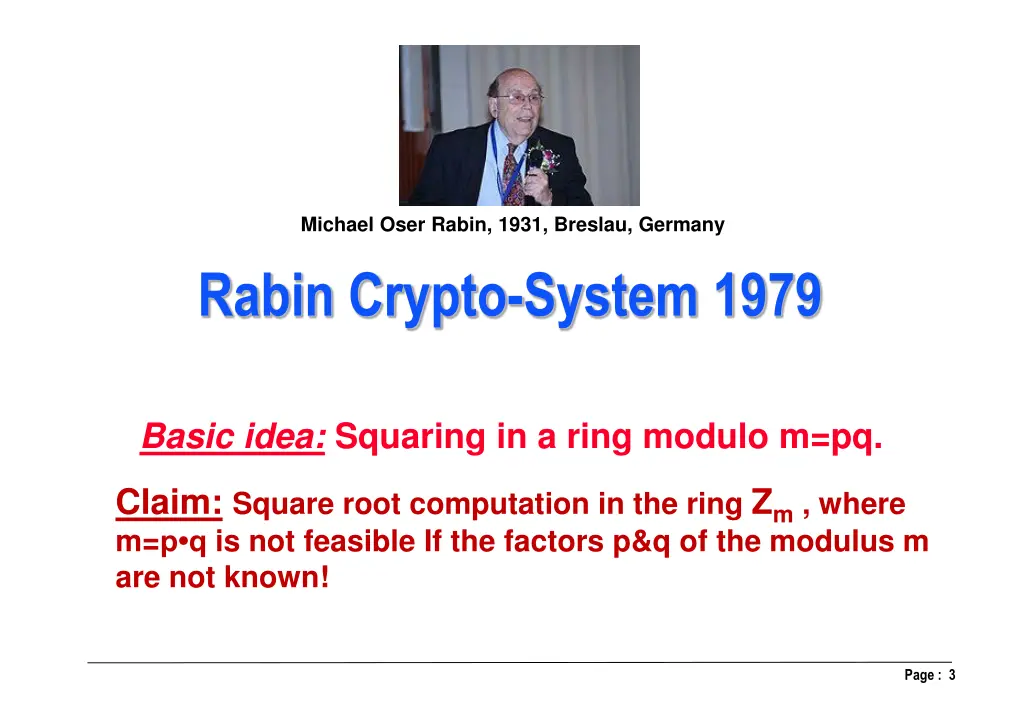
Michael Oser Rabin, 1931, Breslau, Germany Rabin Crypto-System 1979 Basic idea: Squaring in a ring modulo m=pq. Claim: Square root computation in the ring Zm, where m=p q is not feasible If the factors p&q of the modulus m are not known! Page : 3
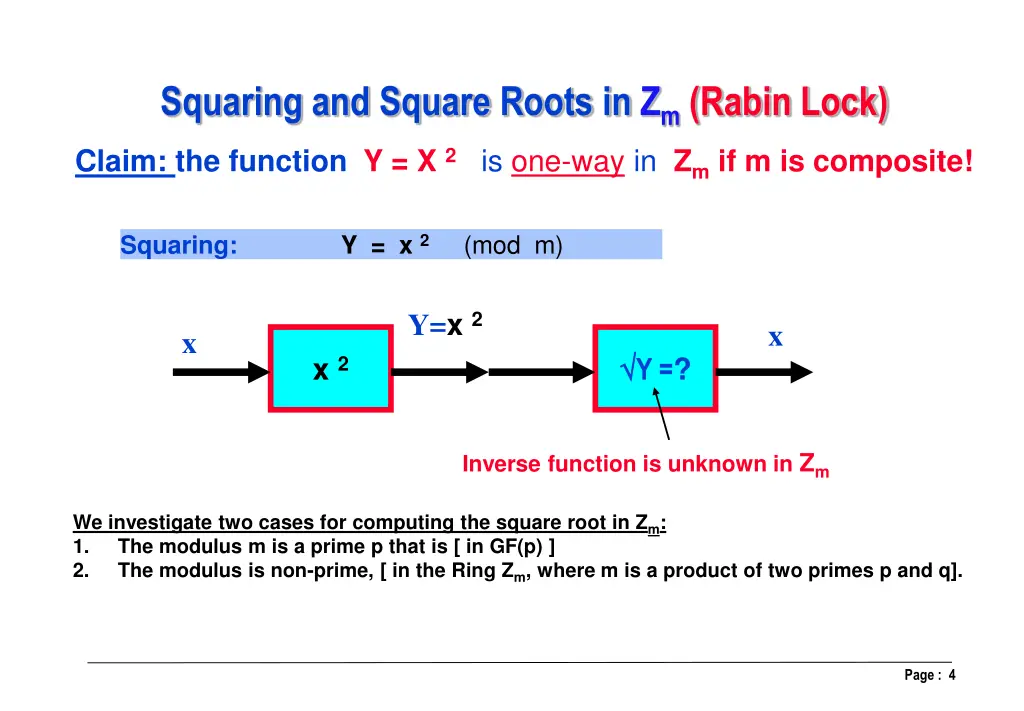
Squaring and Square Roots in Zm(Rabin Lock) Claim: the function Y = X2is one-way in Zmif m is composite! (mod m) Squaring: Y = x2 Y=x 2 x x Y =? x 2 Inverse function is unknown in Zm We investigate two cases for computing the square root in Zm: 1. The modulus m is a prime p that is [ in GF(p) ] 2. The modulus is non-prime, [ in the Ring Zm, where m is a product of two primes p and q]. Page : 4
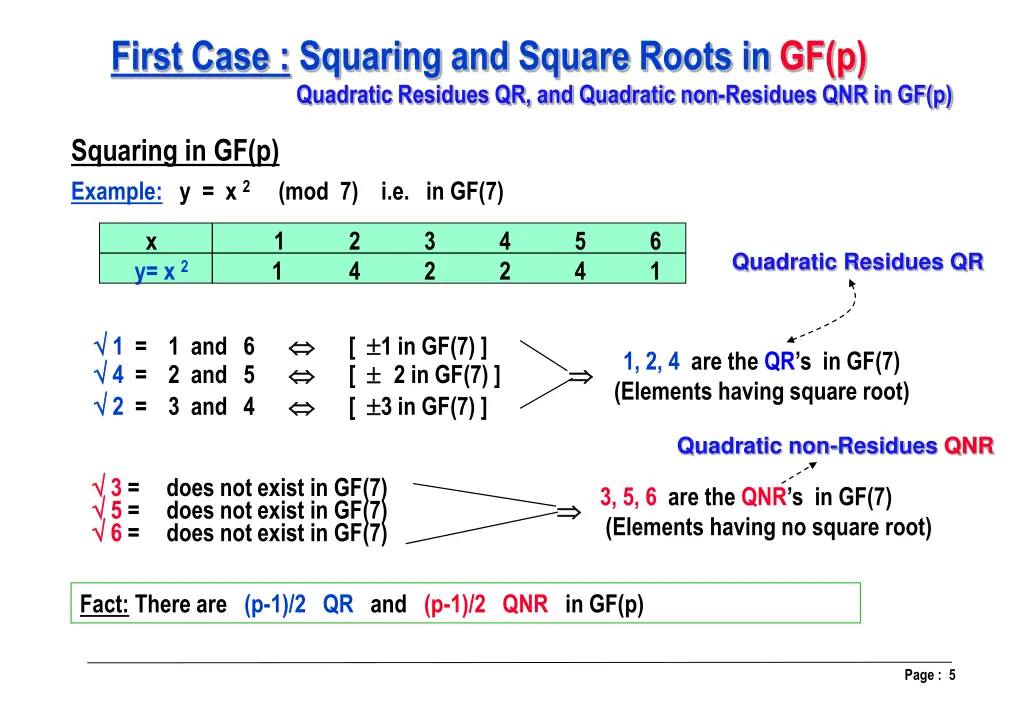
First Case : Squaring and Square Roots in GF(p) Quadratic Residues QR, and Quadratic non-Residues QNR in GF(p) Squaring in GF(p) Example: y = x 2 (mod 7) i.e. in GF(7) x y= x2 1 1 2 4 3 2 4 2 5 4 6 1 Quadratic Residues QR 1 = 1 and 6 [ 1 in GF(7) ] 1, 2, 4 are the QR s in GF(7) (Elements having square root) 4 = 2 and 5 2 = 3 and 4 [ 2 in GF(7) ] [ 3 in GF(7) ] Quadratic non-Residues QNR 3 = does not exist in GF(7) 5 = does not exist in GF(7) 3, 5, 6 are the QNR s in GF(7) (Elements having no square root) 6 = does not exist in GF(7) Fact: There are (p-1)/2 QR and (p-1)/2 QNR in GF(p) Page : 5
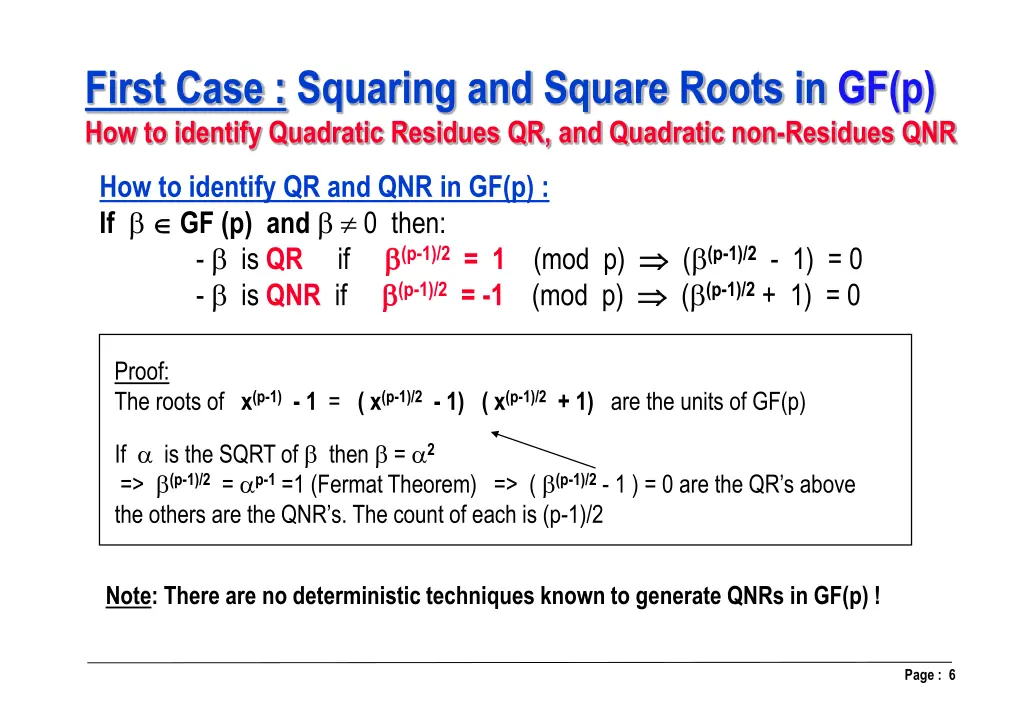
First Case : Squaring and Square Roots in GF(p) How to identify Quadratic Residues QR, and Quadratic non-Residues QNR How to identify QR and QNR in GF(p) : If GF (p) and 0 then: - is QR - is QNR if (p-1)/2= -1 if (p-1)/2= 1 (mod p) (mod p) ( (p-1)/2- 1) = 0 ( (p-1)/2+ 1) = 0 Proof: The roots of x(p-1)- 1 = ( x(p-1)/2- 1) ( x(p-1)/2+ 1) are the units of GF(p) If is the SQRT of then = 2 => (p-1)/2= p-1=1 (Fermat Theorem) => ( (p-1)/2- 1 ) = 0 are the QR s above the others are the QNR s. The count of each is (p-1)/2 Note: There are no deterministic techniques known to generate QNRs in GF(p) ! Page : 6
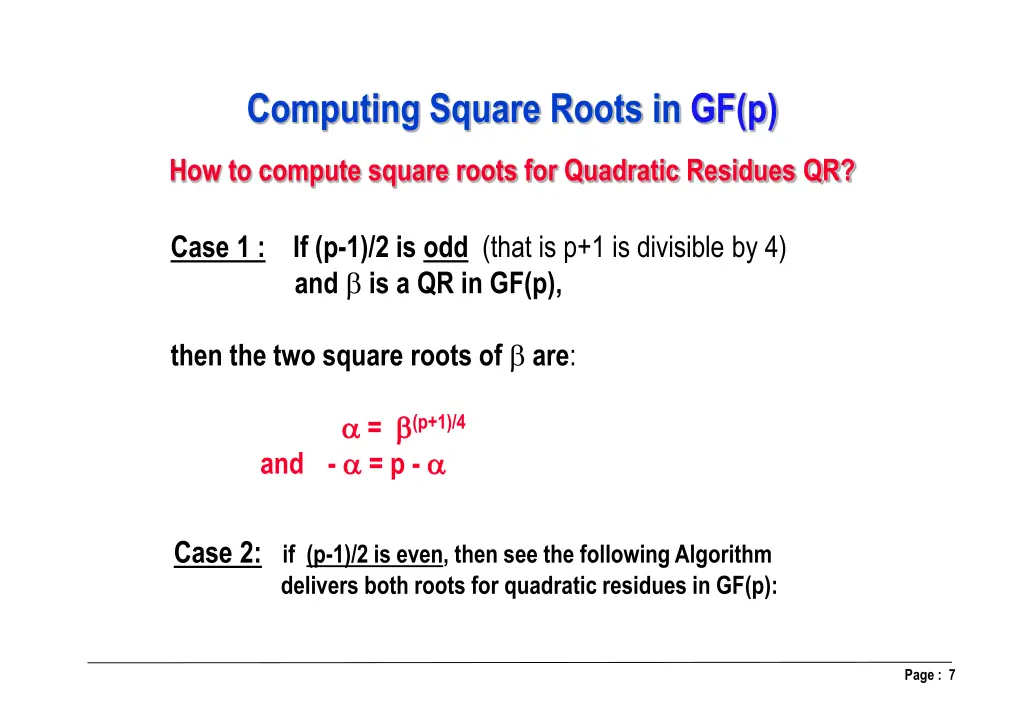
Computing Square Roots in GF(p) How to compute square roots for Quadratic Residues QR? Case 1 : If (p-1)/2 is odd (that is p+1 is divisible by 4) and is a QR in GF(p), then the two square roots of are: = (p+1)/4 and - = p - Case 2: if (p-1)/2 is even, then see the following Algorithm delivers both roots for quadratic residues in GF(p): Page : 7
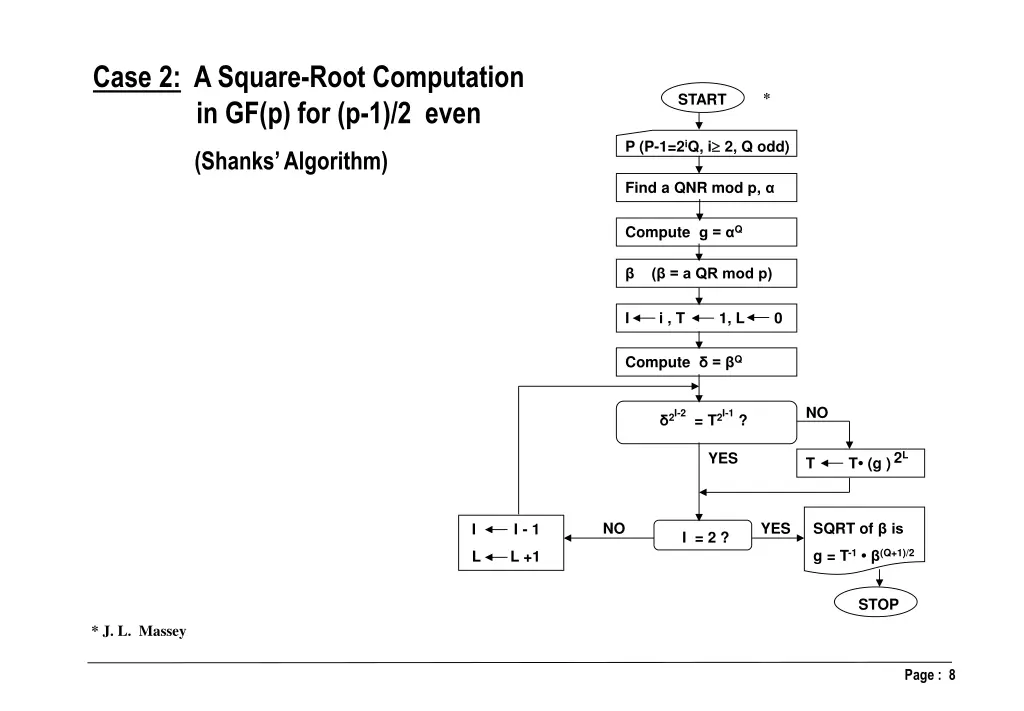
Case 2: A Square-Root Computation in GF(p) for (p-1)/2 even * START P (P-1=2iQ, i 2, Q odd) (Shanks Algorithm) Find a QNR mod p, Compute g = Q ( = a QR mod p) I i , T 1, L 0 Compute = Q NO 2I-2 = T2I-1 ? 2L YES T T (g ) NO YES SQRT of is I I - 1 I = 2 ? g = T-1 (Q+1)/2 L L +1 STOP * J. L. Massey Page : 8
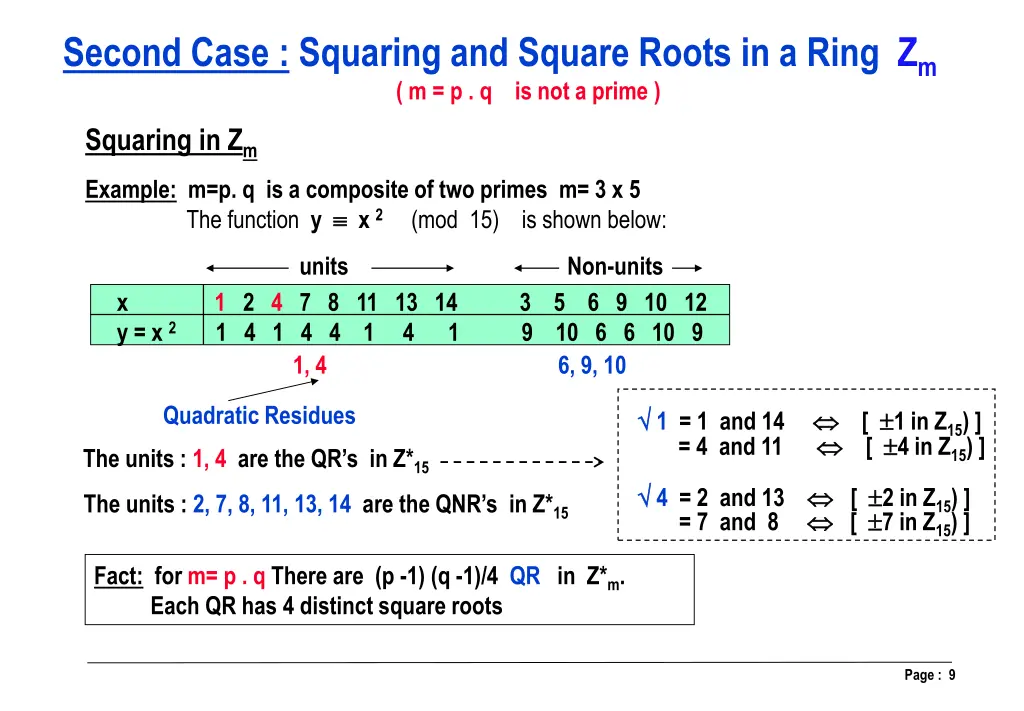
Second Case : Squaring and Square Roots in a Ring Zm ( m = p . q is not a prime ) Squaring in Zm Example: m=p. q is a composite of two primes m= 3 x 5 The function y x2 (mod 15) is shown below: units Non-units x y = x2 1 2 4 7 8 11 13 14 3 5 6 9 10 12 1 4 1 4 4 1 4 1 9 10 6 6 10 9 1, 4 6, 9, 10 Quadratic Residues 1 = 1 and 14 = 4 and 11 [ 1 in Z15) ] [ 4 in Z15) ] The units : 1, 4 are the QR s in Z*15 The units : 2, 7, 8, 11, 13, 14 are the QNR s in Z*15 4 = 2 and 13 = 7 and 8 [ 2 in Z15) ] [ 7 in Z15) ] Fact: for m= p . q There are (p -1) (q -1)/4 QR in Z*m. Each QR has 4 distinct square roots Page : 9
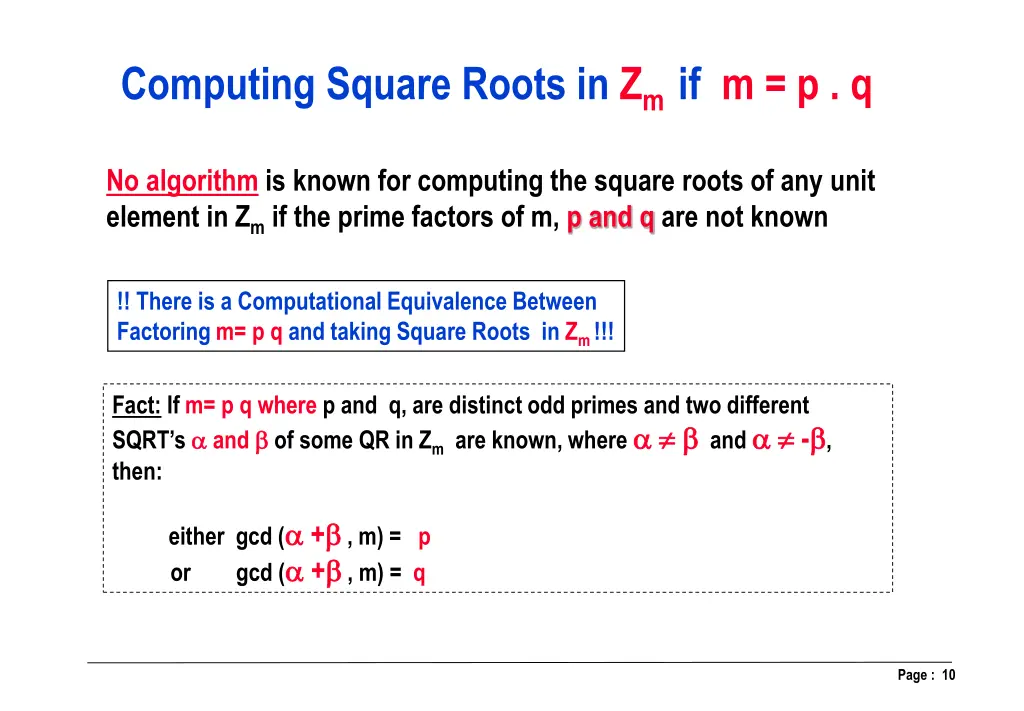
Computing Square Roots in Zmif m = p . q No algorithm is known for computing the square roots of any unit element in Zmif the prime factors of m, p and q are not known !! There is a Computational Equivalence Between Factoring m= p q and taking Square Roots in Zm !!! Fact: If m= p q where p and q, are distinct odd primes and two different SQRT s and of some QR in Zmare known, where and - , then: either gcd ( + , m) = p or gcd ( + , m) = q Page : 10
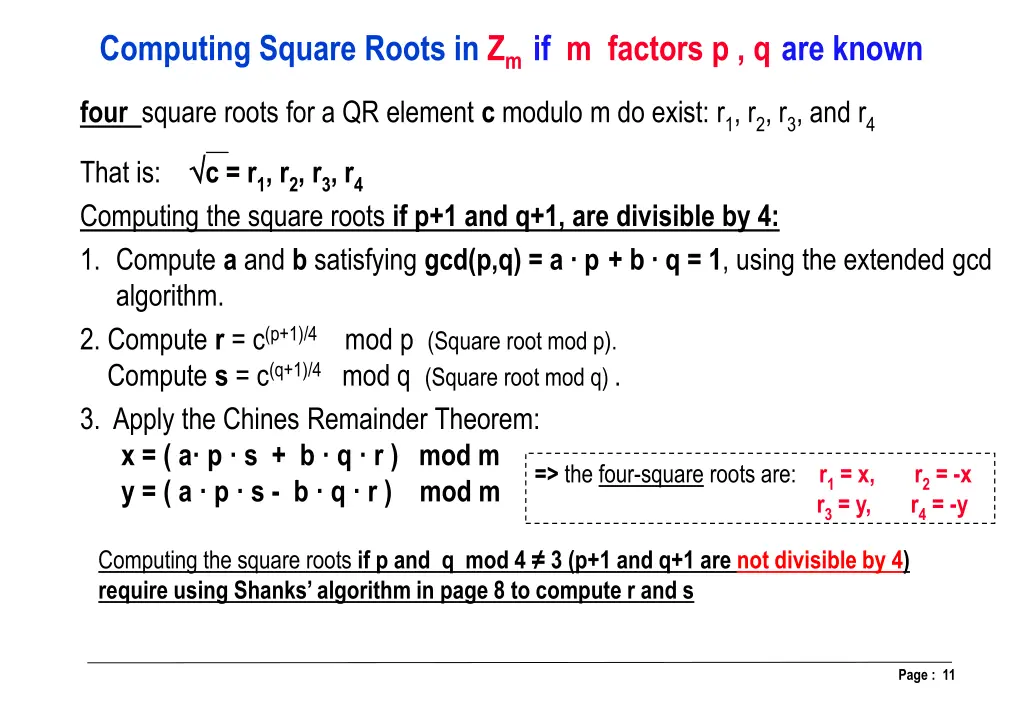
Computing Square Roots in Zmif m factors p , q are known four square roots for a QR element c modulo m do exist: r1, r2, r3, and r4 That is: c = r1, r2, r3, r4 Computing the square roots if p+1 and q+1, are divisible by 4: 1. Compute a and b satisfying gcd(p,q) = a p + b q = 1, using the extended gcd algorithm. 2. Compute r = c(p+1)/4 mod p (Square root mod p). Compute s = c(q+1)/4mod q (Square root mod q) . 3. Apply the Chines Remainder Theorem: x = ( a p s + b q r ) mod m y = ( a p s - b q r ) mod m => the four-square roots are: r1= x, r2= -x r4= -y r3= y, Computing the square roots if p and q mod 4 3 (p+1 and q+1 are not divisible by 4) require using Shanks algorithm in page 8 to compute r and s Page : 11
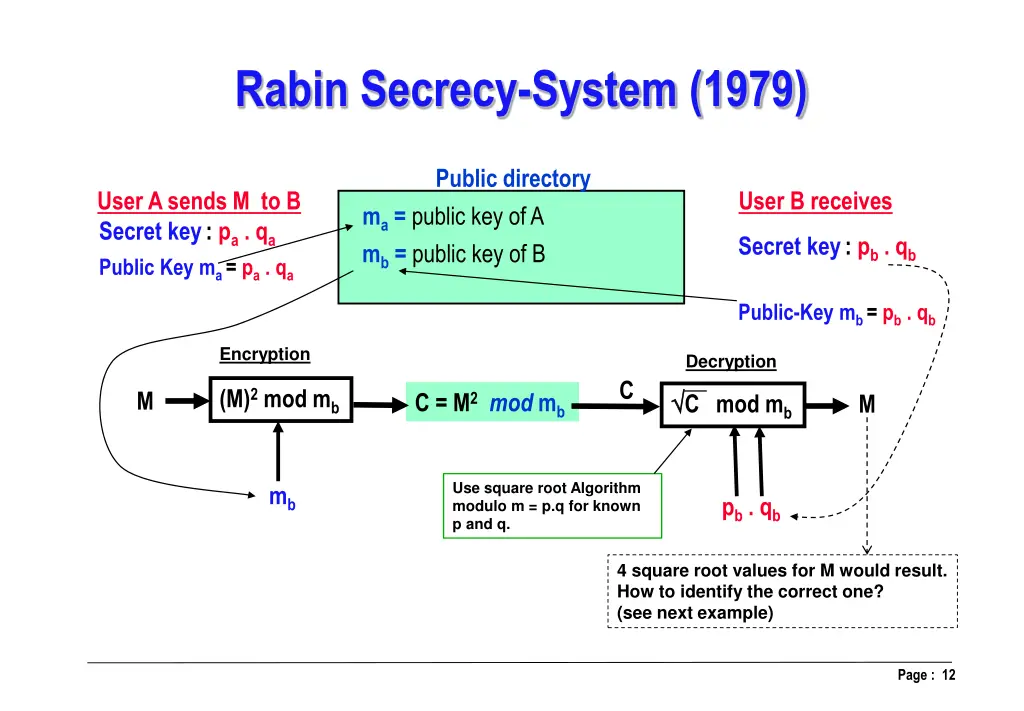
Rabin Secrecy-System (1979) Public directory ma= public key of A mb= public key of B User A sends M to B Secret key: pa. qa User B receives Secret key: pb. qb Public Key ma= pa. qa Public-Key mb= pb. qb Encryption Decryption C (M)2mod mb M C mod mb C = M2mod mb M Use square root Algorithm modulo m = p.q for known p and q. mb pb. qb 4 square root values for M would result. How to identify the correct one? (see next example) Page : 12
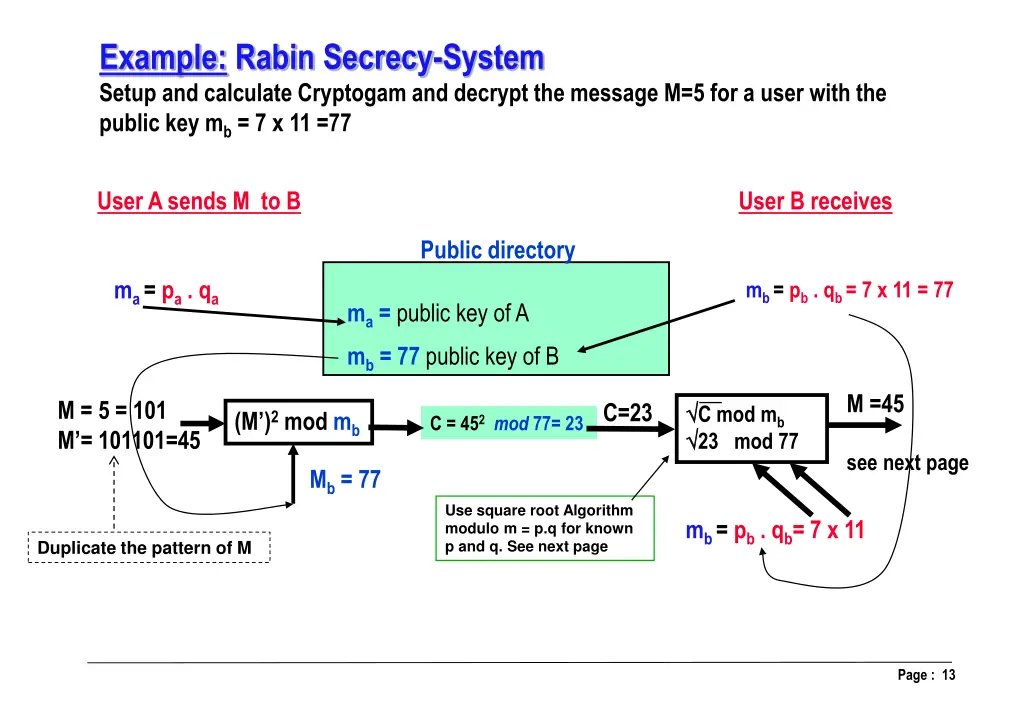
Example: Rabin Secrecy-System Setup and calculate Cryptogam and decrypt the message M=5 for a user with the public key mb= 7 x 11 =77 User A sends M to B User B receives Public directory ma= pa. qa mb= pb. qb = 7 x 11 = 77 ma= public key of A mb= 77 public key of B M =45 M = 5 = 101 M = 101101=45 C=23 C mod mb 23 mod 77 (M )2mod mb C = 452mod 77= 23 see next page Mb= 77 Use square root Algorithm modulo m = p.q for known p and q. See next page mb= pb. qb= 7 x 11 Duplicate the pattern of M Page : 13
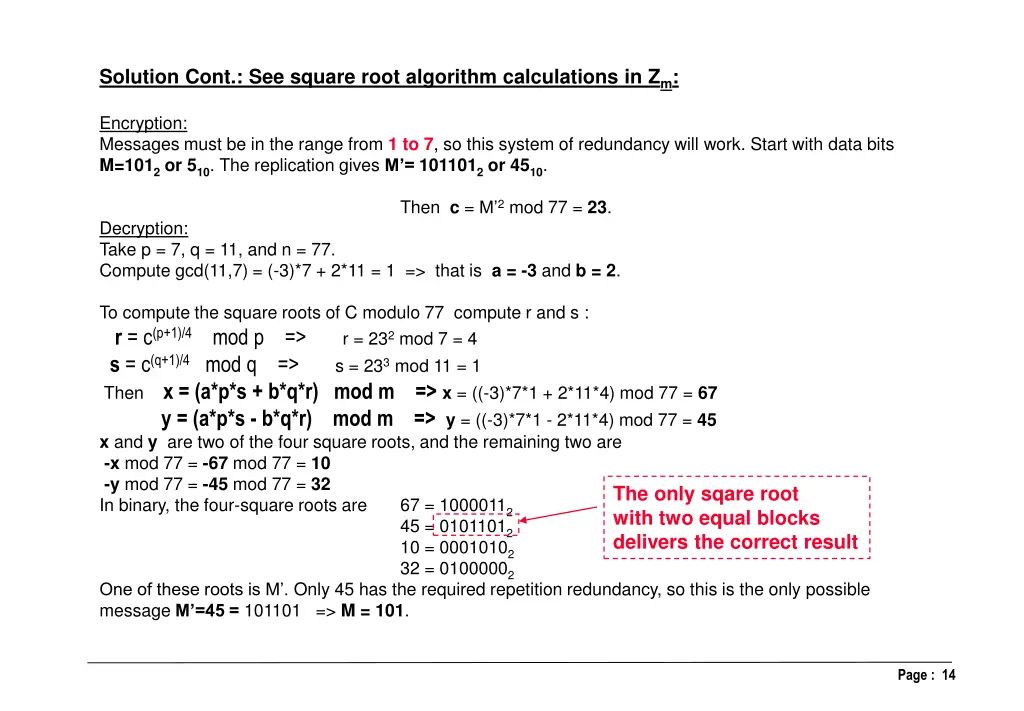
Solution Cont.: See square root algorithm calculations in Zm: Encryption: Messages must be in the range from 1 to 7, so this system of redundancy will work. Start with data bits M=1012or 510. The replication gives M = 1011012or 4510. Then c = M 2mod 77 = 23. Decryption: Take p = 7, q = 11, and n = 77. Compute gcd(11,7) = (-3)*7 + 2*11 = 1 => that is a = -3 and b = 2. To compute the square roots of C modulo 77 compute r and s : r = c(p+1)/4 mod p => r = 232mod 7 = 4 s = c(q+1)/4mod q => s = 233mod 11 = 1 Then x = (a*p*s + b*q*r) mod m => x = ((-3)*7*1 + 2*11*4) mod 77 = 67 y = (a*p*s - b*q*r) mod m => y = ((-3)*7*1 - 2*11*4) mod 77 = 45 x and y are two of the four square roots, and the remaining two are -x mod 77 = -67 mod 77 = 10 -y mod 77 = -45 mod 77 = 32 In binary, the four-square roots are 67 = 10000112 45 = 01011012 10 = 00010102 32 = 01000002 One of these roots is M . Only 45 has the required repetition redundancy, so this is the only possible message M =45 = 101101 => M = 101. The only sqare root with two equal blocks delivers the correct result Page : 14
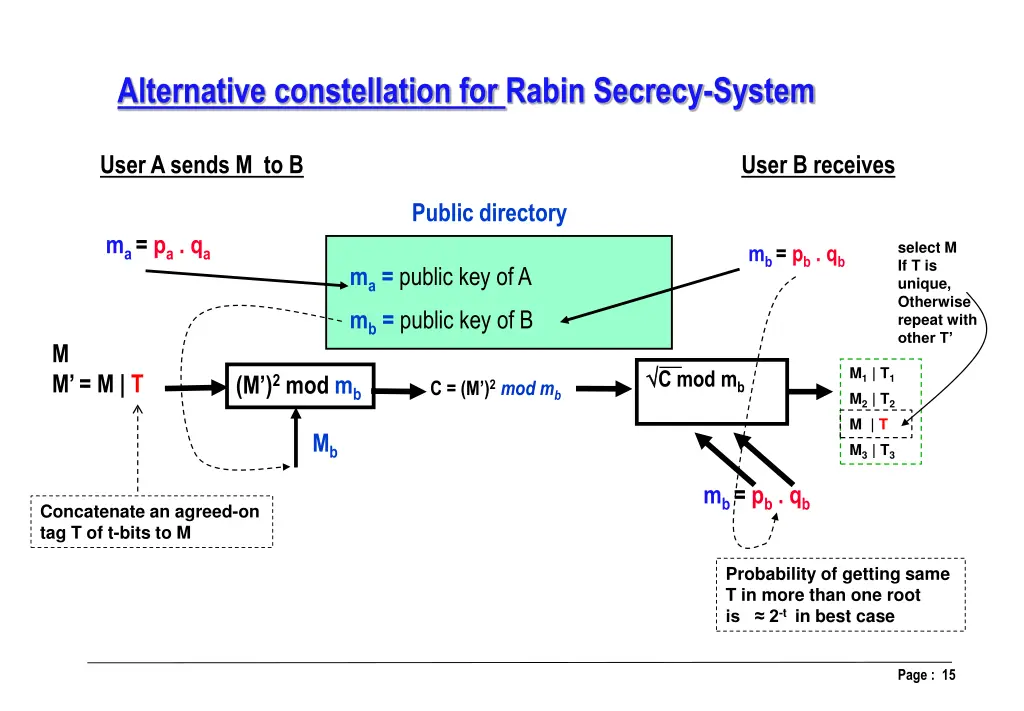
Alternative constellation for Rabin Secrecy-System User A sends M to B User B receives Public directory ma= pa. qa select M If T is unique, Otherwise repeat with other T mb= pb. qb ma= public key of A mb= public key of B M M = M | T C mod mb M1| T1 M2| T2 M | T (M )2mod mb C = (M )2mod mb Mb M3| T3 mb= pb. qb Concatenate an agreed-on tag T of t-bits to M Probability of getting same T in more than one root is 2-t in best case Page : 15
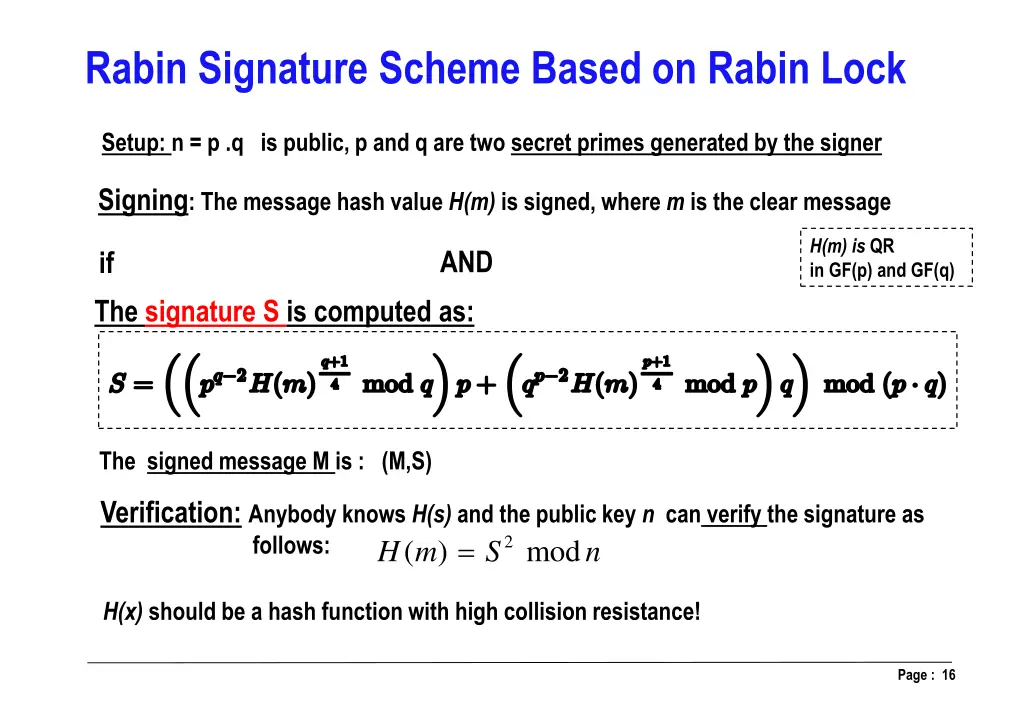
Rabin Signature Scheme Based on Rabin Lock Setup: n = p .q is public, p and q are two secret primes generated by the signer Signing: The message hash value H(m) is signed, where m is the clear message H(m) is QR in GF(p) and GF(q) AND if The signature S is computed as: The signed message M is : (M,S) Verification: Anybody knows H(s) and the public key n can verify the signature as follows: ( ) H m S = 2 mod n H(x) should be a hash function with high collision resistance! Page : 16
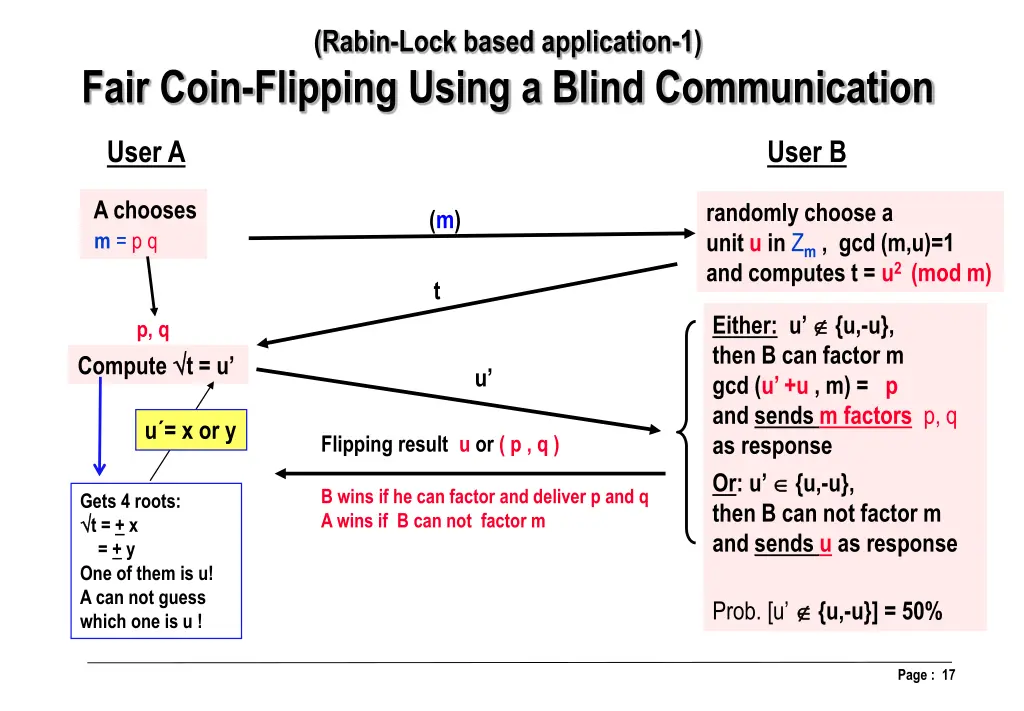
(Rabin-Lock based application-1) Fair Coin-Flipping Using a Blind Communication User A User B A chooses m = p q randomly choose a unit u in Zm, gcd (m,u)=1 and computes t = u2 (mod m) (m) t Either: u {u,-u}, then B can factor m gcd (u +u , m) = p and sends m factors p, q as response Or: u {u,-u}, then B can not factor m and sends u as response p, q Compute t = u u u = x or y Flipping result u or ( p , q ) B wins if he can factor and deliver p and q A wins if B can not factor m Gets 4 roots: t = + x = + y One of them is u! A can not guess which one is u ! Prob. [u {u,-u}] = 50% Page : 17
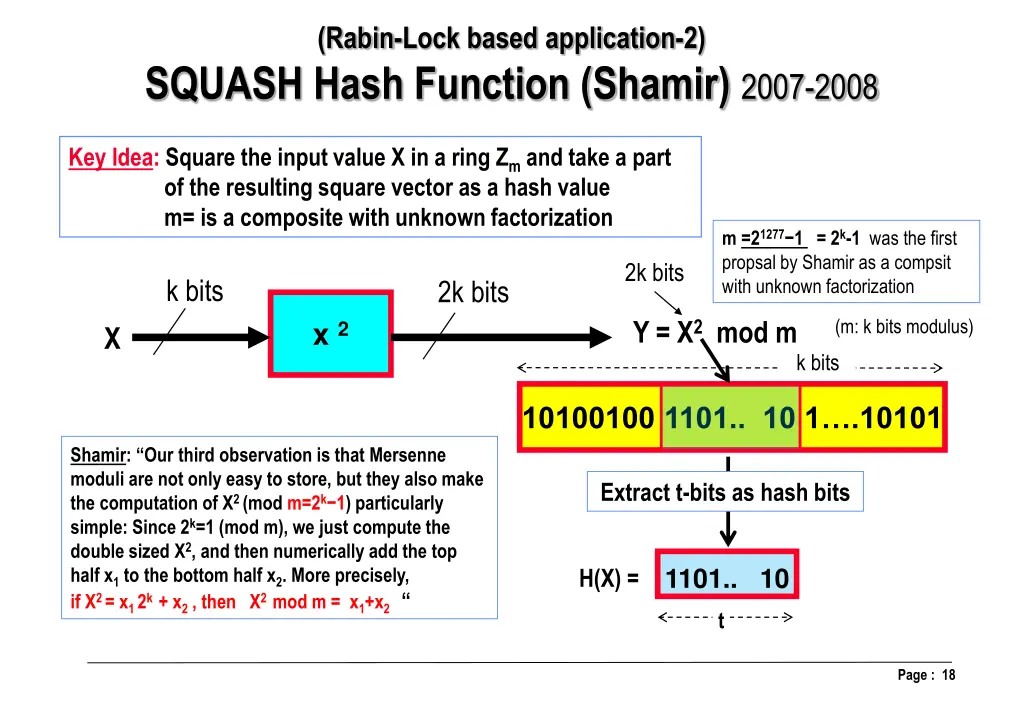
(Rabin-Lock based application-2) SQUASH Hash Function (Shamir) 2007-2008 Key Idea: Square the input value X in a ring Zmand take a part of the resulting square vector as a hash value m= is a composite with unknown factorization m =21277 1 = 2k-1 was the first propsal by Shamir as a compsit with unknown factorization 2k bits k bits 2k bits Y = X2mod m (m: k bits modulus) x 2 X k bits 10100100 1101.. 10 1 .10101 Shamir: Our third observation is that Mersenne moduli are not only easy to store, but they also make the computation of X2 (mod m=2k 1) particularly simple: Since 2k=1 (mod m), we just compute the double sized X2, and then numerically add the top half x1to the bottom half x2. More precisely, if X2 = x1 2k + x2, then X2 mod m = x1+x2 Extract t-bits as hash bits 1101.. 10 H(X) = t Page : 18