Understanding Rescission of Contracts in Contract Law
Learn about rescission of contracts in contract law, including what it means, when it may be adjudged, when it cannot be rescinded, alternative prayers for rescission, and circumstances under which a contract can be rescinded.

Download Presentation

Please find below an Image/Link to download the presentation.
The content on the website is provided AS IS for your information and personal use only. It may not be sold, licensed, or shared on other websites without obtaining consent from the author. If you encounter any issues during the download, it is possible that the publisher has removed the file from their server.
You are allowed to download the files provided on this website for personal or commercial use, subject to the condition that they are used lawfully. All files are the property of their respective owners.
The content on the website is provided AS IS for your information and personal use only. It may not be sold, licensed, or shared on other websites without obtaining consent from the author.
E N D
Presentation Transcript
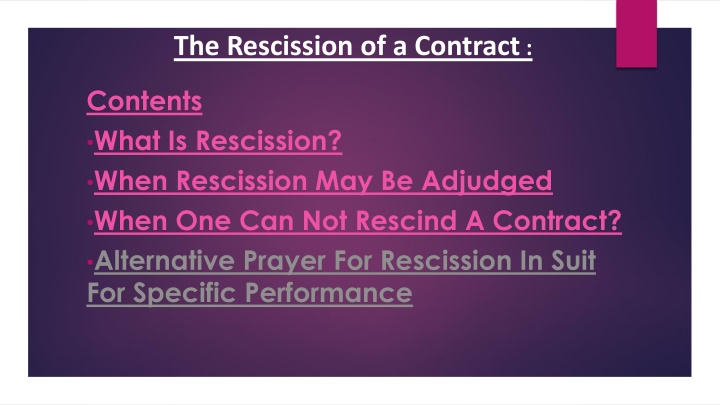
The Rescission of a Contract : Contents What Is Rescission? When Rescission May Be Adjudged When One Can Not Rescind A Contract? Alternative Prayer For Rescission In Suit For Specific Performance
What does rescission of a contract mean? Rescission of contract: In contract law, rescission has been defined as the unmaking of a contract between parties. Rescission is the unwinding of a transaction. This is done to bring the parties, as far as possible, back to the position in which they were before they entered into a contract (the status quo ante.) When a contract is broken by one party, the other party may treat the contract as rescinded. In such a case he is absolved of all his obligations under the contract and is entitled to compensation for any damages that he might have suffered.
Illustration Example: A promises B to deliver 50 bags of cement on a certain day. B agrees to pay the amount on receipt of the goods. A failed to deliver the cement on the appointed day. B is discharged from his liability. In Prem Raj v. D.L.F.M Co. Ltd., it was held that a person who sues for rescission of contract cannot claim alternative relief of specific performance but a person who files the suit for specific enforcement can alternatively claim for rescission of the contract. Section 35-38 of Specific Relief Act, 1877 has talked about rescission of contract.
Under what circumstances can a contract be rescinded? Section 35 of Specific Relief Act, 1877 has stated regarding this matter. One can rescind a contract for: Mutual consent If both parties feel that rescinding the contract is in their best interest, they can consent to rescission through a written document. Issues with the way the contract was formed There are certain legal conditions that must be present for a contract to be legally formed. If there are any conditions that exist in the formation of the contract such as fraud or acquiring by force, then the contract can be rescinded. Fraud can be characterized as a false representation of part of the contract. It is also illegal to form a contract with someone who is under duress or does not have the capacity to enter into a contract agreement. One party will not perform their obligations If one of the contracting parties performs actions that indicate their inability or unwillingness to perform their obligations, a contract can be rescinded. Failed consideration If the consideration of a contract has failed, is inadequate, or is illegal, then there would be a case to have the contract rescinded. Against the interest of the public If the contract is considered to be made in a way that would be against the general consent of the public, then rescission can occur.
When one can not rescind a contract? Rescission of a contract in writing can t be adjudged for mere mistake, unless the party against whom it is adjudged can be restored to substantially some position as if the contract had not been made. (Section 36) A judge may deny a request to rescind a contract based on the following circumstances: Substantial performance One of the parties has confirmed their willingness to fulfill their obligations by performing the actions. Third party benefit If a third party has received some benefit or acquired some rights from the contract, undoing the contract could cause them harm. Other defenses Some of the other defenses that can be used to rescind a contract include unclean hands, which refers to one party filing a breach of contract due to the other party committing a wrong. Another defense is laches, which means one party unnecessarily delayed a filing which caused prejudice to a party.
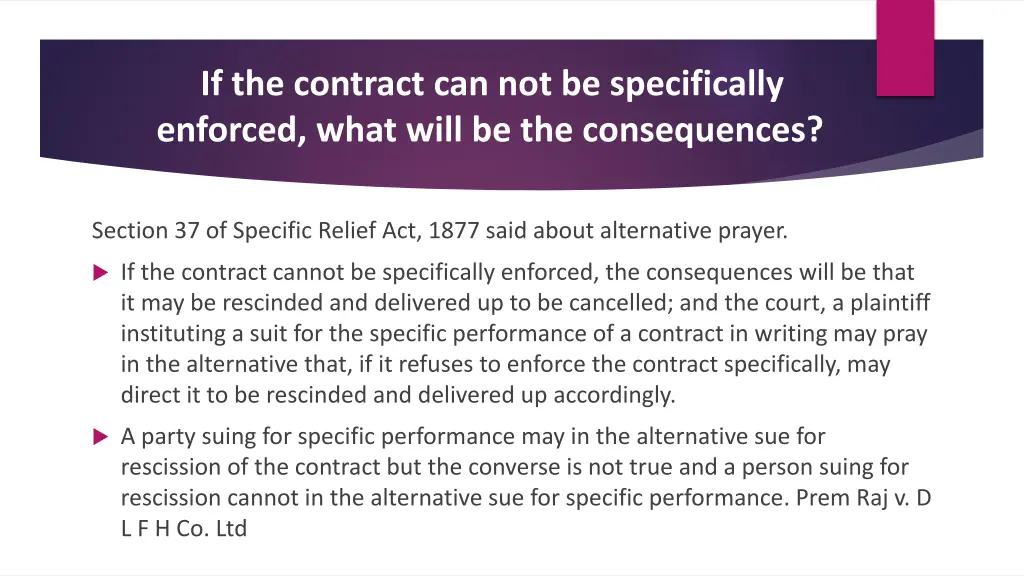
If the contract can not be specifically enforced, what will be the consequences? Section 37 of Specific Relief Act, 1877 said about alternative prayer. If the contract cannot be specifically enforced, the consequences will be that it may be rescinded and delivered up to be cancelled; and the court, a plaintiff instituting a suit for the specific performance of a contract in writing may pray in the alternative that, if it refuses to enforce the contract specifically, may direct it to be rescinded and delivered up accordingly. A party suing for specific performance may in the alternative sue for rescission of the contract but the converse is not true and a person suing for rescission cannot in the alternative sue for specific performance. Prem Raj v. D L F H Co. Ltd
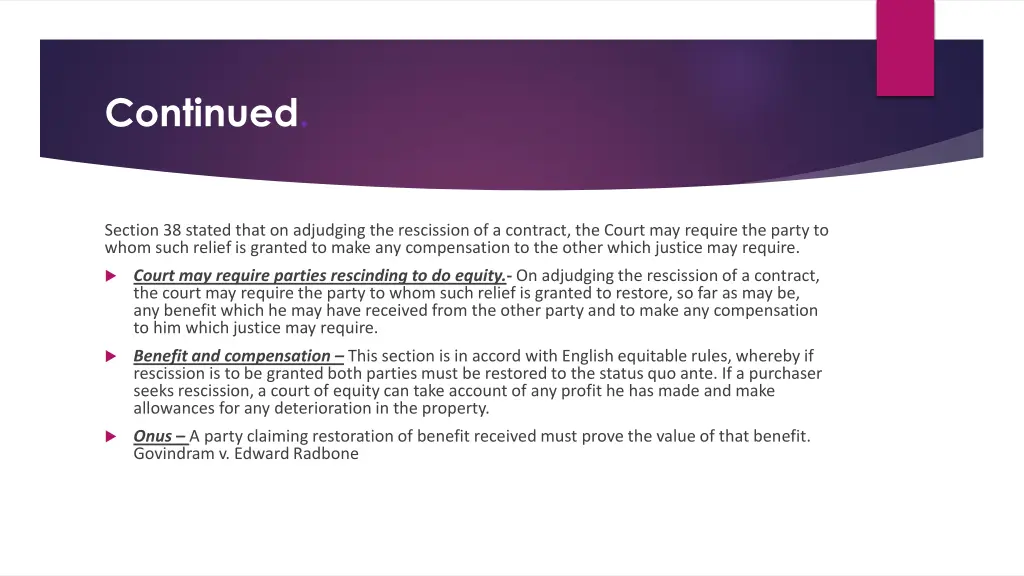
Continued. Section 38 stated that on adjudging the rescission of a contract, the Court may require the party to whom such relief is granted to make any compensation to the other which justice may require. Court may require parties rescinding to do equity.- On adjudging the rescission of a contract, the court may require the party to whom such relief is granted to restore, so far as may be, any benefit which he may have received from the other party and to make any compensation to him which justice may require. Benefit and compensation This section is in accord with English equitable rules, whereby if rescission is to be granted both parties must be restored to the status quo ante. If a purchaser seeks rescission, a court of equity can take account of any profit he has made and make allowances for any deterioration in the property. Onus A party claiming restoration of benefit received must prove the value of that benefit. Govindram v. Edward Radbone