Explore the world of retail marketing, including the key functions, scope, and factors driving the sector's growth. Learn how retailers add value to products and services through activities like merchandising, marketing, and store operations.
Please find below an Image/Link to download the presentation.
The content on the website is provided AS IS for your information and personal use only. It may not be sold, licensed, or shared on other websites without obtaining consent from the author. If you encounter any issues during the download, it is possible that the publisher has removed the file from their server.
You are allowed to download the files provided on this website for personal or commercial use, subject to the condition that they are used lawfully. All files are the property of their respective owners.
The content on the website is provided AS IS for your information and personal use only. It may not be sold, licensed, or shared on other websites without obtaining consent from the author.
E N D
Presentation Transcript
DR.P.KAVIMANI SUBJECT : RETAIL MARKETING CLASS: III YEAR
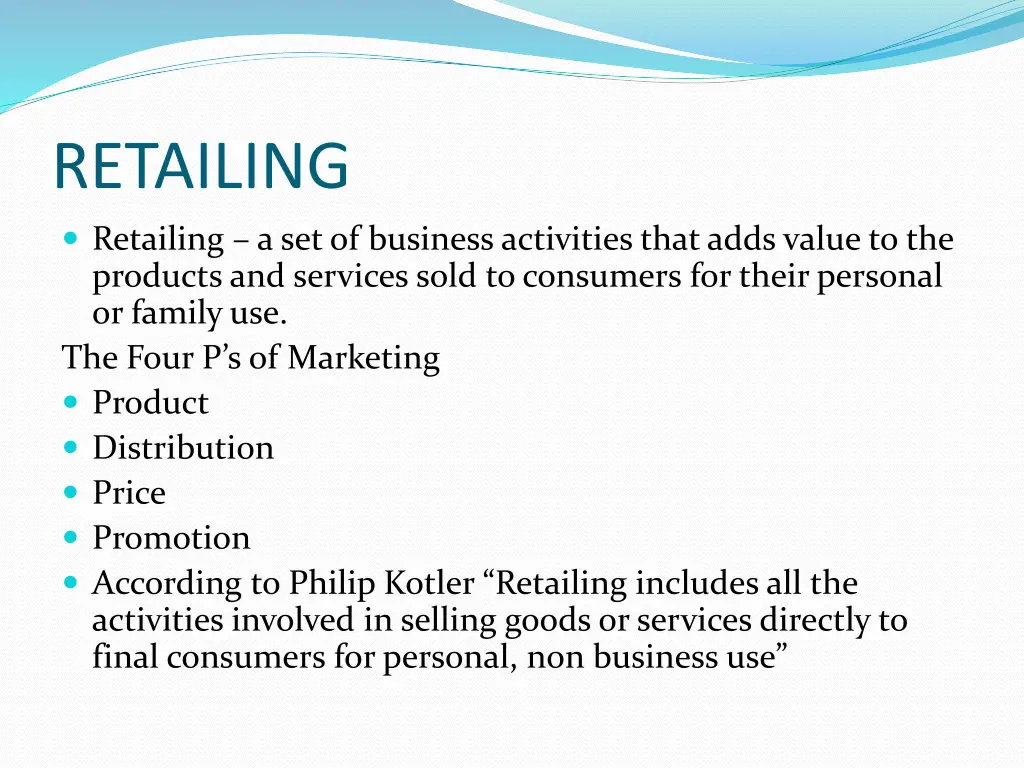
RETAILING Retailing a set of business activities that adds value to the products and services sold to consumers for their personal or family use. The Four P s of Marketing Product Distribution Price Promotion According to Philip Kotler Retailing includes all the activities involved in selling goods or services directly to final consumers for personal, non business use
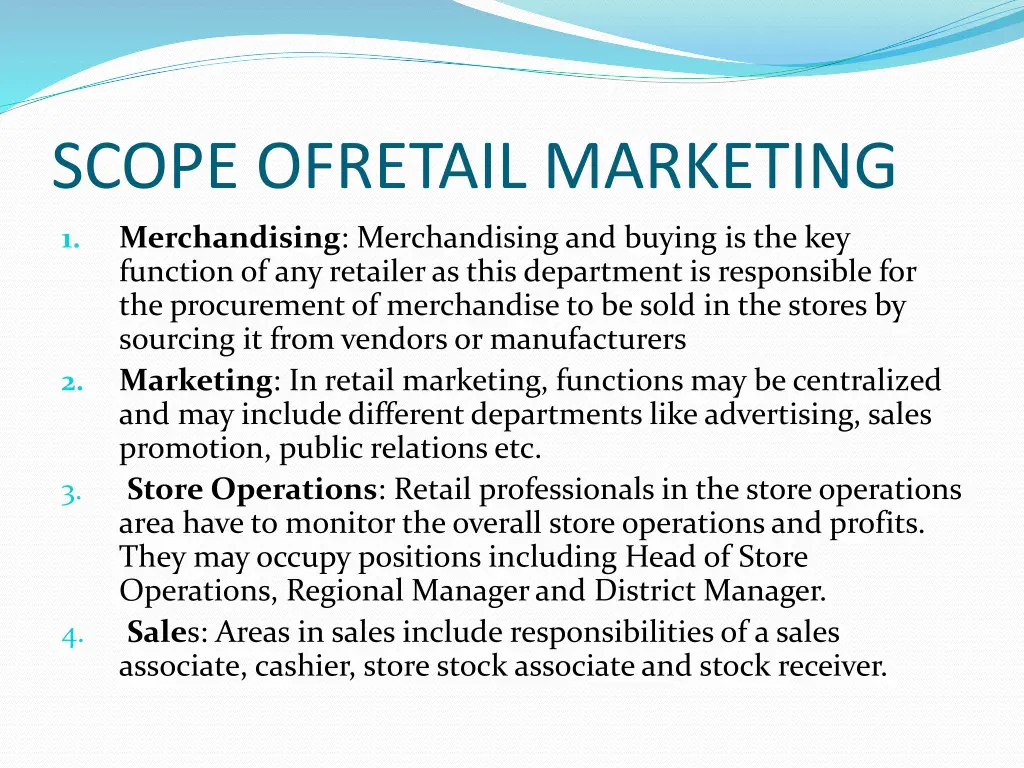
SCOPE OFRETAIL MARKETING Merchandising: Merchandising and buying is the key function of any retailer as this department is responsible for the procurement of merchandise to be sold in the stores by sourcing it from vendors or manufacturers Marketing: In retail marketing, functions may be centralized and may include different departments like advertising, sales promotion, public relations etc. Store Operations: Retail professionals in the store operations area have to monitor the overall store operations and profits. They may occupy positions including Head of Store Operations, Regional Manager and District Manager. Sales: Areas in sales include responsibilities of a sales associate, cashier, store stock associate and stock receiver. 1. 2. 3. 4.
Factors Involve for Growing Importance of Retail Sector Large and increasing contribution to GDP Economic importance more visible Major Employer Retailers as Gatekeepers Retailers diversifying their activities Organization growing on an international scale Size of Operations allowing for supply chain control Blurring of areas of retail to include wider area of business activity
Activities of Retailer The value creating activities of Retailer are: 1. Providing an Assortment of Products and Services Big retailers carry large number of items made by several companies. Offering an assortment enables the customers to choose from the wide selection of brands, designs, sizes, colours etc. at one location. 2. Breaking Bulk - Retailers offer products in smaller quantities tailored to individual consumers and households consumption patterns 3. Holding Inventory Retailers keep inventory, broken into user friendly sizes so that products will be available when consumers want them. 4. Providing Services Retailers provide services that make it easier for customers to buy and use products. 5. Increasing the Value of Products and Services - Thus by providing assortments, breaking bulk, holding inventory and providing services, retailers increase the value that consumers receive from their products and services.
RETAIL STORE CLASSIFICATION Retail stores could be classified in the following ways: By service or product retailing; By type of merchandise e.g., food, apparel, automotive, drug etc., Departmental specialty retailing By margin and turnover, By location, e.g. city centre, out-of-town, free-standing etc., By type of ownership e.g., independent, chain, franchise, etc., By strategic group multiples., Store versus non-store retailing; Electronic or the Internet retailing.
RETAIL PRICING The pricing policy selected by a retailer will usually be directly related to the resultant level of demand over a period of time and with the right margins, to the profitability of the enterprise. As a business, the retailer has to seek cash flow, profitability and growth in order to improve their market position.
COMPETITION AND RETAIL PRICING Competition and retail Pricing Market pricing- many retailers are in market and consumers have many to chose from which makes prices of products very similar Administered pricing- seeks to attract consumers based on uniqueness of offering rather than price
PRICE STRATEGY Demand Oriented price set based on consumers desire . Use demand to estimate what consumers are willing to pay Price- quality association the higher price the higher the quality ,Prestige pricing higher the price the better, consumers preferences Cost Oriented Adding a $ amount to costs to set price Markup pricing &Markup difference between merchandise costs and selling price Competition oriented Use competitions prices ONLY as a guide can price above, below or at same level as competition