Understanding Shell Programming at UC Santa Barbara
Explore the fundamentals of shell programming, system calls, and project requirements at UC Santa Barbara with insights from Bryce Boe's CS170 course in 2011. Learn about simple shell implementation, Minix Lottery Scheduling, and essential system calls for process management.

Download Presentation

Please find below an Image/Link to download the presentation.
The content on the website is provided AS IS for your information and personal use only. It may not be sold, licensed, or shared on other websites without obtaining consent from the author. If you encounter any issues during the download, it is possible that the publisher has removed the file from their server.
You are allowed to download the files provided on this website for personal or commercial use, subject to the condition that they are used lawfully. All files are the property of their respective owners.
The content on the website is provided AS IS for your information and personal use only. It may not be sold, licensed, or shared on other websites without obtaining consent from the author.
E N D
Presentation Transcript
UC Santa Barbara Project 1 Discussion Bryce Boe 2011/04/12
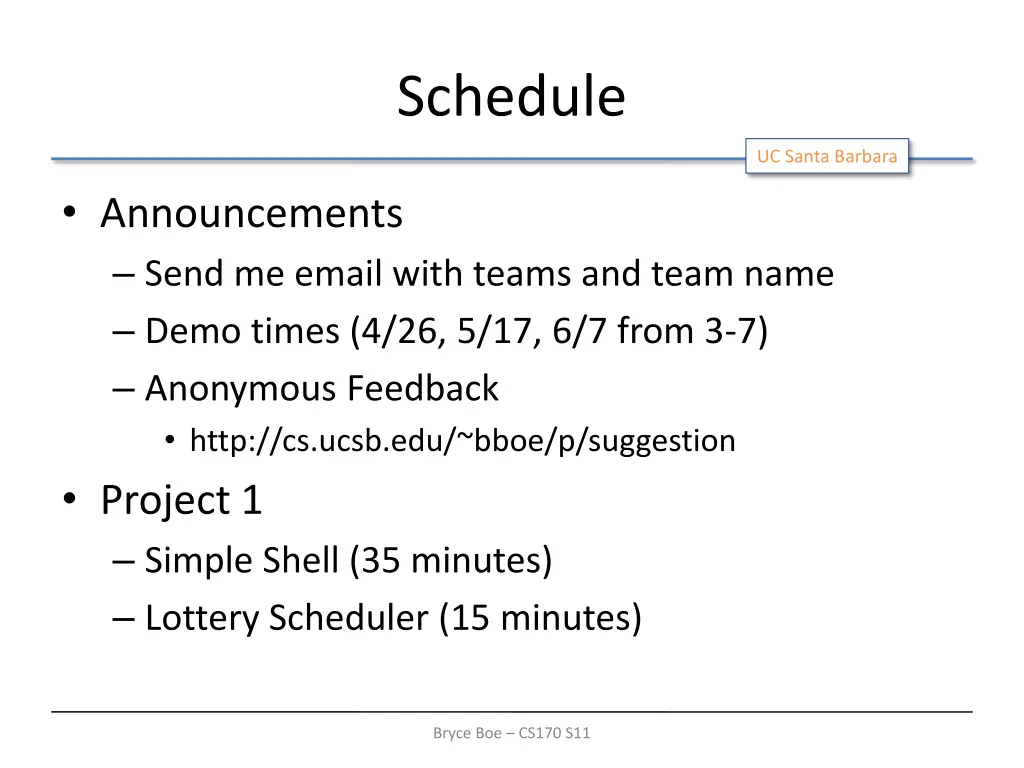
Schedule UC Santa Barbara Announcements Send me email with teams and team name Demo times (4/26, 5/17, 6/7 from 3-7) Anonymous Feedback http://cs.ucsb.edu/~bboe/p/suggestion Project 1 Simple Shell (35 minutes) Lottery Scheduler (15 minutes) Bryce Boe CS170 S11
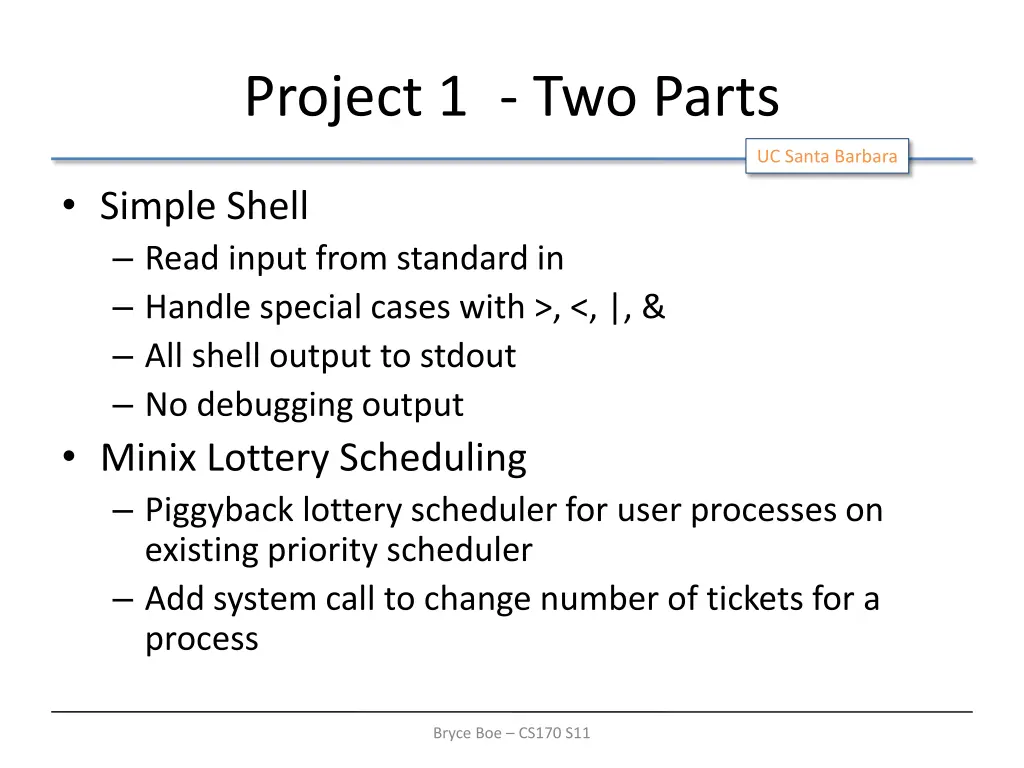
Project 1 - Two Parts UC Santa Barbara Simple Shell Read input from standard in Handle special cases with >, <, |, & All shell output to stdout No debugging output Minix Lottery Scheduling Piggyback lottery scheduler for user processes on existing priority scheduler Add system call to change number of tickets for a process Bryce Boe CS170 S11
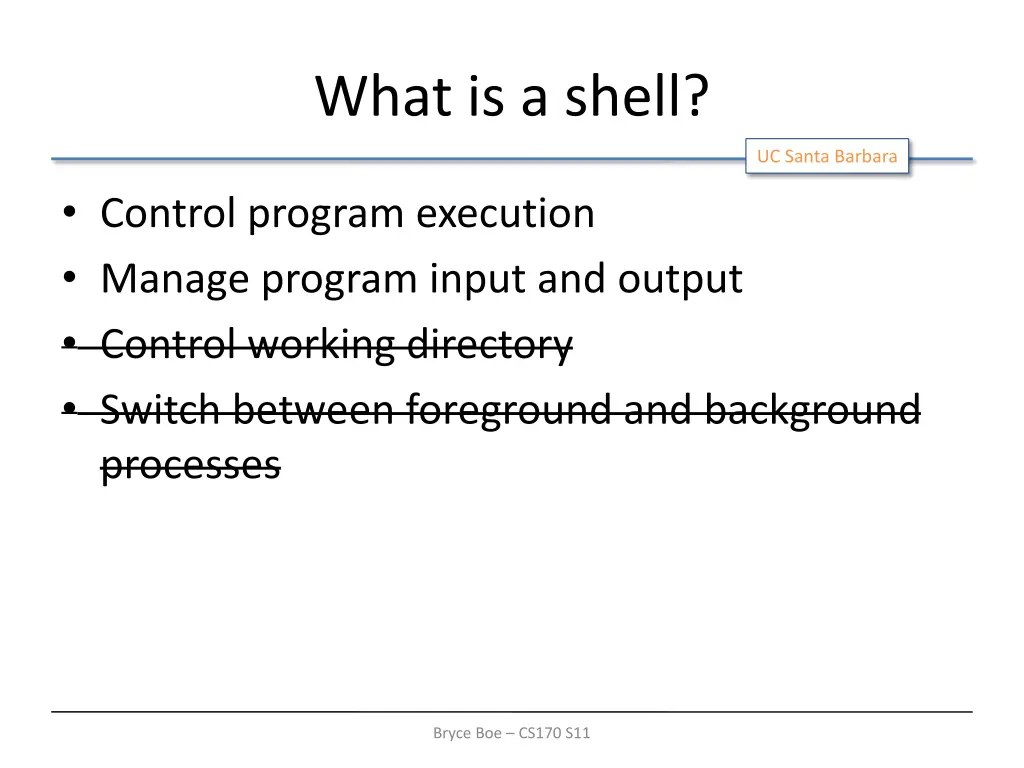
What is a shell? UC Santa Barbara Control program execution Manage program input and output Control working directory Switch between foreground and background processes Bryce Boe CS170 S11
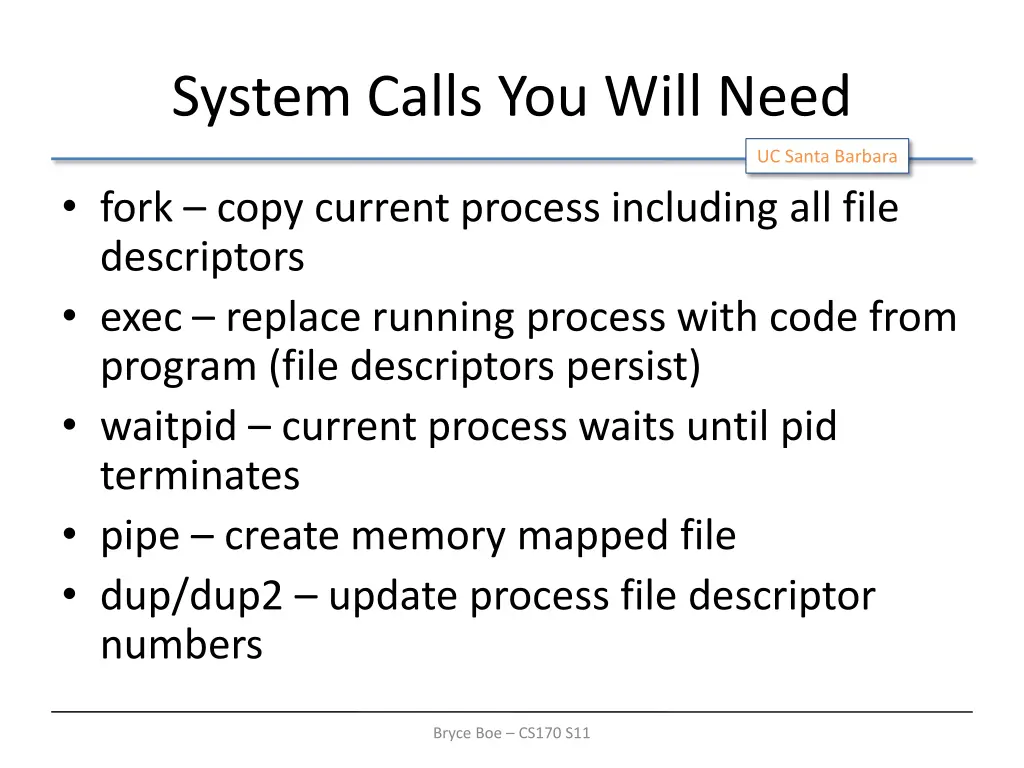
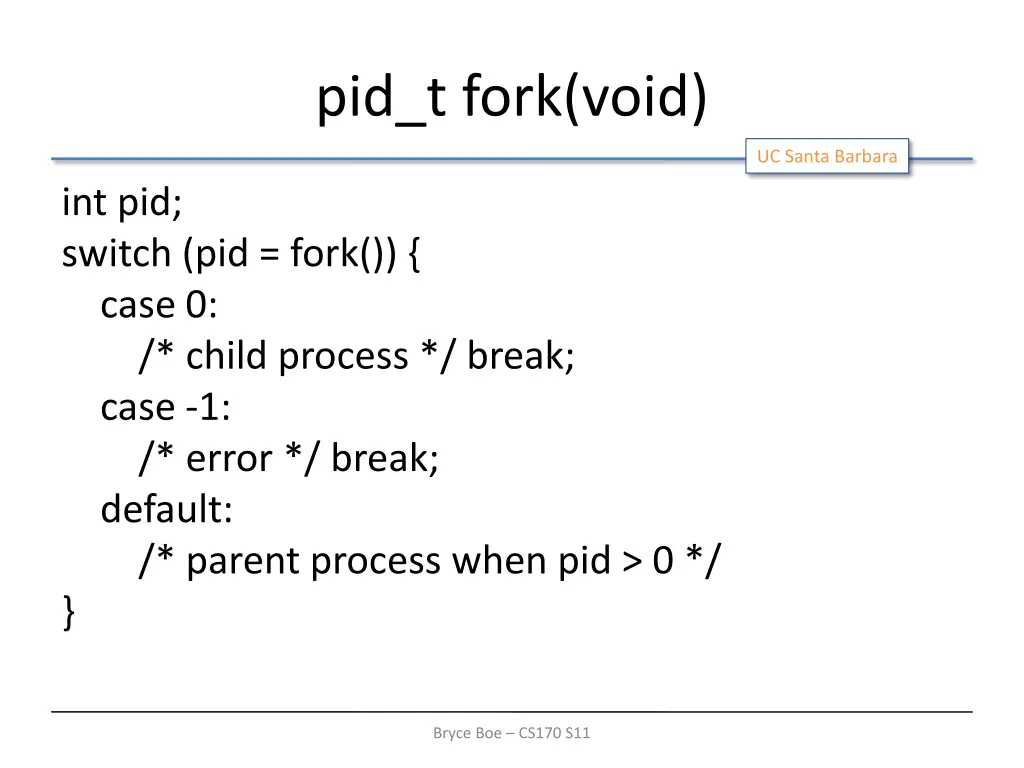
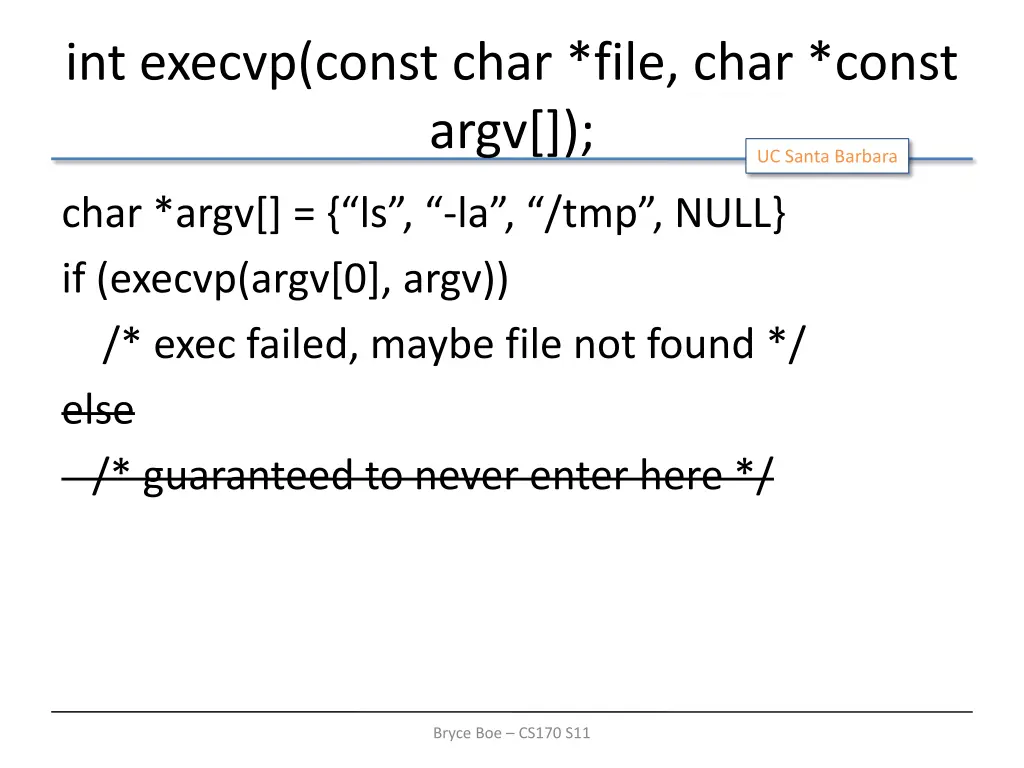
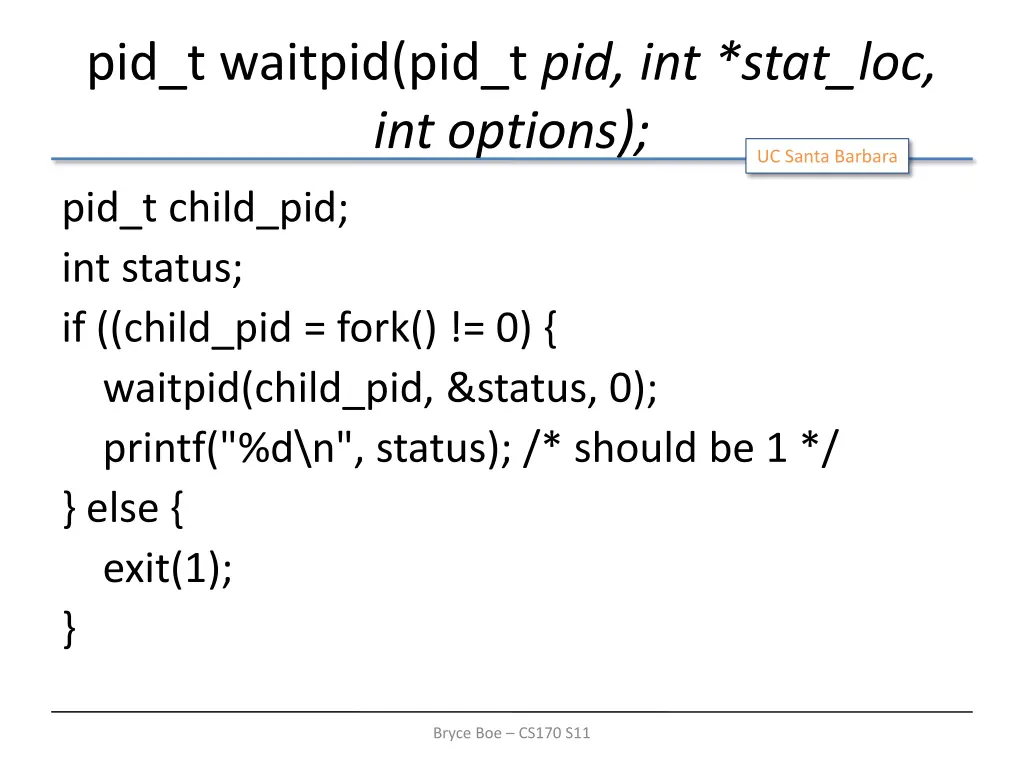
System Calls You Will Need UC Santa Barbara fork copy current process including all file descriptors exec replace running process with code from program (file descriptors persist) waitpid current process waits until pid terminates pipe create memory mapped file dup/dup2 update process file descriptor numbers Bryce Boe CS170 S11
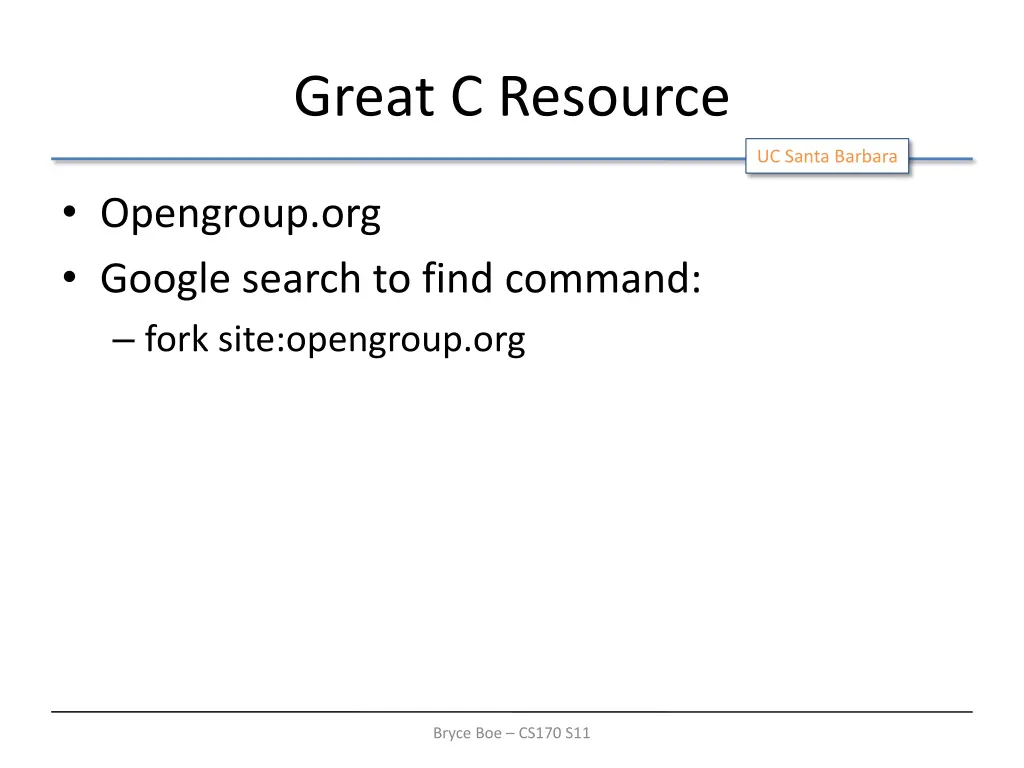
Great C Resource UC Santa Barbara Opengroup.org Google search to find command: fork site:opengroup.org Bryce Boe CS170 S11
pid_t fork(void) UC Santa Barbara int pid; switch (pid = fork()) { case 0: /* child process */ break; case -1: /* error */ break; default: /* parent process when pid > 0 */ } Bryce Boe CS170 S11
int execvp(const char *file, char *const argv[]); UC Santa Barbara char *argv[] = { ls , -la , /tmp , NULL} if (execvp(argv[0], argv)) /* exec failed, maybe file not found */ else /* guaranteed to never enter here */ Bryce Boe CS170 S11
pid_t waitpid(pid_t pid, int *stat_loc, int options); UC Santa Barbara pid_t child_pid; int status; if ((child_pid = fork() != 0) { waitpid(child_pid, &status, 0); printf("%d\n", status); /* should be 1 */ } else { exit(1); } Bryce Boe CS170 S11
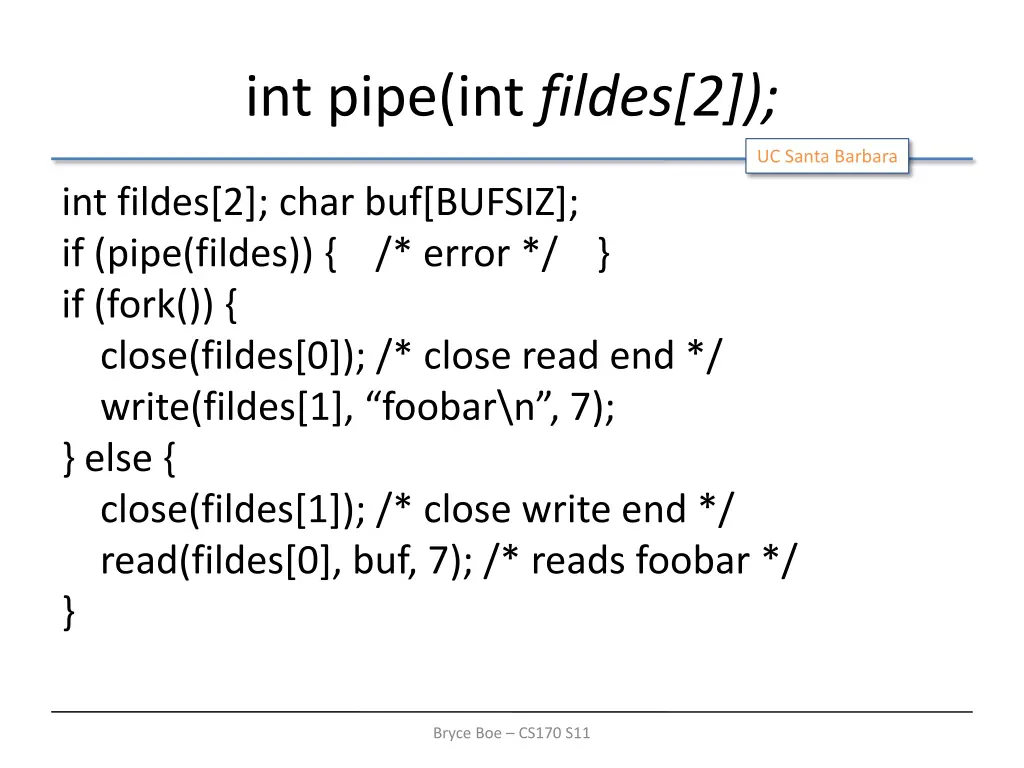
int pipe(int fildes[2]); UC Santa Barbara int fildes[2]; char buf[BUFSIZ]; if (pipe(fildes)) { /* error */ } if (fork()) { close(fildes[0]); /* close read end */ write(fildes[1], foobar\n , 7); } else { close(fildes[1]); /* close write end */ read(fildes[0], buf, 7); /* reads foobar */ } Bryce Boe CS170 S11
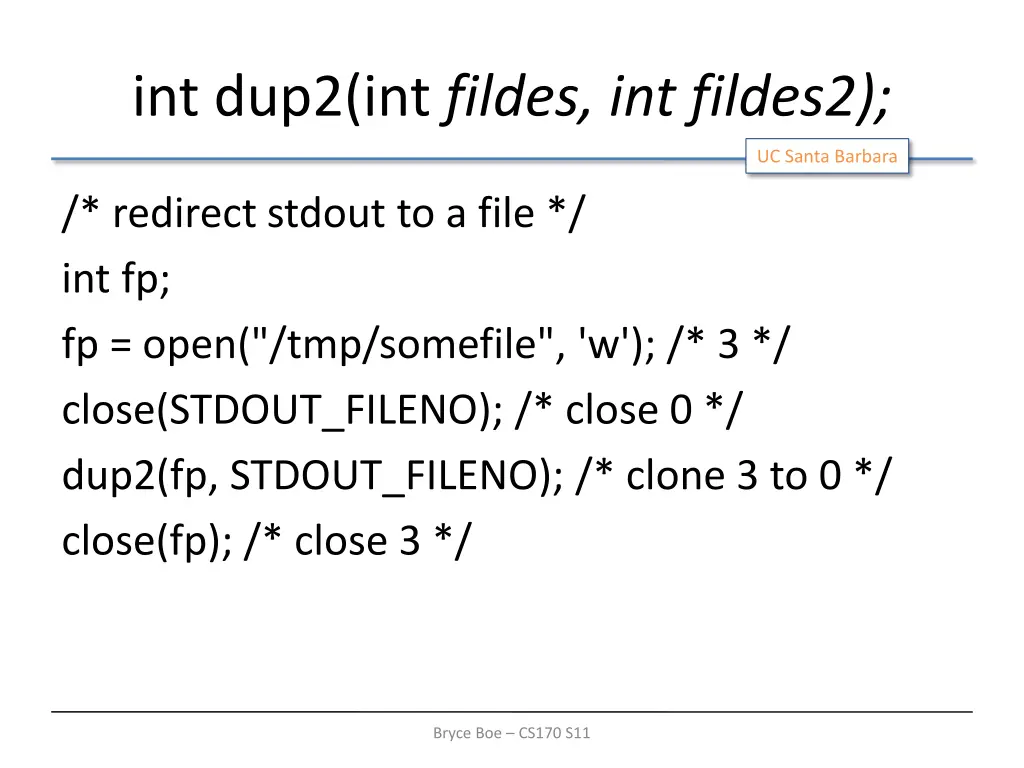
int dup2(int fildes, int fildes2); UC Santa Barbara /* redirect stdout to a file */ int fp; fp = open("/tmp/somefile", 'w'); /* 3 */ close(STDOUT_FILENO); /* close 0 */ dup2(fp, STDOUT_FILENO); /* clone 3 to 0 */ close(fp); /* close 3 */ Bryce Boe CS170 S11
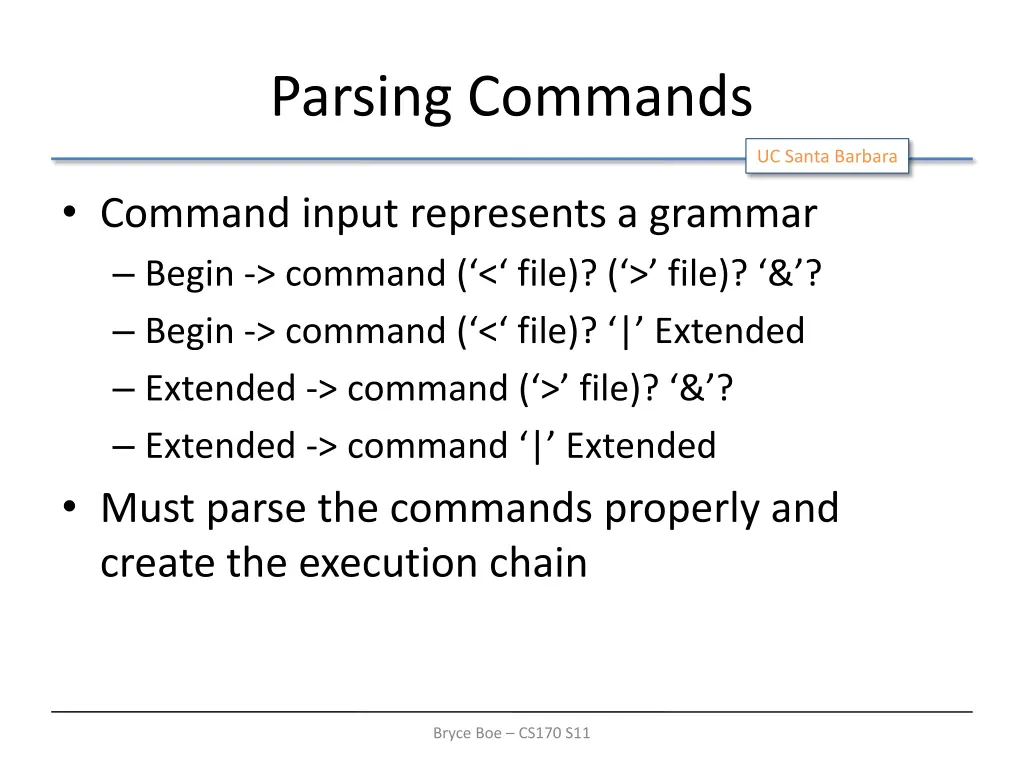
Parsing Commands UC Santa Barbara Command input represents a grammar Begin -> command ( < file)? ( > file)? & ? Begin -> command ( < file)? | Extended Extended -> command ( > file)? & ? Extended -> command | Extended Must parse the commands properly and create the execution chain Bryce Boe CS170 S11
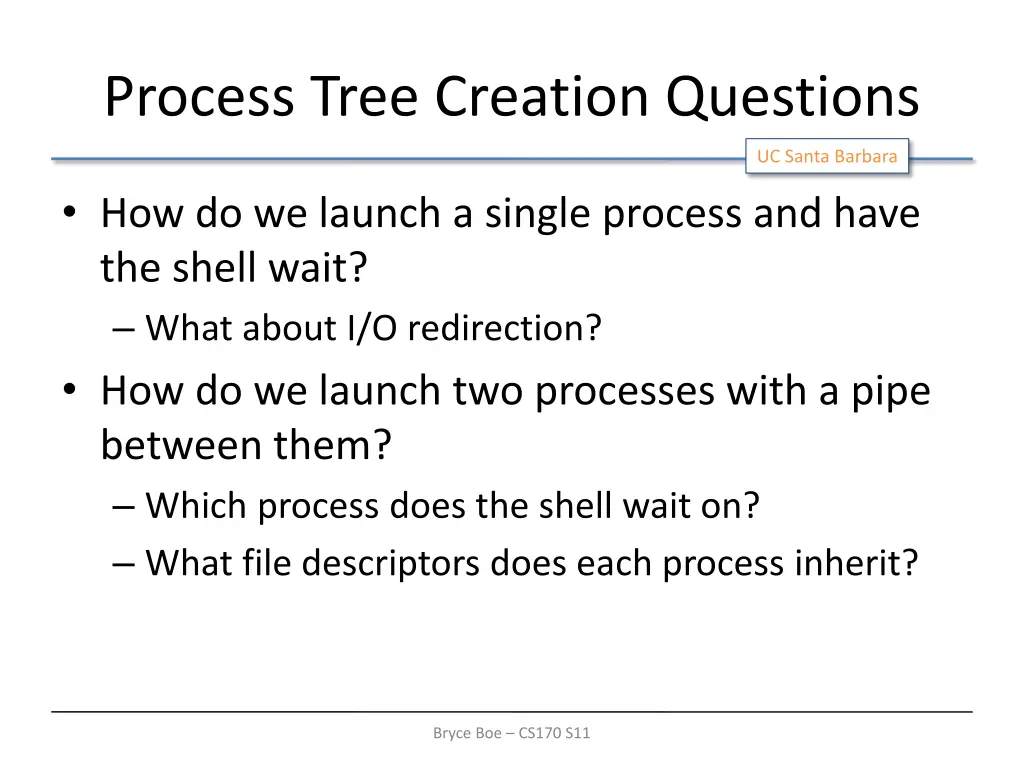
Process Tree Creation Questions UC Santa Barbara How do we launch a single process and have the shell wait? What about I/O redirection? How do we launch two processes with a pipe between them? Which process does the shell wait on? What file descriptors does each process inherit? Bryce Boe CS170 S11
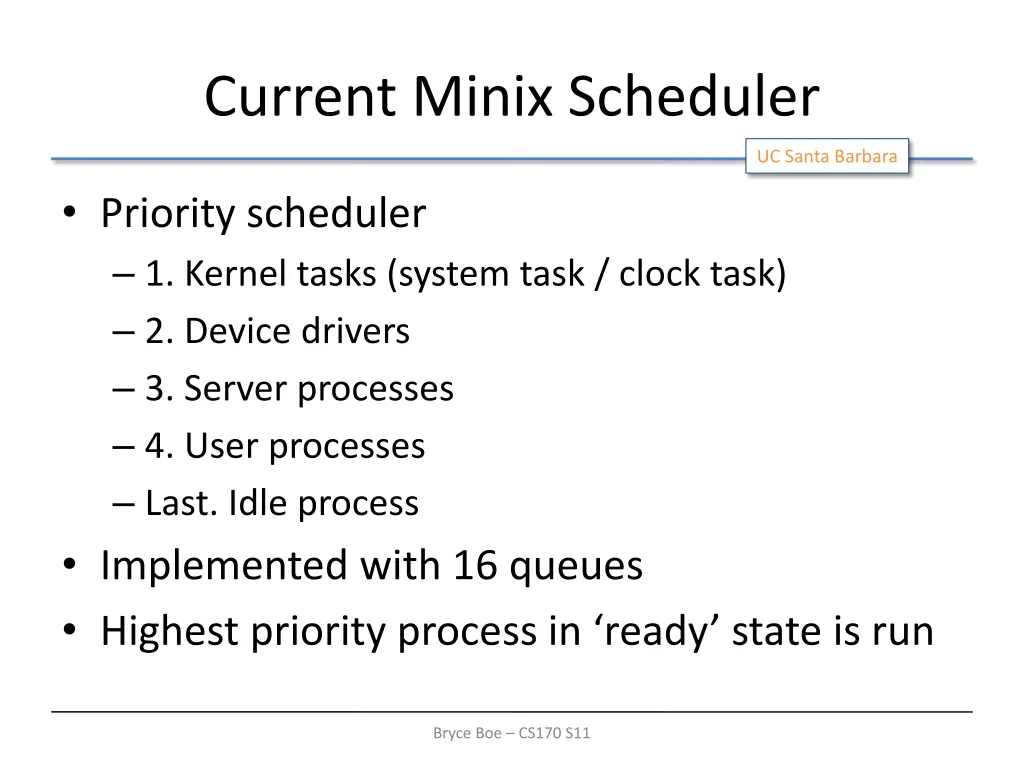
Current Minix Scheduler UC Santa Barbara Priority scheduler 1. Kernel tasks (system task / clock task) 2. Device drivers 3. Server processes 4. User processes Last. Idle process Implemented with 16 queues Highest priority process in ready state is run Bryce Boe CS170 S11
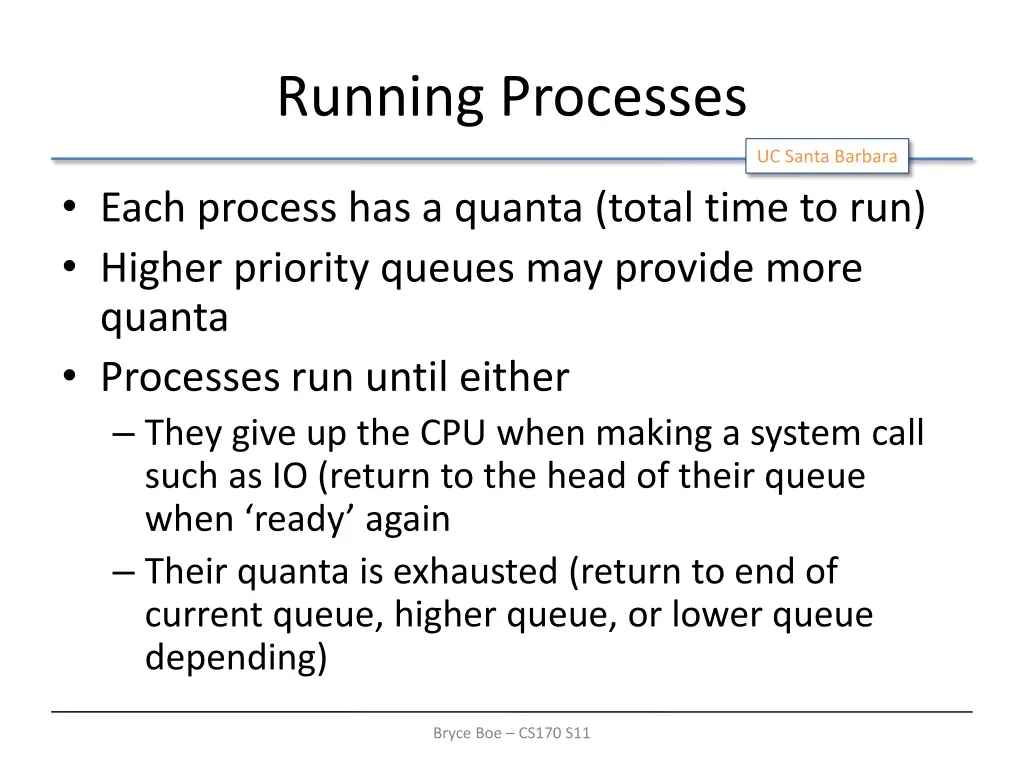
Running Processes UC Santa Barbara Each process has a quanta (total time to run) Higher priority queues may provide more quanta Processes run until either They give up the CPU when making a system call such as IO (return to the head of their queue when ready again Their quanta is exhausted (return to end of current queue, higher queue, or lower queue depending) Bryce Boe CS170 S11
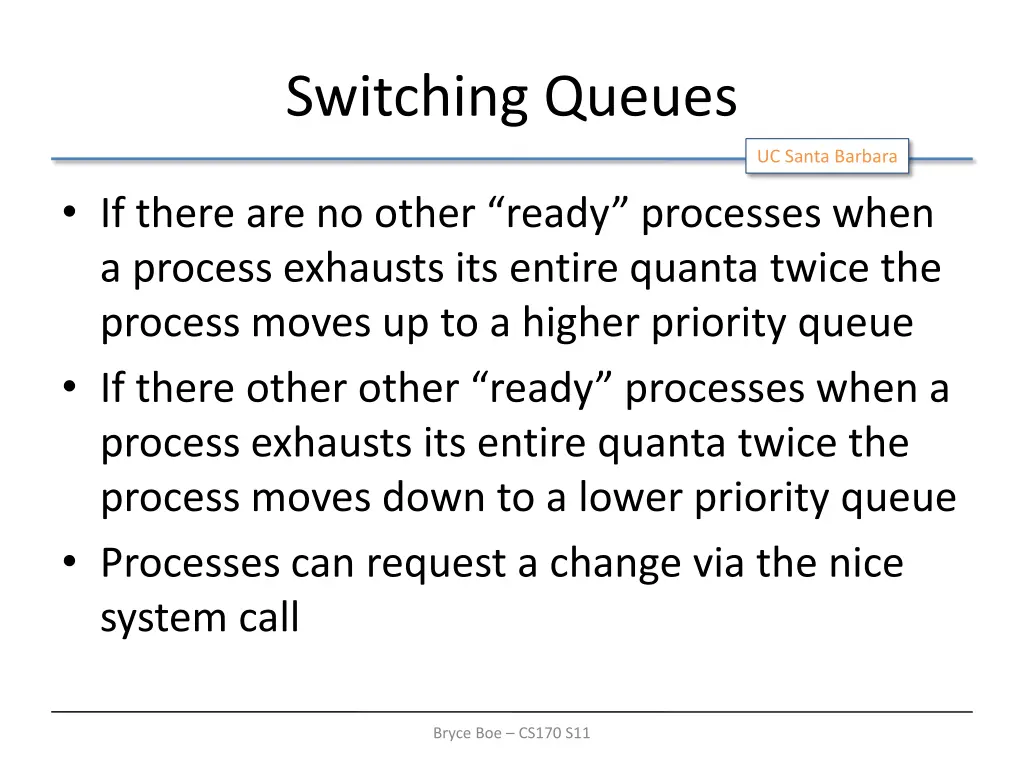
Switching Queues UC Santa Barbara If there are no other ready processes when a process exhausts its entire quanta twice the process moves up to a higher priority queue If there other other ready processes when a process exhausts its entire quanta twice the process moves down to a lower priority queue Processes can request a change via the nice system call Bryce Boe CS170 S11
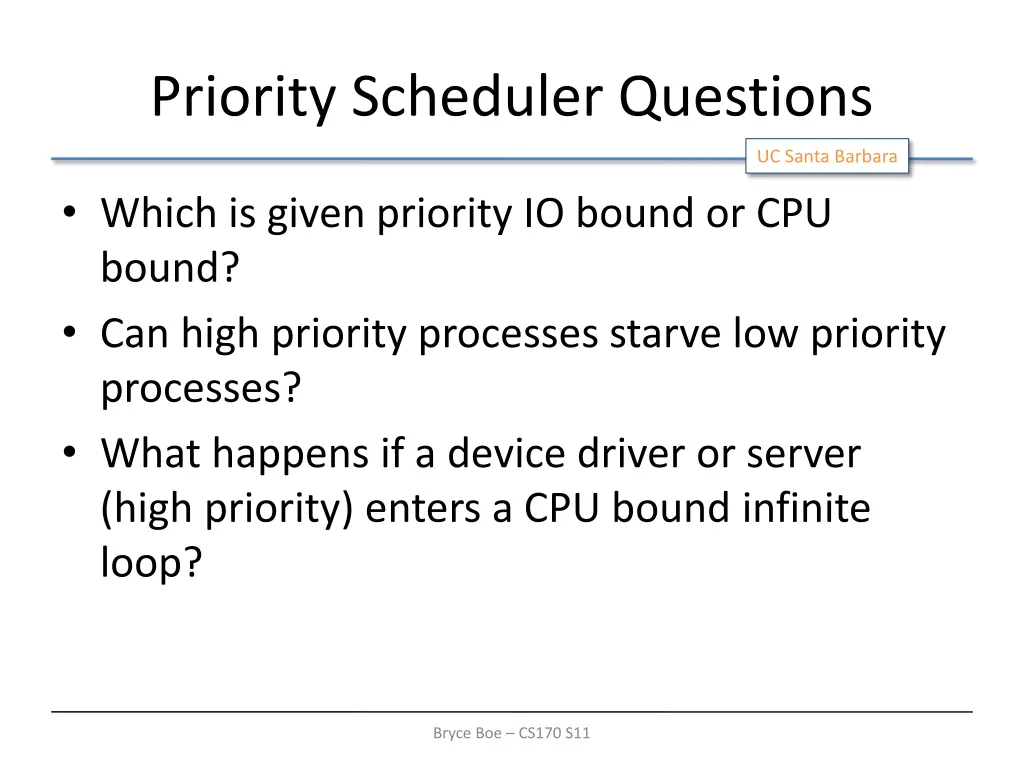
Priority Scheduler Questions UC Santa Barbara Which is given priority IO bound or CPU bound? Can high priority processes starve low priority processes? What happens if a device driver or server (high priority) enters a CPU bound infinite loop? Bryce Boe CS170 S11
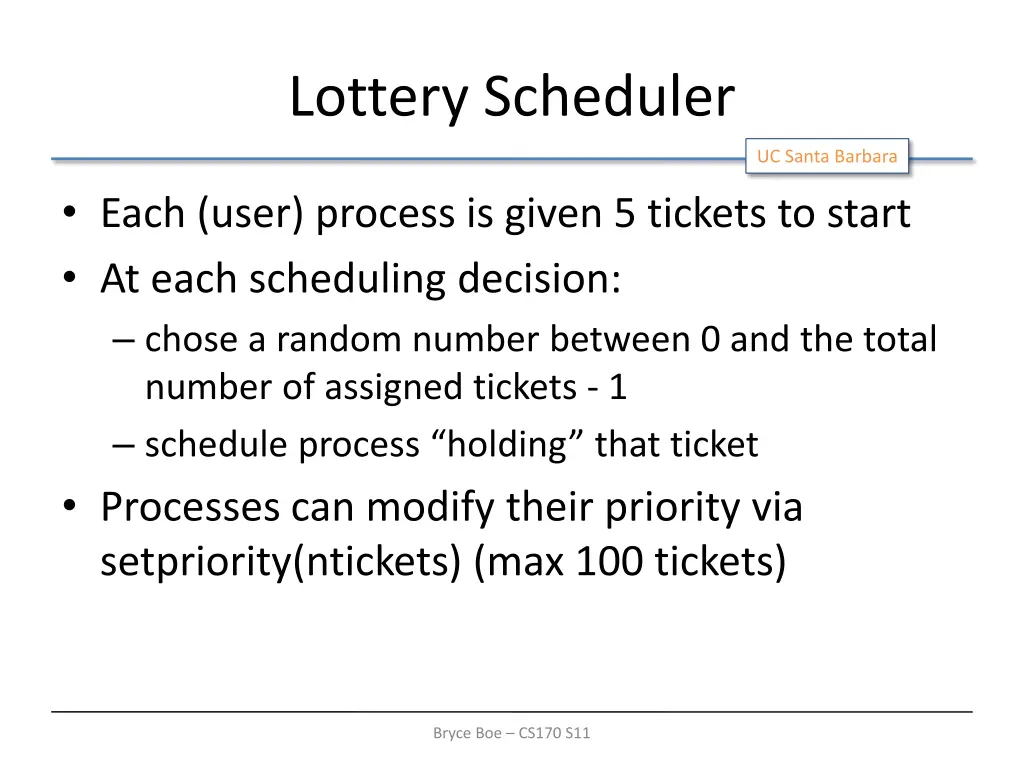
Lottery Scheduler UC Santa Barbara Each (user) process is given 5 tickets to start At each scheduling decision: chose a random number between 0 and the total number of assigned tickets - 1 schedule process holding that ticket Processes can modify their priority via setpriority(ntickets) (max 100 tickets) Bryce Boe CS170 S11
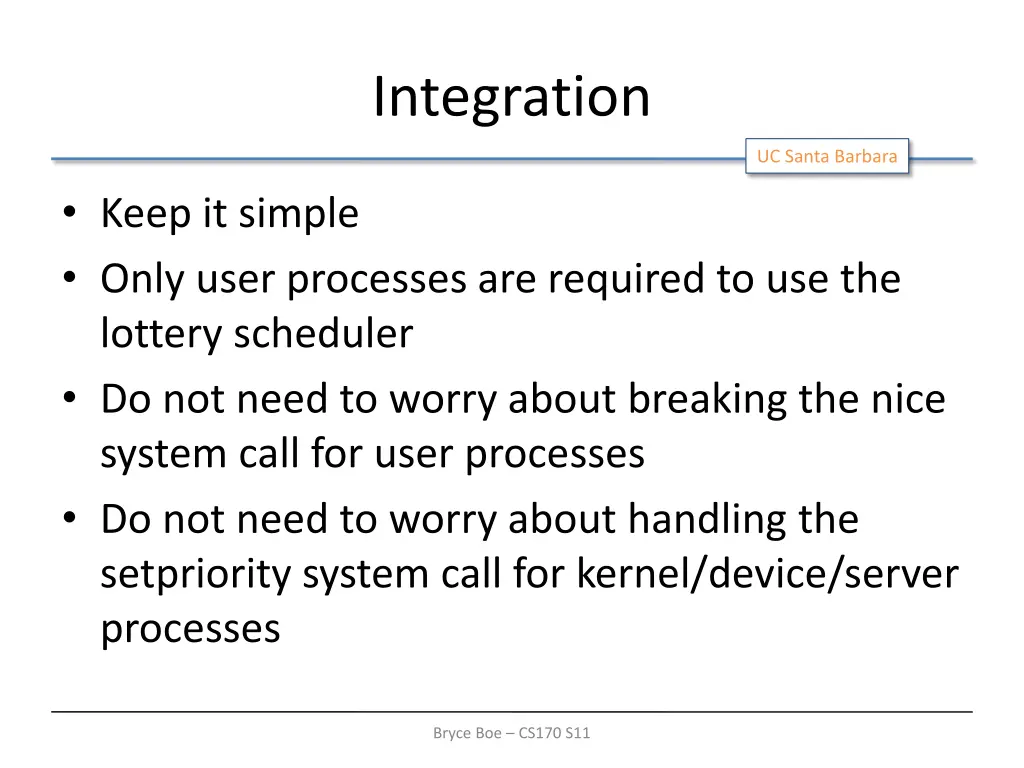
Integration UC Santa Barbara Keep it simple Only user processes are required to use the lottery scheduler Do not need to worry about breaking the nice system call for user processes Do not need to worry about handling the setpriority system call for kernel/device/server processes Bryce Boe CS170 S11
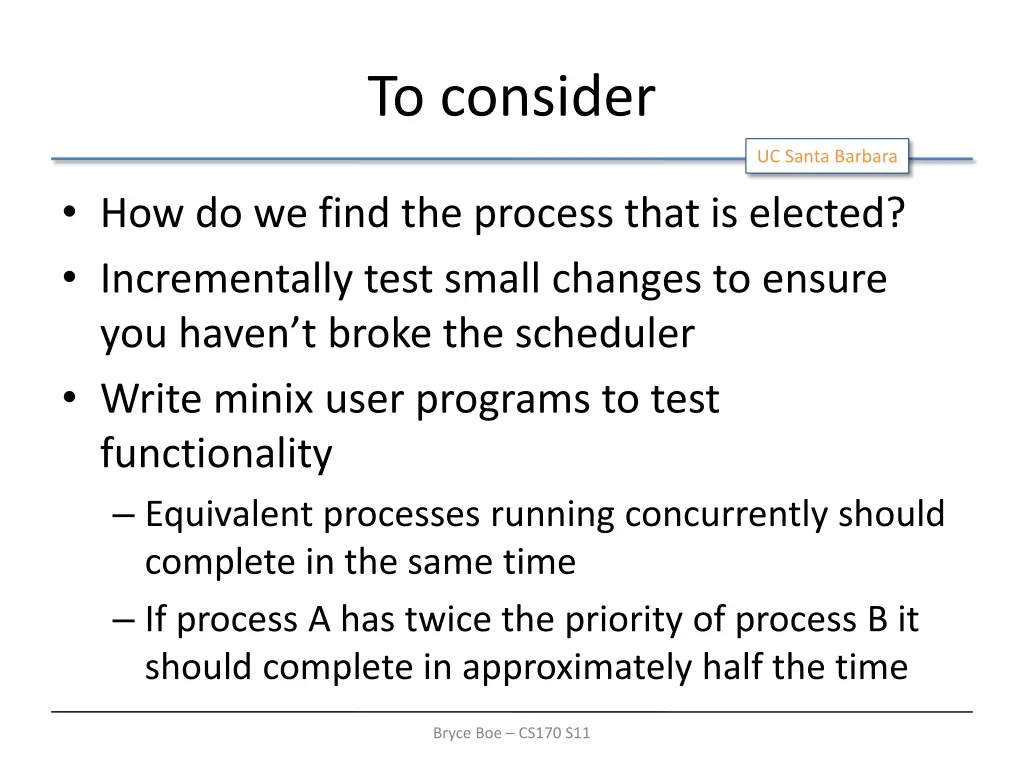
To consider UC Santa Barbara How do we find the process that is elected? Incrementally test small changes to ensure you haven t broke the scheduler Write minix user programs to test functionality Equivalent processes running concurrently should complete in the same time If process A has twice the priority of process B it should complete in approximately half the time Bryce Boe CS170 S11
Good luck! UC Santa Barbara Questions? Bryce Boe CS170 S11