Explore the concept of similar polygons, where shapes look alike but vary in size, and practice calculating the side lengths of hexagons. Complete Section 7.3 assignments online at BCMath.ca.
Please find below an Image/Link to download the presentation.
The content on the website is provided AS IS for your information and personal use only. It may not be sold, licensed, or shared on other websites without obtaining consent from the author. If you encounter any issues during the download, it is possible that the publisher has removed the file from their server.
You are allowed to download the files provided on this website for personal or commercial use, subject to the condition that they are used lawfully. All files are the property of their respective owners.
The content on the website is provided AS IS for your information and personal use only. It may not be sold, licensed, or shared on other websites without obtaining consent from the author.
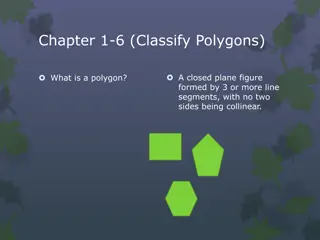
SIMILAR POLYGONS Two polygons are similar if they look the same but have different sizes One can be bigger than the other, but all the lengths must be proportional Ex: Given the following shapes, indicate which ones are similar polygons: The two circles are similar The two squares are similar
Two shapes are similar if all corresponding angles are equal and all corresponding sides are equal in RATIO!! The top angles are equal y v a b The left angles are equal The right angles are equal c e w x The bottom angles that correspond are equal d z a v= b= c= w d= z e y x Note: All squares & circles are similar to each other because corresponding sides are always in ratio
EX: GIVENTHEDIMENSIONSOFTHELARGER HEXAGON, FINDTHELENGTHOFEACHSIDE: 10 v 5 6 3.5 8 y x 9 6 6 z 10 6 10 z 10 5 = 8 = 10y = 48 x = z = Now suppose the 5 became 6 = 6 3.5 3.5 = = 6 z = 2 2 6 12 v v 10 10 6 v 10 5 = 5 = 10x = 45 x = x = = 6 = 10 10 5 6 10x = 54 10 10 9 9 9 9 z = y y 8 = 3.5 7 v = 35 = 6v 5.833 = 6 6 2 2 x x x x 10 10 10 5 =8 y = 2 2 y 4 4.8 v 4.5 5.4