Explore the world of telescopes with insights on refractors and reflectors. Learn about different types, advantages, disadvantages, glass materials, and quality considerations. Enhance your knowledge for better stargazing experiences.
Please find below an Image/Link to download the presentation.
The content on the website is provided AS IS for your information and personal use only. It may not be sold, licensed, or shared on other websites without obtaining consent from the author. If you encounter any issues during the download, it is possible that the publisher has removed the file from their server.
You are allowed to download the files provided on this website for personal or commercial use, subject to the condition that they are used lawfully. All files are the property of their respective owners.
The content on the website is provided AS IS for your information and personal use only. It may not be sold, licensed, or shared on other websites without obtaining consent from the author.
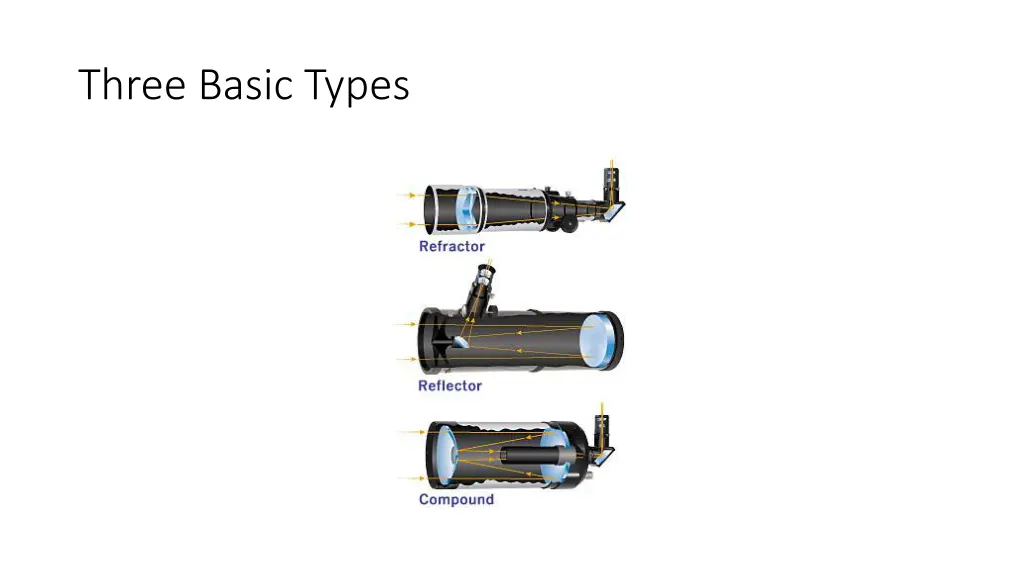
Refractors Typical 3 to 6 Disadvantages - Generally have small apertures, typically 3 to 6 inches. Advantages -Easy to use and consistent due to the simplicity of design. - Images are very sharp - Smaller apertures mean poorer viewing of distant galaxies and nebulae. - Excellent for lunar, planetary and binary stargazing especially with larger apertures. - Heavier, longer and bulkier than reflector and cassegrain telescopes of equal aperture. - Sealed tube protects optics and reduces image degrading air currents. -Great for wide field deep sky astrophotography. - Good-quality refractors cost more per inch of aperture than any other kind of telescope. - Rugged, needs little or no maintenance and its sealed tube protects optics from image degrading.
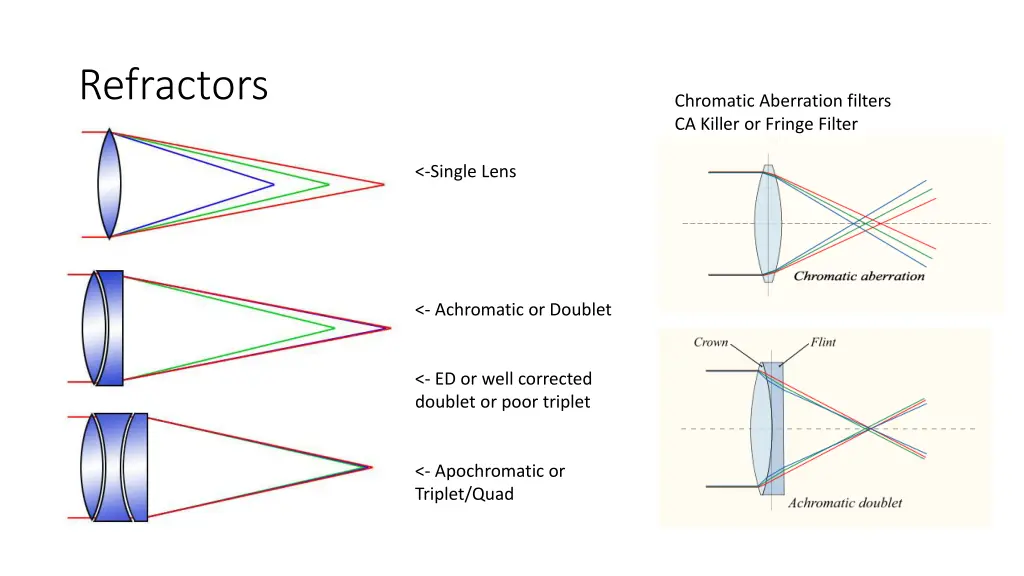
Refractors Chromatic Aberration filters CA Killer or Fringe Filter <-Single Lens <- Achromatic or Doublet <- ED or well corrected doublet or poor triplet <- Apochromatic or Triplet/Quad
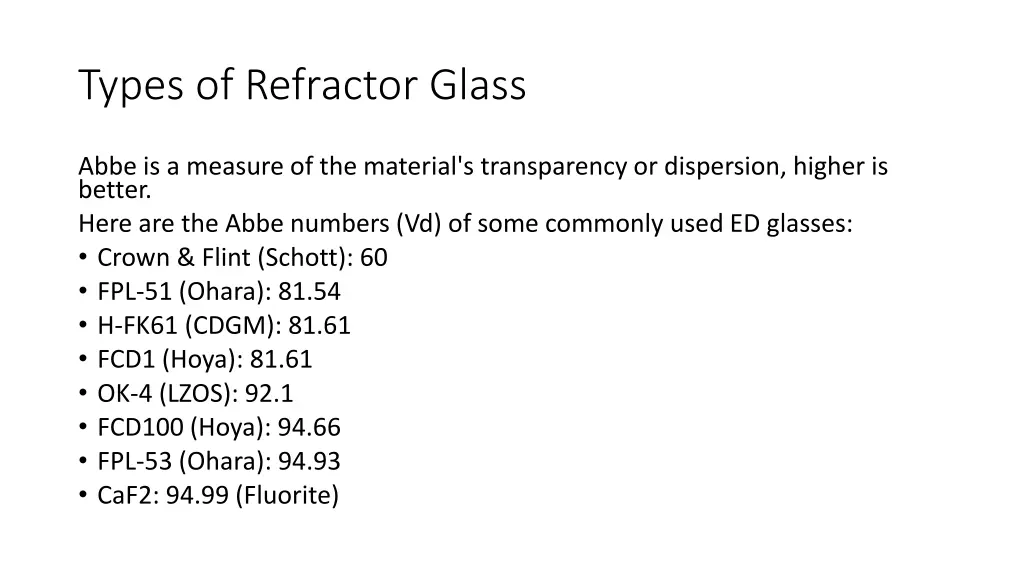
Types of Refractor Glass Abbe is a measure of the material's transparency or dispersion, higher is better. Here are the Abbe numbers (Vd) of some commonly used ED glasses: Crown & Flint (Schott): 60 FPL-51 (Ohara): 81.54 H-FK61 (CDGM): 81.61 FCD1 (Hoya): 81.61 OK-4 (LZOS): 92.1 FCD100 (Hoya): 94.66 FPL-53 (Ohara): 94.93 CaF2: 94.99 (Fluorite)
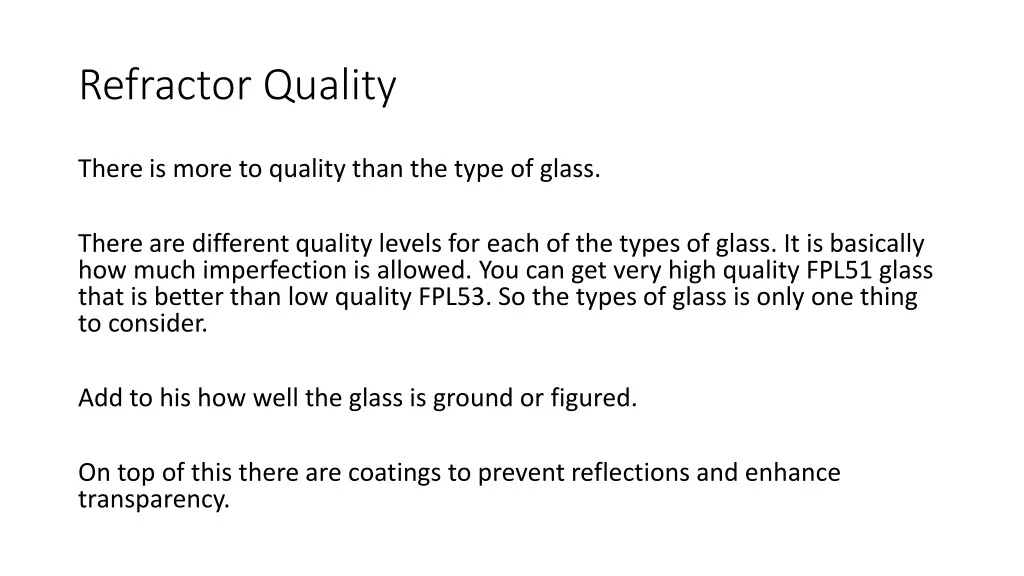
Refractor Quality There is more to quality than the type of glass. There are different quality levels for each of the types of glass. It is basically how much imperfection is allowed. You can get very high quality FPL51 glass that is better than low quality FPL53. So the types of glass is only one thing to consider. Add to his how well the glass is ground or figured. On top of this there are coatings to prevent reflections and enhance transparency.
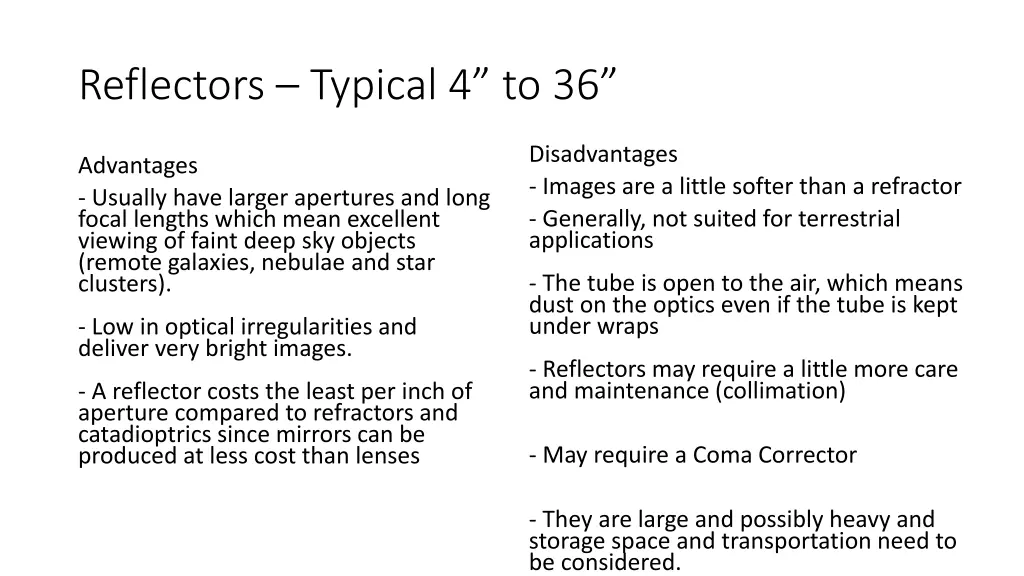
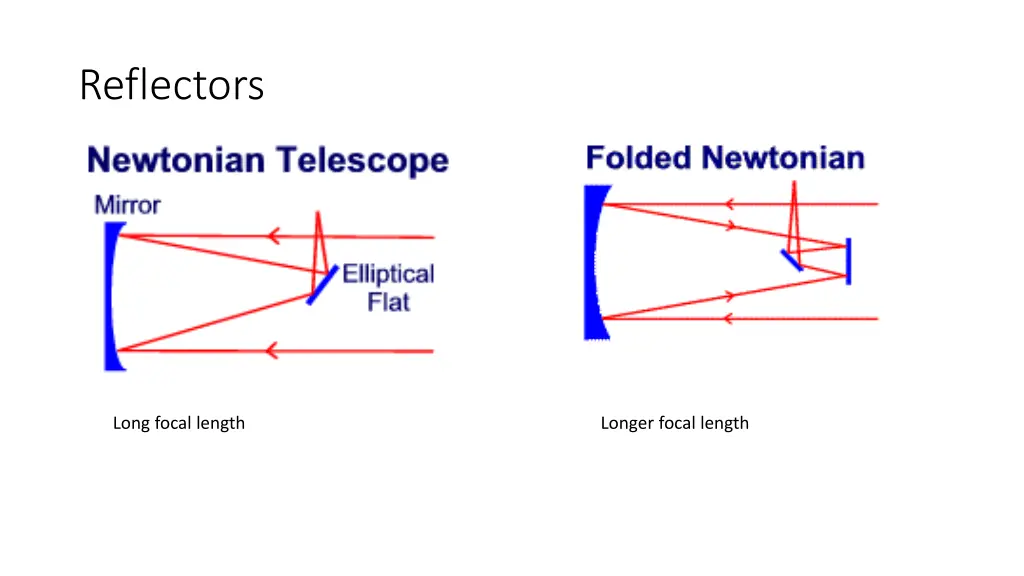
Reflectors Typical 4 to 36 Disadvantages - Images are a little softer than a refractor - Generally, not suited for terrestrial applications Advantages - Usually have larger apertures and long focal lengths which mean excellent viewing of faint deep sky objects (remote galaxies, nebulae and star clusters). - The tube is open to the air, which means dust on the optics even if the tube is kept under wraps - Low in optical irregularities and deliver very bright images. - Reflectors may require a little more care and maintenance (collimation) - A reflector costs the least per inch of aperture compared to refractors and catadioptrics since mirrors can be produced at less cost than lenses - May require a Coma Corrector - They are large and possibly heavy and storage space and transportation need to be considered.
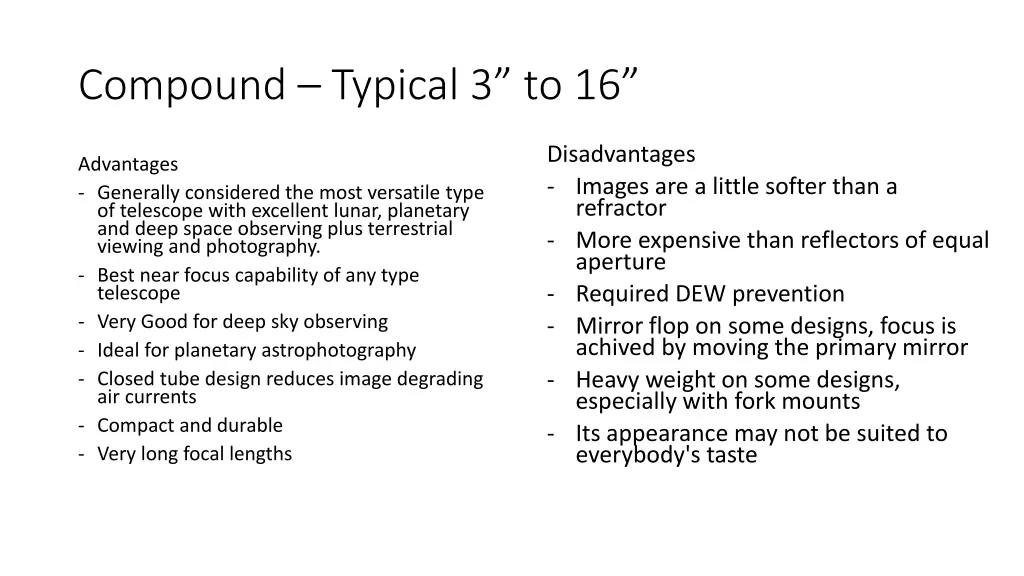
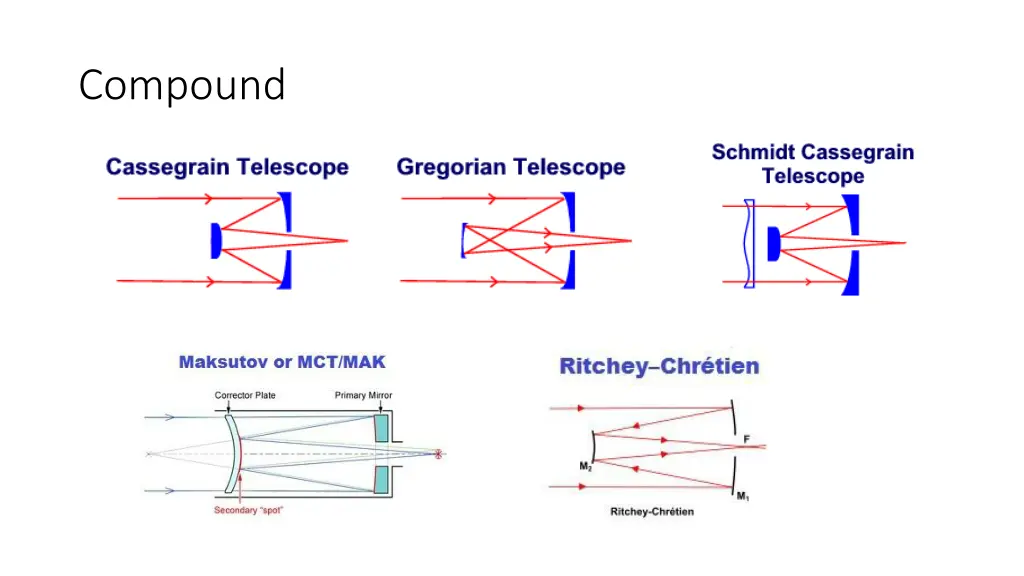
Compound Typical 3 to 16 Disadvantages - Images are a little softer than a refractor - More expensive than reflectors of equal aperture - Required DEW prevention - Mirror flop on some designs, focus is achived by moving the primary mirror - Heavy weight on some designs, especially with fork mounts - Its appearance may not be suited to everybody's taste Advantages - Generally considered the most versatile type of telescope with excellent lunar, planetary and deep space observing plus terrestrial viewing and photography. - Best near focus capability of any type telescope - Very Good for deep sky observing - Ideal for planetary astrophotography - Closed tube design reduces image degrading air currents - Compact and durable - Very long focal lengths