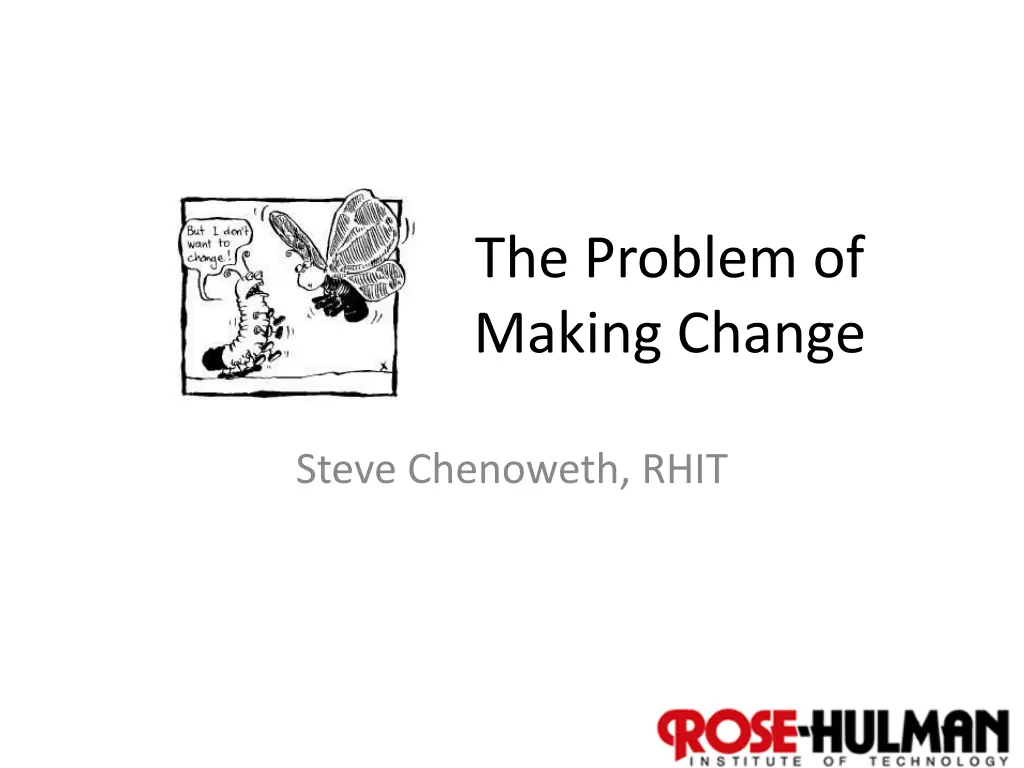
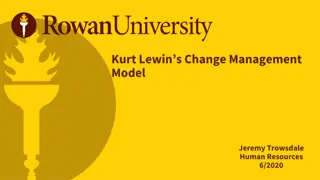
Learn about the complexities of driving change within organizations and the stages of learning and adaptation proposed by Kurt Lewin in 1947. Discover the obstacles faced by change agents in making necessary changes happen and the importance of perseverance in the process of organizational transformation.
Please find below an Image/Link to download the presentation.
The content on the website is provided AS IS for your information and personal use only. It may not be sold, licensed, or shared on other websites without obtaining consent from the author. If you encounter any issues during the download, it is possible that the publisher has removed the file from their server.
You are allowed to download the files provided on this website for personal or commercial use, subject to the condition that they are used lawfully. All files are the property of their respective owners.
The content on the website is provided AS IS for your information and personal use only. It may not be sold, licensed, or shared on other websites without obtaining consent from the author.
One goal of the MSSE program Is for you to become great at your chosen profession. But, we also have an obligation to the software industry, to contribute to improving that industry Indirectly Through you 2
So, We are hoping you become change agents. But, we know that s not easy. You are trying to make change from the bottom, within an organization. How to get the changes you know are needed to actually happen!? 3
As engineers, what wed like is Better ideas win on their own merits. It s objective, or at least clear, so eventually everyone agrees on the same course. After all, our work is all based on objective realities, like, What runs best in the computer. So, if we have a discussion with someone, and our points are stronger, then 6
By all rights, They ought to change and do things the way we proved they should be done. We sort of do this to customers. At least when we are the experts on a technology that they want to use. And our casual water cooler conversations do lead to improved product and process ideas being imple- mented, we think. Here s why you need the new wheels, too 7
But organizations dont readily change In 1947, Kurt Lewinproposed the stages of learning/change : Stage 1 - Unfreezing: Creating the Motivation to change Disconfirmation Creation of survival anxiety or guilt Creation of psychological safety to overcome learning anxiety Stage 2 - Learning new concepts, New Meanings for Old Concepts, and New Standards for Judgment Imitation and identification with role models Scanning for solutions and trial-and-error learning Stage 3 - Internalizing New Concepts, Meanings and Standards Incorporation into self-concept and identity Incorporation into ongoing relationships It s all soft science 8
During Stage 2, Everything s chaotic, versus how it is now. Everyone knows it would be a struggle to get over that, learn all the new stuff, and settle back down. So they resist all our good ideas! The odds are that things won t change. 9
How tough is it? Lewin s model was adopted by Edgar Schein to explain what s necessary to cause transformational organizational change:* Everyone assumes current success is based on everything about the current ways of acting. Culture is a learned defense mechanism, to avoid uncertainty and anxiety. All the cultural elements of behavior have secondary value. Lots of conjectured dependencies! Borderline superstitious. *I.e., change that sticks. 10
The inherent barriers are real Everyone knows change is hard. In relearning, you lose your identity. It often requires some kind of crisis to propel change, like a public scandal that explodes myths. Attempts to induce organi- zational change produce responses like denial, scapegoating, and bargaining. Changing a culture requires power change agents make it happen using interventions, or it evolves via leadership or via self-assessment and rebirth within the organization. 11
Things you can expect Denial Oddly, when you ask why people haven t tried something new, which you d sparked their interest in, they ll explain they figured out why it isn t valid after all. Scapegoating The problem is in some other department, and we re ok, etc. Maneuvering and bargaining This is extra work. It has to be worth a lot MORE to be worth taking it on. 12
But the software business has some advantages Everyone knows we have to change to survive. People know they have to adopt new processes, switch to creating different kinds of products, and adapt to changing organizations. We know our project work has a significant amount of new work and so is inherently risky. Being in limbo is part of the job! We re used to learning anxiety. We all suffer from incompetence. Group memberships change. Fluid identity is a part of the work. 13
How to push it over the top Schein s Principles: 1. Survival anxiety or guilt must be greater than learning anxiety. 2. Learning anxiety must be reduced rather than increasing survival anxiety. I.e., Inject hope! Above - We all get computer anxiety when staring down new technology. 14
Some specifics Have a compelling positive vision. Give formal and informal training on new skills needed. Learners have to be involved, and the learning flexible. Build new culture like relevant family groups and teams. E.g., Bust-up existing organizations, whose ratings of good vs bad are based on the old ways. Provide practice, with coaches and feedback. If the boss calls, get their name! 15
More specifics Provide positive role models. Give forums for learning problems. Introduce systems and structures consistent with the new way of thinking and working. Easy to be an unquestioned role model if you re the Dad and they re like 6. Schein says, Most transformational change programs fail because they do not create these eight conditions. 16
Where to start Have a clear definition of the operational problem or issue causing a need for change. Provide specific new behavioral goals. Then consider how the existing culture will aid or hinder these things. There s a lot more See Schein s book: Organizational Culture and Leadership. Jossey- Bass; 4 ed., 2010. ISBN 0470190604. 17