Explore the concept of flipped classrooms, advantages, challenges, and implementation strategies to engage students effectively. Learn about out-of-class tasks, in-class activities, student assessment, and collaborative learning opportunities.
Please find below an Image/Link to download the presentation.
The content on the website is provided AS IS for your information and personal use only. It may not be sold, licensed, or shared on other websites without obtaining consent from the author. If you encounter any issues during the download, it is possible that the publisher has removed the file from their server.
You are allowed to download the files provided on this website for personal or commercial use, subject to the condition that they are used lawfully. All files are the property of their respective owners.
The content on the website is provided AS IS for your information and personal use only. It may not be sold, licensed, or shared on other websites without obtaining consent from the author.
E N D
Presentation Transcript
Flipping the Classroom Dr. Mark Morton Jane Holbrook Centre for Teaching Excellence http://bit.ly/flip-loop
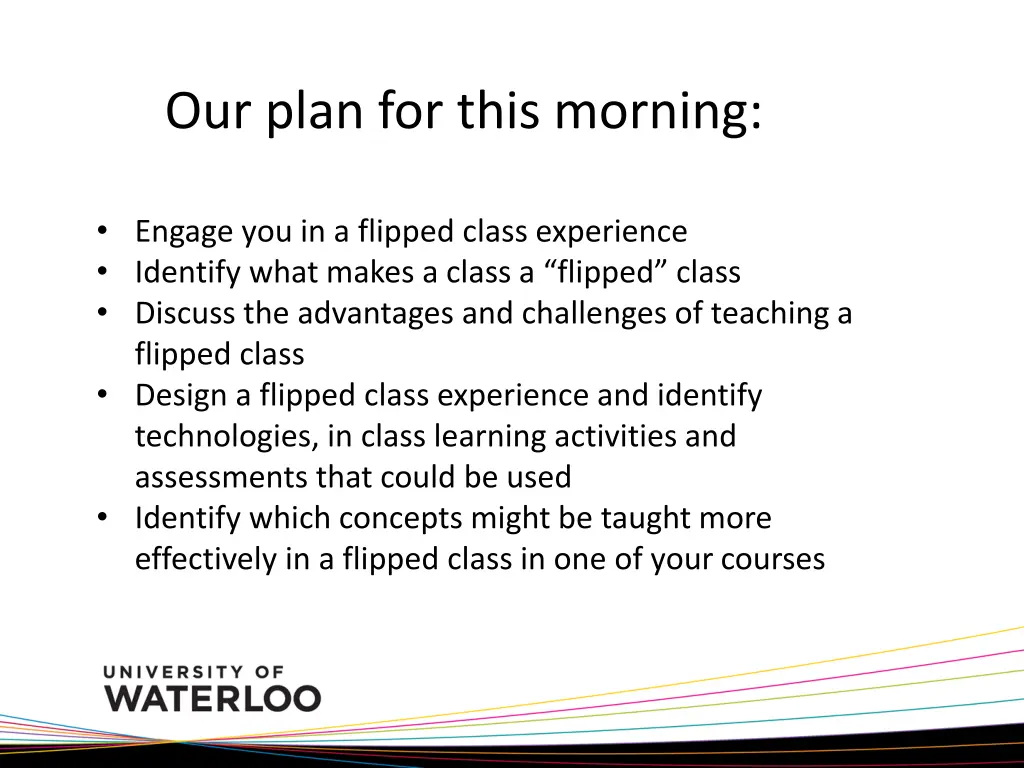
Our plan for this morning: Engage you in a flipped class experience Identify what makes a class a flipped class Discuss the advantages and challenges of teaching a flipped class Design a flipped class experience and identify technologies, in class learning activities and assessments that could be used Identify which concepts might be taught more effectively in a flipped class in one of your courses
Why might we want to do this? Discuss the advantages and challenges of teaching a flipped class with three other people.
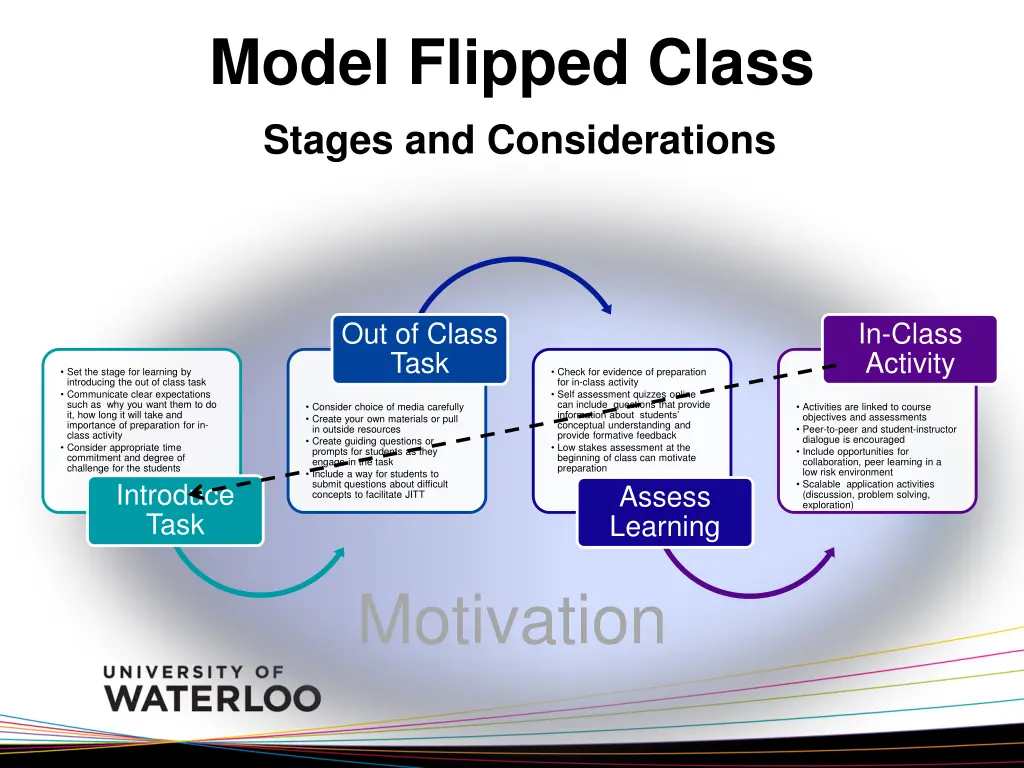
Model Flipped Class Stages and Considerations Out of Class Task In-Class Activity Set the stage for learning by introducing the out of class task Communicate clear expectations such as why you want them to do it, how long it will take and importance of preparation for in- class activity Consider appropriate time commitment and degree of challenge for the students Introduce Task Check for evidence of preparation for in-class activity Self assessment quizzes online can include questions that provide information about students conceptual understanding and provide formative feedback Low stakes assessment at the beginning of class can motivate preparation Assess Learning Consider choice of media carefully Create your own materials or pull in outside resources Create guiding questions or prompts for students as they engage in the task Include a way for students to submit questions about difficult concepts to facilitate JITT Activities are linked to course objectives and assessments Peer-to-peer and student-instructor dialogue is encouraged Include opportunities for collaboration, peer learning in a low risk environment Scalable application activities (discussion, problem solving, exploration) Motivation
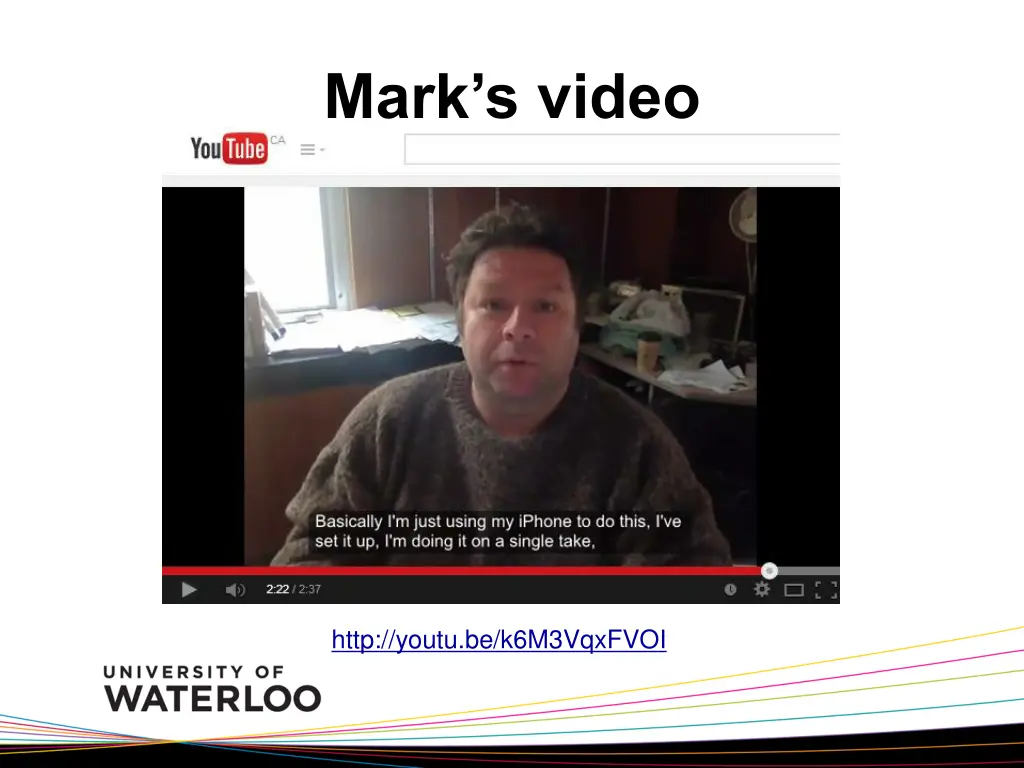
Screencasting Tools Refer to the list Mark compiled on this CTE Teaching Tip Sheet.
Design a flipped class What is a challenging concept in one of your courses? What do you want the students to be able to do that involves that concept? Use the template we have supplied to design a flipped class.
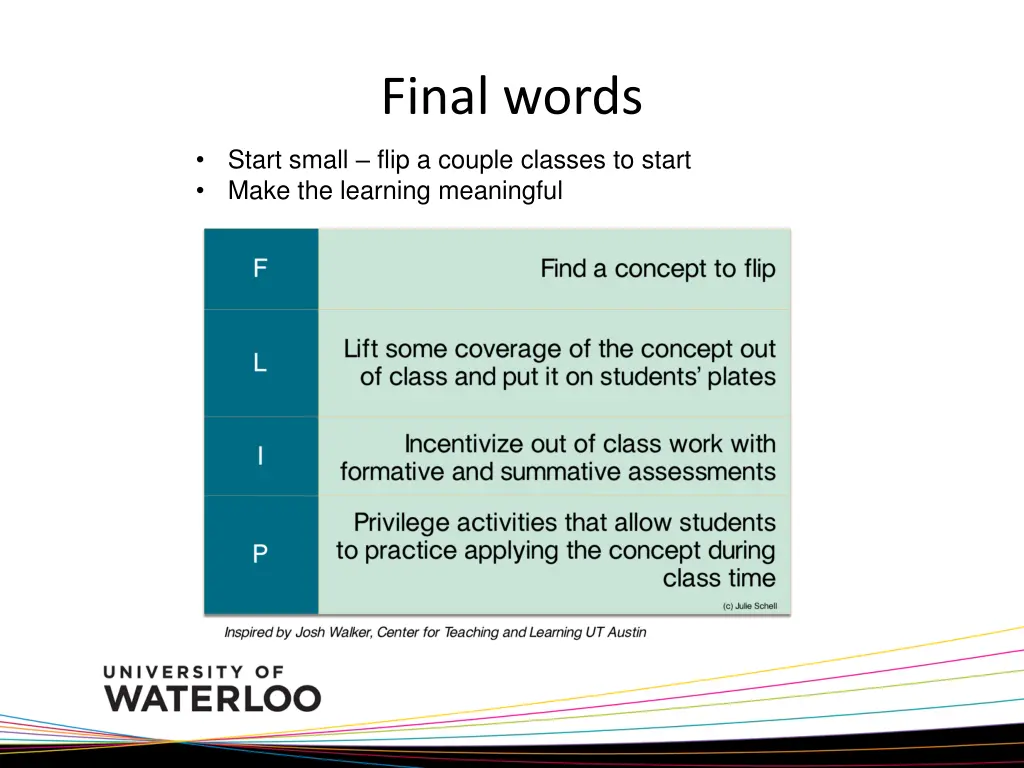
Final words Start small flip a couple classes to start Make the learning meaningful
Other Resources The Flipped Class Revealed . http://www.thedailyriff.com/articles/the-flipped-class-what-does-a-good-one-look-like- 692.php 7 Things You Need to Know about Flipping the Classroom. A white paper from Information Technology Services at Penn State University. http://tlt.its.psu.edu/files/2011/09/2011-Flipping-the-Classroom.pdf How Flipping the Classroom Can Improve the Traditional Lecture. Dan Berret. Chronicle of Higher Education. http://chronicle.com/article/How-Flipping-the-Classroom/130857/ (this link only works if you are on a uWaterloo network). Exploding the Lecture. Steve Kolowich. Inside Higher Ed. http://www.insidehighered.com/news/2011/11/15/professor- tries-improving-lectures-removing-them-class Many amazing resources on flipped classroom strategies from the Turn to Your Neighbour - Peer Instruction Blog. http://blog.peerinstruction.net/?s=flipped , especially see the 7 Myths http://blog.peerinstruction.net/7-myths-about-the- flipped-classroom-debunked/ Let's Use Video to Reinvent Education. Salman Khan (the founder of the Khan Academy). A 20-minute video of a Ted Talk. http://www.ted.com/talks/salman_khan_let_s_use_video_to_reinvent_education.html Five Best Practices for the Flipped Classroom. Andrew Miller. Edutopia. http://www.edutopia.org/blog/flipped-classroom- best-practices-andrew-miller Flipping for Beginners. Dave Saltman. Harvard Education Letter. http://www.hepg.org/hel/article/517#home Confessions of a Converted Lecturer. Eric Mazur. A 5-minute YouTube video. http://youtu.be/hbBz9J-xVxE Flipped Training Introduction by Katie Gimbar. A three-minute YouTube video : http://youtu.be/_6Z_77fSjGo How do you do make your videos? by Katie Gimbar. http://youtu.be/Icn8kMoH28Y Derek Bruff's blog on "Flipping Out". http://derekbruff.org/?p=2108 Flipping a Class University of Texas - http://ctl.utexas.edu/ctl/node/320
Active Learning Students involved in more than listening Less emphasis placed on transmitting information , more on developing students skills Students are involved in higher-order thinking (analysis, synthesis, evaluation) Students are engaged in activities (e.g reading, discussion, writing, presenting) Greater emphasis placed on students exploration of their own attitudes and values Bomwell and Eisen (1991) Active Learning : Creating excitement in the classroom p2. One must learn by doing the thing, for though you think you know it-- you have no certainty until you try. (Sophocles, 5th c. B.C.)
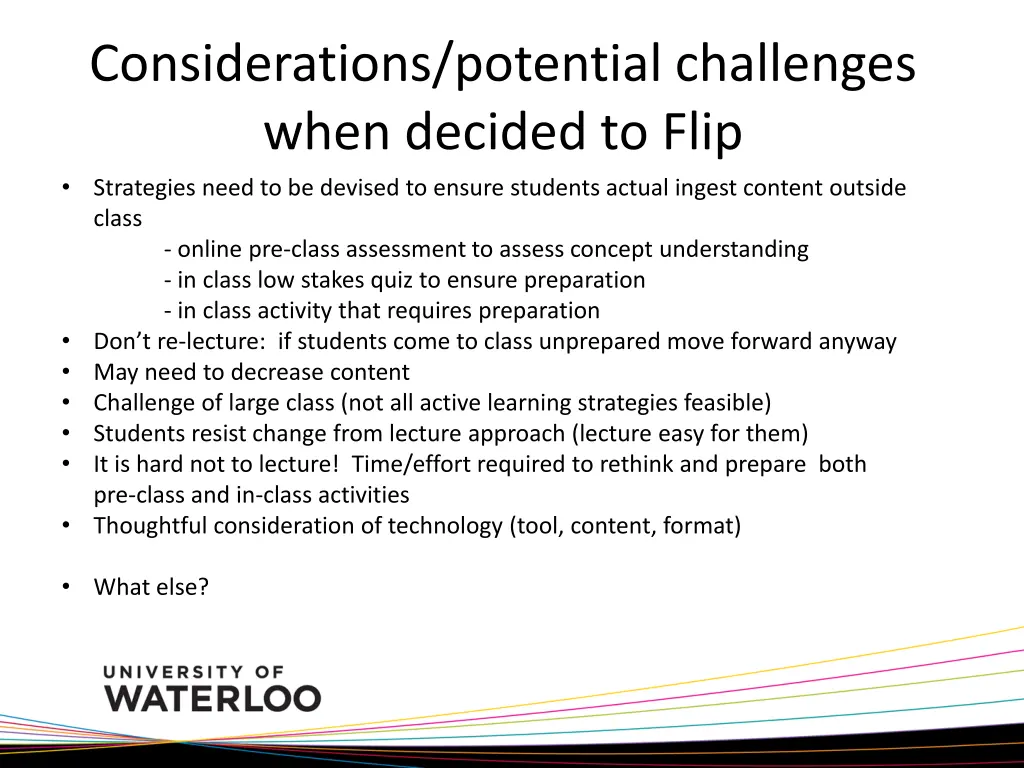
Considerations/potential challenges when decided to Flip Strategies need to be devised to ensure students actual ingest content outside class - online pre-class assessment to assess concept understanding - in class low stakes quiz to ensure preparation - in class activity that requires preparation Don t re-lecture: if students come to class unprepared move forward anyway May need to decrease content Challenge of large class (not all active learning strategies feasible) Students resist change from lecture approach (lecture easy for them) It is hard not to lecture! Time/effort required to rethink and prepare both pre-class and in-class activities Thoughtful consideration of technology (tool, content, format) What else?
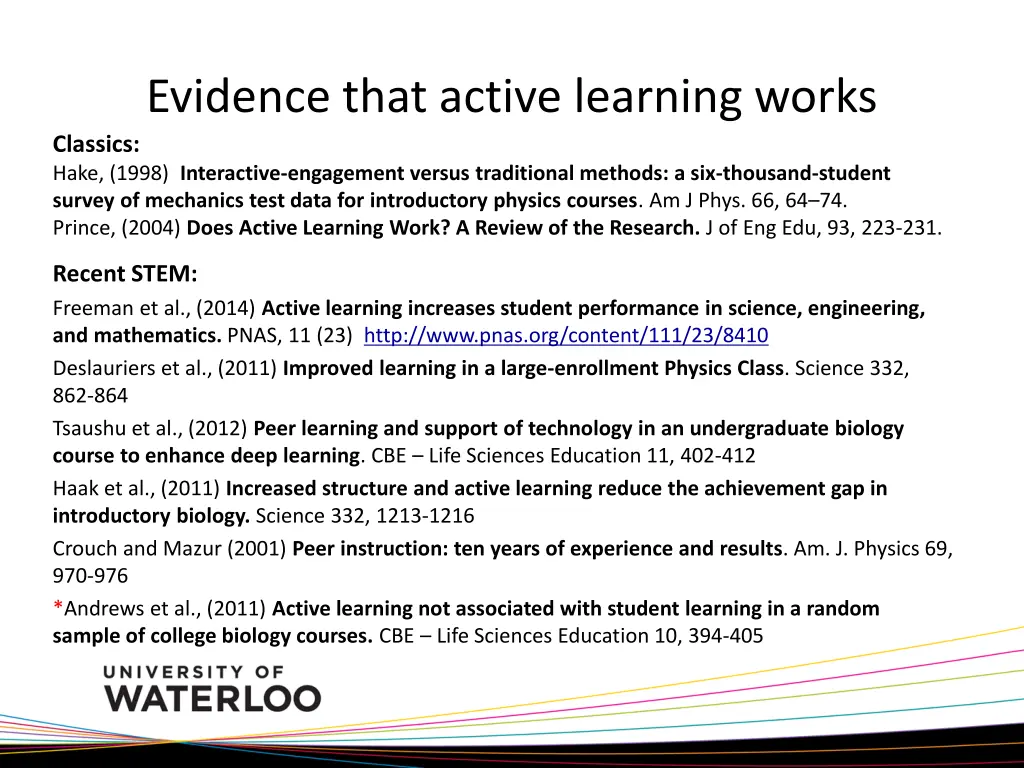
Evidence that active learning works Classics: Hake, (1998) Interactive-engagement versus traditional methods: a six-thousand-student survey of mechanics test data for introductory physics courses. Am J Phys. 66, 64 74. Prince, (2004) Does Active Learning Work? A Review of the Research. J of Eng Edu, 93, 223-231. Recent STEM: Freeman et al., (2014) Active learning increases student performance in science, engineering, and mathematics. PNAS, 11 (23) http://www.pnas.org/content/111/23/8410 Deslauriers et al., (2011) Improved learning in a large-enrollment Physics Class. Science 332, 862-864 Tsaushu et al., (2012) Peer learning and support of technology in an undergraduate biology course to enhance deep learning. CBE Life Sciences Education 11, 402-412 Haak et al., (2011) Increased structure and active learning reduce the achievement gap in introductory biology. Science 332, 1213-1216 Crouch and Mazur (2001) Peer instruction: ten years of experience and results. Am. J. Physics 69, 970-976 *Andrews et al., (2011) Active learning not associated with student learning in a random sample of college biology courses. CBE Life Sciences Education 10, 394-405