Understanding the Impact of Materialism and Ignorance on Climate Crisis
Explore the relationship between materialism, consumerism, and ignorance in the context of the climate crisis. Discover how these factors hinder our response to environmental challenges and contribute to sustainability issues.

Download Presentation

Please find below an Image/Link to download the presentation.
The content on the website is provided AS IS for your information and personal use only. It may not be sold, licensed, or shared on other websites without obtaining consent from the author. If you encounter any issues during the download, it is possible that the publisher has removed the file from their server.
You are allowed to download the files provided on this website for personal or commercial use, subject to the condition that they are used lawfully. All files are the property of their respective owners.
The content on the website is provided AS IS for your information and personal use only. It may not be sold, licensed, or shared on other websites without obtaining consent from the author.
E N D
Presentation Transcript
Buddhism and the Climate Crisis Buddhism and the Climate Crisis Chris Ives
Mindfulness in the Marketplace: Compassionate Responses to Consumerism, edited by Allan Hunt Badiner (2002) Hooked! Buddhist Writings on Greed, Desire, and the Urge to Consume, edited by Stephanie Kaza (2005)
a working definition Consumerism is 1. the belief that buying/having certain things and experiences will make a person happy, and 2. the actions based on that belief, including certain consumer behaviors and the ascription of high status to those who possess wealth or desired consumer goods and experiences.
For most of us, not full-blown desire for more, but fear of having less (attachment to our lifestyle) The issue may be our clinging more than our craving. desire as craving for things/situations we don t have clinging to things/situations we do have Less a desire to have more than a fear of having less. The issue may be materialism more than consumerism.
materialism and its environmental impact as one cause of the climate crisis
freneticism and distraction, in part caused and/or exacerbated by certain ways of using technology) freneticism and distraction as a hindrance to responding to the climate crisis
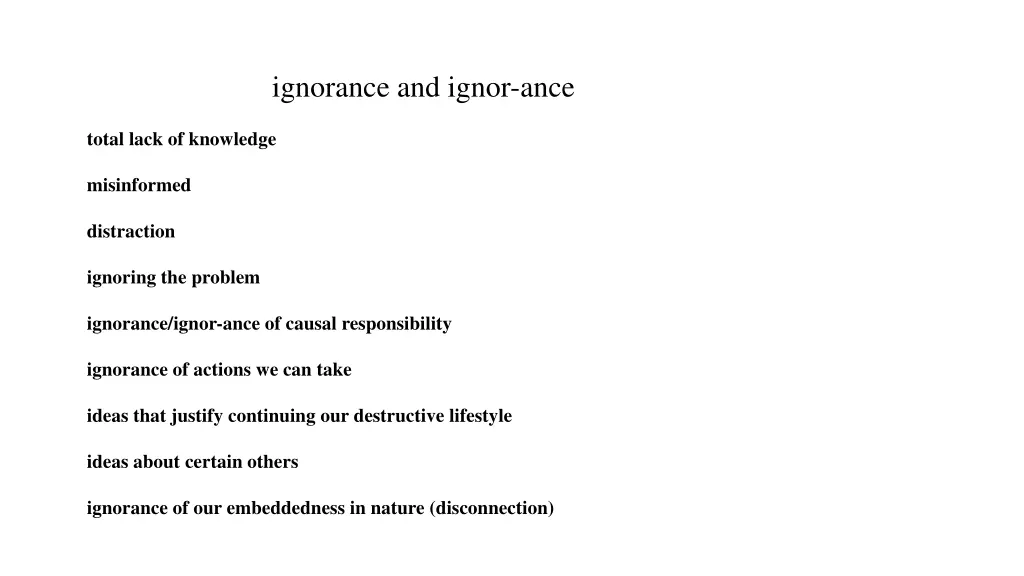
ignorance and ignor-ance total lack of knowledge misinformed distraction ignoring the problem ignorance/ignor-ance of causal responsibility ignorance of actions we can take ideas that justify continuing our destructive lifestyle ideas about certain others ignorance of our embeddedness in nature (disconnection)
materialism as one cause of the climate crisis freneticism and ignorance/ignor-ance as hindrance to responding to the crisis
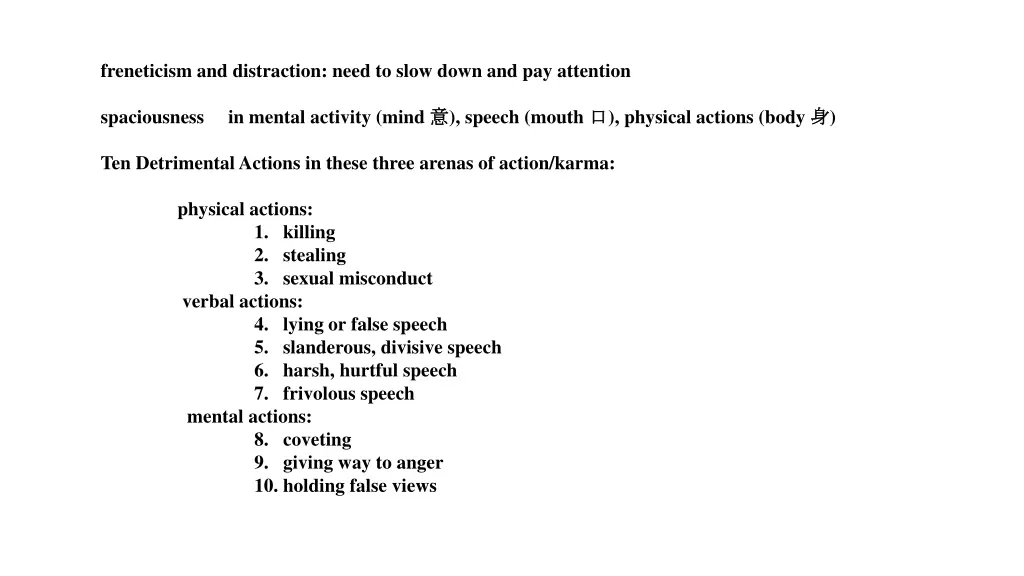
freneticism and distraction: need to slow down and pay attention spaciousnessin mental activity (mind ), speech (mouth ), physical actions (body ) Ten Detrimental Actions in these three arenas of action/karma: physical actions: verbal actions: mental actions: 1. killing 2. stealing 3. sexual misconduct 4. lying or false speech 5. slanderous, divisive speech 6. harsh, hurtful speech 7. frivolous speech 8. coveting 9. giving way to anger 10. holding false views
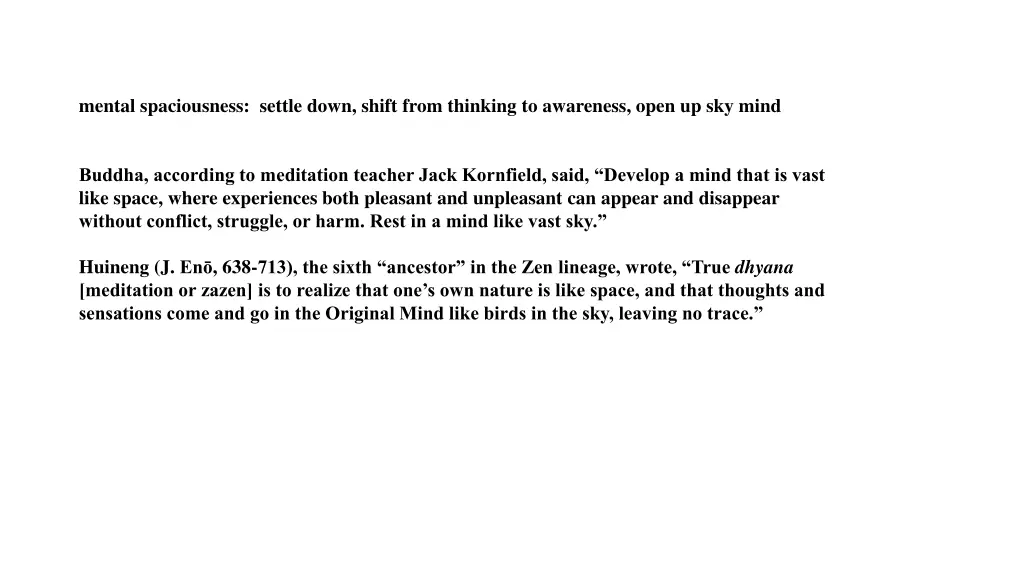
mental spaciousness: settle down, shift from thinking to awareness, open up sky mind Buddha, according to meditation teacher Jack Kornfield, said, Develop a mind that is vast like space, where experiences both pleasant and unpleasant can appear and disappear without conflict, struggle, or harm. Rest in a mind like vast sky. Huineng (J. En , 638-713), the sixth ancestor in the Zen lineage, wrote, True dhyana [meditation or zazen] is to realize that one s own nature is like space, and that thoughts and sensations come and go in the Original Mind like birds in the sky, leaving no trace.
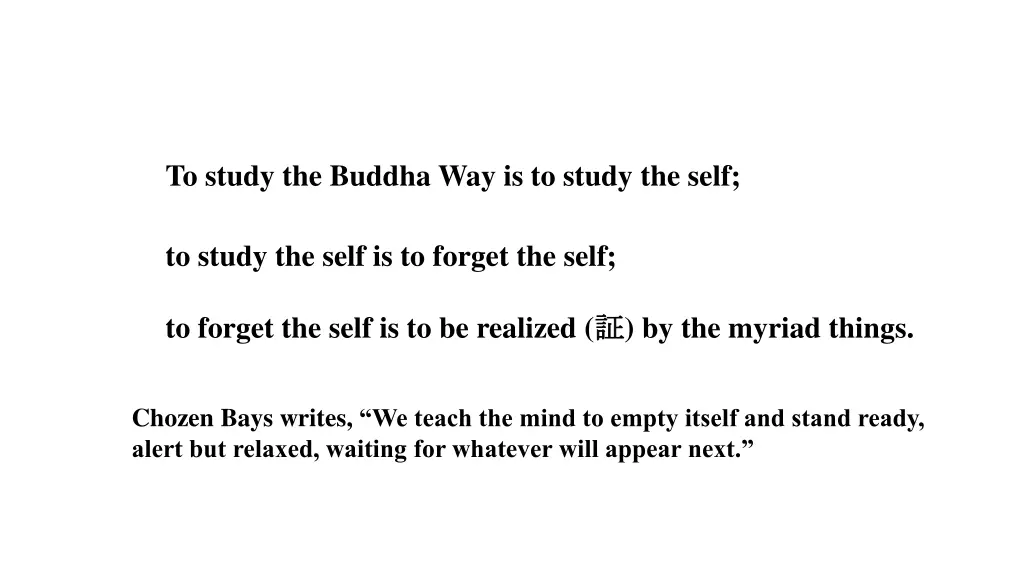
To study the Buddha Way is to study the self; to study the self is to forget the self; to forget the self is to be realized ( ) by the myriad things. Chozen Bays writes, We teach the mind to empty itself and stand ready, alert but relaxed, waiting for whatever will appear next.
Wake up as the mind that is emptied, spacious, and like the sky. kara ( ) sora ( ) k ( )
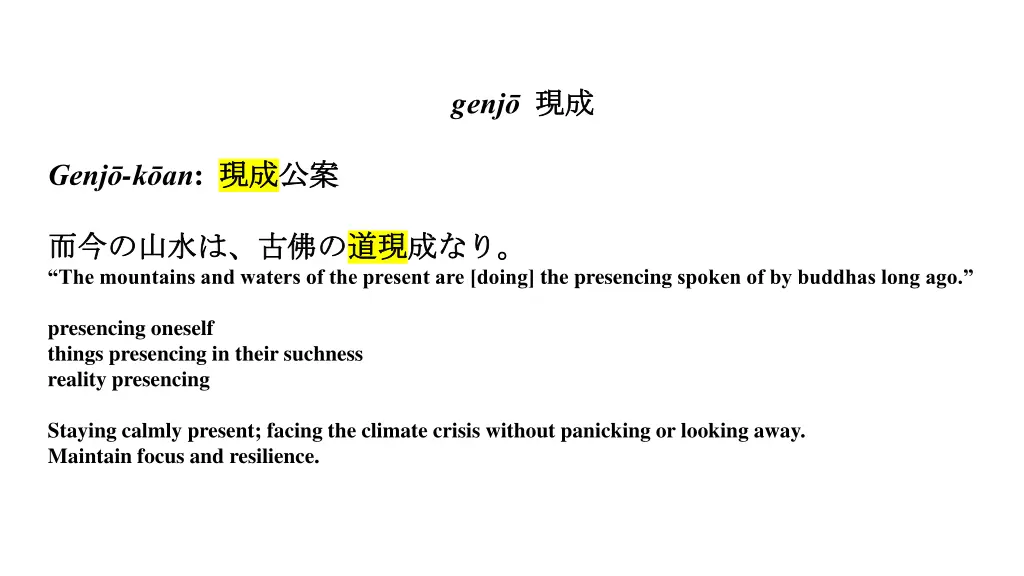
genj Genj -k an: The mountains and waters of the present are [doing]the presencing spoken of by buddhas long ago. presencing oneself things presencing in their suchness reality presencing Staying calmly present; facing the climate crisis without panicking or looking away. Maintain focus and resilience.
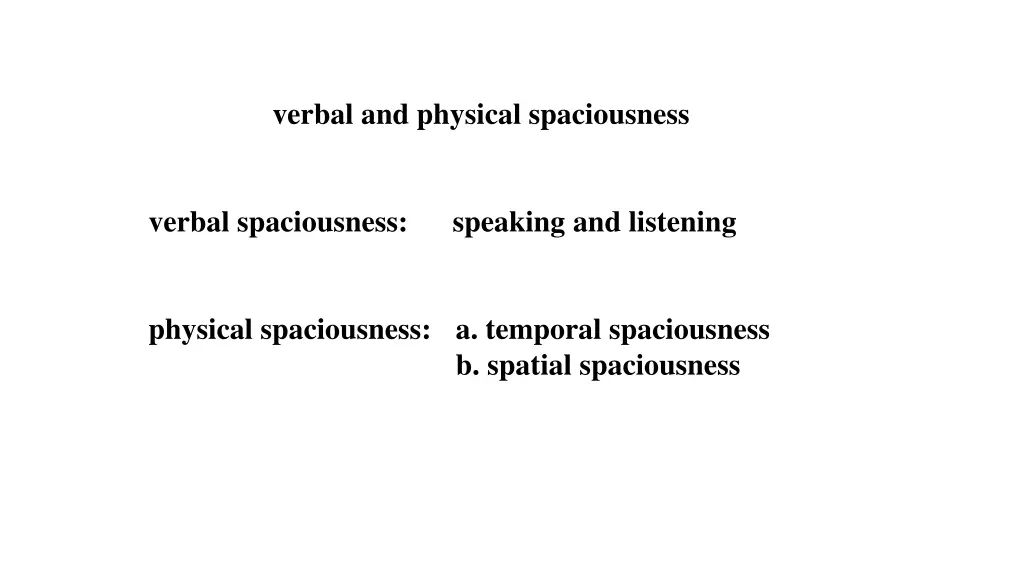
verbal and physical spaciousness verbal spaciousness: speaking and listening physical spaciousness: a. temporal spaciousness b. spatial spaciousness
freneticism and distraction: need to slow down and pay attention (spaciousness) high-impact materialistic living: need to simplify our lifestyle
environmental virtue ethic as basis for simple, lower-impact living restraint simplicity contentment recognition of what we receive ( on, blessings): insight into interconnectedness gratitude giving and generosity respect non-harming compassion patience
home monastery with support structures Zen monasticism as template
living embedded in nature in ones specific place one type of ignorance is our sense of being separate from nature Zen and the natural world 1. realize our embeddedness in nature as nature; overcome felt sense of separation 2. appreciate, value, and care for nature
Buddhism and animalsa mixed bag David Abram, The Spell of the Sensuous: we are part of sensuous reality, animals are intelligent, presences speaking their own languages Through dialogue with Abram, Indigenous people/traditions, and certain scientists, Buddhists can gain a more sophisticated understanding and valuation of non-human animals and the more-than- human world.
reinhabitation see Gary Snyder, Reinhabitation (in his A Place in Space)
To look only at materialism and freneticism/distraction is to focus on individual, ordinary people and their lifestyle, and overlook powerful actors, institutions, structures, systems, and economic models (growth paradigm, etc.) that cause or contribute to climate crisis and other problems.
We need to focus not only on lifestyle change but also on structural change. Otherwise, we will end up simply blaming individual consumers and not dealing with larger causes of environmental issues.
community Snyder in Reinhabitation and Bill McKibben in Eaarth and Deep Economy stress the importance of building local community for reducing negative impact, for resilience, for activism.
How equipped is Buddhism to go beyond its analysis/criticism of our desire and our way of living and grapple with larger social, political, and economic structures/systems?
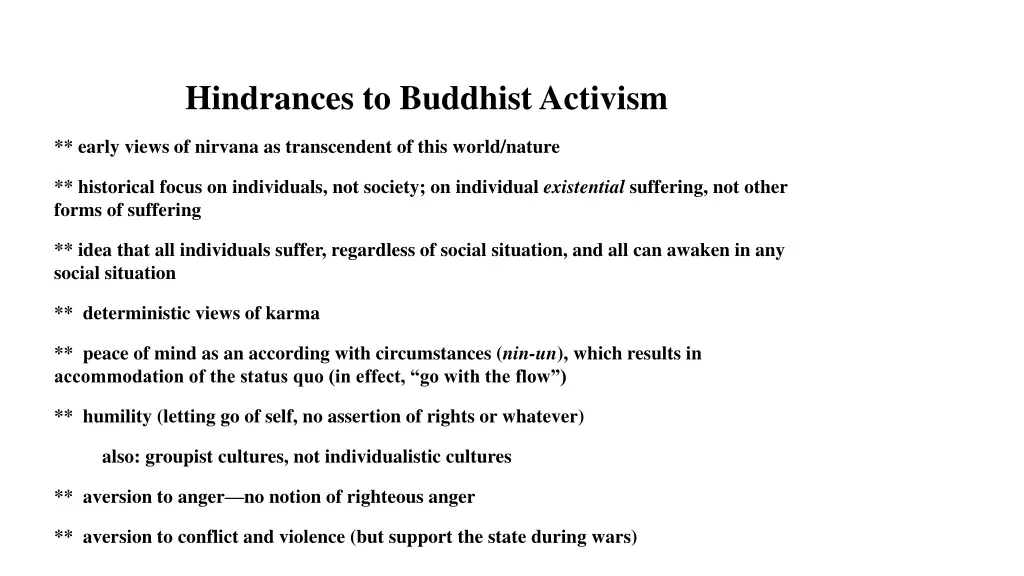
Hindrances to Buddhist Activism ** early views of nirvana as transcendent of this world/nature ** historical focus on individuals, not society; on individual existential suffering, not other forms of suffering ** idea that all individuals suffer, regardless of social situation, and all can awaken in any social situation ** deterministic views of karma ** peace of mind as an according with circumstances (nin-un), which results in accommodation of the status quo (in effect, go with the flow ) ** humility (letting go of self, no assertion of rights or whatever) also: groupist cultures, not individualistic cultures ** aversion to anger no notion of righteous anger ** aversion to conflict and violence (but support the state during wars)
** institutional symbiosis with ruling powers ** no notion of social justice (but karma as retributive justice) ** decentralized character of Buddhism ** disengaged Buddhism (see Amod Lele essay in JBE)
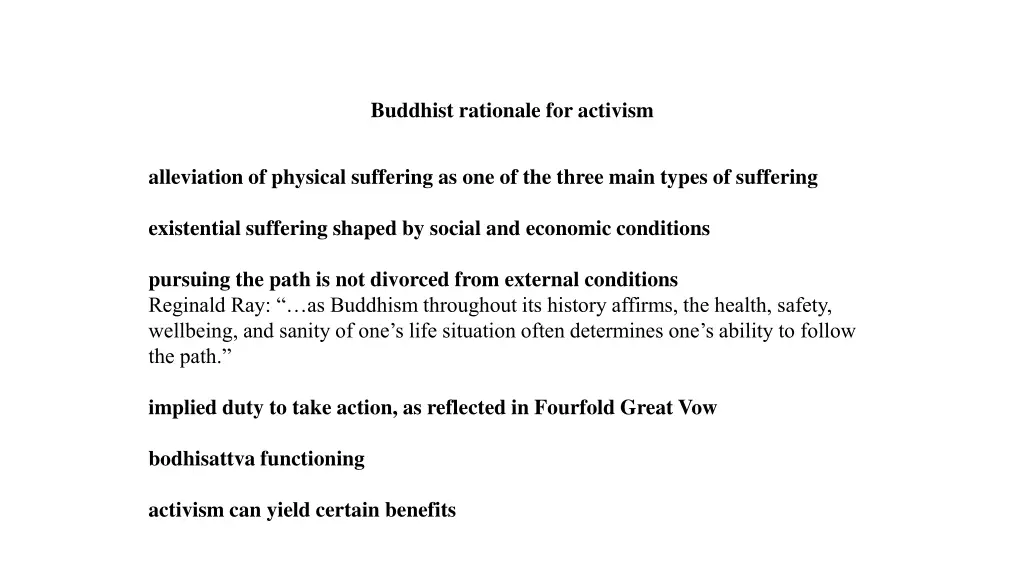
Buddhist rationale for activism alleviation of physical suffering as one of the three main types of suffering existential suffering shaped by social and economic conditions pursuing the path is not divorced from external conditions Reginald Ray: as Buddhism throughout its history affirms, the health, safety, wellbeing, and sanity of one s life situation often determines one s ability to follow the path. implied duty to take action, as reflected in Fourfold Great Vow bodhisattva functioning activism can yield certain benefits
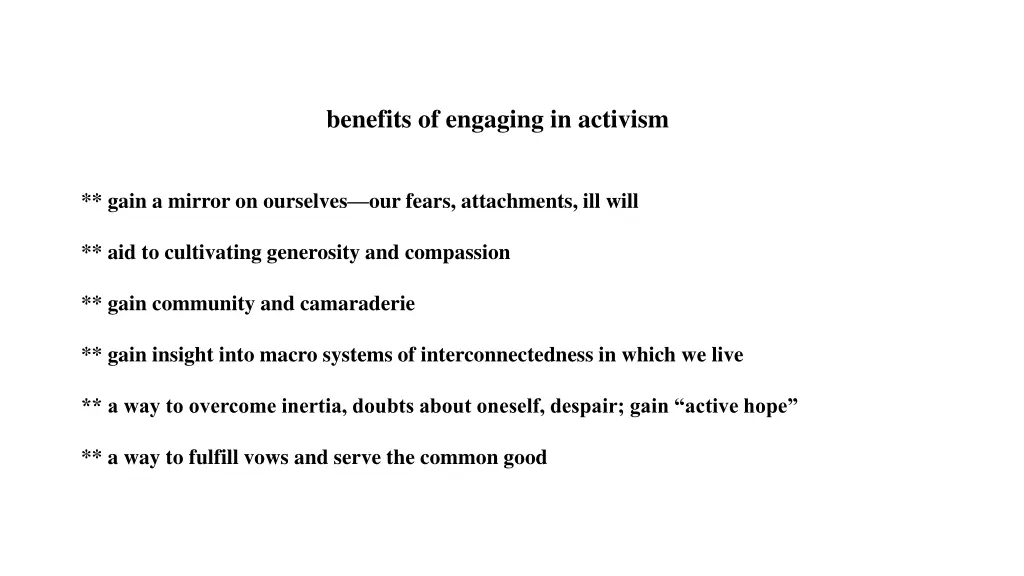
benefits of engaging in activism ** gain a mirror on ourselves our fears, attachments, ill will ** aid to cultivating generosity and compassion ** gain community and camaraderie ** gain insight into macro systems of interconnectedness in which we live ** a way to overcome inertia, doubts about oneself, despair; gain active hope ** a way to fulfill vows and serve the common good
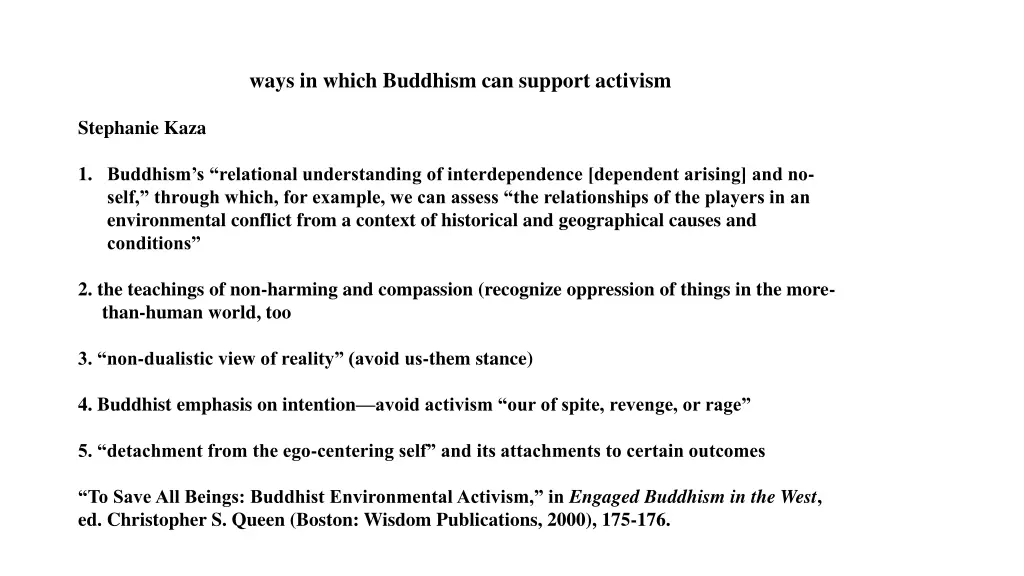
ways in which Buddhism can support activism Stephanie Kaza 1. Buddhism s relational understanding of interdependence [dependent arising] and no- self, through which, for example, we can assess the relationships of the players in an environmental conflict from a context of historical and geographical causes and conditions 2. the teachings of non-harming and compassion (recognize oppression of things in the more- than-human world, too 3. non-dualistic view of reality (avoid us-them stance) 4. Buddhist emphasis on intention avoid activism our of spite, revenge, or rage 5. detachment from the ego-centering self and its attachments to certain outcomes To Save All Beings: Buddhist Environmental Activism, in Engaged Buddhism in the West, ed. Christopher S. Queen (Boston: Wisdom Publications, 2000), 175-176.
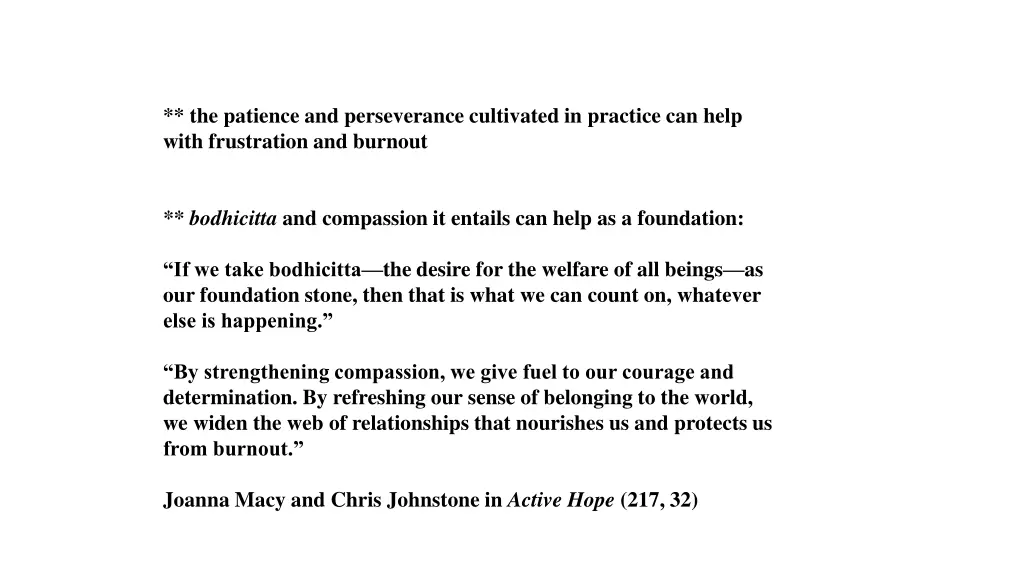
** the patience and perseverance cultivated in practice can help with frustration and burnout ** bodhicitta and compassion it entails can help as a foundation: If we take bodhicitta the desire for the welfare of all beings as our foundation stone, then that is what we can count on, whatever else is happening. By strengthening compassion, we give fuel to our courage and determination. By refreshing our sense of belonging to the world, we widen the web of relationships that nourishes us and protects us from burnout. Joanna Macy and Chris Johnstone in Active Hope (217, 32)
What can we do at various levels? individual local regional national international