Understanding the Impact of Role-Emerging Placements on Occupational Therapy Staff
Explore how role-emerging placements influence the understanding of occupational therapy within host organizations, focusing on changing perceptions, holistic nature of occupation, valued skills, and future employment considerations. Study conducted in the UK through qualitative interviews with on-site supervisors.

Download Presentation

Please find below an Image/Link to download the presentation.
The content on the website is provided AS IS for your information and personal use only. It may not be sold, licensed, or shared on other websites without obtaining consent from the author. If you encounter any issues during the download, it is possible that the publisher has removed the file from their server.
You are allowed to download the files provided on this website for personal or commercial use, subject to the condition that they are used lawfully. All files are the property of their respective owners.
The content on the website is provided AS IS for your information and personal use only. It may not be sold, licensed, or shared on other websites without obtaining consent from the author.
E N D
Presentation Transcript
Walking the Talk on Role-emerging placements Pam Toothill & Dr. Alison Warren Master s Dissertation - 2018
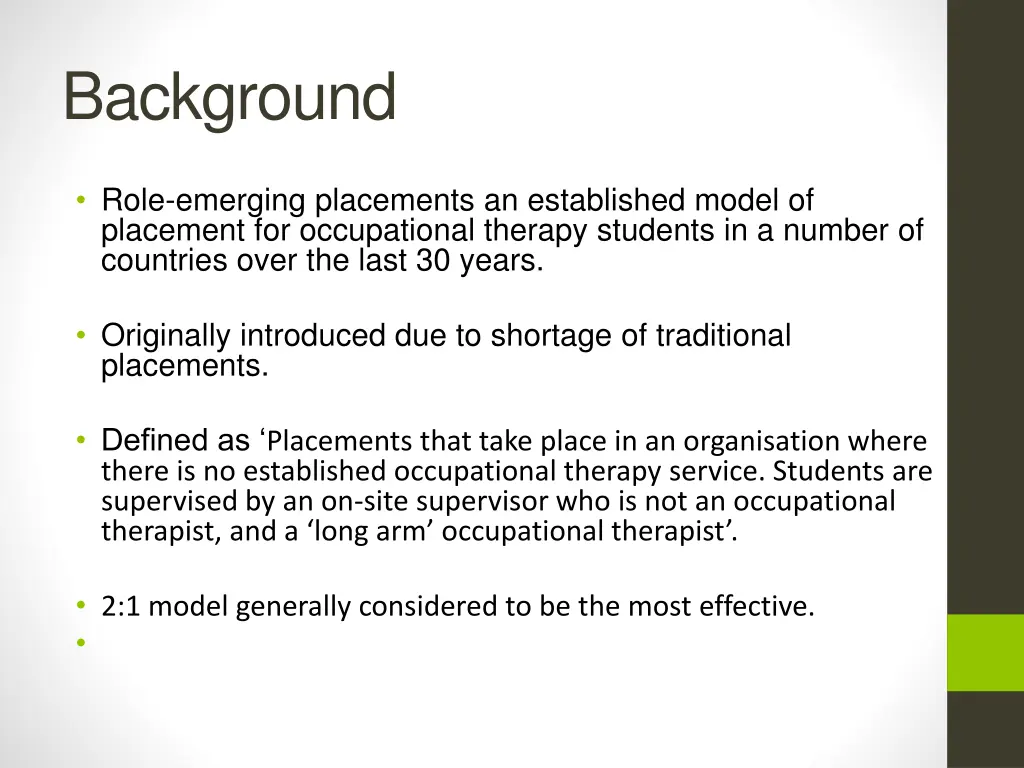
Background Role-emerging placements an established model of placement for occupational therapy students in a number of countries over the last 30 years. Originally introduced due to shortage of traditional placements. Defined as Placements that take place in an organisation where there is no established occupational therapy service. Students are supervised by an on-site supervisor who is not an occupational therapist, and a long arm occupational therapist . 2:1 model generally considered to be the most effective.
Background Research has concentrated mainly on student learning and development of professional identity. Paucity of research on the views of host-organisations. (Clarke et al., 2014)
Research Question How do role-emerging placements influence the understanding of occupational therapy for staff within host organisations?
Objectives To investigate whether perceptions of occupational therapy by staff in organisations hosting occupational therapy students on role-emerging placements are subject to change during the course of the placement. To explore whether staff in organisations gain a greater understanding of the holistic nature of occupation during placements.
Objectives To identify which skills and qualities, demonstrated by occupational therapy students, are valued by the staff in the organisations. To gain an understanding of the factors that may facilitate or hinder host organisations in considering future employment of occupational therapists, following a role-emerging placement.
Methods Staff from host organisations, partnering with three universities in the UK Qualitative descriptive study Purposive sampling 10 participants who were on- site supervisors Semi-structured interviews Inductive thematic analysis (Braun and Clarke, 2013)
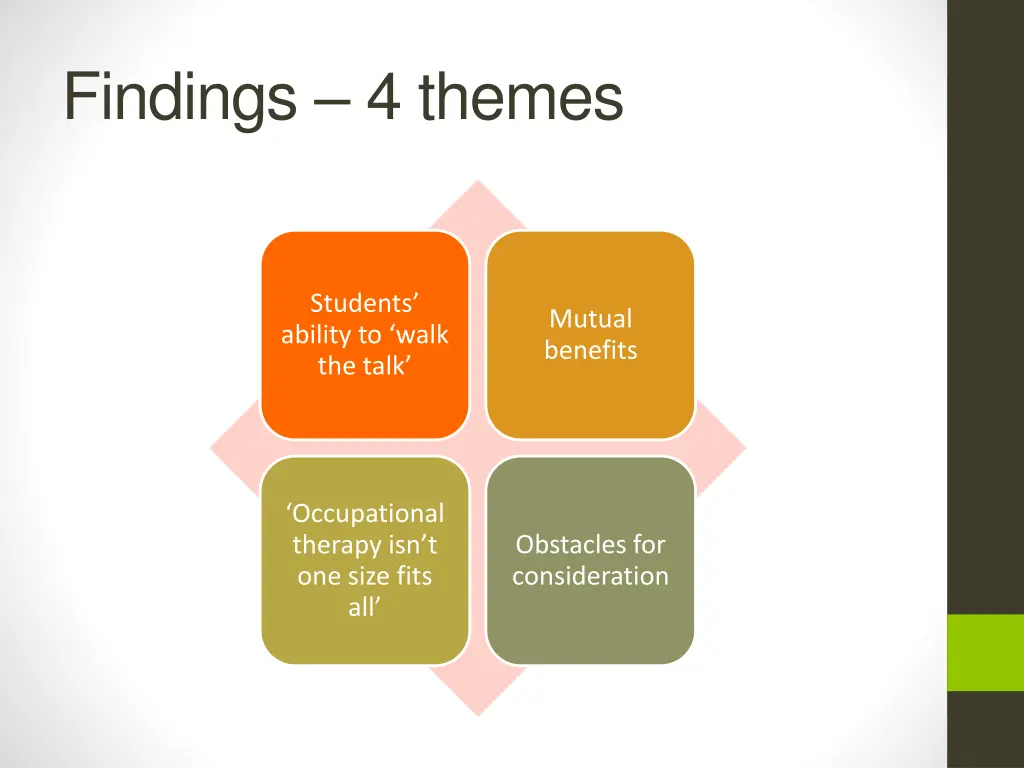
Findings 4 themes Students ability to walk the talk Mutual benefits Occupational therapy isn t one size fits all Obstacles for consideration
Students ability to walk the talk Student strengths They re ALWAYS enthusiastic and I ll say again that they can come up with new ideas that maybe we ve not thought of (Margaret) An occupational therapy perspective They allow, they re not doing for the service user what the service user can do. They re enabling straight away (John)
Mutual benefits Reciprocal support Development I think, development for the staff, new ideas. Er for the people we support, improvement. Skills, skills that we probably don t have the time to think about or to put anything in place, or how to do it (Cheynne) Keen for further involvement in role-emerging placements We want them because we ve learnt so much and we think that the three pairs up to now have got a lot out of it plus the fact we ve spoken a lot about what WE VE got from them (Peter)
Occupational therapy isnt one size fits all Reflections on Knowledge of Occupational Therapy I didn t realise that there was so much variety in what occupational therapy was about (Alex) Defining occupation I now very much see that occupation is ANYTHING that you choose to do. Any activity that you choose to do, and the therapy aspect comes in to enabling you to do that (Georgie) Similarities & differences in approach The students coming in and showing us, actually just because somebody s got a disability or they ve suddenly got dementia, doesn t mean that we can take away everything that they can do (Cheynne)
Obstacles for consideration Potential threats to smooth running of placements They re only here for six weeks so it s almost opening the door as opposed to being able to take something forward (Peter) Factors related to future employment of an occupational therapist So there is potential for future placements AND if funding wasn t an issue, there would be an awful lot of work in this centre for an OT to do (Georgie)
Discussion The majority of participants stated that their understanding of occupational therapy and the term occupation had changed during the placements. Participants learned about occupational therapy through skills, knowledge and values demonstrated by the students. Skills included professionalism, effective communication and good organisational skills (Warren, 2014; Fortune and McKinstry, 2012). Students also brought ideas to the placements (Mulholland and Derdall, 2005). Students also demonstrated a client-centred approach (Warren, 2014) and therapeutic use of self. An enabling approach to service users, and the ability to grade and adapt was also observed. The enabling approach demonstrated by the students prompted some organisations to question their own approach to service users.
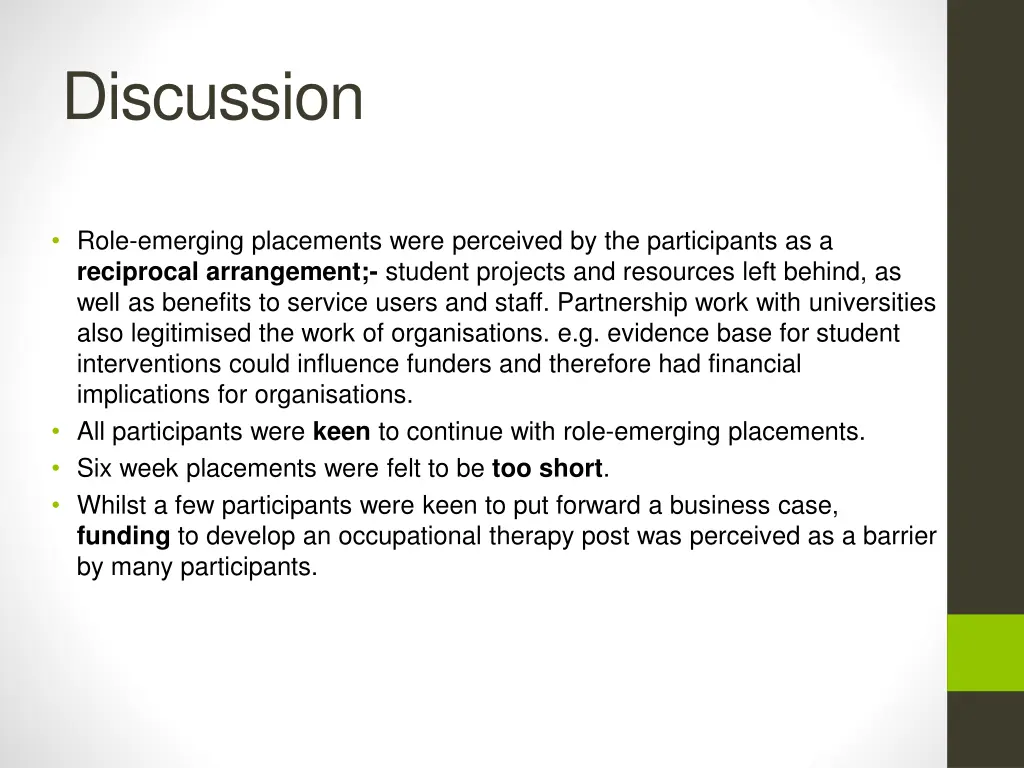
Discussion Role-emerging placements were perceived by the participants as a reciprocal arrangement;- student projects and resources left behind, as well as benefits to service users and staff. Partnership work with universities also legitimised the work of organisations. e.g. evidence base for student interventions could influence funders and therefore had financial implications for organisations. All participants were keen to continue with role-emerging placements. Six week placements were felt to be too short. Whilst a few participants were keen to put forward a business case, funding to develop an occupational therapy post was perceived as a barrier by many participants.
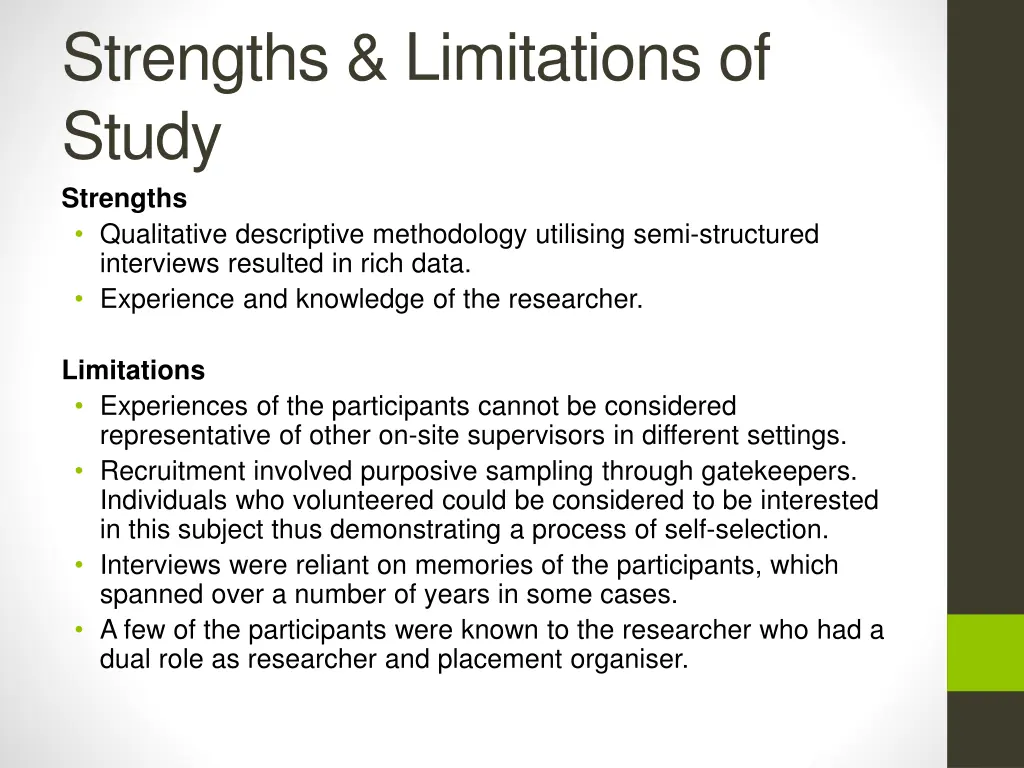
Strengths & Limitations of Study Strengths Qualitative descriptive methodology utilising semi-structured interviews resulted in rich data. Experience and knowledge of the researcher. Limitations Experiences of the participants cannot be considered representative of other on-site supervisors in different settings. Recruitment involved purposive sampling through gatekeepers. Individuals who volunteered could be considered to be interested in this subject thus demonstrating a process of self-selection. Interviews were reliant on memories of the participants, which spanned over a number of years in some cases. A few of the participants were known to the researcher who had a dual role as researcher and placement organiser.
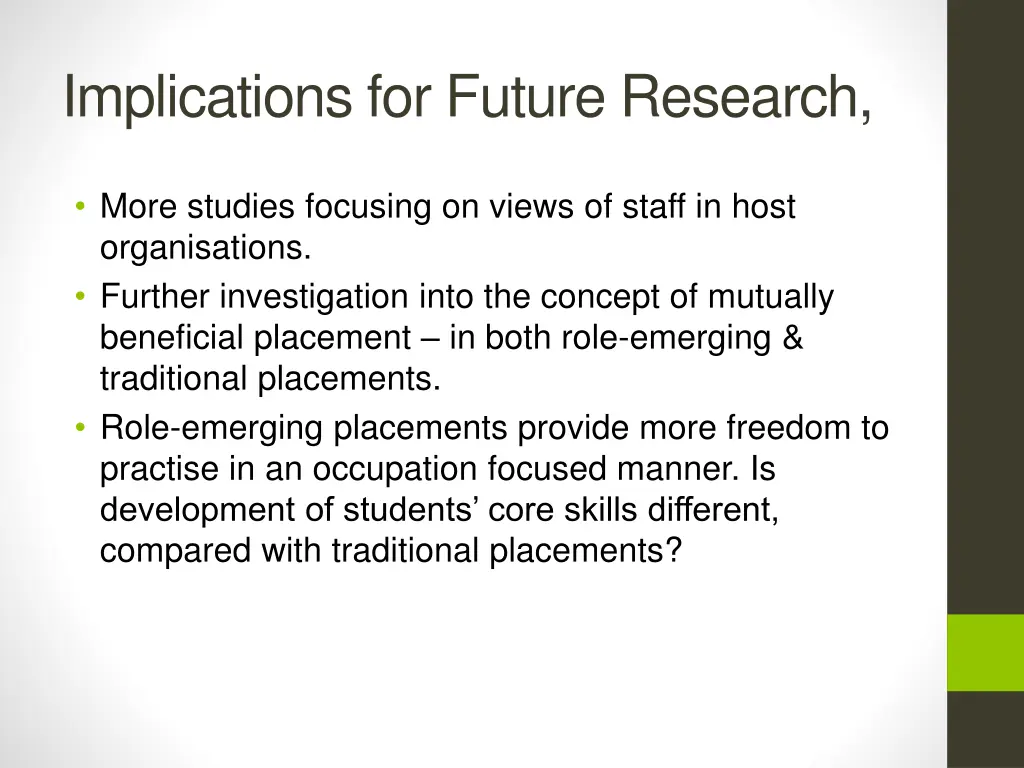
Implications for Future Research, More studies focusing on views of staff in host organisations. Further investigation into the concept of mutually beneficial placement in both role-emerging & traditional placements. Role-emerging placements provide more freedom to practise in an occupation focused manner. Is development of students core skills different, compared with traditional placements?
Implications for Future Education The core skills and enabling approach of occupational therapists should be highlighted when occupational therapy is explained to others.
Implications for Future Practice Universities should consider the consequences of continuing to place students in the same host organisation on a repeated basis. By doing this, the roles never emerge as new occupational therapy posts. The length of role-emerging placements should be considered. Within the literature, terms for role-emerging placements vary. More consistency would be helpful in order to create clarity and prevent confusion.
References Braun, V. and Clarke, V. (2013) Successful Qualitative Research; A practical guide for beginners. Los Angeles: Sage. Clarke, C., de-Visser, R., Martin, M. and Sadlo, G. (2014) Role-emerging Placements: a Useful Model for Occupational Therapy Practice Education? A Review of the Literature . International Journal of Practice-based Learning in Health and Social Care, 2 (2), pp. 14 - 26. Fortune, T. and McKinstry, C. (2012) Project-based fieldwork: Perspectives of graduate entry students and project sponsors . Australian Occupational Therapy Journal, 59, pp. 265 275. Mulholland, S. and Derdall, M. (2005) A strategy for supervising occupational therapy students at community sites . Occupational Therapy International, 12 (1), pp. 28 43. Warren, A. (2014) Innovation, Personal Growth and Professional Identity: perspectives on role emerging placements in occupational therapy. Ph.D. Thesis. University of Limerick, Ireland.
Any Questions? P.Toothill@bradford.ac.uk