Understanding Transfer Functions in Control Systems
Explore the concept of transfer functions in control systems, including their definition, representation in block diagrams, Laplace transforms, and the characteristics of first-order systems. Learn about the relationship between input and output signals and the significance of unity negative feedback in closed-loop systems.

Download Presentation

Please find below an Image/Link to download the presentation.
The content on the website is provided AS IS for your information and personal use only. It may not be sold, licensed, or shared on other websites without obtaining consent from the author. If you encounter any issues during the download, it is possible that the publisher has removed the file from their server.
You are allowed to download the files provided on this website for personal or commercial use, subject to the condition that they are used lawfully. All files are the property of their respective owners.
The content on the website is provided AS IS for your information and personal use only. It may not be sold, licensed, or shared on other websites without obtaining consent from the author.
E N D
Presentation Transcript
J. R. Prajapati Electrical Dept. RNGPIT
Transfer Function of Control System A transfer function represents the relationship between the output signal of a control system and the input signal, for all possible input values. A block diagram is a visualization of the control system which uses blocks to represent the transfer function, and arrows which represent the various input and output signals. For any control system, there exists a reference input known as excitation or cause which operates through a transfer operation (i.e. the transfer function) to produce an effect resulting in controlled output or response.
Transfer Function Cont In a Laplace Transform if the input is represented by R(s) and the output is represented by C(s), then the transfer function will be: Transfer function of the system multiplied by the input function gives the output function of the system.
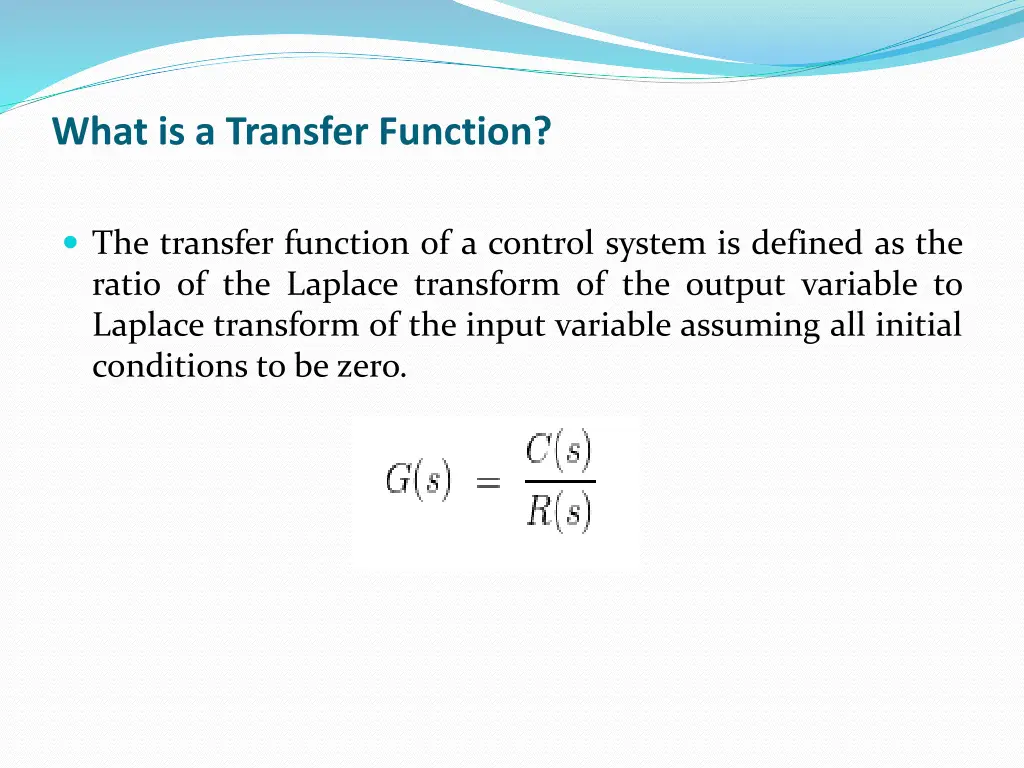
What is a Transfer Function? The transfer function of a control system is defined as the ratio of the Laplace transform of the output variable to Laplace transform of the input variable assuming all initial conditions to be zero.
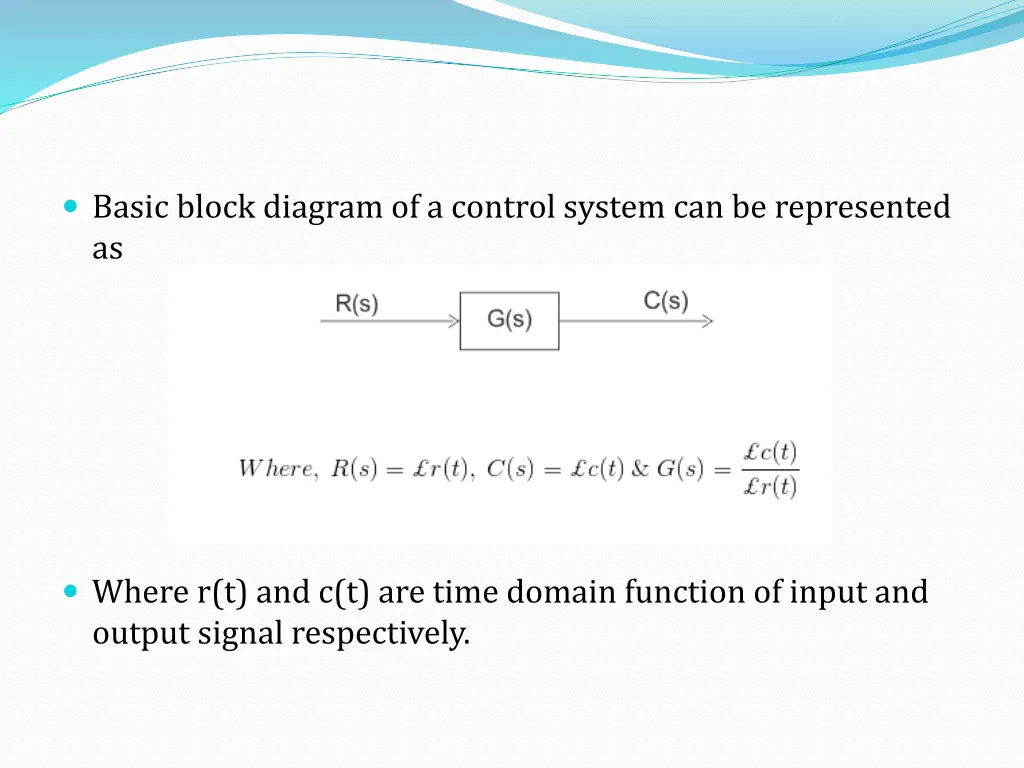
Basic block diagram of a control system can be represented as Where r(t) and c(t) are time domain function of input and output signal respectively.
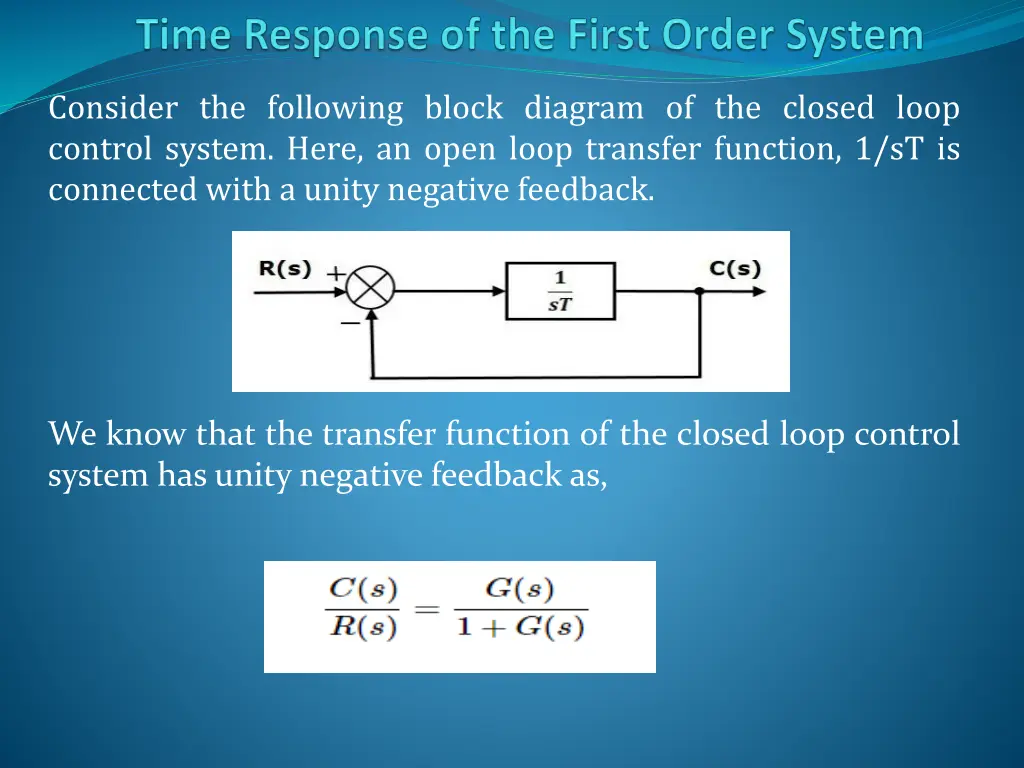
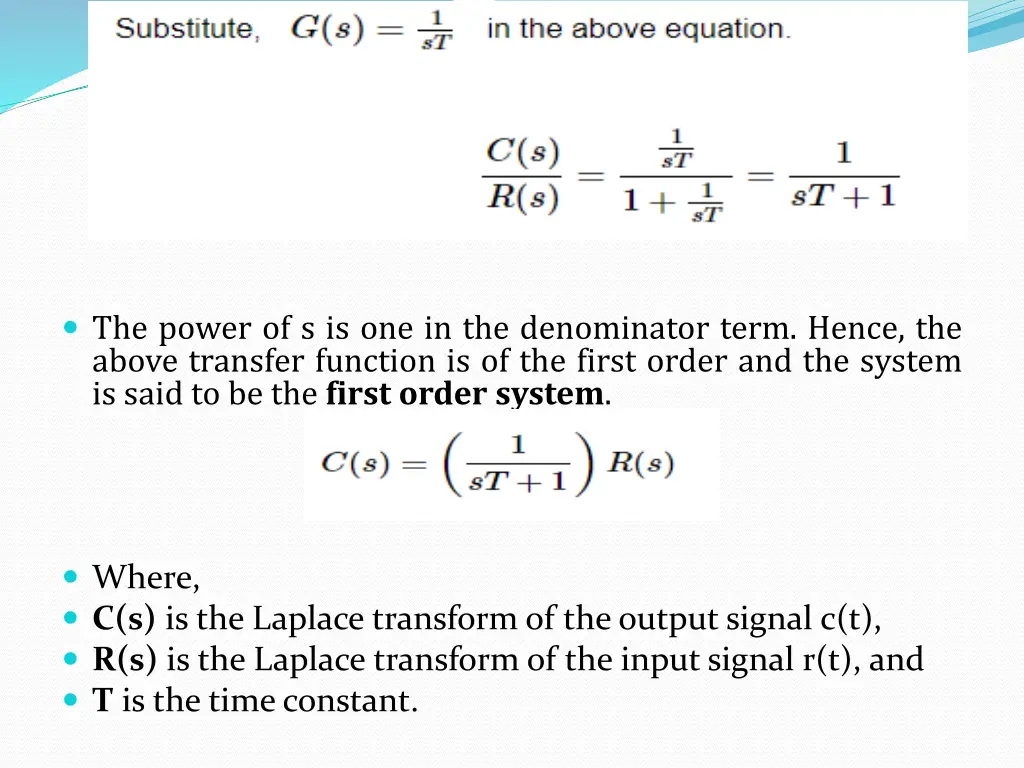
Consider the following block diagram of the closed loop control system. Here, an open loop transfer function, 1/sT is connected with a unity negative feedback. We know that the transfer function of the closed loop control system has unity negative feedback as,
The power of s is one in the denominator term. Hence, the above transfer function is of the first order and the system is said to be the first order system. Where, C(s) is the Laplace transform of the output signal c(t), R(s) is the Laplace transform of the input signal r(t), and T is the time constant.
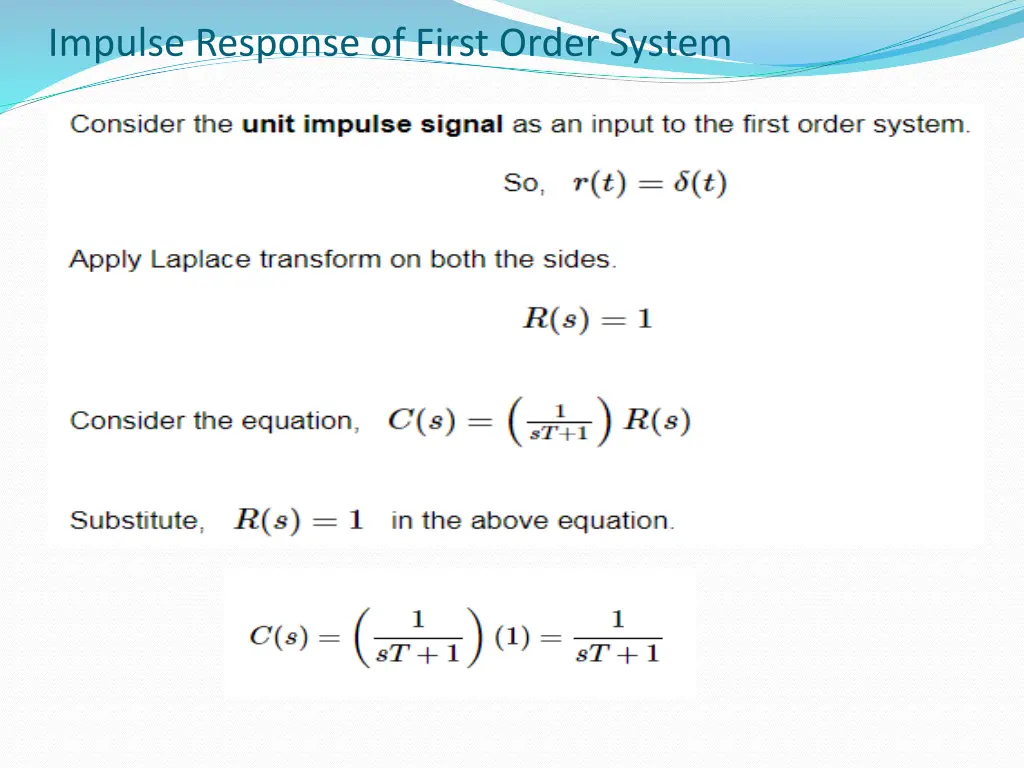
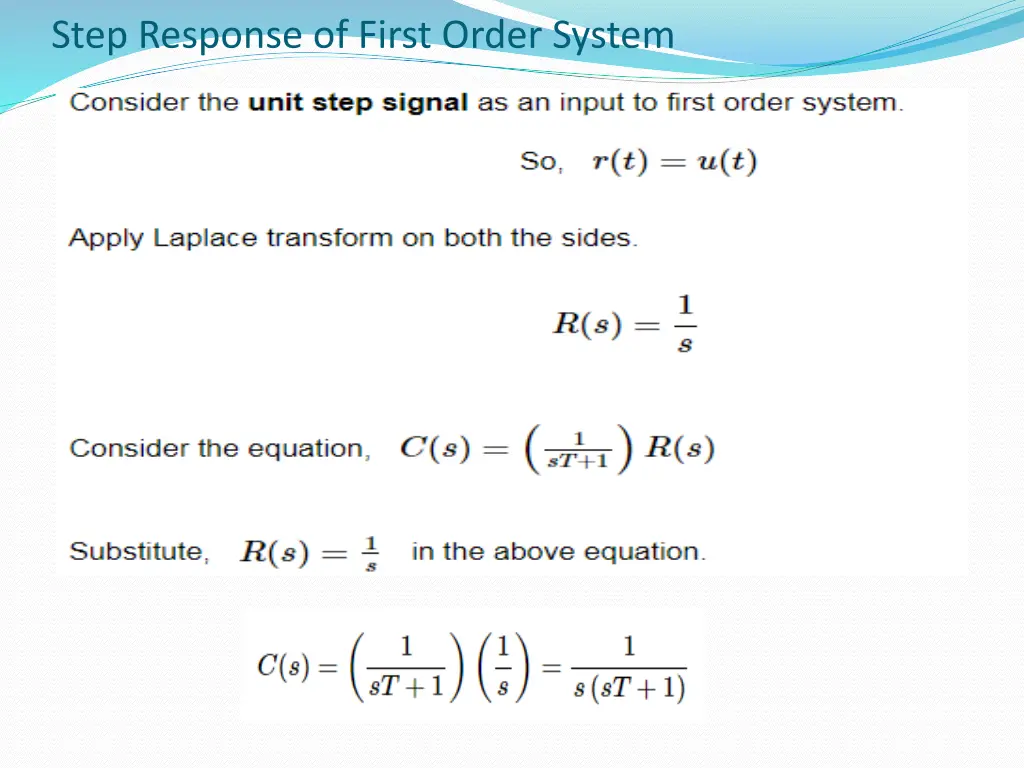
We have seen the standard test signals like impulse, step, ramp and parabolic. Let us now find out the responses of the first order system for each input, one by one. The name of the response is given as per the name of the input signal. For example, the response of the system for an impulse input is called as impulse response.
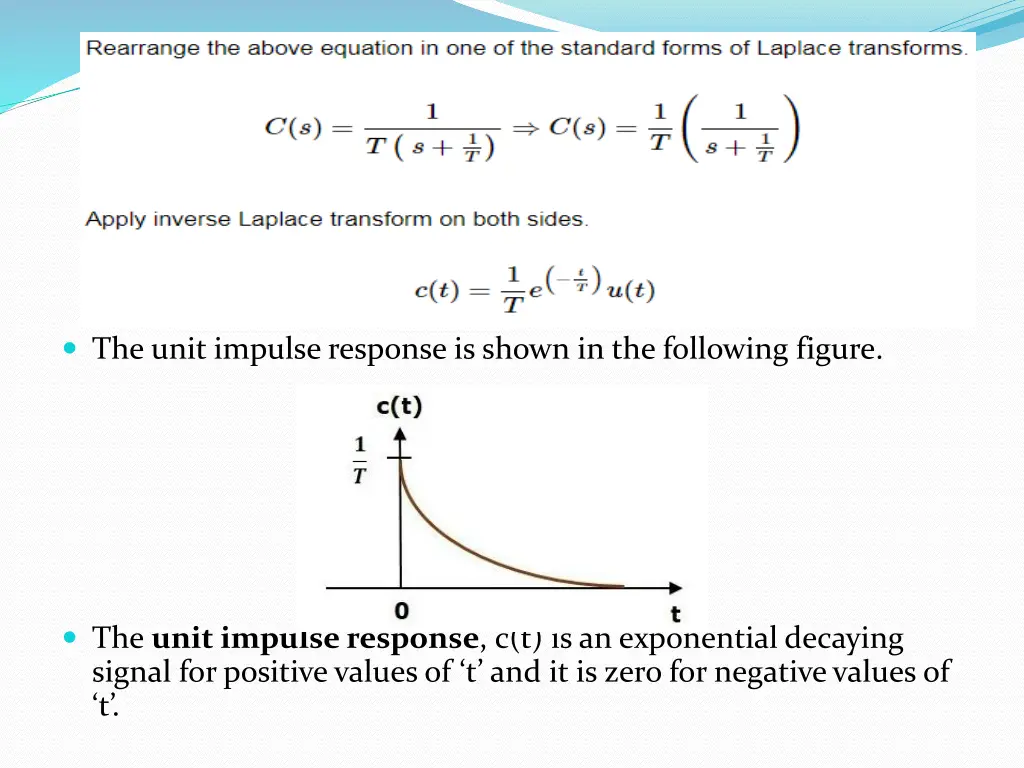
The unit impulse response is shown in the following figure. The unit impulse response, c(t) is an exponential decaying signal for positive values of t and it is zero for negative values of t .