Understanding Transport Layer Security Essentials
Explore the essentials of Transport Layer Security (TLS) and its role in providing data confidentiality, integrity, and authentication services. Learn about TLS protocols, security problems, and comparisons with SSL. Delve into the layers of TLS and the handshake protocol for secure communication.

Download Presentation

Please find below an Image/Link to download the presentation.
The content on the website is provided AS IS for your information and personal use only. It may not be sold, licensed, or shared on other websites without obtaining consent from the author. If you encounter any issues during the download, it is possible that the publisher has removed the file from their server.
You are allowed to download the files provided on this website for personal or commercial use, subject to the condition that they are used lawfully. All files are the property of their respective owners.
The content on the website is provided AS IS for your information and personal use only. It may not be sold, licensed, or shared on other websites without obtaining consent from the author.
E N D
Presentation Transcript
A First Look at Transport Layer Security Rocky K. C. Chang, 23 January 2015 1
Outline Pros and cons of providing security at the transport layer. TLS sessions, connections, and states TLS record layer TLS handshake layer Some TLS/SSL security problems TLS performance 2 Rocky, K. C. Chang
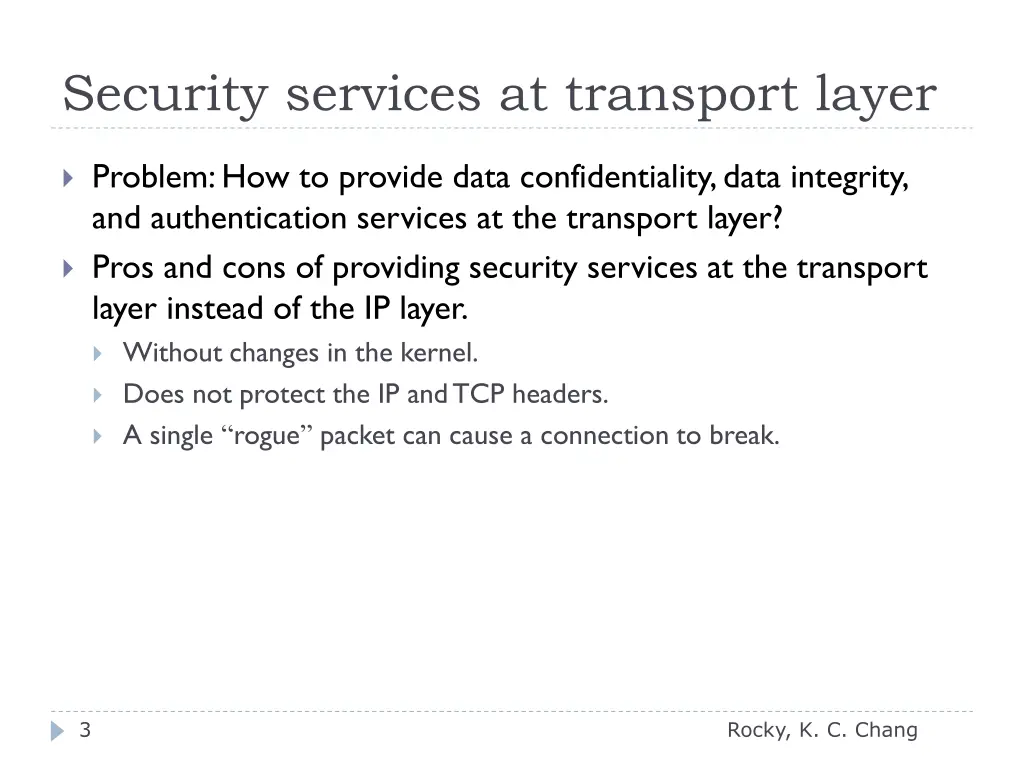
Security services at transport layer Problem: How to provide data confidentiality, data integrity, and authentication services at the transport layer? Pros and cons of providing security services at the transport layer instead of the IP layer. Without changes in the kernel. Does not protect the IP and TCP headers. A single rogue packet can cause a connection to break. 3 Rocky, K. C. Chang
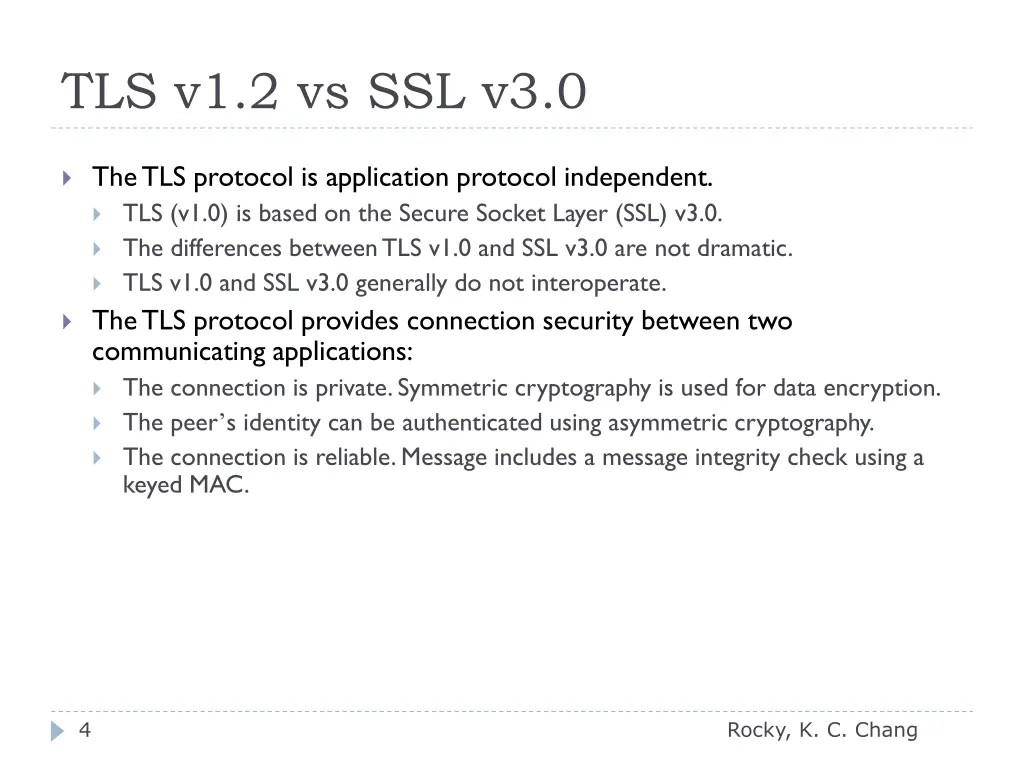
TLS v1.2 vs SSL v3.0 The TLS protocol is application protocol independent. TLS (v1.0) is based on the Secure Socket Layer (SSL) v3.0. The differences between TLS v1.0 and SSL v3.0 are not dramatic. TLS v1.0 and SSL v3.0 generally do not interoperate. The TLS protocol provides connection security between two communicating applications: The connection is private. Symmetric cryptography is used for data encryption. The peer s identity can be authenticated using asymmetric cryptography. The connection is reliable. Message includes a message integrity check using a keyed MAC. 4 Rocky, K. C. Chang
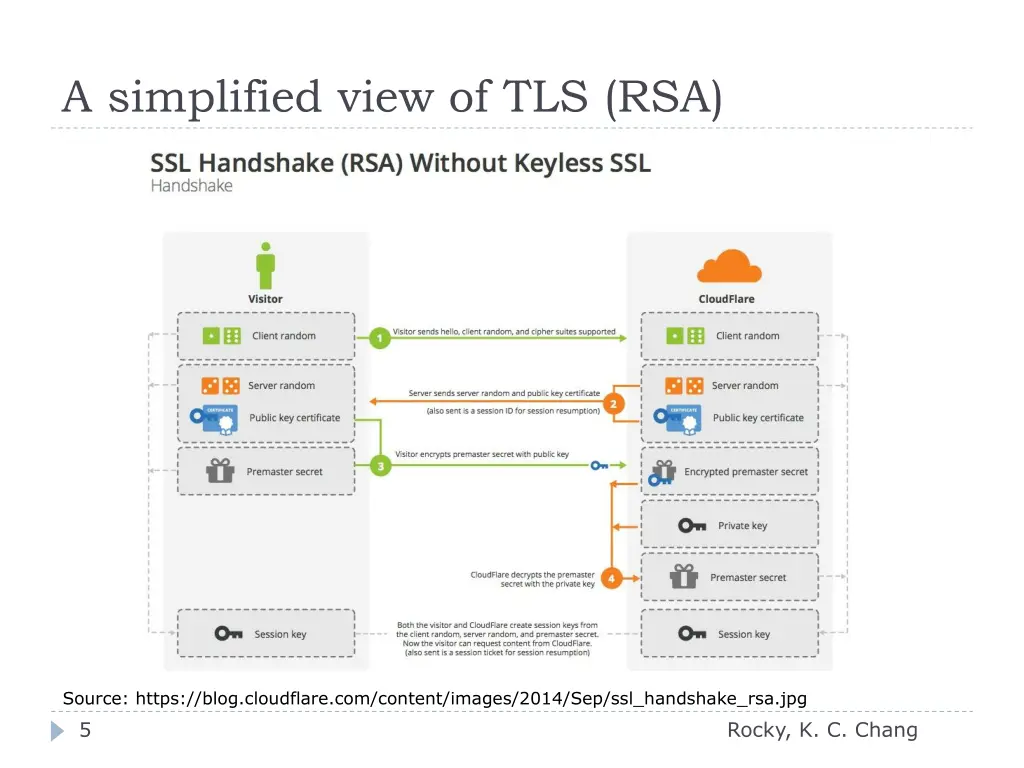
A simplified view of TLS (RSA) Source: https://blog.cloudflare.com/content/images/2014/Sep/ssl_handshake_rsa.jpg 5 Rocky, K. C. Chang
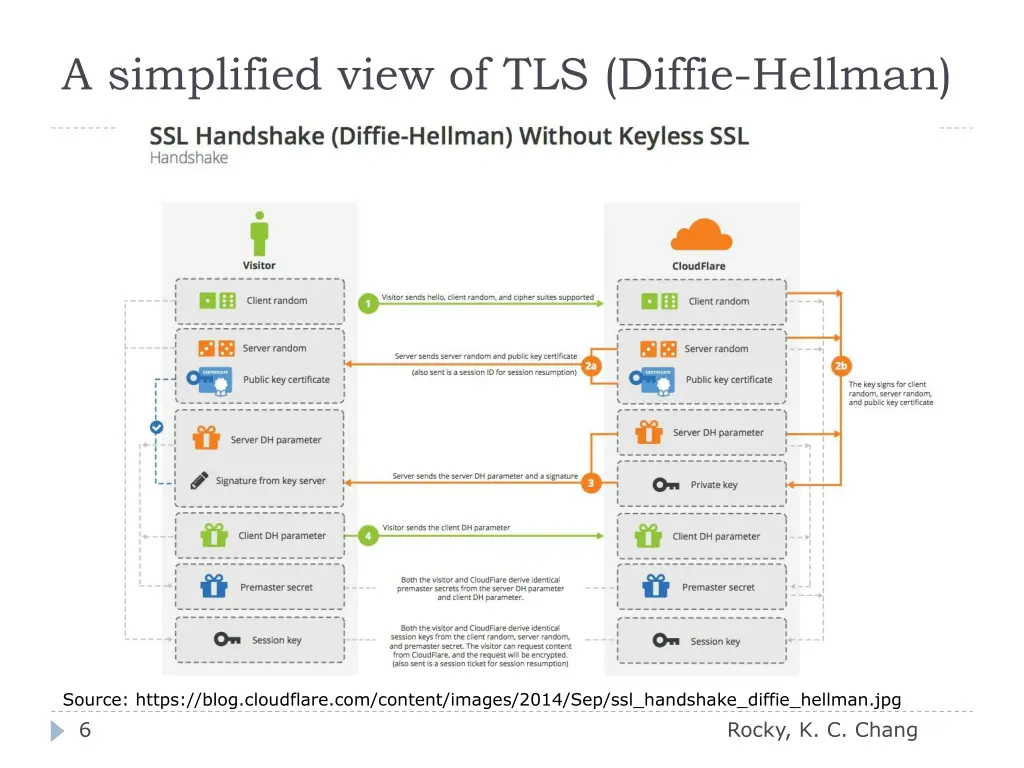
A simplified view of TLS (Diffie-Hellman) Source: https://blog.cloudflare.com/content/images/2014/Sep/ssl_handshake_diffie_hellman.jpg 6 Rocky, K. C. Chang
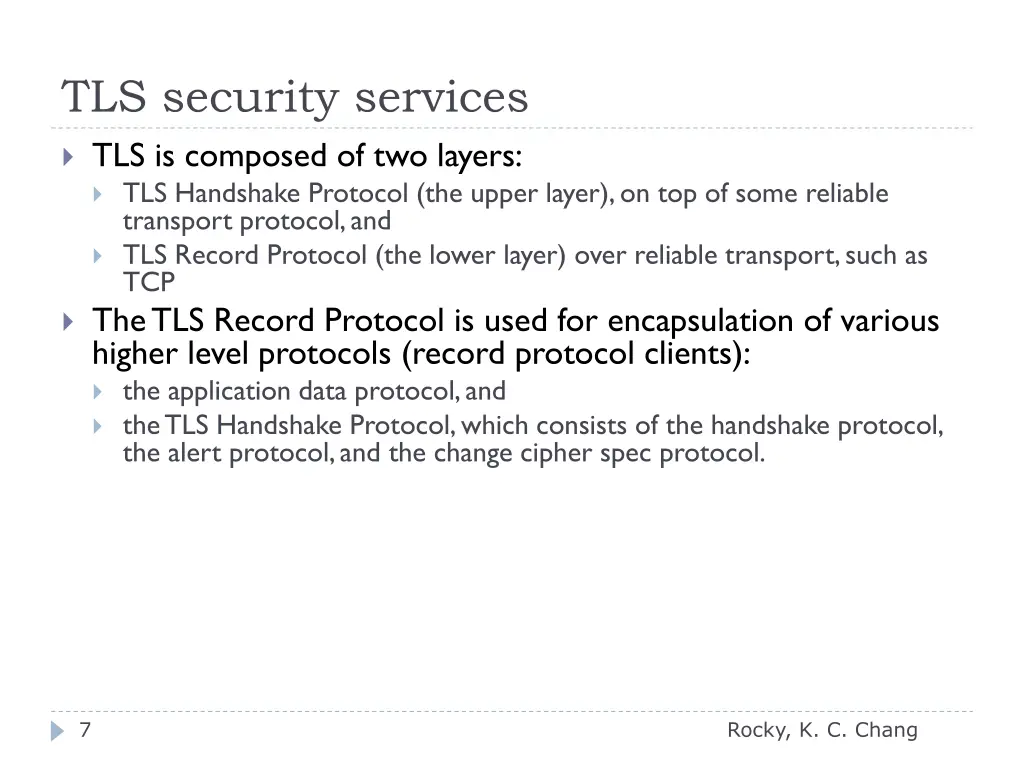
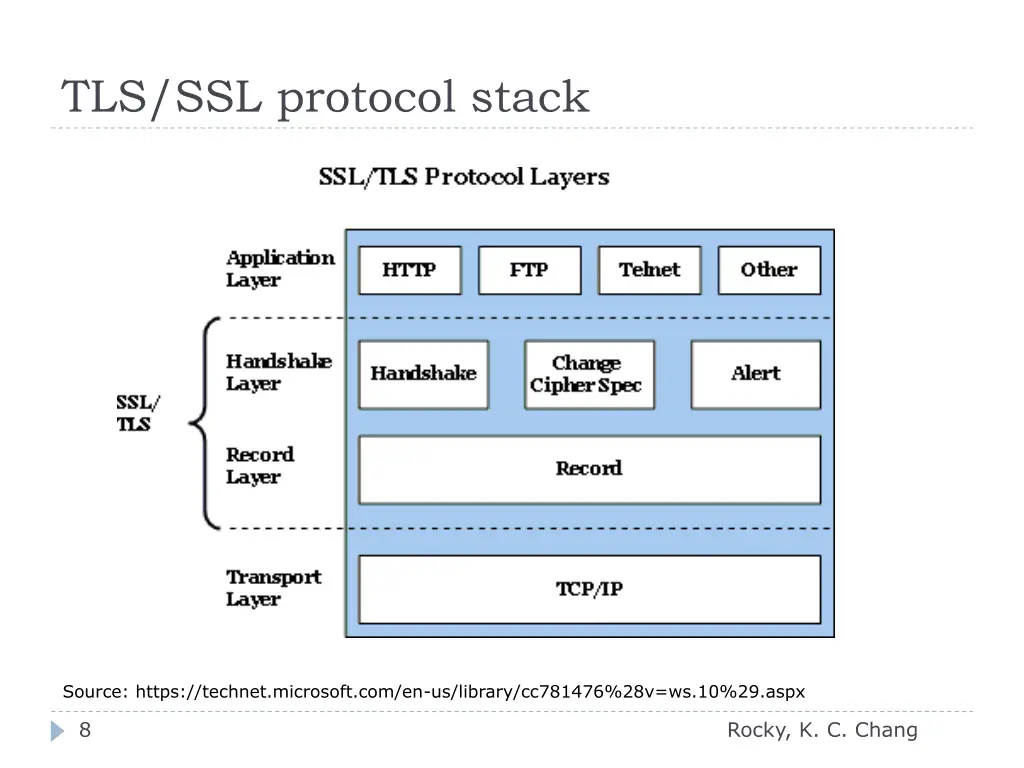
TLS security services TLS is composed of two layers: TLS Handshake Protocol (the upper layer), on top of some reliable transport protocol, and TLS Record Protocol (the lower layer) over reliable transport, such as TCP The TLS Record Protocol is used for encapsulation of various higher level protocols (record protocol clients): the application data protocol, and the TLS Handshake Protocol, which consists of the handshake protocol, the alert protocol, and the change cipher spec protocol. 7 Rocky, K. C. Chang
TLS/SSL protocol stack Source: https://technet.microsoft.com/en-us/library/cc781476%28v=ws.10%29.aspx 8 Rocky, K. C. Chang
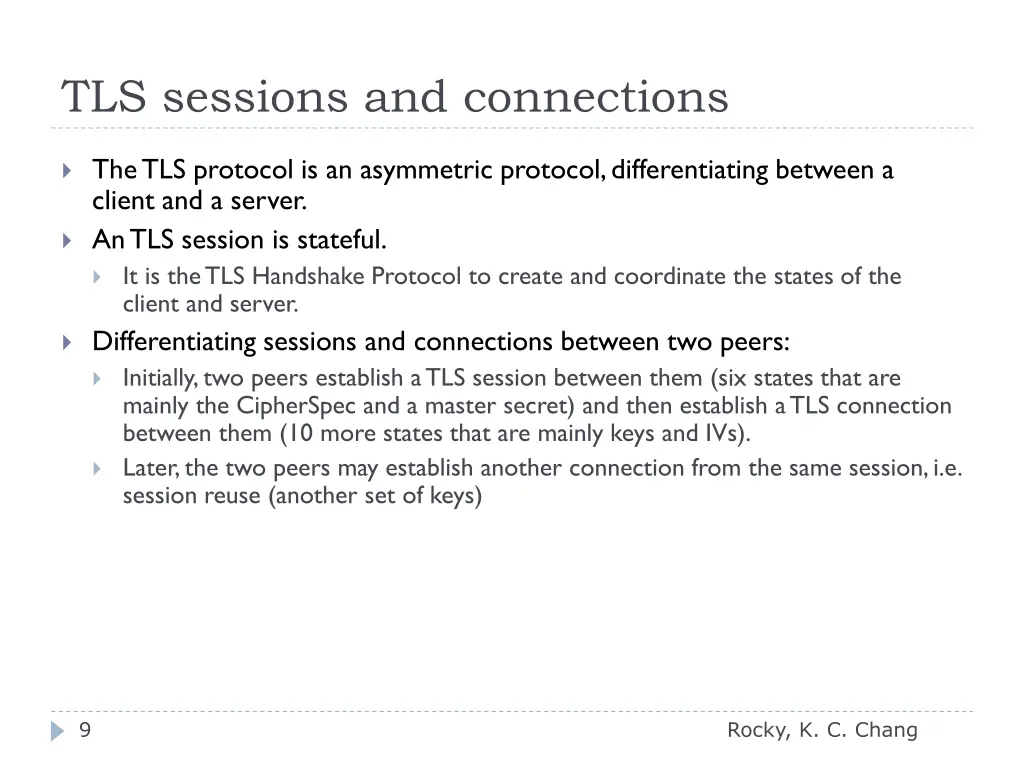
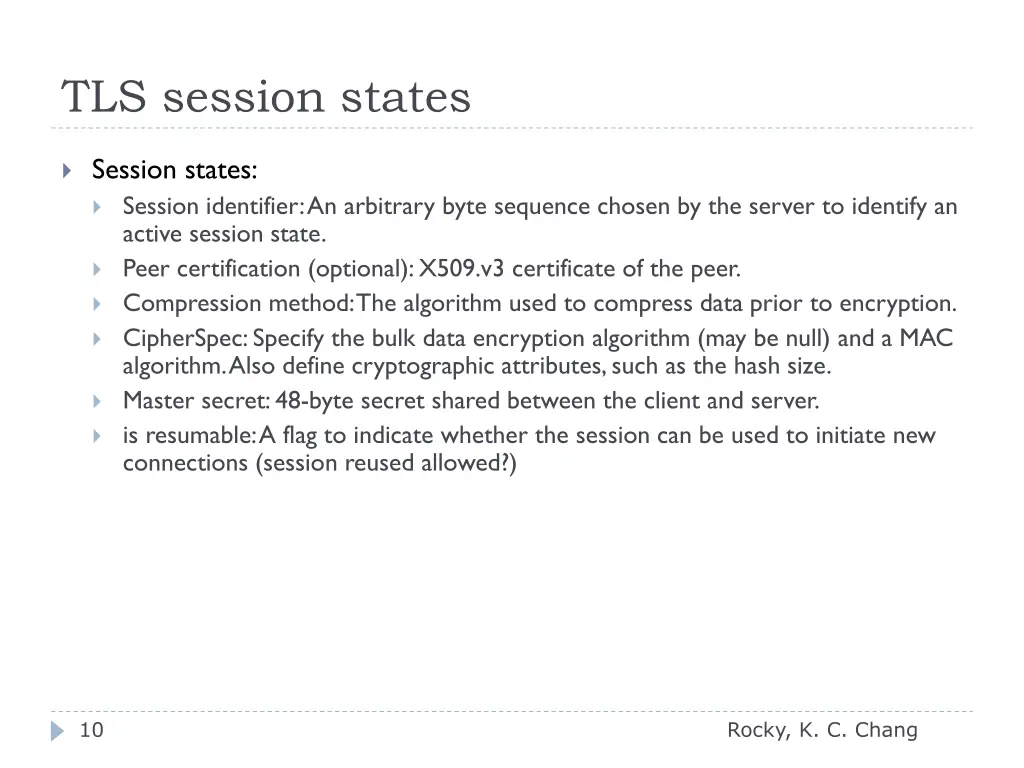
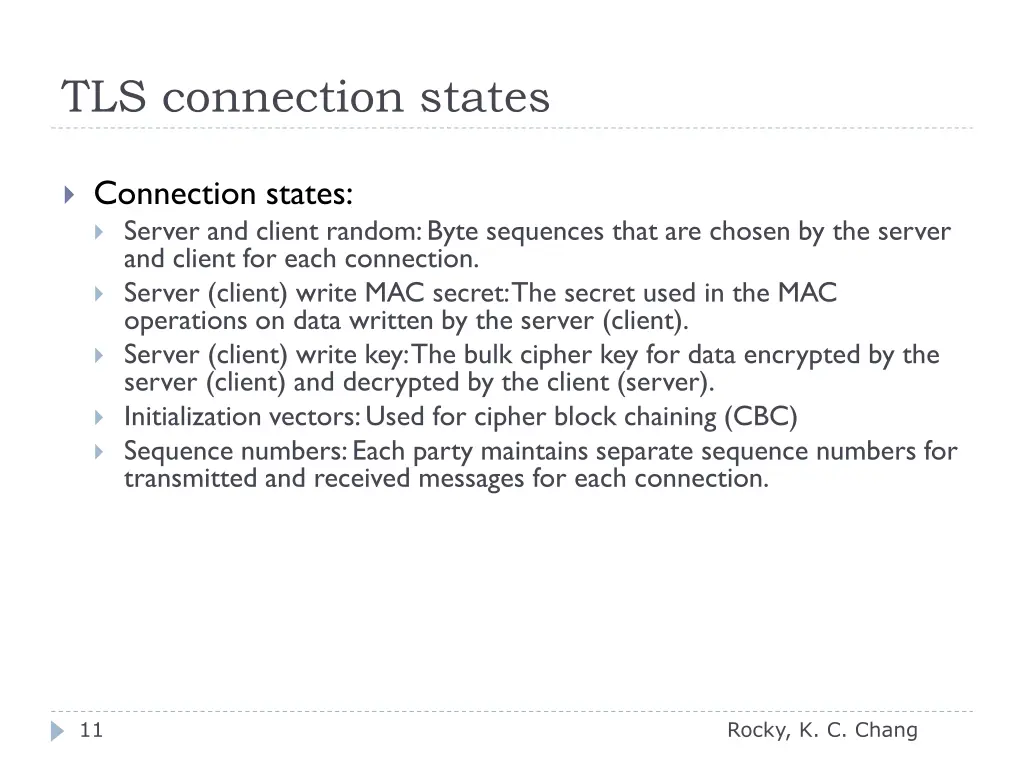
TLS sessions and connections The TLS protocol is an asymmetric protocol, differentiating between a client and a server. An TLS session is stateful. It is the TLS Handshake Protocol to create and coordinate the states of the client and server. Differentiating sessions and connections between two peers: Initially, two peers establish a TLS session between them (six states that are mainly the CipherSpec and a master secret) and then establish a TLS connection between them (10 more states that are mainly keys and IVs). Later, the two peers may establish another connection from the same session, i.e. session reuse (another set of keys) 9 Rocky, K. C. Chang
TLS session states Session states: Session identifier: An arbitrary byte sequence chosen by the server to identify an active session state. Peer certification (optional): X509.v3 certificate of the peer. Compression method: The algorithm used to compress data prior to encryption. CipherSpec: Specify the bulk data encryption algorithm (may be null) and a MAC algorithm. Also define cryptographic attributes, such as the hash size. Master secret: 48-byte secret shared between the client and server. is resumable: A flag to indicate whether the session can be used to initiate new connections (session reused allowed?) 10 Rocky, K. C. Chang
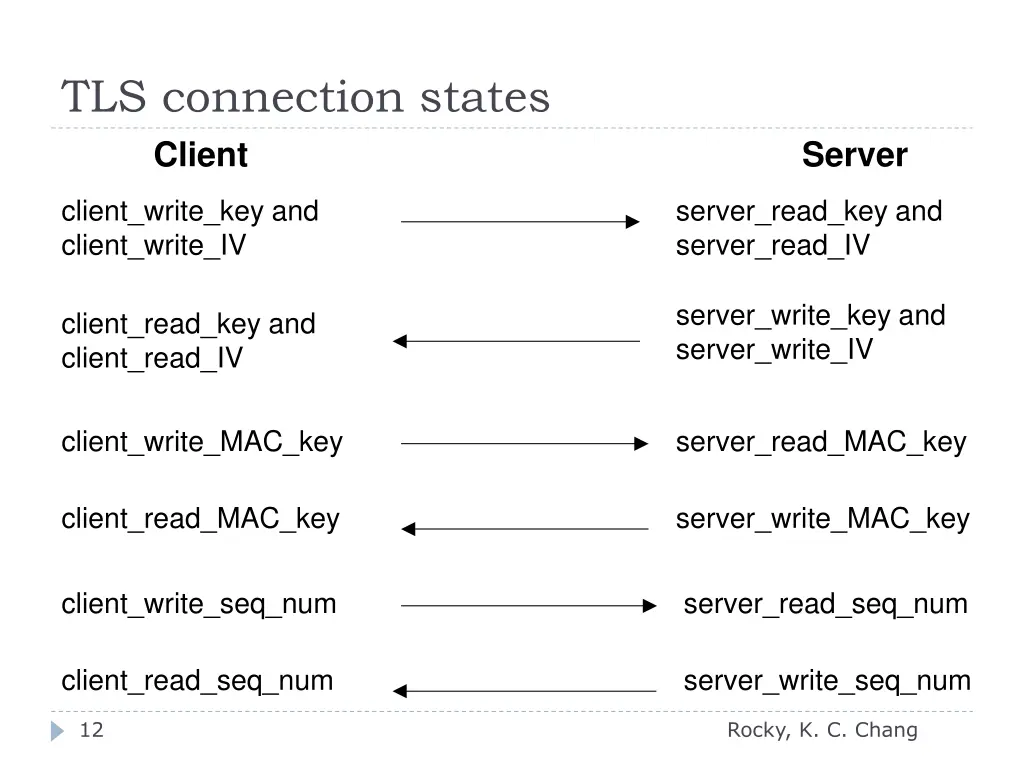
TLS connection states Connection states: Server and client random: Byte sequences that are chosen by the server and client for each connection. Server (client) write MAC secret: The secret used in the MAC operations on data written by the server (client). Server (client) write key: The bulk cipher key for data encrypted by the server (client) and decrypted by the client (server). Initialization vectors: Used for cipher block chaining (CBC) Sequence numbers: Each party maintains separate sequence numbers for transmitted and received messages for each connection. 11 Rocky, K. C. Chang
TLS connection states Client Server client_write_key and client_write_IV server_read_key and server_read_IV server_write_key and server_write_IV client_read_key and client_read_IV client_write_MAC_key server_read_MAC_key client_read_MAC_key server_write_MAC_key client_write_seq_num server_read_seq_num client_read_seq_num server_write_seq_num 12 Rocky, K. C. Chang
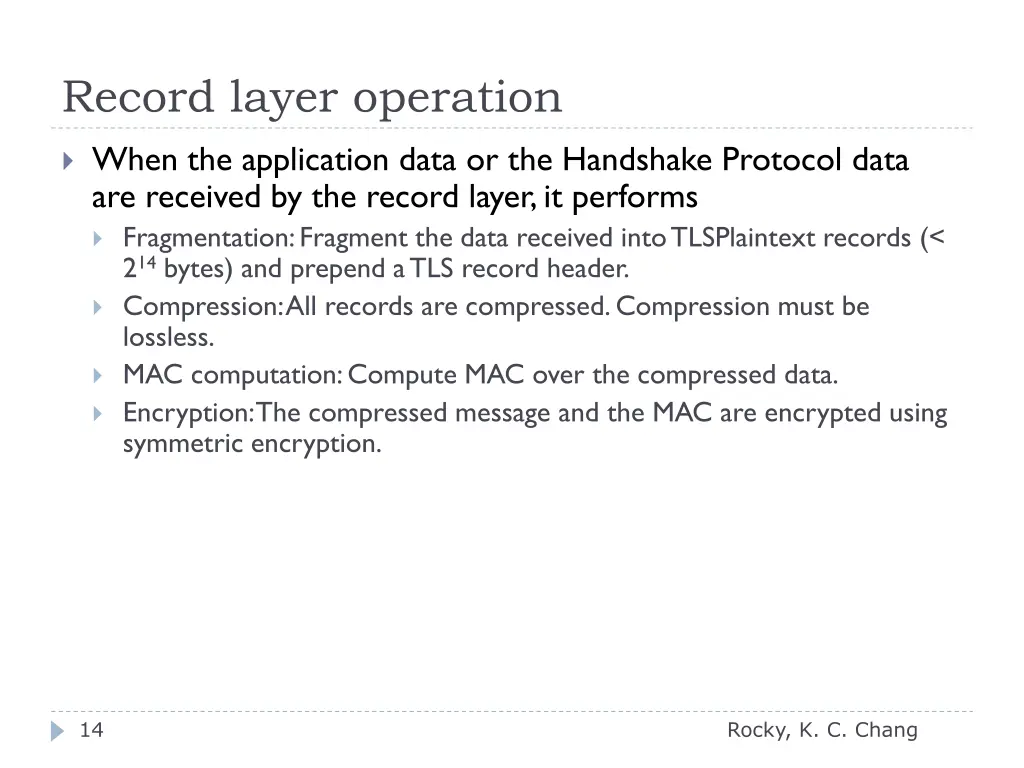
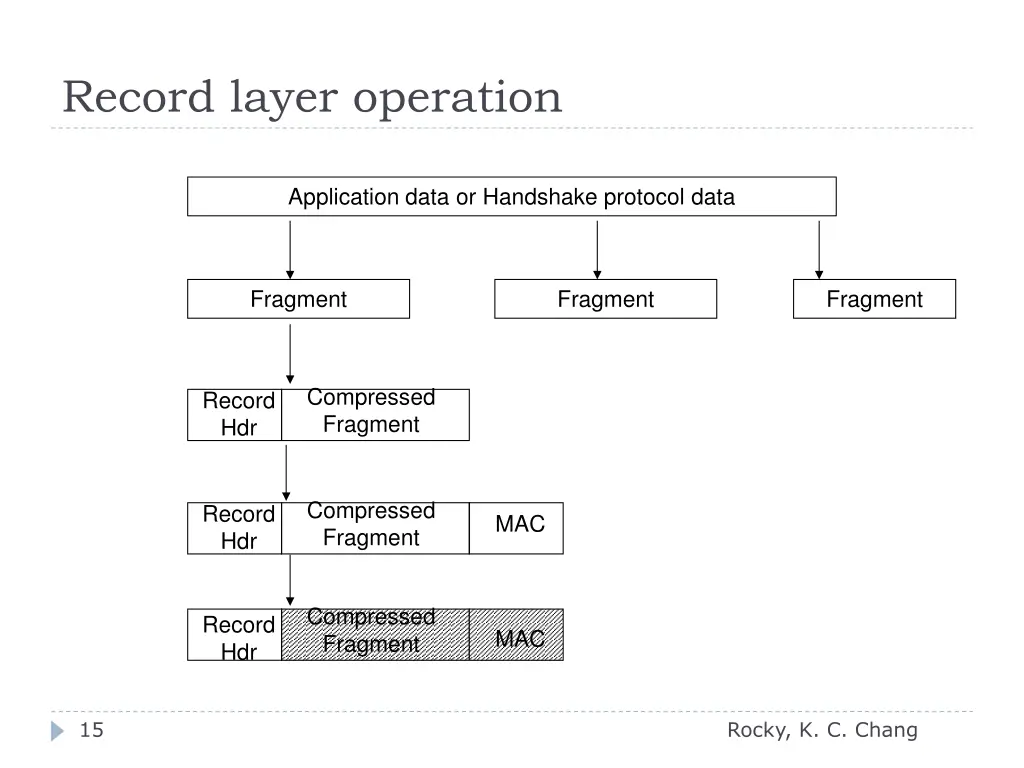
Record layer operation When the application data or the Handshake Protocol data are received by the record layer, it performs Fragmentation: Fragment the data received into TLSPlaintext records (< 214 bytes) and prepend a TLS record header. Compression: All records are compressed. Compression must be lossless. MAC computation: Compute MAC over the compressed data. Encryption: The compressed message and the MAC are encrypted using symmetric encryption. 14 Rocky, K. C. Chang
Record layer operation Application data or Handshake protocol data Fragment Fragment Fragment Compressed Fragment Record Hdr Compressed Fragment Record Hdr MAC Compressed Fragment Record Hdr MAC 15 Rocky, K. C. Chang
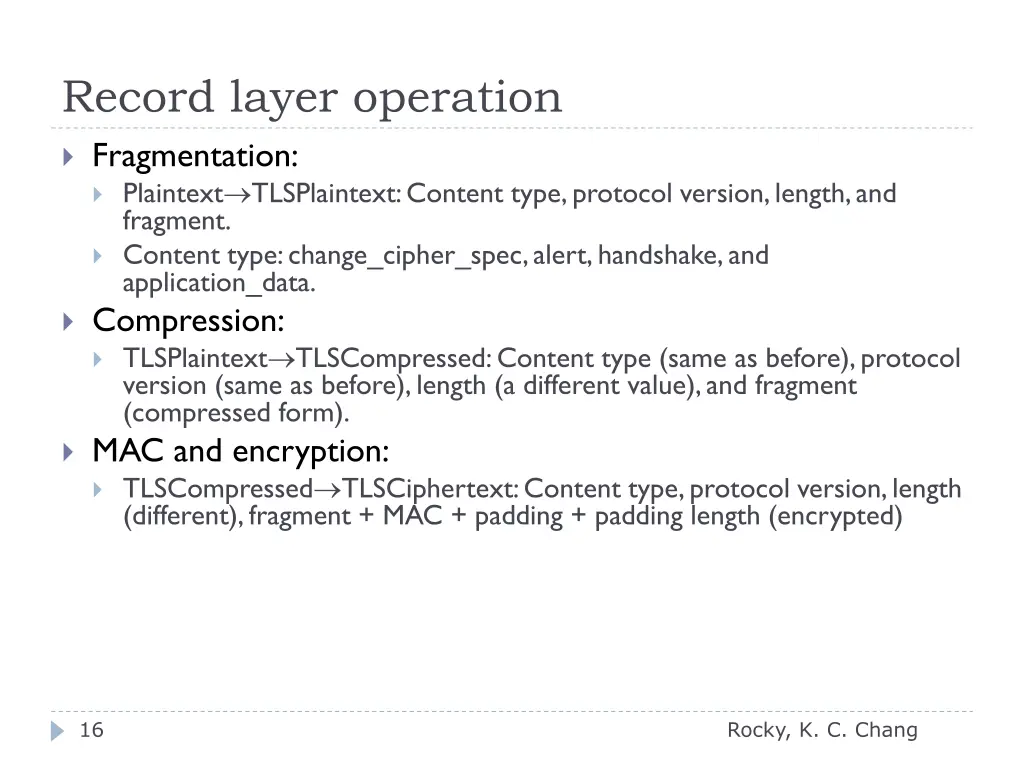
Record layer operation Fragmentation: Plaintext TLSPlaintext: Content type, protocol version, length, and fragment. Content type: change_cipher_spec, alert, handshake, and application_data. Compression: TLSPlaintext TLSCompressed: Content type (same as before), protocol version (same as before), length (a different value), and fragment (compressed form). MAC and encryption: TLSCompressed TLSCiphertext: Content type, protocol version, length (different), fragment + MAC + padding + padding length (encrypted) 16 Rocky, K. C. Chang
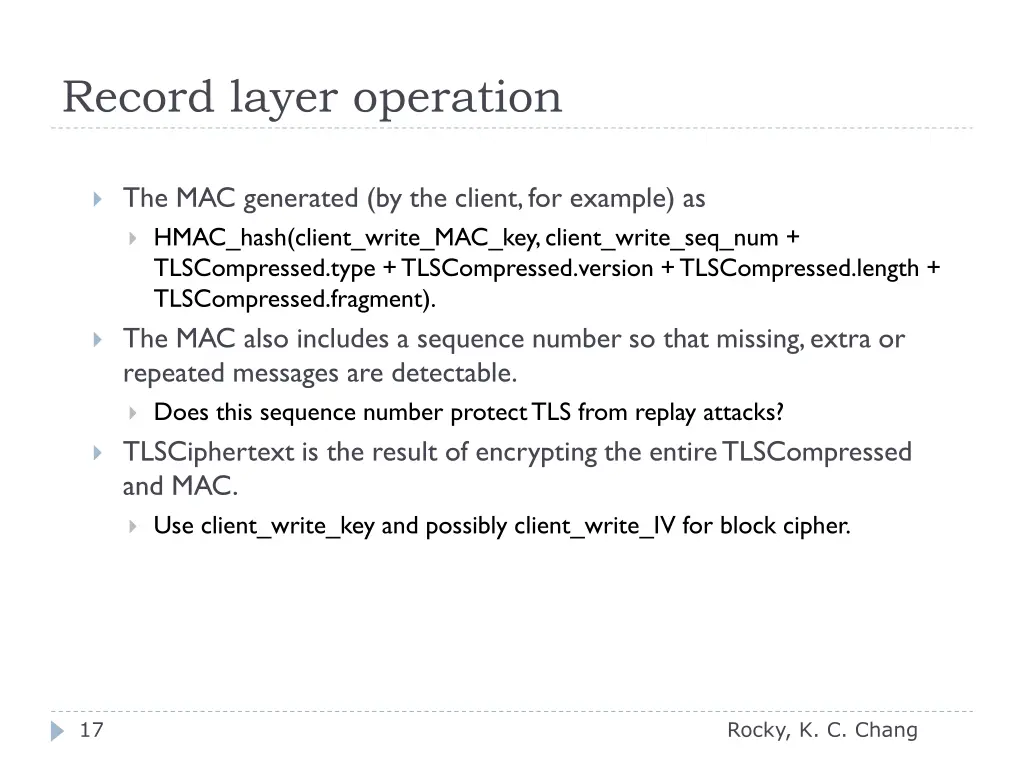
Record layer operation The MAC generated (by the client, for example) as HMAC_hash(client_write_MAC_key, client_write_seq_num + TLSCompressed.type + TLSCompressed.version + TLSCompressed.length + TLSCompressed.fragment). The MAC also includes a sequence number so that missing, extra or repeated messages are detectable. Does this sequence number protect TLS from replay attacks? TLSCiphertext is the result of encrypting the entire TLSCompressed and MAC. Use client_write_key and possibly client_write_IV for block cipher. 17 Rocky, K. C. Chang
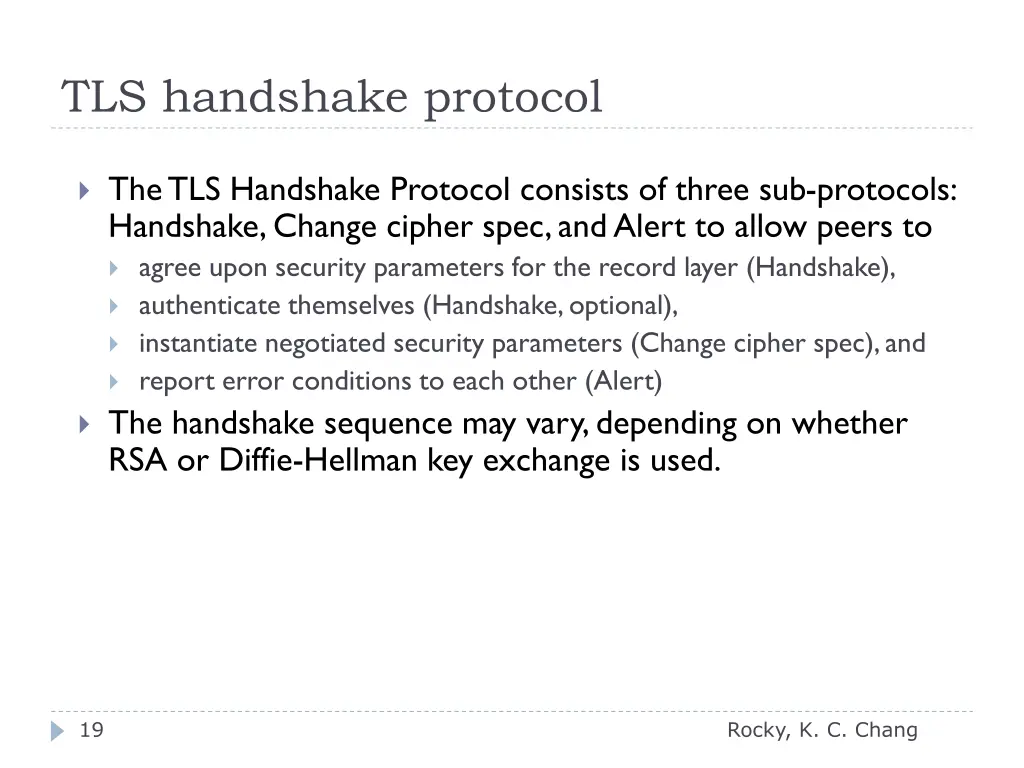
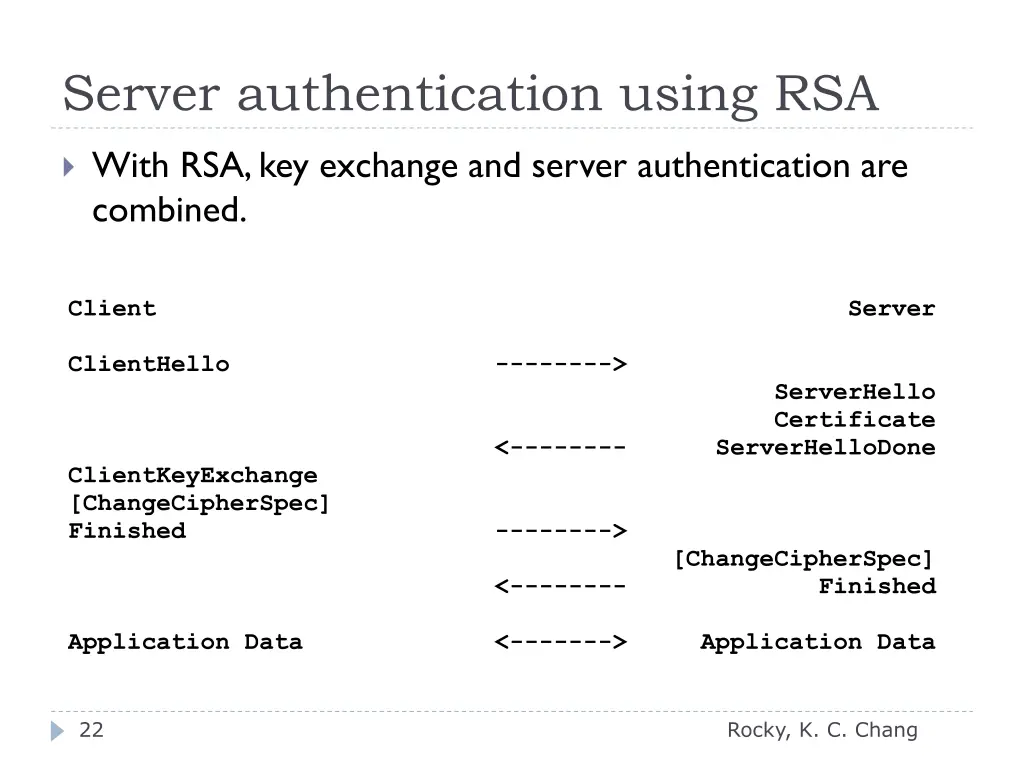
TLS handshake protocol The TLS Handshake Protocol consists of three sub-protocols: Handshake, Change cipher spec, and Alert to allow peers to agree upon security parameters for the record layer (Handshake), authenticate themselves (Handshake, optional), instantiate negotiated security parameters (Change cipher spec), and report error conditions to each other (Alert) The handshake sequence may vary, depending on whether RSA or Diffie-Hellman key exchange is used. 19 Rocky, K. C. Chang
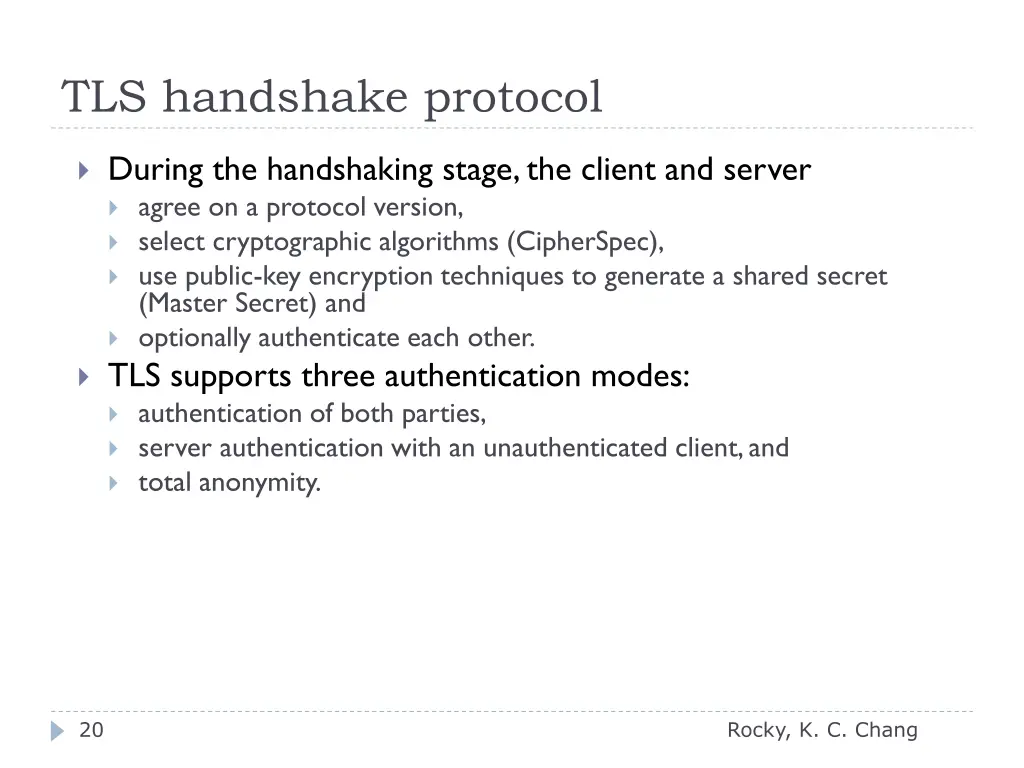
TLS handshake protocol During the handshaking stage, the client and server agree on a protocol version, select cryptographic algorithms (CipherSpec), use public-key encryption techniques to generate a shared secret (Master Secret) and optionally authenticate each other. TLS supports three authentication modes: authentication of both parties, server authentication with an unauthenticated client, and total anonymity. 20 Rocky, K. C. Chang
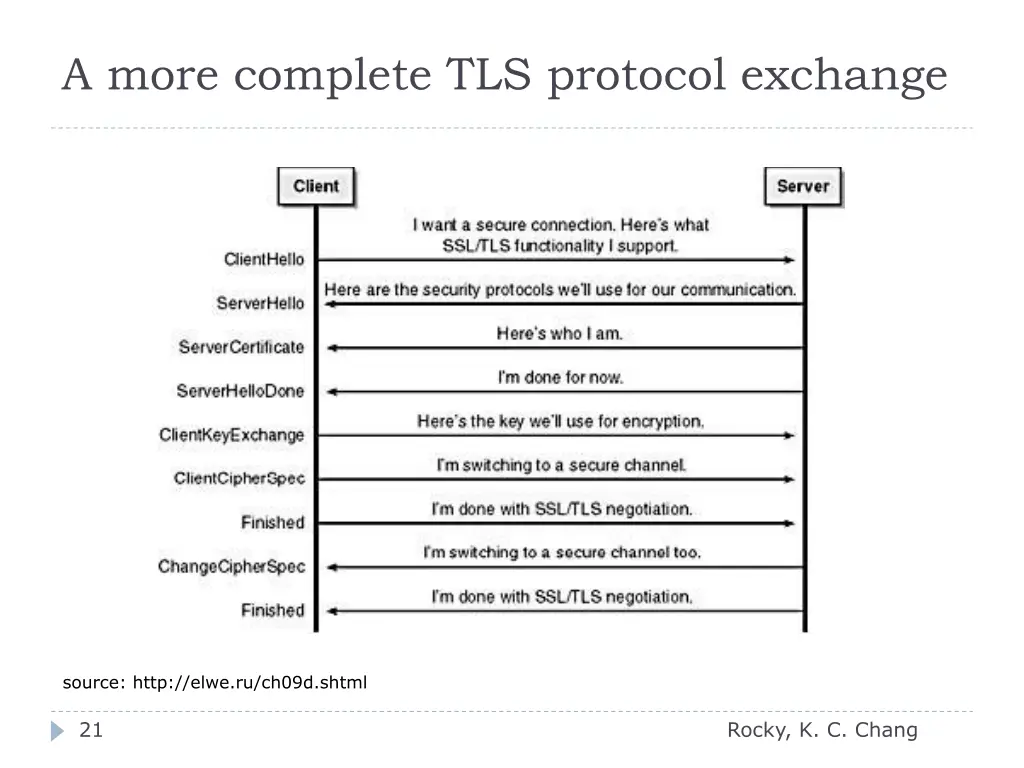
A more complete TLS protocol exchange source: http://elwe.ru/ch09d.shtml 21 Rocky, K. C. Chang
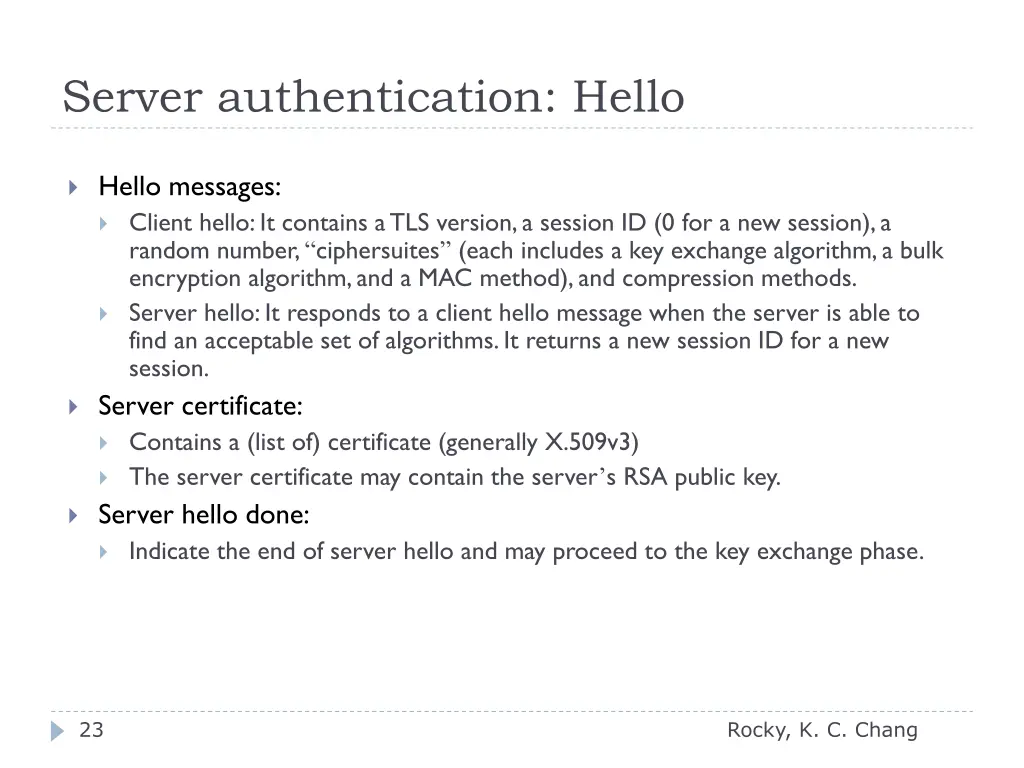
Server authentication using RSA With RSA, key exchange and server authentication are combined. Client Server ClientHello --------> ServerHello Certificate <-------- ServerHelloDone ClientKeyExchange [ChangeCipherSpec] Finished --------> [ChangeCipherSpec] <-------- Finished Application Data <-------> Application Data 22 Rocky, K. C. Chang
Server authentication: Hello Hello messages: Client hello: It contains a TLS version, a session ID (0 for a new session), a random number, ciphersuites (each includes a key exchange algorithm, a bulk encryption algorithm, and a MAC method), and compression methods. Server hello: It responds to a client hello message when the server is able to find an acceptable set of algorithms. It returns a new session ID for a new session. Server certificate: Contains a (list of) certificate (generally X.509v3) The server certificate may contain the server s RSA public key. Server hello done: Indicate the end of server hello and may proceed to the key exchange phase. 23 Rocky, K. C. Chang
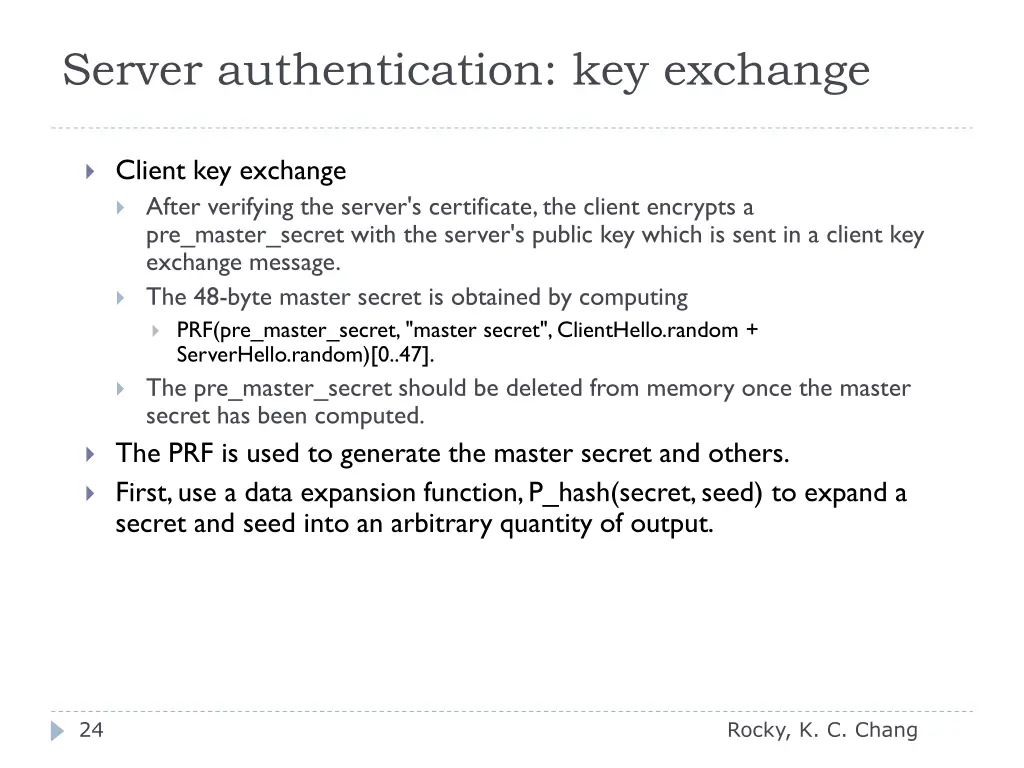
Server authentication: key exchange Client key exchange After verifying the server's certificate, the client encrypts a pre_master_secret with the server's public key which is sent in a client key exchange message. The 48-byte master secret is obtained by computing PRF(pre_master_secret, "master secret", ClientHello.random + ServerHello.random)[0..47]. The pre_master_secret should be deleted from memory once the master secret has been computed. The PRF is used to generate the master secret and others. First, use a data expansion function, P_hash(secret, seed) to expand a secret and seed into an arbitrary quantity of output. 24 Rocky, K. C. Chang
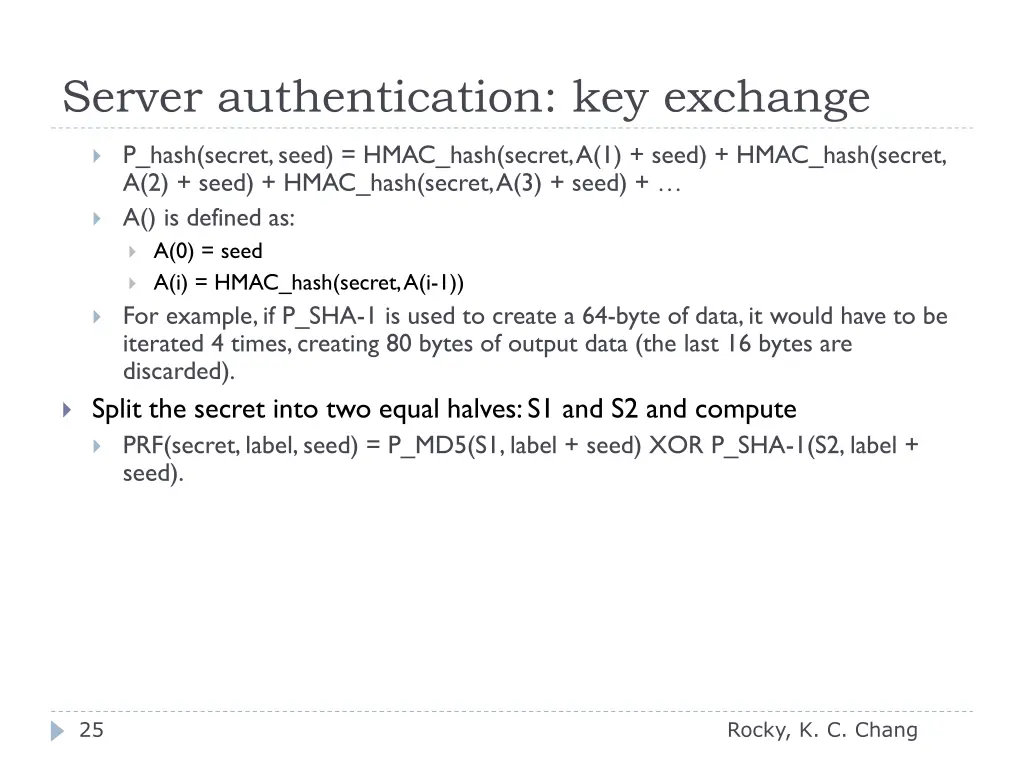
Server authentication: key exchange P_hash(secret, seed) = HMAC_hash(secret, A(1) + seed) + HMAC_hash(secret, A(2) + seed) + HMAC_hash(secret, A(3) + seed) + A() is defined as: A(0) = seed A(i) = HMAC_hash(secret, A(i-1)) For example, if P_SHA-1 is used to create a 64-byte of data, it would have to be iterated 4 times, creating 80 bytes of output data (the last 16 bytes are discarded). Split the secret into two equal halves: S1 and S2 and compute PRF(secret, label, seed) = P_MD5(S1, label + seed) XOR P_SHA-1(S2, label + seed). 25 Rocky, K. C. Chang
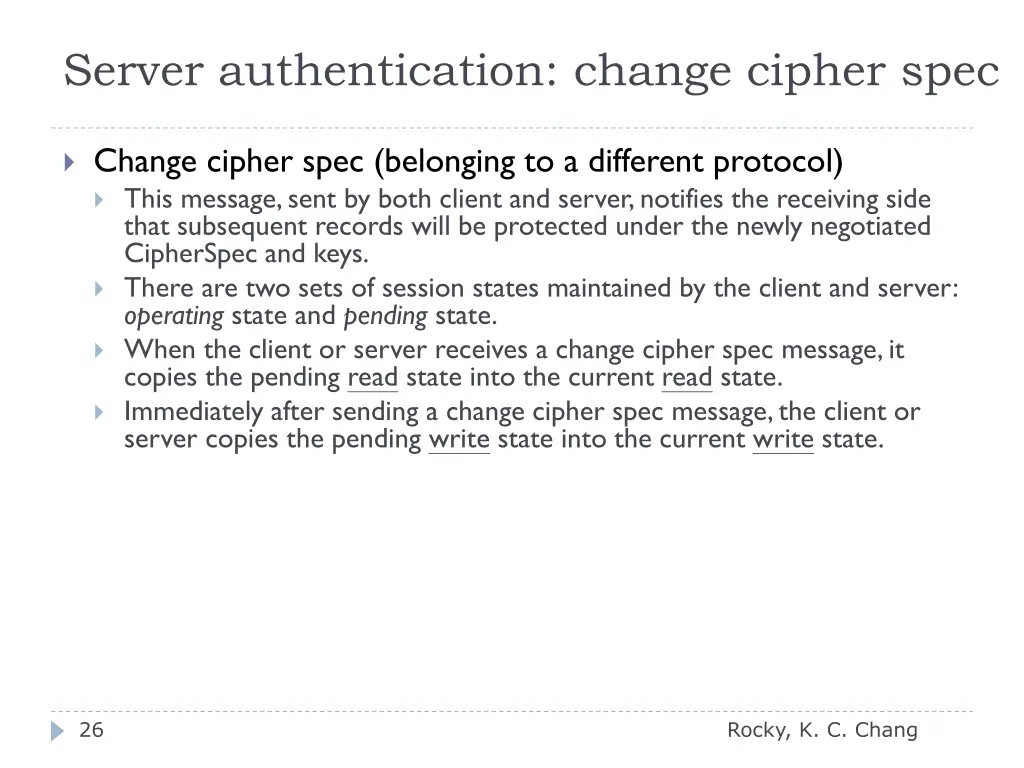
Server authentication: change cipher spec Change cipher spec (belonging to a different protocol) This message, sent by both client and server, notifies the receiving side that subsequent records will be protected under the newly negotiated CipherSpec and keys. There are two sets of session states maintained by the client and server: operating state and pending state. When the client or server receives a change cipher spec message, it copies the pending read state into the current read state. Immediately after sending a change cipher spec message, the client or server copies the pending write state into the current write state. 26 Rocky, K. C. Chang
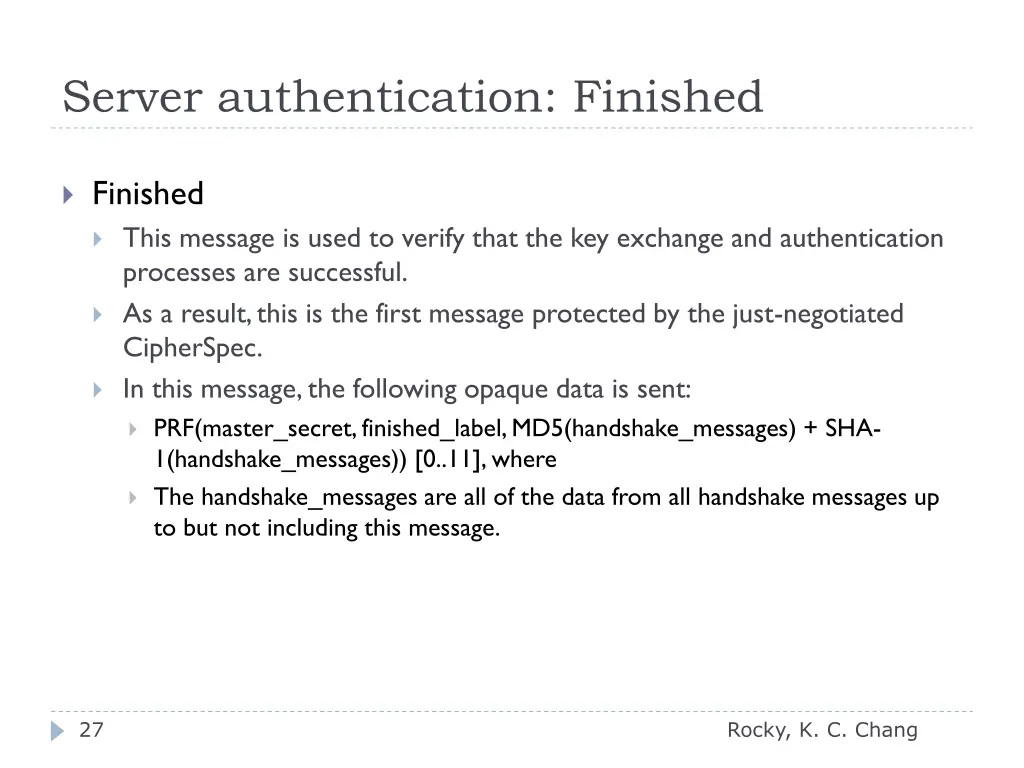
Server authentication: Finished Finished This message is used to verify that the key exchange and authentication processes are successful. As a result, this is the first message protected by the just-negotiated CipherSpec. In this message, the following opaque data is sent: PRF(master_secret, finished_label, MD5(handshake_messages) + SHA- 1(handshake_messages)) [0..11], where The handshake_messages are all of the data from all handshake messages up to but not including this message. 27 Rocky, K. C. Chang
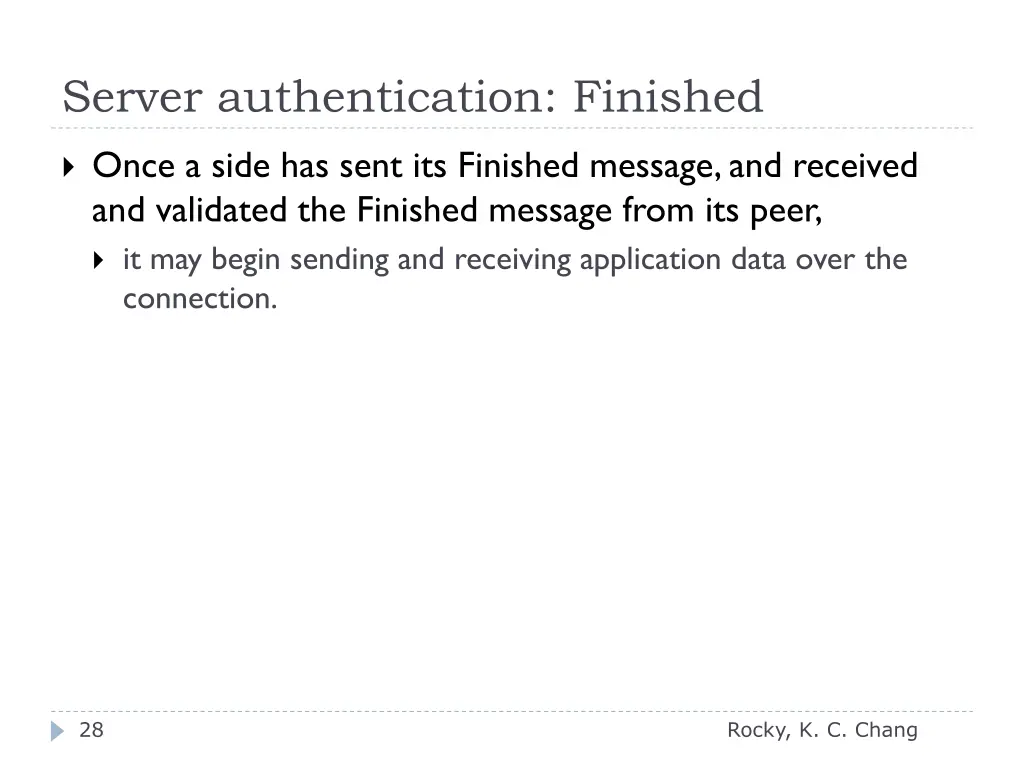
Server authentication: Finished Once a side has sent its Finished message, and received and validated the Finished message from its peer, it may begin sending and receiving application data over the connection. 28 Rocky, K. C. Chang
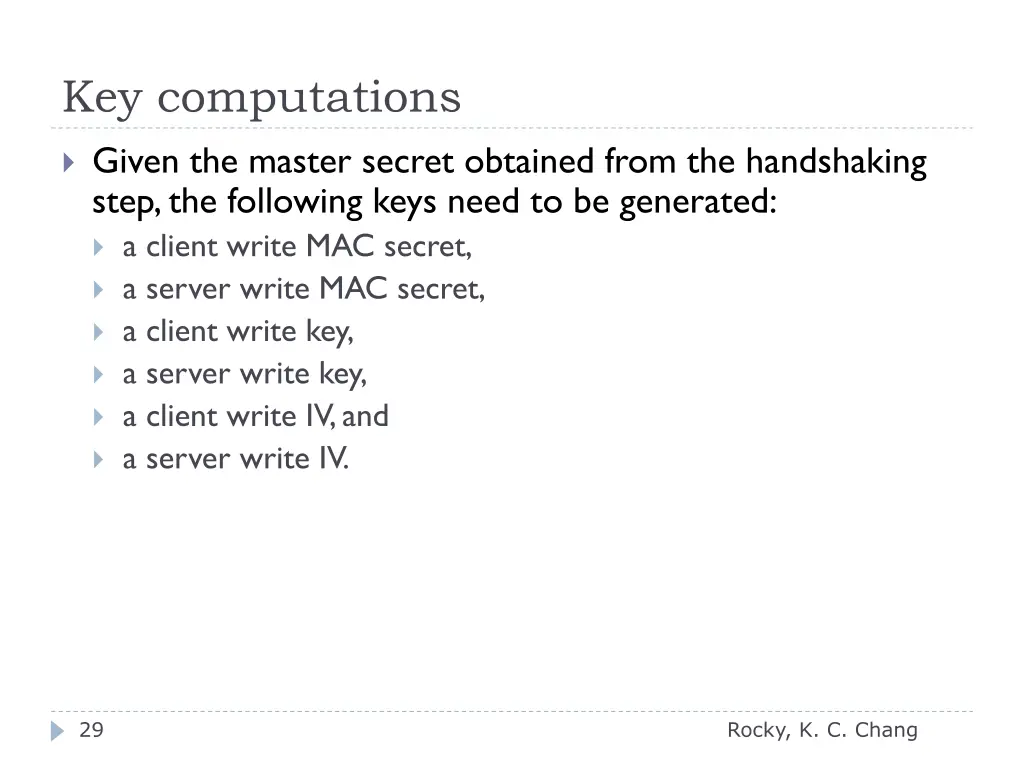
Key computations Given the master secret obtained from the handshaking step, the following keys need to be generated: a client write MAC secret, a server write MAC secret, a client write key, a server write key, a client write IV, and a server write IV. 29 Rocky, K. C. Chang
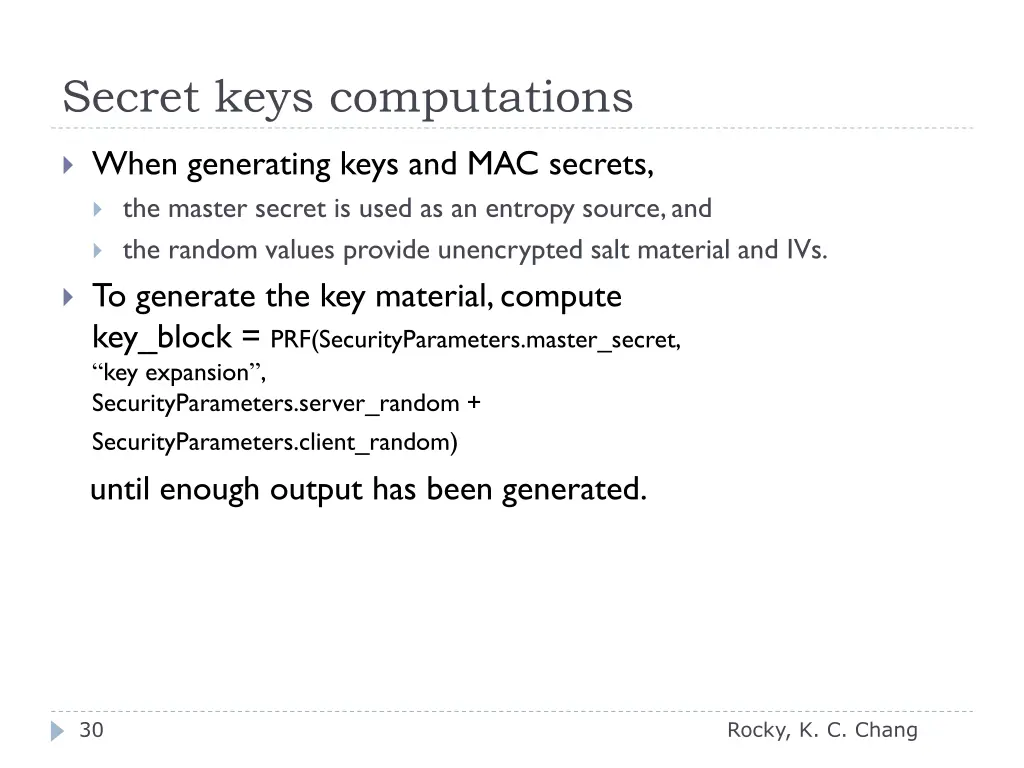
Secret keys computations When generating keys and MAC secrets, the master secret is used as an entropy source, and the random values provide unencrypted salt material and IVs. To generate the key material, compute key_block = PRF(SecurityParameters.master_secret, key expansion , SecurityParameters.server_random + SecurityParameters.client_random) until enough output has been generated. 30 Rocky, K. C. Chang
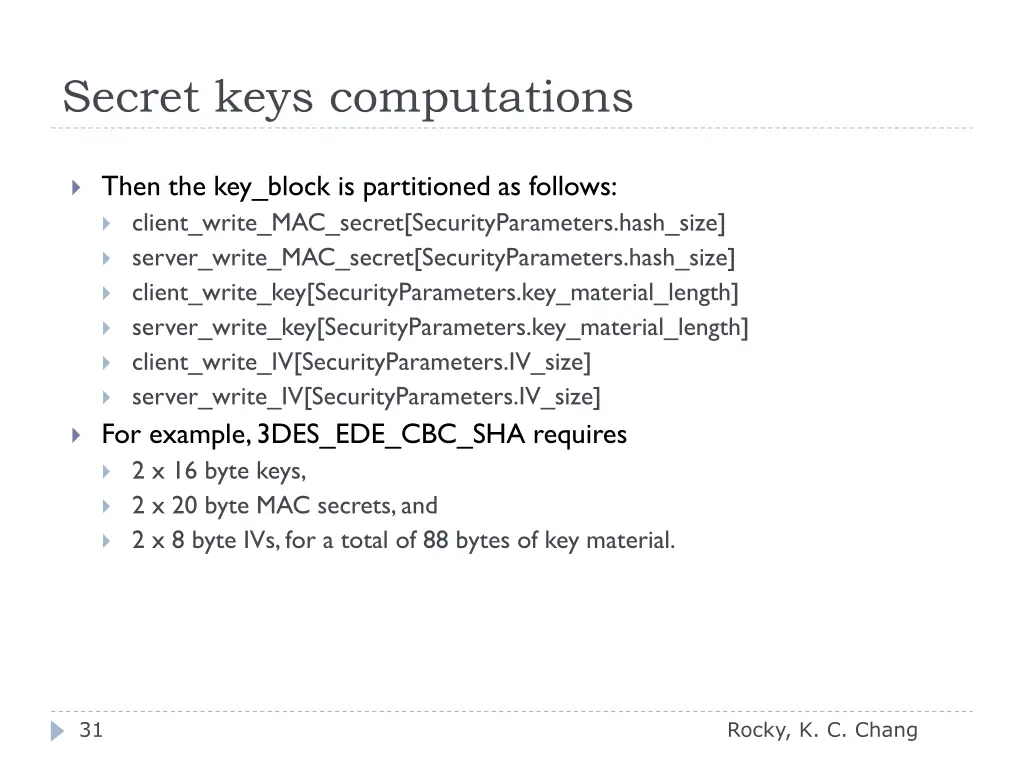
Secret keys computations Then the key_block is partitioned as follows: client_write_MAC_secret[SecurityParameters.hash_size] server_write_MAC_secret[SecurityParameters.hash_size] client_write_key[SecurityParameters.key_material_length] server_write_key[SecurityParameters.key_material_length] client_write_IV[SecurityParameters.IV_size] server_write_IV[SecurityParameters.IV_size] For example, 3DES_EDE_CBC_SHA requires 2 x 16 byte keys, 2 x 20 byte MAC secrets, and 2 x 8 byte IVs, for a total of 88 bytes of key material. 31 Rocky, K. C. Chang
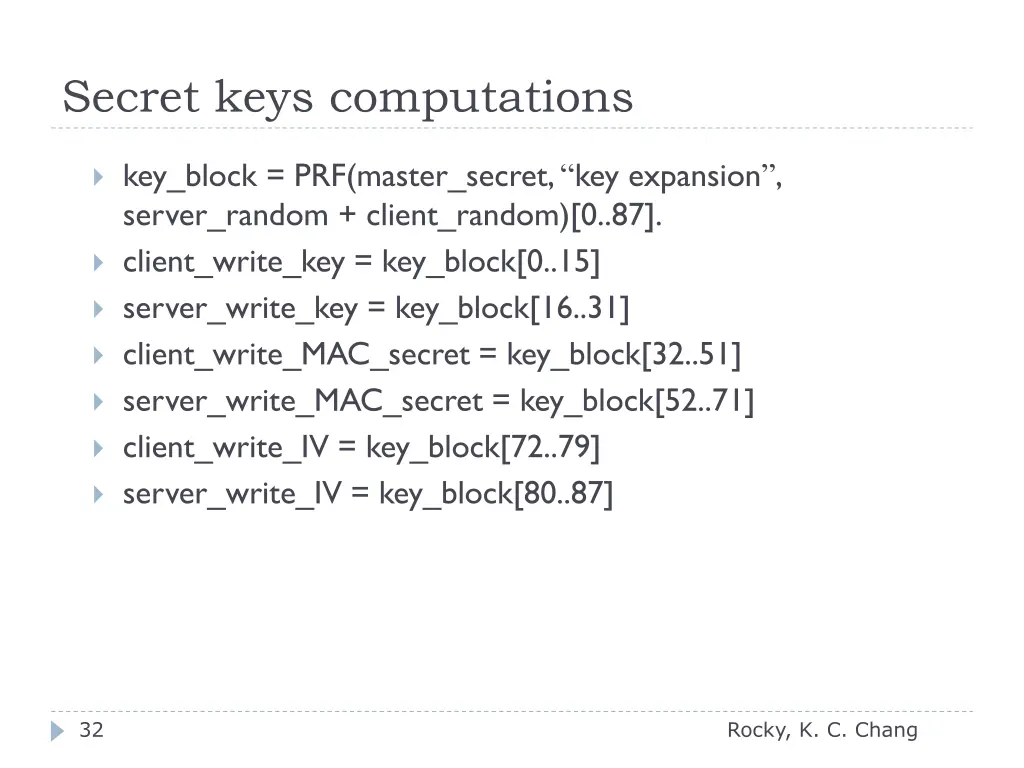
Secret keys computations key_block = PRF(master_secret, key expansion , server_random + client_random)[0..87]. client_write_key = key_block[0..15] server_write_key = key_block[16..31] client_write_MAC_secret = key_block[32..51] server_write_MAC_secret = key_block[52..71] client_write_IV = key_block[72..79] server_write_IV = key_block[80..87] 32 Rocky, K. C. Chang
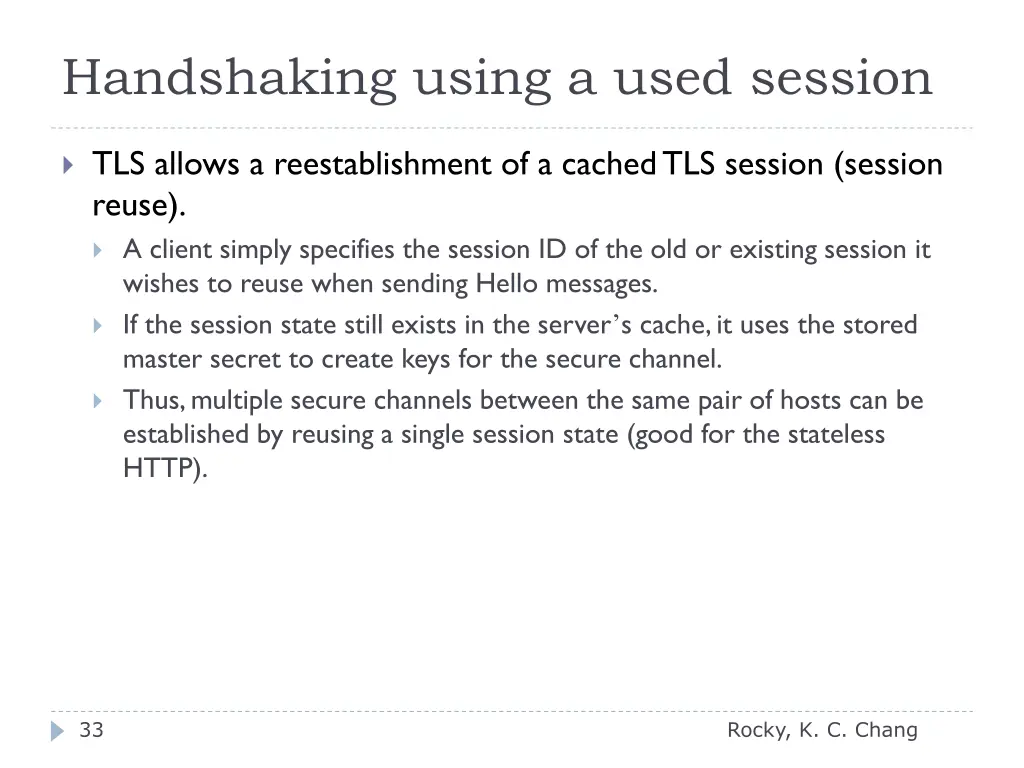
Handshaking using a used session TLS allows a reestablishment of a cached TLS session (session reuse). A client simply specifies the session ID of the old or existing session it wishes to reuse when sending Hello messages. If the session state still exists in the server s cache, it uses the stored master secret to create keys for the secure channel. Thus, multiple secure channels between the same pair of hosts can be established by reusing a single session state (good for the stateless HTTP). 33 Rocky, K. C. Chang
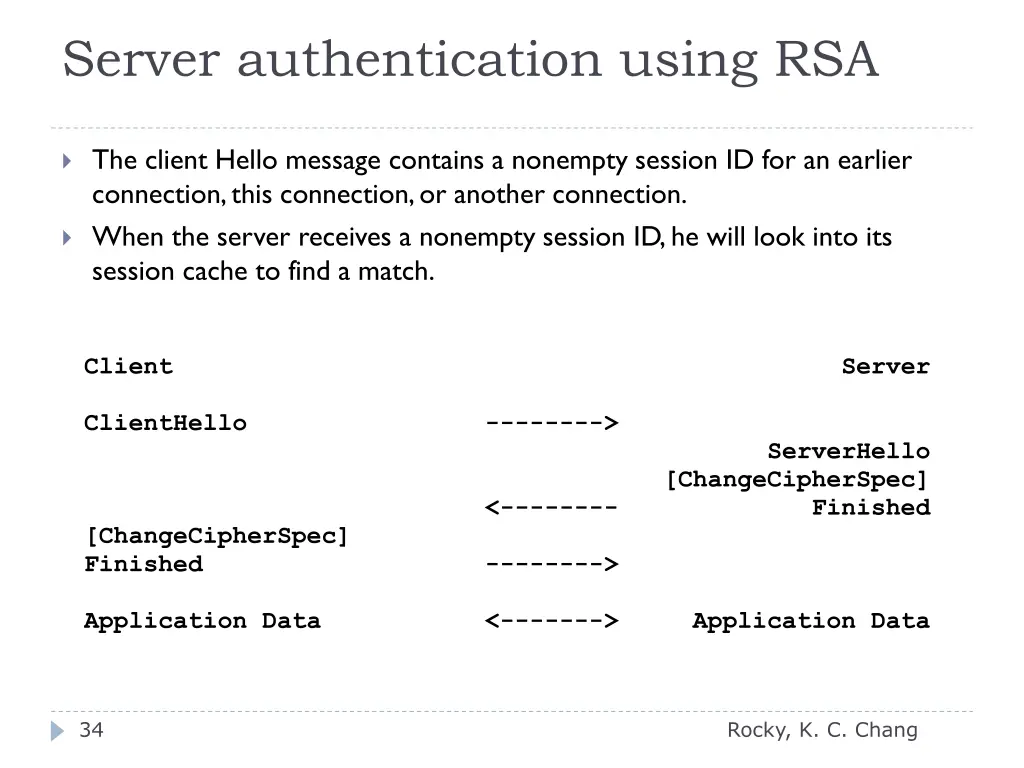
Server authentication using RSA The client Hello message contains a nonempty session ID for an earlier connection, this connection, or another connection. When the server receives a nonempty session ID, he will look into its session cache to find a match. Client Server ClientHello --------> ServerHello [ChangeCipherSpec] <-------- Finished [ChangeCipherSpec] Finished --------> Application Data <-------> Application Data 34 Rocky, K. C. Chang
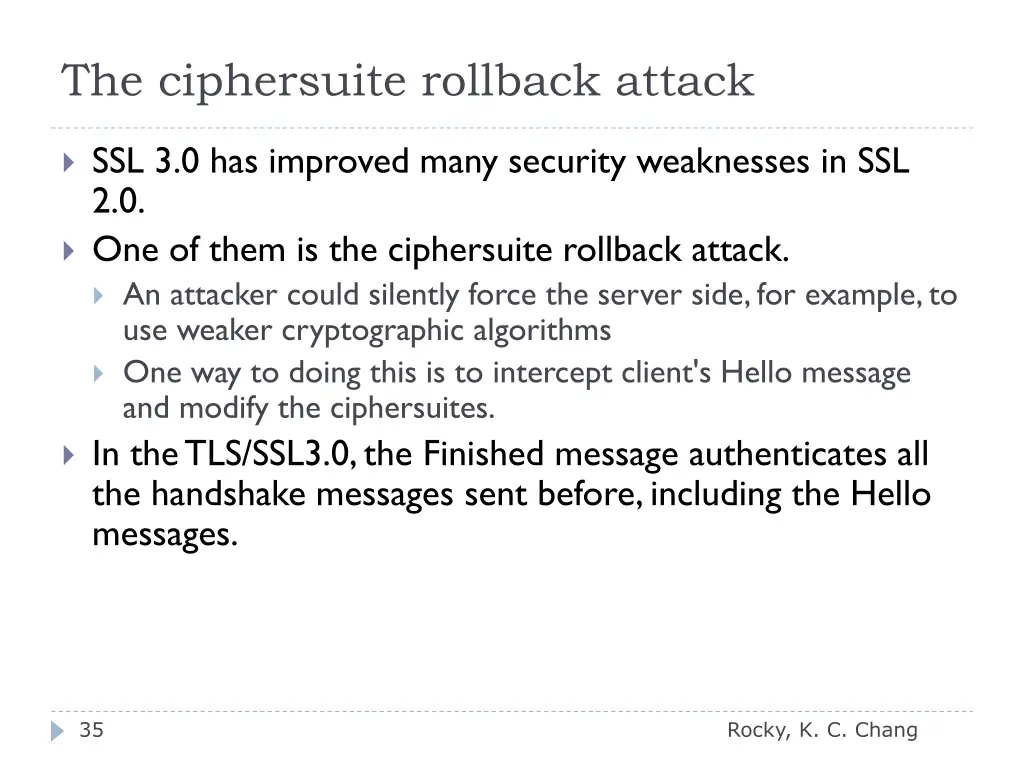
The ciphersuite rollback attack SSL 3.0 has improved many security weaknesses in SSL 2.0. One of them is the ciphersuite rollback attack. An attacker could silently force the server side, for example, to use weaker cryptographic algorithms One way to doing this is to intercept client's Hello message and modify the ciphersuites. In the TLS/SSL3.0, the Finished message authenticates all the handshake messages sent before, including the Hello messages. 35 Rocky, K. C. Chang
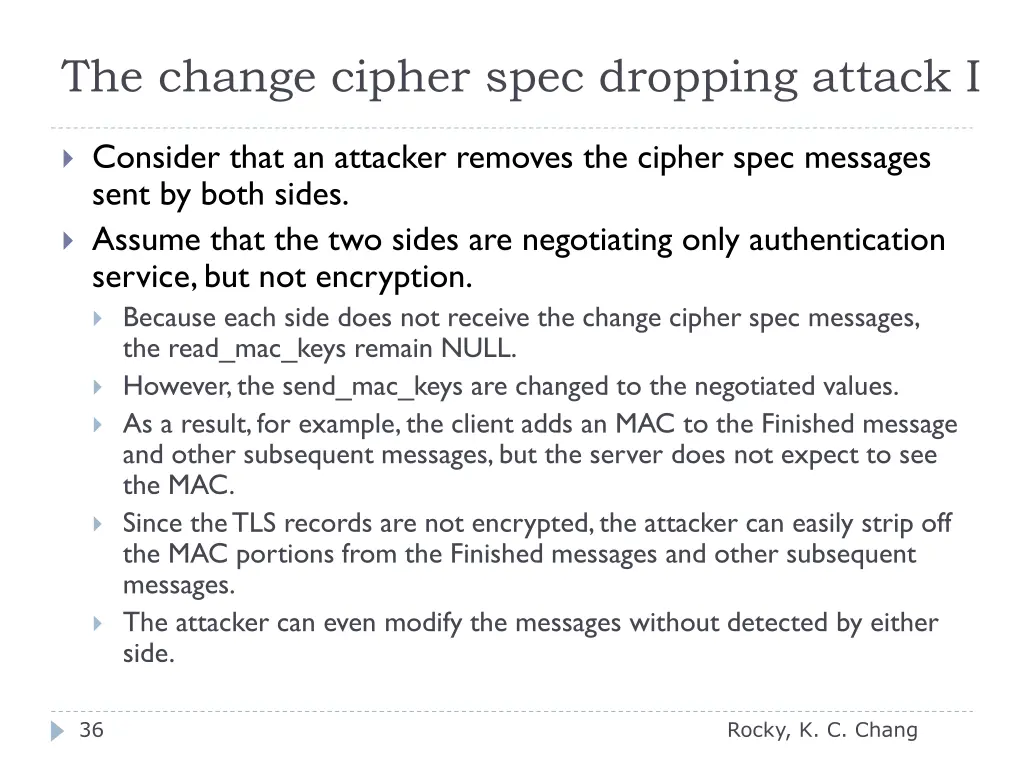
The change cipher spec dropping attack I Consider that an attacker removes the cipher spec messages sent by both sides. Assume that the two sides are negotiating only authentication service, but not encryption. Because each side does not receive the change cipher spec messages, the read_mac_keys remain NULL. However, the send_mac_keys are changed to the negotiated values. As a result, for example, the client adds an MAC to the Finished message and other subsequent messages, but the server does not expect to see the MAC. Since the TLS records are not encrypted, the attacker can easily strip off the MAC portions from the Finished messages and other subsequent messages. The attacker can even modify the messages without detected by either side. 36 Rocky, K. C. Chang
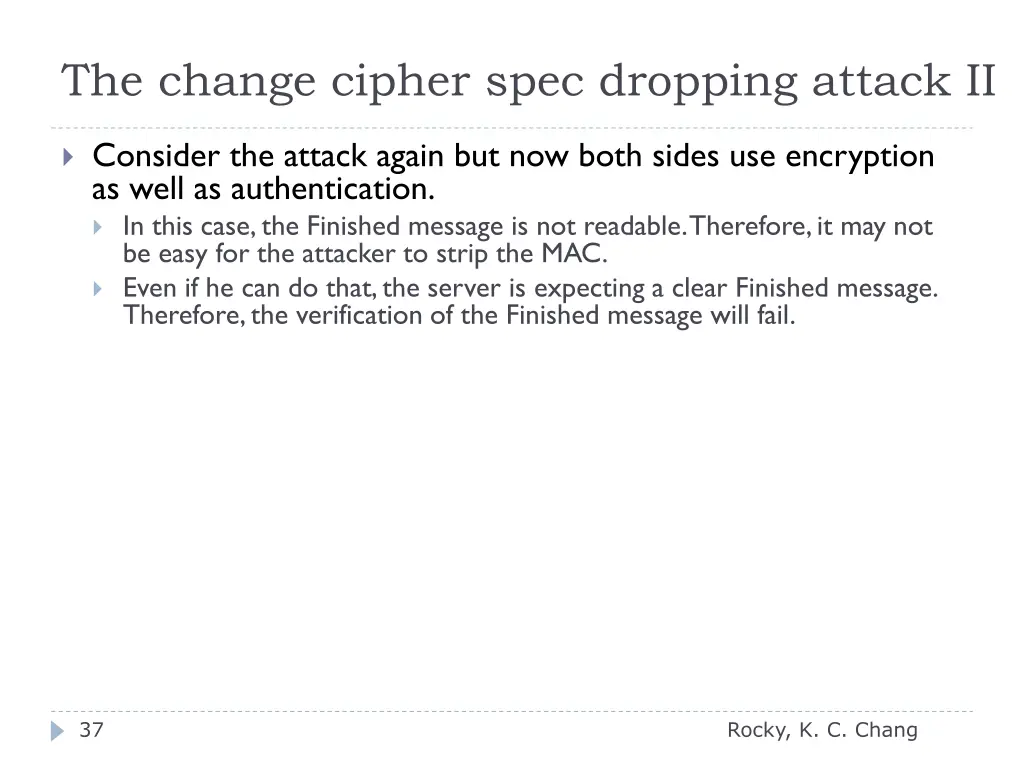
The change cipher spec dropping attack II Consider the attack again but now both sides use encryption as well as authentication. In this case, the Finished message is not readable. Therefore, it may not be easy for the attacker to strip the MAC. Even if he can do that, the server is expecting a clear Finished message. Therefore, the verification of the Finished message will fail. 37 Rocky, K. C. Chang
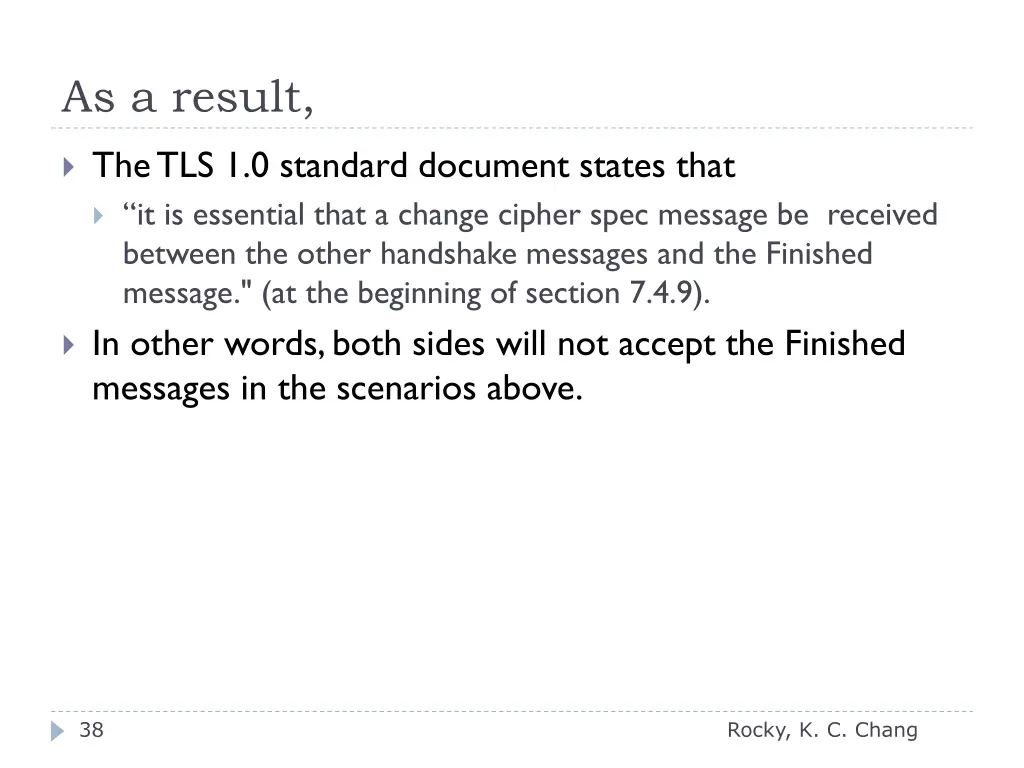
As a result, The TLS 1.0 standard document states that it is essential that a change cipher spec message be received between the other handshake messages and the Finished message." (at the beginning of section 7.4.9). In other words, both sides will not accept the Finished messages in the scenarios above. 38 Rocky, K. C. Chang
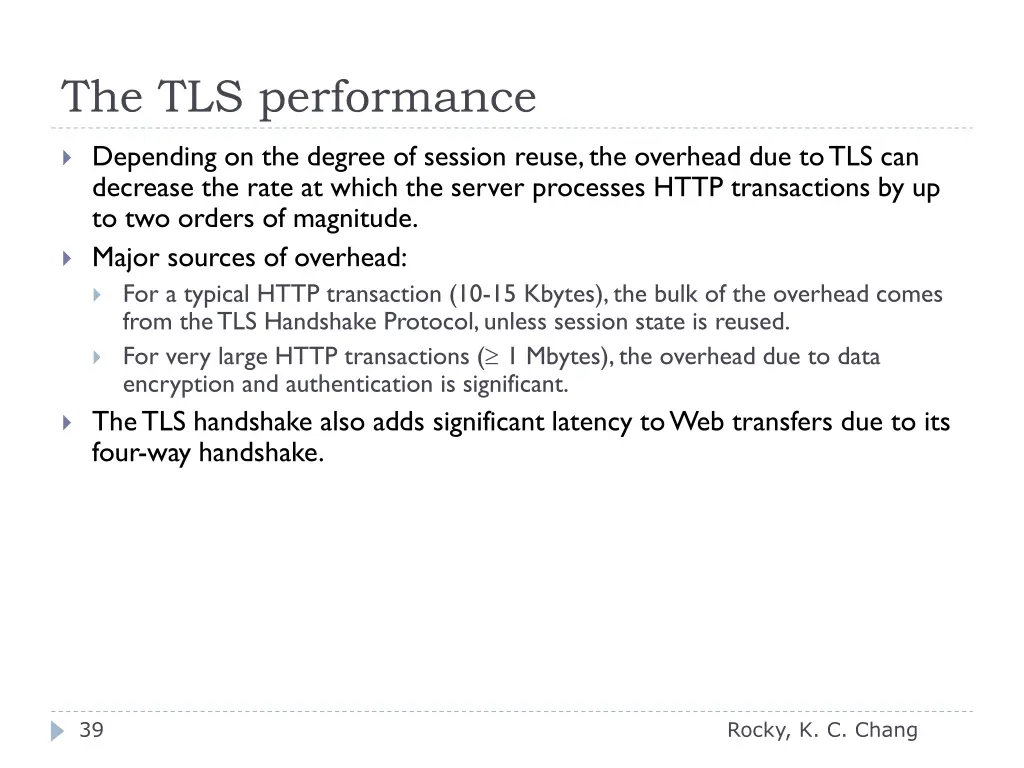
The TLS performance Depending on the degree of session reuse, the overhead due to TLS can decrease the rate at which the server processes HTTP transactions by up to two orders of magnitude. Major sources of overhead: For a typical HTTP transaction (10-15 Kbytes), the bulk of the overhead comes from the TLS Handshake Protocol, unless session state is reused. For very large HTTP transactions ( 1 Mbytes), the overhead due to data encryption and authentication is significant. The TLS handshake also adds significant latency to Web transfers due to its four-way handshake. 39 Rocky, K. C. Chang
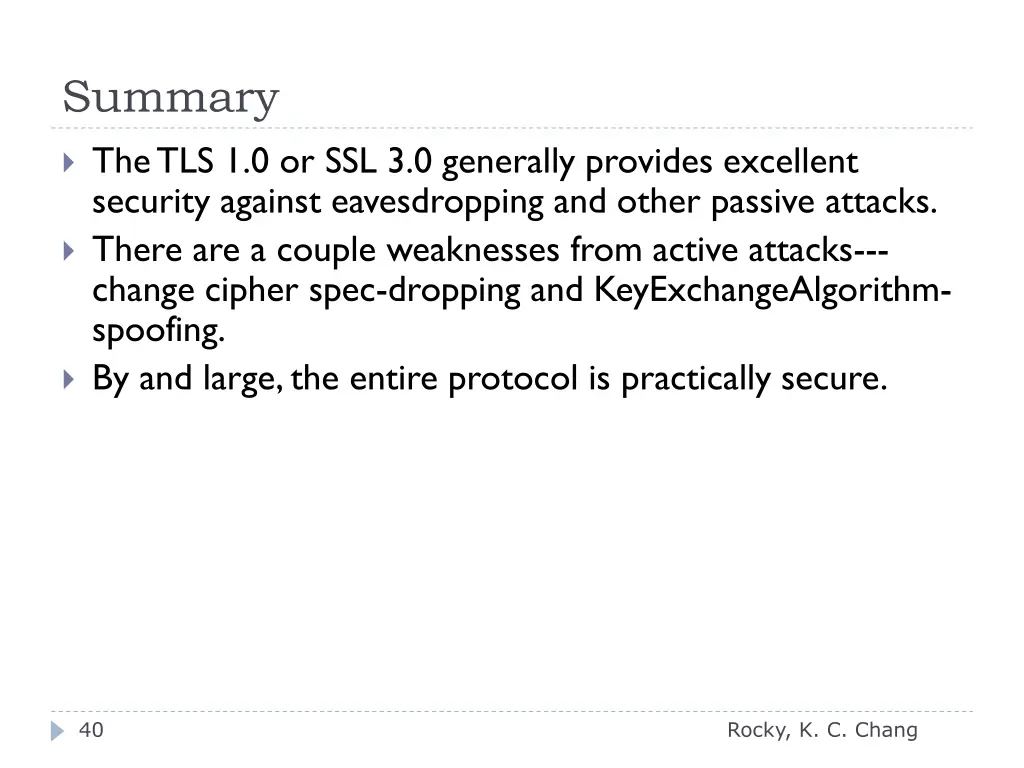
Summary The TLS 1.0 or SSL 3.0 generally provides excellent security against eavesdropping and other passive attacks. There are a couple weaknesses from active attacks--- change cipher spec-dropping and KeyExchangeAlgorithm- spoofing. By and large, the entire protocol is practically secure. 40 Rocky, K. C. Chang
Acknowledgements The notes are based on T. Dierks, C. Allen, The TLS Protocol Version 1.0, RFC 2246, January 1999. A. Freier, P. Karlton, and P. Kocher, The SSL Protocol 3.0, Netscape Commun. Corp., March 1996. G. Apostolopoulos, V. Peris, and D. Saha, Transport Layer Security: How Much Does It Really Cost? Proc. IEEE INFOCOM, 1999. 41 Rocky, K. C. Chang