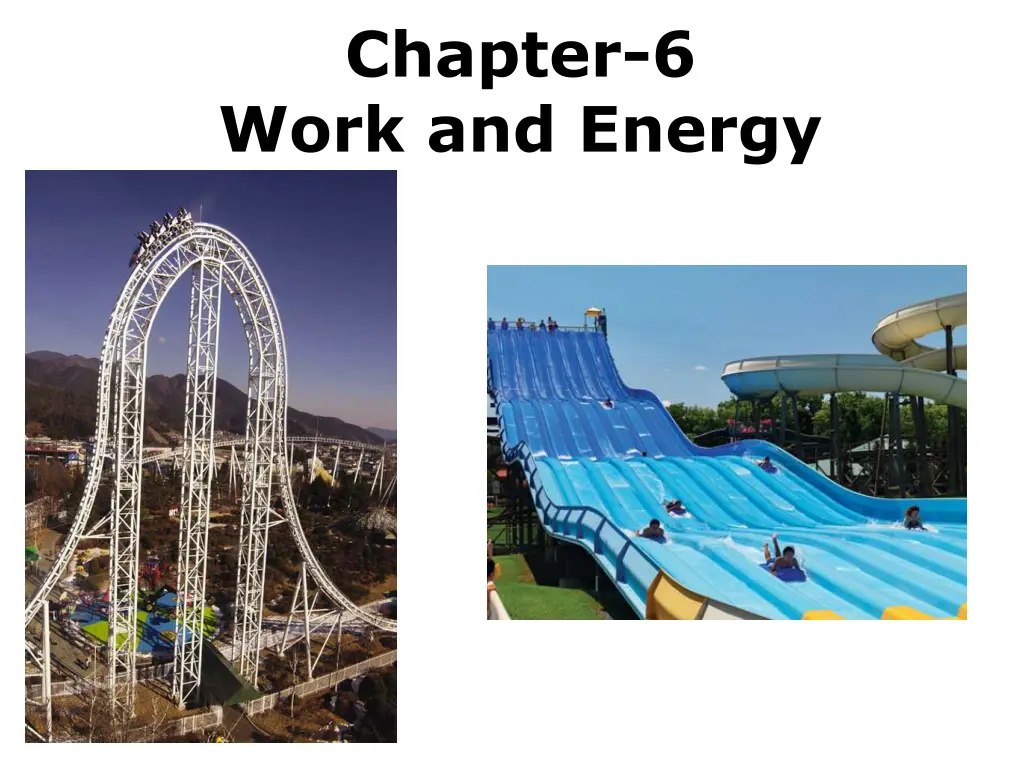
Explore the concepts of work, energy, and kinetic theory in physics. Learn about the calculations involving forces, displacements, and energies. Discover how gravitational potential energy and the work-energy theorem play a role in various scenarios like bench pressing, skiing, and trampoline gymnastics. Dive into the fundamental principles and applications of these key physics concepts.
Please find below an Image/Link to download the presentation.
The content on the website is provided AS IS for your information and personal use only. It may not be sold, licensed, or shared on other websites without obtaining consent from the author. If you encounter any issues during the download, it is possible that the publisher has removed the file from their server.
You are allowed to download the files provided on this website for personal or commercial use, subject to the condition that they are used lawfully. All files are the property of their respective owners.
The content on the website is provided AS IS for your information and personal use only. It may not be sold, licensed, or shared on other websites without obtaining consent from the author.
6.1. Work Done by a Constant Force Work is done when a force F pushes a car through a displacement s. Work = Force X Displacement. SI Unit of Work: joule, J Work is a scalar.
Work-Energy Theorem and Kinetic Energy 1 1 2 2 = = W KE KE mv mv 0 0 f f 2 2 SI Unit of Kinetic Energy: joule (J)
Downhill Skiing A 58-kg skier is coasting down a 25 slope. A kinetic frictional force of magnitude 70-N opposes her motion. Near the top of the slope, the skier s speed is 3.6 m/s. Ignoring air resistance, determine the speed vf at a point that is displaced 57-m downhill.
6.3 Gravitational Potential Energy The gravitational potential energy PE is the energy that an object of mass m has by virtue of its position relative to the surface of the earth. That position is measured by the height h of the object relative to an arbitrary zero level: SI Unit of Gravitational Potential Energy: joule (J)
A Gymnast on a Trampoline Example 7 A gymnast springs vertically upward from a trampoline. The gymnast leaves the trampoline at a height of 1.20 m and reaches a maximum height of 4.80 m before falling back down. All heights are measured with respect to the ground. Ignoring air resistance, determine the initial speed v0 with which the gymnast leaves the trampoline.
6-4: Conservative and Non-conservative Forces A force is a conservative force if the net work it does on a particle moving around any closed path, from an initial point and then back to that point, is zero. Equivalently, a force is conservative if the net work it does on a particle moving between two points does not depend on the path taken by the particle. A force is non-conservative if the net work it does on a particle moving between two points does depend on the path taken by the particle.
Examples Conservative Forces Gravitational force (Ch. 4) Elastic spring force (Ch. 10) Electric force (Ch. 18, 19) Nonconservative Forces Static and kinetic frictional forces Air resistance Tension Normal force Propulsion force of a rocket
THE PRINCIPLE OF CONSERVATION OF MECHANICAL ENERGY The total mechanical energy (E = KE + PE) of an object remains constant as the object moves, provided that the net work done by external nonconservative forces is zero.
Conservation of Mechanical Energy If friction and wind resistance are ignored, a bobsled run illustrates how kinetic and potential energy can be interconverted, while the total mechanical energy remains constant.
A Daredevil Motorcyclist A motorcyclist is trying to leap across the canyon shown in Figure 6.16 by driving horizontally off the cliff at a speed of 38.0 m/s. Ignoring air resistance, find the speed with which the cycle strikes the ground on the other side.
Roller Coaster (Ideal) The ride includes a vertical drop of 93.5 m. The coaster has a speed of 3.0 m/s at the top of the drop. Neglect friction and find the speed of the riders at the bottom.
6.6 Nonconservative Forces and the Work Energy Theorem In the roller coaster example, we ignored nonconservative forces, such as friction. In reality, however, such forces are present when the roller coaster descends. The actual speed of the riders at the bottom is 41.0 m/s. Assuming again that the coaster has a speed of 3.0 m/s at the top, find the work done by nonconservative forces on a 55.0-kg rider during the descent.