Underwater Trajectory Behavior of Heavy Oil Jet in Cross-Flow
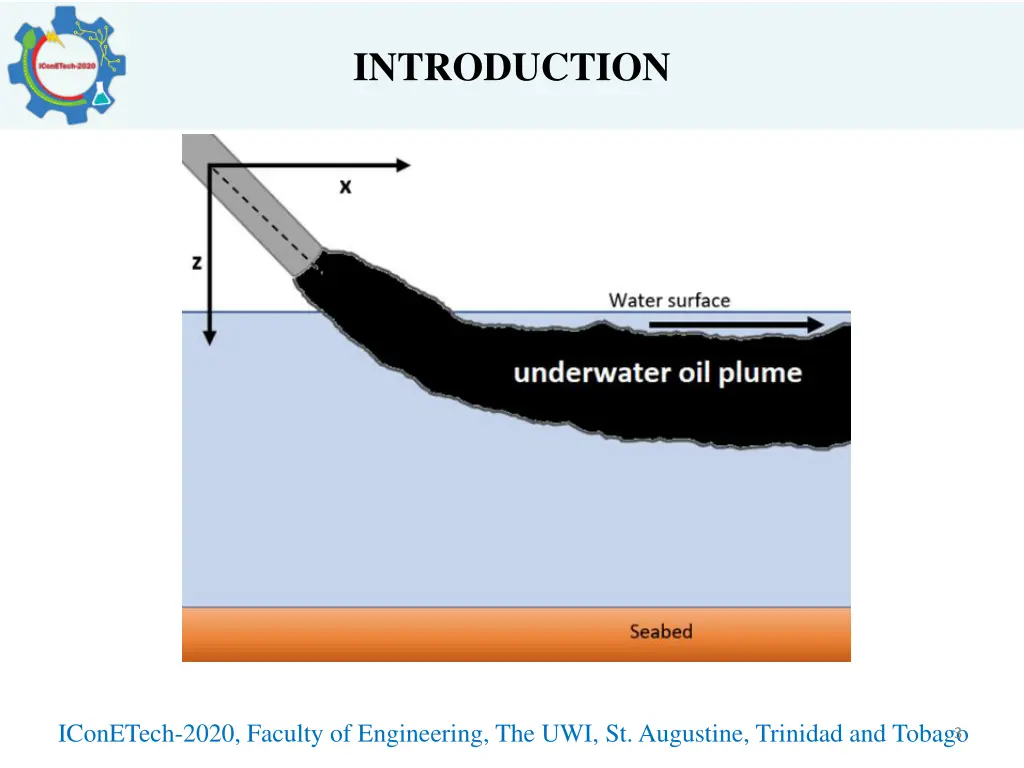
This study explores the behavior of heavy oil jets underwater from a broken-surface pipeline, focusing on vertical dispersion modeling based on Navier-Stokes equations and experimental work by Delvigne and Sweeney. The research delves into the theory of wave-induced dispersion and the modeling approaches combining Lagrangian particle transport and random walk techniques. Detailed numerical results and analysis contribute to understanding oil spill dynamics in aquatic environments.

Download Presentation

Please find below an Image/Link to download the presentation.
The content on the website is provided AS IS for your information and personal use only. It may not be sold, licensed, or shared on other websites without obtaining consent from the author.If you encounter any issues during the download, it is possible that the publisher has removed the file from their server.
You are allowed to download the files provided on this website for personal or commercial use, subject to the condition that they are used lawfully. All files are the property of their respective owners.
The content on the website is provided AS IS for your information and personal use only. It may not be sold, licensed, or shared on other websites without obtaining consent from the author.
E N D
Presentation Transcript
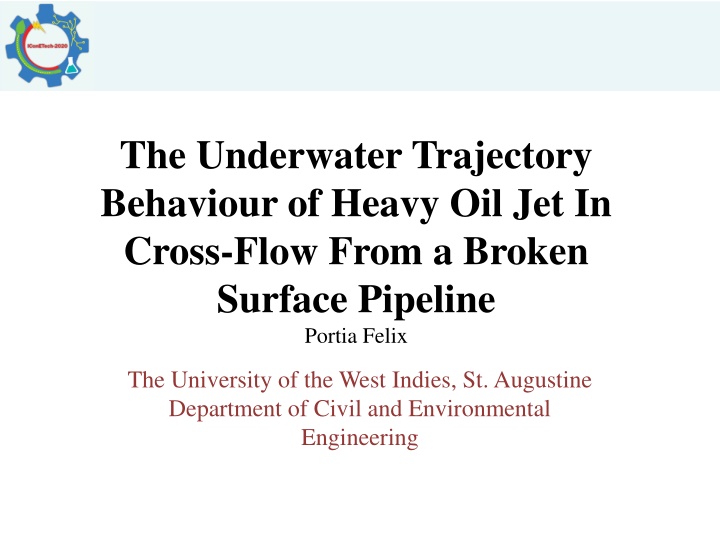
The Underwater Trajectory Behaviour of Heavy Oil Jet In Cross-Flow From a Broken Surface Pipeline Portia Felix The University of the West Indies, St. Augustine Department of Civil and Environmental Engineering
OUTLINE Introduction State of the Art in Vertical Dispersion Oil Spill Modeling Mathematical Model- The Navier-Stokes Equations Numerical Results of the Research Model Conclusion IConETech-2020, Faculty of Engineering, The UWI, St. Augustine, Trinidad and Tobago 2
INTRODUCTION IConETech-2020, Faculty of Engineering, The UWI, St. Augustine, Trinidad and Tobago 3
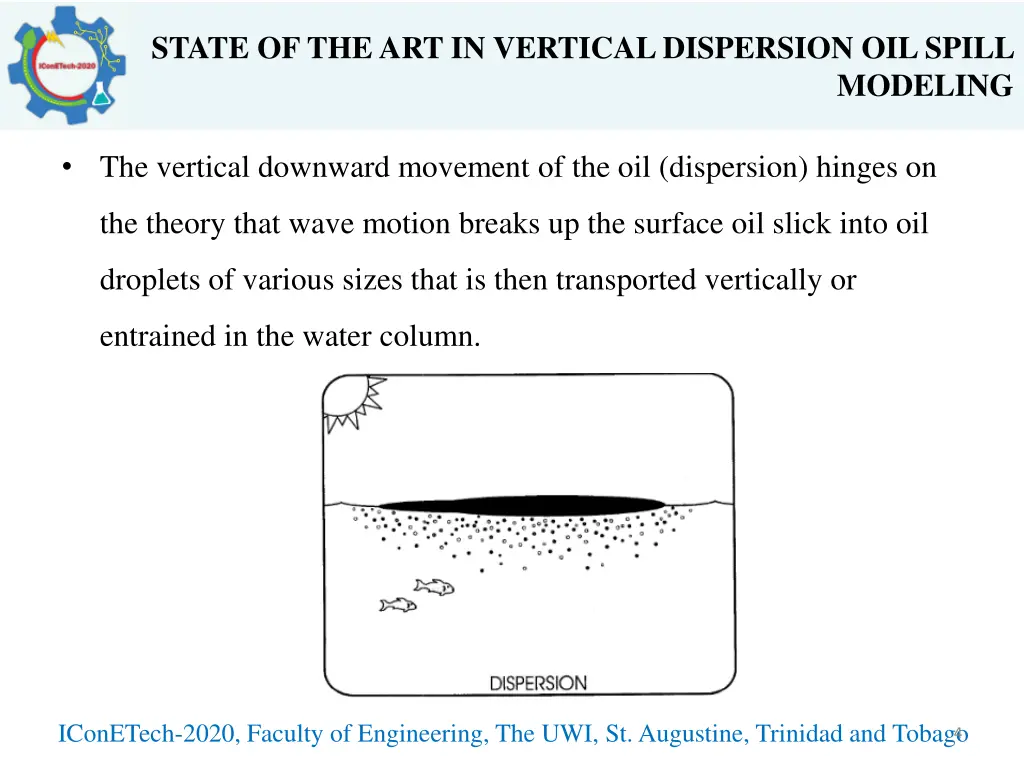
STATE OF THE ART IN VERTICAL DISPERSION OIL SPILL MODELING The vertical downward movement of the oil (dispersion) hinges on the theory that wave motion breaks up the surface oil slick into oil droplets of various sizes that is then transported vertically or entrained in the water column. IConETech-2020, Faculty of Engineering, The UWI, St. Augustine, Trinidad and Tobago 4
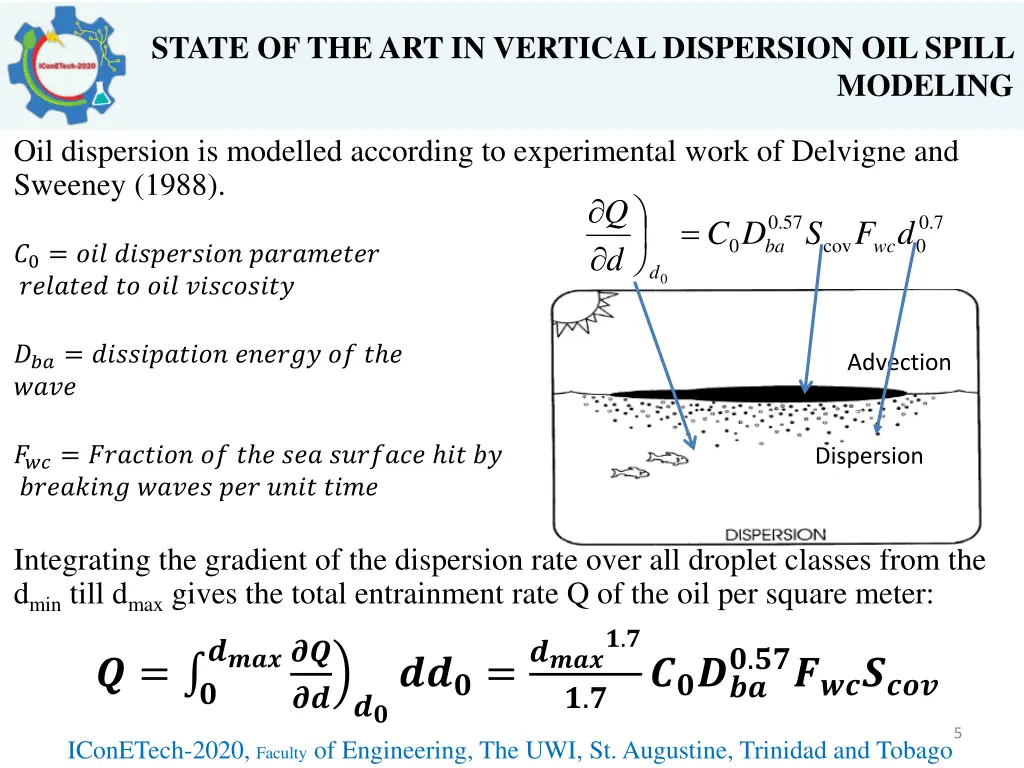
STATE OF THE ART IN VERTICAL DISPERSION OIL SPILL MODELING Oil dispersion is modelled according to experimental work of Delvigne and Sweeney (1988). Q = . 0 ba 57 7 . 0 0 C D S F d 0 cov wc d ?0= ??? ?????????? ????????? ??????? ?? ??? ????????? d 0 ???= ??????????? ?????? ?? ? ? ???? ???= ???????? ?? ? ? ??? ??????? ?? ?? ???????? ????? ??? ???? ???? Advection Dispersion Integrating the gradient of the dispersion rate over all droplet classes from the dmin till dmax gives the total entrainment rate Q of the oil per square meter: ???????=?????.? ?????? ?.????????? ? = ????? ? ?.? 5 IConETech-2020, Faculty of Engineering, The UWI, St. Augustine, Trinidad and Tobago
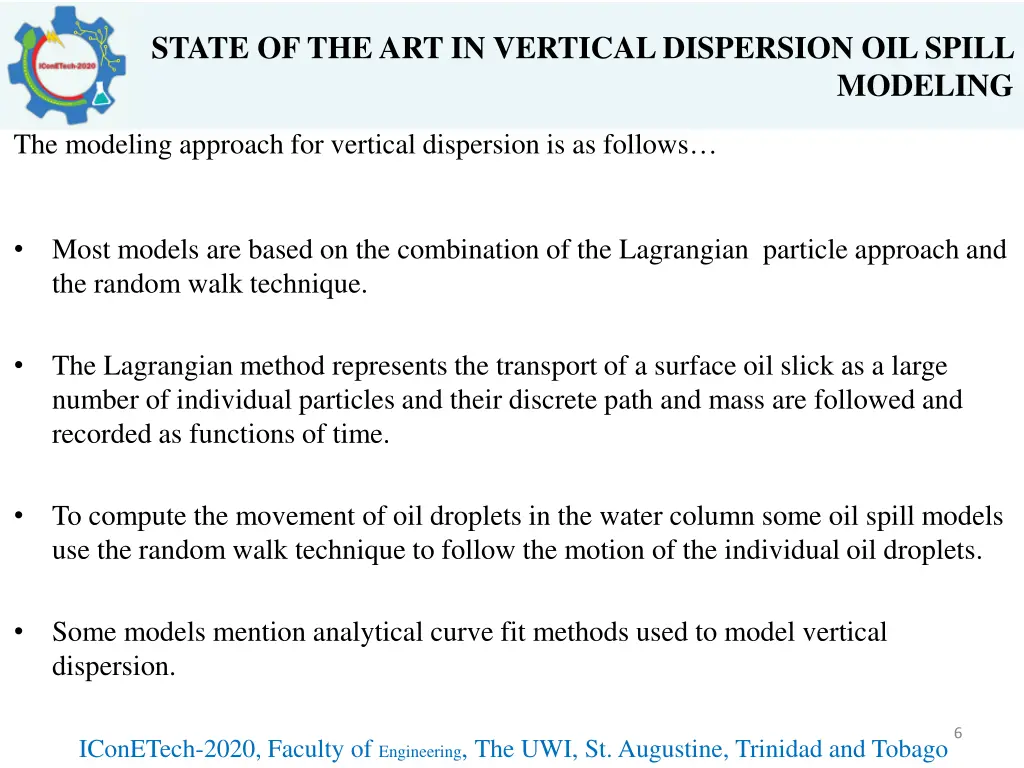
STATE OF THE ART IN VERTICAL DISPERSION OIL SPILL MODELING The modeling approach for vertical dispersion is as follows Most models are based on the combination of the Lagrangian particle approach and the random walk technique. The Lagrangian method represents the transport of a surface oil slick as a large number of individual particles and their discrete path and mass are followed and recorded as functions of time. To compute the movement of oil droplets in the water column some oil spill models use the random walk technique to follow the motion of the individual oil droplets. Some models mention analytical curve fit methods used to model vertical dispersion. 6 IConETech-2020, Faculty of Engineering, The UWI, St. Augustine, Trinidad and Tobago
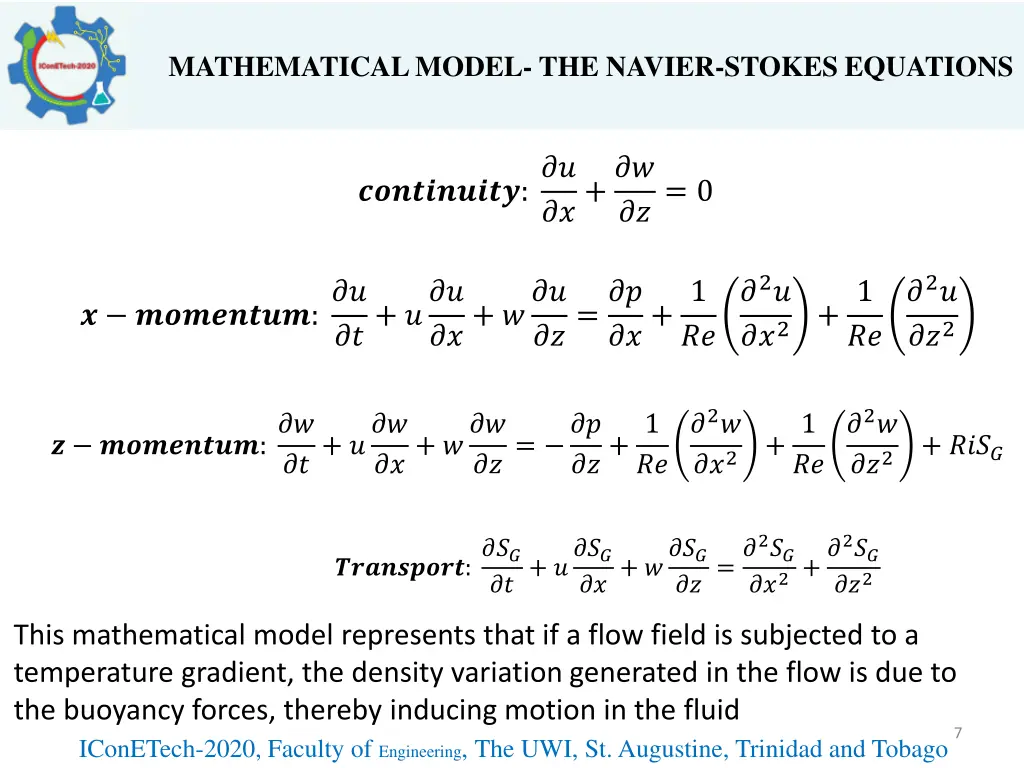
MATHEMATICAL MODEL- THE NAVIER-STOKES EQUATIONS ??????????:?? ??+?? ??= 0 ?2? ??2 ?2? ??2 ? ????????:?? ??+ ??? ??+ ??? ??=?? 1 1 ??+ + ?? ?? ?2? ??2 ?2? ??2 ? ????????:?? ??+ ??? ??+ ??? ??= ?? 1 1 ??+ + + ???? ?? ?? ??=?2?? ??2+?2?? ?????????:??? ??+ ???? ??+ ???? ??2 This mathematical model represents that if a flow field is subjected to a temperature gradient, the density variation generated in the flow is due to the buoyancy forces, thereby inducing motion in the fluid 7 IConETech-2020, Faculty of Engineering, The UWI, St. Augustine, Trinidad and Tobago
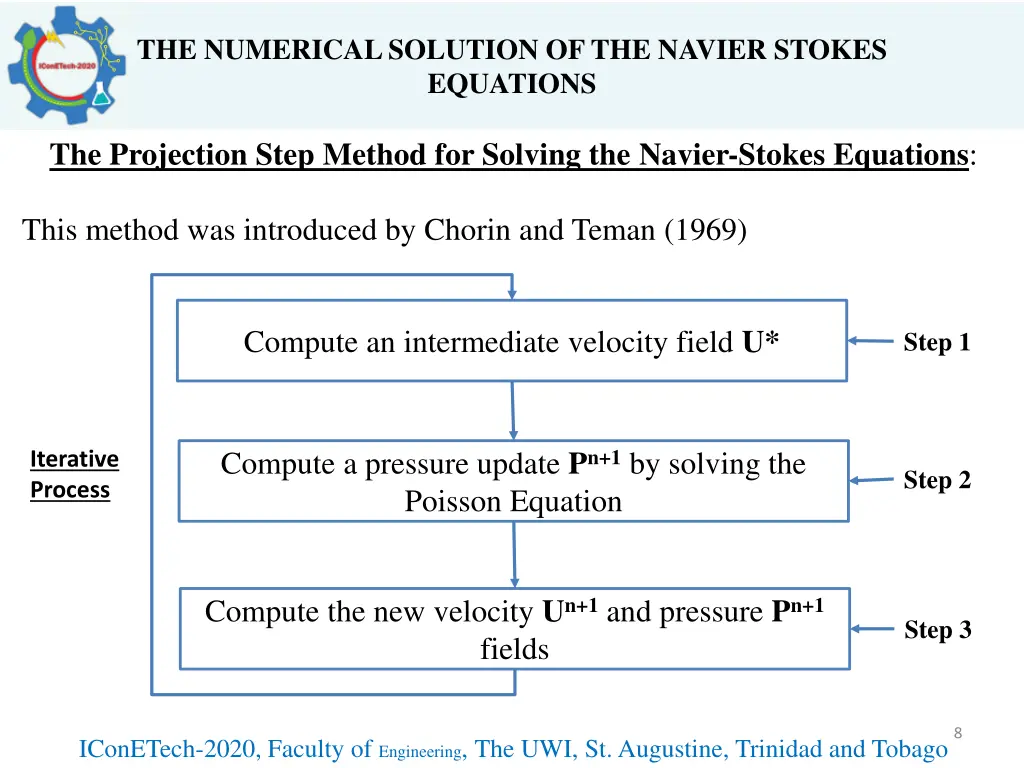
THE NUMERICAL SOLUTION OF THE NAVIER STOKES EQUATIONS The Projection Step Method for Solving the Navier-Stokes Equations: This method was introduced by Chorin and Teman (1969) Compute an intermediate velocity field U* Step 1 Compute a pressure update Pn+1 by solving the Poisson Equation Iterative Process Step 2 Compute the new velocity Un+1 and pressure Pn+1 fields Step 3 8 IConETech-2020, Faculty of Engineering, The UWI, St. Augustine, Trinidad and Tobago
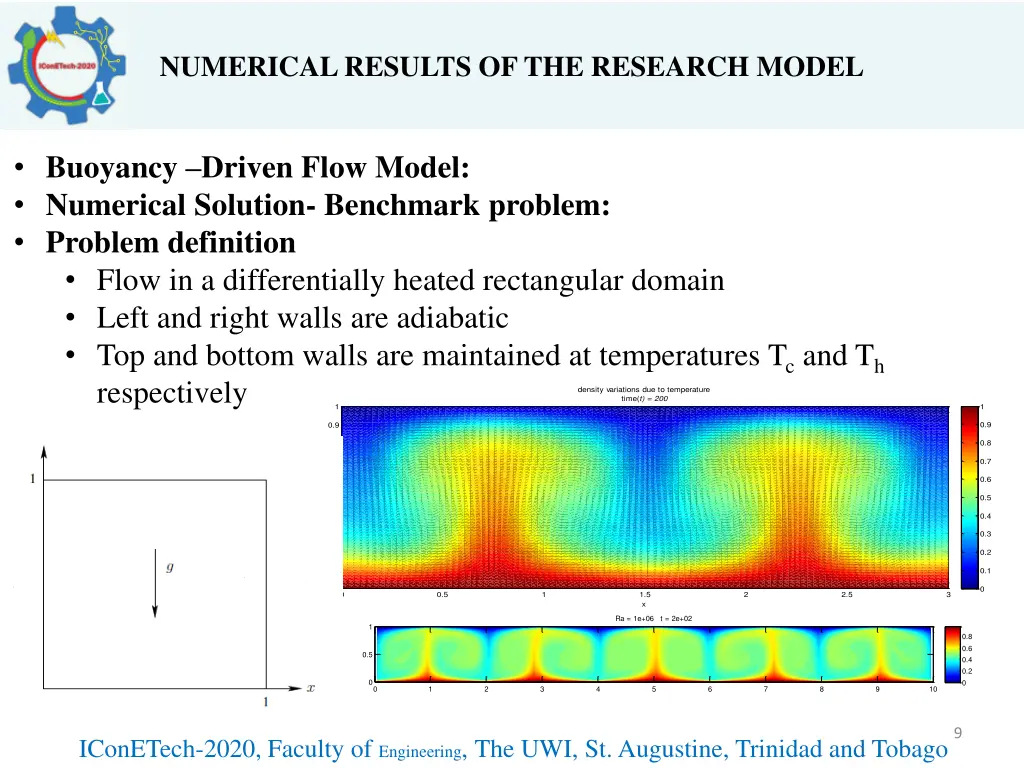
NUMERICAL RESULTS OF THE RESEARCH MODEL Buoyancy Driven Flow Model: Numerical Solution- Benchmark problem: Problem definition Flow in a differentially heated rectangular domain Left and right walls are adiabatic Top and bottom walls are maintained at temperatures Tc and Th respectively density variations due to temperature time(t) = 200 1 1 0.9 0.9 0.8 0.8 0.7 0.7 0.6 0.6 0.5 0.5 z 0.4 0.4 0.3 0.3 0.2 0.2 0.1 0.1 0 0 0 0.5 1 1.5 x 2 2.5 3 Ra = 1e+06 t = 2e+02 1 0.8 0.6 0.5 0.4 0.2 0 0 0 1 2 3 4 5 6 7 8 9 10 9 IConETech-2020, Faculty of Engineering, The UWI, St. Augustine, Trinidad and Tobago
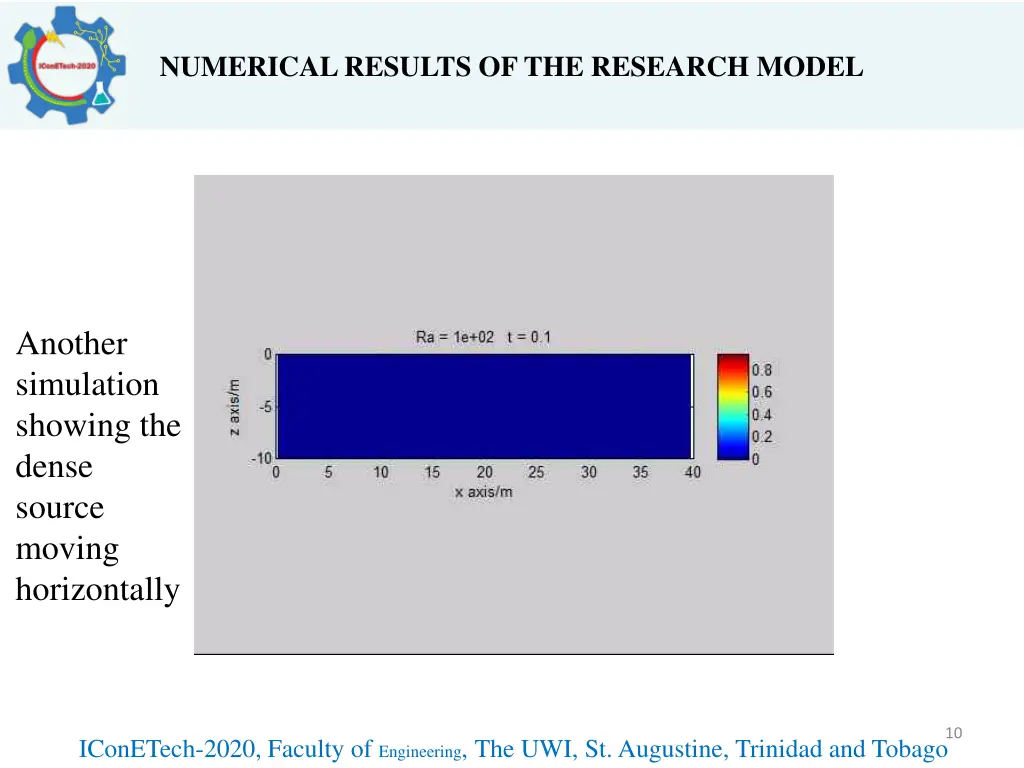
NUMERICAL RESULTS OF THE RESEARCH MODEL Another simulation showing the dense source moving horizontally 10 IConETech-2020, Faculty of Engineering, The UWI, St. Augustine, Trinidad and Tobago
NUMERICAL RESULTS OF THE RESEARCH MODEL Another simulation showing the dense source moving horizontally 11 IConETech-2020, Faculty of Engineering, The UWI, St. Augustine, Trinidad and Tobago
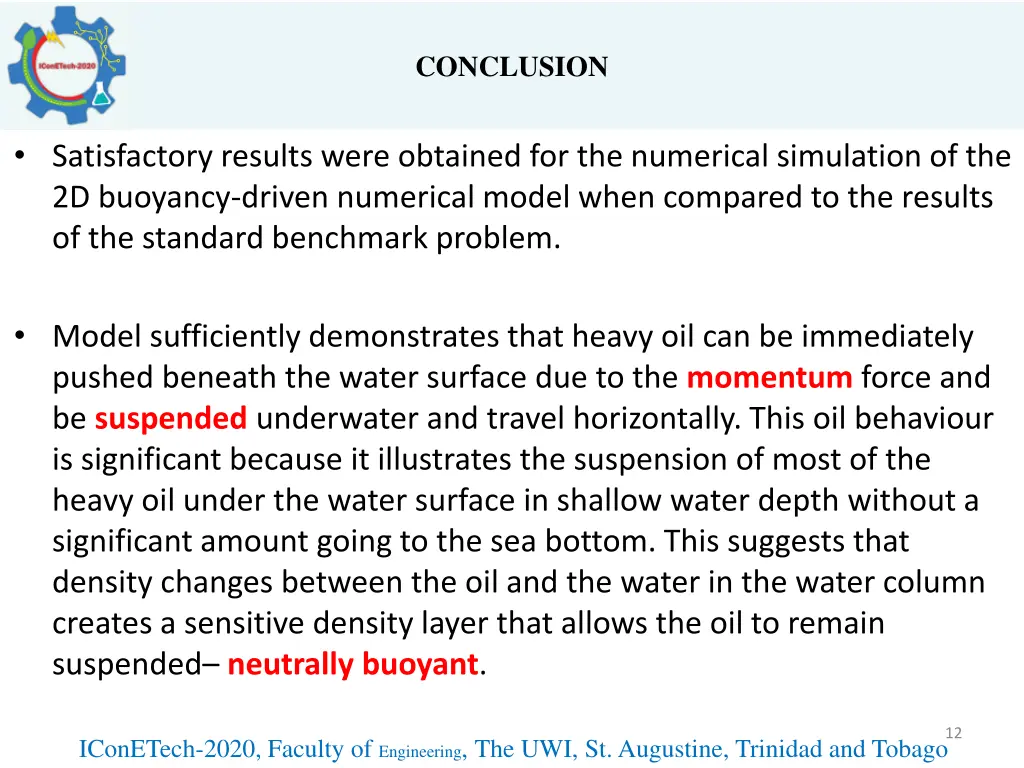
CONCLUSION Satisfactory results were obtained for the numerical simulation of the 2D buoyancy-driven numerical model when compared to the results of the standard benchmark problem. Model sufficiently demonstrates that heavy oil can be immediately pushed beneath the water surface due to the momentum force and be suspended underwater and travel horizontally. This oil behaviour is significant because it illustrates the suspension of most of the heavy oil under the water surface in shallow water depth without a significant amount going to the sea bottom. This suggests that density changes between the oil and the water in the water column creates a sensitive density layer that allows the oil to remain suspended neutrally buoyant. 12 IConETech-2020, Faculty of Engineering, The UWI, St. Augustine, Trinidad and Tobago
THANK YOU! IConETech-2020, Faculty of Engineering, The UWI, St. Augustine, Trinidad and Tobago 13