Unit 1 The Parts of Medicare
Explore the key aspects of Medicare, including eligibility criteria, enrollment periods, coverage details of Parts A and B, and important considerations for individuals turning 65 or with specific medical conditions. Gain insights into when to enroll and what services are covered under each part.

Uploaded on Feb 26, 2025 | 1 Views
Download Presentation

Please find below an Image/Link to download the presentation.
The content on the website is provided AS IS for your information and personal use only. It may not be sold, licensed, or shared on other websites without obtaining consent from the author.If you encounter any issues during the download, it is possible that the publisher has removed the file from their server.
You are allowed to download the files provided on this website for personal or commercial use, subject to the condition that they are used lawfully. All files are the property of their respective owners.
The content on the website is provided AS IS for your information and personal use only. It may not be sold, licensed, or shared on other websites without obtaining consent from the author.
E N D
Presentation Transcript
Unit 1 The Parts of Medicare Section 1 Medicare Parts A and B
Who Qualifies for Medicare? Individuals Turning 65 Individuals over the age of 65 Individuals Under 65 with Medicaid Individuals With ESRD
When to Enroll in Medicare Enrollment in Part A is automatic for anyone who qualifies for Premium Free Part A. Part B is automatic for some people. Others have to Manually Enroll, during their Initial Enrollment Period (IEP). Here is a list of scenarios where someone is automatically enrolled in both Part A and Part B People who are enrolled automatically receive their Medicare card either on the 25th month of disability or three months before their 65th birthday.
The Parts of Medicare and What is Covered Medicare Part A, also known as Hospital insurance, covers the following Hospital care Skilled nursing in a facility Hospice care Home health services Nursing home care as long as it is more than custodial care Religious non-medical health care institutions inpatient care Here is a complete list of Medicare Part A covered services.
The Parts of Medicare, and What is Covered Medicare Part B covers most outpatient and doctors services like: Ambulance Physical Therapy Doctors visits Labs Durable Medical Equipment And many more services Here is a complete list of Medicare Part B covered services.
Check Point Question INSERT QUESTION HERE RANDOMLY TAKEN FROM THE COURSE EXAM. IF QUESTION IS ANSWERED INCORRECTLY, OFFER THE CHANCE TO REVIEW THE RELEVANT SECTION BEFORE MOVING ON.
When to Enroll in Medicare Individuals who do not qualify for Premium-Free Part A have the option to enroll during the initial enrollment period. If an individual buys Part A, they also have to buy Part B. Anyone who misses the Initial Enrollment Period will have to enroll during the Open Enrollment Period. Enrolling late in Medicare can result in penalties on the Part B premium unless that individual is deferring Part B, and has Creditable Coverage.
When to Enroll in Medicare Some individuals may want to defer their Medicare Part B if they are covered under an employer or a spouses employer coverage. However, for someone under a Small Employer Group, that may be a problem as Medicare will be the Primary Payer in the Coordination of Benefits. Medicare is the Secondary Payer for Large Employer Groups. Individuals who defer Medicare Part B will receive a Special Election to enroll when they leave group coverage.
Medicare Premiums and Cost Sharing Most Individuals do not pay the Part A Premium However, everyone pays a Part B Premium unless it is being covered by Medicaid. The amount someone might pay if they don t qualify for Premium Free Part A varies based on the number of quarters they did work if any. The amount someone pays for Part B premiums is based on their income for the last 2 years they filed taxes. Though most pay the standard premium.
Medicare Premiums and Cost Sharing Those who have to pay more for Part B are subject to an Income Related Monthly Adjustment Amount (IRMAA). If a beneficiary has a Qualifying Event, they can file an appeal of their IRMAA with Social Security, using a form SSA-44.
Medicare Premiums and Cost Sharing In addition to premiums there are Part A Deductibles and Part B Deductibles. Once the Part A deductible is met, the beneficiary will have set Co-Pays for Inpatient Hospital and Skilled Nursing Facility stays. Part A co-pays are per Benefit Period. If an inpatient stay goes beyond 90 days, it will result in the beneficiary using their Lifetime Reserve Days. If a beneficiary uses all of their lifetime reserve days, they will be responsible for all costs if they exceed 90 days in a benefit period.
Medicare Premiums and Cost Sharing Once the Part B deductible is met, the beneficiary will be responsible for 20% of the Medicare-Approved Amount. There is no cap on the 20% co-insurance for Part B. Here is a quick reference for all Medicare cost sharing and premiums.
Check Point Question INSERT QUESTION HERE RANDOMLY TAKEN FROM THE COURSE EXAM. IF QUESTION IS ANSWERED INCORRECTLY, OFFER THE CHANCE TO REVIEW THE RELEVANT SECTION BEFORE MOVING ON.
Unit 1 The Parts of Medicare Section 2 Medicare Parts C and D
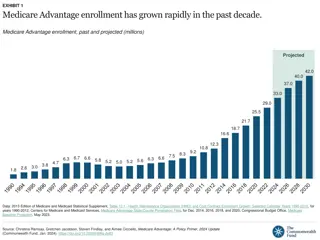
Medicare Part C Basics Medicare Advantage (MA) is another name for Medicare Part C. These types of plans are offered by private insurance companies or provider networks that contract with Medicare to provide Part A and Part B benefits. An MA plan usually resembles a traditional HMO or PPO plan. MA plans replace traditional Medicare. Most MA Plans also have additional Prescription Drug Coverage.
Medicare Part C Basics Though HMO and PPO plans are the most common, there are many MA plans types: HMO PPO PFFS PACE SNP MSA Group MA
What Does Medicare Part C Cover Medicare Advantage Plans cover all Medicare Covered Services for both Parts A and B. Medicare Advantage plans can also offer additional coverage that is not covered by Medicare A and B such as: Dental Vision Hearing Prescription Drugs
Medicare Part C Cost Sharing While Medicare Advantage replaces Part A and B, beneficiaries must still pay the Part B Premium. Some plans may have a Part B buyback, where the premium can be partially or fully reimbursed. Medicare Advantage plans also have a premium that must be paid. Some Medicare Advantage Plans may have $0 premium as well. Some individuals may have the MA premium covered by Medicaid.
Medicare Part C Cost Sharing Most Medicare Advantage plans do not have a deductible for Part A and B services. They do however have a Maximum Out of Pocket (MOOP) Usually, a beneficiary must pay Co-Pays or Co-Insurance until they reach their MOOP. Once the MOOP is met, beneficiaries will not pay anything for Medicare covered services. If the plan is combined with Part D, there may be a separate deductible for prescription drugs as well as copays.
Check Point Question INSERT QUESTION HERE RANDOMLY TAKEN FROM THE COURSE EXAM. IF QUESTION IS ANSWERED INCORRECTLY, OFFER THE CHANCE TO REVIEW THE RELEVANT SECTION BEFORE MOVING ON.
Eligibility and Enrollment for Part C The Initial Enrollment Period for Part C is the same seven- month period as the Initial Enrollment Period for Part A and Part B. Part C follows all the same qualifications as Part A and Part B, with the exception that individuals with ESRD cannot enroll. If someone signs up for an MA plan in the Initial Enrollment Period, they can drop that plan at any time during the next 12 months and go back to Original Medicare.
Eligibility and Enrollment for Medicare Advantage There are also a number of Special Enrollment Periods (SEPs). Some things that can trigger these include: Moving Becoming eligible for Medicaid Qualifying for extra help with Medicare prescription drug costs Getting care in an institution, like a skilled nursing facility or long-term care hospital Switching to a plan with a five-star overall quality rating Here is a comprehensive chart of SEPs for Medicare Advantage
Additional Enrollment Periods Aside from the Initial Enrollment Period and SEPs, there are additional enrollment periods for Medicare Advantage: AEP- Annual Enrollment Period OEP Open Enrollment Period (Replaced the Annual Disenrollment Period) Also individuals with Medicaid or Extra Help, can switch once per quarter, in the first three quarters of the year.
Medicare Part D Basics Medicare Part D is the prescription drug plan for seniors and others on Medicare. It is designed to help subsidize the cost of prescription drugs through private insurance plans. They can be sold as Part of a combined MAPD Plan or standalone. They cannot be sold in conjunction with a standalone MA Plan.
What Part D Covers What a PDP covers is based on the plan s Formulary. A carrier can change its formulary at any time. However, there are some rules they have to follow that afford the beneficiary at least a little protection. Generally, a formulary is only going to cover Medicare-Covered drugs, but a carrier can enhance the benefits of the plan to include drugs not covered by Medicare. These are called Enhanced Plans.
What Part D Covers If someone enrolls in a PDP and they are taking a drug that is not covered, the carrier is still required to provide a one-time supply in the first 90 days. This allows time for a replacement to be found by the physician or an Formulary Exception to be requested. Some drugs may also require Step Therapy before they can be covered. There may also be Quantity Limits for some drugs.
What Part D Covers Medicare Part D does not cover: Drugs Covered by Medicare Parts A and B (Except in a few situations) Drugs not on Medicare's Drug List (Unless it s an enhanced plan)
Check Point Question INSERT QUESTION HERE RANDOMLY TAKEN FROM THE COURSE EXAM. IF QUESTION IS ANSWERED INCORRECTLY, OFFER THE CHANCE TO REVIEW THE RELEVANT SECTION BEFORE MOVING ON.
Medicare Part D Cost Sharing Medicare Part D Plans have: Premiums Copays Coinsurance Deductibles The premium will always be paid, but the other costs can vary or be nonexistent based on the tier of the drug.
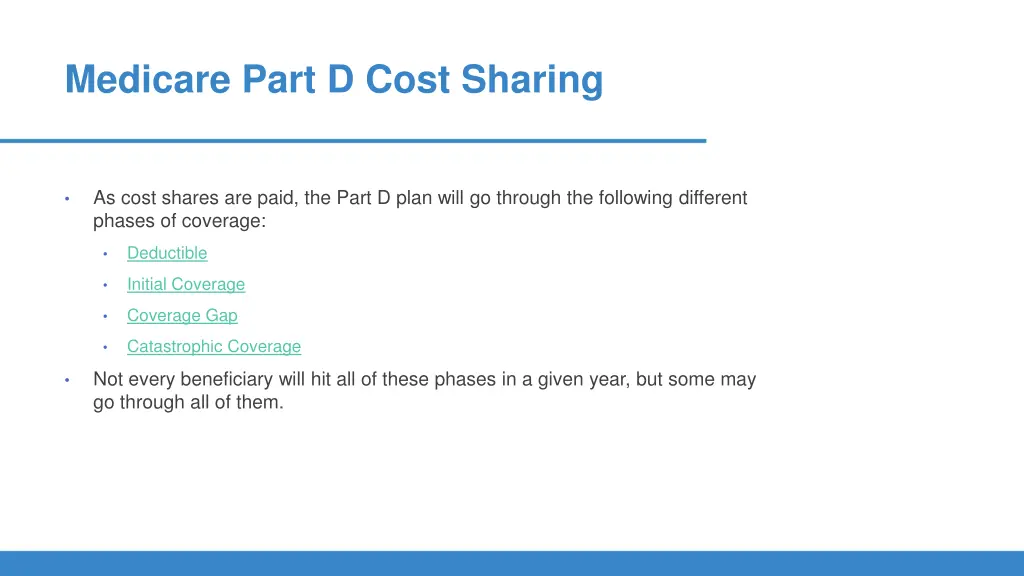
Medicare Part D Cost Sharing As cost shares are paid, the Part D plan will go through the following different phases of coverage: Deductible Initial Coverage Coverage Gap Catastrophic Coverage Not every beneficiary will hit all of these phases in a given year, but some may go through all of them.
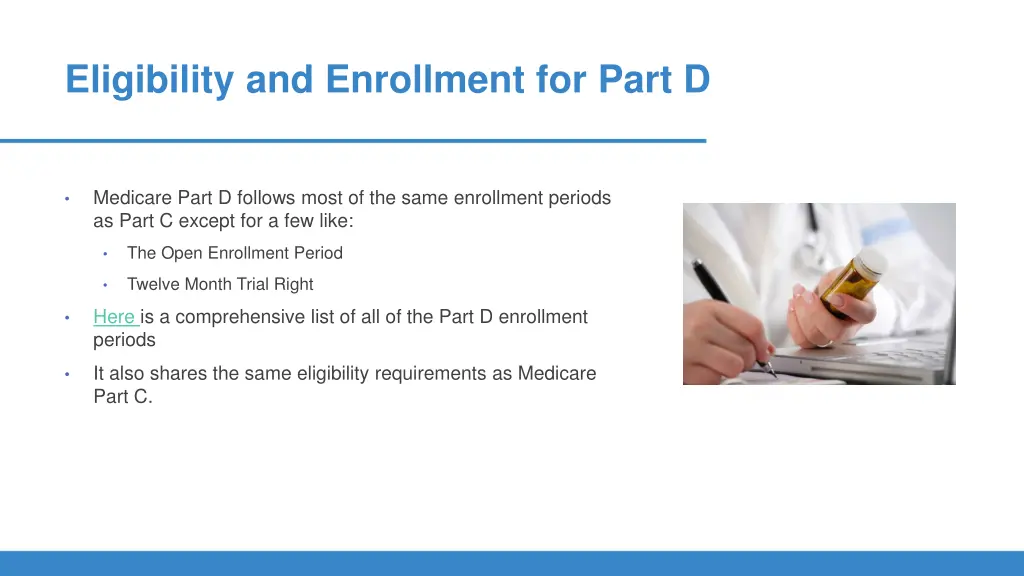
Eligibility and Enrollment for Part D Medicare Part D follows most of the same enrollment periods as Part C except for a few like: The Open Enrollment Period Twelve Month Trial Right Here is a comprehensive list of all of the Part D enrollment periods It also shares the same eligibility requirements as Medicare Part C.
Unit 1 The Parts of Medicare Section 3 Dual Eligible, Medicare, Medicaid and Extra Help
Medicare, Medicaid and Extra Help Some individuals get assistance with paying for the Medicare A, B, C and/or Part D. Those who get assistance from Medicaid are Dual Eligible. Dual Eligible Individuals have benefits that coordinate between Medicare and Medicaid. Medicare will be the Primary Payer for some Services like: Part A services Part B services Part D coverage Skilled nursing facilities (SNF) Home health care Long-term care (LTC)
Medicare, Medicaid, and Extra Help Anything not covered by Medicare, is usually paid by Medicaid. Medicaid can also cover some or all of the beneficiaries cost sharing, depending on the Medicaid Qualification. It is important to always check with Medicaid, in the beneficiary s state, to ensure what the program offers, and what the eligibility requirements are. There are general guidelines, but it is truly up to each state to establish who qualifies for the state s Medicaid program, and at what level.
Check Point Question INSERT QUESTION HERE RANDOMLY TAKEN FROM THE COURSE EXAM. IF QUESTION IS ANSWERED INCORRECTLY, OFFER THE CHANCE TO REVIEW THE RELEVANT SECTION BEFORE MOVING ON.
Medicaid Eligibility Category There are Several Categories for Medicare Eligibility when on Medicaid. They are as follows: Qualified Medicare Beneficiary Without Other Medicaid (QMB Only) QMB+ Specified Low-Income Medicare Beneficiary Without Other Medicaid (SLMB Only) SLMB+ Qualifying Individual (QI) Qualifying Disabled and Working Individual (QDWI) Other Full Benefit Dual Eligible (FBDE)
D-SNP Category People who are dual eligible may have access to certain Special Needs Plans based on availability, carrier guidelines and their dual eligible status. These are called Dual Special Needs Plans (D-SNP)s. There are several categories of SNP plans varying levels of coverage and cost sharing: All-Dual D-SNPs Full-Benefit D-SNPs Medicare Zero Cost Sharing D-SNPs Dual Eligible Subset D-SNPs Institutional plans Institutional Equivalent plans Chronic Condition plans
Other Types of Extra Help Many states have additional programs that either go above and beyond Medicaid, or provide extra assistance to individuals, who are in bad financial situations, but that would not quite qualify for Medicaid. These are referred to as Extra Help. Check with your states Social Security and/or Health and Human Services Department for information on assistance that may be available in your area.
Check Point Question INSERT QUESTION HERE RANDOMLY TAKEN FROM THE COURSE EXAM. IF QUESTION IS ANSWERED INCORRECTLY, OFFER THE CHANCE TO REVIEW THE RELEVANT SECTION BEFORE MOVING ON.
Unit 1 The Parts of Medicare Section 3 Medicare Supplements
Medicare Supplement Standard Medicare only covers 80% of the cost for most services. Medigap plans, also known as a Medicare Supplement plans, are offered by private insurers, and pays some, or all of the 20% remaining, after Medicare pays. Medicare Supplement plans are standardized by the National Association of Insurance Commissioners (NAIC). Here is a grid showing all the standard Medicare Supplement plans and what they cover. The most popular plan types in order are G, F and N.
Medicare Supplement Initial Eligibility To be eligible for a Medicare Supplement plan, two criteria must be met. The individual must have both Part A and Part B The individual must be at least 65. At that time an individual will qualify for Open Enrollment and choose any plan. Some individuals under the age of 65 who also qualify for Medicare and get a Medicare Supplement, however, the Rules governing this, vary by state. Here is a list of states who mandate carriers provide plans to individuals under 65. Some individuals Delay their Medicare Part B at 65 because they are still covered under employer coverage. When they eventually leave employer coverage, they will receive a special election to get their Part B and subsequently an Open Enrollment Period into a Medicare Supplement.
Guarantee Issue Rights For many reasons an individual may qualify for a Guarantee Issue (GI) outside Open Enrollment for a Medicare Supplement. Unlike Open Enrollment, a GI is more limited. The enrollment eligibility period is usually shorter, and all plans are not made available. Some GI scenarios are state specific, however most are standardized. Here is a complete list of universal guarantee issue scenarios.
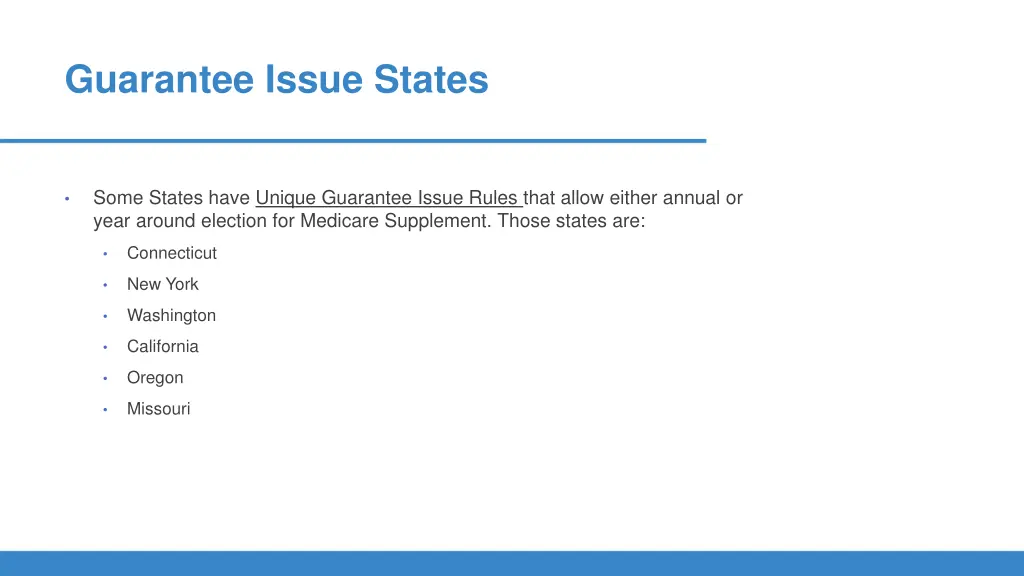
Guarantee Issue States Some States have Unique Guarantee Issue Rules that allow either annual or year around election for Medicare Supplement. Those states are: Connecticut New York Washington California Oregon Missouri
State Guaranteed-Issue Rules When Leaving a Group Sometime, individuals take their Part B while continuing to work. Usually, these are individuals who are part of small employer groups, but not always. Some states have different rules regarding if someone will receive a GI into a Medicare Supplement plan when leaving a group, and what conditions may have to be met. Here are the general guidelines and a chart that explain the rules for various states.
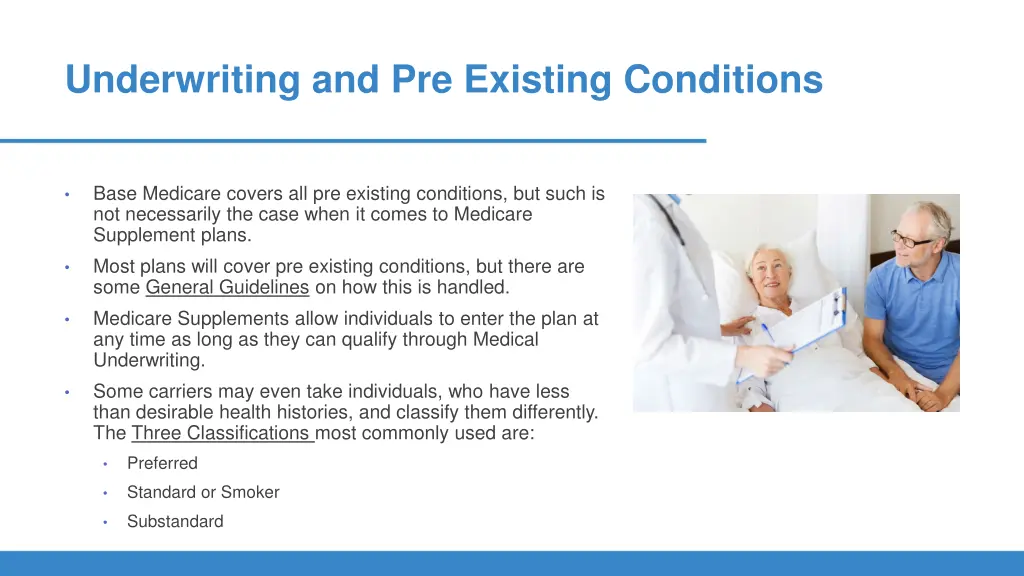
Underwriting and Pre Existing Conditions Base Medicare covers all pre existing conditions, but such is not necessarily the case when it comes to Medicare Supplement plans. Most plans will cover pre existing conditions, but there are some General Guidelines on how this is handled. Medicare Supplements allow individuals to enter the plan at any time as long as they can qualify through Medical Underwriting. Some carriers may even take individuals, who have less than desirable health histories, and classify them differently. The Three Classifications most commonly used are: Preferred Standard or Smoker Substandard
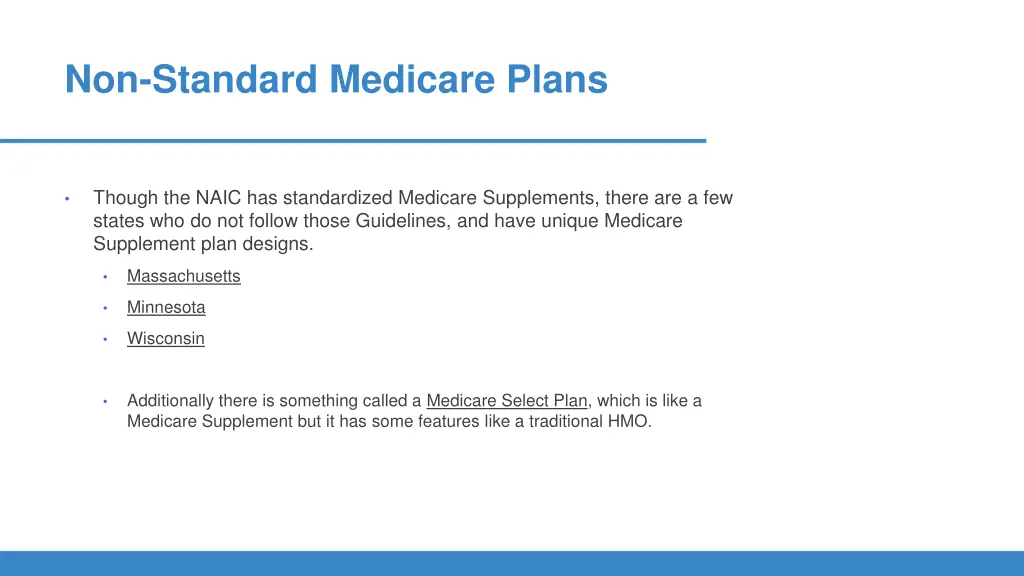
Non-Standard Medicare Plans Though the NAIC has standardized Medicare Supplements, there are a few states who do not follow those Guidelines, and have unique Medicare Supplement plan designs. Massachusetts Minnesota Wisconsin Additionally there is something called a Medicare Select Plan, which is like a Medicare Supplement but it has some features like a traditional HMO.
Medicare Supplement Pricing States help determine how a Medicare Supplement is priced (rated), what demographic factors a carrier can used to determine those rates, and who pays. There are Three Categories: Community Rate Issue-Age Rate Attained-Aged Rated