Unraveling Information Literacy: Combatting Fake News Through Critical Thinking
Enhance information literacy with lesson plans on identifying fake news, understanding cognitive biases, and evaluating sources. Explore scenarios and learn habits for effective fact-checking in various disciplines. Dive into the world of questionable sources to empower critical thinking skills.

Download Presentation

Please find below an Image/Link to download the presentation.
The content on the website is provided AS IS for your information and personal use only. It may not be sold, licensed, or shared on other websites without obtaining consent from the author. If you encounter any issues during the download, it is possible that the publisher has removed the file from their server.
You are allowed to download the files provided on this website for personal or commercial use, subject to the condition that they are used lawfully. All files are the property of their respective owners.
The content on the website is provided AS IS for your information and personal use only. It may not be sold, licensed, or shared on other websites without obtaining consent from the author.
E N D
Presentation Transcript
Questionable Sources? Helping Writing Center Tutees with Information Literacy Teaching About Fake News: Lesson Plans for Different Disciplines and Audiences
Workshop Plan True or False? Thinking about Thinking Two Habits of Highly Successful Tutors Scenarios Search the ACRL Sandbox for more lessons with #fakenews
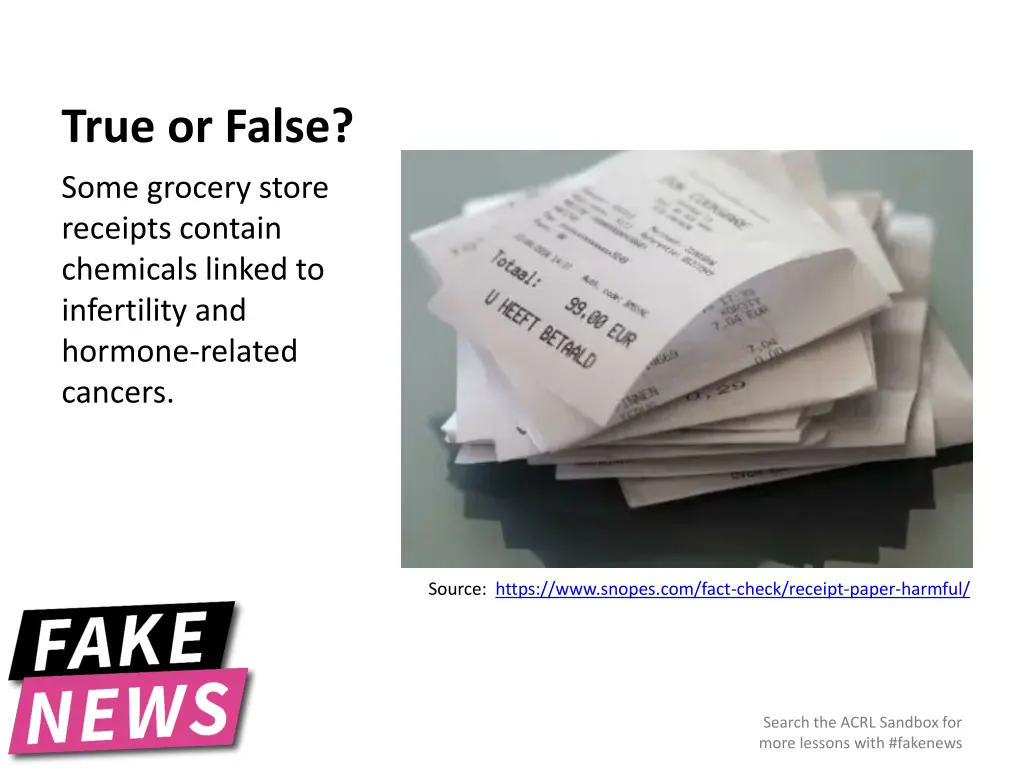
True or False? Some grocery store receipts contain chemicals linked to infertility and hormone-related cancers. Source: https://www.snopes.com/fact-check/receipt-paper-harmful/ Search the ACRL Sandbox for more lessons with #fakenews
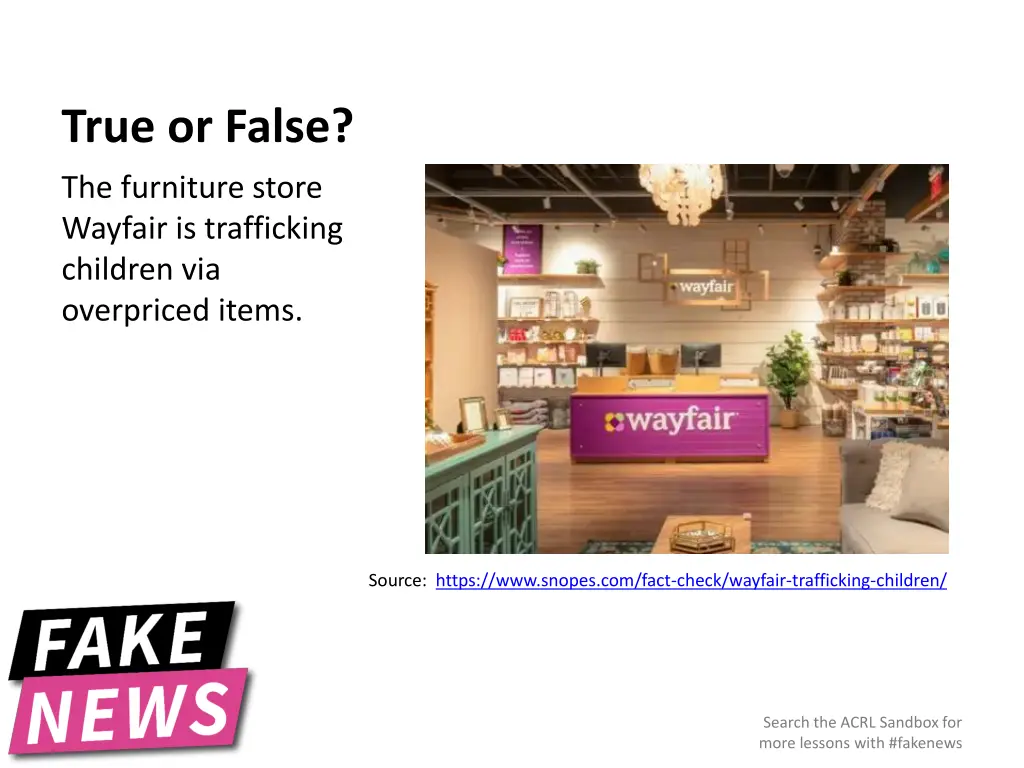
True or False? The furniture store Wayfair is trafficking children via overpriced items. Source: https://www.snopes.com/fact-check/wayfair-trafficking-children/ Search the ACRL Sandbox for more lessons with #fakenews
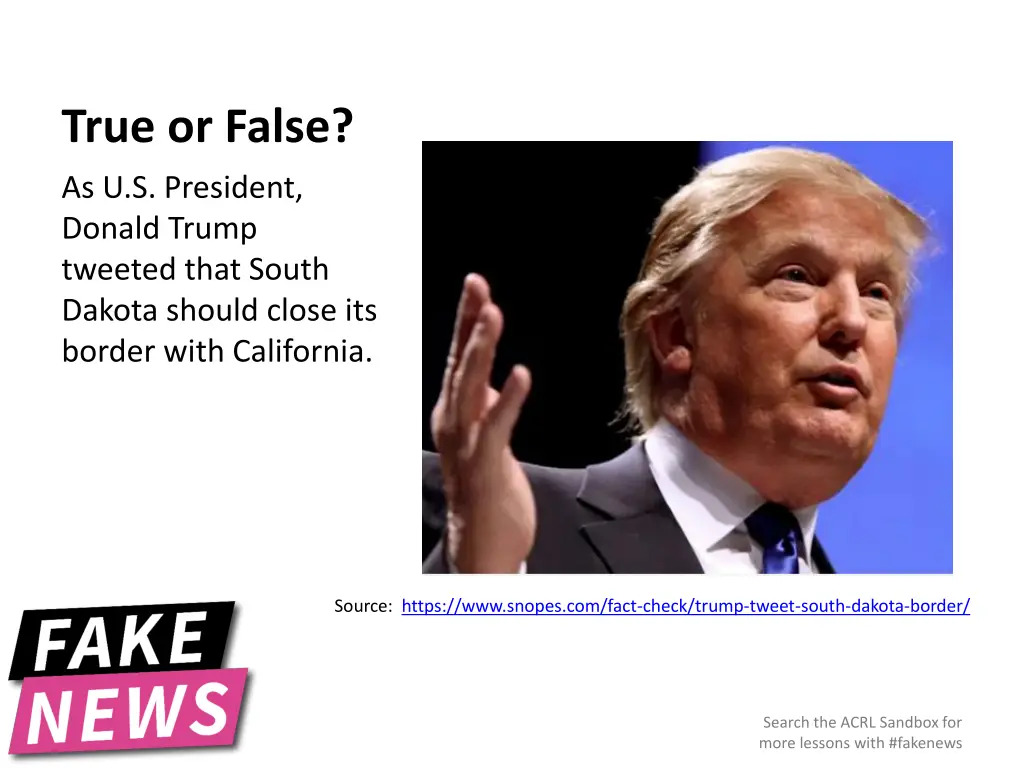
True or False? As U.S. President, Donald Trump tweeted that South Dakota should close its border with California. Source: https://www.snopes.com/fact-check/trump-tweet-south-dakota-border/ Search the ACRL Sandbox for more lessons with #fakenews
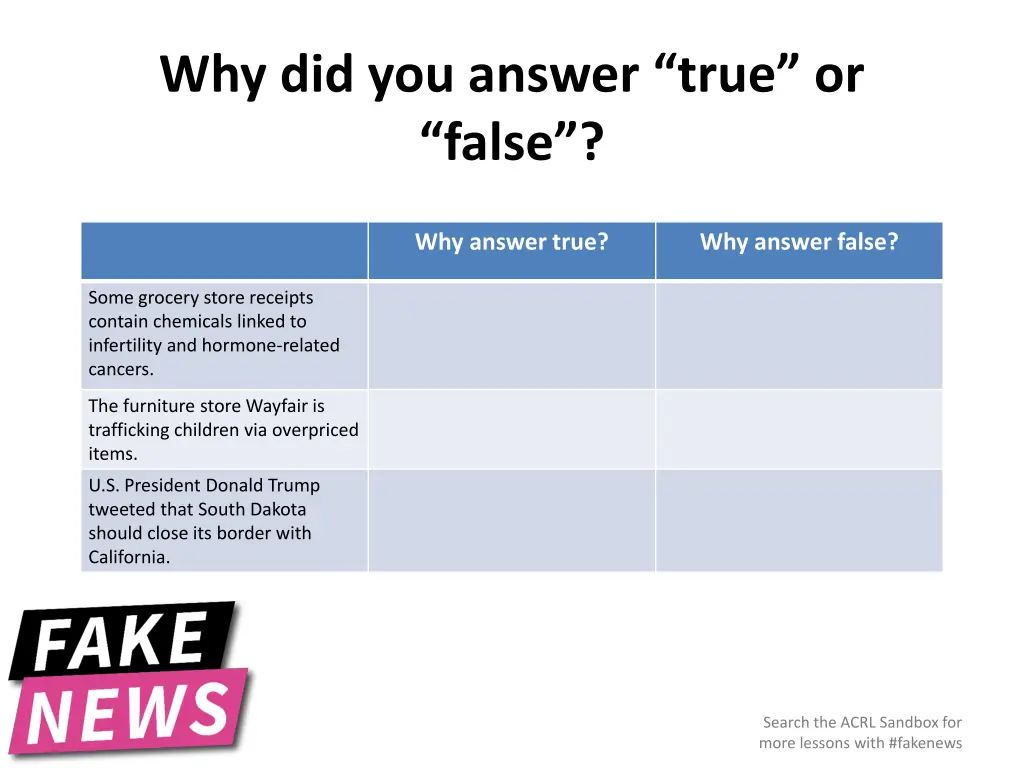
Why did you answer true or false ? Why answer true? Why answer false? Some grocery store receipts contain chemicals linked to infertility and hormone-related cancers. The furniture store Wayfair is trafficking children via overpriced items. U.S. President Donald Trump tweeted that South Dakota should close its border with California. Search the ACRL Sandbox for more lessons with #fakenews
Human Brains Like to Take Shortcuts Also known as cognitive biases, these shortcuts are errors in thinking that affect how we process and interpret information. Search the ACRL Sandbox for more lessons with #fakenews
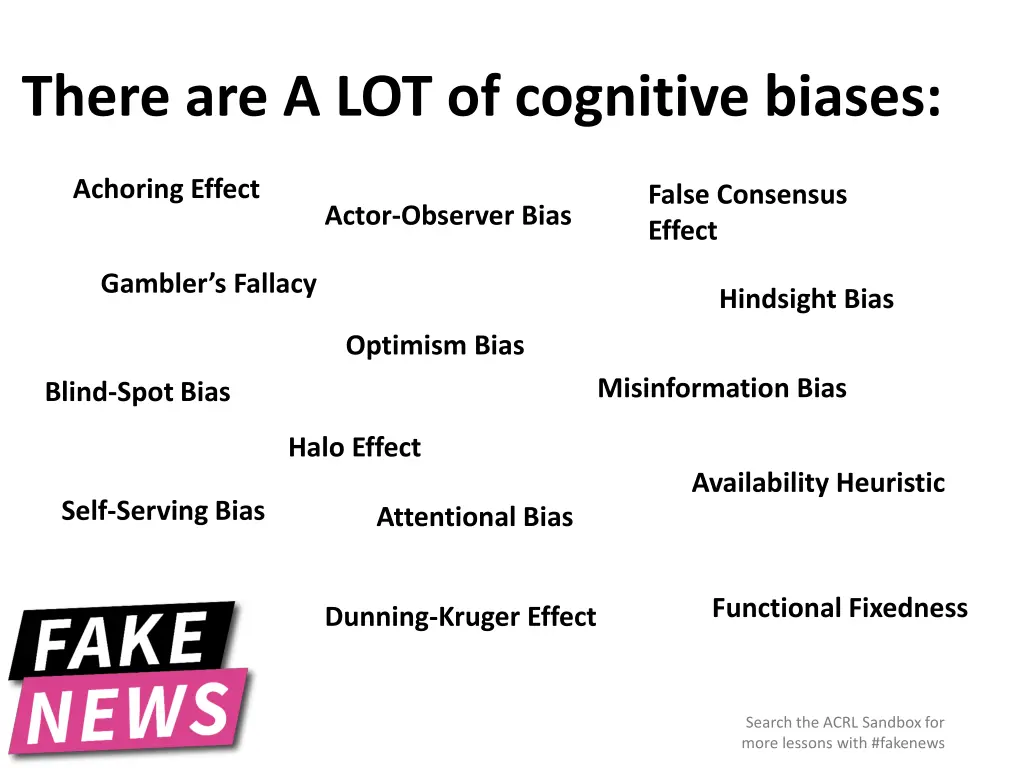
There are A LOT of cognitive biases: Achoring Effect False Consensus Effect Actor-Observer Bias Gambler s Fallacy Hindsight Bias Optimism Bias Misinformation Bias Blind-Spot Bias Halo Effect Availability Heuristic Self-Serving Bias Attentional Bias Functional Fixedness Dunning-Kruger Effect Search the ACRL Sandbox for more lessons with #fakenews
Confirmation Bias the human tendency to seek, interpret, and remember information that confirms your own preexisting beliefs. Eyal, Nir. Confirmation Bias: Why You Make Terrible Life Choices. Psychology Today, October 17, 2017. Search the ACRL Sandbox for more lessons with #fakenews
Motivated Reasoning An unconscious tendency to evaluate information based on a desired goal or outcome. Biased Information Search Biased Assimilation Identity-Protective Cognition Kahan, Dan. "What is Motivated Reasoning? How Does It Work? Dan Kahan Answers." The Intersection, May 5, 2011. Search the ACRL Sandbox for more lessons with #fakenews
Cognitive Dissonance An intense feeling of stress or anxiety that emerges from the part of the brain that controls feelings of physical pain. Eyal, Nir. Confirmation Bias: Why You Make Terrible Life Choices. Psychology Today, October 17, 2017. Search the ACRL Sandbox for more lessons with #fakenews
You CAN counteract cognitive bias! Approach life with curiosity, not conviction. Seek and understand disagreement. Think about thinking. Eyal, Nir. Confirmation Bias: Why You Make Terrible Life Choices. Psychology Today, October 17, 2017. Search the ACRL Sandbox for more lessons with #fakenews
Two Habits of Highly Successful Tutors Critical Empathy Critical empathy means to engage with others reflectively and judiciously, while understanding that their ideas and beliefs should be treated with wisdom and care. Collaborative Fact-Engagement Because consultations prioritize cooperation and proceeding on a fact-finding mission together, the anxiety about whether a student s research is wrong can be alleviated more easily through peer-to-peer rapport-building. Source: McKeehen, Shannon. 2017. "Critical Empathy and Collaborative Fact-Engagement in the Trump Age: A Writing Center Approach." The Peer Review 1 (2). Search the ACRL Sandbox for more lessons with #fakenews
Tutoring to Counteract Cognitive Bias Reconsider the assignment Identify information needs Question assumptions Collaborate on a fact-finding mission Engage in discourse analysis Reconstruct the search Introduce naysayers Search the ACRL Sandbox for more lessons with #fakenews
Reconsider the Assignment When you encounter the use of problematic source material, one potentially effective strategy is to draw the student s attention back to the assignment. Has the instructor provided guidance about the use of sources? This form of collaborative fact engagement guides the student to be more attentive to assignment parameters, and opens an opportunity for the tutor to help the student learn how to find appropriate sources. Search the ACRL Sandbox for more lessons with #fakenews
Identify Information Needs A student s information needs will vary depending on the assignment or project. Try using a focused freewriting exercise to help students identify both what they already know about a topic and what questions still need to be answered. The conversation following this exercise could be used to refine the questions that guide the research and identify potential search terms. Search the ACRL Sandbox for more lessons with #fakenews
Question Assumptions If a student assumes something to be true, they may think of it as common knowledge without need for scrutiny or attribution. In a one-on-one writing center session, you can ask questions that help the student identify the original source of the information, evaluate that source, and then seek out corroborating evidence. Conversations about the assumptions implicit in an argument can also help students develop audience awareness and refine their claims. Search the ACRL Sandbox for more lessons with #fakenews
Collaborate on a Fact-Finding Mission Try asking questions about a student s information sources, initiating a conversation about accuracy, reliability, and trustworthiness. Other strategies: Author searches: together, search for information about the author of a source to understand the nature of the author s expertise and reveal potential biases. Engage in the four moves described in Web Literacy for Student Fact Checkers to evaluate the authority and reliability of web sources: check for previous work, go upstream, read laterally, and circle back. Introduce students to fact-checking sites such as PolitiFact, FactCheck.org, FAIR (Fairness & Accuracy in Reporting), OpenSecrets.org (from the Center for Responsible Politics), and Snopes.com. Search the ACRL Sandbox for more lessons with #fakenews
Engage in Discourse Analysis To help a student understand the stance of a particular source, collaborate on a close reading to reveal potential bias. McKeehen argues that a lot can be uncovered when a tutor helps a student deconstruct a single paragraph of a source; its ideology will become transparent upon analysis. Source: McKeehen, Shannon. 2017. "Critical Empathy and Collaborative Fact-Engagement in the Trump Age: A Writing Center Approach." The Peer Review 1 (2). Search the ACRL Sandbox for more lessons with #fakenews
Reconstruct the Search Ask questions about the student s search process, and then collaborate to recreate and evolve the search. By starting with the tutee s original search terms and then asking questions to elicit other ideas and possibilities, you can help the student practice refining terms and locating alternative repositories of information (for example, moving from a simple Google search to one that includes library databases). Search the ACRL Sandbox for more lessons with #fakenews
Introduce Naysayers When a student s evidence appears to be inaccurate or improbable, you can suggest planting a naysayer into the text. This principle of argumentation also known as counterargument requires students to anticipate objections, present objections fairly, and then respond with concessions or a rebuttal. Students may need to research objections in order to represent them fairly and answer them persuasively. Search the ACRL Sandbox for more lessons with #fakenews
Practice: Tutoring Scenarios What do you know about this writer and this writing situation? What is the writer s primary concern? What is your (the tutor s) primary concern? What questions would you ask to better understand this writing situation? Is this writer using motivated reasoning or confirmation bias? How can you tell? What tutoring strategies would you use to help this writer? Search the ACRL Sandbox for more lessons with #fakenews
Student #1 You received a low grade on your first paper in your political science class. When you met with your professor about it, she said that you relied too heavily on evidence from one unreliable source. You find this response confusing, because the source is a lecturer at a university, has a Ph.D., and writes a blog that often appears on your social media feed. You learned in high school that academic degrees were evidence of reliability, and the blog posts make a lot of sense to you, even though they sometimes seem overly political. Your professor says that you can revise your paper. You ve come to the writing center feeling frustrated and confused about what to do next. Search the ACRL Sandbox for more lessons with #fakenews
Student #2 In your first-year composition course, your instructor asked you to select a controversial issue currently in the news, then write a paper in which you take a position on the issue and support it with evidence. You ve decided to focus on the gun control debate. You did a quick online search and found a website for an organization that promotes Second Amendment rights. This site contains information and statistics that support your position that new gun laws aren t needed. It even has links to other websites and articles that further reinforce this stance. You feel you have enough information to write the paper, but you re a little unsure about how to cite your sources. You ve come to the writing center to learn how. Search the ACRL Sandbox for more lessons with #fakenews
Student #3 When the instructor in your research ethics class gave you freedom to choose the topic on your final paper, you knew exactly what you were going to write about: lab animals. Ever since you first learned about the use of animals in research studies, you been 100% against it. In fact, the issue of animal rights has become an important part of your identity since you started college. You ve become a vegan, and you ve joined your campus chapter of PETA (People for the Ethical Treatment of Animals) where you ve made a lot of friends. You care about this topic, and you want to do a good job on this paper. You ve collected tons of evidence that proves why it s such a bad idea to do research experiments on animals, and you ve come to the writing center to figure out the best way to organize your ideas. Search the ACRL Sandbox for more lessons with #fakenews
Student #4 For your final group project in your public health course, you have to design a public service campaign that will make an impact on the health of children. Your group has decided to focus on childhood vaccinations. You have mixed feelings about this topic, for personal reasons. When your brother was a toddler, he was diagnosed with a chronic condition that your parents are convinced was caused by vaccines. You feel it s important that your project represent the perspectives of families who are resistant to childhood vaccinations, but whenever you bring up this issue your classmates make jokes about anti-vaxxers. You ve come to the writing center hoping to find a way to incorporate alternative views, even though you know the campaign is supposed to convince parents to have their children vaccinated. Search the ACRL Sandbox for more lessons with #fakenews
Student #5 For your media studies course, you have to give a final presentation that uses evidence to explain why the media is sometimes called the fourth branch of government and to make an argument about this idea. You didn t think this would be a hard assignment, and you ve been really busy with other classes, so you waited until the last minute to do your research. You ve decided to argue that the media is failing its role of holding the other three branches of government accountable. You did a Google search for failing media and found a few strongly worded opinion pieces. You ve brought these in to the writing center to see how to work them into your presentation. Search the ACRL Sandbox for more lessons with #fakenews
Student #6 You are writing a paper on the health benefits of vegetarianism for your nutrition science course. In one section of the paper, you ve decided to focus on the unhealthy use of animal proteins in fast food restaurants. One of your sources is Fast Food Nation by Eric Schlosser, a source you know is reliable since your professor assigned it. You support this section with additional information about how fast food chains like Chipotle and Wendy s sometimes use dog, cat, horse, and rat meat in their products. You re feeling good about the strength of your argument, and you ve come to the writing center to check on grammar and readability. Search the ACRL Sandbox for more lessons with #fakenews
Student #7 For your developmental psychology course, you are creating a brochure designed to inform parents about sex differences and sex- role development in children. Your instructor explained that the brochure should be informed by psychological research but written so that a general audience can easily understand it. You ve found pertinent information on two websites: the American Academy of Pediatrics (aap.org) and American College of Pediatricians (acpeds.org). You re having trouble deciding which information to include, and you ve come to the writing center for help with focusing and organizing your ideas. Search the ACRL Sandbox for more lessons with #fakenews
Takeaways? What one thing do you most want to remember from today s workshop? Search the ACRL Sandbox for more lessons with #fakenews