Discover the intricate dynamics of planetary motion in our solar system and beyond. From the influence of gravity to the rules of orbital mechanics, delve into the continuous dance of planets as they journey through space. Explore the races around the sun of inner planets and the steady orbits of outer giants. Gain insights into exoplanetary motion and the impact of planetary motion on Earth's climate and life. Join us on a cosmic symphony of celestial movements.
Please find below an Image/Link to download the presentation.
The content on the website is provided AS IS for your information and personal use only. It may not be sold, licensed, or shared on other websites without obtaining consent from the author. If you encounter any issues during the download, it is possible that the publisher has removed the file from their server.
You are allowed to download the files provided on this website for personal or commercial use, subject to the condition that they are used lawfully. All files are the property of their respective owners.
The content on the website is provided AS IS for your information and personal use only. It may not be sold, licensed, or shared on other websites without obtaining consent from the author.
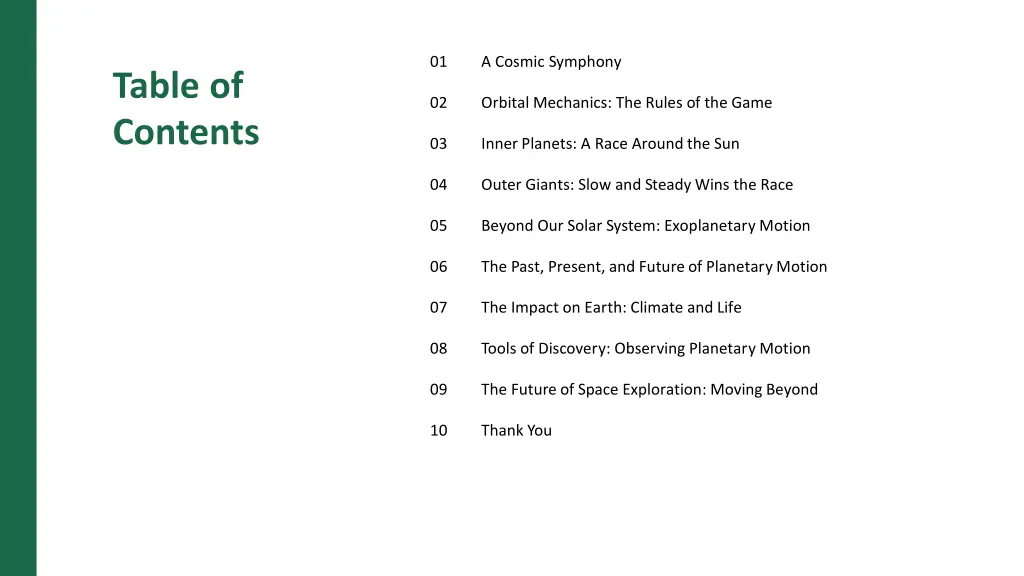
01 A Cosmic Symphony Table of Contents 02 Orbital Mechanics: The Rules of the Game 03 Inner Planets: A Race Around the Sun 04 Outer Giants: Slow and Steady Wins the Race 05 Beyond Our Solar System: Exoplanetary Motion 06 The Past, Present, and Future of Planetary Motion 07 The Impact on Earth: Climate and Life 08 Tools of Discovery: Observing Planetary Motion 09 The Future of Space Exploration: Moving Beyond 10 Thank You
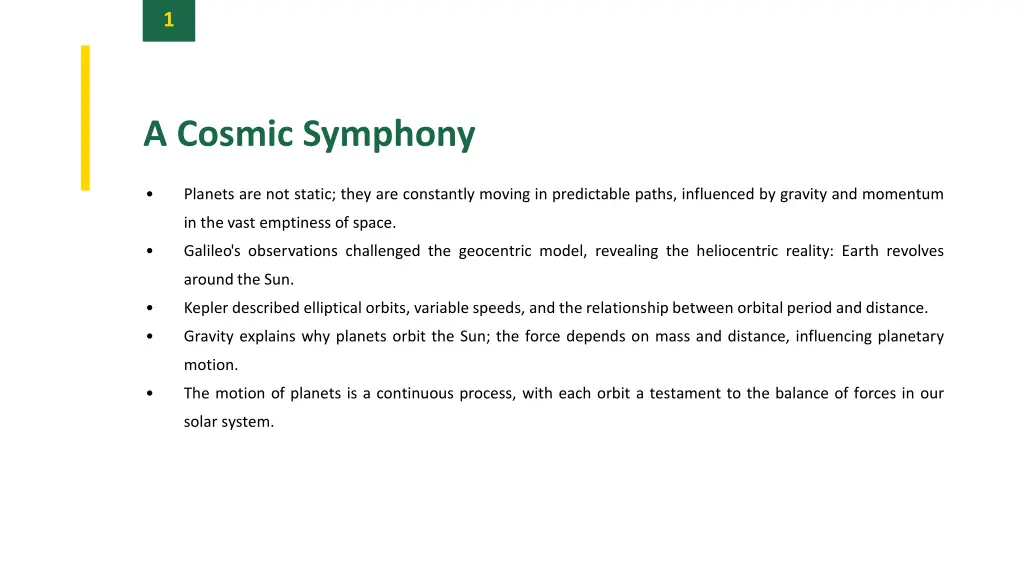
1 A Cosmic Symphony Planets are not static; they are constantly moving in predictable paths, influenced by gravity and momentum in the vast emptiness of space. Galileo's observations challenged the geocentric model, revealing the heliocentric reality: Earth revolves aroundthe Sun. Kepler described elliptical orbits, variable speeds, and the relationshipbetween orbital period and distance. Gravity explains why planets orbit the Sun; the force depends on mass and distance, influencing planetary motion. The motion of planets is a continuous process, with each orbit a testament to the balance of forces in our solar system.
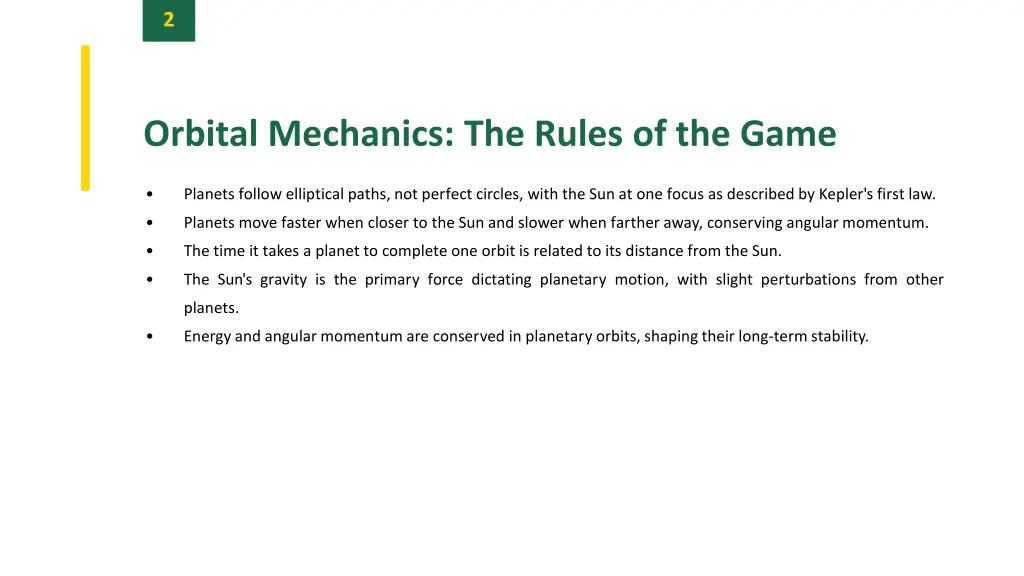
2 Orbital Mechanics: The Rules of the Game Planets follow elliptical paths, not perfect circles, with the Sun at one focus as described by Kepler's first law. Planets move faster when closer to the Sun and slower when farther away, conserving angular momentum. The time it takes a planet to complete one orbit is related to its distance from the Sun. The Sun's gravity is the primary force dictating planetary motion, with slight perturbations from other planets. Energy and angular momentum are conserved in planetary orbits, shaping their long-term stability.
3 Inner Planets: A Race Around the Sun The closest planet to the Sun, it has the shortest orbital period, zippingaround in only 88 Earth days. Venus rotates backwards compared to most other planets, a peculiar characteristic influenced by past collisions. Our planet's yearly journey aroundthe Sun dictates seasons and climate patterns. Mars's orbit is more elliptical than Earth's, leading to greater variations in solar radiation throughoutits year. The inner planets are constantly influenced by each other's gravity, altering their orbits slightly.
4 Outer Giants: Slow and Steady Wins the Race Jupiter's immense gravity affects the orbits of smaller bodies in the solar system, acting as a protector. The rings of Saturnshowcase orbital mechanics, with countless particles orbiting according to Kepler's laws. Uranus spins on its side, an extreme axial tilt likely caused by a major collision early in its history. Neptune takes 165 Earth years to orbit the Sun, a testament to its vast distance. The outer planets' gravity affects each other, resulting in orbital resonances and long-term changes.
5 Beyond Our Solar System: Exoplanetary Motion Detecting exoplanets by measuring the wobble of a star caused by the planet's gravity. Observing exoplanets as they pass in frontof their stars, causing a slight dimming of light. Massive exoplanets orbiting very close to their stars, completing orbits in just days. Many exoplanets have highly elliptical orbits, challenging our understanding of planetaryformation. Discovering systems with multiple exoplanets orbitingthe same star, revealing complex orbital interactions.
6 The Past, Present, and Future of Planetary Motion Planetary orbits have changed over billions of years due to gravitational interactions and collisions. Stable orbital configurations where planets exert periodic gravitational influences on each other. Predicting the long-term stability of planetary orbits is a complex challenge. Simulations suggest that, althoughimprobable, planetarycollisions are possible over billions of years. Planetary orbits will continue to evolve due to gravitational interactions and external forces.
7 The Impact on Earth: Climate and Life Earth's axial tilt causes seasons as differenthemispheres receive varying amounts of sunlight. Changes in Earth's orbit affect long-term climate patterns and ice ages. Earth's rotationcreates day and night, regulating our biological rhythms. Earth's orbit around the Sun defines our year, dictating agricultural cycles and cultural calendars. The Moon's gravity creates tides, influencingcoastal ecosystems and human activities.
8 Tools of Discovery: Observing Planetary Motion Telescopes on Earth and in space allow us to observe planetarymotion with incredible precision. Spacecraft provide close-up views of planets, allowing us to study their movements and characteristics. Radar is used to measure the distance and speed of planets and asteroids. Computer models help us simulate planetary orbits and predict their future behavior. Amateur astronomers contributeto planetary science by tracking and observing celestial objects.
9 The Future of Space Exploration: Moving Beyond Future technologies may allow us to travel to other star systems and study exoplanets up close. Next-generation telescopes will provide even more detailed observations of planetary motion. Understanding planetarymotion is crucial for protecting Earth from asteroid impacts. Establishing a human presence on Mars will require a thoroughunderstanding of planetary motion. Continued exploration will reveal new insights into planetary motion and the formation of our universe.
10 Thank You We appreciate your time and attention during this presentation. We hope this presentation has sparked your curiosity about planetary motion. We encourage you to continue learning about astronomy and space exploration. May the wonders of the universe inspire you to reach for the stars. Thank you once again for being a part of this journey!