User Datagram Protocol in Computer Networking
Discover the fundamentals of User Datagram Protocol (UDP) in computer networking, including its structure, features, applications, and advantages over Transmission Control Protocol (TCP). Learn about UDP's error detection mechanisms, demultiplexing process, packet structure, and more through detailed explanations and visual aids.

Download Presentation

Please find below an Image/Link to download the presentation.
The content on the website is provided AS IS for your information and personal use only. It may not be sold, licensed, or shared on other websites without obtaining consent from the author. If you encounter any issues during the download, it is possible that the publisher has removed the file from their server.
You are allowed to download the files provided on this website for personal or commercial use, subject to the condition that they are used lawfully. All files are the property of their respective owners.
The content on the website is provided AS IS for your information and personal use only. It may not be sold, licensed, or shared on other websites without obtaining consent from the author.
E N D
Presentation Transcript
CS 352 User Datagram Protocol CS 352, Lecture 8.1 http://www.cs.rutgers.edu/~sn624/352 Srinivas Narayana 1
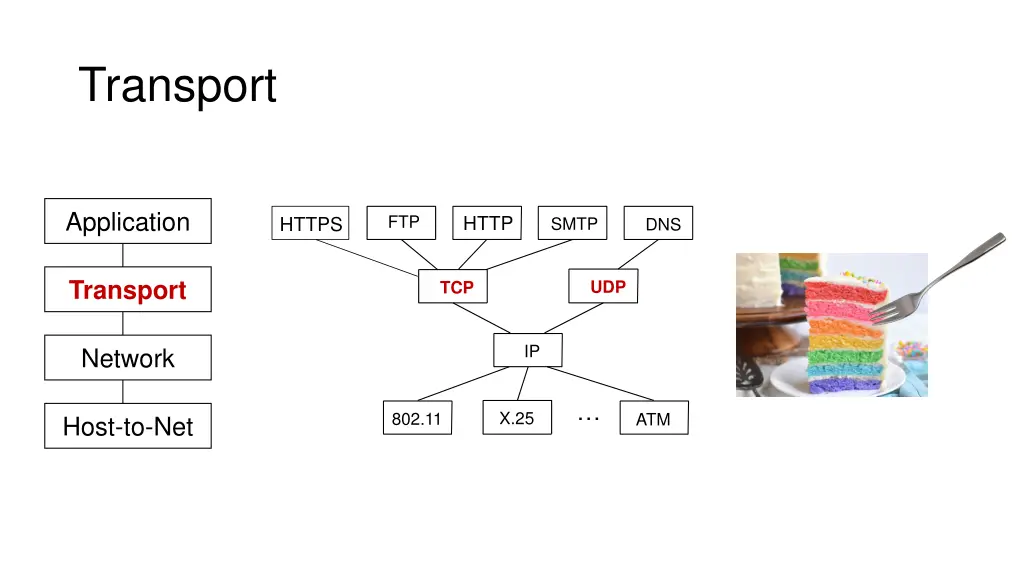
Transport Application FTP HTTP HTTPS SMTP DNS Transport UDP TCP IP Network X.25 802.11 ATM Host-to-Net
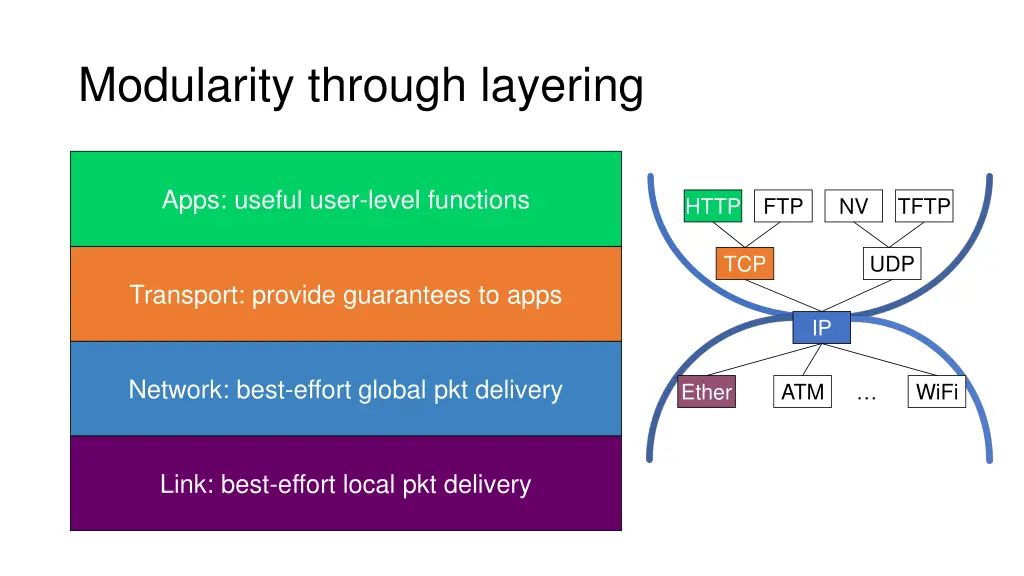
Modularity through layering Apps: useful user-level functions HTTP FTP NV TFTP TCP UDP Transport: provide guarantees to apps IP Network: best-effort global pkt delivery Ether ATM WiFi Link: best-effort local pkt delivery
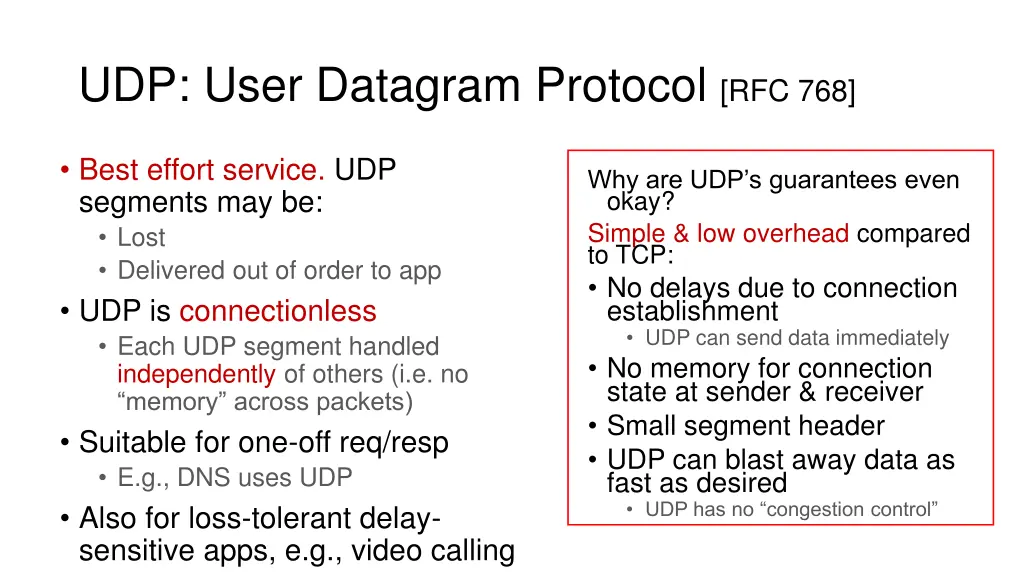
UDP: User Datagram Protocol [RFC 768] Best effort service. UDP segments may be: Lost Delivered out of order to app UDP is connectionless Each UDP segment handled independently of others (i.e. no memory across packets) Suitable for one-off req/resp E.g., DNS uses UDP Also for loss-tolerant delay- sensitive apps, e.g., video calling Why are UDP s guarantees even okay? Simple & low overhead compared to TCP: No delays due to connection establishment UDP can send data immediately No memory for connection state at sender & receiver Small segment header UDP can blast away data as fast as desired UDP has no congestion control
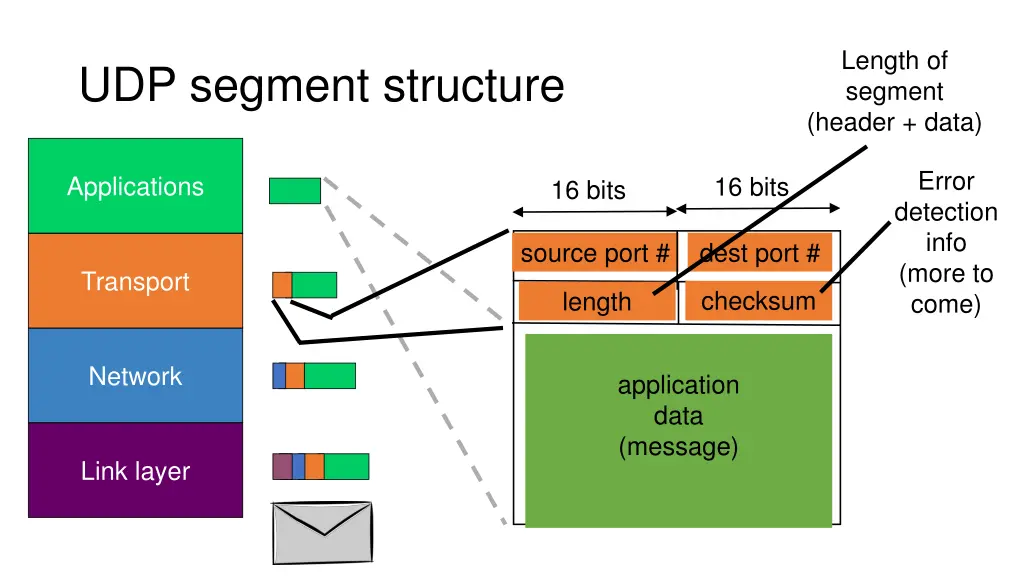
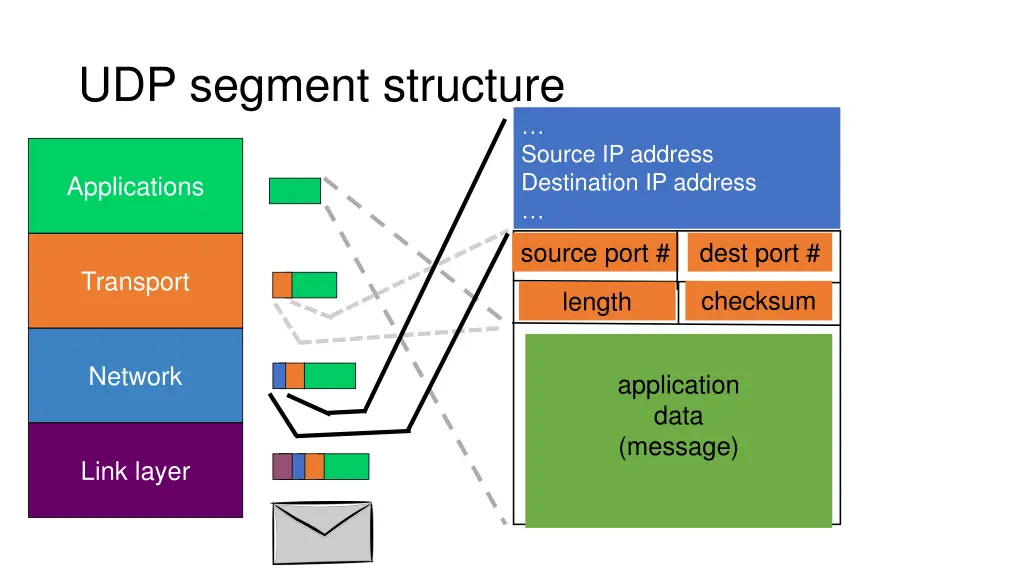
Length of segment (header + data) UDP segment structure Error detection info (more to come) Applications 16 bits 16 bits source port # dest port # Transport checksum length Network application data (message) Link layer
UDP segment structure Source IP address Destination IP address Applications source port # dest port # Transport checksum length Network application data (message) Link layer
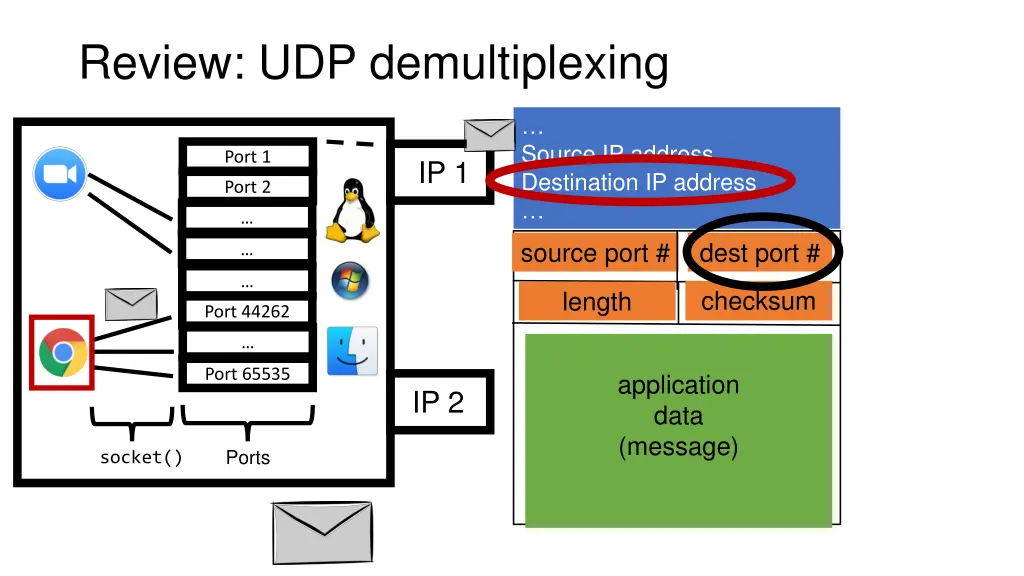
Review: UDP demultiplexing Source IP address Destination IP address Port 1 Machine 1 IP 1 Port 2 source port # dest port # checksum length Machine 1 Port 44262 Port 65535 application data (message) Machine 1 IP 2 Ports socket()
UDP packets A small demo
CS 352 UDP: Error Detection CS 352, Lecture 8.2 http://www.cs.rutgers.edu/~sn624/352 Srinivas Narayana 10
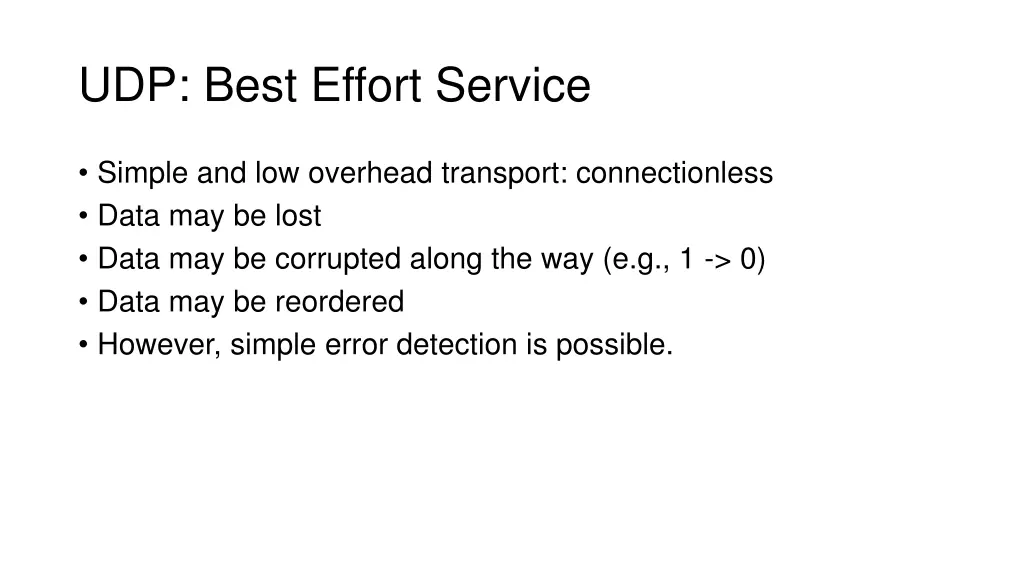
UDP: Best Effort Service Simple and low overhead transport: connectionless Data may be lost Data may be corrupted along the way (e.g., 1 -> 0) Data may be reordered However, simple error detection is possible.
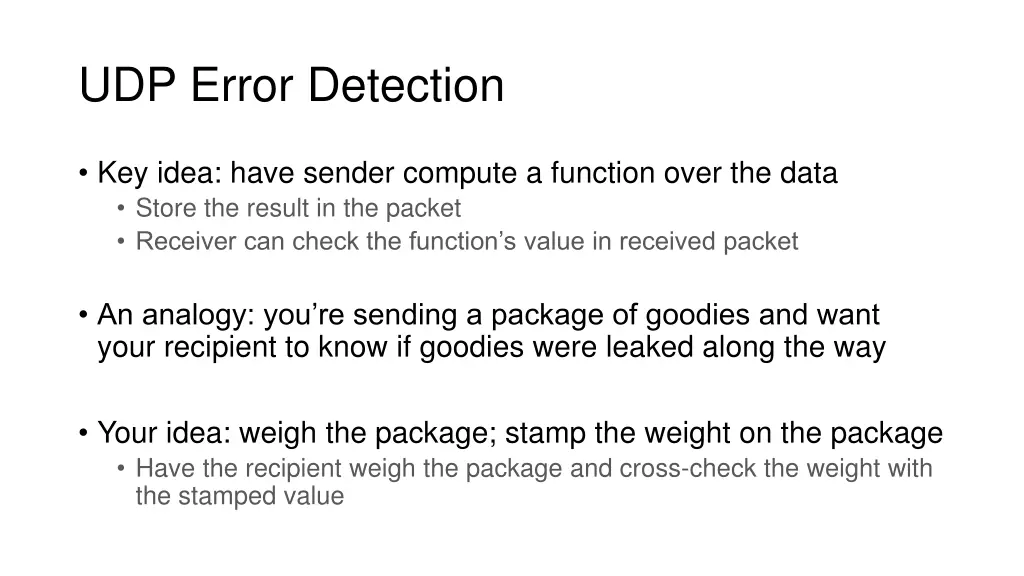
UDP Error Detection Key idea: have sender compute a function over the data Store the result in the packet Receiver can check the function s value in received packet An analogy: you re sending a package of goodies and want your recipient to know if goodies were leaked along the way Your idea: weigh the package; stamp the weight on the package Have the recipient weigh the package and cross-check the weight with the stamped value
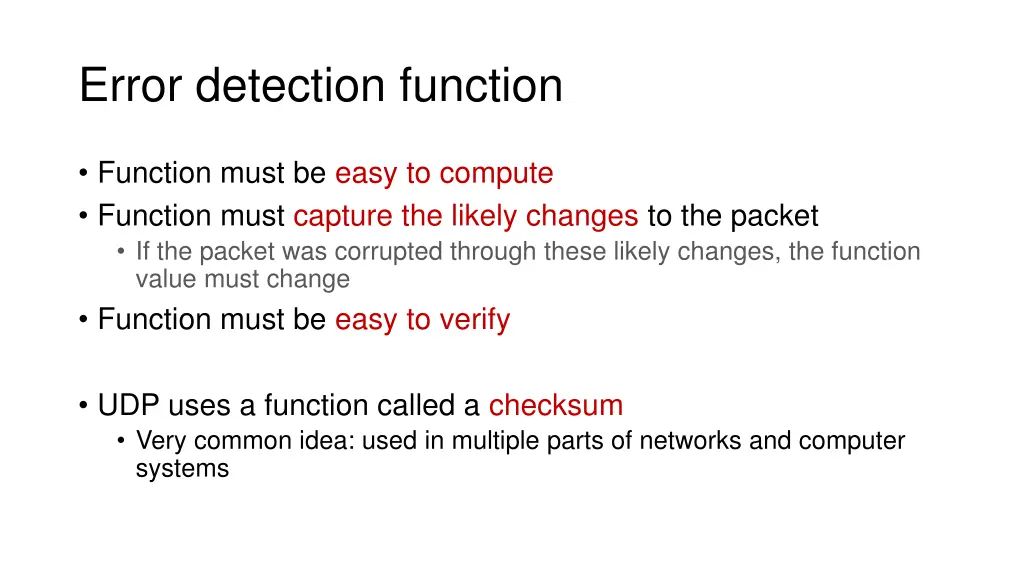
Error detection function Function must be easy to compute Function must capture the likely changes to the packet If the packet was corrupted through these likely changes, the function value must change Function must be easy to verify UDP uses a function called a checksum Very common idea: used in multiple parts of networks and computer systems
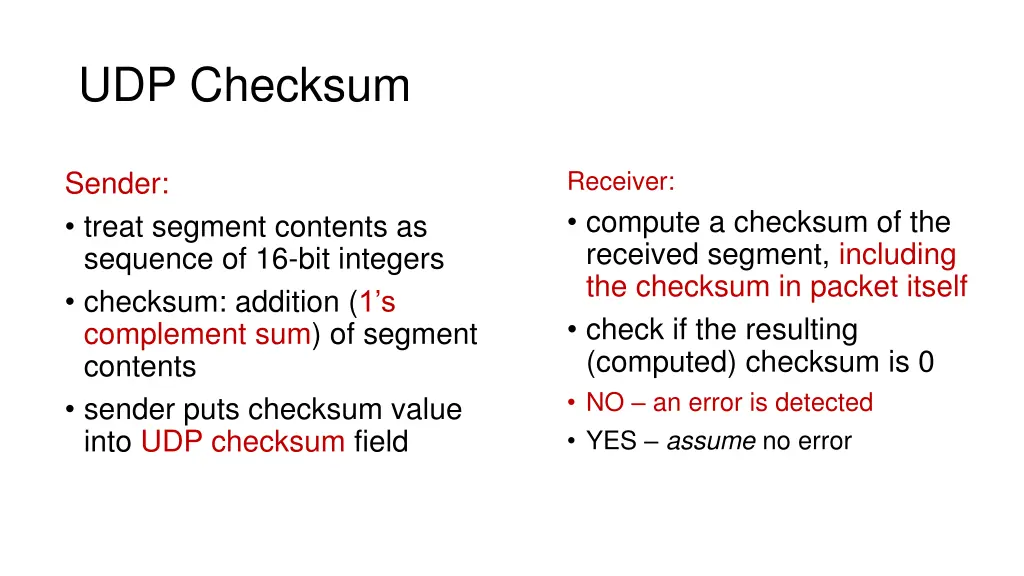
UDP Checksum Sender: treat segment contents as sequence of 16-bit integers checksum: addition (1 s complement sum) of segment contents sender puts checksum value into UDP checksum field Receiver: compute a checksum of the received segment, including the checksum in packet itself check if the resulting (computed) checksum is 0 NO an error is detected YES assume no error
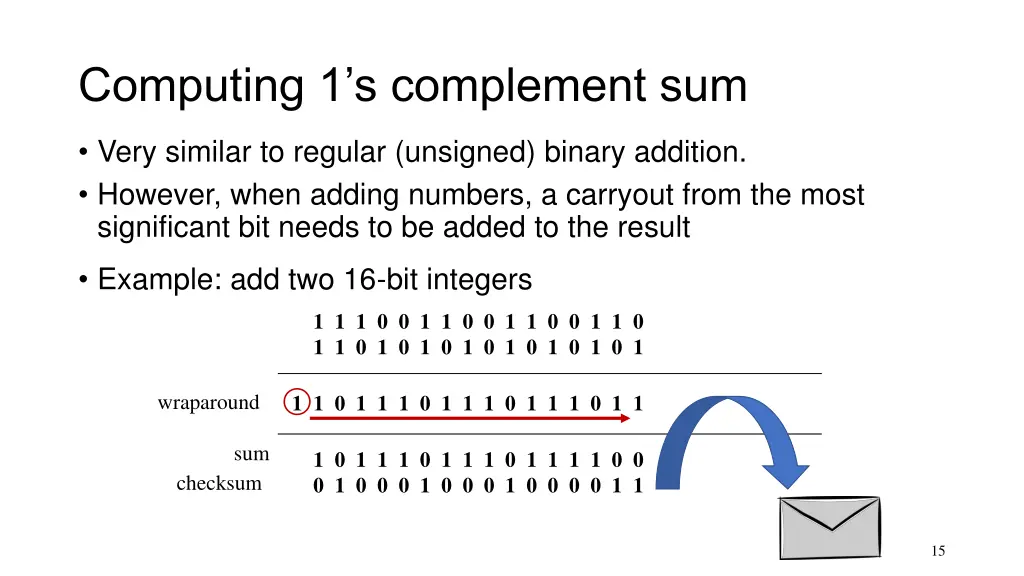
Computing 1s complement sum Very similar to regular (unsigned) binary addition. However, when adding numbers, a carryout from the most significant bit needs to be added to the result Example: add two 16-bit integers 1 1 1 1 0 0 1 1 0 0 1 1 0 0 1 1 0 1 1 1 0 1 0 1 0 1 0 1 0 1 0 1 0 1 wraparound 1 1 0 1 1 1 0 1 1 1 0 1 1 1 0 1 1 sum 1 1 0 1 1 1 0 1 1 1 0 1 1 1 1 0 0 1 0 1 0 0 0 1 0 0 0 1 0 0 0 0 1 1 checksum 15
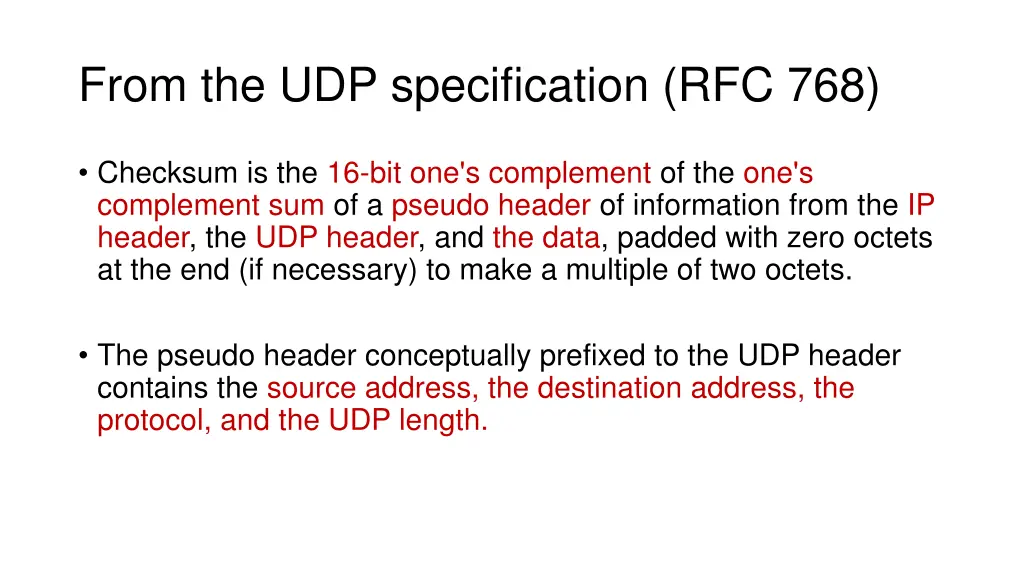
From the UDP specification (RFC 768) Checksum is the 16-bit one's complement of the one's complement sum of a pseudo header of information from the IP header, the UDP header, and the data, padded with zero octets at the end (if necessary) to make a multiple of two octets. The pseudo header conceptually prefixed to the UDP header contains the source address, the destination address, the protocol, and the UDP length.
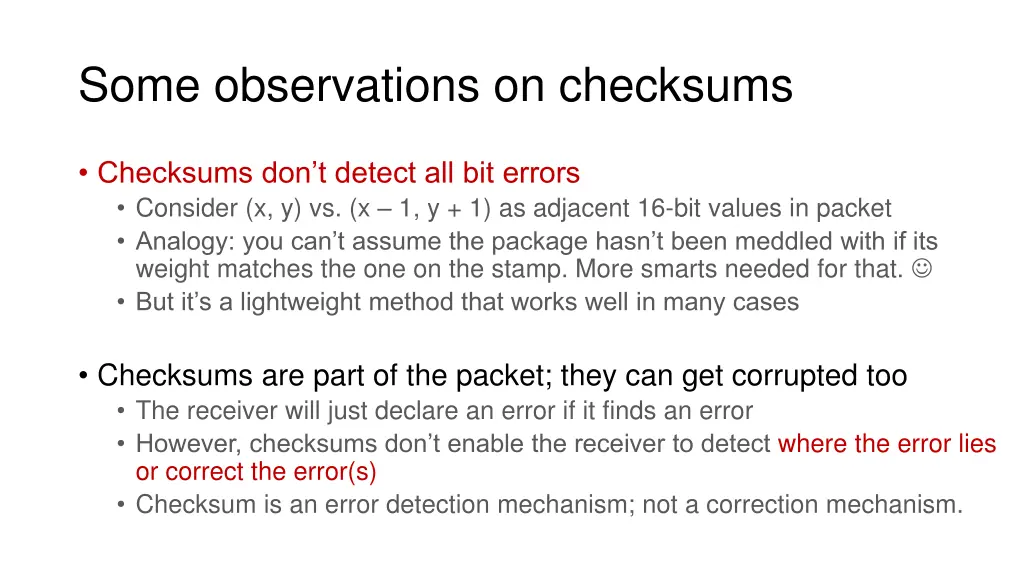
Some observations on checksums Checksums don t detect all bit errors Consider (x, y) vs. (x 1, y + 1) as adjacent 16-bit values in packet Analogy: you can t assume the package hasn t been meddled with if its weight matches the one on the stamp. More smarts needed for that. But it s a lightweight method that works well in many cases Checksums are part of the packet; they can get corrupted too The receiver will just declare an error if it finds an error However, checksums don t enable the receiver to detect where the error lies or correct the error(s) Checksum is an error detection mechanism; not a correction mechanism.
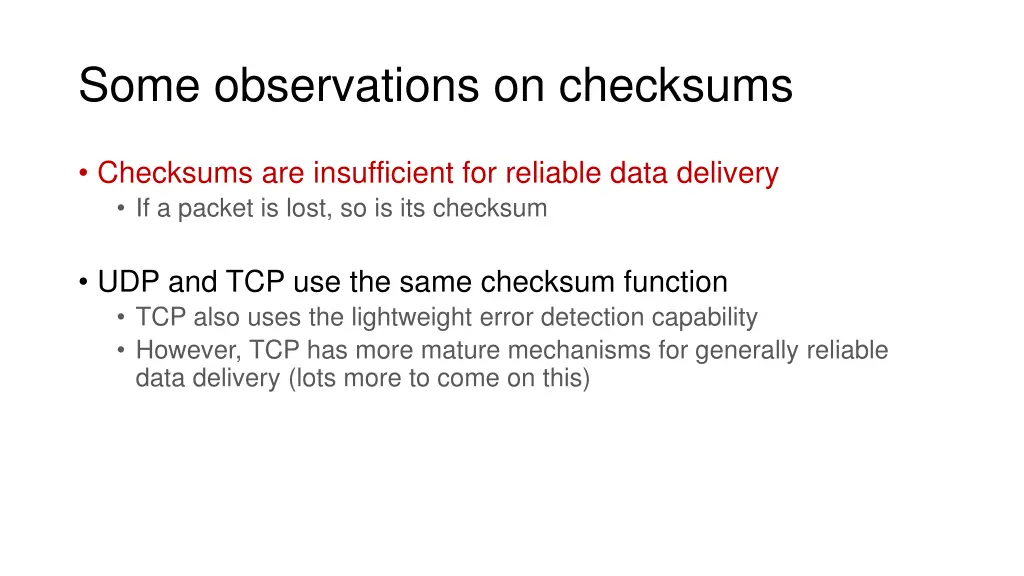
Some observations on checksums Checksums are insufficient for reliable data delivery If a packet is lost, so is its checksum UDP and TCP use the same checksum function TCP also uses the lightweight error detection capability However, TCP has more mature mechanisms for generally reliable data delivery (lots more to come on this)
Playing with checksums A small demo
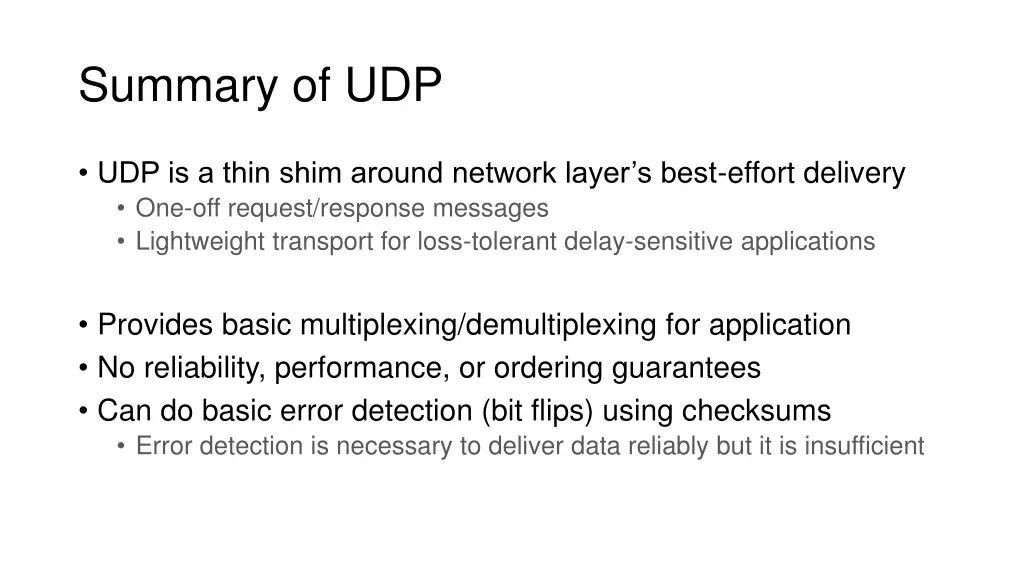
Summary of UDP UDP is a thin shim around network layer s best-effort delivery One-off request/response messages Lightweight transport for loss-tolerant delay-sensitive applications Provides basic multiplexing/demultiplexing for application No reliability, performance, or ordering guarantees Can do basic error detection (bit flips) using checksums Error detection is necessary to deliver data reliably but it is insufficient