"Explore the August 2020 IEEE 802.11-20/0363r3 proposal for efficient utilization of unused bandwidth in wireless communication by allowing transmission on idle channels. Addressing inefficient bandwidth usage issues and proposing solutions for improved access methods in WLAN technology."
Please find below an Image/Link to download the presentation.
The content on the website is provided AS IS for your information and personal use only. It may not be sold, licensed, or shared on other websites without obtaining consent from the author. If you encounter any issues during the download, it is possible that the publisher has removed the file from their server.
You are allowed to download the files provided on this website for personal or commercial use, subject to the condition that they are used lawfully. All files are the property of their respective owners.
The content on the website is provided AS IS for your information and personal use only. It may not be sold, licensed, or shared on other websites without obtaining consent from the author.
E N D
Presentation Transcript
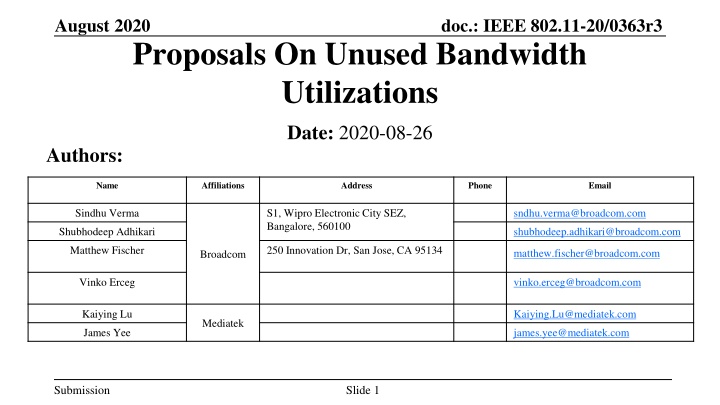
doc.: IEEE 802.11-20/0363r3 August 2020 Proposals On Unused Bandwidth Utilizations Date: 2020-08-26 Authors: Name Affiliations Address Phone Email Sindhu Verma S1, Wipro Electronic City SEZ, Bangalore, 560100 sndhu.verma@broadcom.com Shubhodeep Adhikari shubhodeep.adhikari@broadcom.com Matthew Fischer 250 Innovation Dr, San Jose, CA 95134 matthew.fischer@broadcom.com Broadcom Vinko Erceg vinko.erceg@broadcom.com Kaiying Lu Kaiying.Lu@mediatek.com Mediatek James Yee james.yee@mediatek.com Submission Slide 1
doc.: IEEE 802.11-20/0363r3 August 2020 Abstract A proposal to allow the utilization of some portion of the operating bandwidth when another portion of the operating bandwidth has been detected as BUSY Submission Slide 2
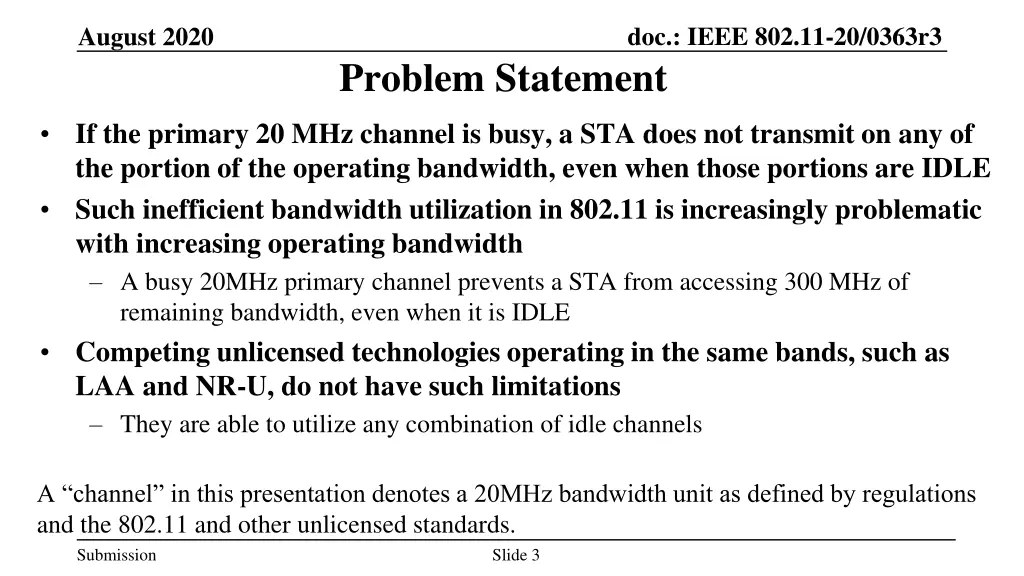
doc.: IEEE 802.11-20/0363r3 August 2020 Problem Statement If the primary 20 MHz channel is busy, a STA does not transmit on any of the portion of the operating bandwidth, even when those portions are IDLE Such inefficient bandwidth utilization in 802.11 is increasingly problematic with increasing operating bandwidth A busy 20MHz primary channel prevents a STA from accessing 300 MHz of remaining bandwidth, even when it is IDLE Competing unlicensed technologies operating in the same bands, such as LAA and NR-U, do not have such limitations They are able to utilize any combination of idle channels A channel in this presentation denotes a 20MHz bandwidth unit as defined by regulations and the 802.11 and other unlicensed standards. Slide 3 Submission
doc.: IEEE 802.11-20/0363r3 August 2020 Solution The problem of inefficient bandwidth usage can be alleviated by allowing a STA to transmit on any subset of channels that are a part of its operating bandwidth if they are idle And other qualifying conditions are met Submission Slide 4
doc.: IEEE 802.11-20/0363r3 August 2020 TXOP Initiation While competing for access, an AP or non-AP STA finds the primary 20 MHz channel is BUSY MyBSS or OBSS transmission Proposal: While the primary is BUSY, the STA performs CCA on other channels in its operating bandwidth and transmits on the channels where CCA completes successfully Submission Slide 5
doc.: IEEE 802.11-20/0363r3 August 2020 Considerations For Access Method The access method which allows the use of unutilized portions of the operating bandwidth needs to: Ensure fairness to other devices attempting to use the channels E.g. randomized access process Adhere to regulatory rules Submission Slide 6
doc.: IEEE 802.11-20/0363r3 August 2020 Proposed Access Method for non-Primary Channels (1) Regardless of the reason for the BUSY primary channel: MyBSS, OBSS or unknown, e.g. ED CCA shall be performed on the other channels in the operating bandwidth Option 1: A device starts full CCA on other channels after it determines the primary is busy E.g. suitable for devices which cannot perform full CCA in parallel on multiple channels Such sequential CCA can delay gaining access on the idle non-primary channels Submission Slide 7
doc.: IEEE 802.11-20/0363r3 August 2020 Proposed Access Method for non-Primary Channels (2) Option 2: A device performs full CCA in parallel on multiple channels in its operating bandwidth, including the primary. If the primary is BUSY, CCA continues on other channels This is suitable for devices that can perform full CCA in parallel on multiple channels Reduces the delay in gaining access to non-primary channels Definition of Full CCA ED or ED+PD With EDCA-style truncated exponential backoff NAV Submission Slide 8
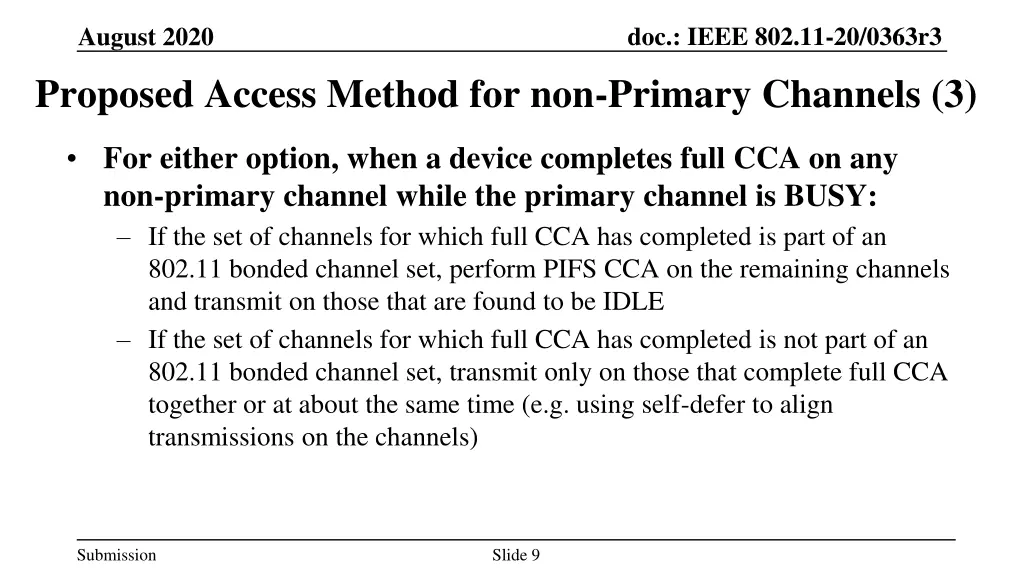
doc.: IEEE 802.11-20/0363r3 August 2020 Proposed Access Method for non-Primary Channels (3) For either option, when a device completes full CCA on any non-primary channel while the primary channel is BUSY: If the set of channels for which full CCA has completed is part of an 802.11 bonded channel set, perform PIFS CCA on the remaining channels and transmit on those that are found to be IDLE If the set of channels for which full CCA has completed is not part of an 802.11 bonded channel set, transmit only on those that complete full CCA together or at about the same time (e.g. using self-defer to align transmissions on the channels) Submission Slide 9
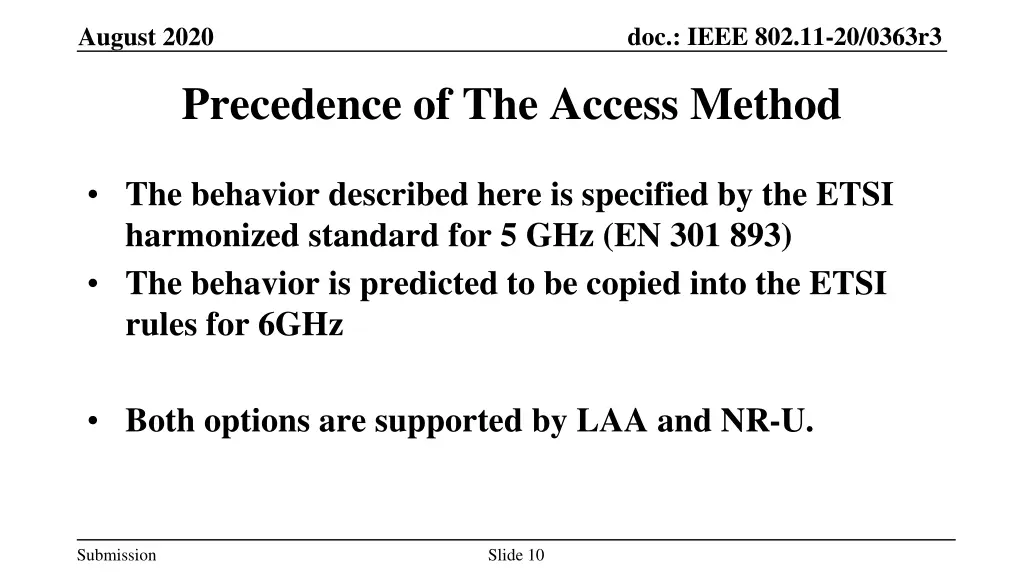
doc.: IEEE 802.11-20/0363r3 August 2020 Precedence of The Access Method The behavior described here is specified by the ETSI harmonized standard for 5 GHz (EN 301 893) The behavior is predicted to be copied into the ETSI rules for 6GHz Both options are supported by LAA and NR-U. Submission Slide 10
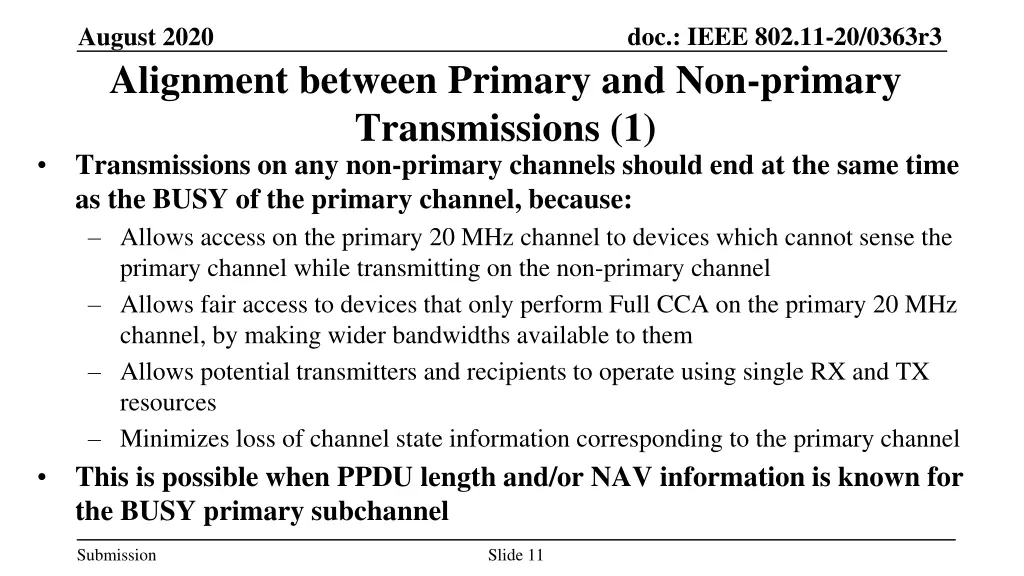
doc.: IEEE 802.11-20/0363r3 August 2020 Alignment between Primary and Non-primary Transmissions (1) Transmissions on any non-primary channels should end at the same time as the BUSY of the primary channel, because: Allows access on the primary 20 MHz channel to devices which cannot sense the primary channel while transmitting on the non-primary channel Allows fair access to devices that only perform Full CCA on the primary 20 MHz channel, by making wider bandwidths available to them Allows potential transmitters and recipients to operate using single RX and TX resources Minimizes loss of channel state information corresponding to the primary channel This is possible when PPDU length and/or NAV information is known for the BUSY primary subchannel Submission Slide 11
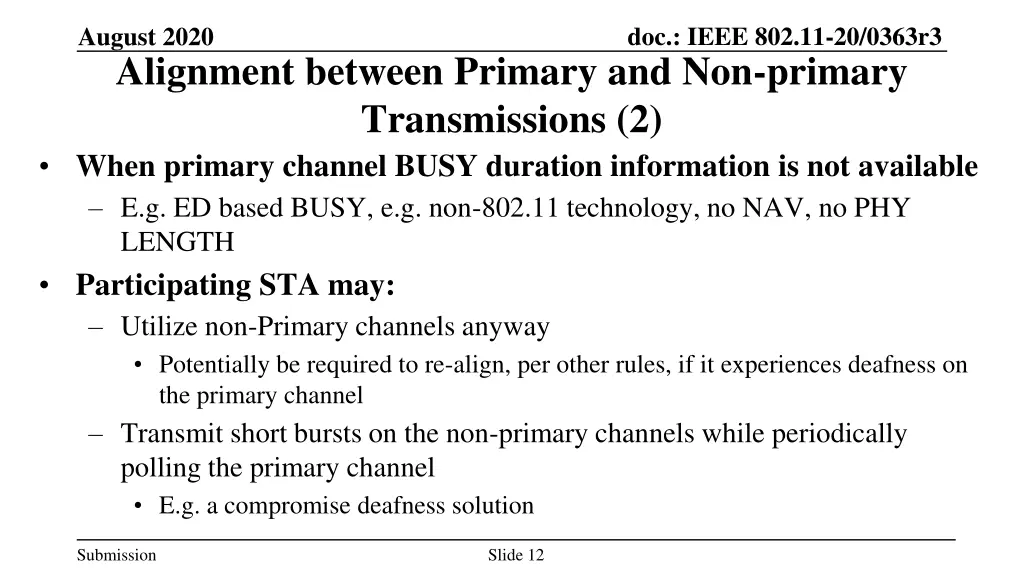
doc.: IEEE 802.11-20/0363r3 August 2020 Alignment between Primary and Non-primary Transmissions (2) When primary channel BUSY duration information is not available E.g. ED based BUSY, e.g. non-802.11 technology, no NAV, no PHY LENGTH Participating STA may: Utilize non-Primary channels anyway Potentially be required to re-align, per other rules, if it experiences deafness on the primary channel Transmit short bursts on the non-primary channels while periodically polling the primary channel E.g. a compromise deafness solution Submission Slide 12
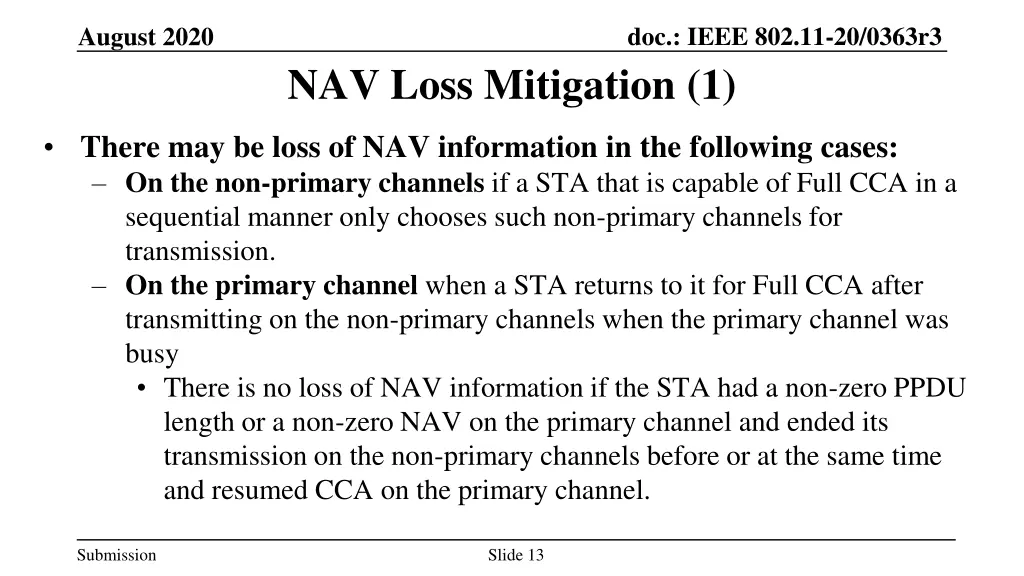
doc.: IEEE 802.11-20/0363r3 August 2020 NAV Loss Mitigation (1) There may be loss of NAV information in the following cases: On the non-primary channels if a STA that is capable of Full CCA in a sequential manner only chooses such non-primary channels for transmission. On the primary channel when a STA returns to it for Full CCA after transmitting on the non-primary channels when the primary channel was busy There is no loss of NAV information if the STA had a non-zero PPDU length or a non-zero NAV on the primary channel and ended its transmission on the non-primary channels before or at the same time and resumed CCA on the primary channel. Submission Slide 13
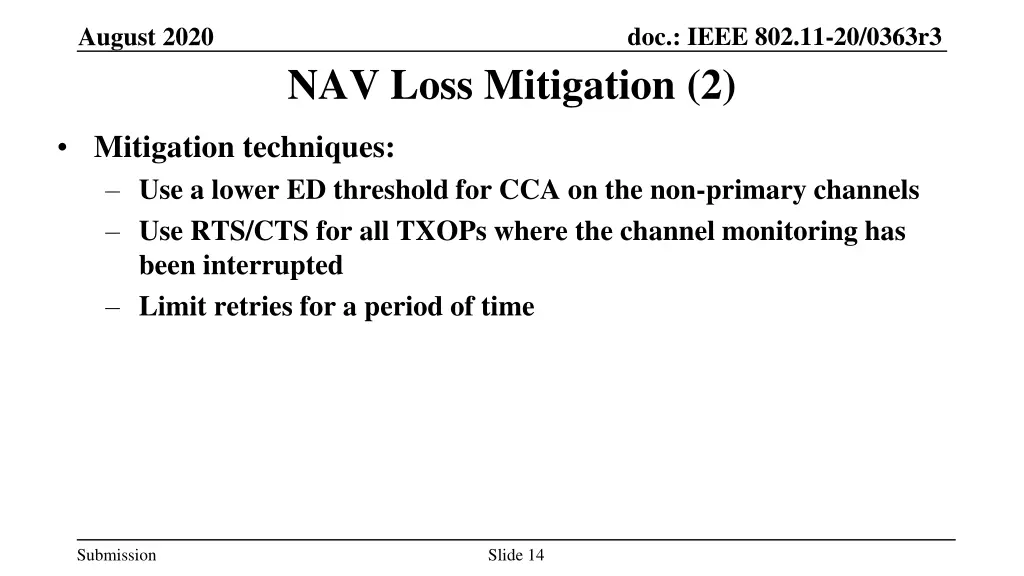
doc.: IEEE 802.11-20/0363r3 August 2020 NAV Loss Mitigation (2) Mitigation techniques: Use a lower ED threshold for CCA on the non-primary channels Use RTS/CTS for all TXOPs where the channel monitoring has been interrupted Limit retries for a period of time Submission Slide 14
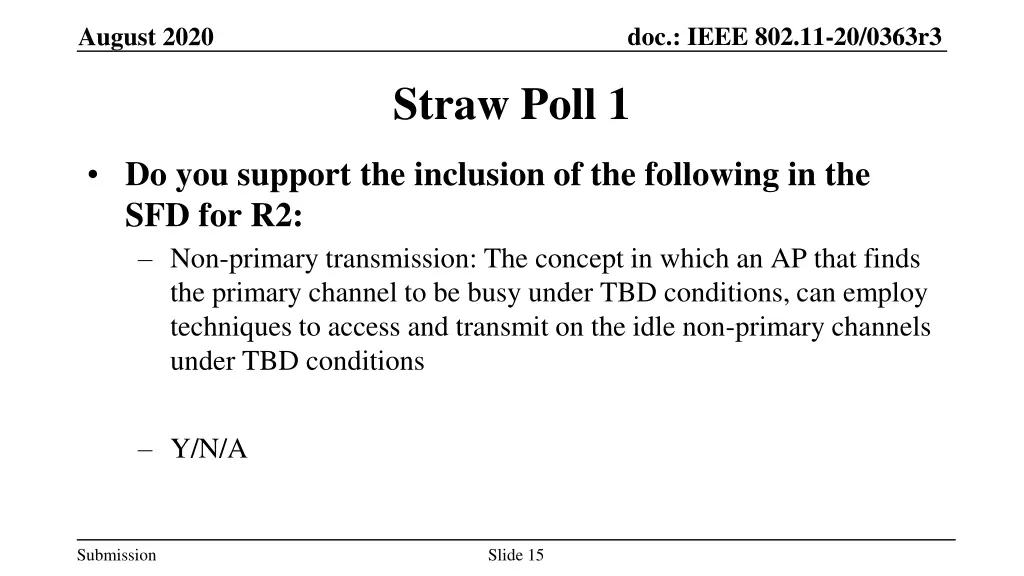
doc.: IEEE 802.11-20/0363r3 August 2020 Straw Poll 1 Do you support the inclusion of the following in the SFD for R2: Non-primary transmission: The concept in which an AP that finds the primary channel to be busy under TBD conditions, can employ techniques to access and transmit on the idle non-primary channels under TBD conditions Y/N/A Submission Slide 15
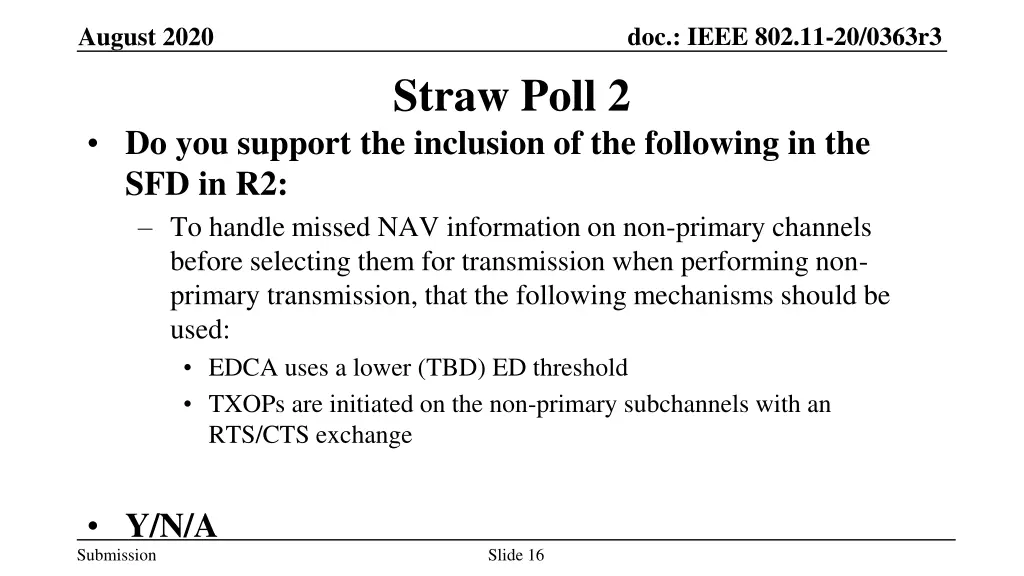
doc.: IEEE 802.11-20/0363r3 August 2020 Straw Poll 2 Do you support the inclusion of the following in the SFD in R2: To handle missed NAV information on non-primary channels before selecting them for transmission when performing non- primary transmission, that the following mechanisms should be used: EDCA uses a lower (TBD) ED threshold TXOPs are initiated on the non-primary subchannels with an RTS/CTS exchange Y/N/A Submission Slide 16
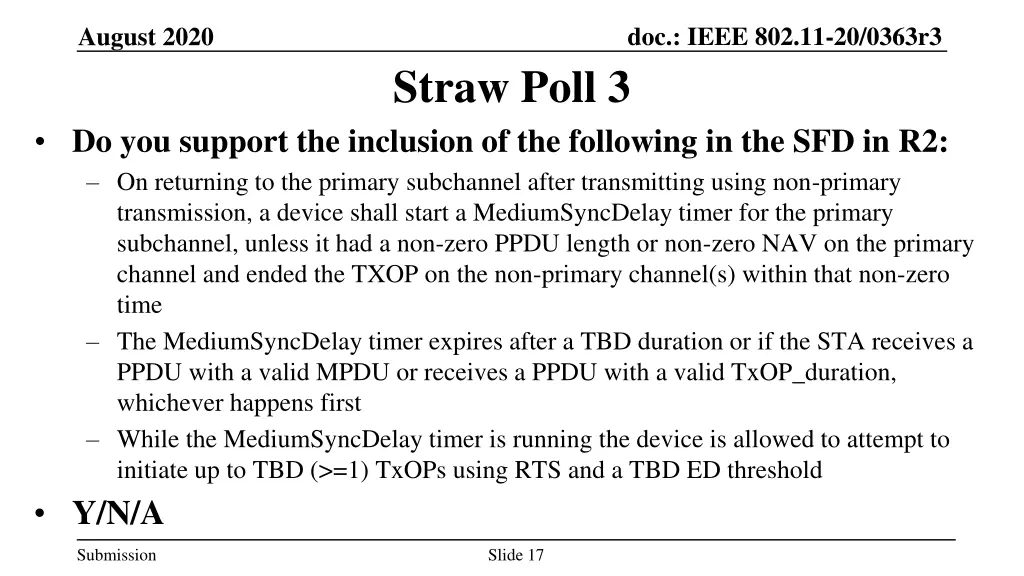
doc.: IEEE 802.11-20/0363r3 August 2020 Straw Poll 3 Do you support the inclusion of the following in the SFD in R2: On returning to the primary subchannel after transmitting using non-primary transmission, a device shall start a MediumSyncDelay timer for the primary subchannel, unless it had a non-zero PPDU length or non-zero NAV on the primary channel and ended the TXOP on the non-primary channel(s) within that non-zero time The MediumSyncDelay timer expires after a TBD duration or if the STA receives a PPDU with a valid MPDU or receives a PPDU with a valid TxOP_duration, whichever happens first While the MediumSyncDelay timer is running the device is allowed to attempt to initiate up to TBD (>=1) TxOPs using RTS and a TBD ED threshold Y/N/A Submission Slide 17