Valuation Reports Peer Review Process
Enhance the credibility of valuation firms through peer reviews to improve service quality by adopting best practices. Learn about the scope of work for reviewers and document retention requirements, ensuring compliance with regulations and standards.

Download Presentation

Please find below an Image/Link to download the presentation.
The content on the website is provided AS IS for your information and personal use only. It may not be sold, licensed, or shared on other websites without obtaining consent from the author. If you encounter any issues during the download, it is possible that the publisher has removed the file from their server.
You are allowed to download the files provided on this website for personal or commercial use, subject to the condition that they are used lawfully. All files are the property of their respective owners.
The content on the website is provided AS IS for your information and personal use only. It may not be sold, licensed, or shared on other websites without obtaining consent from the author.
E N D
Presentation Transcript
BangaloreValuers Association Reports through Reviewers Lens Based on PEER REVIEW of RV reports Sumit Dhadda
Purpose of Peer Review to improve quality of service rendered by Firms by way of enhancing credibility, transparency and adopting best practices and imparting knowledge and skills. peer review identifies the areas where a RV/Firm may require guidance in improving the quality of his performance and adherence to various requirements as per applicable technical Standards
REVIEWER SCOPE of WORK To give opinion on the quality of the Valuation Report under review basis the Key Aspects to be reviewed To review compliance with the i) Rule 8 of the Companies (Registered Valuer and Valuation) Rules, 2017 ii) Specific Rules, Regulations and Guidelines issued by related Regulators Not to give opinion on the Conclusion of Value To maintain confidentiality
Document retention 8 year as per ICAI Valuation Standards 2018 "Validity of Report is 3 years from the date of Report", as this provision is the requirement to maintain records for 3 years and not validity of Report or validity of valuation.
For issue of shares to NRI: What practice you follow: (a) Separate report on RV & CA letterhead (b) One report with common letterhead
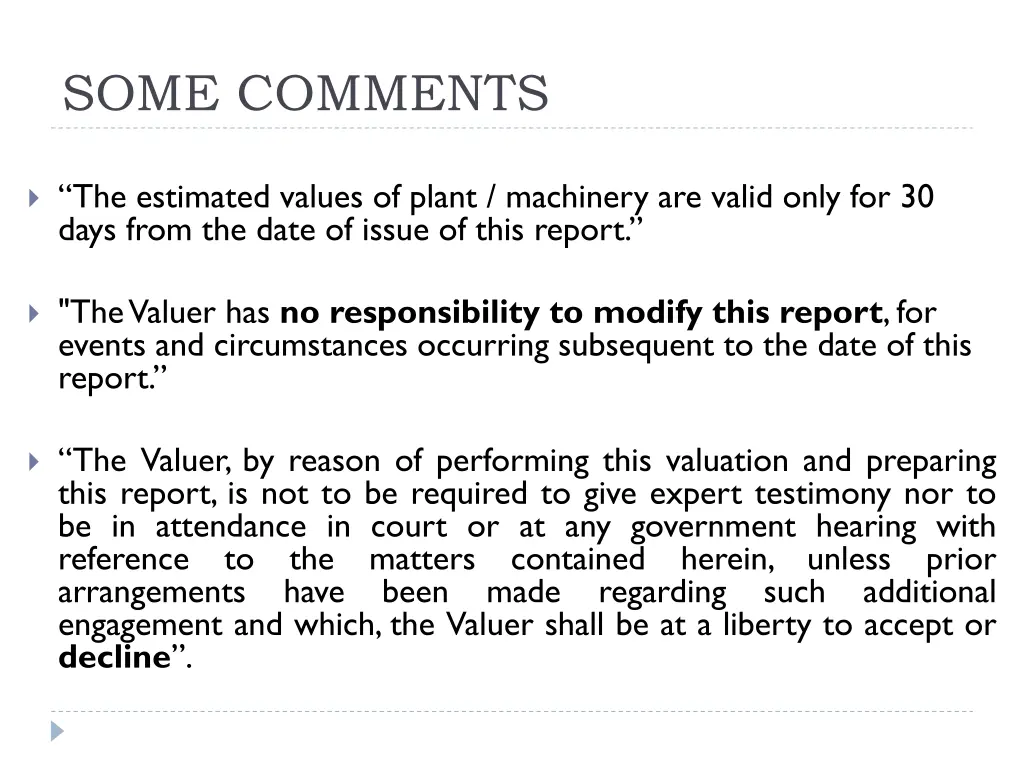
SOME COMMENTS The estimated values of plant / machinery are valid only for 30 days from the date of issue of this report. "The Valuer has no responsibility to modify this report, for events and circumstances occurring subsequent to the date of this report. The Valuer, by reason of performing this valuation and preparing this report, is not to be required to give expert testimony nor to be in attendance in court or at any government hearing with reference to the matters contained herein, unless prior arrangements have been made regarding such additional engagement and which, the Valuer shall be at a liberty to accept or decline .
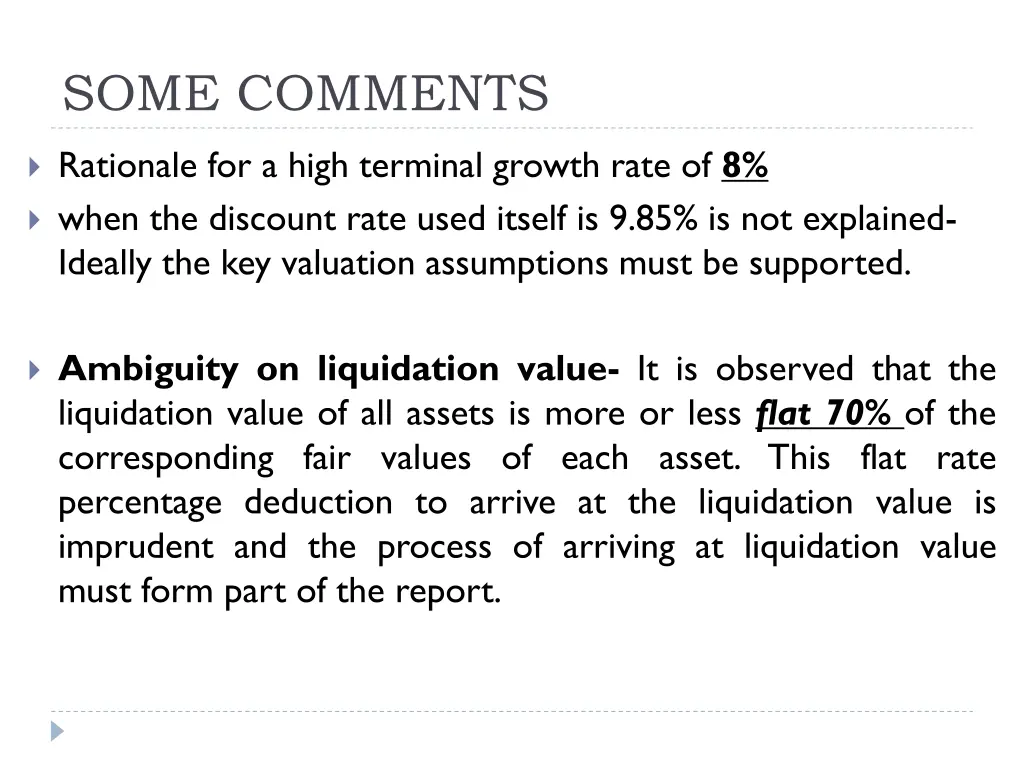
SOME COMMENTS Rationale for a high terminal growth rate of 8% when the discount rate used itself is 9.85% is not explained- Ideally the key valuation assumptions must be supported. Ambiguity on liquidation value- It is observed that the liquidation value of all assets is more or less flat 70% of the corresponding fair values of each asset. This flat rate percentage deduction to arrive at the liquidation value is imprudent and the process of arriving at liquidation value must form part of the report.
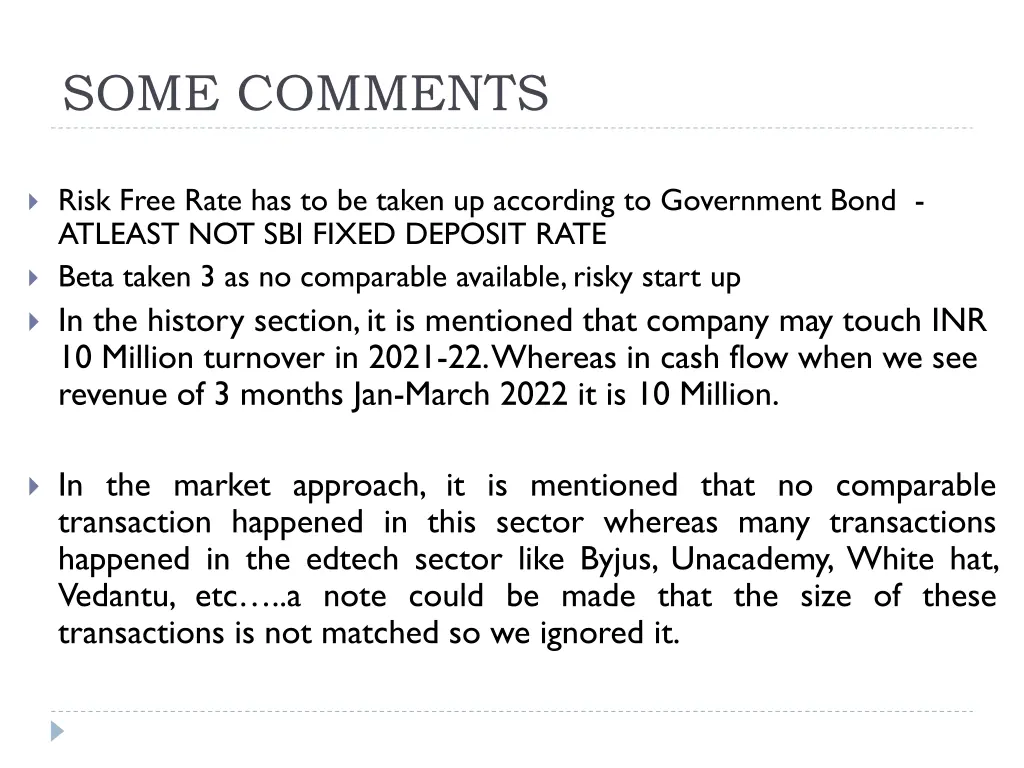
SOME COMMENTS Risk Free Rate has to be taken up according to Government Bond - ATLEAST NOT SBI FIXED DEPOSIT RATE Beta taken 3 as no comparable available, risky start up In the history section, it is mentioned that company may touch INR 10 Million turnover in 2021-22. Whereas in cash flow when we see revenue of 3 months Jan-March 2022 it is 10 Million. In the market approach, it is mentioned that no comparable transaction happened in this sector whereas many transactions happened in the edtech sector like Byjus, Unacademy, White hat, Vedantu, etc ..a note could be made that the size of these transactions is not matched so we ignored it.
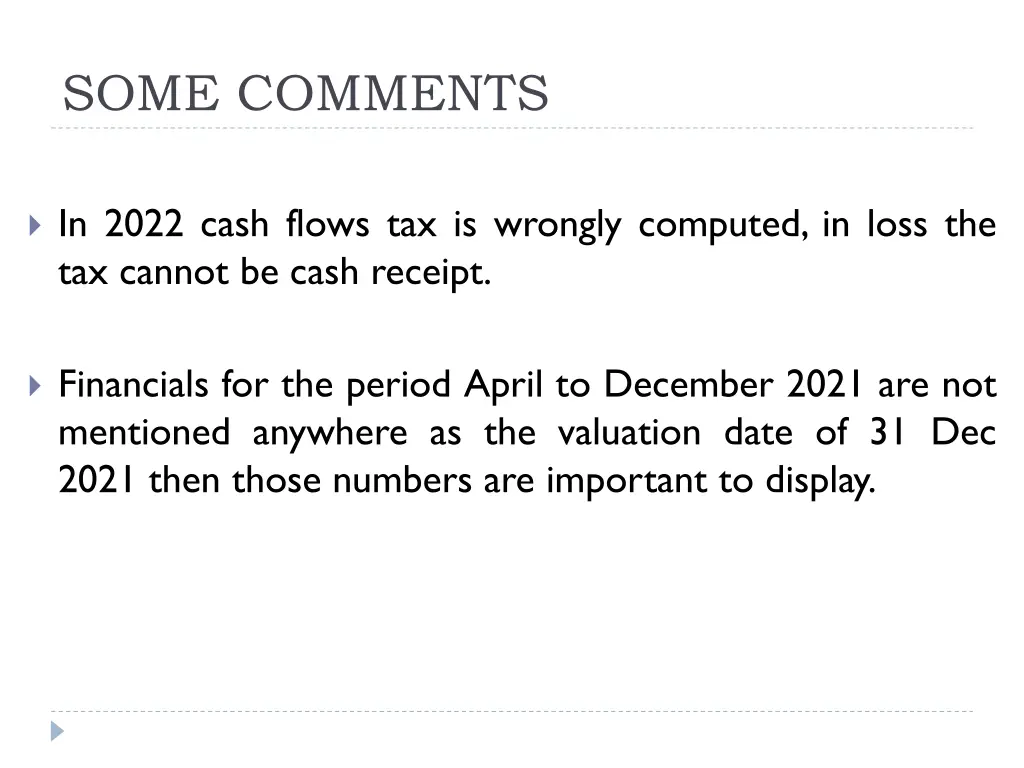
SOME COMMENTS In 2022 cash flows tax is wrongly computed, in loss the tax cannot be cash receipt. Financials for the period April to December 2021 are not mentioned anywhere as the valuation date of 31 Dec 2021 then those numbers are important to display.
Golden Rule of Report Drafting Write what you DO, & Do what you WRITE
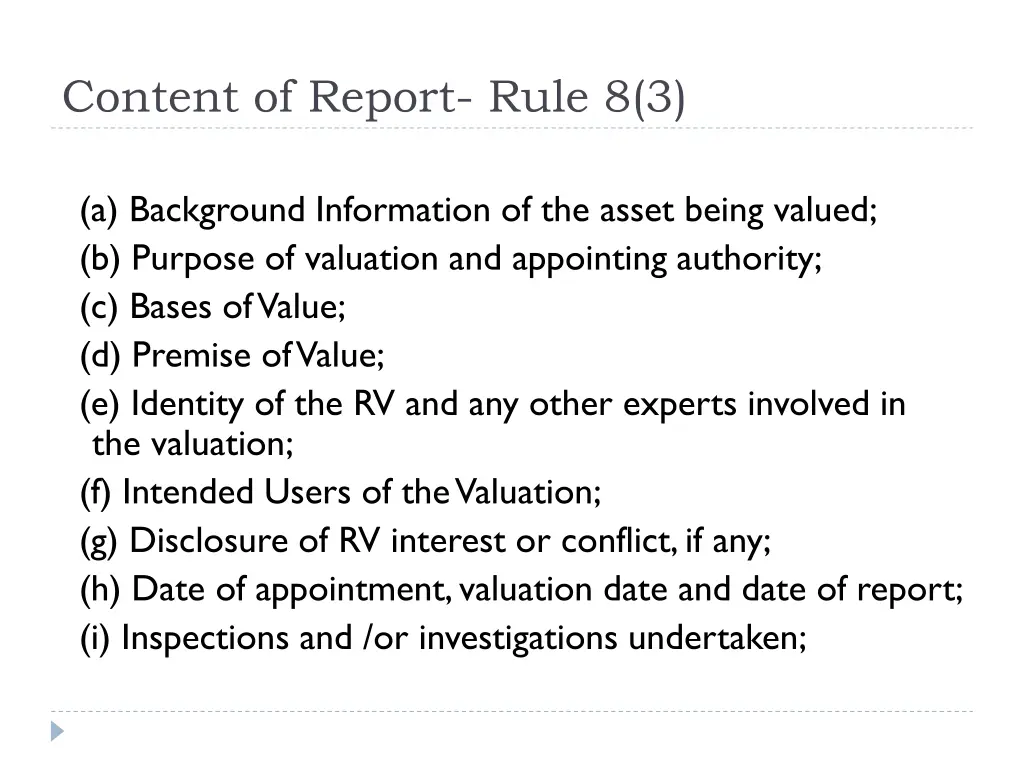
Content of Report- Rule 8(3) (a) Background Information of the asset being valued; (b) Purpose of valuation and appointing authority; (c) Bases of Value; (d) Premise of Value; (e) Identity of the RV and any other experts involved in the valuation; (f) Intended Users of the Valuation; (g) Disclosure of RV interest or conflict, if any; (h) Date of appointment, valuation date and date of report; (i) Inspections and /or investigations undertaken;
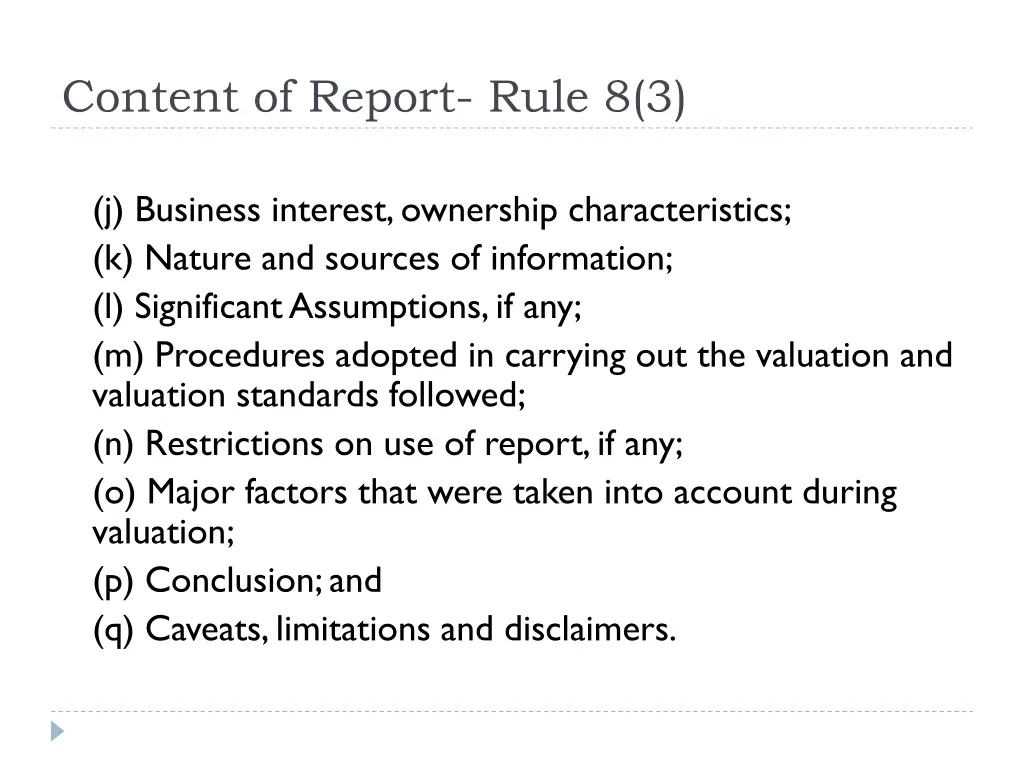
Content of Report- Rule 8(3) (j) Business interest, ownership characteristics; (k) Nature and sources of information; (l) Significant Assumptions, if any; (m) Procedures adopted in carrying out the valuation and valuation standards followed; (n) Restrictions on use of report, if any; (o) Major factors that were taken into account during valuation; (p) Conclusion; and (q) Caveats, limitations and disclaimers.
Projections More fiction is written in Microsoft Excelthan in Microsoft Word
Mandatory Content The RV should also include in his report: an affirmative statement that information provided and assumptions used by developing projections have been appropriately reviewed, enquiries made regarding basis of key assumptions in context of business being valued and the industry/economy; and an affirmative statement on adequacy of information and time for carrying out the valuations; management/others in
Procedures involved Review of past financials; Review and analysis of financial projections; Industry analysis; SWOT analysis; Comparison with similar transactions; Comparison with other similar listed companies; Discussions with the management; Review of principal agreements/documents etc; Site visit (external, internal or both) or desktop valuation; Any assumption made in case of desktop valuation, a RV must state that the basis of the report is photographs and documents provided and Process of site identification, i.e., self-identified or with the help of clients representative or client itself.
MAJOR FINDINGS OF THE PEERREVIEW REPORTS
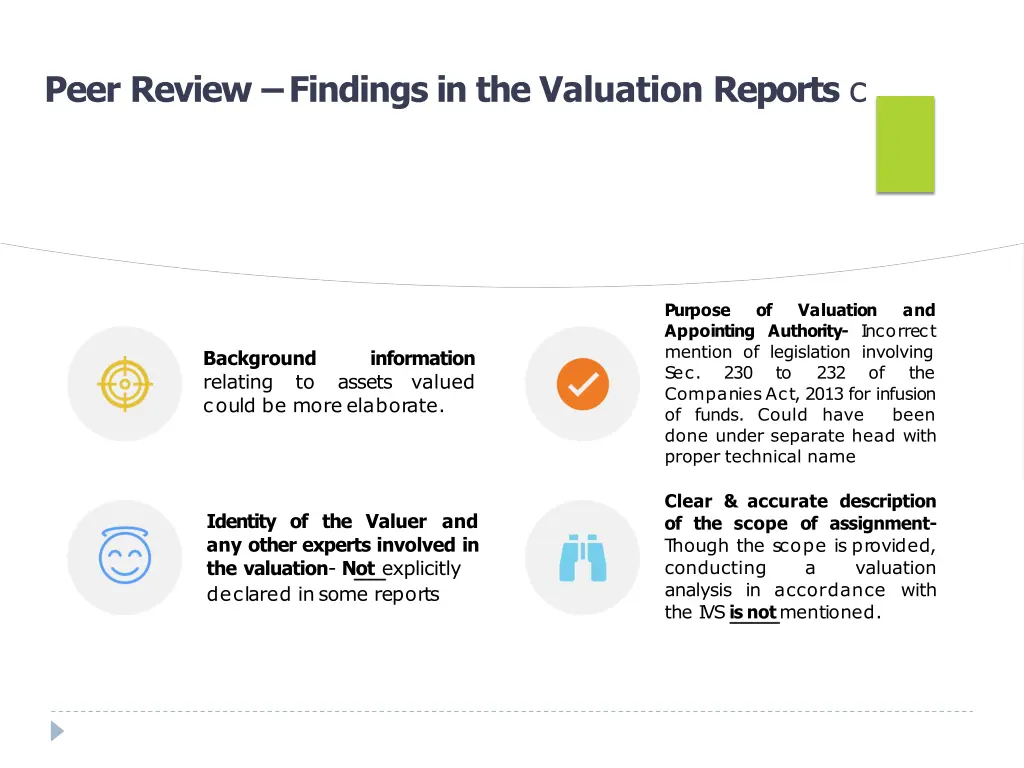
Peer Review Findings in the Valuation Reports c Purpose Appointing Authority- Incorrect mention of legislation involving Sec. 230 to CompaniesAct, 2013 for infusion of funds. Could have done under separate head with proper technical name of Valuation and Background relating could be more elaborate. information assets 232 of the to valued been Clear & accurate description of the scope of assignment- Though the scope is provided, conducting analysis in accordance with the IVSis notmentioned. Identity of the Valuer and any other experts involved in the valuation- Not explicitly declared insome reports a valuation
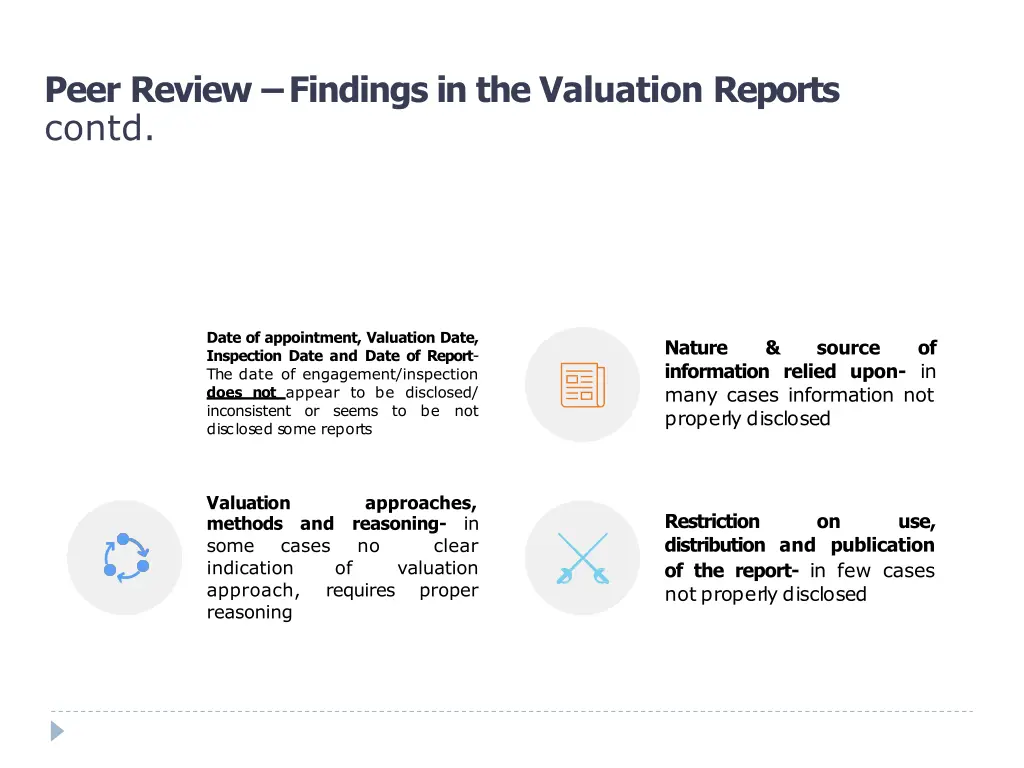
Peer Review Findings in the Valuation Reports contd. ICAI RVO 16 Date of appointment, Valuation Date, Inspection Date and Date of Report- The date of engagement/inspection does not appear to be disclosed/ inconsistent or seems to disclosed some reports Nature information relied upon- in many cases information not properly disclosed & source of be not Valuation methods some indication approach, reasoning approaches, reasoning- no of valuation requires Restriction distribution of the report- in few cases not properly disclosed on use, in and and publication cases clear proper
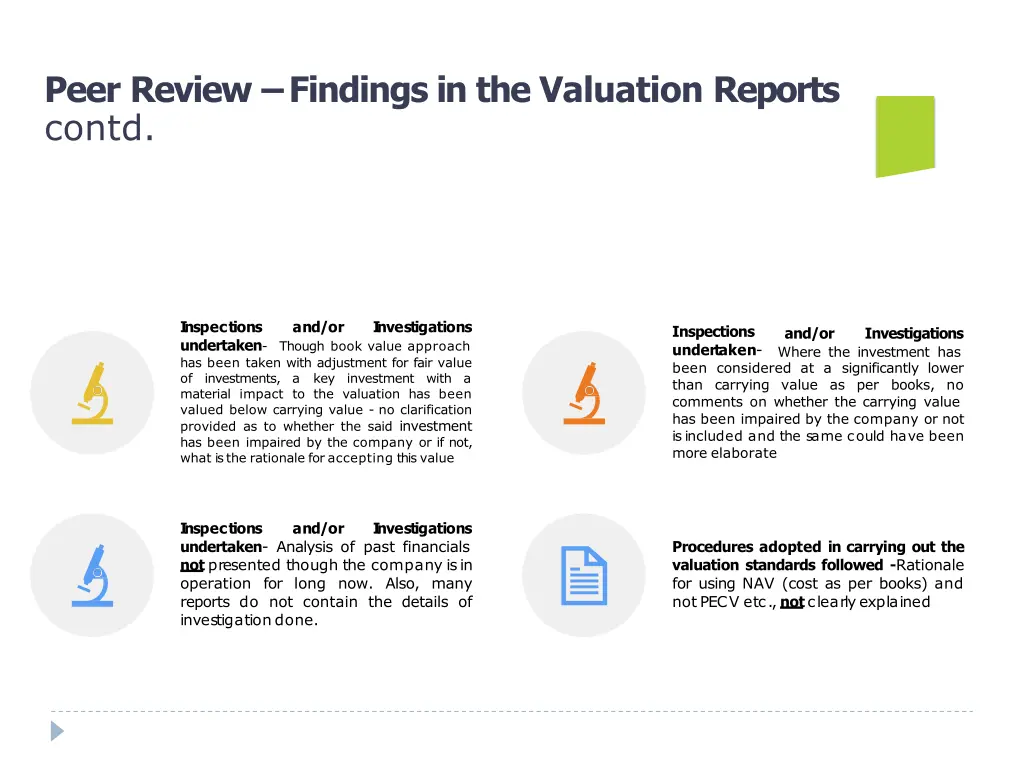
Peer Review Findings in the Valuation Reports contd. Inspections undertaken- has been taken with adjustment for fair value of investments, a key material impact to the valuation has been valued below carrying value - no clarification provided as to whether the said investment has been impaired by the company or if not, what isthe rationale for accepting this value and/or Though book value approach Investigations Inspections undertaken- been considered at a significantly lower than carrying value as per books, no comments on whether the carrying value has been impaired by the company or not isincluded and the same could have been more elaborate and/or Where the investment has Investigations investment with a Inspections undertaken- Analysis of past financials not presented though the company isin operation for long now. Also, many reports do not contain the details of investigationdone. and/or Investigations Procedures adopted in carrying out the valuation standards followed -Rationale for using NAV (cost as per books) and notPECV etc., notclearlyexplained
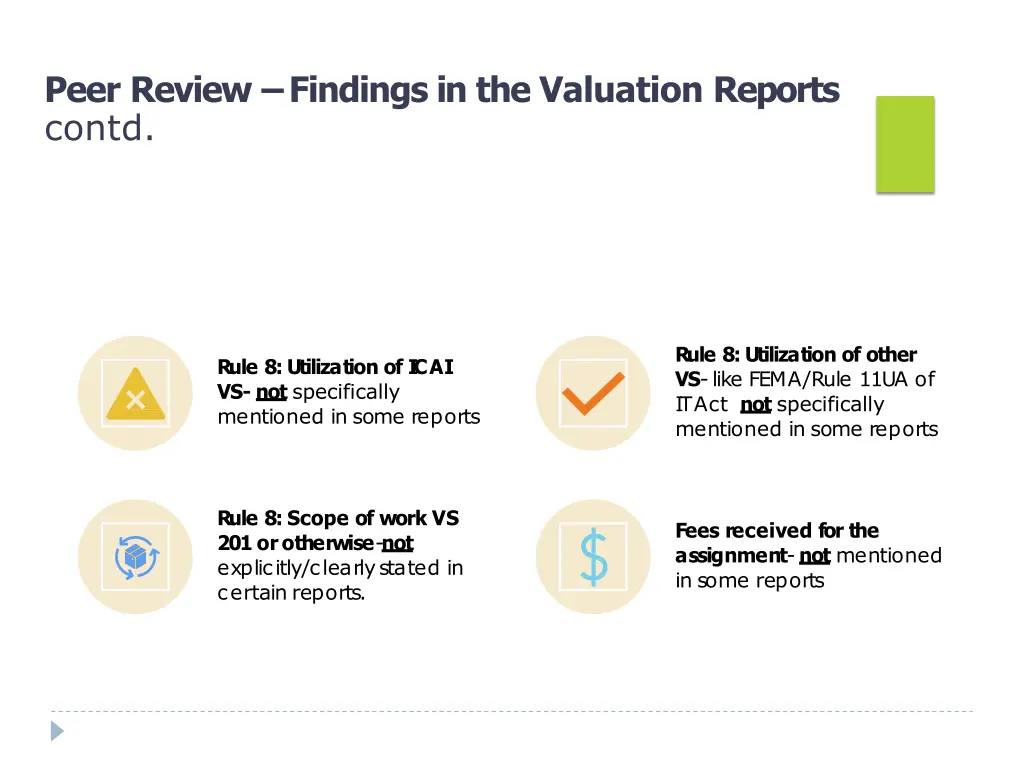
Peer Review Findings in the Valuation Reports contd. Rule 8:Utilization of other VS-like FEMA/Rule 11UA of ITAct not specifically mentioned in some reports Rule 8:Utilization of I CAI VS- not specifically mentioned in some reports Rule 8: Scope of work VS 201 orotherwise-not explicitly/clearlystated in certain reports. Fees received for the assignment-not mentioned in some reports
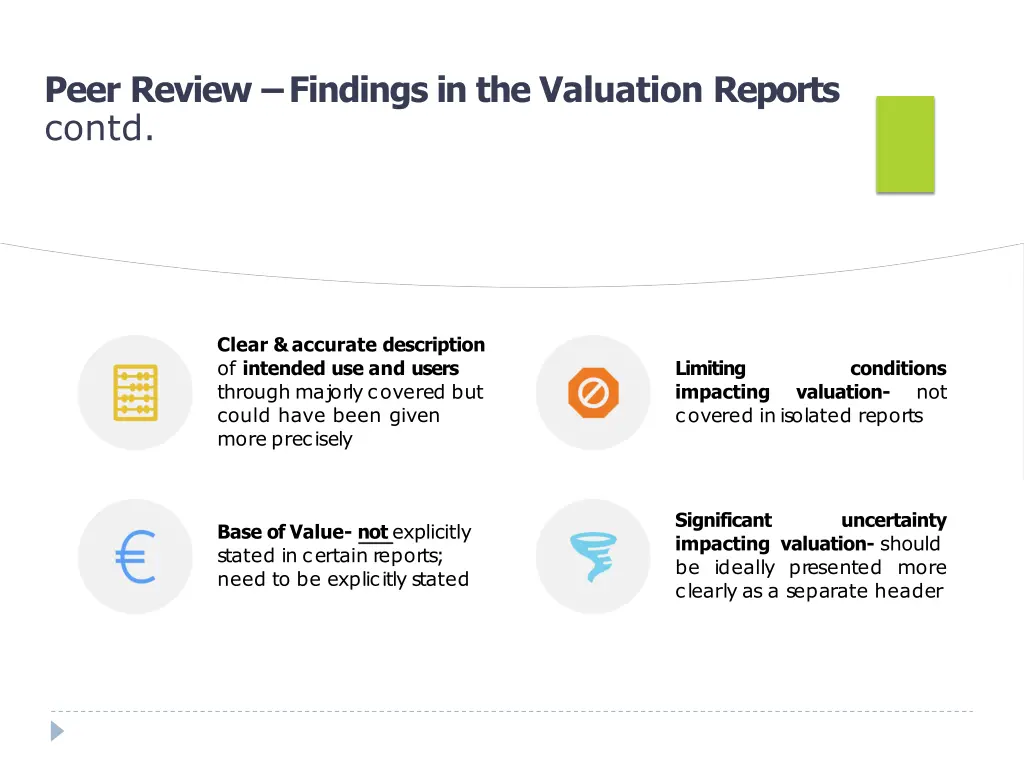
Peer Review Findings in the Valuation Reports contd. Clear &accurate description of intended use and users through majorly covered but could have been given more precisely Limiting impacting covered inisolated reports conditions not valuation- Significant impacting valuation- should be ideally presented more clearly as a separate header uncertainty Base of Value- not explicitly stated in certain reports; need to be explicitly stated
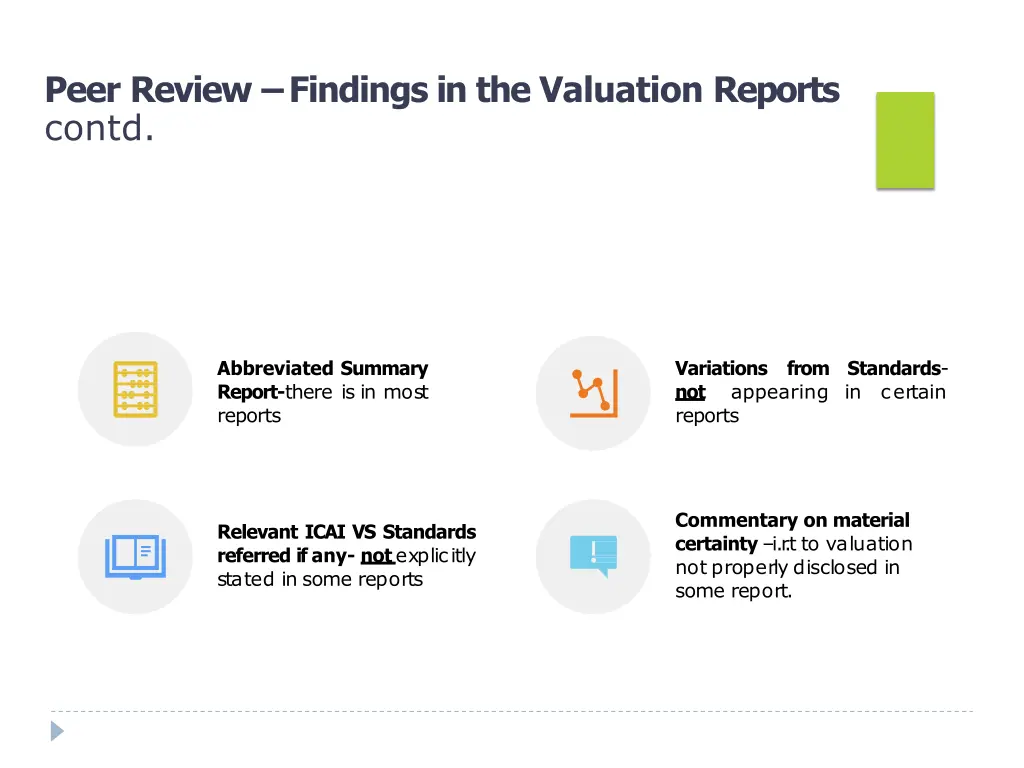
Peer Review Findings in the Valuation Reports contd. Standards- in certain Abbreviated Summary Report-there is in most reports Variations not reports from appearing Commentary on material certainty i.r .t to valuation not properly disclosed in some report. Relevant ICAI VS Standards referred if any- notexplicitly stated in some reports
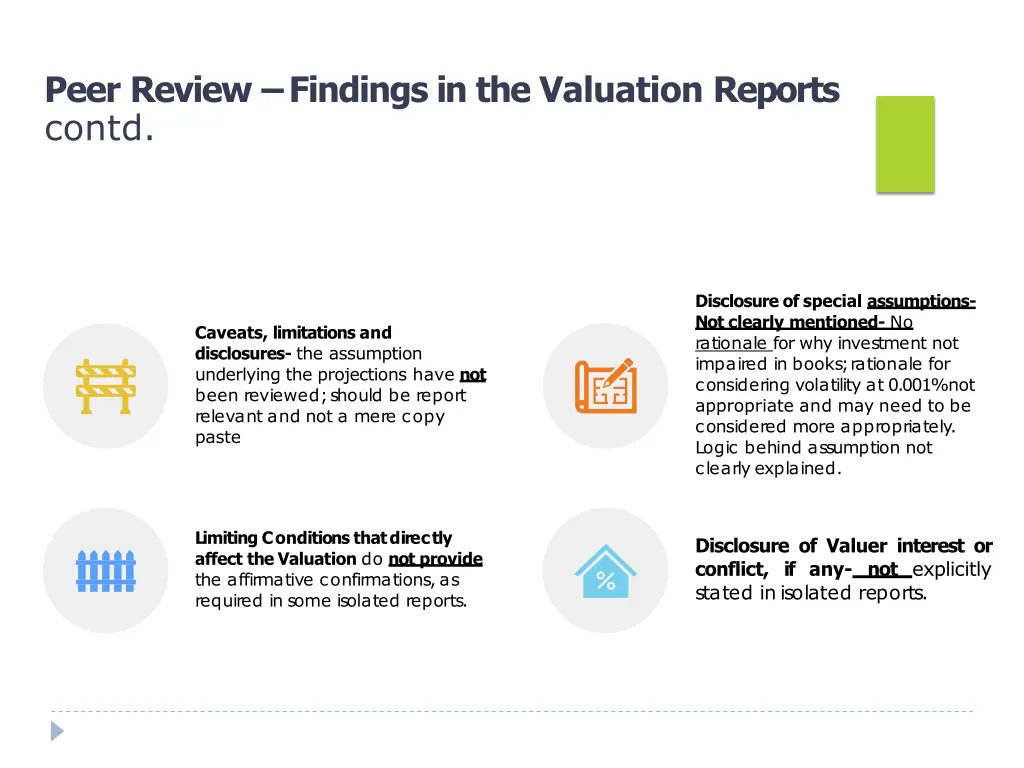
Peer Review Findings in the Valuation Reports contd. Disclosure of special assumptions- Not clearly mentioned- No rationale for why investment not impaired in books;rationale for considering volatility at 0.001%not appropriate and may need to be considered more appropriately. Logic behind assumption not clearly explained. Caveats, limitations and disclosures- the assumption underlying the projections have not been reviewed;should be report relevant and not a mere copy paste Limiting Conditions thatdirectly affect the Valuation do not provide the affirmative confirmations, as required in some isolated reports. Disclosure of Valuer interest or conflict, if any- not explicitly stated inisolated reports.
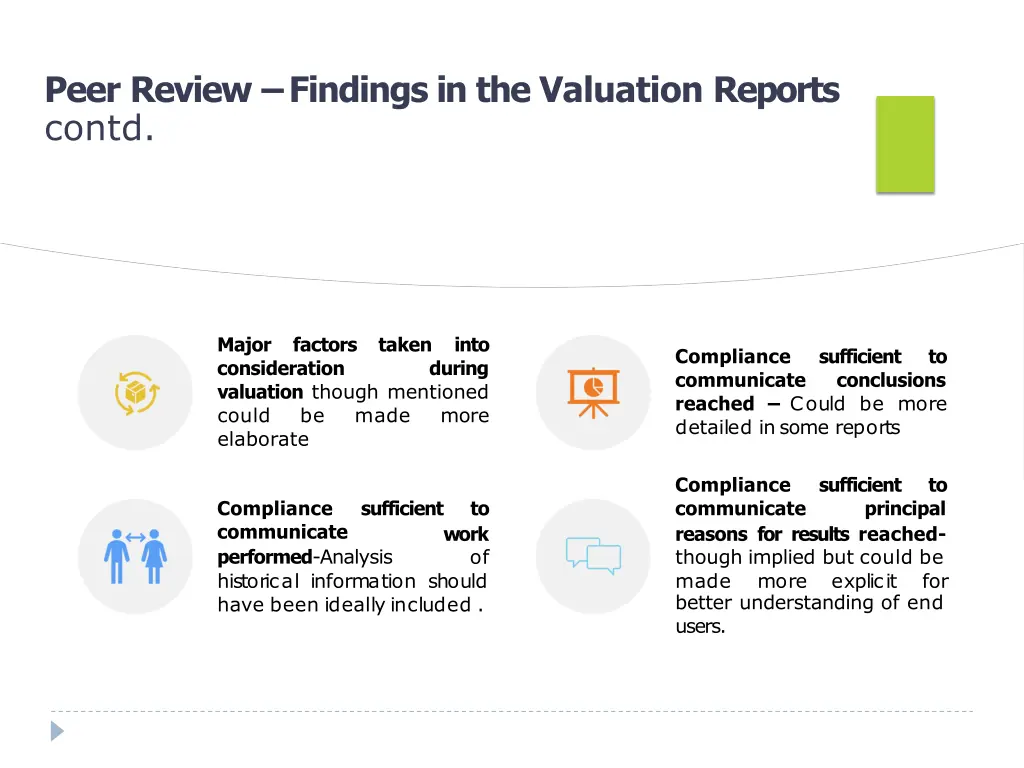
Peer Review Findings in the Valuation Reports contd. Major consideration valuation though mentioned could be elaborate factors taken into Compliance communicate reached Could be more detailed insome reports sufficient conclusions to during made more Compliance communicate reasons for results reached- though implied but could be made more better understanding of end users. sufficient to Compliance communicate performed-Analysis historical information should have been ideally included . sufficient to principal work of explicit for
IBBI FINDINGS OF PEER REVIEW 14 February 2020 26
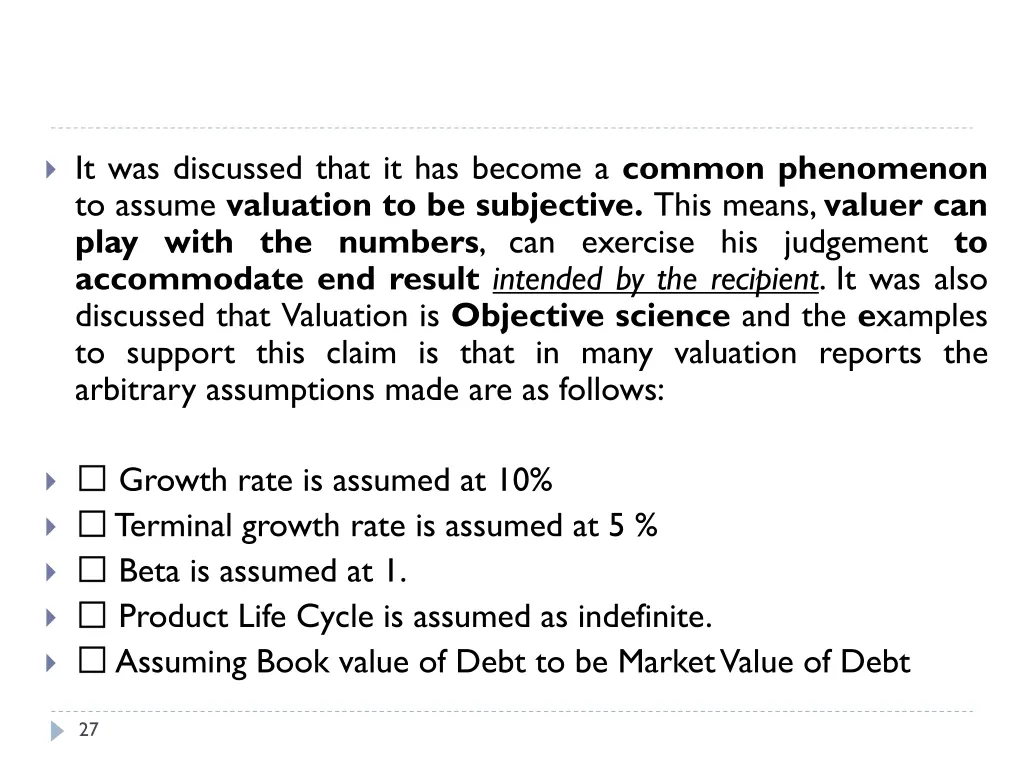
It was discussed that it has become a common phenomenon to assume valuation to be subjective. This means, valuer can play with the numbers, can exercise his judgement to accommodate end resultintended by the recipient. It was also discussed that Valuation is Objective science and the examples to support this claim is that in many valuation reports the arbitrary assumptions made are as follows: Growth rate is assumed at 10% Terminal growth rate is assumed at 5 % Beta is assumed at 1. Product Life Cycle is assumed as indefinite. Assuming Book value of Debt to be Market Value of Debt 27
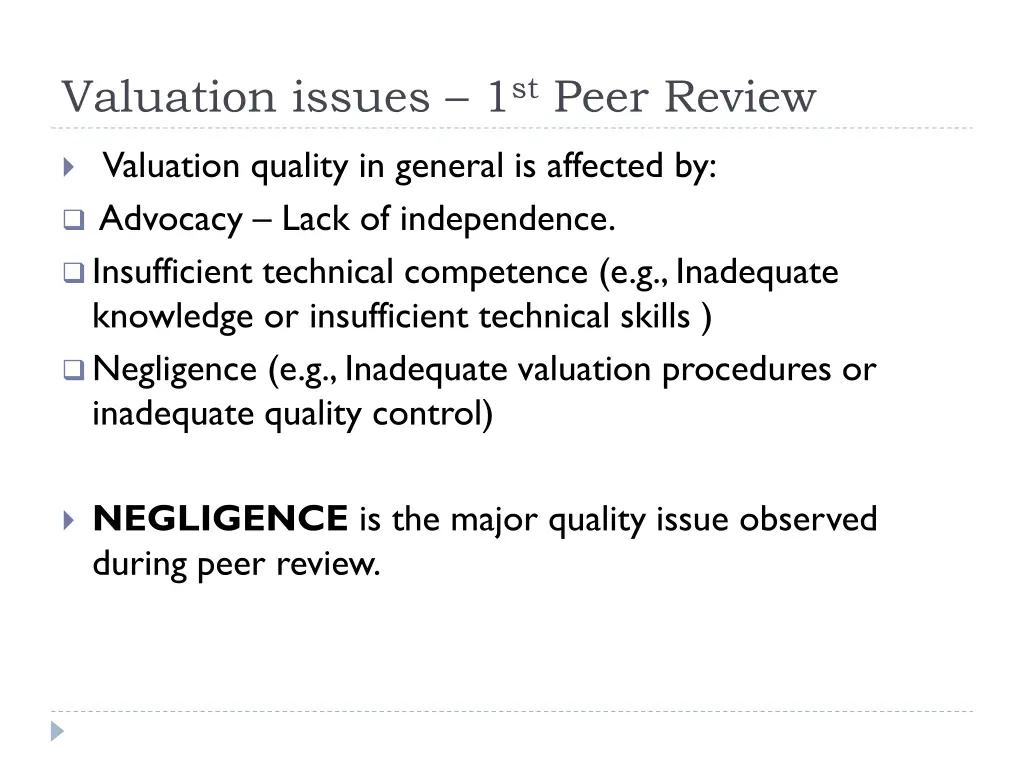
Valuation issues 1st Peer Review Valuation quality in general is affected by: Advocacy Lack of independence. Insufficient technical competence (e.g., Inadequate knowledge or insufficient technical skills ) Negligence (e.g., Inadequate valuation procedures or inadequate quality control) NEGLIGENCE is the major quality issue observed during peer review.
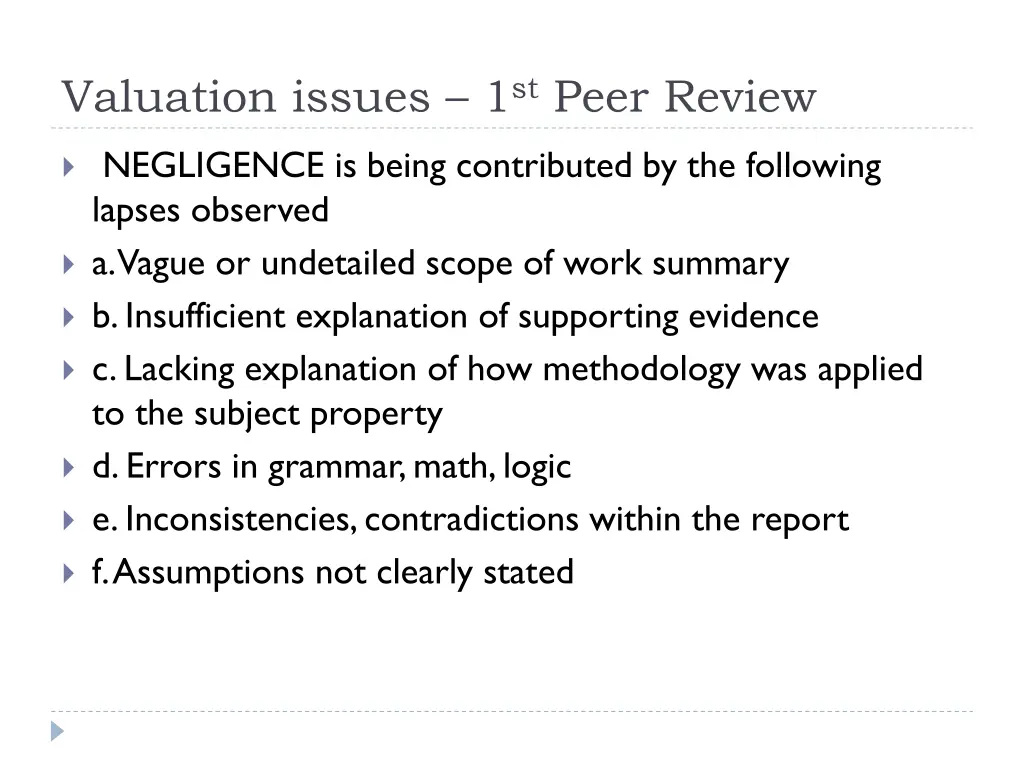
Valuation issues 1st Peer Review NEGLIGENCE is being contributed by the following lapses observed a. Vague or undetailed scope of work summary b. Insufficient explanation of supporting evidence c. Lacking explanation of how methodology was applied to the subject property d. Errors in grammar, math, logic e. Inconsistencies, contradictions within the report f. Assumptions not clearly stated
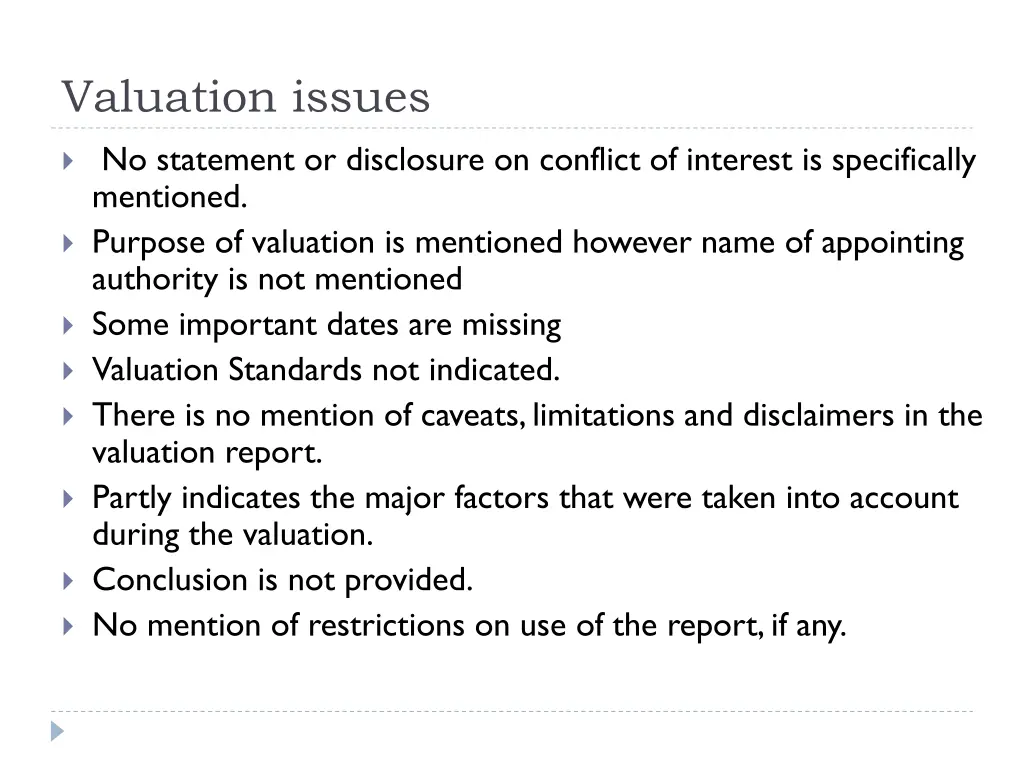
Valuation issues No statement or disclosure on conflict of interest is specifically mentioned. Purpose of valuation is mentioned however name of appointing authority is not mentioned Some important dates are missing Valuation Standards not indicated. There is no mention of caveats, limitations and disclaimers in the valuation report. Partly indicates the major factors that were taken into account during the valuation. Conclusion is not provided. No mention of restrictions on use of the report, if any.
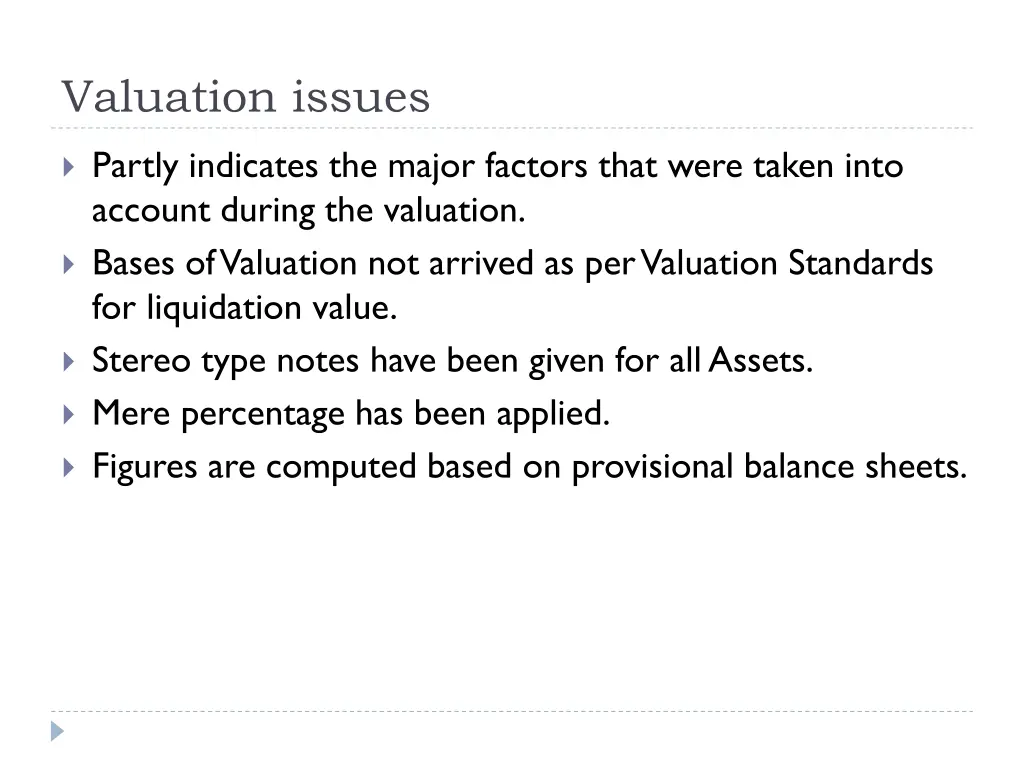
Valuation issues Partly indicates the major factors that were taken into account during the valuation. Bases of Valuation not arrived as per Valuation Standards for liquidation value. Stereo type notes have been given for all Assets. Mere percentage has been applied. Figures are computed based on provisional balance sheets.
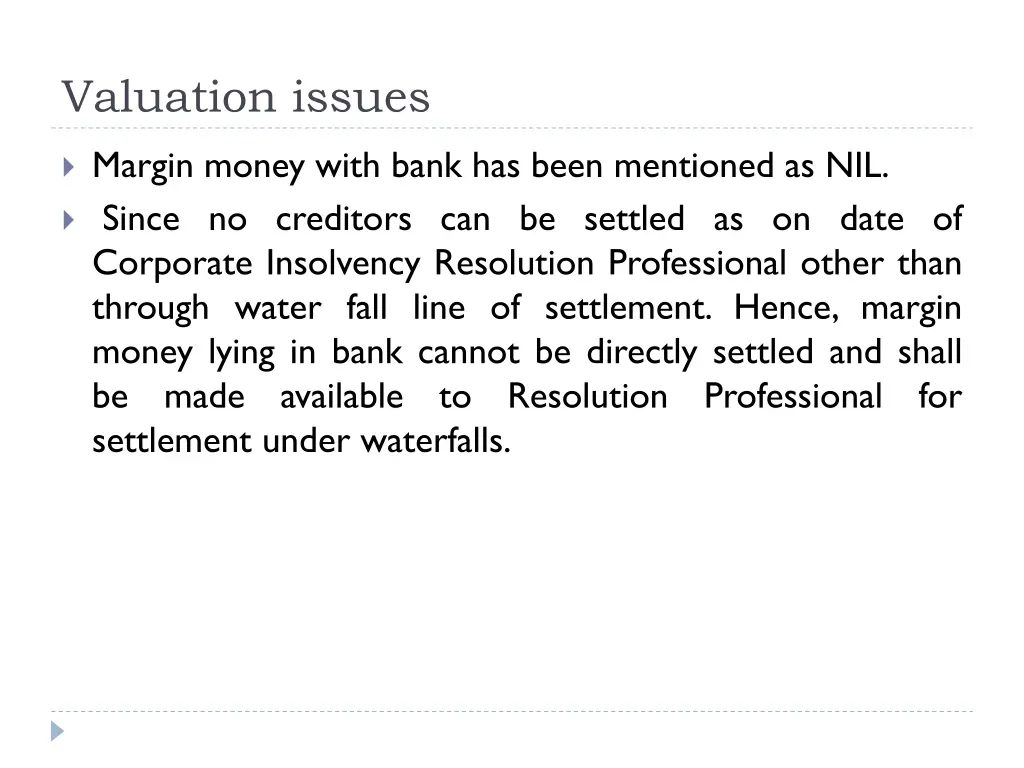
Valuation issues Margin money with bank has been mentioned as NIL. Since no creditors can be settled as on date of Corporate Insolvency Resolution Professional other than through water fall line of settlement. Hence, margin money lying in bank cannot be directly settled and shall be made available to Resolution Professional for settlement under waterfalls.
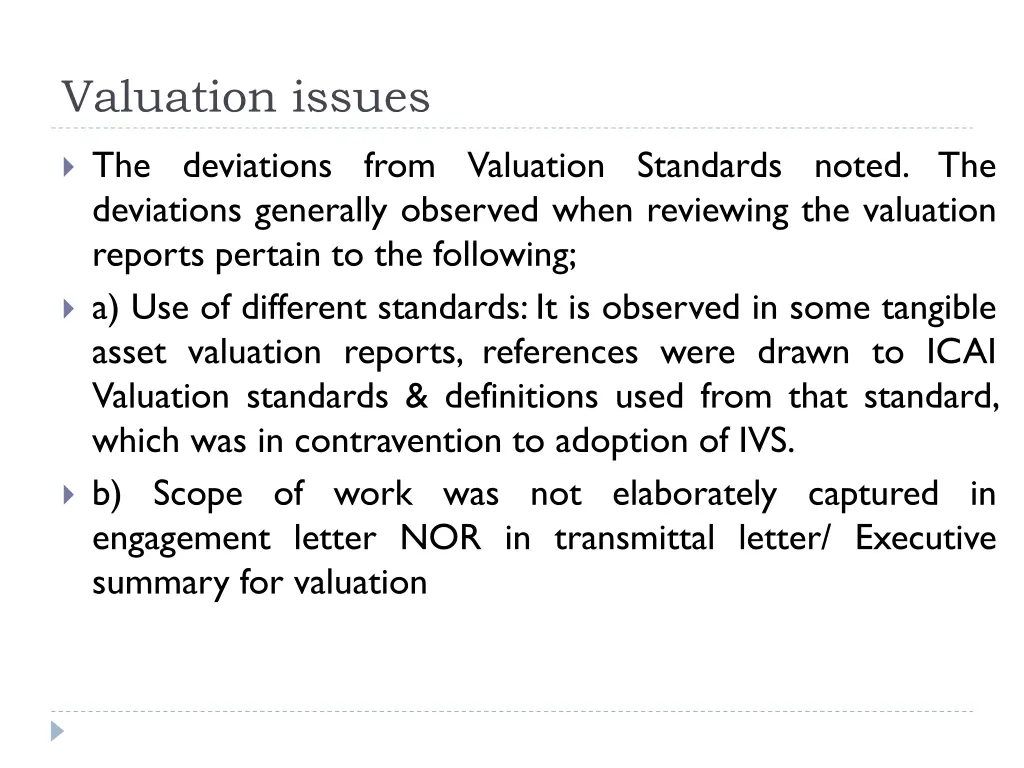
Valuation issues The deviations from Valuation Standards noted. The deviations generally observed when reviewing the valuation reports pertain to the following; a) Use of different standards: It is observed in some tangible asset valuation reports, references were drawn to ICAI Valuation standards & definitions used from that standard, which was in contravention to adoption of IVS. b) Scope of work was not elaborately captured in engagement letter NOR in transmittal letter/ Executive summary for valuation
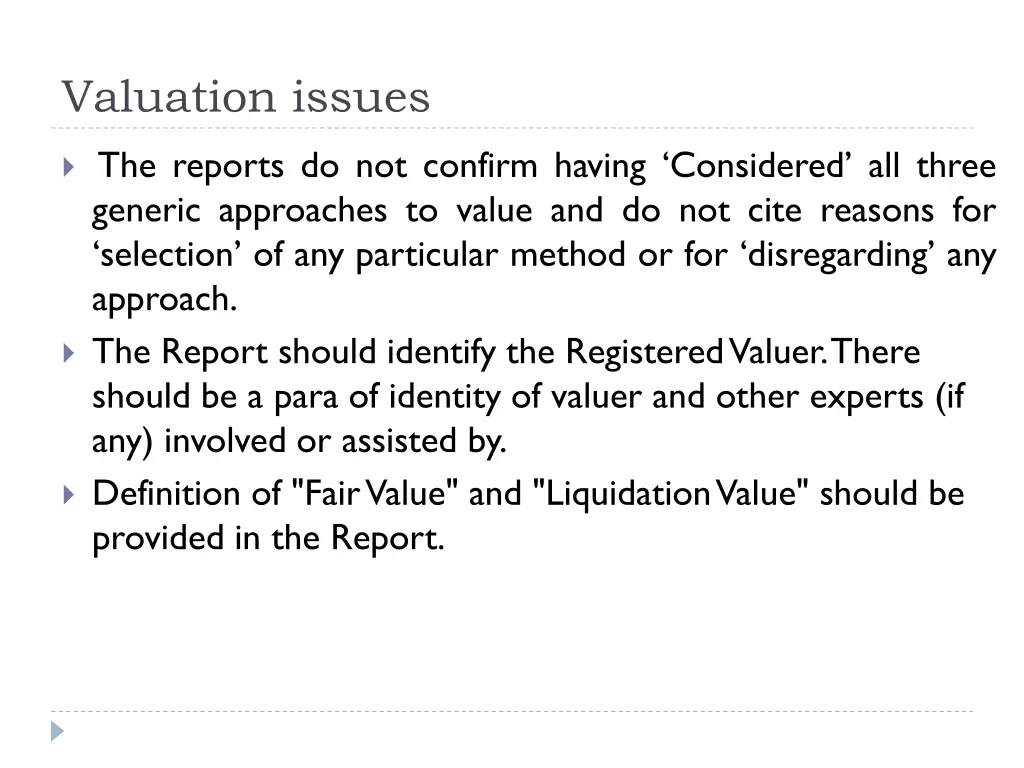
Valuation issues The reports do not confirm having Considered all three generic approaches to value and do not cite reasons for selection of any particular method or for disregarding any approach. The Report should identify the Registered Valuer. There should be a para of identity of valuer and other experts (if any) involved or assisted by. Definition of "Fair Value" and "Liquidation Value" should be provided in the Report.
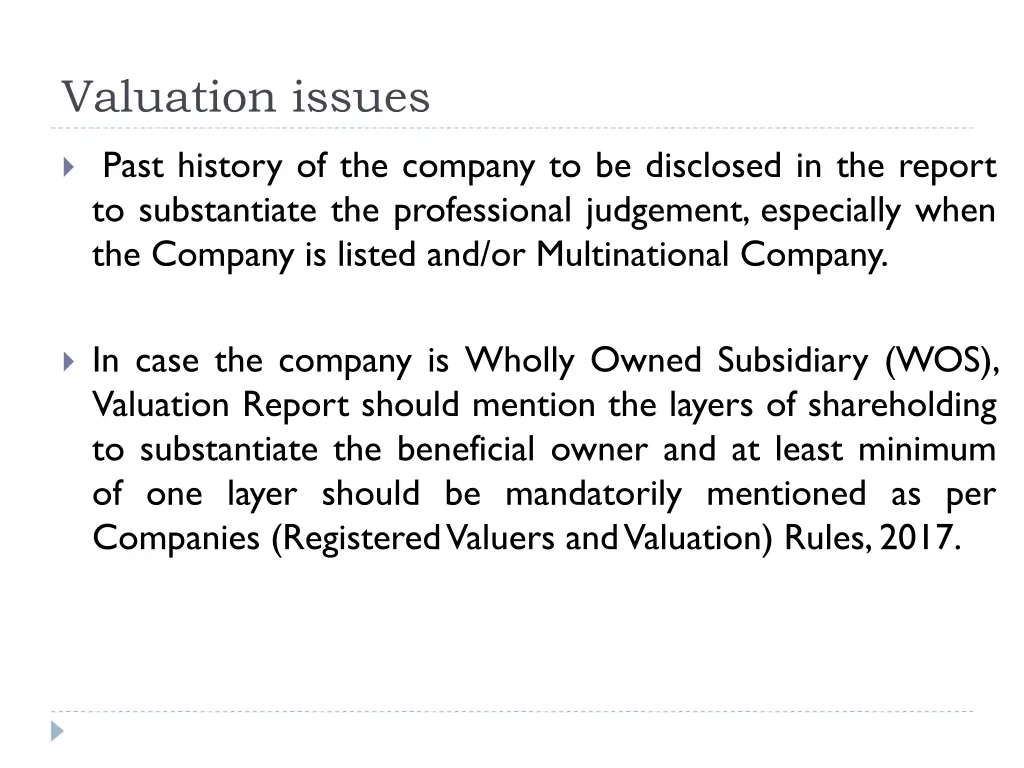
Valuation issues Past history of the company to be disclosed in the report to substantiate the professional judgement, especially when the Company is listed and/or Multinational Company. In case the company is Wholly Owned Subsidiary (WOS), Valuation Report should mention the layers of shareholding to substantiate the beneficial owner and at least minimum of one layer should be mandatorily mentioned as per Companies (Registered Valuers and Valuation) Rules, 2017.
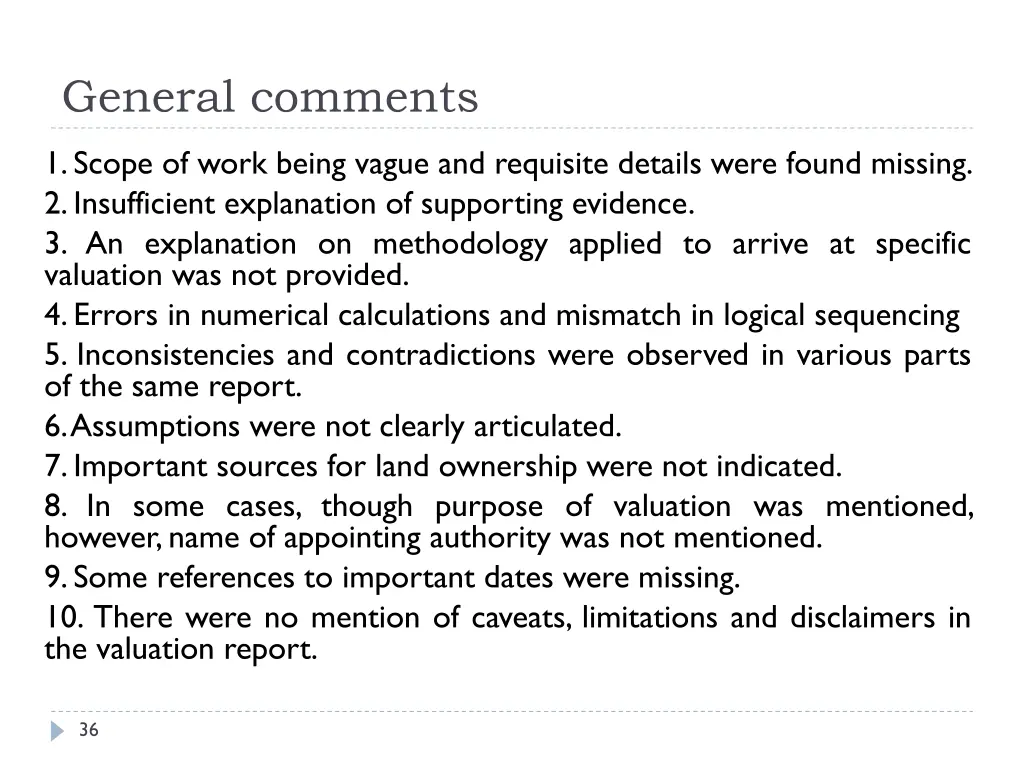
General comments 1. Scope of work being vague and requisite details were found missing. 2. Insufficient explanation of supporting evidence. 3. An explanation on methodology applied to arrive at specific valuation was not provided. 4. Errors in numerical calculations and mismatch in logical sequencing 5. Inconsistencies and contradictions were observed in various parts of the same report. 6. Assumptions were not clearly articulated. 7. Important sources for land ownership were not indicated. 8. In some cases, though purpose of valuation was mentioned, however, name of appointing authority was not mentioned. 9. Some references to important dates were missing. 10. There were no mention of caveats, limitations and disclaimers in the valuation report. 36
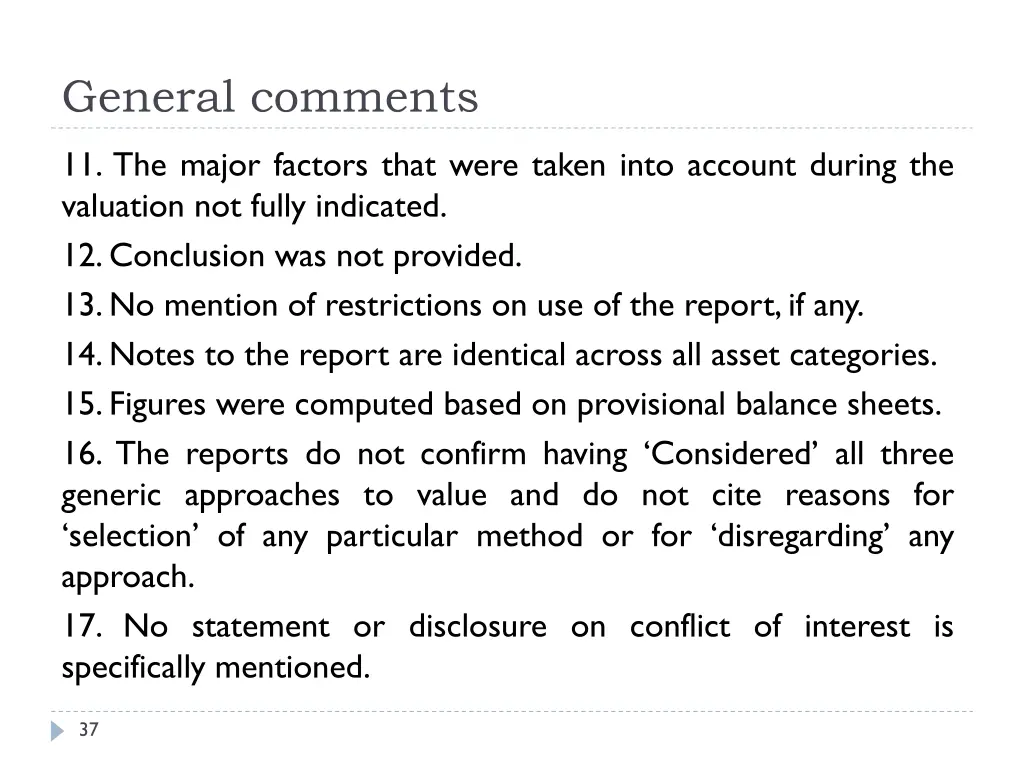
General comments 11. The major factors that were taken into account during the valuation not fully indicated. 12. Conclusion was not provided. 13. No mention of restrictions on use of the report, if any. 14. Notes to the report are identical across all asset categories. 15. Figures were computed based on provisional balance sheets. 16. The reports do not confirm having Considered all three generic approaches to value and do not cite reasons for selection of any particular method or for disregarding any approach. 17. No statement or disclosure on conflict of interest is specifically mentioned. 37
IBBI FINDINGS OF PEER REVIEW 17 February 2021 38
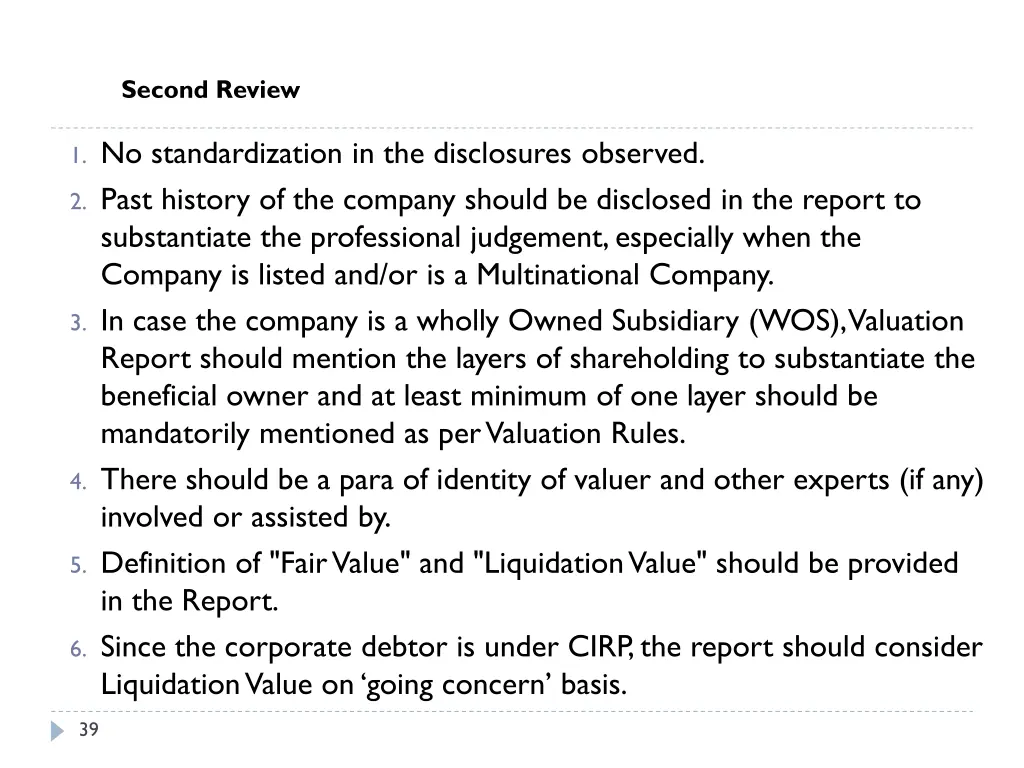
Second Review 1. No standardization in the disclosures observed. 2. Past history of the company should be disclosed in the report to substantiate the professional judgement, especially when the Company is listed and/or is a Multinational Company. 3. In case the company is a wholly Owned Subsidiary (WOS), Valuation Report should mention the layers of shareholding to substantiate the beneficial owner and at least minimum of one layer should be mandatorily mentioned as per Valuation Rules. 4. There should be a para of identity of valuer and other experts (if any) involved or assisted by. 5. Definition of "Fair Value" and "Liquidation Value" should be provided in the Report. 6. Since the corporate debtor is under CIRP, the report should consider Liquidation Value on going concern basis. 39
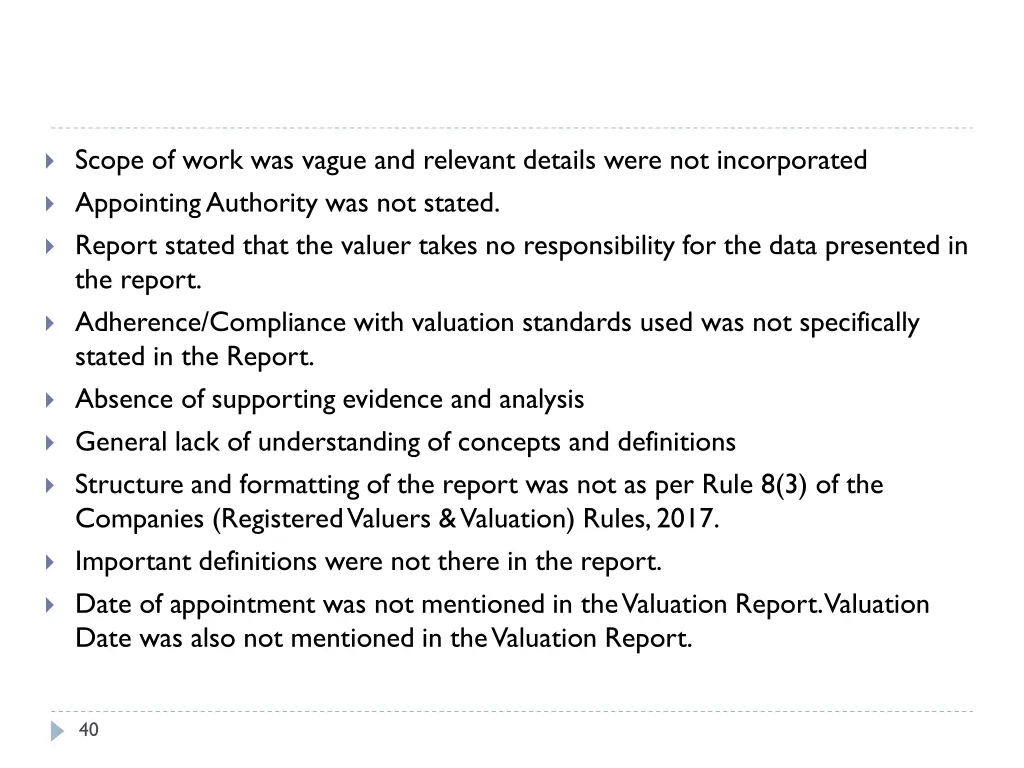
Scope of work was vague and relevant details were not incorporated Appointing Authority was not stated. Report stated that the valuer takes no responsibility for the data presented in the report. Adherence/Compliance with valuation standards used was not specifically stated in the Report. Absence of supporting evidence and analysis General lack of understanding of concepts and definitions Structure and formatting of the report was not as per Rule 8(3) of the Companies (Registered Valuers & Valuation) Rules, 2017. Important definitions were not there in the report. Date of appointment was not mentioned in the Valuation Report. Valuation Date was also not mentioned in the Valuation Report. 40
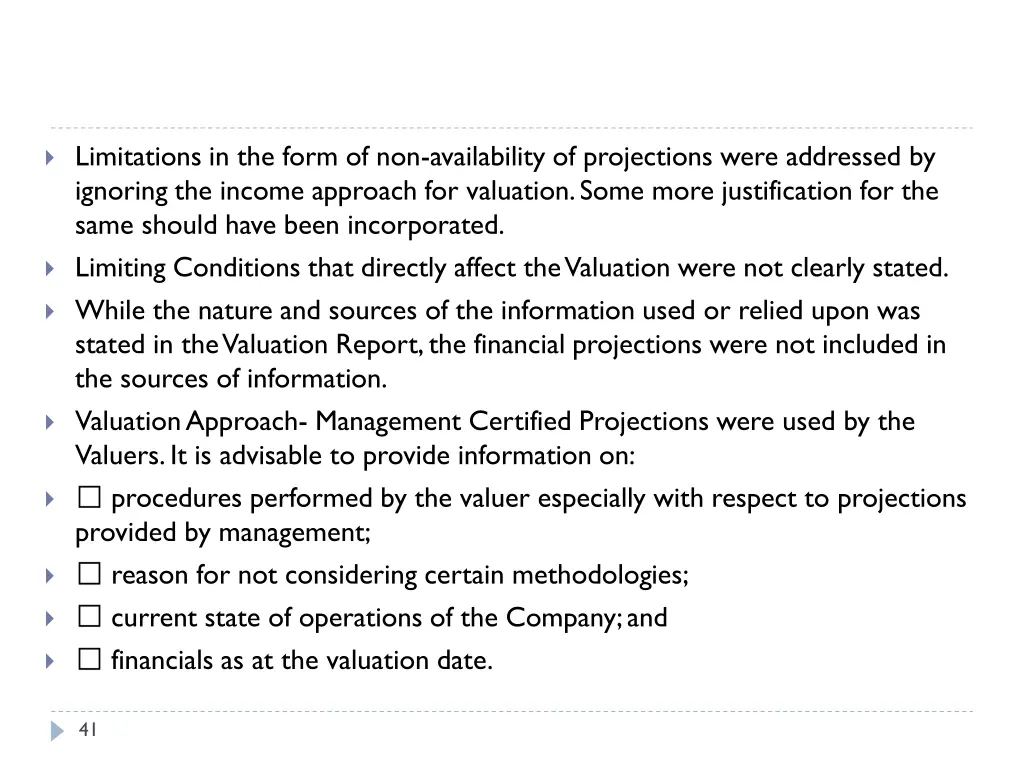
Limitations in the form of non-availability of projections were addressed by ignoring the income approach for valuation. Some more justification for the same should have been incorporated. Limiting Conditions that directly affect the Valuation were not clearly stated. While the nature and sources of the information used or relied upon was stated in the Valuation Report, the financial projections were not included in the sources of information. Valuation Approach- Management Certified Projections were used by the Valuers. It is advisable to provide information on: procedures performed by the valuer especially with respect to projections provided by management; reason for not considering certain methodologies; current state of operations of the Company; and financials as at the valuation date. 41
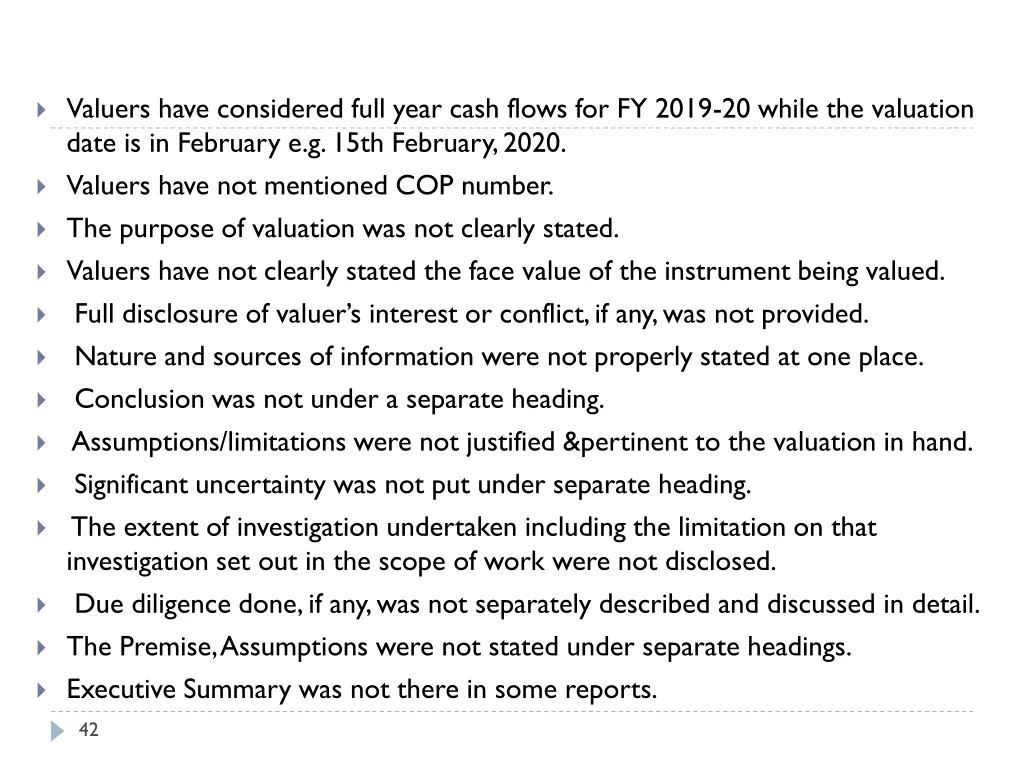
Valuers have considered full year cash flows for FY 2019-20 while the valuation date is in February e.g. 15th February, 2020. Valuers have not mentioned COP number. The purpose of valuation was not clearly stated. Valuers have not clearly stated the face value of the instrument being valued. Full disclosure of valuer s interest or conflict, if any, was not provided. Nature and sources of information were not properly stated at one place. Conclusion was not under a separate heading. Assumptions/limitations were not justified &pertinent to the valuation in hand. Significant uncertainty was not put under separate heading. The extent of investigation undertaken including the limitation on that investigation set out in the scope of work were not disclosed. Due diligence done, if any, was not separately described and discussed in detail. The Premise, Assumptions were not stated under separate headings. Executive Summary was not there in some reports. 42
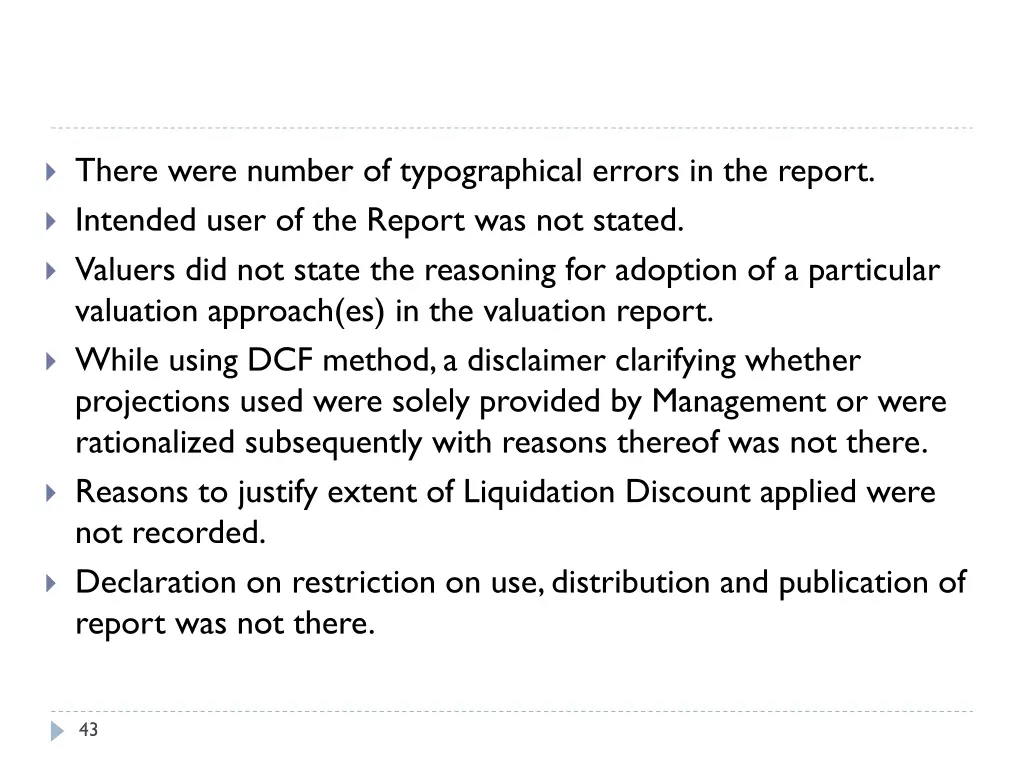
There were number of typographical errors in the report. Intended user of the Report was not stated. Valuers did not state the reasoning for adoption of a particular valuation approach(es) in the valuation report. While using DCF method, a disclaimer clarifying whether projections used were solely provided by Management or were rationalized subsequently with reasons thereof was not there. Reasons to justify extent of Liquidation Discount applied were not recorded. Declaration on restriction on use, distribution and publication of report was not there. 43
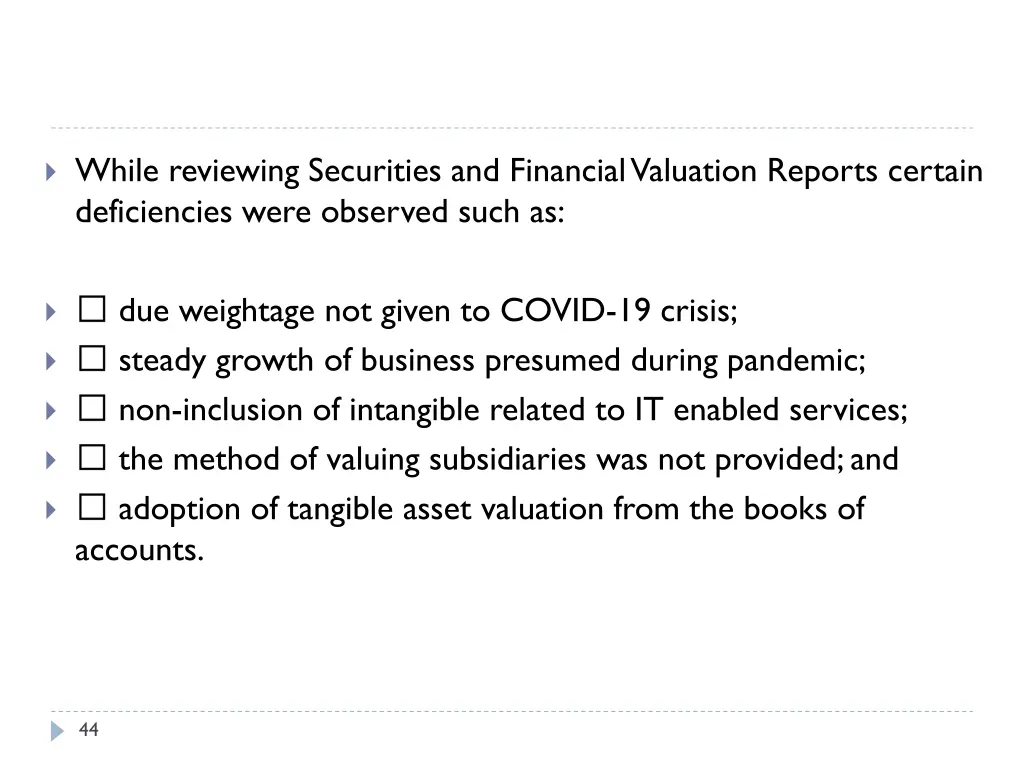
While reviewing Securities and Financial Valuation Reports certain deficiencies were observed such as: due weightage not given to COVID-19 crisis; steady growth of business presumed during pandemic; non-inclusion of intangible related to IT enabled services; the method of valuing subsidiaries was not provided; and adoption of tangible asset valuation from the books of accounts. 44
IBBI FINDINGS OF PEER REVIEW 21 April 2022 45
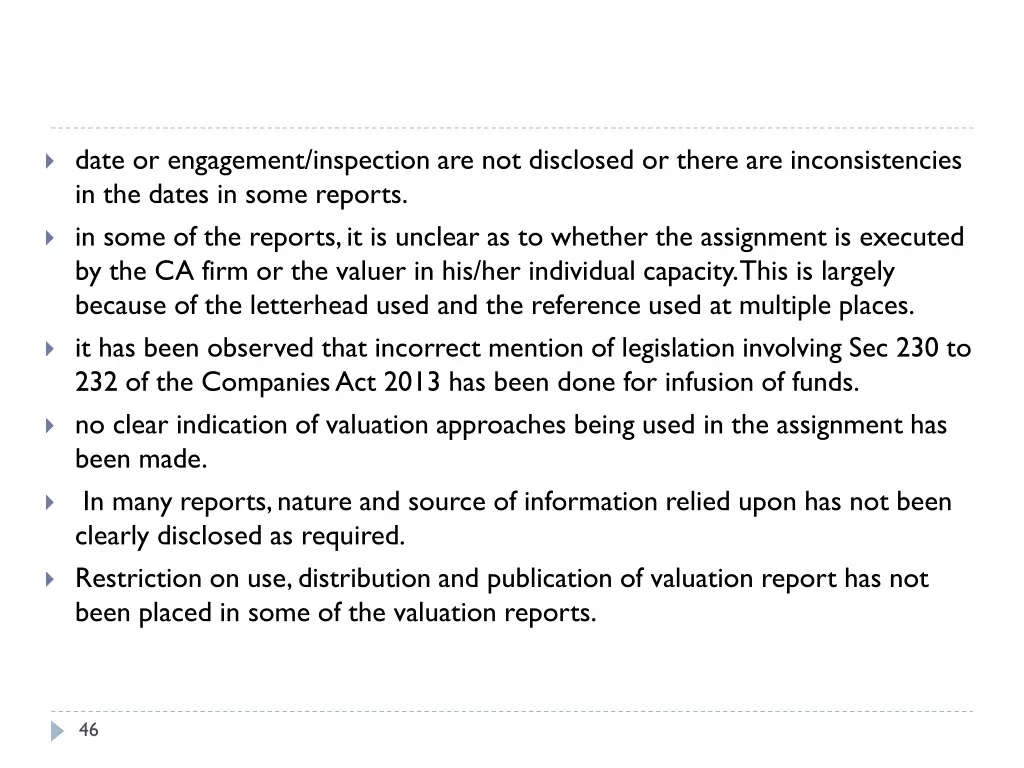
date or engagement/inspection are not disclosed or there are inconsistencies in the dates in some reports. in some of the reports, it is unclear as to whether the assignment is executed by the CA firm or the valuer in his/her individual capacity. This is largely because of the letterhead used and the reference used at multiple places. it has been observed that incorrect mention of legislation involving Sec 230 to 232 of the Companies Act 2013 has been done for infusion of funds. no clear indication of valuation approaches being used in the assignment has been made. In many reports, nature and source of information relied upon has not been clearly disclosed as required. Restriction on use, distribution and publication of valuation report has not been placed in some of the valuation reports. 46
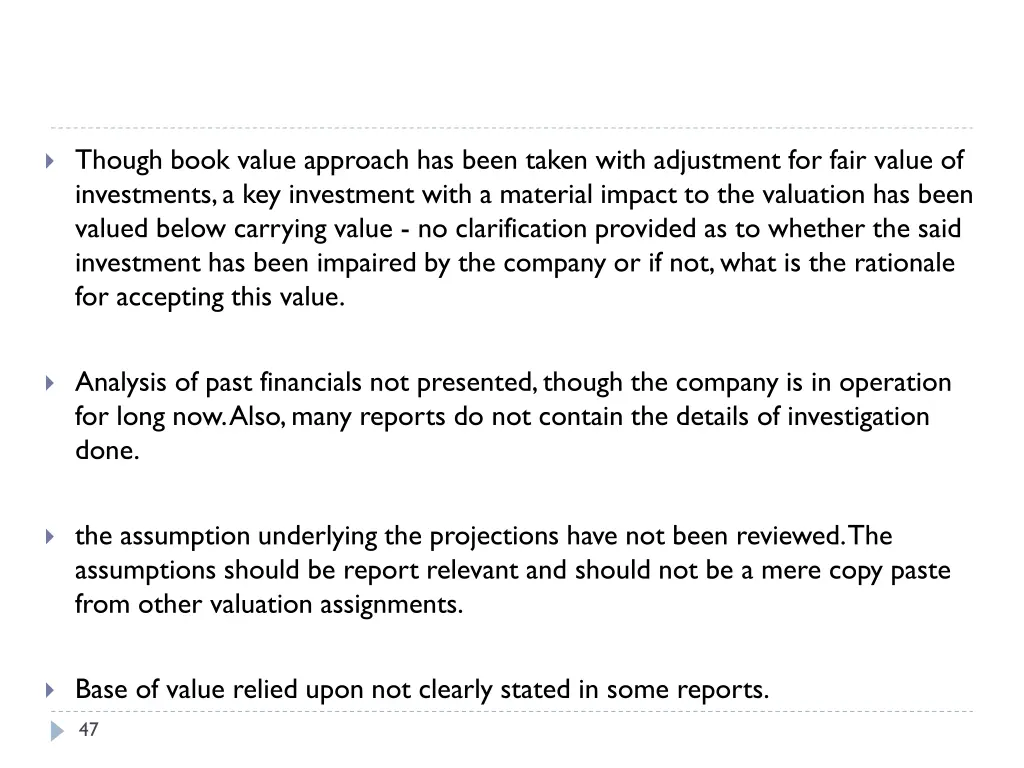
Though book value approach has been taken with adjustment for fair value of investments, a key investment with a material impact to the valuation has been valued below carrying value - no clarification provided as to whether the said investment has been impaired by the company or if not, what is the rationale for accepting this value. Analysis of past financials not presented, though the company is in operation for long now. Also, many reports do not contain the details of investigation done. the assumption underlying the projections have not been reviewed. The assumptions should be report relevant and should not be a mere copy paste from other valuation assignments. Base of value relied upon not clearly stated in some reports. 47
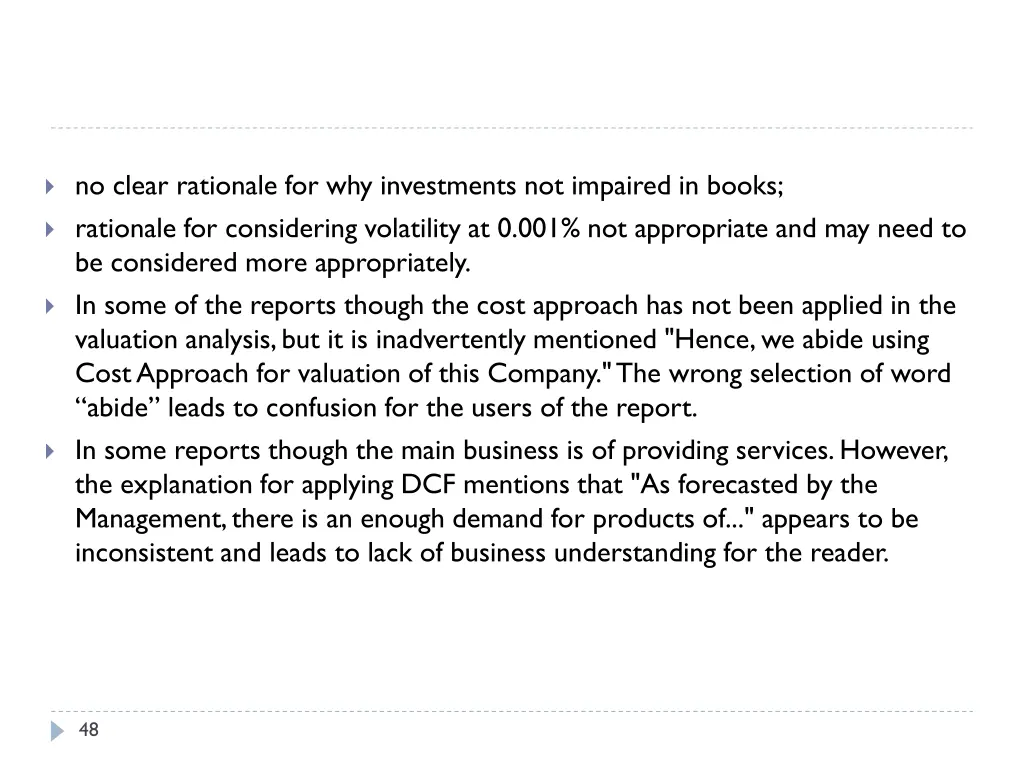
no clear rationale for why investments not impaired in books; rationale for considering volatility at 0.001% not appropriate and may need to be considered more appropriately. In some of the reports though the cost approach has not been applied in the valuation analysis, but it is inadvertently mentioned "Hence, we abide using Cost Approach for valuation of this Company." The wrong selection of word abide leads to confusion for the users of the report. In some reports though the main business is of providing services. However, the explanation for applying DCF mentions that "As forecasted by the Management, there is an enough demand for products of..." appears to be inconsistent and leads to lack of business understanding for the reader. 48
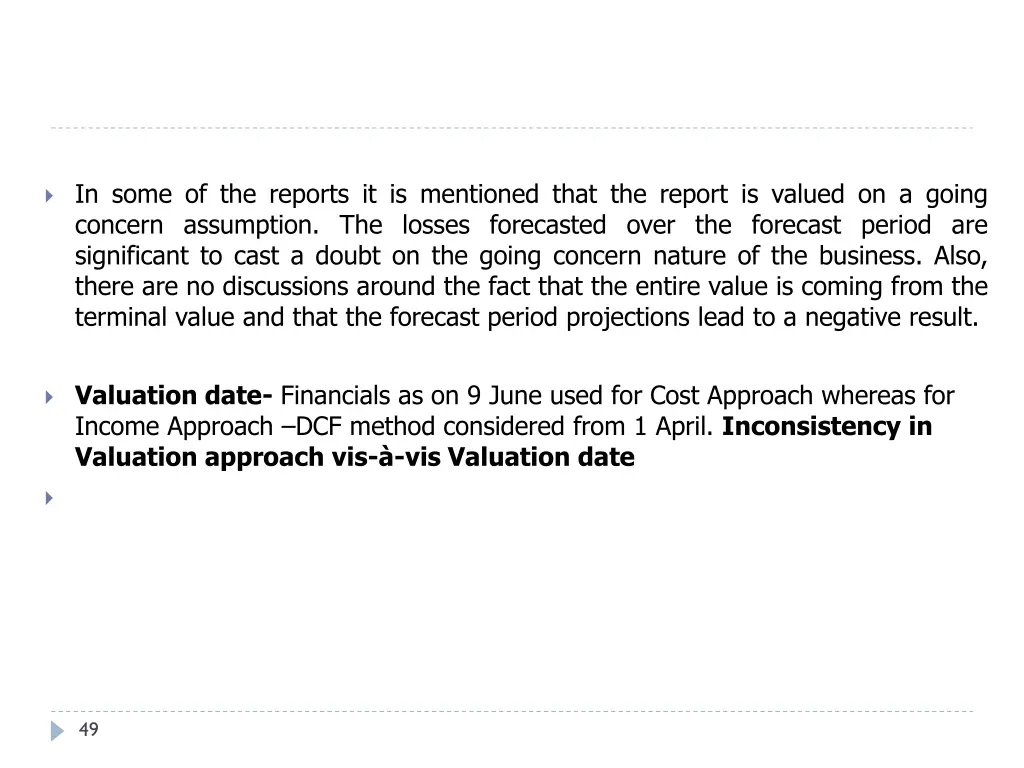
In some of the reports it is mentioned that the report is valued on a going concern assumption. The losses forecasted over the forecast period are significant to cast a doubt on the going concern nature of the business. Also, there are no discussions around the fact that the entire value is coming from the terminal value and that the forecast period projections lead to a negative result. Valuation date- Financials as on 9 June used for Cost Approach whereas for Income Approach DCF method considered from 1 April. Inconsistency in Valuation approach vis- -vis Valuation date 49
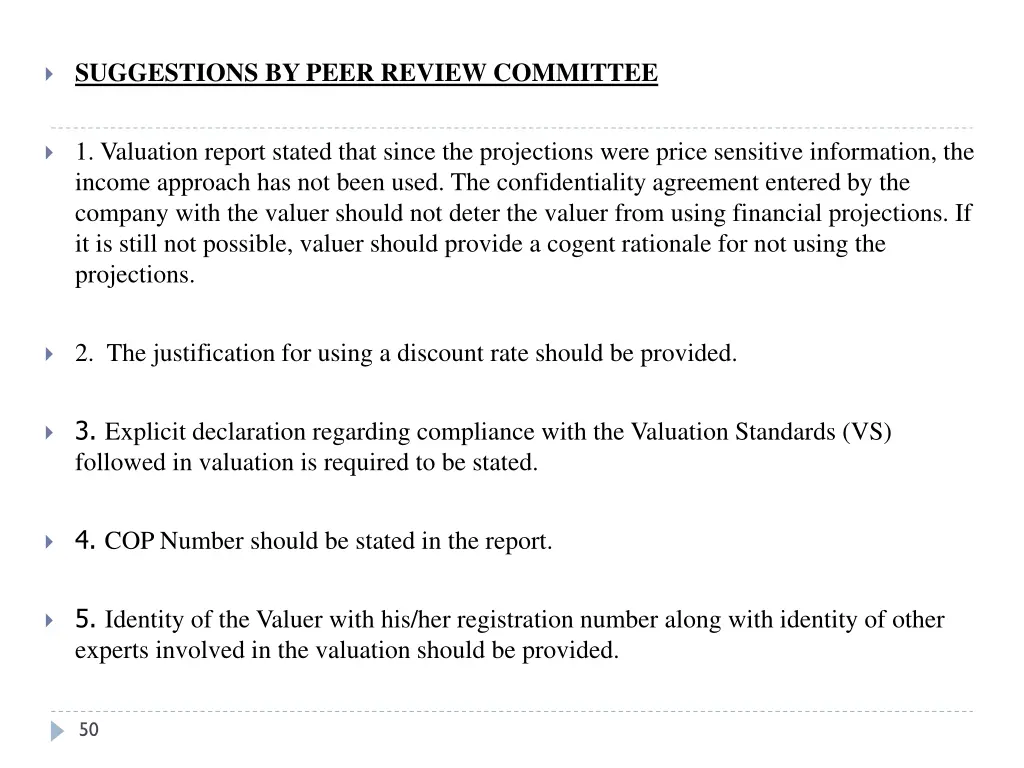
SUGGESTIONS BY PEER REVIEW COMMITTEE 1. Valuation report stated that since the projections were price sensitive information, the income approach has not been used. The confidentiality agreement entered by the company with the valuer should not deter the valuer from using financial projections. If it is still not possible, valuer should provide a cogent rationale for not using the projections. 2. The justification for using a discount rate should be provided. 3. Explicit declaration regarding compliance with the Valuation Standards (VS) followed in valuation is required to be stated. 4. COP Number should be stated in the report. 5. Identity of the Valuer with his/her registration number along with identity of other experts involved in the valuation should be provided. 50