Explore the fundamental concepts of variables and types in programming, including definitions, declarations, and initialization. Learn about explicit vs. implicit conversion, static vs. dynamic types, immutable vs. mutable variables, and more. Gain insights into how variables store values and how types define the range of values a variable can hold.
Please find below an Image/Link to download the presentation.
The content on the website is provided AS IS for your information and personal use only. It may not be sold, licensed, or shared on other websites without obtaining consent from the author. If you encounter any issues during the download, it is possible that the publisher has removed the file from their server.
You are allowed to download the files provided on this website for personal or commercial use, subject to the condition that they are used lawfully. All files are the property of their respective owners.
The content on the website is provided AS IS for your information and personal use only. It may not be sold, licensed, or shared on other websites without obtaining consent from the author.
E N D
Presentation Transcript
Variables, Types, Type Checking author nlahn@radford.edu; modified by ibarland@radford.edu. CC-BY 4.0
Today Defining a few basic concepts that have to do with variables / types These apply to many different languages Explicit vs. Implicit. Conversion Static vs. Dynamic Inferred types Immutable vs. Mutable author nlahn@radford.edu; modified by ibarland@radford.edu. CC-BY 4.0
What is a variable? author nlahn@radford.edu; modified by ibarland@radford.edu. CC-BY 4.0
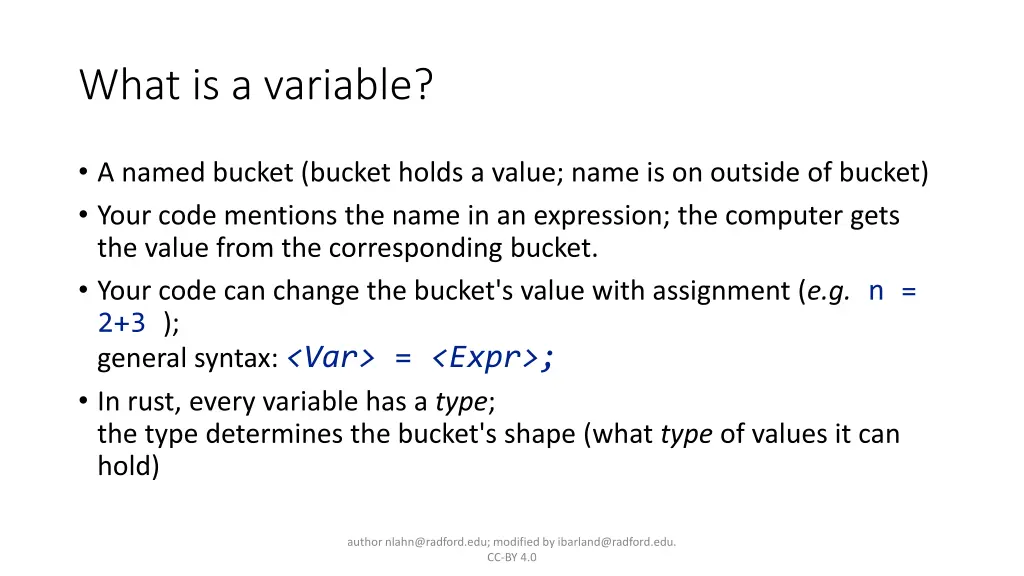
What is a variable? A named bucket (bucket holds a value; name is on outside of bucket) Your code mentions the name in an expression; the computer gets the value from the corresponding bucket. Your code can change the bucket's value with assignment (e.g. n = 2+3 ); general syntax: <Var> = <Expr>; In rust, every variable has a type; the type determines the bucket's shape (what type of values it can hold) author nlahn@radford.edu; modified by ibarland@radford.edu. CC-BY 4.0
What is a type? author nlahn@radford.edu; modified by ibarland@radford.edu. CC-BY 4.0
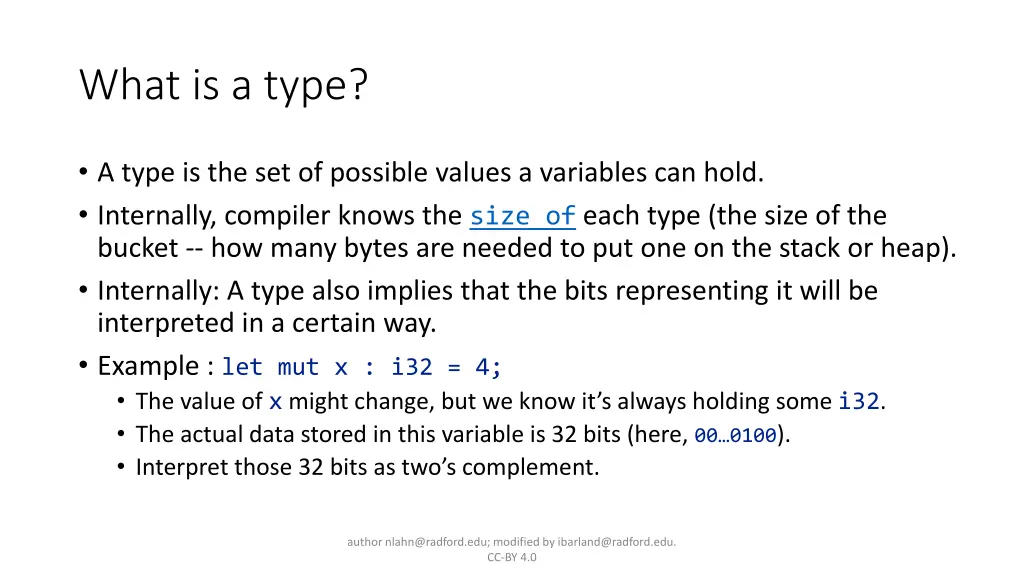
What is a type? A type is the set of possible values a variables can hold. Internally, compiler knows the size_of each type (the size of the bucket -- how many bytes are needed to put one on the stack or heap). Internally: A type also implies that the bits representing it will be interpreted in a certain way. Example : let mut x : i32 = 4; The value of xmight change, but we know it s always holding some i32. The actual data stored in this variable is 32 bits (here, 00 0100). Interpret those 32 bits as two s complement. author nlahn@radford.edu; modified by ibarland@radford.edu. CC-BY 4.0
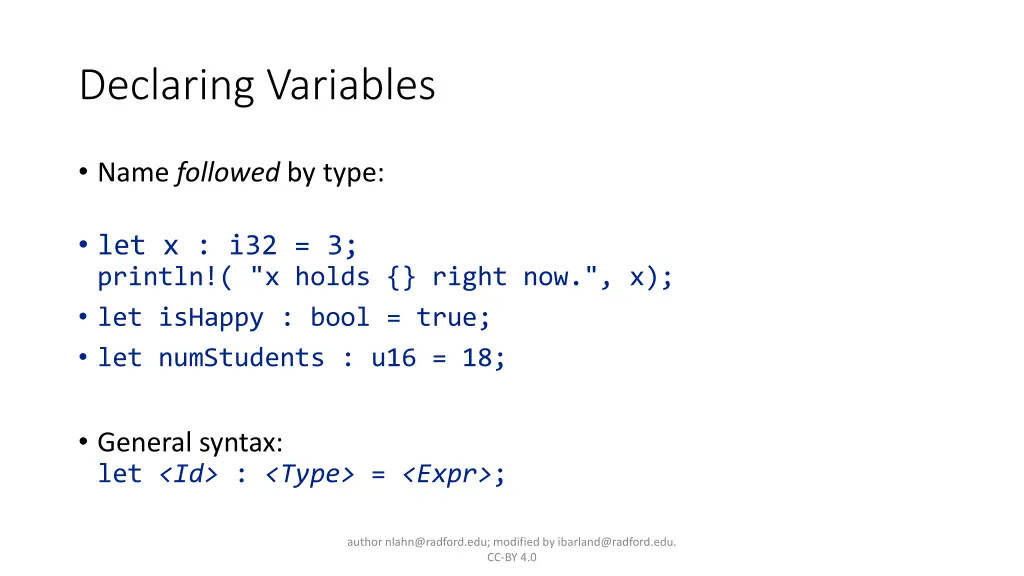
Declaring Variables Name followed by type: let x : i32 = 3; println!( "x holds {} right now.", x); let isHappy : bool = true; let numStudents : u16 = 18; General syntax: let <Id> : <Type> = <Expr>; author nlahn@radford.edu; modified by ibarland@radford.edu. CC-BY 4.0
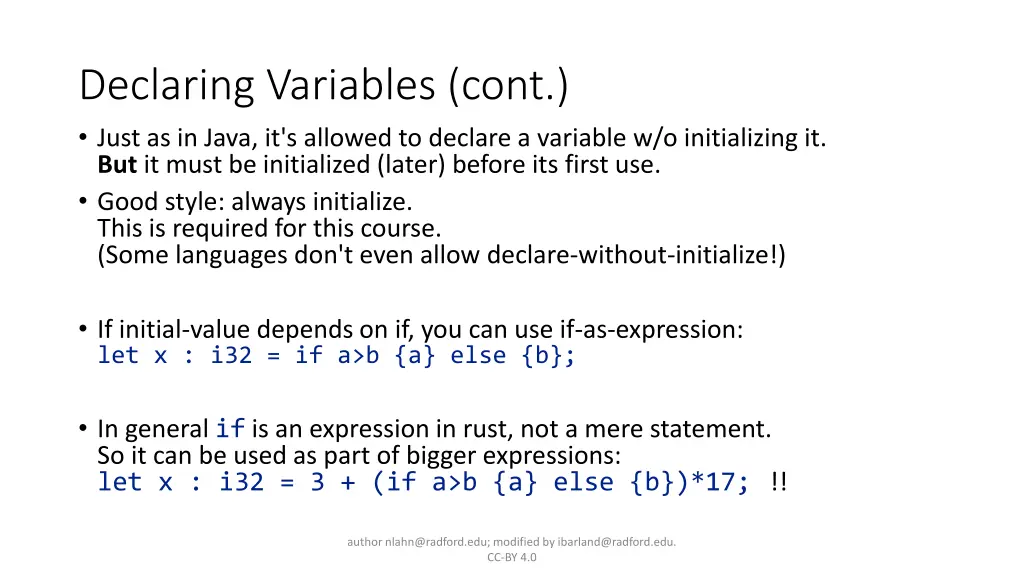
Declaring Variables (cont.) Just as in Java, it's allowed to declare a variable w/o initializing it. But it must be initialized (later) before its first use. Good style: always initialize. This is required for this course. (Some languages don't even allow declare-without-initialize!) If initial-value depends on if, you can use if-as-expression: let x : i32 = if a>b {a} else {b}; In general if is an expression in rust, not a mere statement. So it can be used as part of bigger expressions: let x : i32 = 3 + (if a>b {a} else {b})*17; !! author nlahn@radford.edu; modified by ibarland@radford.edu. CC-BY 4.0
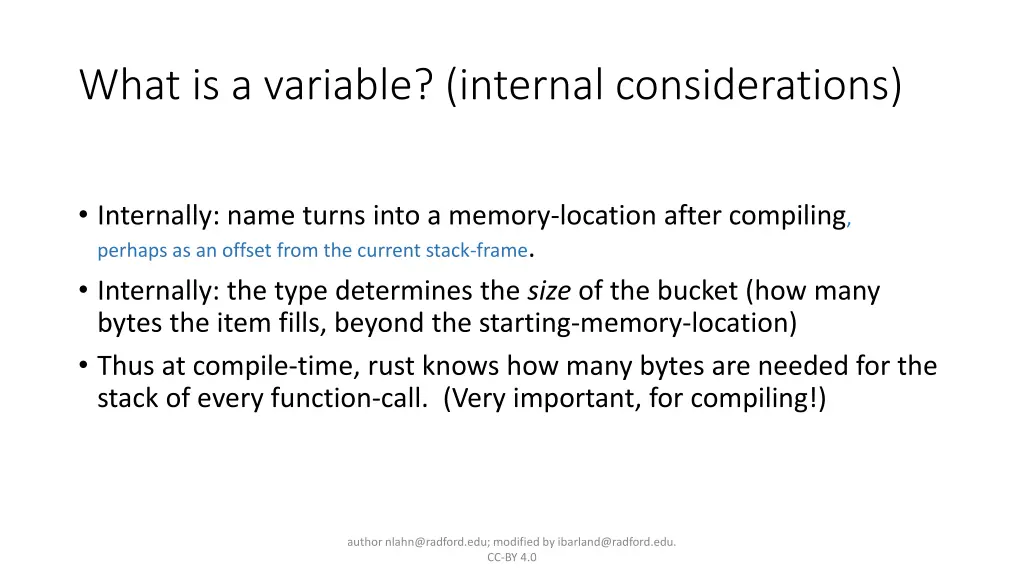
What is a variable? (internal considerations) Internally: name turns into a memory-location after compiling, perhaps as an offset from the current stack-frame. Internally: the type determines the size of the bucket (how many bytes the item fills, beyond the starting-memory-location) Thus at compile-time, rust knows how many bytes are needed for the stack of every function-call. (Very important, for compiling!) author nlahn@radford.edu; modified by ibarland@radford.edu. CC-BY 4.0
What is a type? (cont.) Each type also has a corresponding set of operations These may be defined as part of the type definition, or separately. Usually, the operations are functions ("methods"), but can also be operators (which are morally functions, but called infix rather than prefix). Ex: A Java class has: Fields: the sub-types comprising the overall class-type. Methods: defines the allowed operations on objects of this class/type. author nlahn@radford.edu; modified by ibarland@radford.edu. CC-BY 4.0
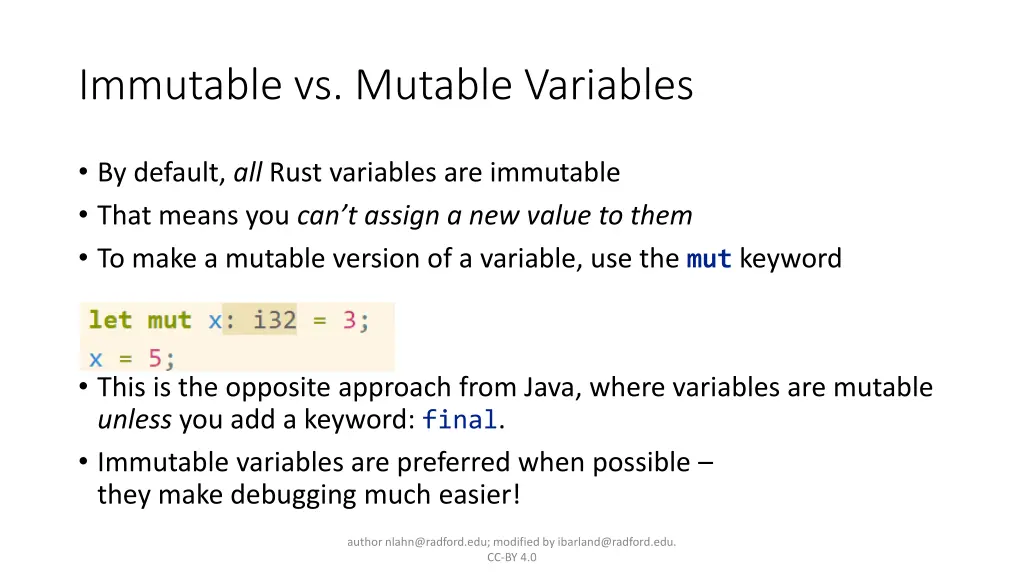
Immutable vs. Mutable Variables By default, all Rust variables are immutable That means you can t assign a new value to them To make a mutable version of a variable, use the mut keyword This is the opposite approach from Java, where variables are mutable unless you add a keyword: final. Immutable variables are preferred when possible they make debugging much easier! author nlahn@radford.edu; modified by ibarland@radford.edu. CC-BY 4.0
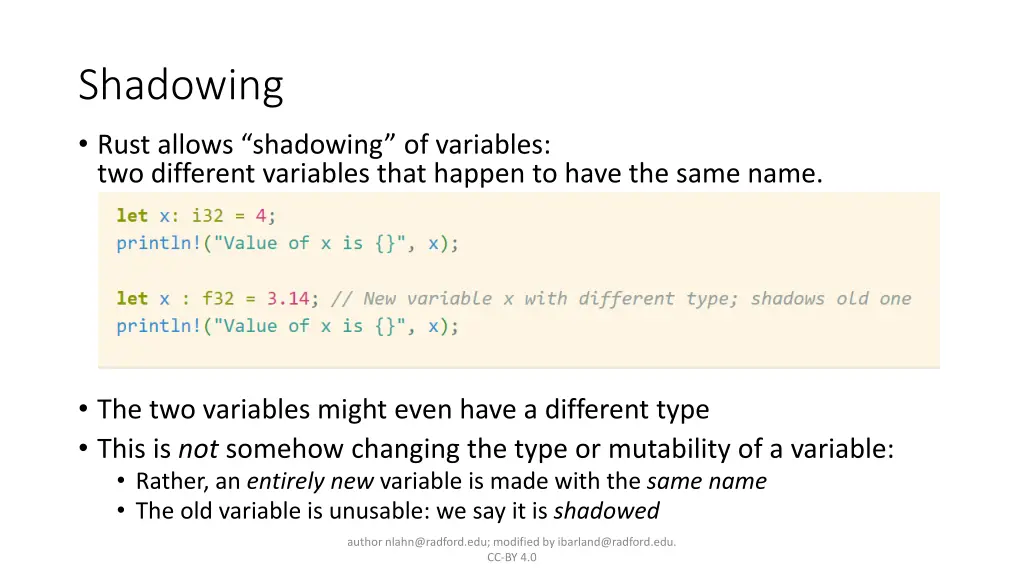
Shadowing Rust allows shadowing of variables: two different variables that happen to have the same name. The two variables might even have a different type This is not somehow changing the type or mutability of a variable: Rather, an entirely new variable is made with the same name The old variable is unusable: we say it is shadowed author nlahn@radford.edu; modified by ibarland@radford.edu. CC-BY 4.0
Implicit vs. Explicit Conversion Conversion: Replace a value of one type with a value of another type Explicit conversion : You have to explicitly tell the program to do the conversion Sometimes known as type casting It's a function (input: bits-for-int; return: bits-for-double); sometimes uses special syntax instead of function-call. Implicit conversion : The conversion-function is called automatically, without you having to say anything Sometimes known as type coercion author nlahn@radford.edu; modified by ibarland@radford.edu. CC-BY 4.0
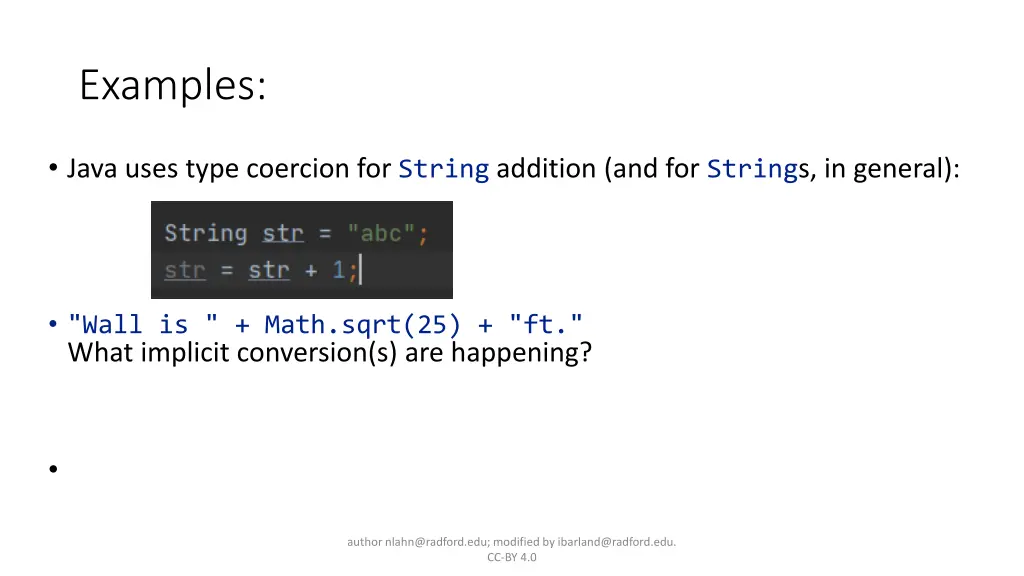
Examples: Java uses type coercion for String addition (and for Strings, in general): "Wall is " + Math.sqrt(25) + "ft." What implicit conversion(s) are happening? author nlahn@radford.edu; modified by ibarland@radford.edu. CC-BY 4.0
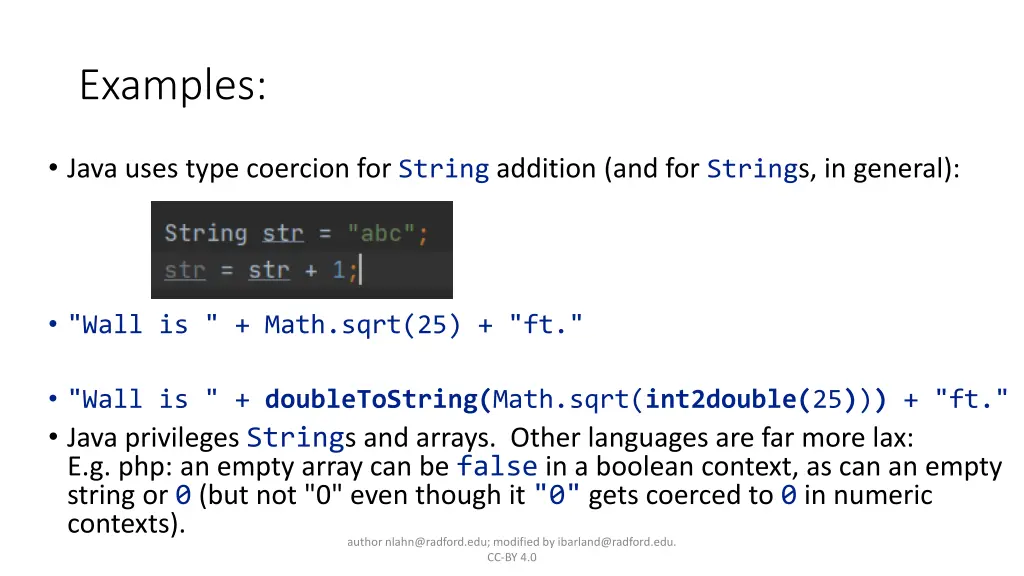
Examples: Java uses type coercion for String addition (and for Strings, in general): "Wall is " + Math.sqrt(25) + "ft." "Wall is " + doubleToString(Math.sqrt(int2double(25))) + "ft." Java privileges Strings and arrays. Other languages are far more lax: E.g. php: an empty array can be false in a boolean context, as can an empty string or 0 (but not "0" even though it "0" gets coerced to 0 in numeric contexts). author nlahn@radford.edu; modified by ibarland@radford.edu. CC-BY 4.0
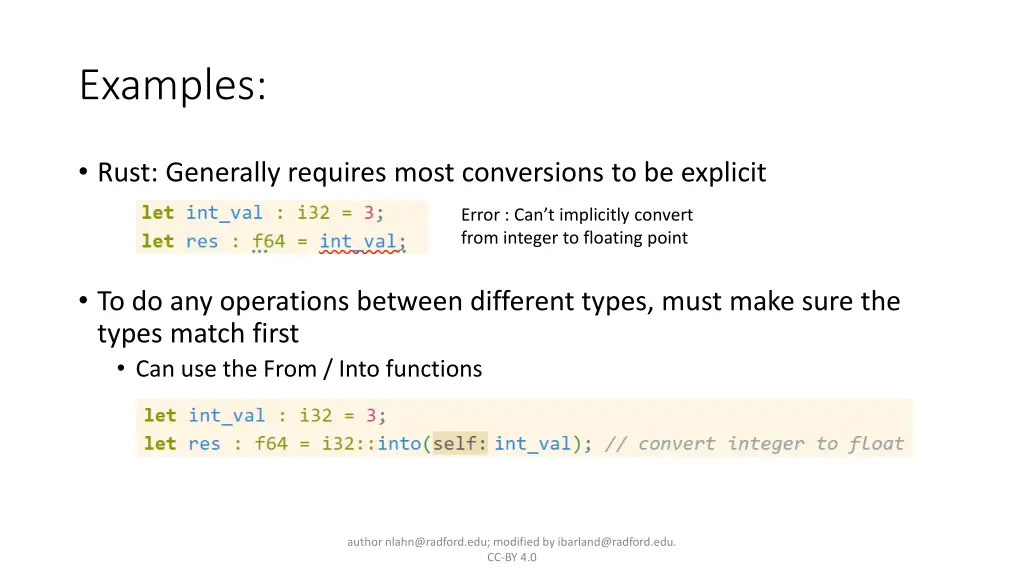
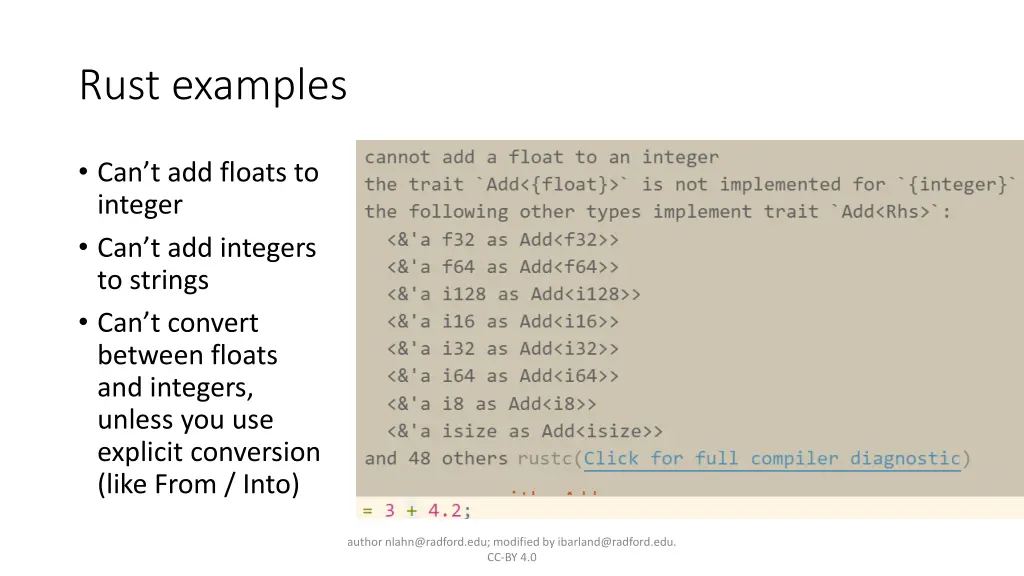
Examples: Rust: Generally requires most conversions to be explicit Error : Can t implicitly convert from integer to floating point To do any operations between different types, must make sure the types match first Can use the From / Into functions author nlahn@radford.edu; modified by ibarland@radford.edu. CC-BY 4.0
Strong vs. Weak Typing author nlahn@radford.edu; modified by ibarland@radford.edu. CC-BY 4.0
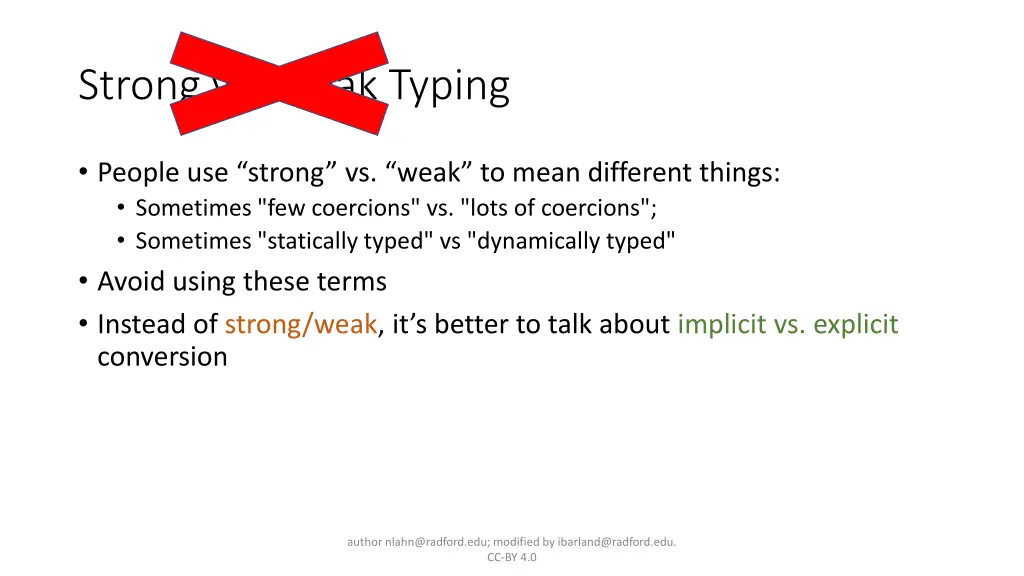
Strong vs. Weak Typing People use strong vs. weak to mean different things: Sometimes "few coercions" vs. "lots of coercions"; Sometimes "statically typed" vs "dynamically typed" Avoid using these terms Instead of strong/weak, it s better to talk about implicit vs. explicit conversion author nlahn@radford.edu; modified by ibarland@radford.edu. CC-BY 4.0
Rust is Statically Typed Variables in Rust are statically associated with a type That means: The type is known at compile time The type can never change Thus Rust always knows the size needed to hold or pass that variable. There are a few exceptions involving polymorphism, but they are rare (and complicated) author nlahn@radford.edu; modified by ibarland@radford.edu. CC-BY 4.0
Comparison: Static Vs. Dynamic typing Generally, statically handling something is faster and safer Faster : Fewer checks needed at runtime Safer : Error detected when program is compiled; no debugging needed. (That is: if it compiles, the compiler has proven there are no type-errors!) Dynamic handling is sometimes necessary though for flexibility. An error might lurk, if your unit-tests weren't thorough. author nlahn@radford.edu; modified by ibarland@radford.edu. CC-BY 4.0
Rust examples Can t add floats to integer Can t add integers to strings Can t convert between floats and integers, unless you use explicit conversion (like From / Into) author nlahn@radford.edu; modified by ibarland@radford.edu. CC-BY 4.0
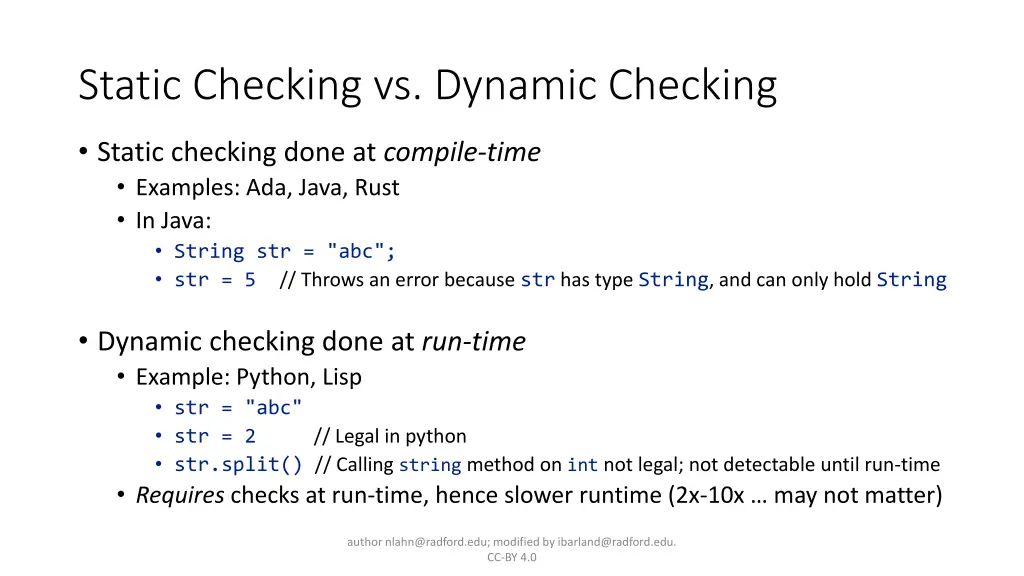
Static Checking vs. Dynamic Checking Static checking done at compile-time Examples: Ada, Java, Rust In Java: String str = "abc"; str = 5 // Throws an error because str has type String, and can only hold String Dynamic checking done at run-time Example: Python, Lisp str = "abc" str = 2 // Legal in python str.split() // Calling string method on int not legal; not detectable until run-time Requires checks at run-time, hence slower runtime (2x-10x may not matter) author nlahn@radford.edu; modified by ibarland@radford.edu. CC-BY 4.0
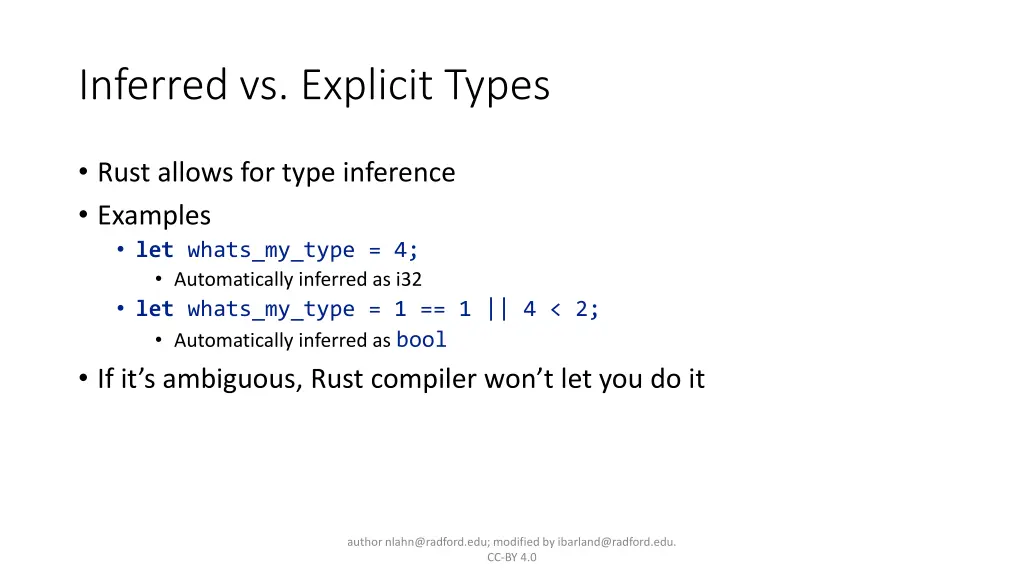
Inferred vs. Explicit Types Rust allows for type inference Examples let whats_my_type = 4; Automatically inferred as i32 let whats_my_type = 1 == 1 || 4 < 2; Automatically inferred as bool If it s ambiguous, Rust compiler won t let you do it author nlahn@radford.edu; modified by ibarland@radford.edu. CC-BY 4.0
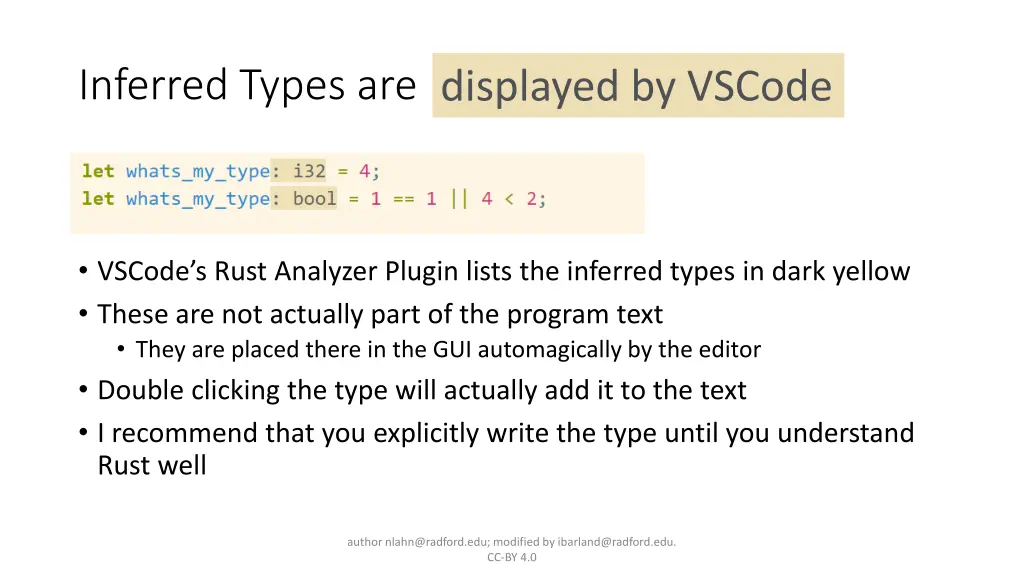
Inferred Types are displayed by VSCode VSCode s Rust Analyzer Plugin lists the inferred types in dark yellow These are not actually part of the program text They are placed there in the GUI automagically by the editor Double clicking the type will actually add it to the text I recommend that you explicitly write the type until you understand Rust well author nlahn@radford.edu; modified by ibarland@radford.edu. CC-BY 4.0