Explore the concepts of relative velocity of two bodies moving in straight lines, motion of a link, and velocity analysis in the field of Kinematics of Machines. Understand how to calculate relative velocities and apply laws of parallelogram/triangle of velocities. Prepared by Prof. Divyesh B. Patel from L.E. College, Morbi.
Please find below an Image/Link to download the presentation.
The content on the website is provided AS IS for your information and personal use only. It may not be sold, licensed, or shared on other websites without obtaining consent from the author. If you encounter any issues during the download, it is possible that the publisher has removed the file from their server.
You are allowed to download the files provided on this website for personal or commercial use, subject to the condition that they are used lawfully. All files are the property of their respective owners.
The content on the website is provided AS IS for your information and personal use only. It may not be sold, licensed, or shared on other websites without obtaining consent from the author.
E N D
Presentation Transcript
KINEMATICS OF MACHINES (KOM) L. E. College, Morbi-2 Industrial Engineering Department Chapter-02 Velocity and Acceleration Analysis of Mechanisms: Prepared by Prof. Divyesh B.Patel Mechanical Engg. Dept LE. College, Morbi +919925282644 divyesh21dragon@gmail.com
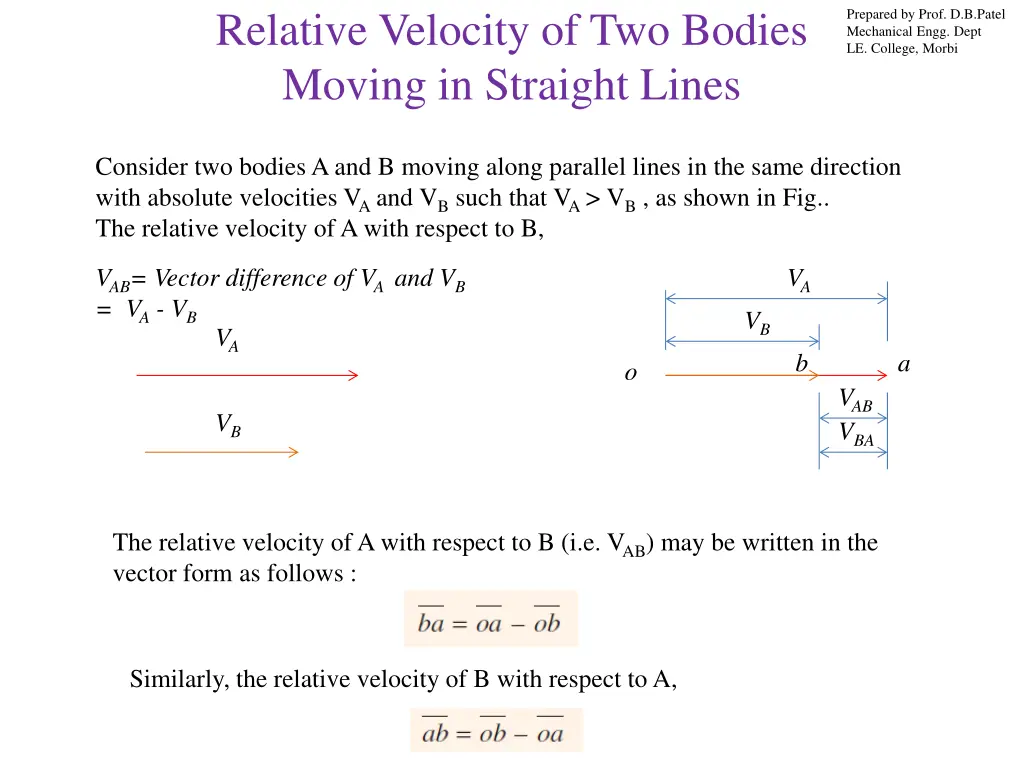
Relative Velocity of Two Bodies Moving in Straight Lines Prepared by Prof. D.B.Patel Mechanical Engg. Dept LE. College, Morbi Consider two bodies A and B moving along parallel lines in the same direction with absolute velocities VA and VB such that VA > VB , as shown in Fig.. The relative velocity of A with respect to B, VAB= Vector difference of VA and VB = VA - VB VA VB VA b a o VAB VBA VB The relative velocity of A with respect to B (i.e. VAB) may be written in the vector form as follows : Similarly, the relative velocity of B with respect to A,
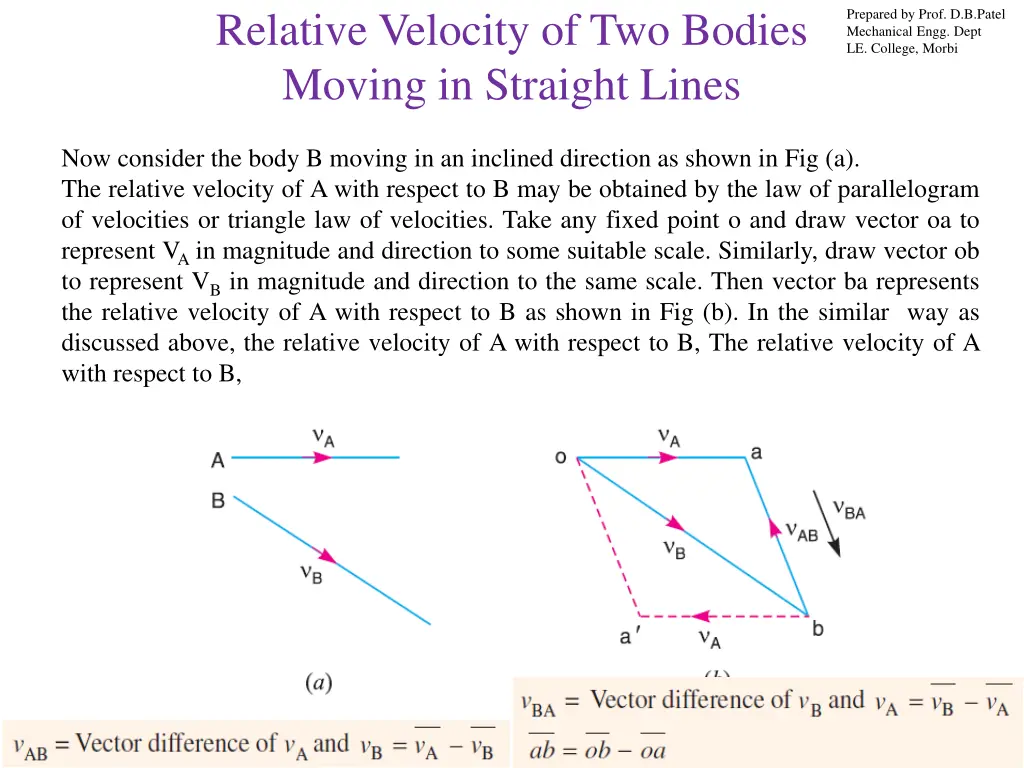
Relative Velocity of Two Bodies Moving in Straight Lines Prepared by Prof. D.B.Patel Mechanical Engg. Dept LE. College, Morbi Now consider the body B moving in an inclined direction as shown in Fig (a). The relative velocity of A with respect to B may be obtained by the law of parallelogram of velocities or triangle law of velocities. Take any fixed point o and draw vector oa to represent VA in magnitude and direction to some suitable scale. Similarly, draw vector ob to represent VB in magnitude and direction to the same scale. Then vector ba represents the relative velocity of A with respect to B as shown in Fig (b). In the similar way as discussed above, the relative velocity of A with respect to B, The relative velocity of A with respect to B,
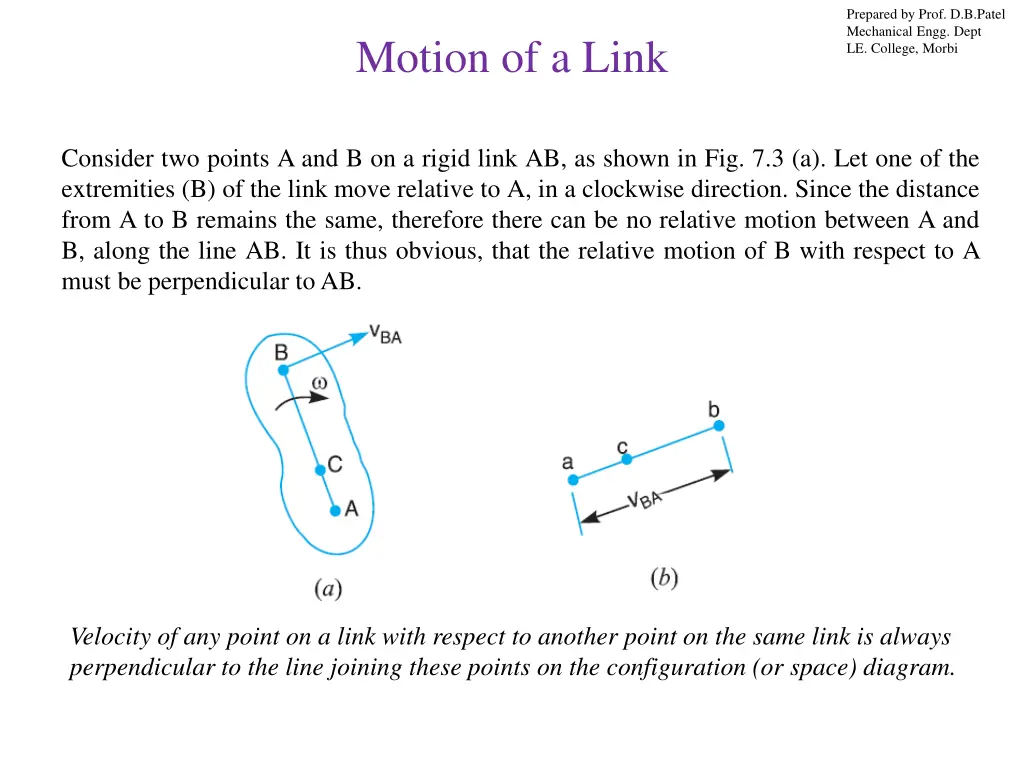
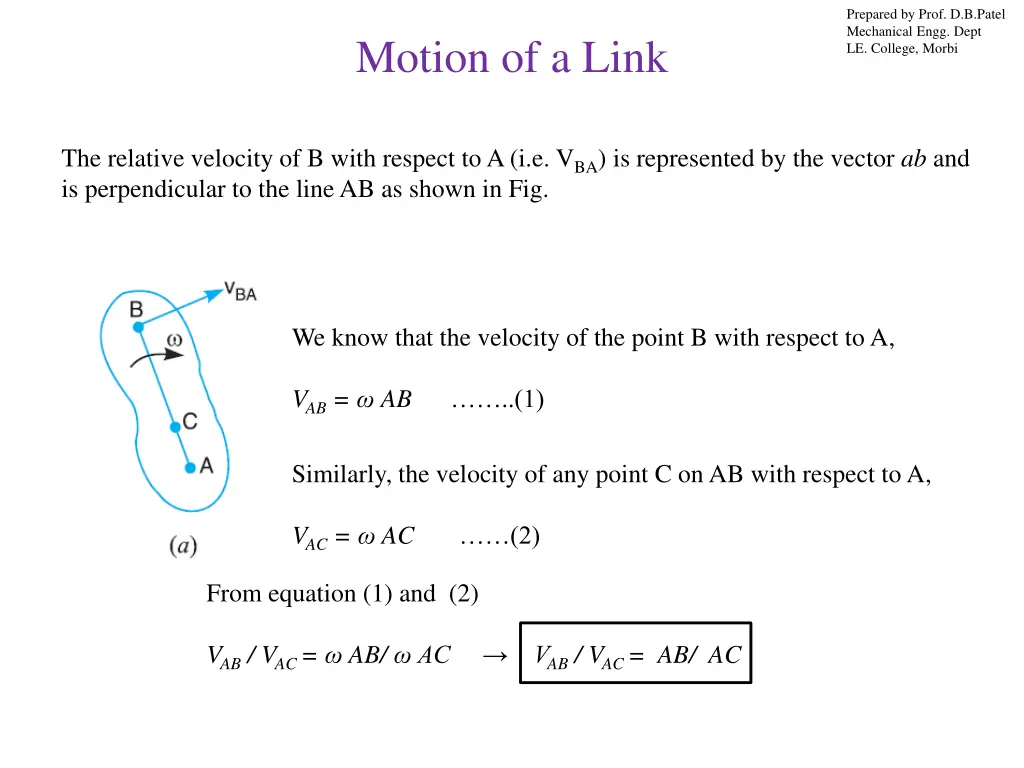
Prepared by Prof. D.B.Patel Mechanical Engg. Dept LE. College, Morbi Motion of a Link Consider two points A and B on a rigid link AB, as shown in Fig. 7.3 (a). Let one of the extremities (B) of the link move relative to A, in a clockwise direction. Since the distance from A to B remains the same, therefore there can be no relative motion between A and B, along the line AB. It is thus obvious, that the relative motion of B with respect to A must be perpendicular to AB. Velocity of any point on a link with respect to another point on the same link is always perpendicular to the line joining these points on the configuration (or space) diagram.
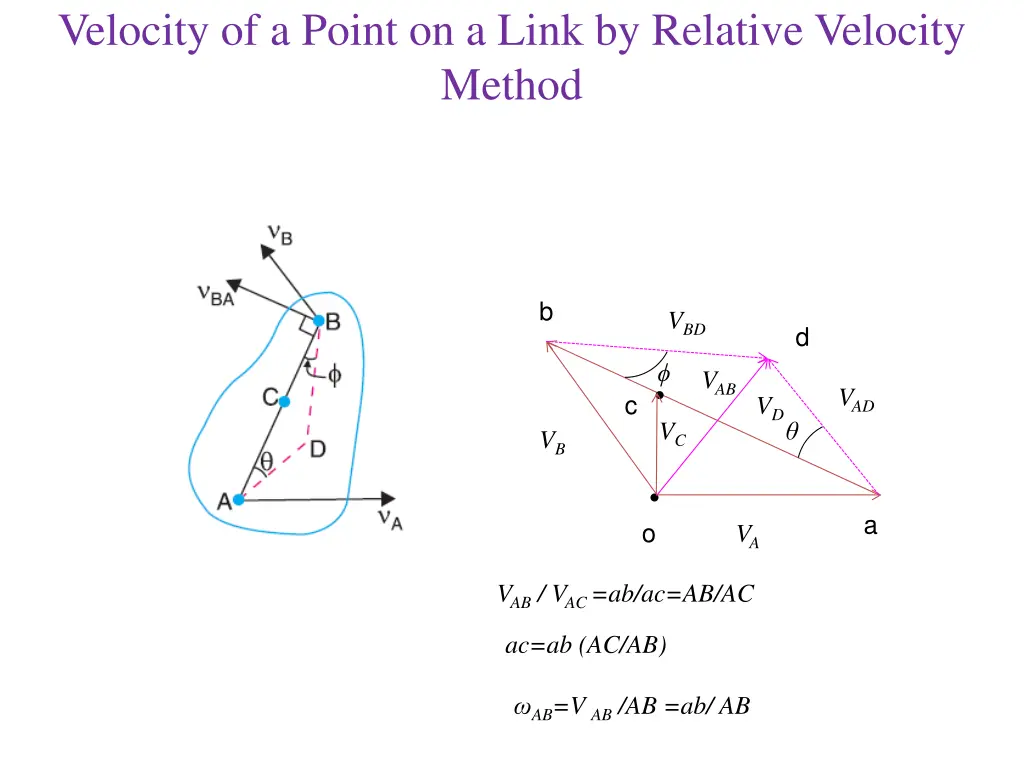
Prepared by Prof. D.B.Patel Mechanical Engg. Dept LE. College, Morbi Motion of a Link The relative velocity of B with respect to A (i.e. VBA) is represented by the vector ab and is perpendicular to the line AB as shown in Fig. We know that the velocity of the point B with respect to A, VAB = AB ..(1) Similarly, the velocity of any point C on AB with respect to A, VAC = AC (2) From equation (1) and (2) VAB / VAC = AB/ AC VAB / VAC = AB/ AC
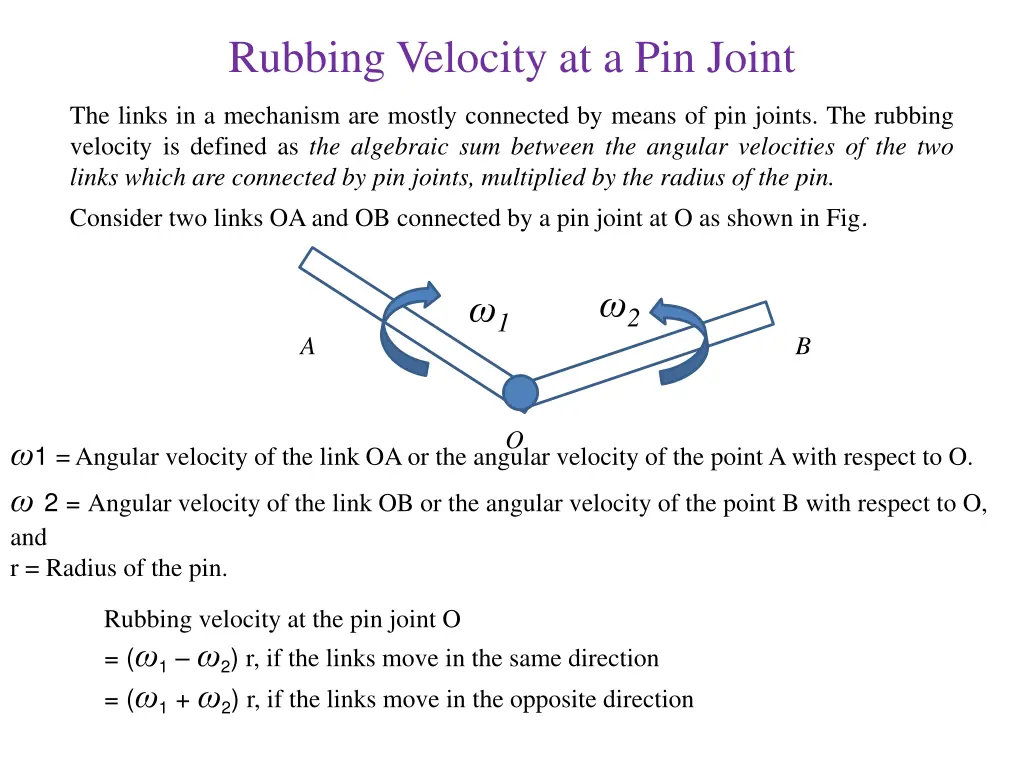
Rubbing Velocity at a Pin Joint The links in a mechanism are mostly connected by means of pin joints. The rubbing velocity is defined as the algebraic sum between the angular velocities of the two links which are connected by pin joints, multiplied by the radius of the pin. Consider two links OA and OB connected by a pin joint at O as shown in Fig. 2 1 A B O 1 = Angular velocity of the link OA or the angular velocity of the point A with respect to O. 2 = Angular velocity of the link OB or the angular velocity of the point B with respect to O, and r = Radius of the pin. Rubbing velocity at the pin joint O = ( 1 2) r, if the links move in the same direction = ( 1 + 2) r, if the links move in the opposite direction
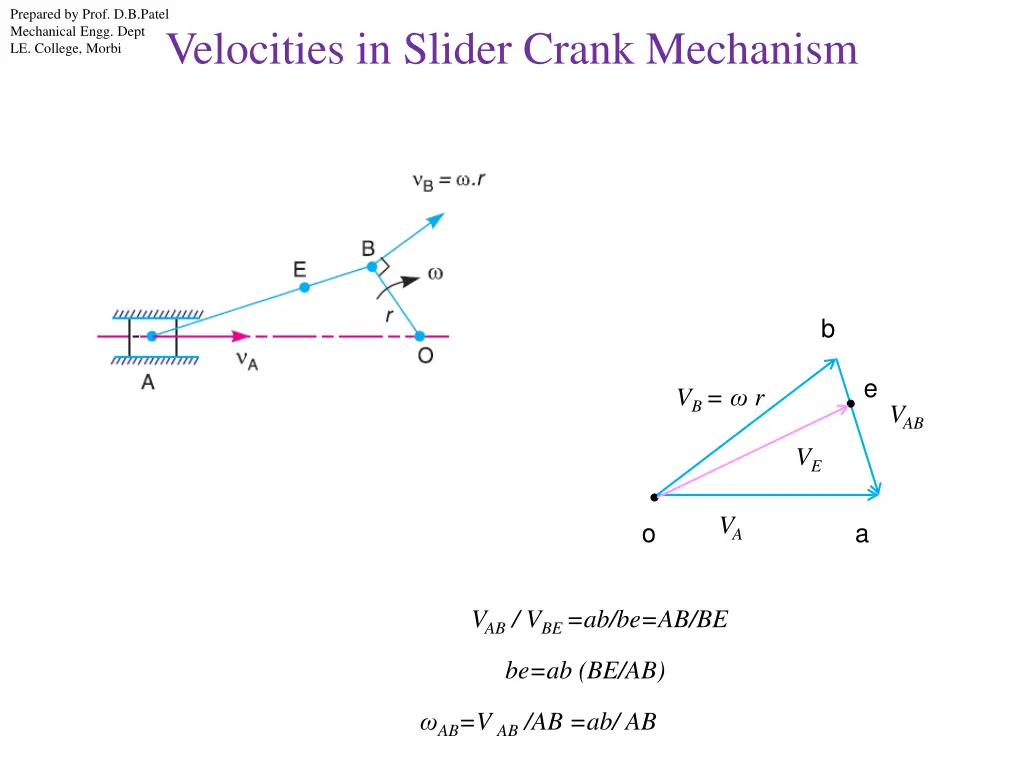
Prepared by Prof. D.B.Patel Mechanical Engg. Dept LE. College, Morbi Velocities in Slider Crank Mechanism b e VB = r VAB VE VA o a VAB / VBE =ab/be=AB/BE be=ab (BE/AB) AB=VAB /AB =ab/ AB
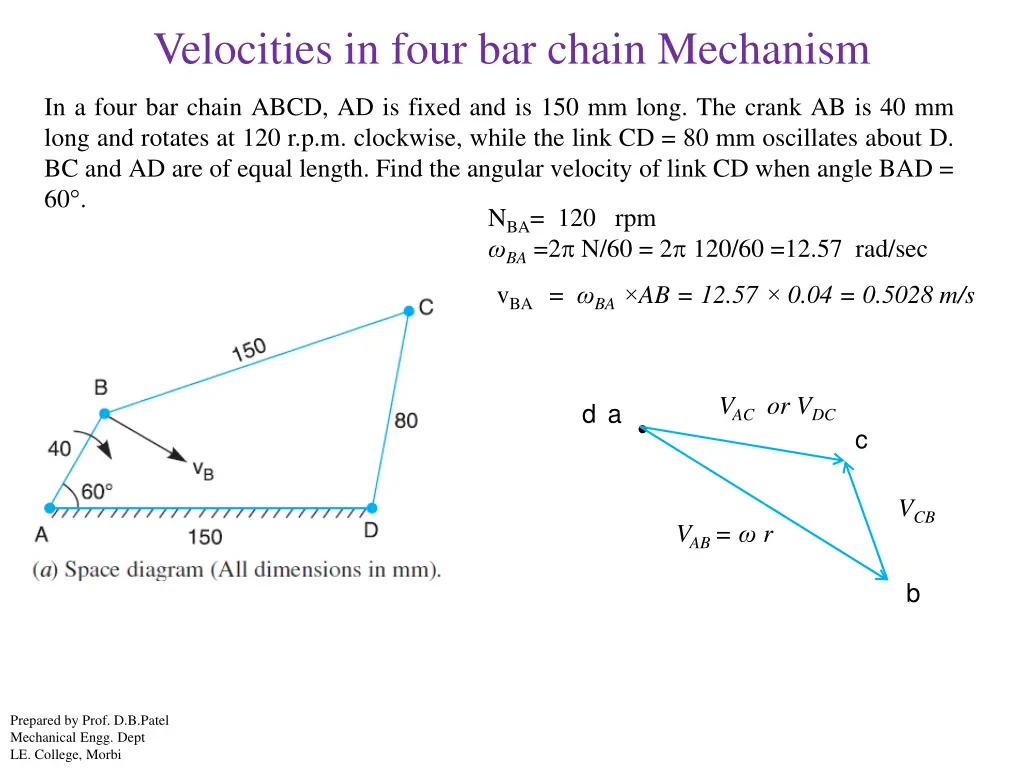
Velocities in four bar chain Mechanism In a four bar chain ABCD, AD is fixed and is 150 mm long. The crank AB is 40 mm long and rotates at 120 r.p.m. clockwise, while the link CD = 80 mm oscillates about D. BC and AD are of equal length. Find the angular velocity of link CD when angle BAD = 60 . NBA= 120 rpm BA =2 N/60 = 2 120/60 =12.57 rad/sec vBA = BA AB = 12.57 0.04 = 0.5028 m/s VAC or VDC d a c VCB VAB = r b Prepared by Prof. D.B.Patel Mechanical Engg. Dept LE. College, Morbi