Verification
In this lecture series by Joel Grodstein and Scott Taylor at Tufts University, the topics cover generating stimulus, random vs. directed testing, writing tests efficiently, and the effectiveness of randomness in testing. The content provides insights into the challenges of verification, the importance of test quality over quantity, and the benefits of machine-generated testing scenarios. Overall, the discussion delves into the complexities of verification processes in the context of hardware and software testing.

Uploaded on Feb 15, 2025 | 0 Views
Download Presentation

Please find below an Image/Link to download the presentation.
The content on the website is provided AS IS for your information and personal use only. It may not be sold, licensed, or shared on other websites without obtaining consent from the author.If you encounter any issues during the download, it is possible that the publisher has removed the file from their server.
You are allowed to download the files provided on this website for personal or commercial use, subject to the condition that they are used lawfully. All files are the property of their respective owners.
The content on the website is provided AS IS for your information and personal use only. It may not be sold, licensed, or shared on other websites without obtaining consent from the author.
E N D
Presentation Transcript
Verification Spring 2022 Tufts University Instructors: Joel Grodstein, Scott Taylor Generating stimulus Verification 1 Joel Grodstein/Scott Taylor
Outline of this lecture Random & directed the basics FPU case study CPU case study Fancy stuff: machine learning Error injection Verification 2 Joel Grodstein/Scott Taylor
Generating test content Word association game good verification write lots of tests More the better So how do you generate stimulus, and lots of it? Aside: we know now there s more to verification than generating stimulus, right? Review but what exactly? Well: monitors, checkers, coverage measures, Verification 3 Joel Grodstein/Scott Taylor
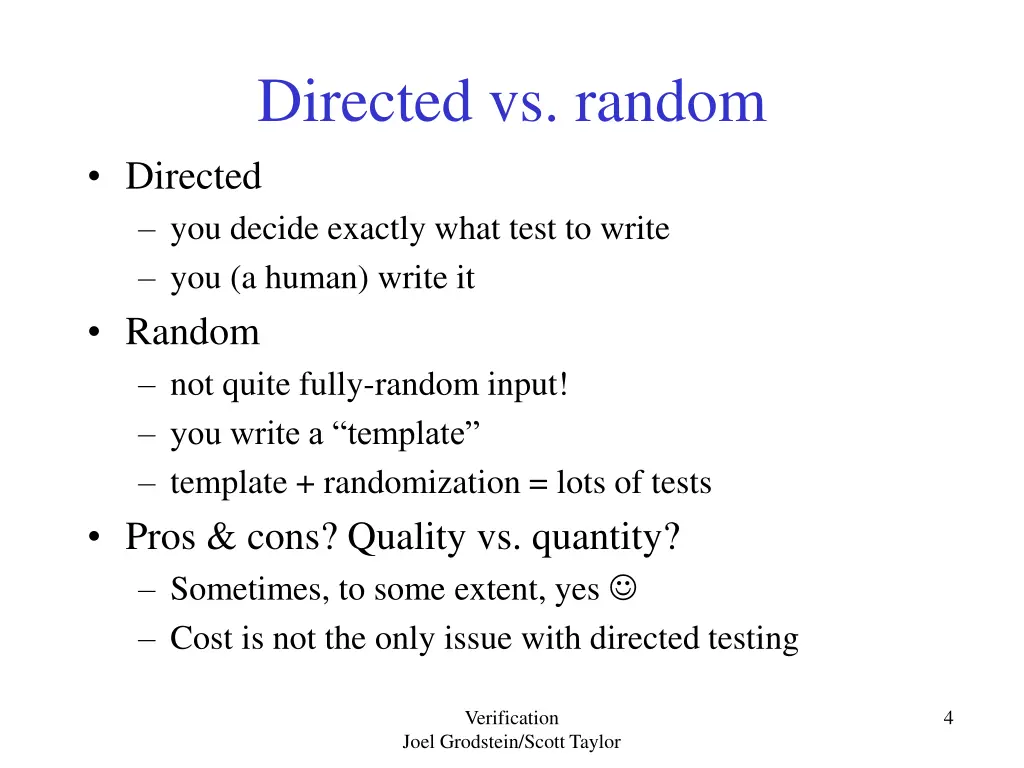
Directed vs. random Directed you decide exactly what test to write you (a human) write it Random not quite fully-random input! you write a template template + randomization = lots of tests Pros & cons? Quality vs. quantity? Sometimes, to some extent, yes Cost is not the only issue with directed testing Verification 4 Joel Grodstein/Scott Taylor
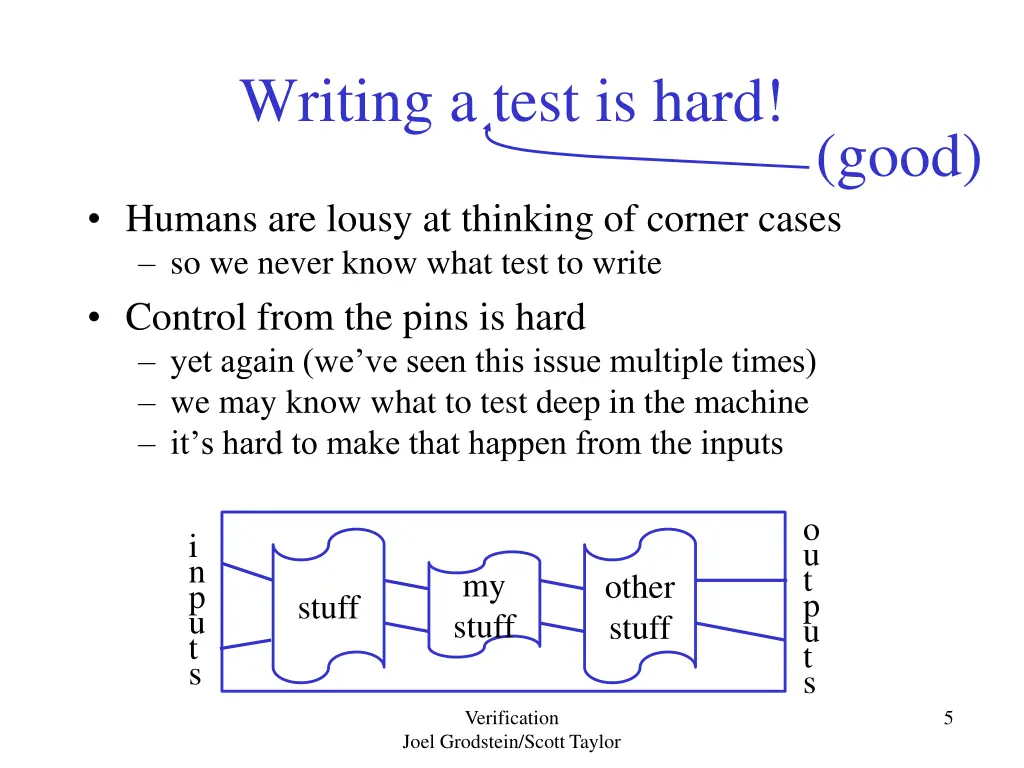
Writing a test is hard! (good) Humans are lousy at thinking of corner cases so we never know what test to write Control from the pins is hard yet again (we ve seen this issue multiple times) we may know what to test deep in the machine it s hard to make that happen from the inputs outpu ts inputs my stuff other stuff stuff Verification 5 Joel Grodstein/Scott Taylor
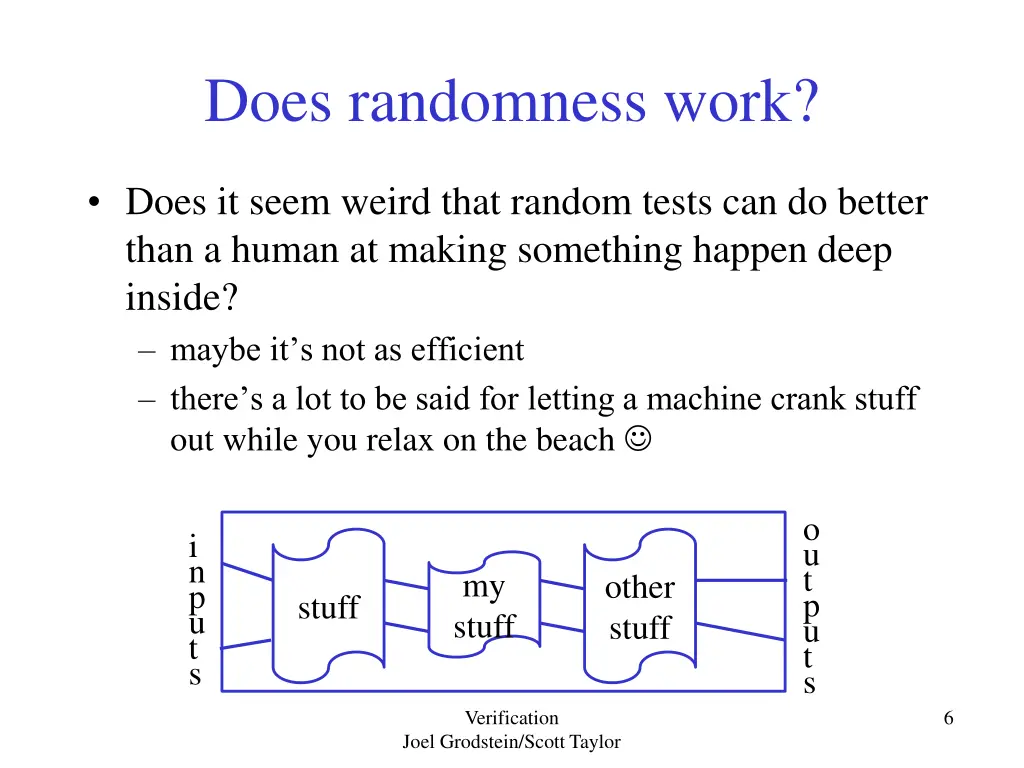
Does randomness work? Does it seem weird that random tests can do better than a human at making something happen deep inside? maybe it s not as efficient there s a lot to be said for letting a machine crank stuff out while you relax on the beach outpu ts inputs my stuff other stuff stuff Verification 6 Joel Grodstein/Scott Taylor
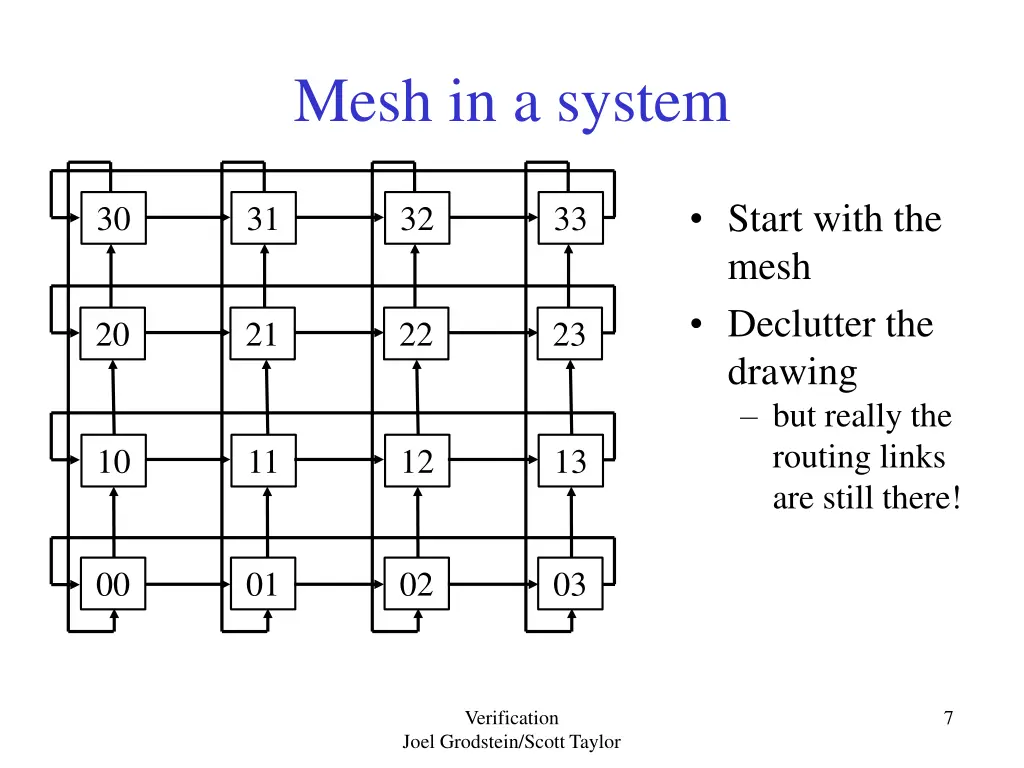
Mesh in a system Start with the mesh Declutter the drawing but really the routing links are still there! 30 31 32 33 20 21 22 23 10 11 12 13 00 01 02 03 Verification 7 Joel Grodstein/Scott Taylor
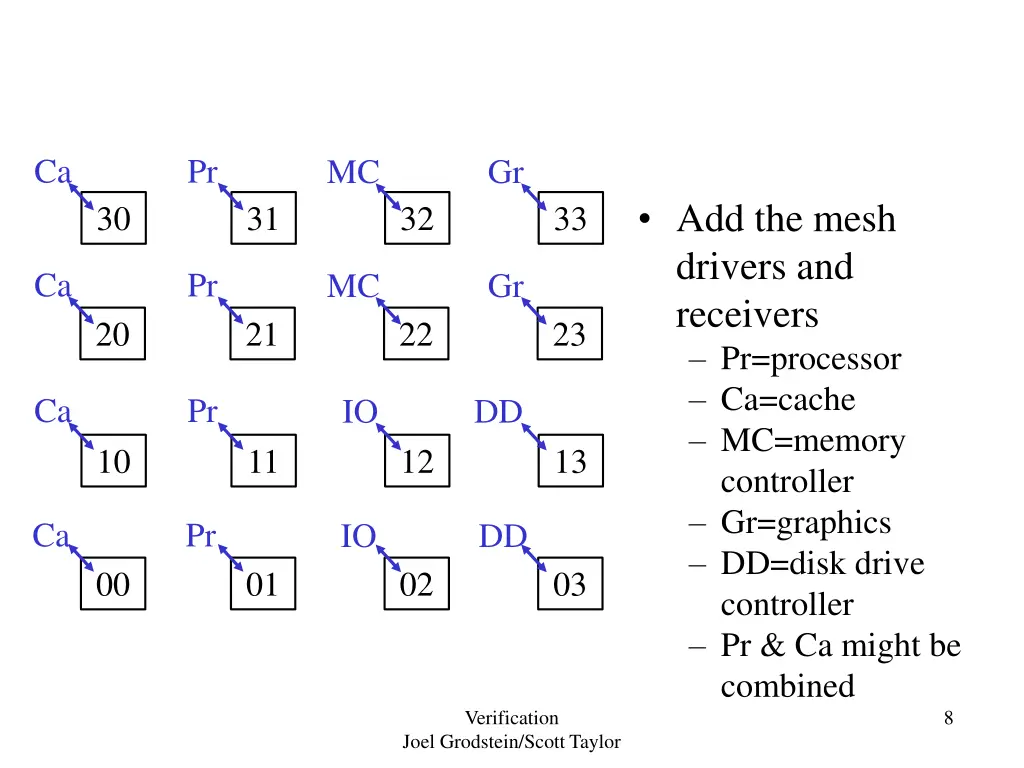
Ca Pr MC Gr Add the mesh drivers and receivers Pr=processor Ca=cache MC=memory controller Gr=graphics DD=disk drive controller Pr & Ca might be combined 30 31 32 33 Ca Pr MC Gr 20 21 22 23 Ca Pr IO DD 10 11 12 13 Ca Pr IO DD 00 01 02 03 Verification 8 Joel Grodstein/Scott Taylor
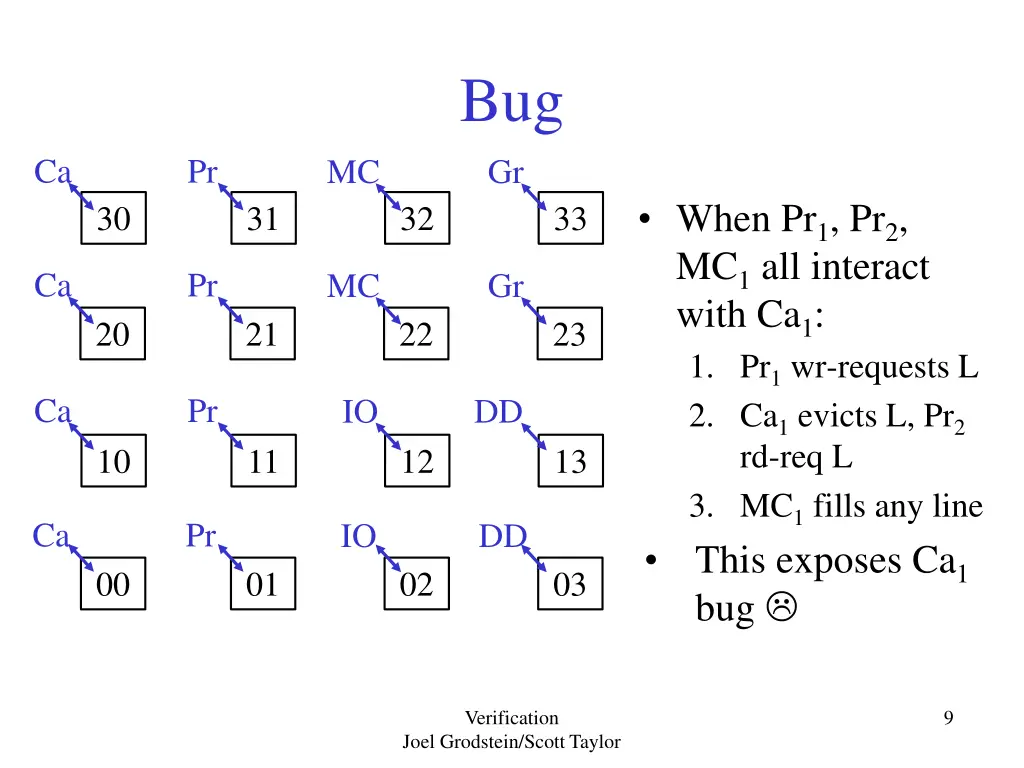
Bug Ca Pr MC Gr When Pr1, Pr2, MC1 all interact with Ca1: 1. Pr1 wr-requests L 2. Ca1 evicts L, Pr2 rd-req L 3. MC1 fills any line This exposes Ca1 bug 30 31 32 33 Ca Pr MC Gr 20 21 22 23 Ca Pr IO DD 10 11 12 13 Ca Pr IO DD 00 01 02 03 Verification 9 Joel Grodstein/Scott Taylor
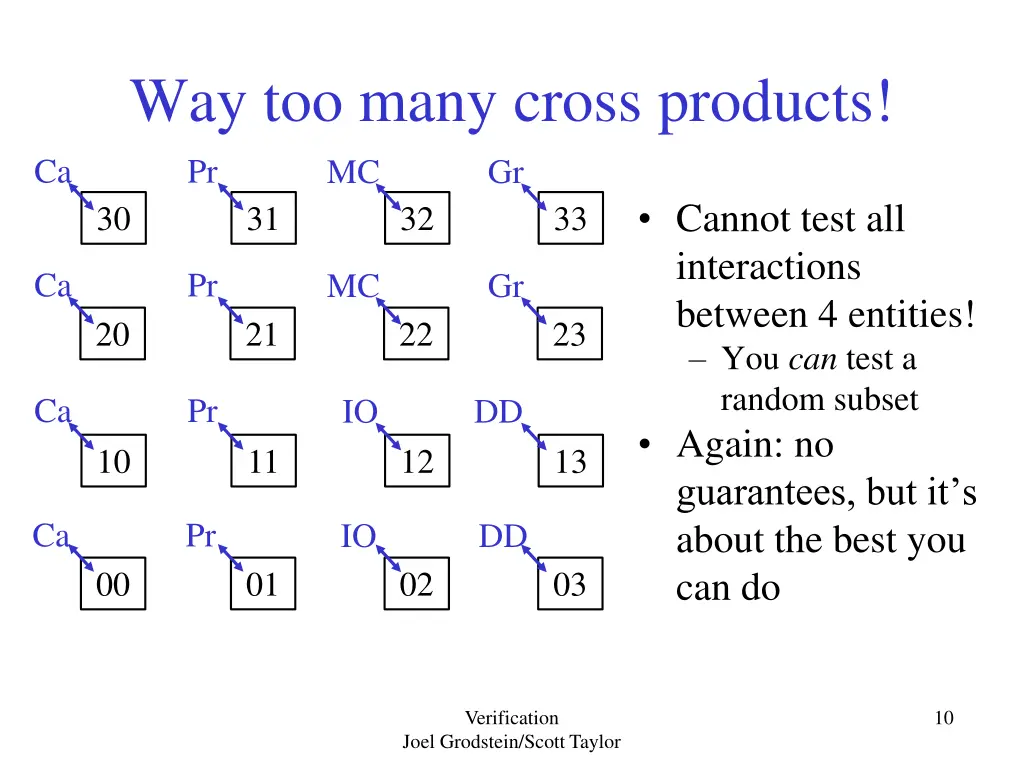
Way too many cross products! Ca Pr MC Gr Cannot test all interactions between 4 entities! You can test a random subset Again: no guarantees, but it s about the best you can do 30 31 32 33 Ca Pr MC Gr 20 21 22 23 Ca Pr IO DD 10 11 12 13 Ca Pr IO DD 00 01 02 03 Verification 10 Joel Grodstein/Scott Taylor
Outline of this lecture Random & directed the basics FPU case study CPU case study Fancy stuff: machine learning Error injection Verification 11 Joel Grodstein/Scott Taylor
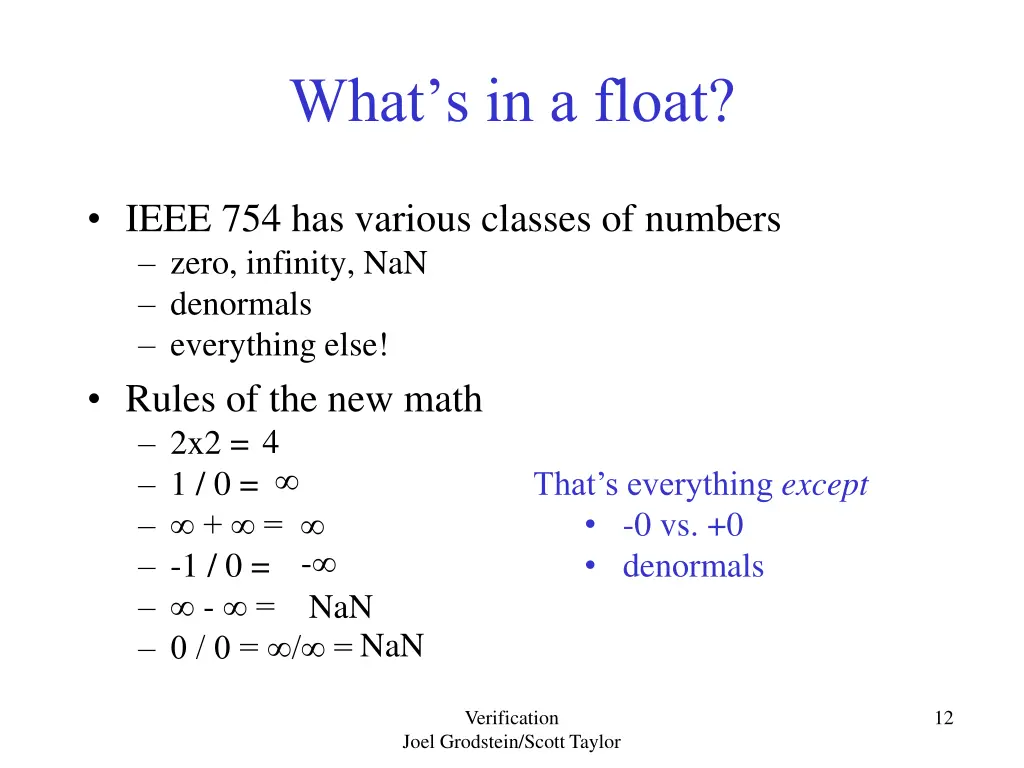
Whats in a float? IEEE 754 has various classes of numbers zero, infinity, NaN denormals everything else! Rules of the new math 2x2 = 1 / 0 = + = -1 / 0 = - = 0 / 0 = / = NaN 4 That s everything except -0 vs. +0 denormals - NaN Verification 12 Joel Grodstein/Scott Taylor
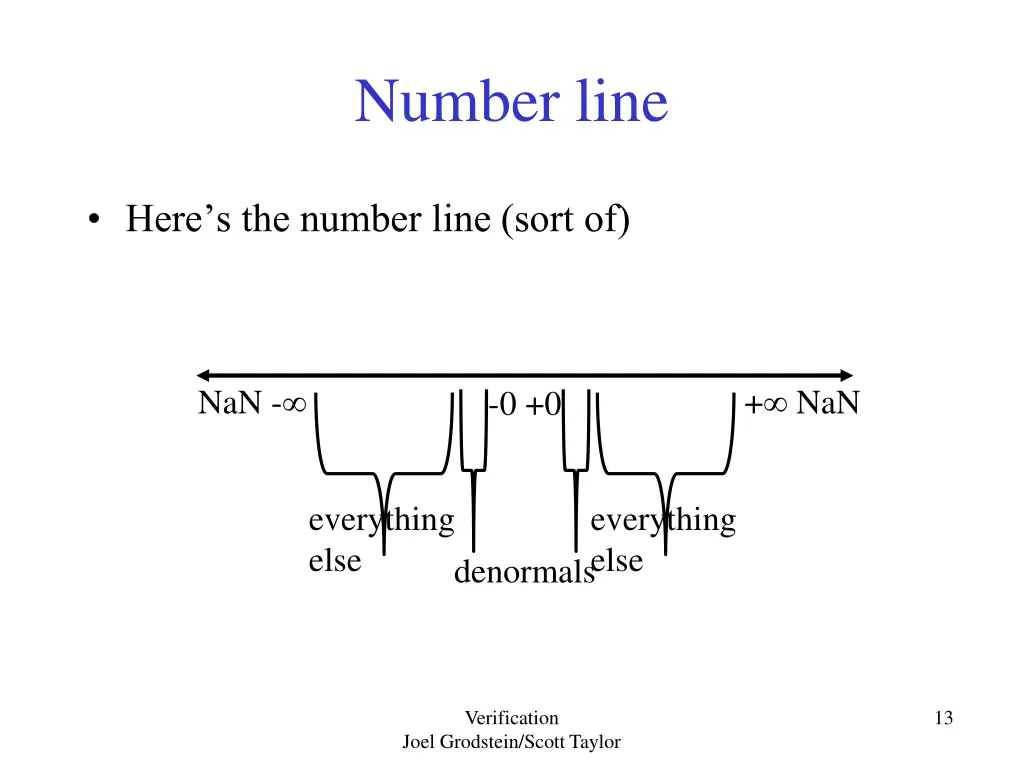
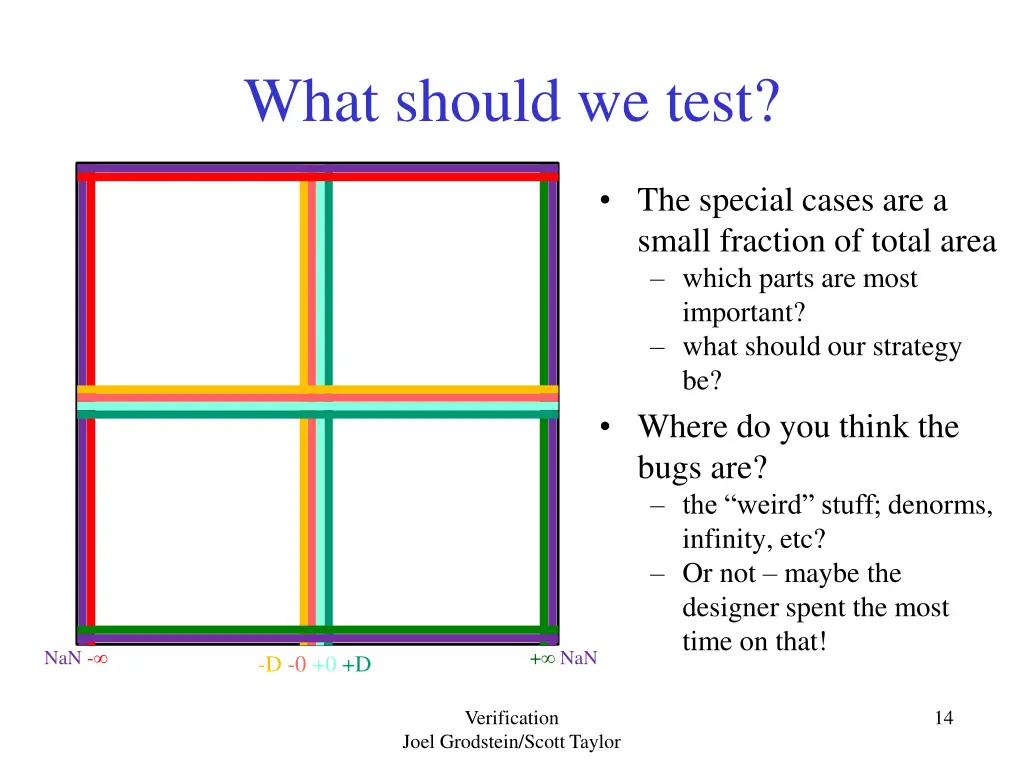
Number line Here s the number line (sort of) NaN - + NaN -0 +0 everything else everything else denormals Verification 13 Joel Grodstein/Scott Taylor
What should we test? The special cases are a small fraction of total area which parts are most important? what should our strategy be? Where do you think the bugs are? the weird stuff; denorms, infinity, etc? Or not maybe the designer spent the most time on that! NaN - + NaN -D -0 +0 +D Verification 14 Joel Grodstein/Scott Taylor
More corner cases FPUs have well-known critical paths designers do headstands to make their FPU run fast do those headstands cause their own corner cases? How might you (the verif. engineer) even know what headstands were done? ask the architect Verification 15 Joel Grodstein/Scott Taylor
Trust or verify? Perhaps the architect says: I love that denormal stuff; all those special cases were really interesting & I know I got it right I hate infinity, honestly I just wrote some junk to make my coding deadlines & it s probably buggy I m pretty sure I got most of the rest right So what content strategy do you use? Write lots of manual tests for , none for denorms, a few for the rest, and you re done? Question: how much do you believe your favorite architect? Verification 16 Joel Grodstein/Scott Taylor
Trust or verify? How many tests did you believe you: would ace and didn t? would fail and didn t? By and large, your guesses about preparedness were probably mostly correct but would you bet project success on it? Verification 17 Joel Grodstein/Scott Taylor
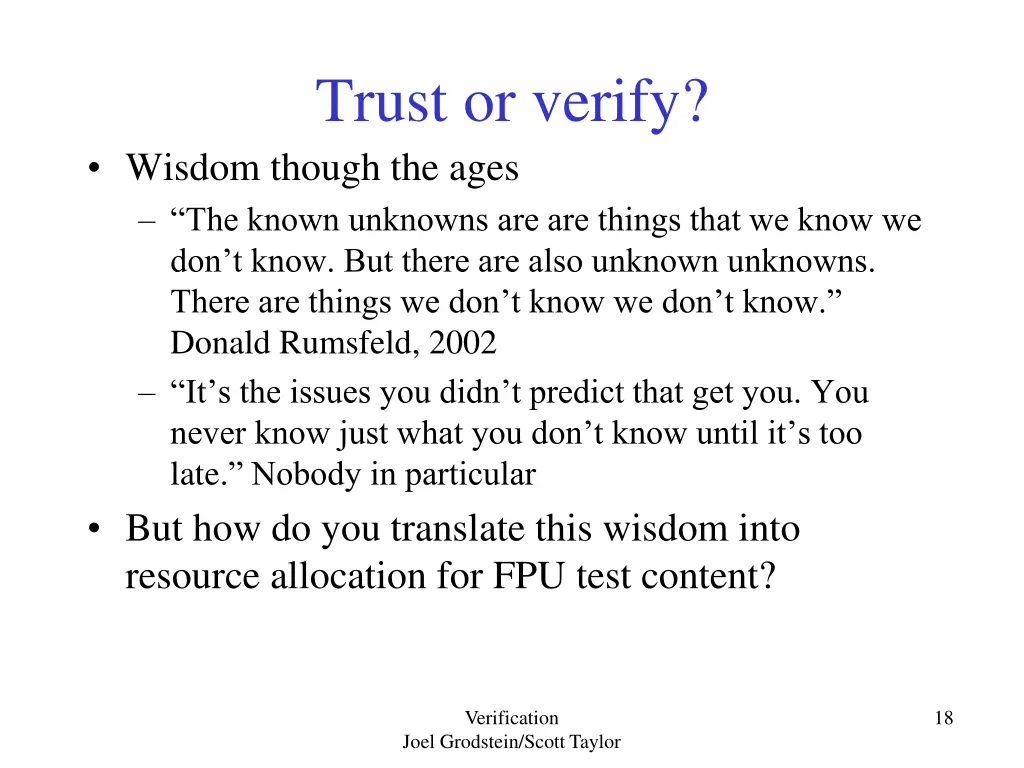
Trust or verify? Wisdom though the ages The known unknowns are are things that we know we don t know. But there are also unknown unknowns. There are things we don t know we don t know. Donald Rumsfeld, 2002 It s the issues you didn t predict that get you. You never know just what you don t know until it s too late. Nobody in particular But how do you translate this wisdom into resource allocation for FPU test content? Verification 18 Joel Grodstein/Scott Taylor
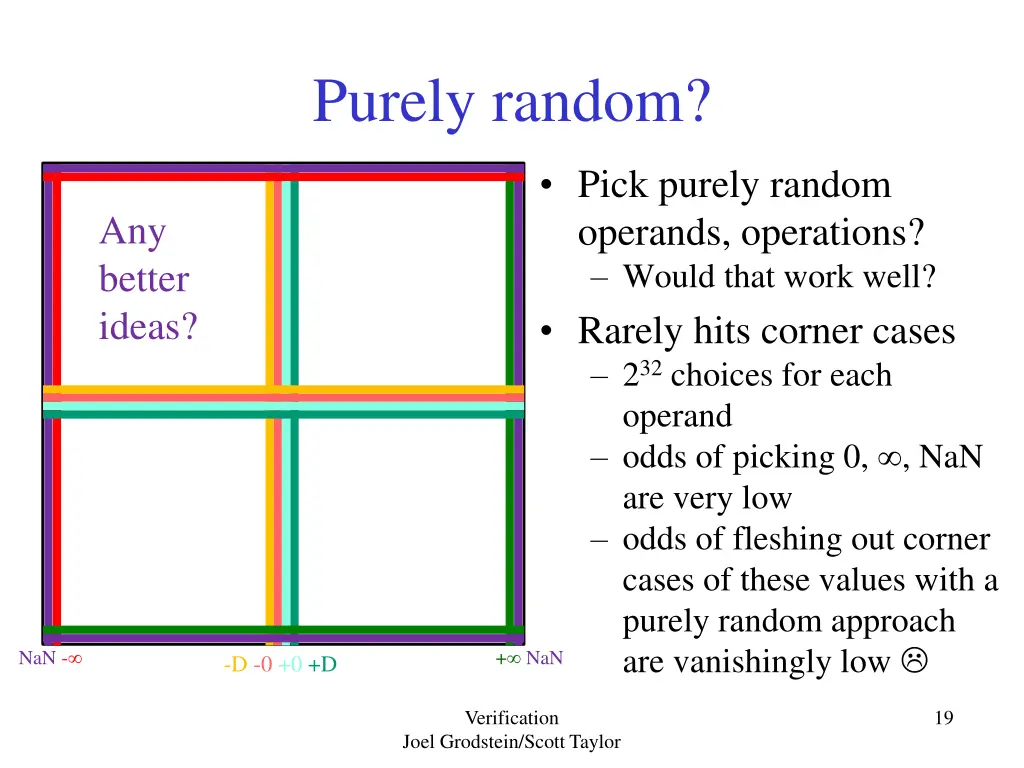
Purely random? Pick purely random operands, operations? Would that work well? Rarely hits corner cases 232 choices for each operand odds of picking 0, , NaN are very low odds of fleshing out corner cases of these values with a purely random approach are vanishingly low Any better ideas? NaN - + NaN -D -0 +0 +D Verification 19 Joel Grodstein/Scott Taylor
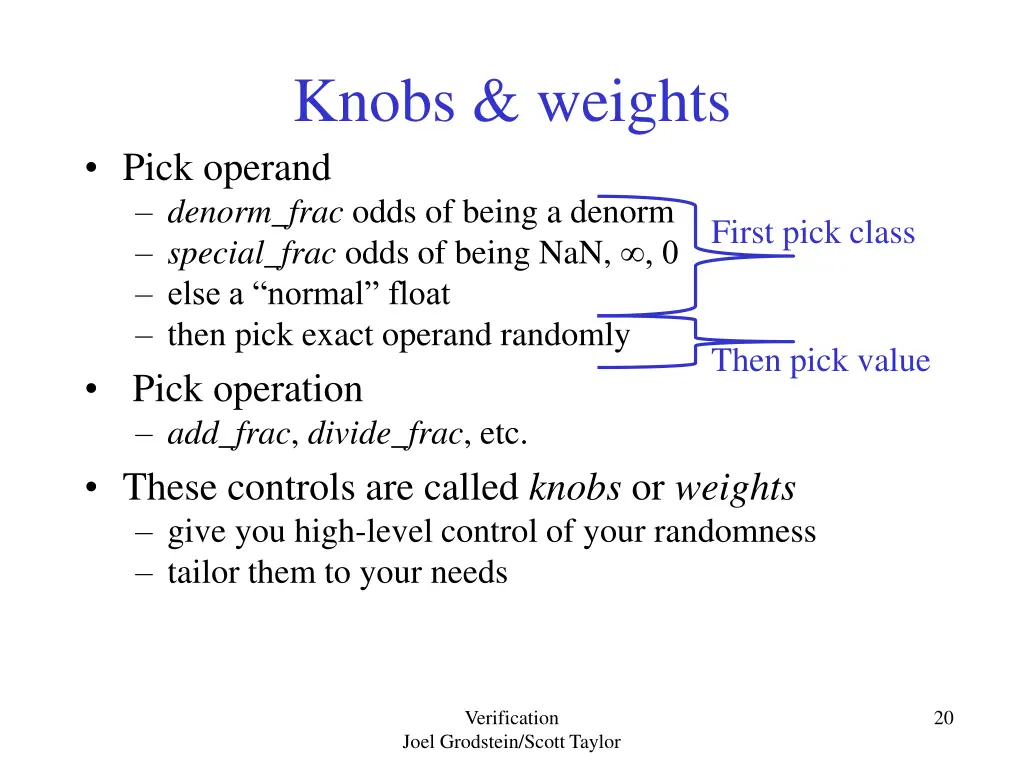
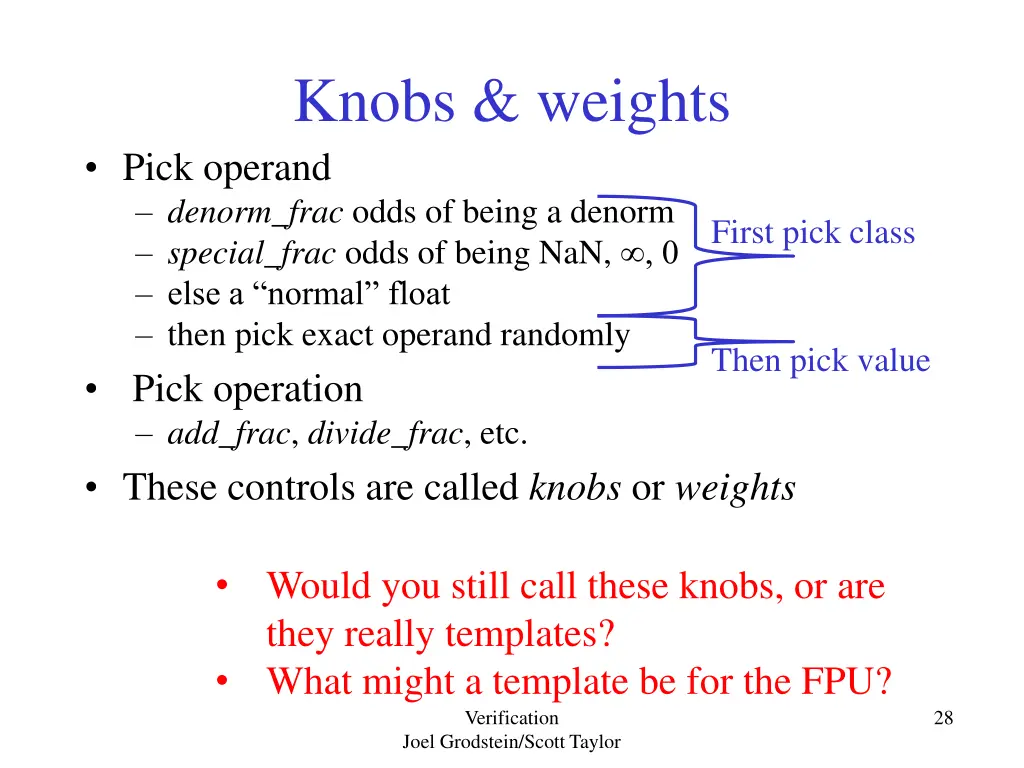
Knobs & weights Pick operand denorm_frac odds of being a denorm special_frac odds of being NaN, , 0 else a normal float then pick exact operand randomly Pick operation add_frac, divide_frac, etc. These controls are called knobs or weights give you high-level control of your randomness tailor them to your needs First pick class Then pick value Verification 20 Joel Grodstein/Scott Taylor
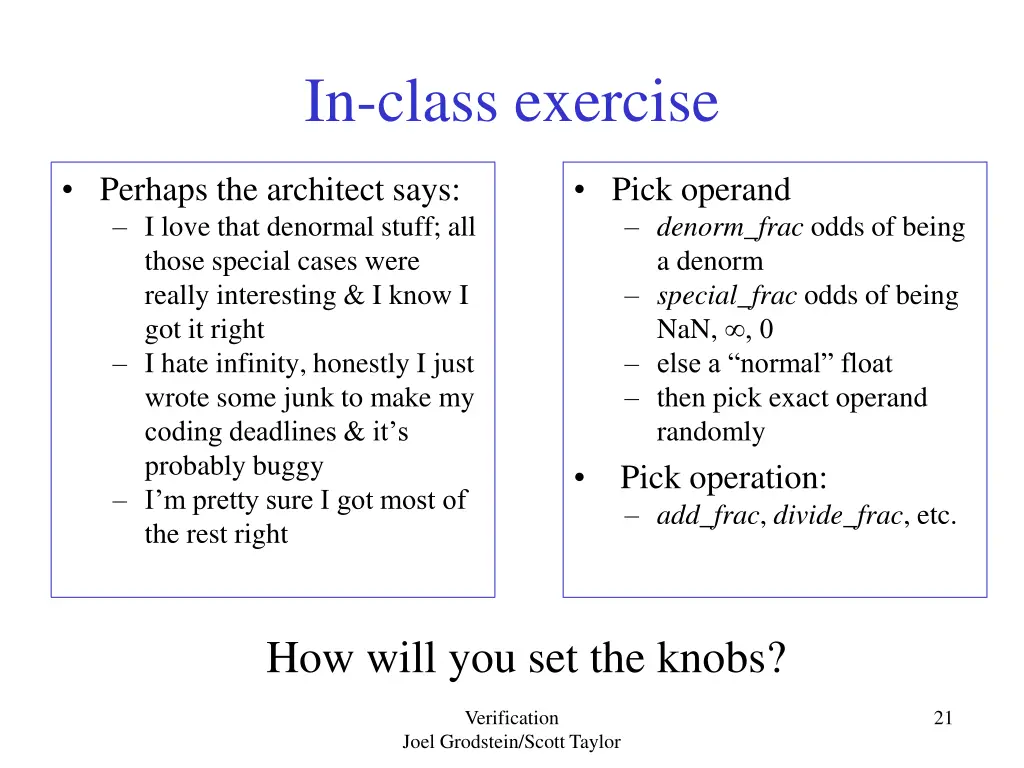
In-class exercise Perhaps the architect says: I love that denormal stuff; all those special cases were really interesting & I know I got it right I hate infinity, honestly I just wrote some junk to make my coding deadlines & it s probably buggy I m pretty sure I got most of the rest right Pick operand denorm_frac odds of being a denorm special_frac odds of being NaN, , 0 else a normal float then pick exact operand randomly Pick operation: add_frac, divide_frac, etc. How will you set the knobs? Verification 21 Joel Grodstein/Scott Taylor
Outline of this lecture Random & directed the basics FPU case study CPU case study Fancy stuff: machine learning Error injection Verification 22 Joel Grodstein/Scott Taylor
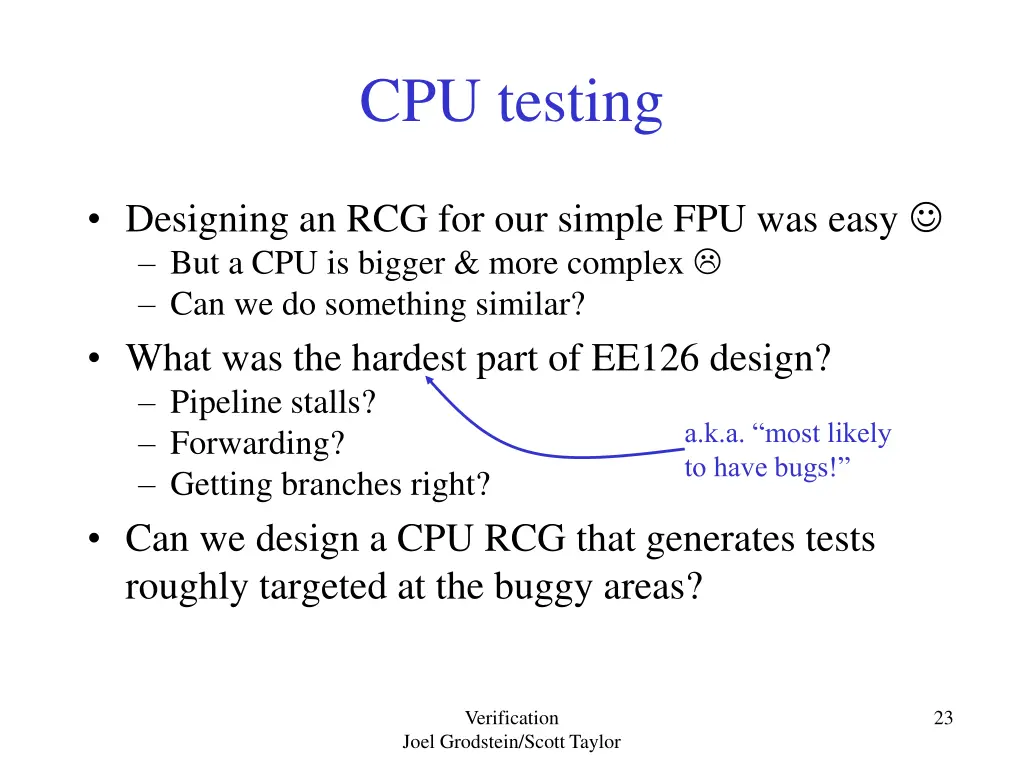
CPU testing Designing an RCG for our simple FPU was easy But a CPU is bigger & more complex Can we do something similar? What was the hardest part of EE126 design? Pipeline stalls? Forwarding? Getting branches right? Can we design a CPU RCG that generates tests roughly targeted at the buggy areas? a.k.a. most likely to have bugs! Verification 23 Joel Grodstein/Scott Taylor
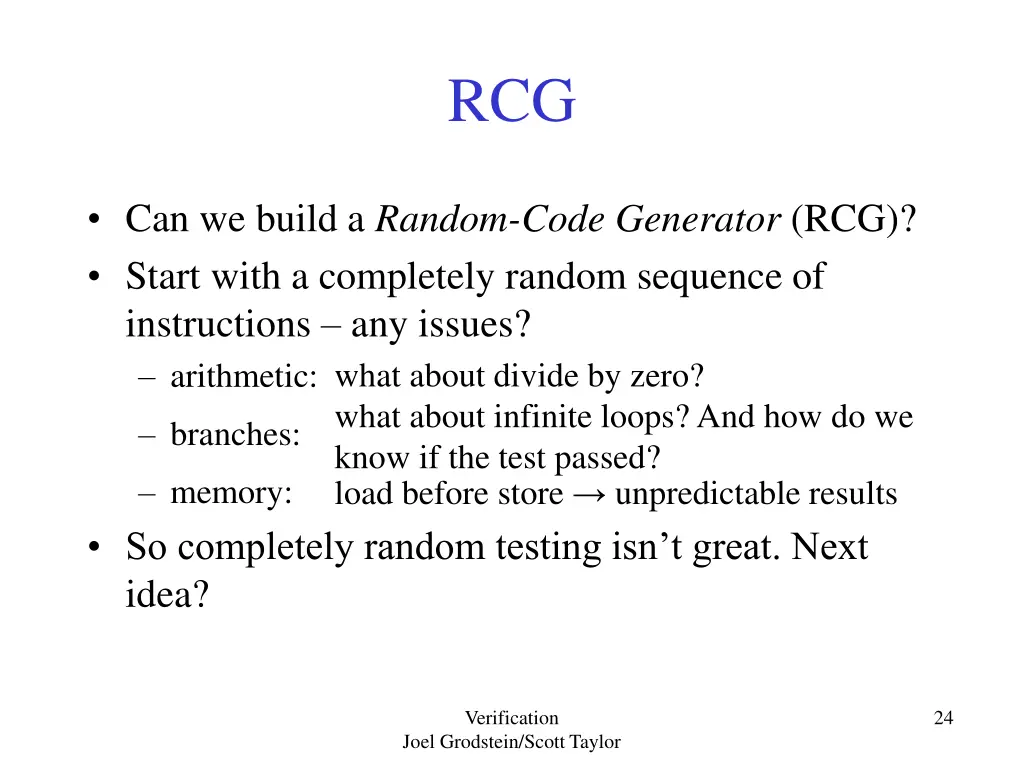
RCG Can we build a Random-Code Generator (RCG)? Start with a completely random sequence of instructions any issues? arithmetic: what about divide by zero? what about infinite loops? And how do we know if the test passed? load before store unpredictable results branches: memory: So completely random testing isn t great. Next idea? Verification 24 Joel Grodstein/Scott Taylor
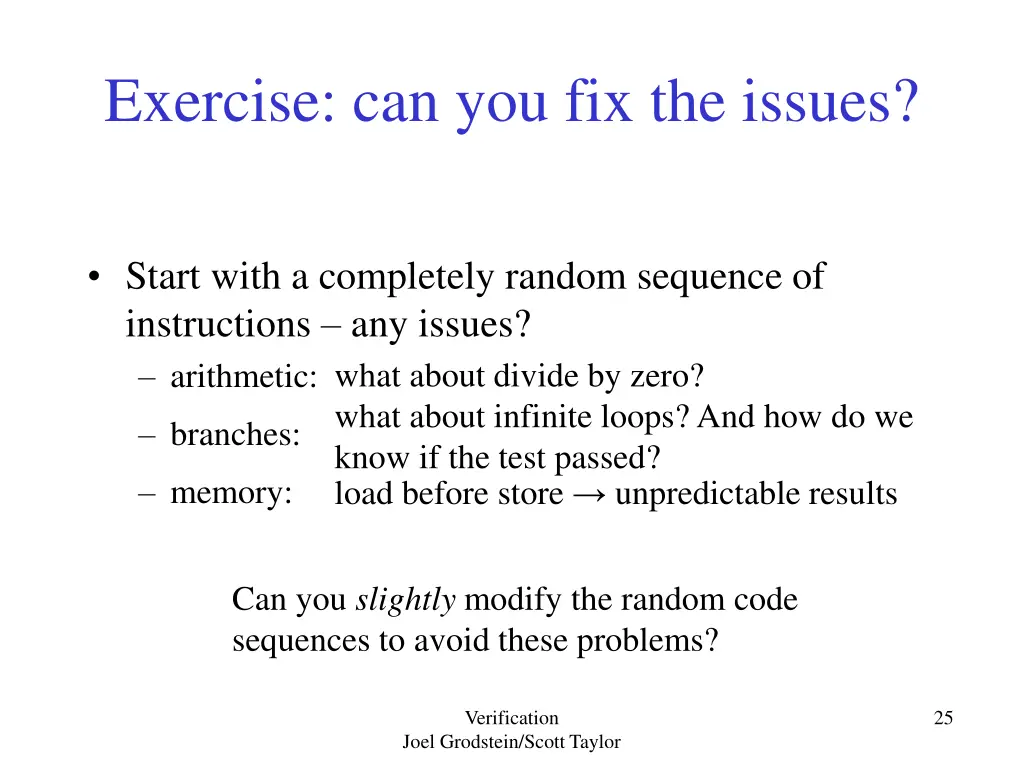
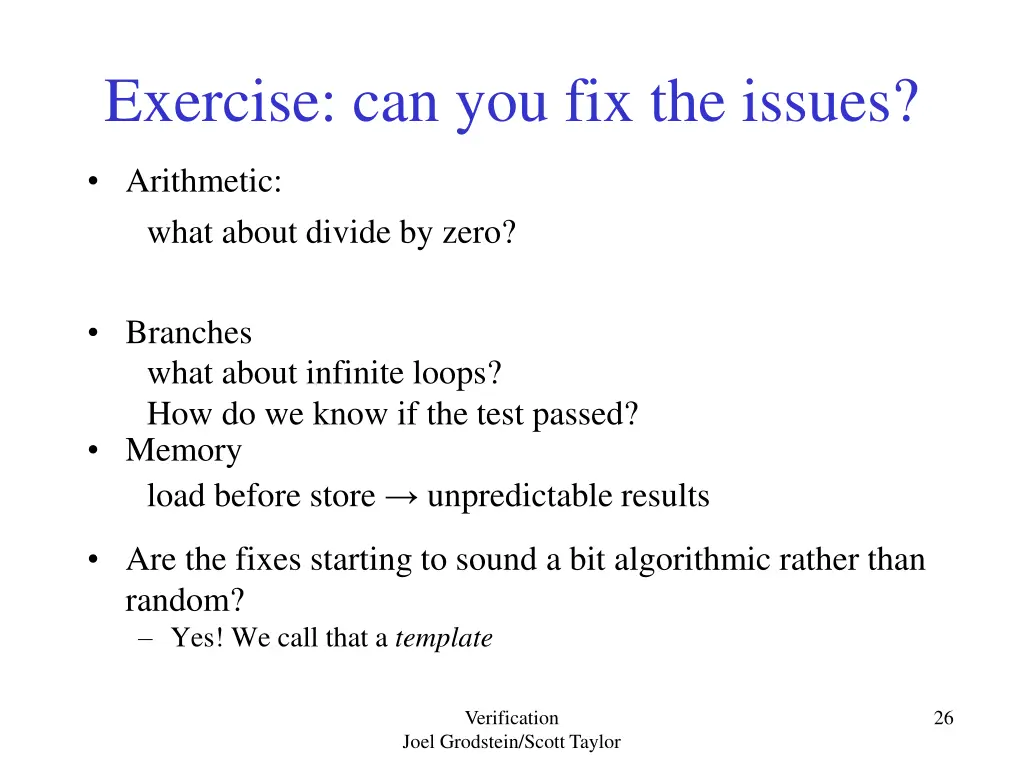
Exercise: can you fix the issues? Start with a completely random sequence of instructions any issues? arithmetic: what about divide by zero? what about infinite loops? And how do we know if the test passed? load before store unpredictable results branches: memory: Can you slightly modify the random code sequences to avoid these problems? Verification 25 Joel Grodstein/Scott Taylor
Exercise: can you fix the issues? Arithmetic: can do random ops, and then throw away the divide-by-zero and similar tests They should be a small fraction of all tests Branches analyze the random programs, remove infinite loops? and put different loads after each branch path? Memory Do loads in store+load pairs Move them randomly but always put the store first Are the fixes starting to sound a bit algorithmic rather than random? Yes! We call that a template what about divide by zero? what about infinite loops? How do we know if the test passed? load before store unpredictable results Verification 26 Joel Grodstein/Scott Taylor
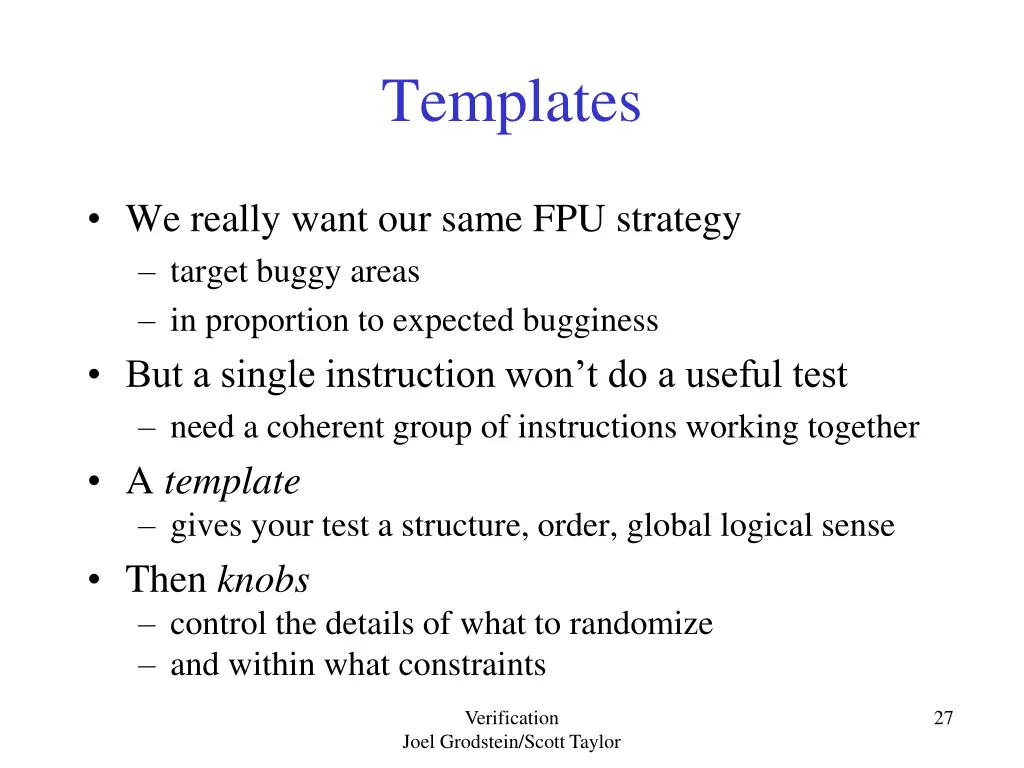
Templates We really want our same FPU strategy target buggy areas in proportion to expected bugginess But a single instruction won t do a useful test need a coherent group of instructions working together A template gives your test a structure, order, global logical sense Then knobs control the details of what to randomize and within what constraints Verification 27 Joel Grodstein/Scott Taylor
Knobs & weights Pick operand denorm_frac odds of being a denorm special_frac odds of being NaN, , 0 else a normal float then pick exact operand randomly Pick operation add_frac, divide_frac, etc. These controls are called knobs or weights First pick class Then pick value Would you still call these knobs, or are they really templates? What might a template be for the FPU? Verification 28 Joel Grodstein/Scott Taylor
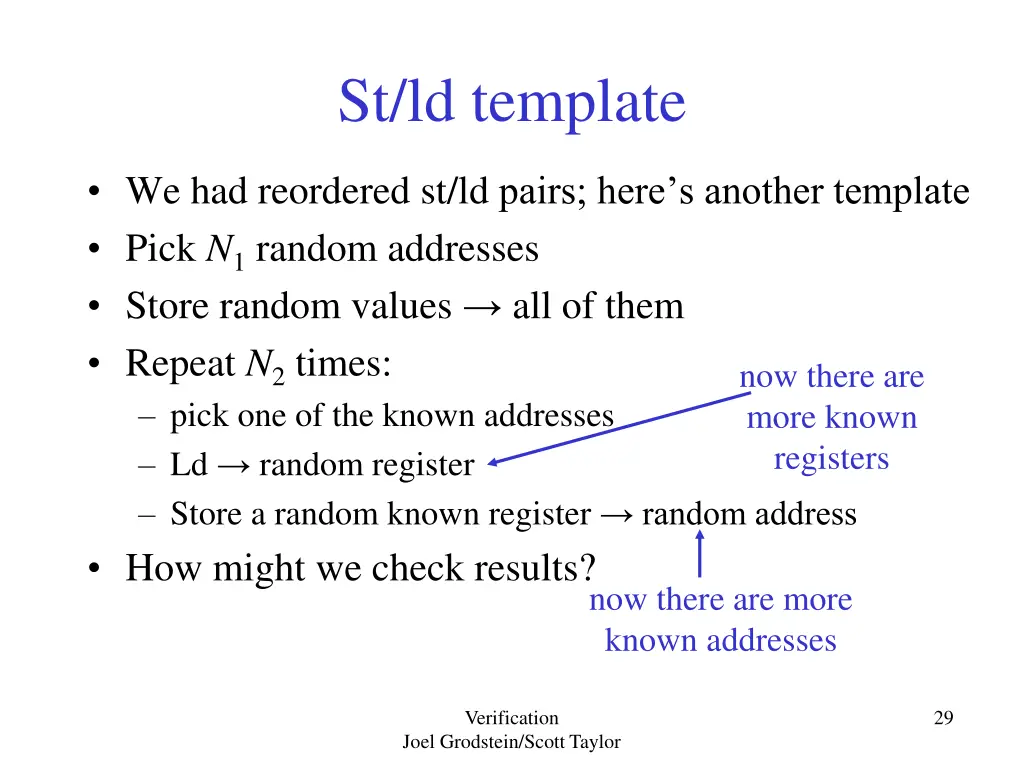
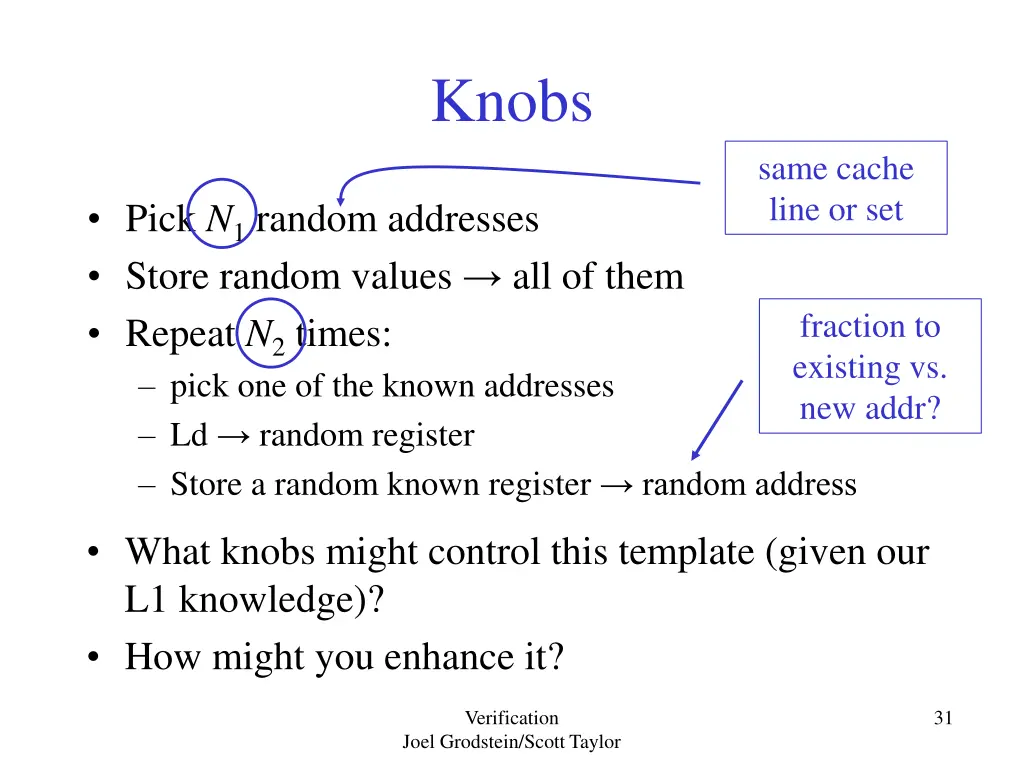
St/ld template We had reordered st/ld pairs; here s another template Pick N1 random addresses Store random values all of them Repeat N2 times: pick one of the known addresses Ld random register Store a random known register random address How might we check results? now there are more known registers now there are more known addresses Verification 29 Joel Grodstein/Scott Taylor
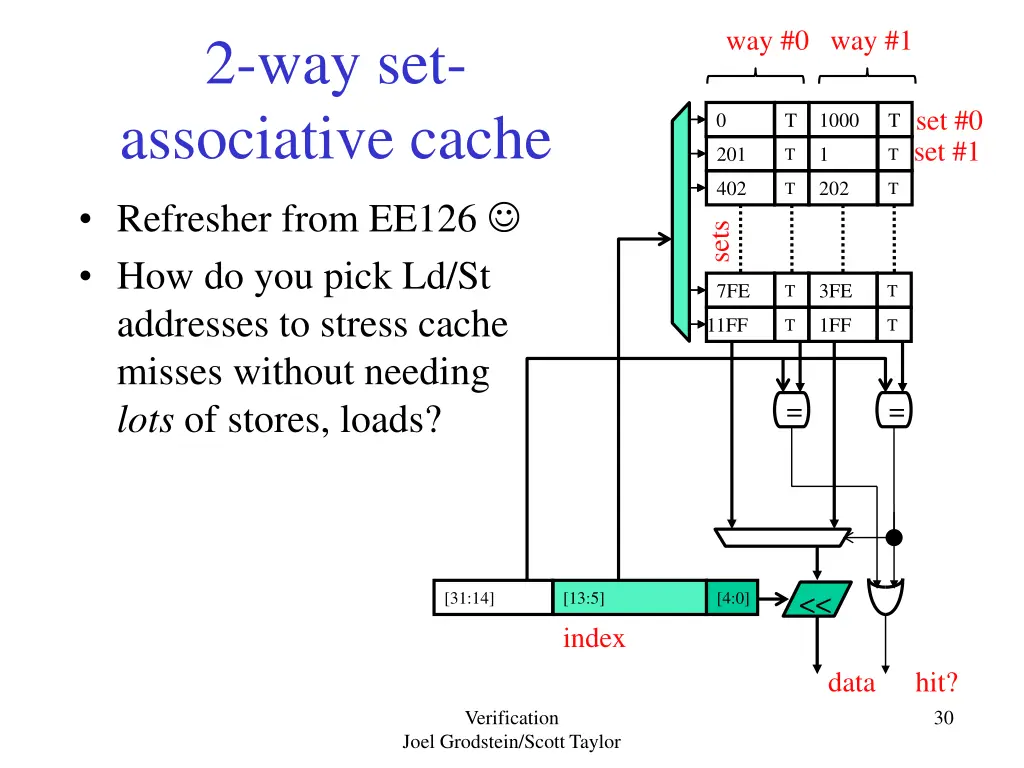
way #0 way #1 2-way set- associative cache set #0 set #1 0 T 1000 T 201 1 T T 402 202 T T Refresher from EE126 How do you pick Ld/St addresses to stress cache misses without needing lots of stores, loads? sets 7FE 3FE T T 11FF 1FF T T = = << [31:14] [13:5] [4:0] index data hit? Verification 30 Joel Grodstein/Scott Taylor
Knobs same cache line or set Pick N1 random addresses Store random values all of them Repeat N2 times: pick one of the known addresses Ld random register Store a random known register random address fraction to existing vs. new addr? What knobs might control this template (given our L1 knowledge)? How might you enhance it? Verification 31 Joel Grodstein/Scott Taylor
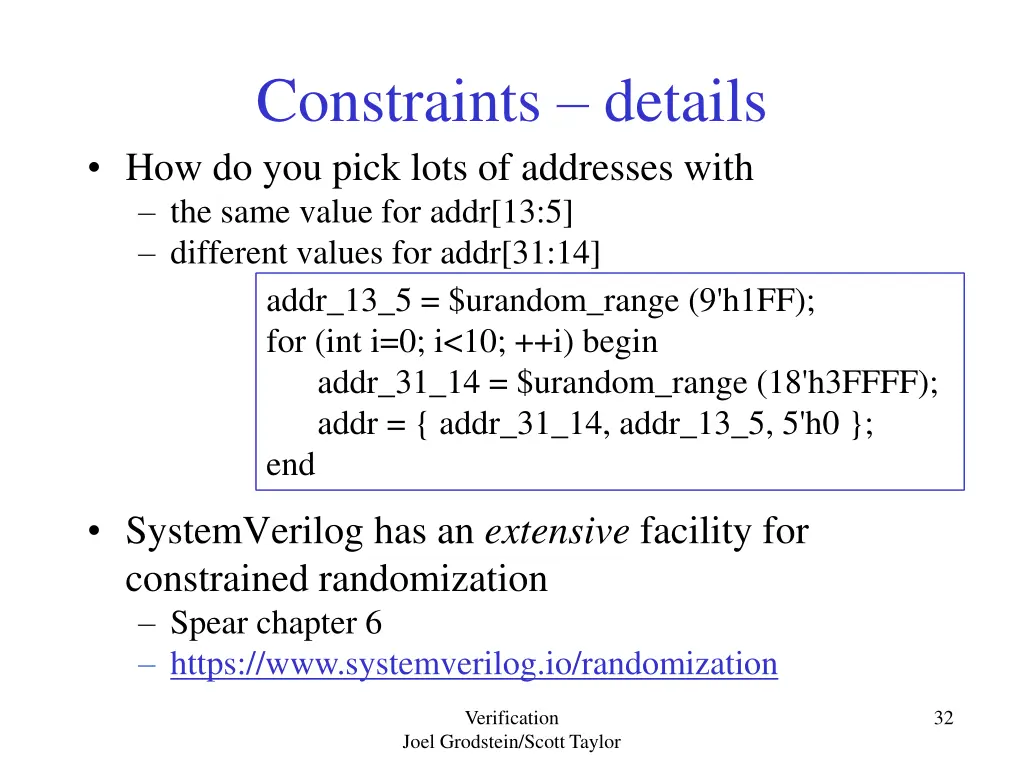
Constraints details How do you pick lots of addresses with the same value for addr[13:5] different values for addr[31:14] addr_13_5 = $urandom_range (9'h1FF); for (int i=0; i<10; ++i) begin addr_31_14 = $urandom_range (18'h3FFFF); addr = { addr_31_14, addr_13_5, 5'h0 }; end SystemVerilog has an extensive facility for constrained randomization Spear chapter 6 https://www.systemverilog.io/randomization Verification 32 Joel Grodstein/Scott Taylor
Discussion Mesh lab #2 asks you to build an RCG to drive the mesh How could it work? What knobs will be useful for your mesh RCG? Verification 33 Joel Grodstein/Scott Taylor
Outline of this lecture Random & directed the basics FPU case study CPU case study Fancy stuff: machine learning Error injection Verification 34 Joel Grodstein/Scott Taylor
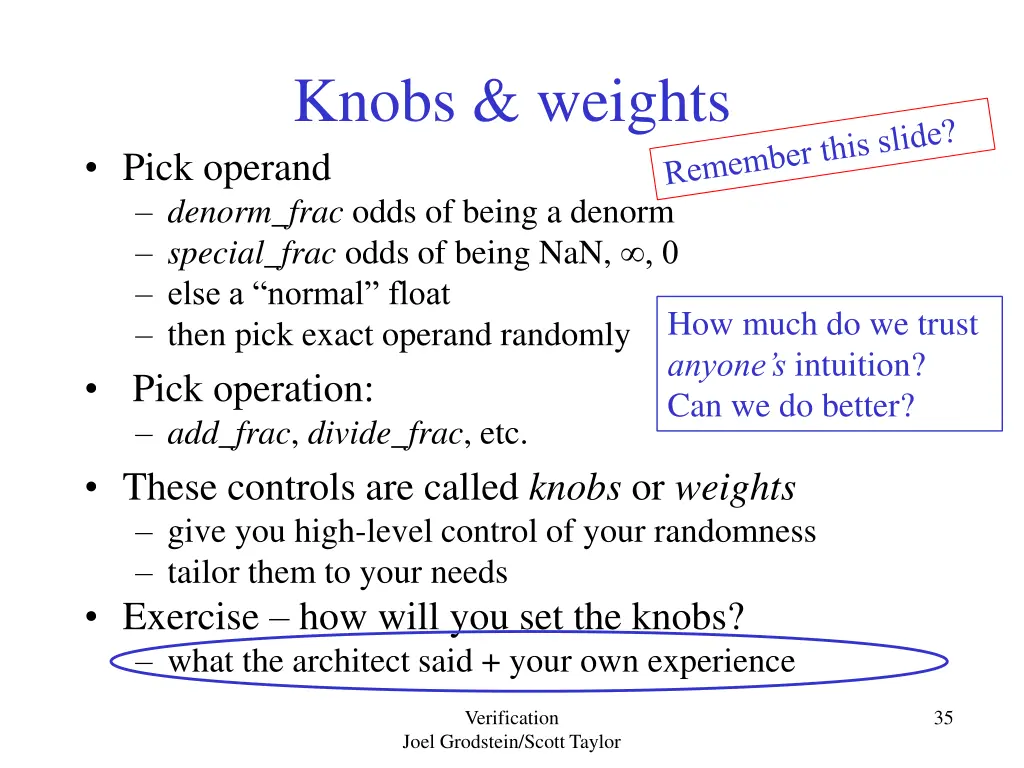
Knobs & weights Pick operand denorm_frac odds of being a denorm special_frac odds of being NaN, , 0 else a normal float then pick exact operand randomly Pick operation: add_frac, divide_frac, etc. These controls are called knobs or weights give you high-level control of your randomness tailor them to your needs Exercise how will you set the knobs? what the architect said + your own experience How much do we trust anyone s intuition? Can we do better? Verification 35 Joel Grodstein/Scott Taylor
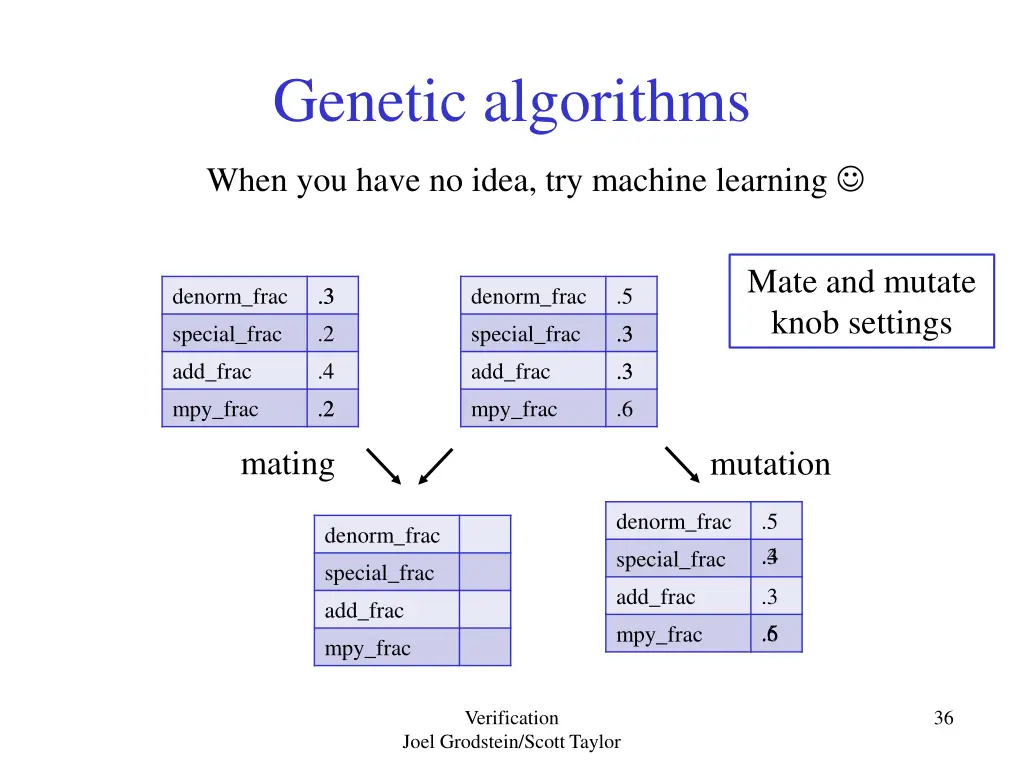
Genetic algorithms When you have no idea, try machine learning Mate and mutate knob settings denorm_frac .3 .3 denorm_frac .5 special_frac .2 special_frac .3 .3 add_frac .4 add_frac .3 .3 mpy_frac .2 .2 mpy_frac .6 mating mutation denorm_frac .5 .3 .4 denorm_frac special_frac special_frac add_frac .3 .5 add_frac .6 mpy_frac mpy_frac Verification 36 Joel Grodstein/Scott Taylor
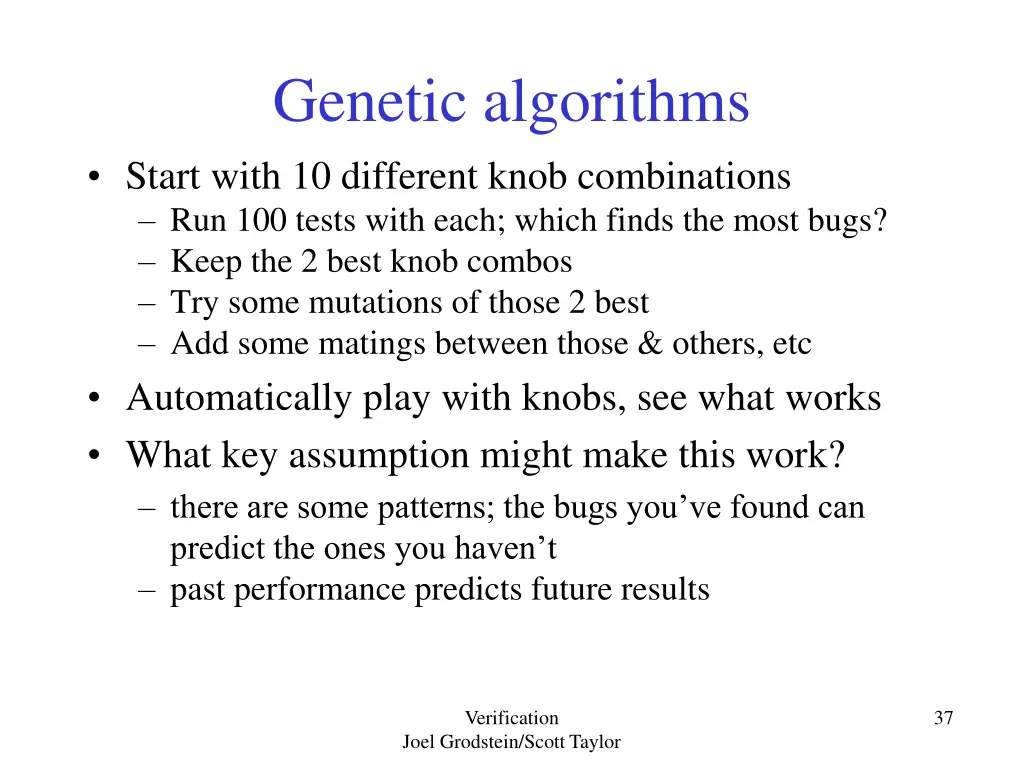
Genetic algorithms Start with 10 different knob combinations Run 100 tests with each; which finds the most bugs? Keep the 2 best knob combos Try some mutations of those 2 best Add some matings between those & others, etc Automatically play with knobs, see what works What key assumption might make this work? there are some patterns; the bugs you ve found can predict the ones you haven t past performance predicts future results Verification 37 Joel Grodstein/Scott Taylor
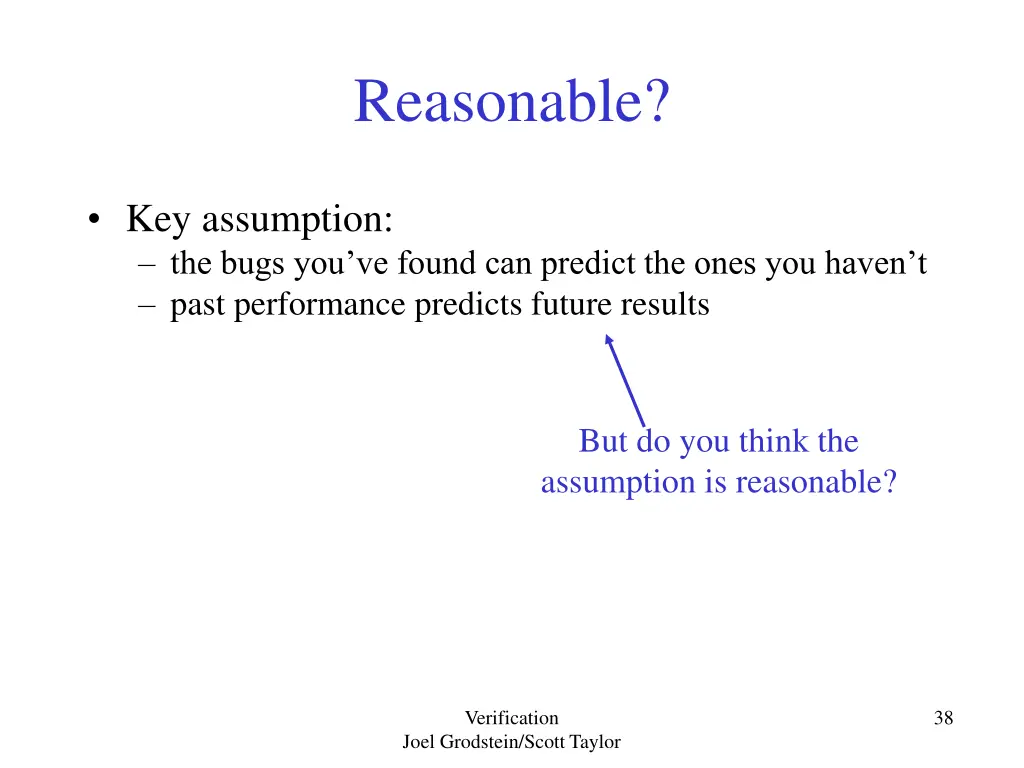
Reasonable? Key assumption: the bugs you ve found can predict the ones you haven t past performance predicts future results But do you think the assumption is reasonable? Verification 38 Joel Grodstein/Scott Taylor
Genetic alg + coverage Our metric: success = most bugs found Another metric for a GA: most coverage will revisit after we discuss coverage Verification 39 Joel Grodstein/Scott Taylor
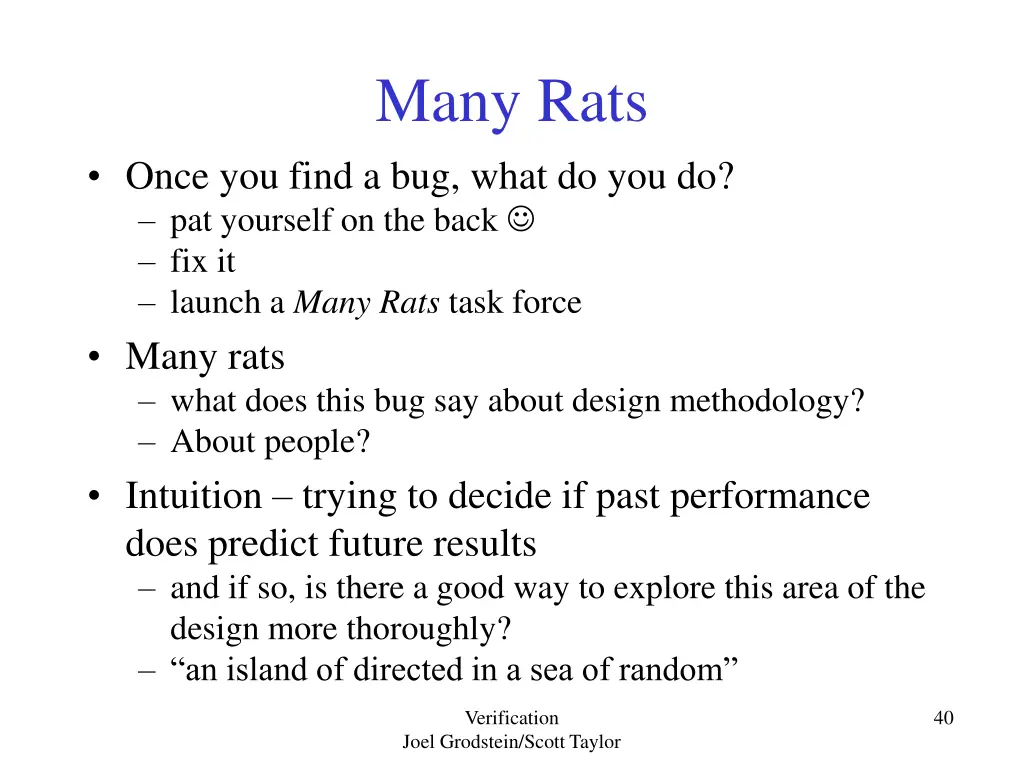
Many Rats Once you find a bug, what do you do? pat yourself on the back fix it launch a Many Rats task force Many rats what does this bug say about design methodology? About people? Intuition trying to decide if past performance does predict future results and if so, is there a good way to explore this area of the design more thoroughly? an island of directed in a sea of random Verification 40 Joel Grodstein/Scott Taylor
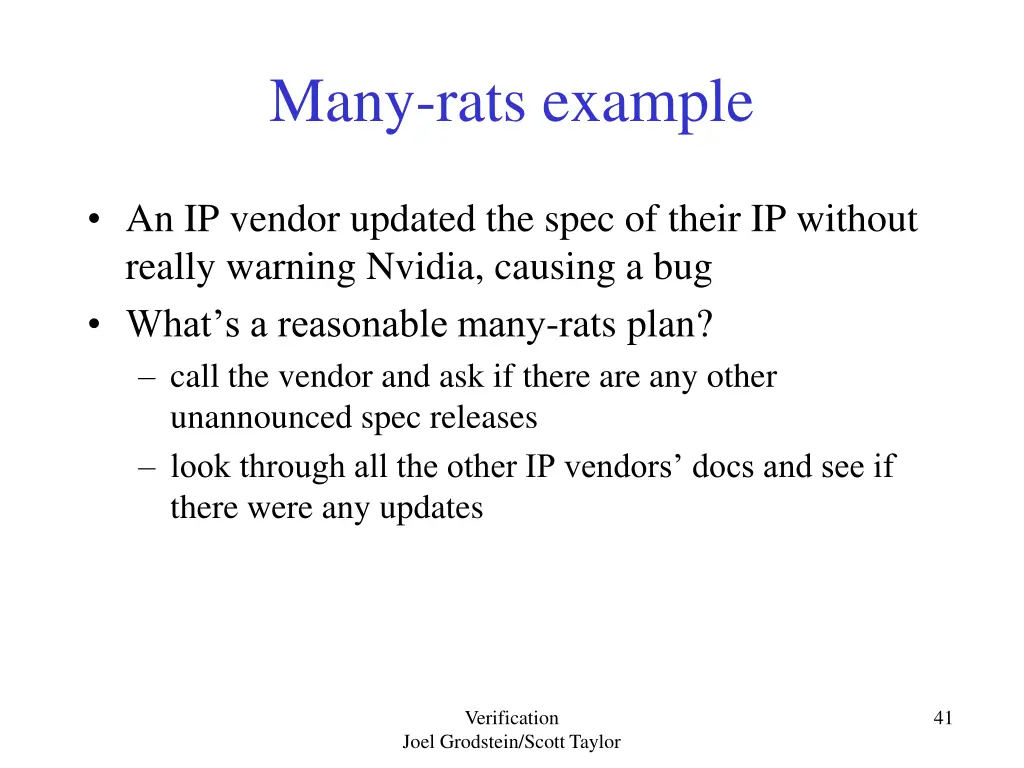
Many-rats example An IP vendor updated the spec of their IP without really warning Nvidia, causing a bug What s a reasonable many-rats plan? call the vendor and ask if there are any other unannounced spec releases look through all the other IP vendors docs and see if there were any updates Verification 41 Joel Grodstein/Scott Taylor
Outline of this lecture Random & directed the basics FPU case study CPU case study Fancy stuff: machine learning Error injection Verification 42 Joel Grodstein/Scott Taylor
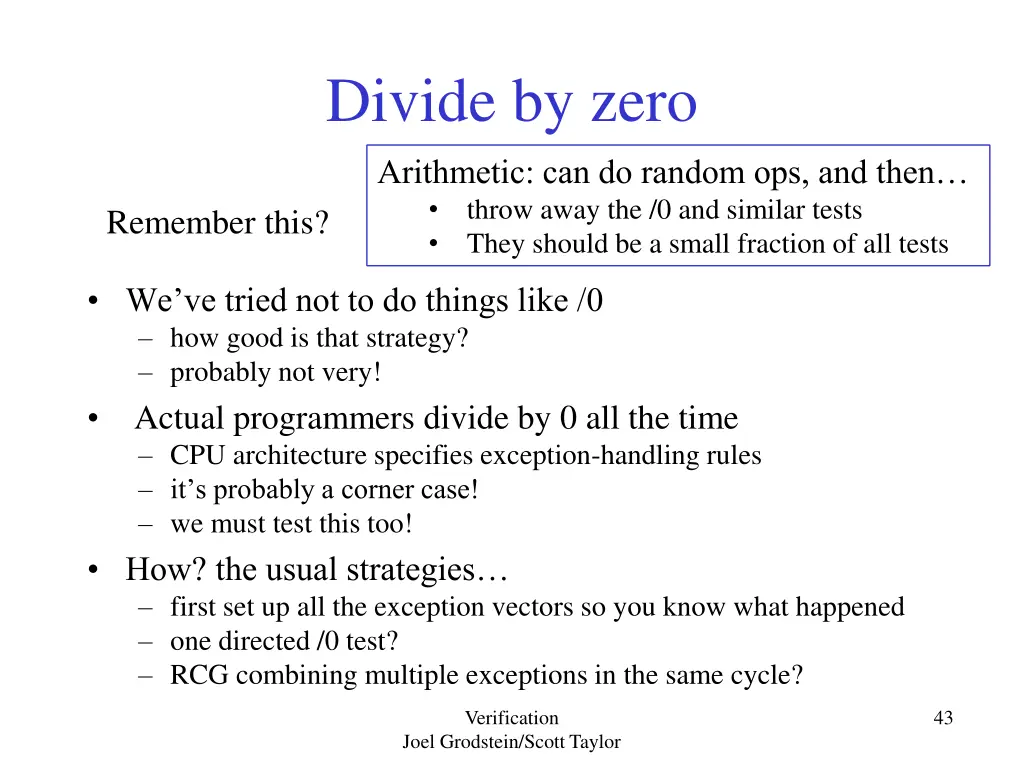
Divide by zero Arithmetic: can do random ops, and then throw away the /0 and similar tests They should be a small fraction of all tests Remember this? We ve tried not to do things like /0 how good is that strategy? probably not very! Actual programmers divide by 0 all the time CPU architecture specifies exception-handling rules it s probably a corner case! we must test this too! How? the usual strategies first set up all the exception vectors so you know what happened one directed /0 test? RCG combining multiple exceptions in the same cycle? Verification 43 Joel Grodstein/Scott Taylor
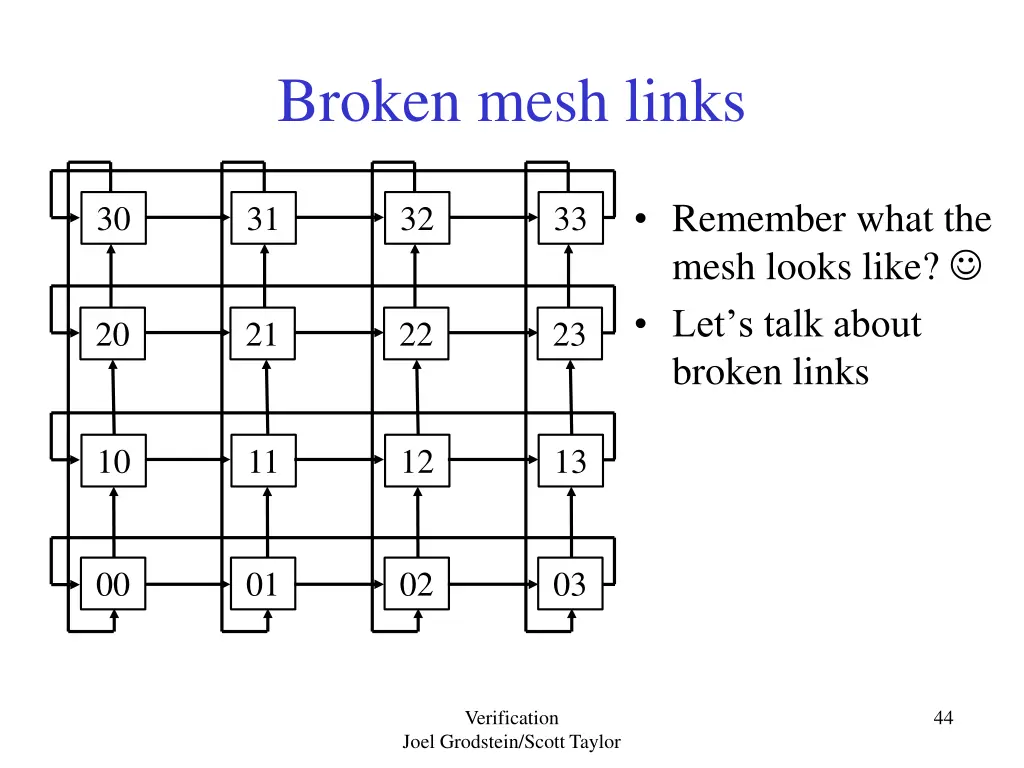
Broken mesh links Remember what the mesh looks like? Let s talk about broken links 30 31 32 33 20 21 22 23 10 11 12 13 00 01 02 03 Verification 44 Joel Grodstein/Scott Taylor
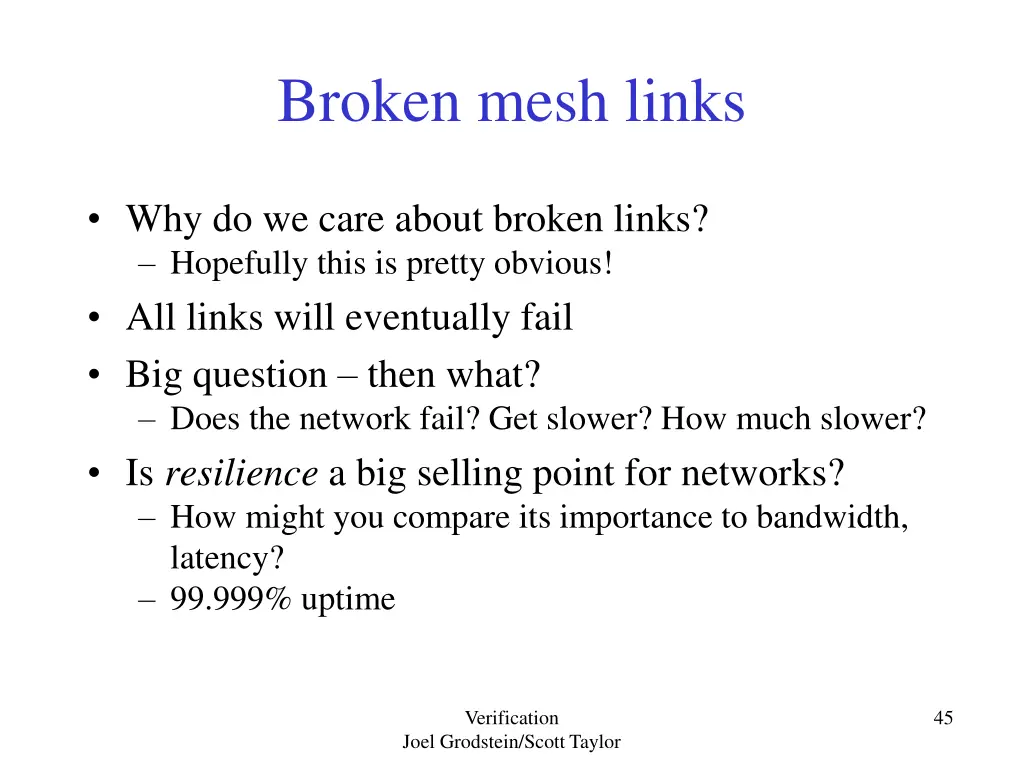
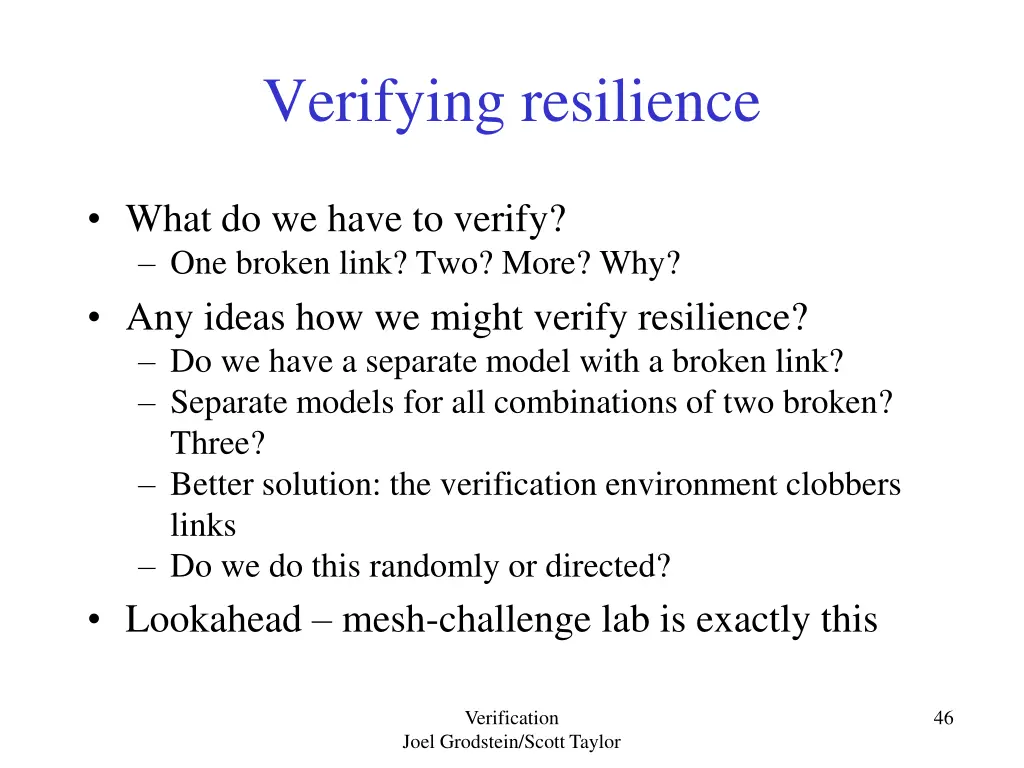
Broken mesh links Why do we care about broken links? Hopefully this is pretty obvious! All links will eventually fail Big question then what? Does the network fail? Get slower? How much slower? Is resilience a big selling point for networks? How might you compare its importance to bandwidth, latency? 99.999% uptime Verification 45 Joel Grodstein/Scott Taylor
Verifying resilience What do we have to verify? One broken link? Two? More? Why? Any ideas how we might verify resilience? Do we have a separate model with a broken link? Separate models for all combinations of two broken? Three? Better solution: the verification environment clobbers links Do we do this randomly or directed? Lookahead mesh-challenge lab is exactly this Verification 46 Joel Grodstein/Scott Taylor
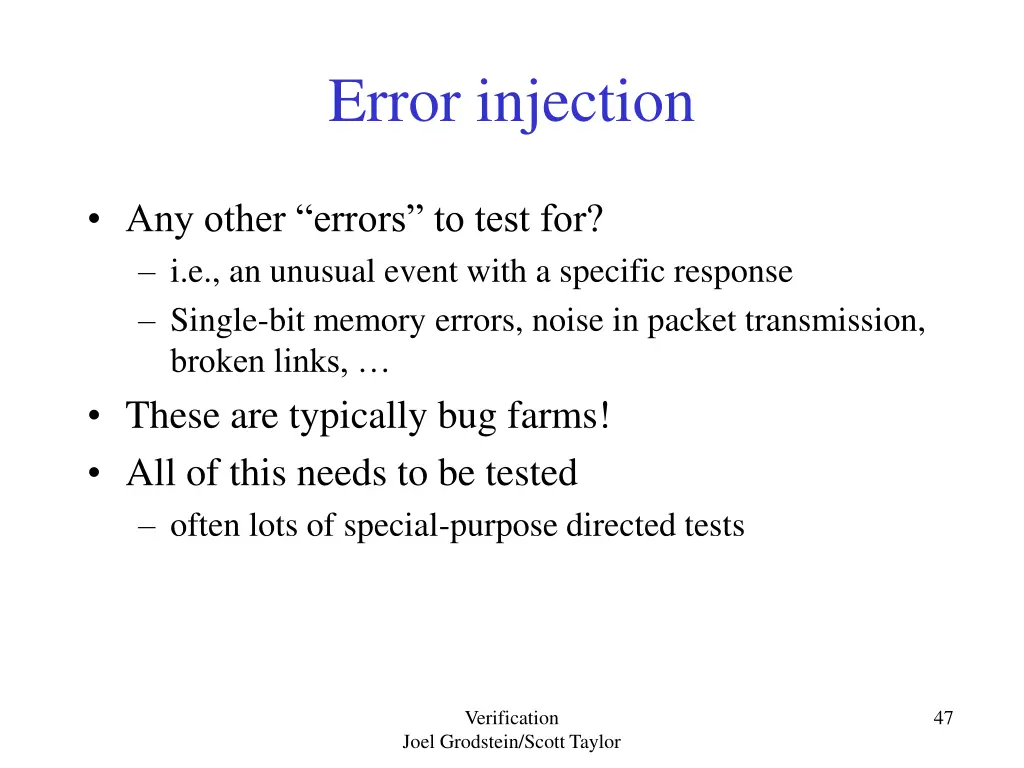
Error injection Any other errors to test for? i.e., an unusual event with a specific response Single-bit memory errors, noise in packet transmission, broken links, These are typically bug farms! All of this needs to be tested often lots of special-purpose directed tests Verification 47 Joel Grodstein/Scott Taylor
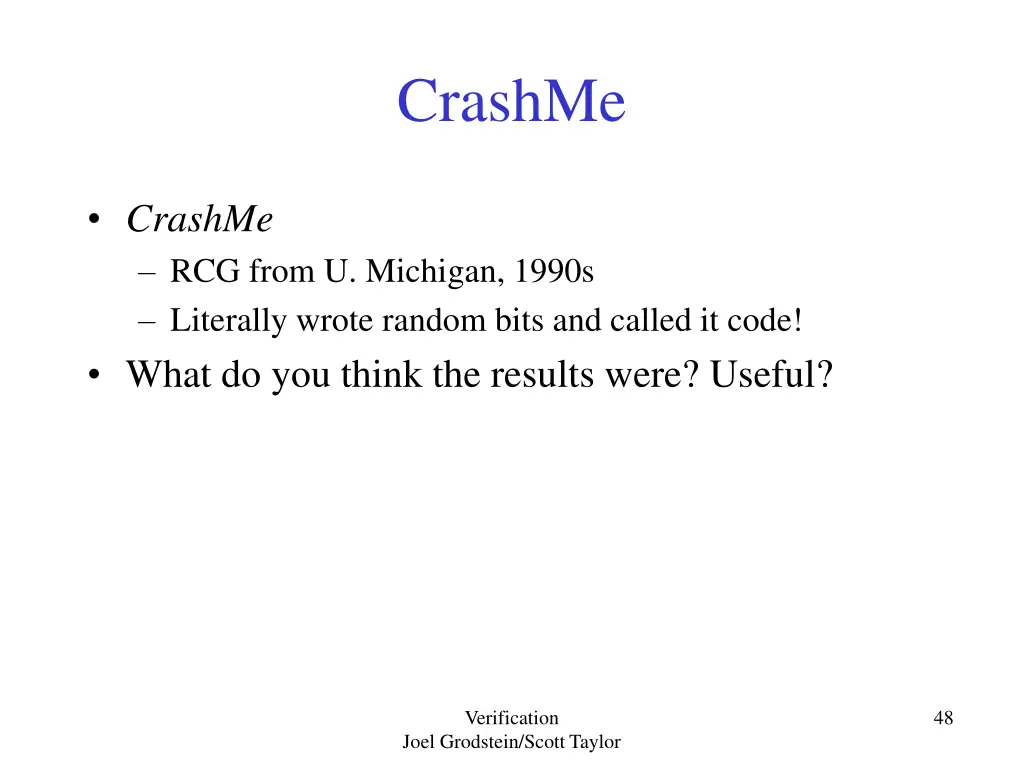
CrashMe CrashMe RCG from U. Michigan, 1990s Literally wrote random bits and called it code! What do you think the results were? Useful? Verification 48 Joel Grodstein/Scott Taylor
BACKUP Verification 49 Joel Grodstein/Scott Taylor
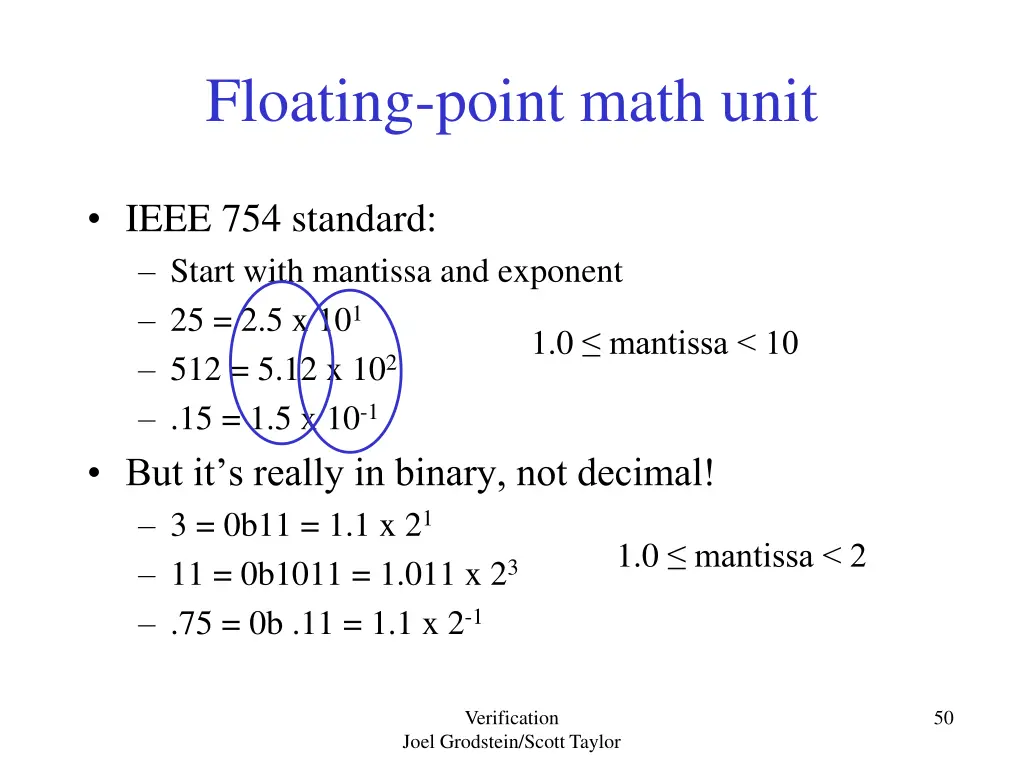
Floating-point math unit IEEE 754 standard: Start with mantissa and exponent 25 = 2.5 x 101 512 = 5.12 x 10² .15 = 1.5 x 10⁻¹ But it s really in binary, not decimal! 3 = 0b11 = 1.1 x 21 11 = 0b1011 = 1.011 x 23 .75 = 0b .11 = 1.1 x 2-1 1.0 mantissa < 10 1.0 mantissa < 2 Verification 50 Joel Grodstein/Scott Taylor