Volume in Mathematics
Explore the concept of volume in mathematics, including definitions, formulas, and practical applications. Learn how to calculate volume for 3D shapes, understand common metric units, and identify the properties of rectangular prisms. Enhance your math skills through interactive activities and diagrams.

Download Presentation

Please find below an Image/Link to download the presentation.
The content on the website is provided AS IS for your information and personal use only. It may not be sold, licensed, or shared on other websites without obtaining consent from the author. If you encounter any issues during the download, it is possible that the publisher has removed the file from their server.
You are allowed to download the files provided on this website for personal or commercial use, subject to the condition that they are used lawfully. All files are the property of their respective owners.
The content on the website is provided AS IS for your information and personal use only. It may not be sold, licensed, or shared on other websites without obtaining consent from the author.
E N D
Presentation Transcript
Volume Session 2 - Green
Session 2 VOLUME Learning Intention: To be able to work out the volume of 3D Success Criteria: I can work out the Volume of a rectangular prism. I can find the volume of common 3D shapes. shapes.
Create a Glossary in your Maths book with the heading Volume -Make sure you take notes that will help you to apply them in future sessions. - Draw labelled diagrams where necessary - When answering questions, show all your working out and label them clearly.
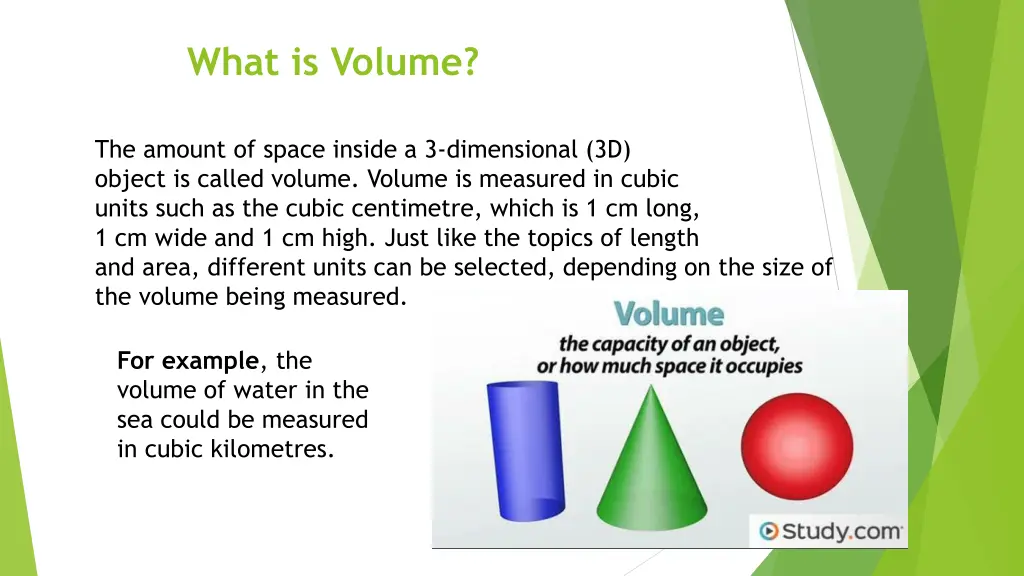
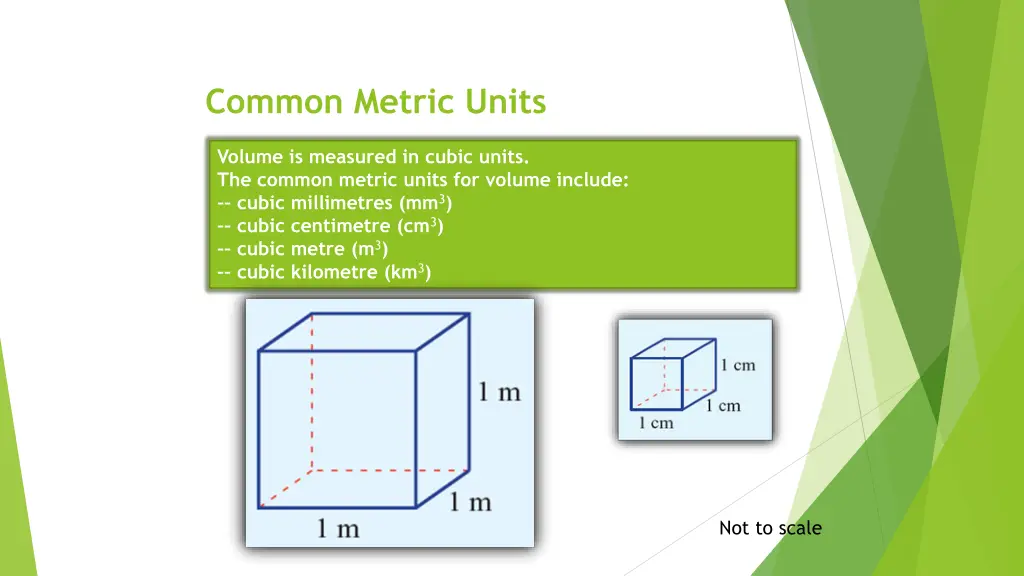
What is Volume? The amount of space inside a 3-dimensional (3D) object is called volume. Volume is measured in cubic units such as the cubic centimetre, which is 1 cm long, 1 cm wide and 1 cm high. Just like the topics of length and area, different units can be selected, depending on the size of the volume being measured. For example, the volume of water in the sea could be measured in cubic kilometres.
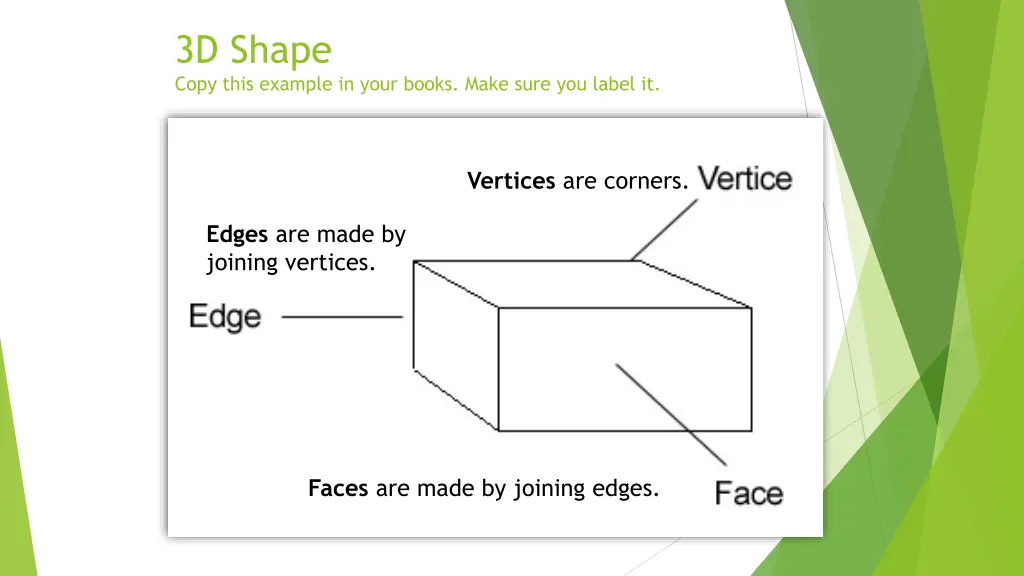
3D Shape Copy this example in your books. Make sure you label it. Vertices are corners. Edges are made by joining vertices. Faces are made by joining edges.
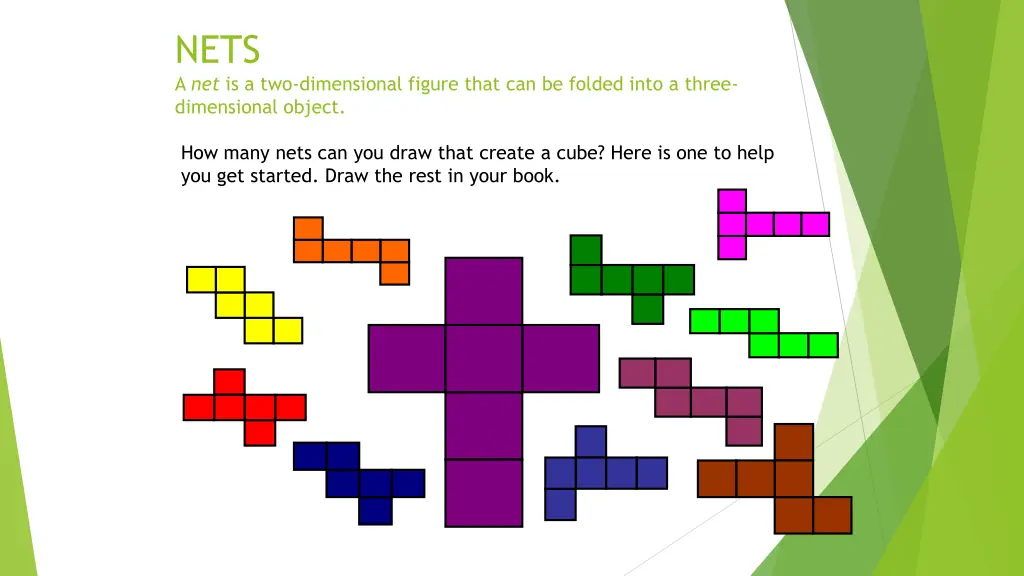
NETS A net is a two-dimensional figure that can be folded into a three- dimensional object. How many nets can you draw that create a cube? Here is one to help you get started. Draw the rest in your book.
Common Metric Units Volume is measured in cubic units. The common metric units for volume include: cubic millimetres (mm3) cubic centimetre (cm3) cubic metre (m3) cubic kilometre (km3) Not to scale
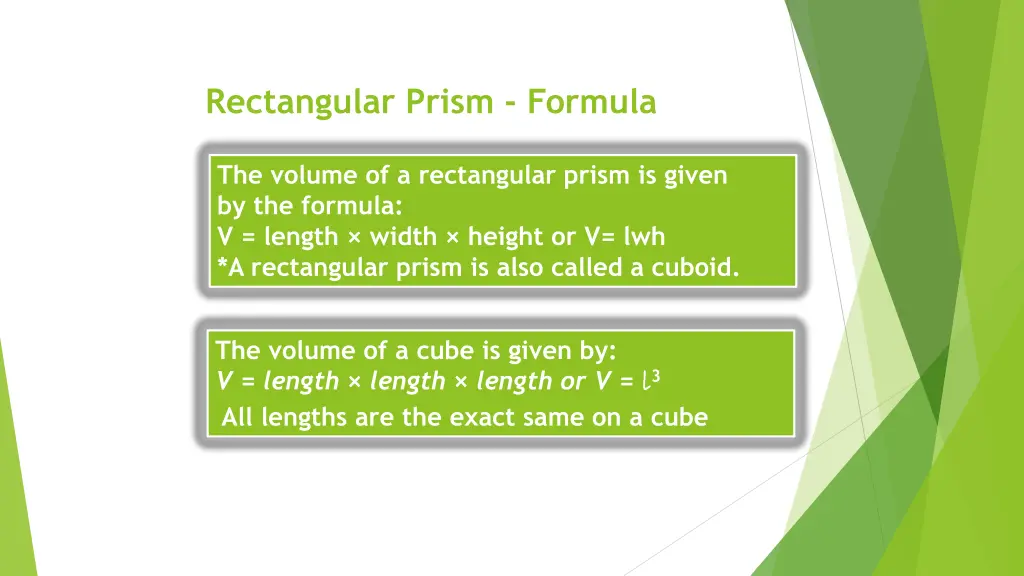
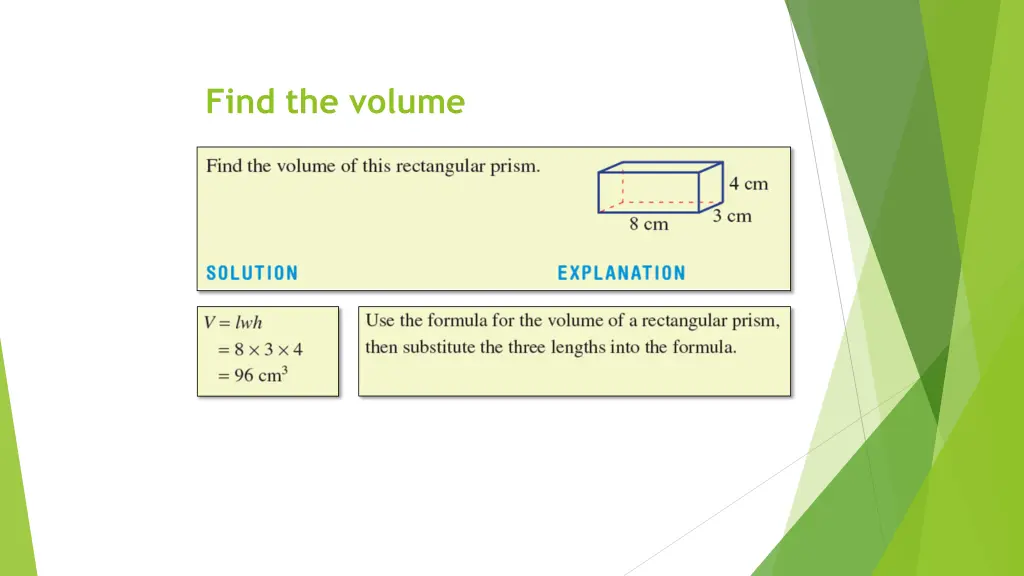
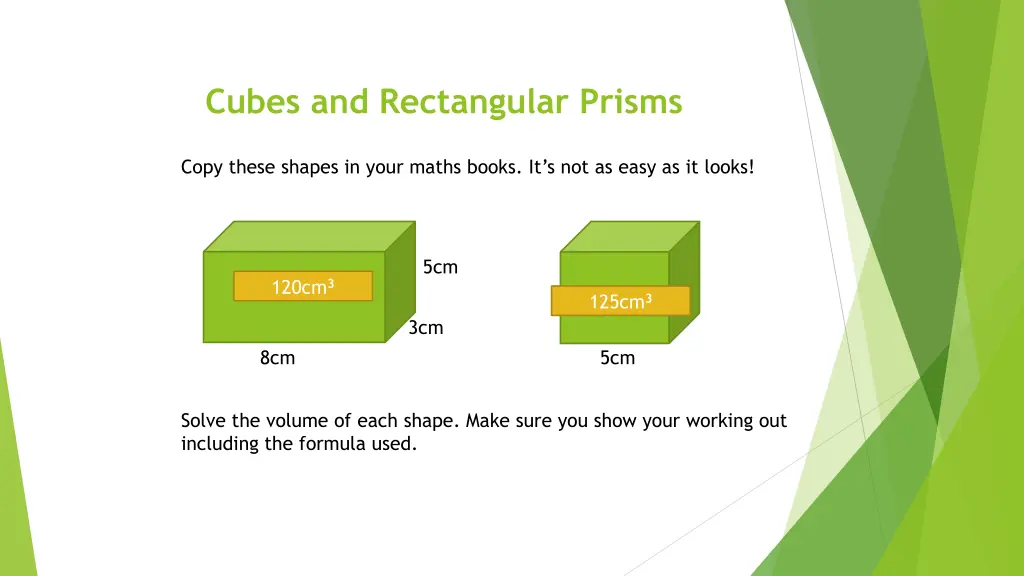
Rectangular Prism - Formula The volume of a rectangular prism is given by the formula: V = length width height or V= lwh *A rectangular prism is also called a cuboid. The volume of a cube is given by: V = length length length or V = l l3 All lengths are the exact same on a cube
Cubes and Rectangular Prisms Copy these shapes in your maths books. It s not as easy as it looks! 5cm 120cm3 125cm3 3cm 8cm 5cm Solve the volume of each shape. Make sure you show your working out including the formula used.
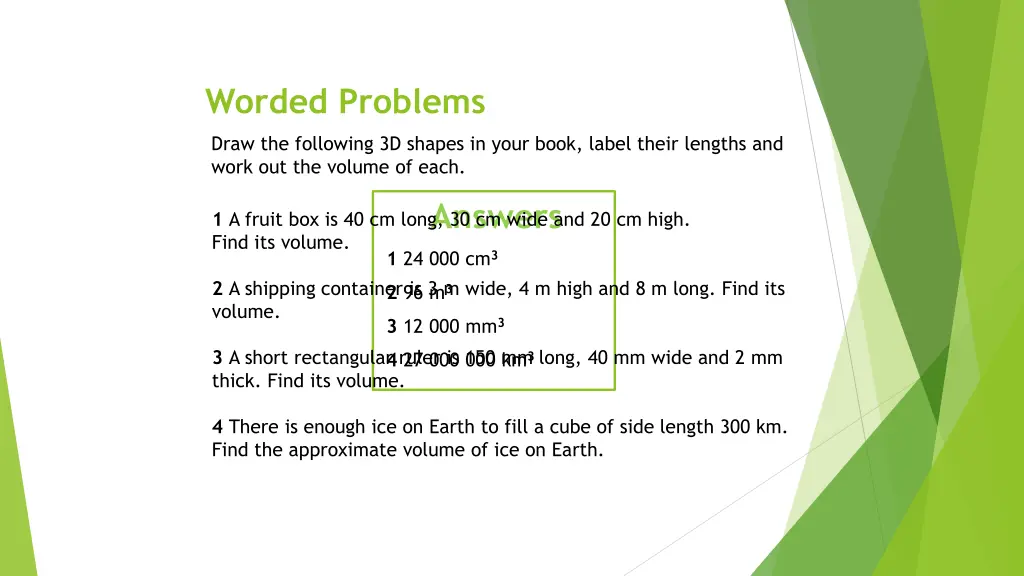
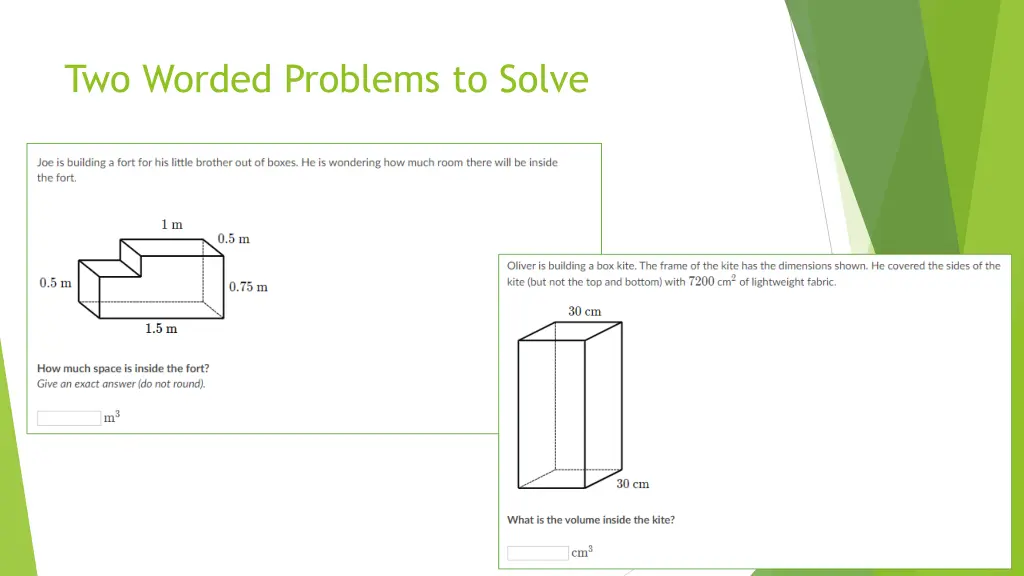
Worded Problems Draw the following 3D shapes in your book, label their lengths and work out the volume of each. Answers 1 A fruit box is 40 cm long, 30 cm wide and 20 cm high. Find its volume. 1 24 000 cm3 2 A shipping container is 3 m wide, 4 m high and 8 m long. Find its volume. 2 96 m3 3 12 000 mm3 3 A short rectangular ruler is 150 mm long, 40 mm wide and 2 mm thick. Find its volume. 4 27 000 000 km3 4 There is enough ice on Earth to fill a cube of side length 300 km. Find the approximate volume of ice on Earth.
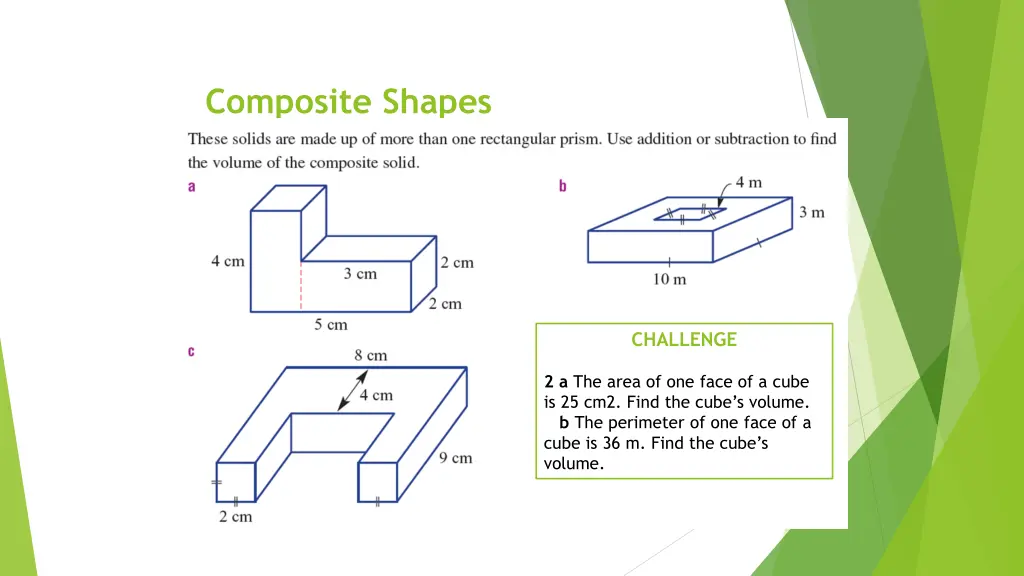
Composite Shapes Answers Composite Shapes a 28 cm3b 252 m3 c 104cm3 Challenge 2a 125 cm3 b 729 m3 CHALLENGE 2 a The area of one face of a cube is 25 cm2. Find the cube s volume. b The perimeter of one face of a cube is 36 m. Find the cube s volume.
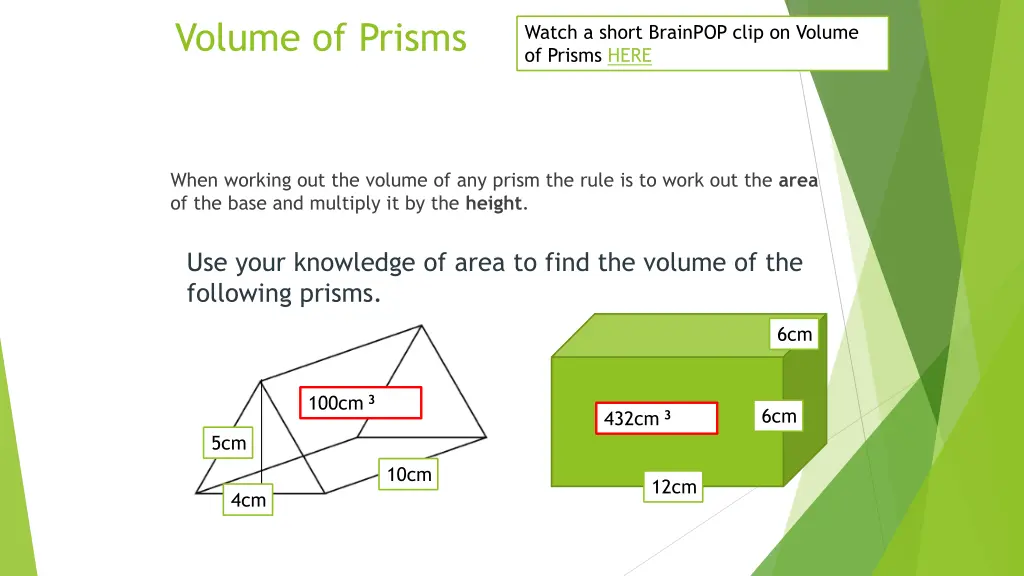
Volume of Prisms Watch a short BrainPOP clip on Volume of Prisms HERE When working out the volume of any prism the rule is to work out the area of the base and multiply it by the height. Use your knowledge of area to find the volume of the following prisms. 6cm 100cm 3 6cm 432cm 3 5cm 10cm 12cm 4cm
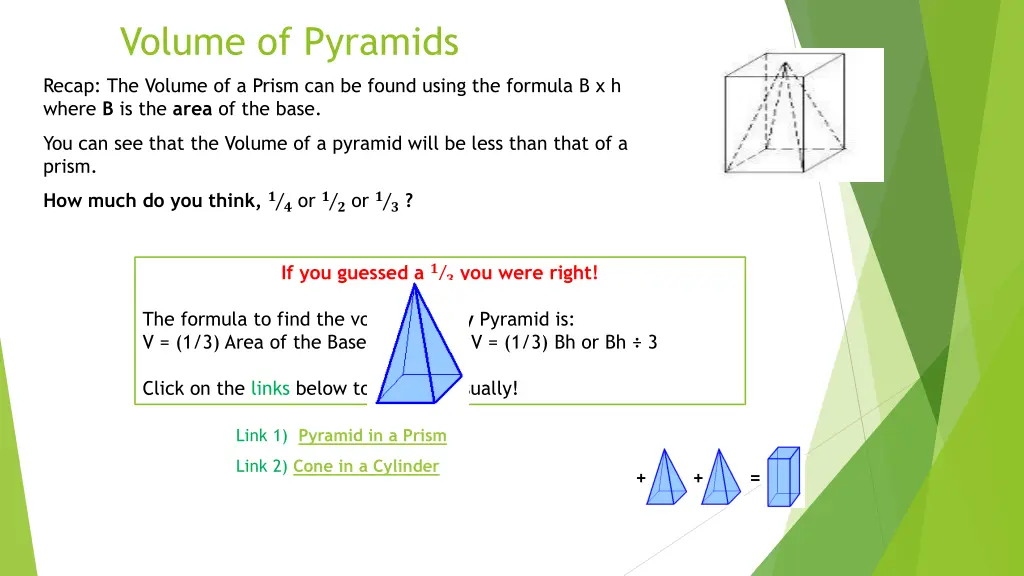
Volume of Pyramids Recap: The Volume of a Prism can be found using the formula B x h where B is the area of the base. You can see that the Volume of a pyramid will be less than that of a prism. How much do you think, ?or ?or ? ? ? ? ? If you guessed a ? you were right! ? The formula to find the volume of any Pyramid is: V = (1/3) Area of the Base x height or V = (1/3) Bh or Bh 3 Click on the links below to see this visually! Link 1) Pyramid in a Prism Link 2) Cone in a Cylinder + + =
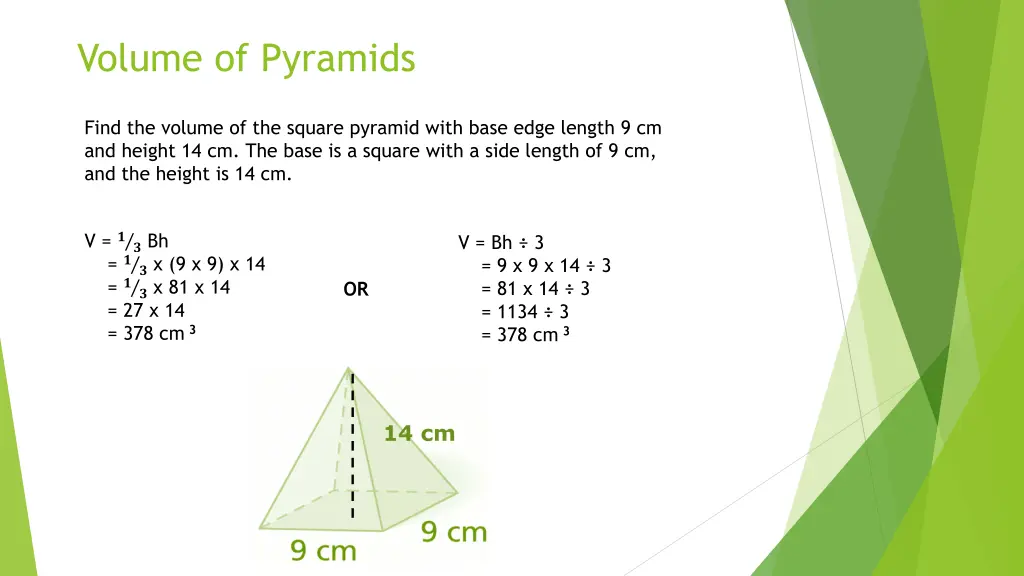
Volume of Pyramids Find the volume of the square pyramid with base edge length 9 cm and height 14 cm. The base is a square with a side length of 9 cm, and the height is 14 cm. V = = = = 27 x 14 = 378 cm 3 ?Bh ?x (9 x 9) x 14 ?x 81 x 14 ? V = Bh 3 = 9 x 9 x 14 3 = 81 x 14 3 = 1134 3 = 378 cm 3 ? ? OR 14 cm
Upload your glossary notes and answers from the PowerPoint to your Seesaw under activity- Maths Session 2- Volume Understanding