Vortex Flows in the Solar Atmosphere: Detection and Heating Mechanisms
Detect and understand vortex flows in the solar atmosphere through 3D MHD numerical simulations. Explore collective motion, energy transport, and dissipation mechanisms associated with vortices. Learn about observations, simulations, and the SWIRL code for vortex identification. See how vortices connect and transport energy in different magnetic field configurations and spatial resolutions, aiming to enhance knowledge of solar dynamics.

Download Presentation

Please find below an Image/Link to download the presentation.
The content on the website is provided AS IS for your information and personal use only. It may not be sold, licensed, or shared on other websites without obtaining consent from the author.If you encounter any issues during the download, it is possible that the publisher has removed the file from their server.
You are allowed to download the files provided on this website for personal or commercial use, subject to the condition that they are used lawfully. All files are the property of their respective owners.
The content on the website is provided AS IS for your information and personal use only. It may not be sold, licensed, or shared on other websites without obtaining consent from the author.
E N D
Presentation Transcript
Vortex Flows in the Solar Atmosphere: Detection and Heating Mechanisms in 3D MHD Numerical Simulations Mat as Koll Pistarini1,2, Elena Khomenko1,2, Tob as Felipe1,2 1 Instituto de Astrof sica de Canarias, 38205 La Laguna, Tenerife, Spain 2Departamento de Astrof sica, Universidad de La Laguna, 38205, La Laguna, Tenerife, Spain ESPM-17 - September 2024
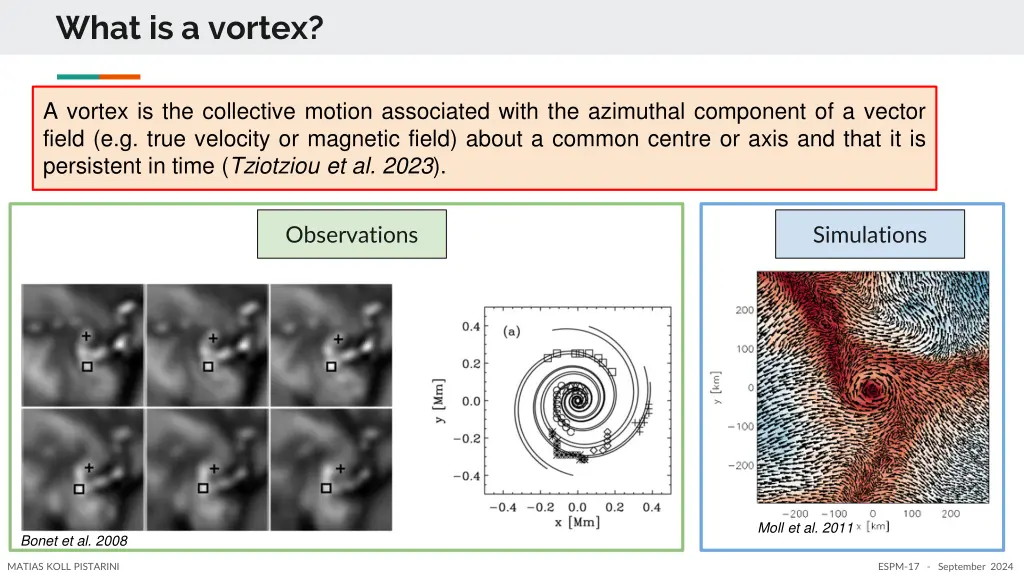
What is a vortex? A vortex is the collective motion associated with the azimuthal component of a vector field (e.g. true velocity or magnetic field) about a common centre or axis and that it is persistent in time (Tziotziou et al. 2023). Observations Simulations Moll et al. 2011 Bonet et al. 2008 MATIAS KOLL PISTARINI ESPM-17 - September 2024
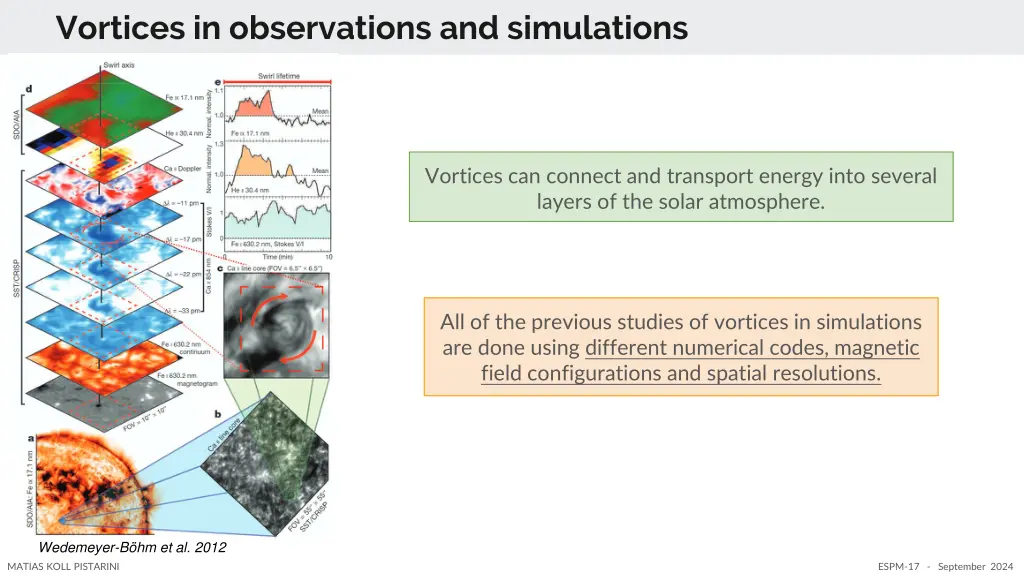
Vortices in observations and simulations Vortices can connect and transport energy into several layers of the solar atmosphere. All of the previous studies of vortices in simulations are done using different numerical codes, magnetic field configurations and spatial resolutions. Wedemeyer-B hm et al. 2012 MATIAS KOLL PISTARINI ESPM-17 - September 2024
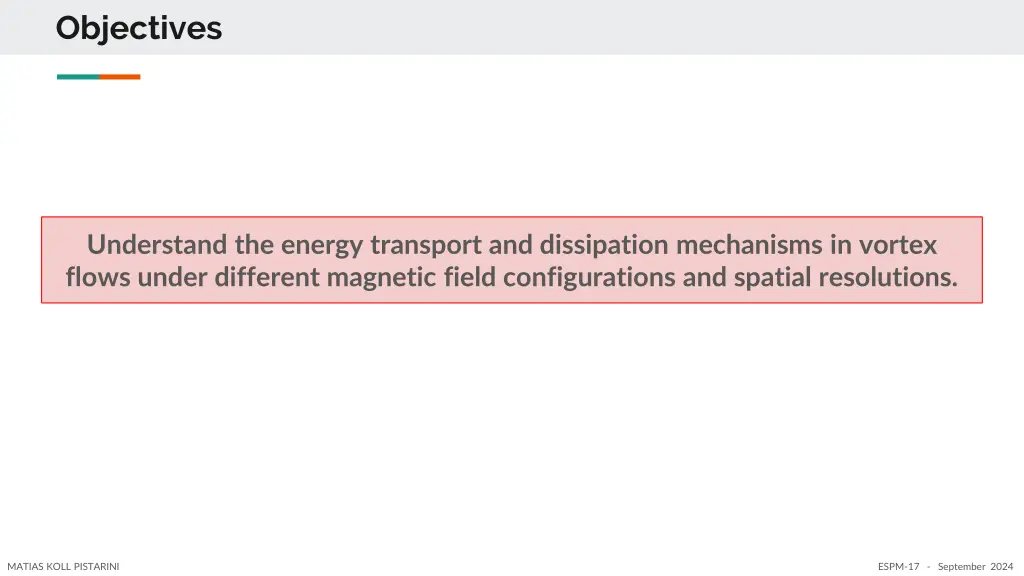
Objectives Understand the energy transport and dissipation mechanisms in vortex flows under different magnetic field configurations and spatial resolutions. MATIAS KOLL PISTARINI ESPM-17 - September 2024
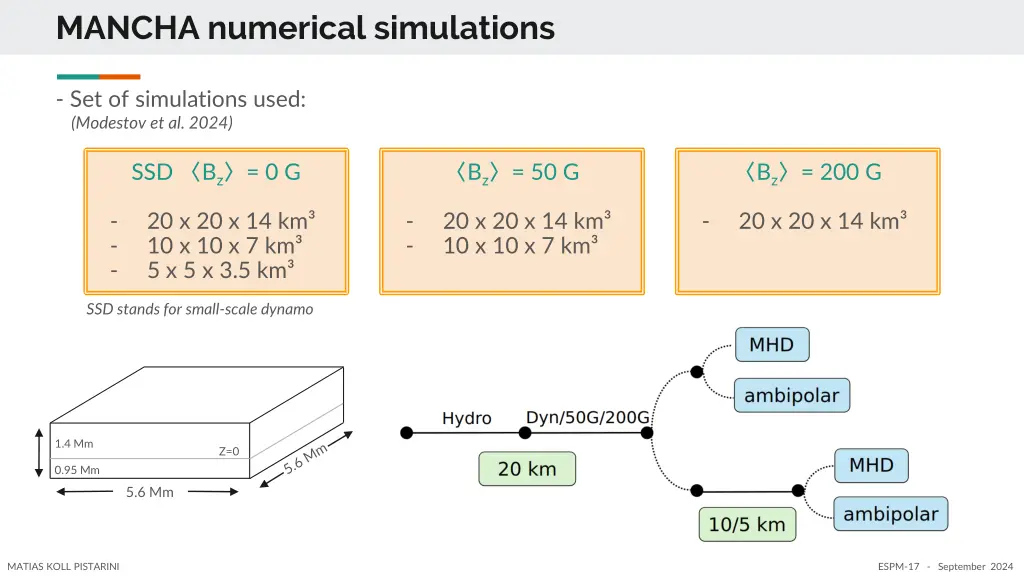
MANCHA numerical simulations - Set of simulations used: (Modestov et al. 2024) SSD Bz = 0 G Bz = 50 G Bz = 200 G - - - 20 x 20 x 14 km 10 x 10 x 7 km 5 x 5 x 3.5 km - - 20 x 20 x 14 km 10 x 10 x 7 km - 20 x 20 x 14 km SSD stands for small-scale dynamo 1.4 Mm Z=0 0.95 Mm 5.6 Mm MATIAS KOLL PISTARINI ESPM-17 - September 2024
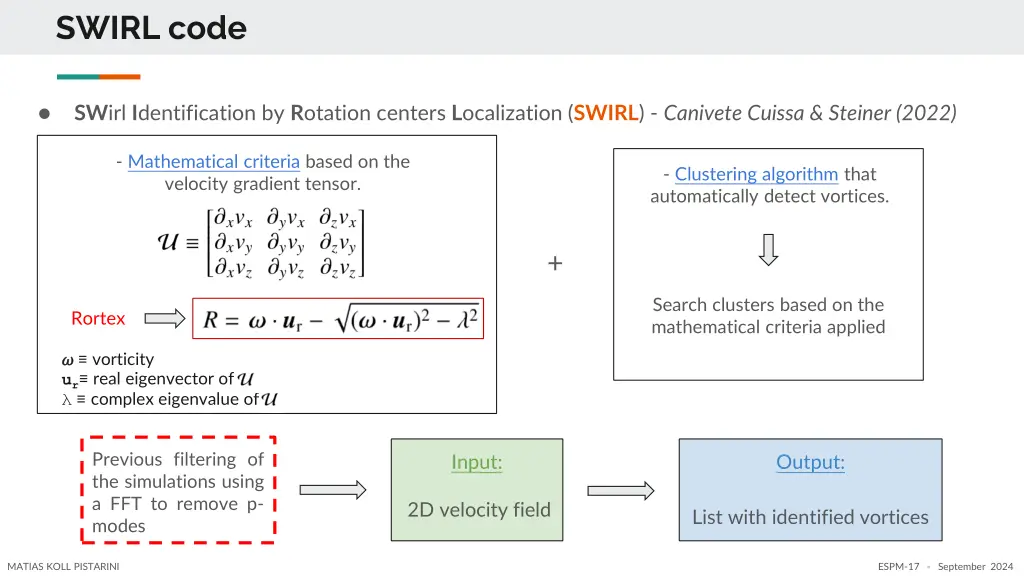
SWIRL code SWirl Identification by Rotation centers Localization (SWIRL) - Canivete Cuissa & Steiner (2022) - Mathematical criteria based on the velocity gradient tensor. - Clustering algorithm that automatically detect vortices. + Search clusters based on the mathematical criteria applied Rortex ? ? vorticity ur real eigenvector of complex eigenvalue of Previous filtering of the simulations using a FFT to remove p- modes Input: Output: 2D velocity field List with identified vortices MATIAS KOLL PISTARINI ESPM-17 - September 2024
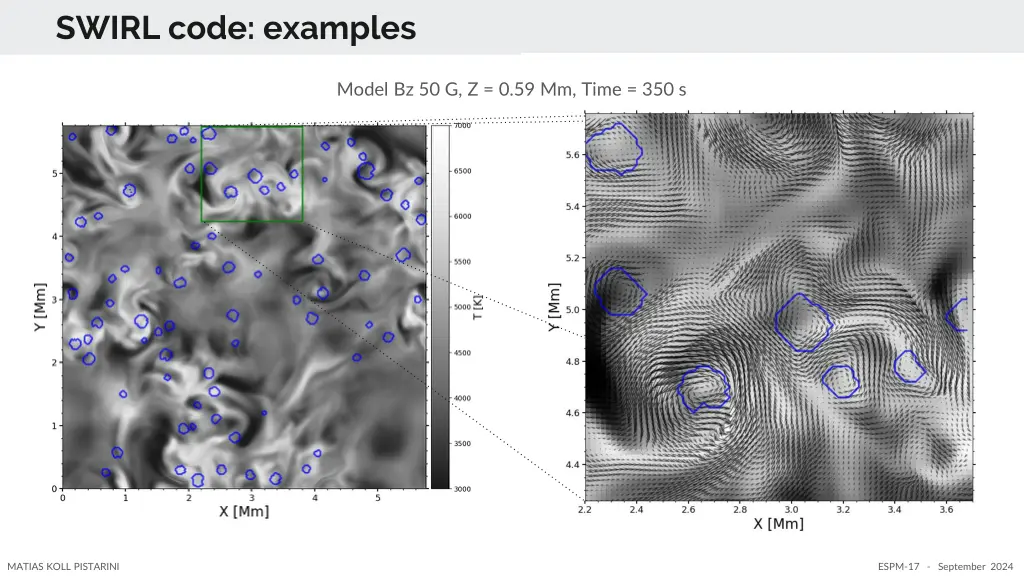
SWIRL code: examples Model Bz 50 G, Z = 0.59 Mm, Time = 350 s MATIAS KOLL PISTARINI ESPM-17 - September 2024
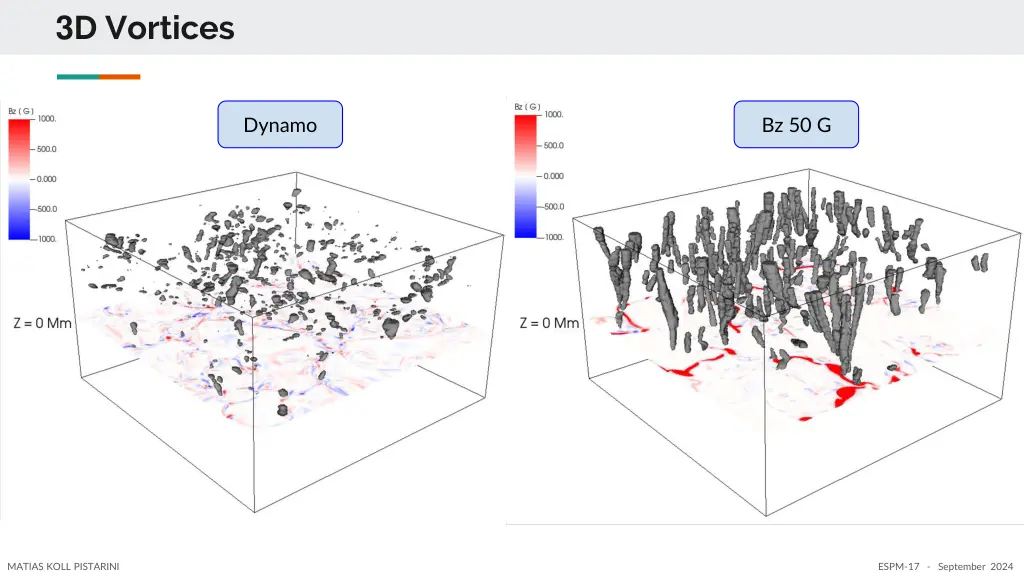
3D Vortices Dynamo Bz 50 G MATIAS KOLL PISTARINI ESPM-17 - September 2024
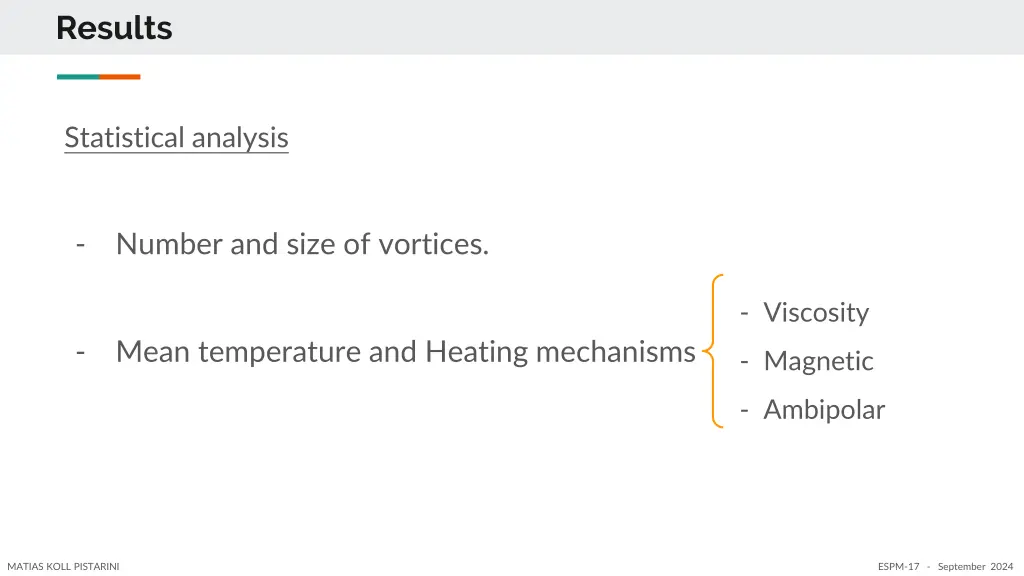
Results Statistical analysis - Number and size of vortices. - Viscosity - Mean temperature and Heating mechanisms - Magnetic - Ambipolar MATIAS KOLL PISTARINI ESPM-17 - September 2024
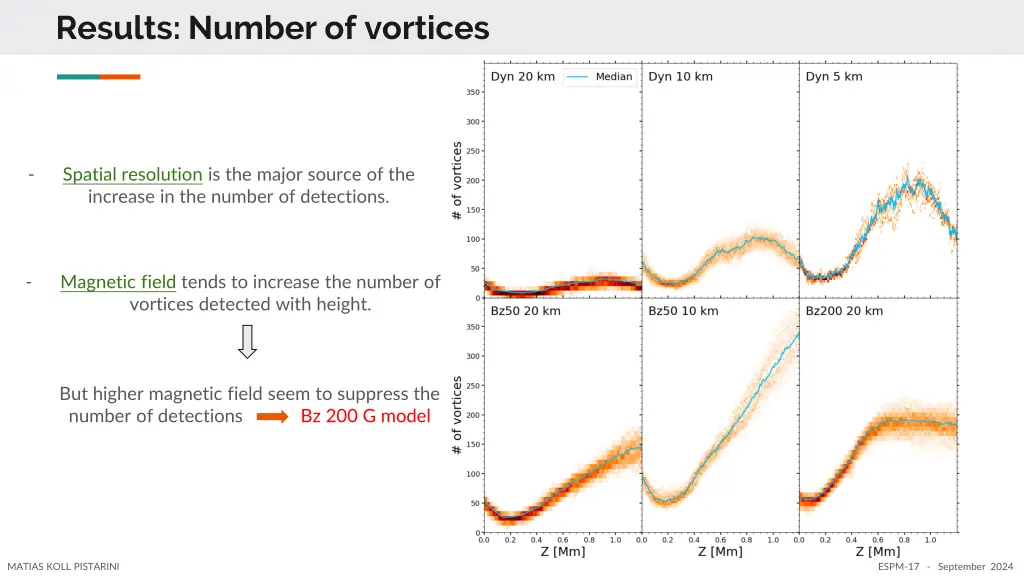
Results: Number of vortices - Spatial resolution is the major source of the increase in the number of detections. - Magnetic field tends to increase the number of vortices detected with height. But higher magnetic field seem to suppress the number of detections Bz 200 G model MATIAS KOLL PISTARINI ESPM-17 - September 2024
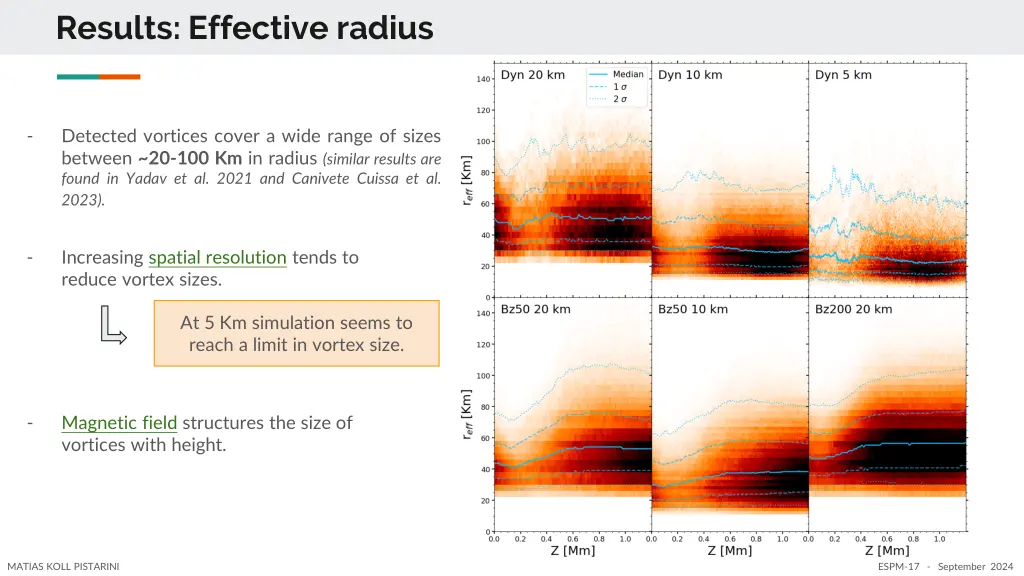
Results: Effective radius - Detected vortices cover a wide range of sizes between ~20-100 Km in radius (similar results are found in Yadav et al. 2021 and Canivete Cuissa et al. 2023). - Increasing spatial resolution tends to reduce vortex sizes. At 5 Km simulation seems to reach a limit in vortex size. - Magnetic field structures the size of vortices with height. MATIAS KOLL PISTARINI ESPM-17 - September 2024
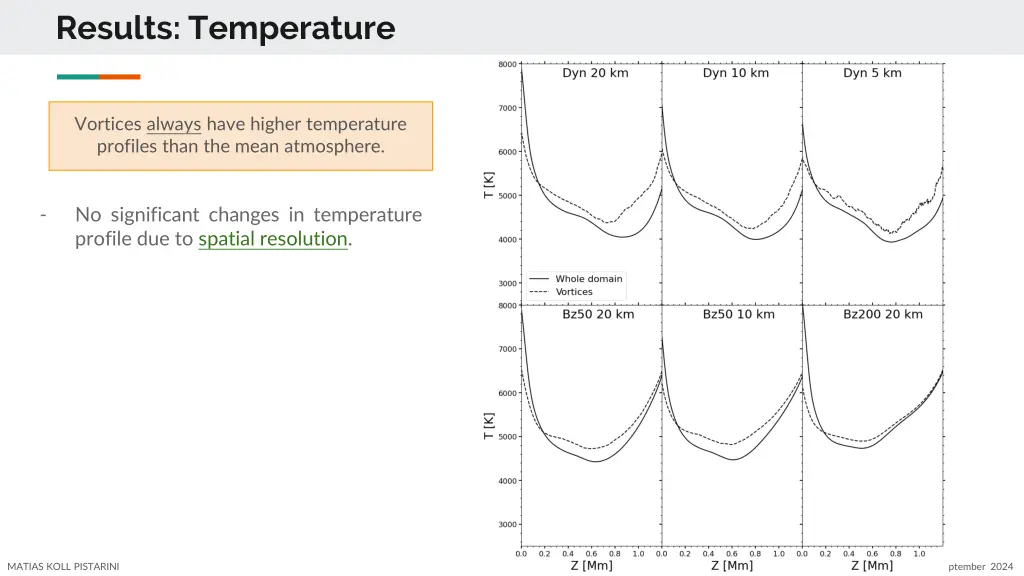
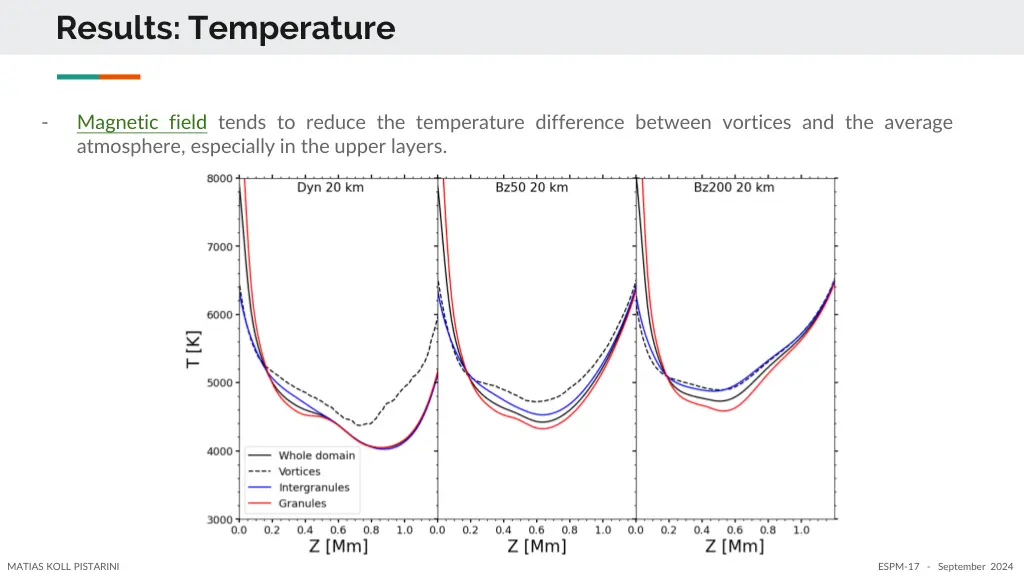
Results: Temperature Vortices always have higher temperature profiles than the mean atmosphere. - No significant changes in temperature profile due to spatial resolution. MATIAS KOLL PISTARINI ESPM-17 - September 2024
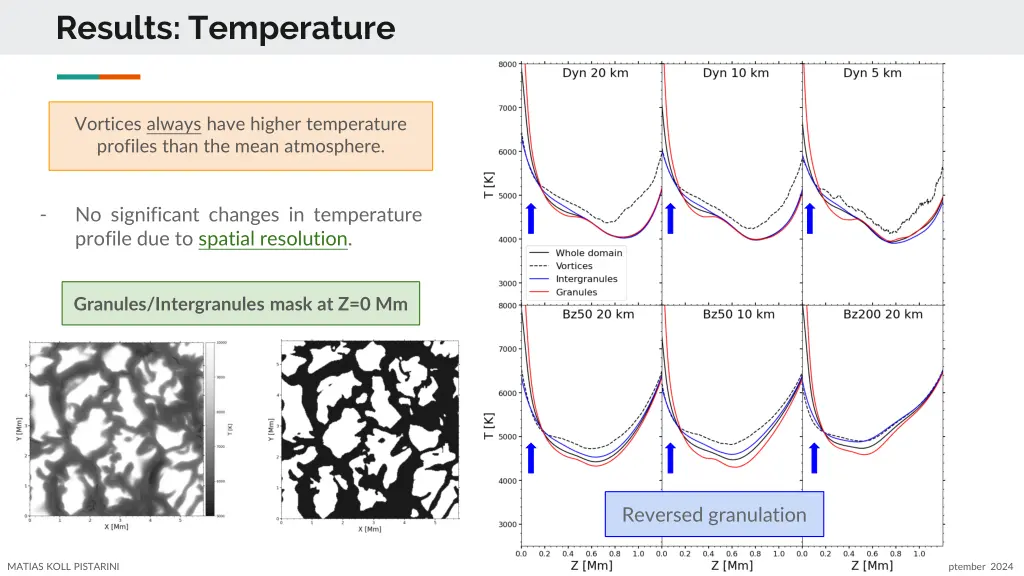
Results: Temperature Vortices always have higher temperature profiles than the mean atmosphere. - No significant changes in temperature profile due to spatial resolution. Granules/Intergranules mask at Z=0 Mm Reversed granulation MATIAS KOLL PISTARINI ESPM-17 - September 2024
Results: Temperature - Magnetic field tends to reduce the temperature difference between vortices and the average atmosphere, especially in the upper layers. MATIAS KOLL PISTARINI ESPM-17 - September 2024
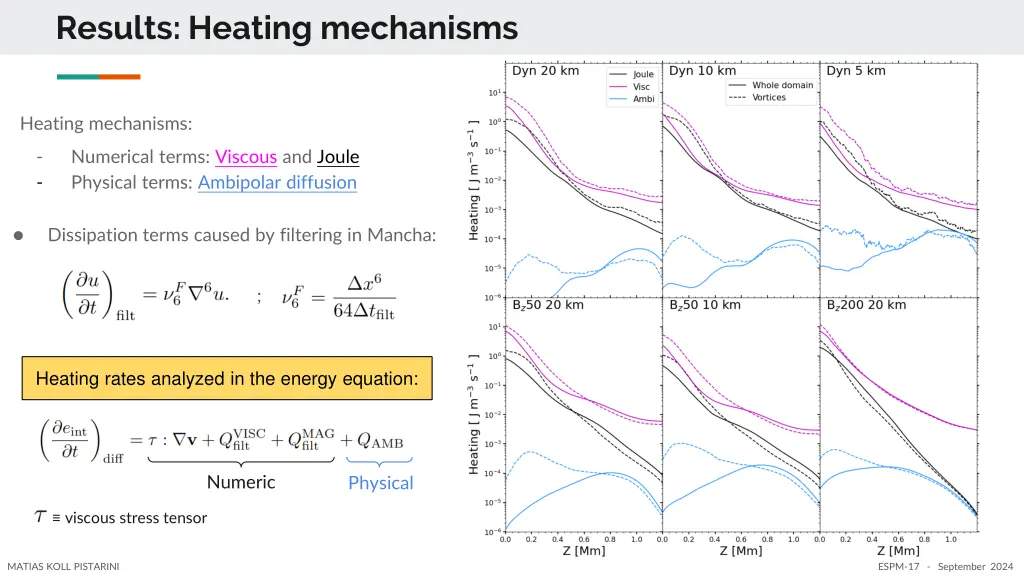
Results: Heating mechanisms Heating mechanisms: - - Numerical terms: Viscous and Joule Physical terms: Ambipolar diffusion Dissipation terms caused by filtering in Mancha: ; Heating rates analyzed in the energy equation: Numeric Physical viscous stress tensor MATIAS KOLL PISTARINI ESPM-17 - September 2024
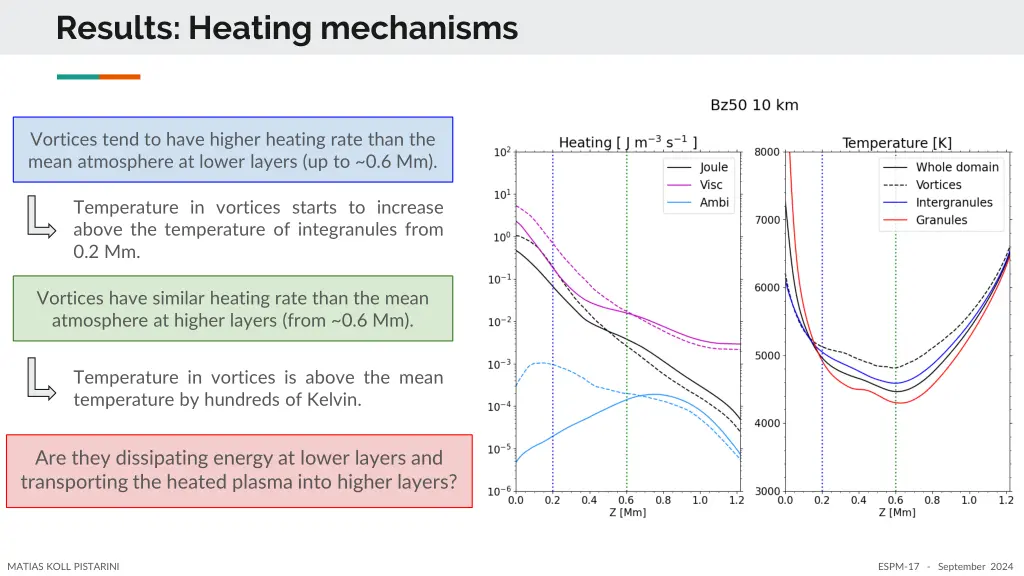
Results: Heating mechanisms Vortices tend to have higher heating rate than the mean atmosphere at lower layers (up to ~0.6 Mm). Temperature in vortices starts to increase above the temperature of integranules from 0.2 Mm. Vortices have similar heating rate than the mean atmosphere at higher layers (from ~0.6 Mm). Temperature in vortices is above the mean temperature by hundreds of Kelvin. Are they dissipating energy at lower layers and transporting the heated plasma into higher layers? MATIAS KOLL PISTARINI ESPM-17 - September 2024
Conclusions SWIRL code allows to perform a reliable detection of vortices in numerical simulations. Number and size of vortices highly depend on the magnetic field configuration and the spatial resolution. Confirm that vortices have higher temperatures than the surrounding media. Heating rates are higher in vortices than in the mean atmosphere just in lower layers. - Viscous heating is the dominant mechanism in all the models. We speculate that vortices dissipate energy in the lower layers, transporting the heated plasma into higher layers in order to explain the observed increase in temperature. Project PID2021-127487NB-I00 funded by We thankfully acknowledge the technical expertise and assistance provided by the Spanish Supercomputing Network (Red Espa ola de Supercomputaci n), as well as the computer resources used: LaPalma Supercomputer, located at the Instituto de Astrof sica de Canarias, and MareNostrum based in Barcelona/Spain. The simulations analyzed in this work required about 15 millions of CPU/hours MATIAS KOLL PISTARINI ESPM-17 - September 2024
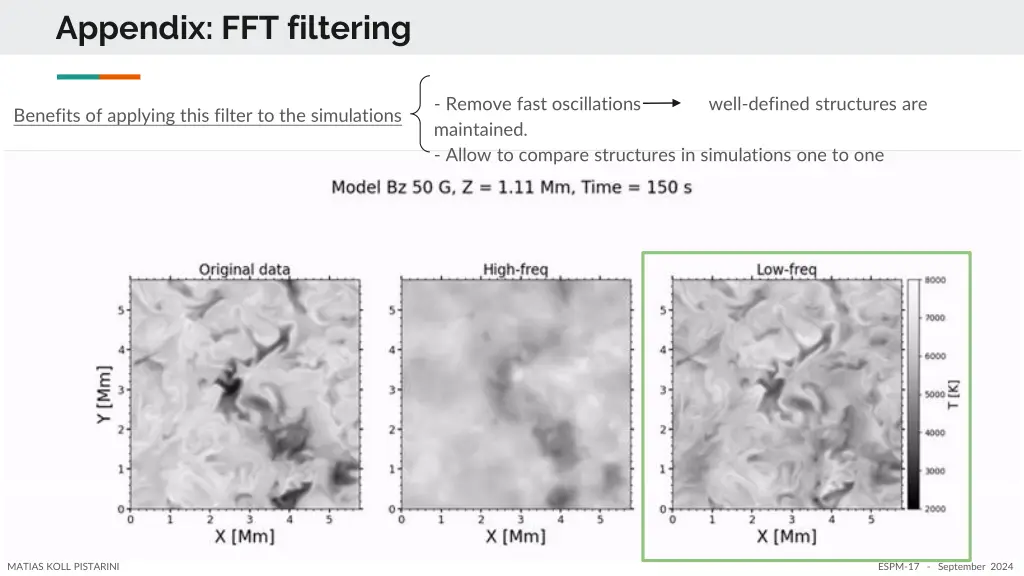
Appendix: FFT filtering - Remove fast oscillations well-defined structures are maintained. - Allow to compare structures in simulations one to one Benefits of applying this filter to the simulations MATIAS KOLL PISTARINI ESPM-17 - September 2024
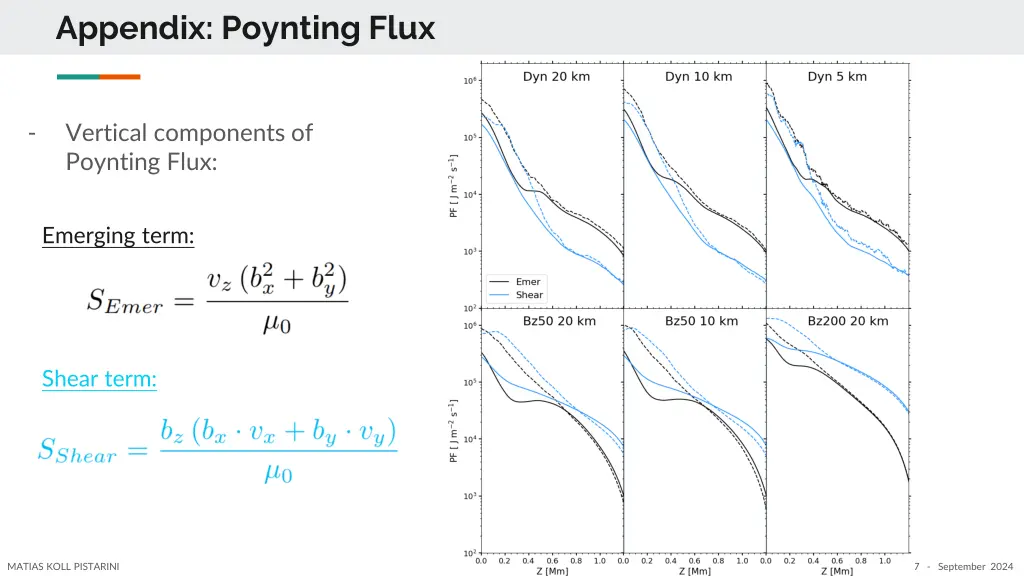
Appendix: Poynting Flux - Vertical components of Poynting Flux: Emerging term: Shear term: MATIAS KOLL PISTARINI ESPM-17 - September 2024
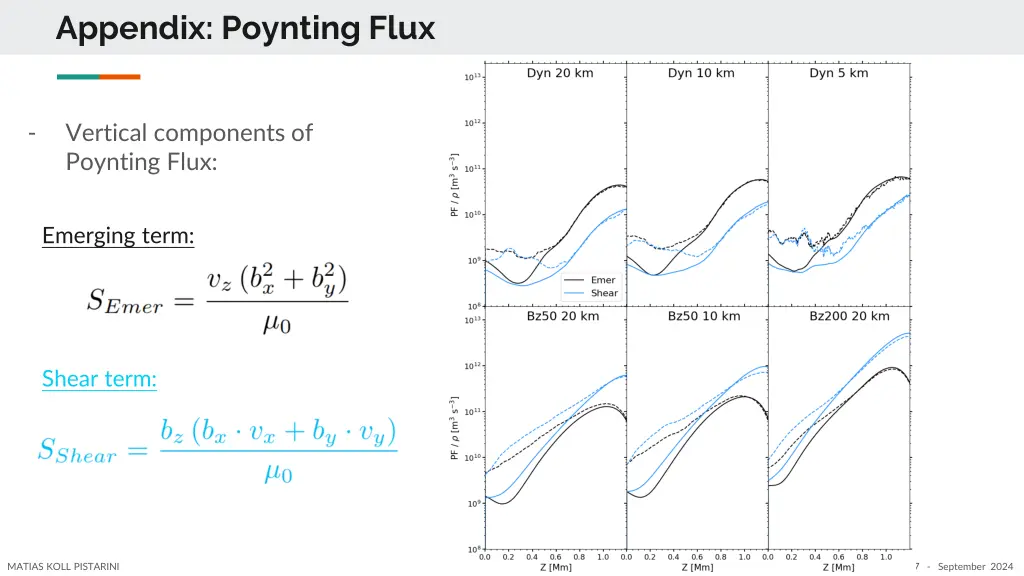
Appendix: Poynting Flux - Vertical components of Poynting Flux: Emerging term: Shear term: MATIAS KOLL PISTARINI ESPM-17 - September 2024